

Daily Comment (May 23, 2022)

by Patrick Fearon-Hernandez, CFA, and Thomas Wash

[Posted: 9:30 AM EDT] | PDF

Good morning and happy Monday!  On Friday, the S&P 500 flirted with official bear market territory (a decline of 20% from the high), but using the words of a locally once famous market strategist, it made a “Hollywood finish” and closed nearly unchanged.  We are seeing follow through buying this morning with bond yields up a bit after stabilizing recently.  The dollar is sharply lower this morning, with the EUR rallying on reports the ECB is poised to end its negative policy rate soon.  The World Economic Forum is being held in Davos this week, and continuing the tradition of stating the obvious, the tone of the meeting is the end of globalization.

Our coverage this morning begins with China news, focusing on comments from President Biden on Taiwan.  From there, we take a look at the Australian elections, where a transfer of power has occurred.  An update on the Ukraine war follows.  We have a long read on the change in German thinking and the problems it presents for the Social Democrats.  A quick update on some economic and international news comes next and we finish with the latest on the pandemic.

China news:  While at a press conference in Tokyo, President Biden stated that the U.S. would militarily intervene if China were to invade Taiwan.  This is monumental.  America’s policy toward Taiwan has traditionally been strategic ambiguity.  We never committed to the defense of the island for a couple of reasons.  Knowing it was defended could change Taiwan’s behavior.  It could either (a) become reckless, threatening Chinese actions in the region (imagine shooting down Chinese warplanes that regularly penetrate its airspace), or (b) knowing the U.S. would act, no longer take steps to defend itself.  There have been voices calling for such a declaration. These were not universal.  The White House claimed this wasn’t a change in policy, but that is contradicted by similar comments made last year that set off a scramble by the State Department to walk back the president’s remarks.  Although the U.S. never said it wouldn’t defend Taiwan, the end of strategic ambiguity is a new complication for the region and U.S.-Chinese relations.  As one would expect, China isn’t happy with the comments.  In other news relating to China:

  • The first time we noticed Chinese capital flight was in 2012, which was just about the time Xi Jinping began his first term. Despite capital controls, Chinese money flowing into various markets became noticeable.  For example, the FHFA House Price Index for the Pacific region (where the impact was noticeable) was markedly different from that in New England.

In 2013, the first year after Xi’s elevation to power, Pacific home prices rose nearly 19% compared to New England, where prices rose a modest 4.5% (for the U.S. as a whole, including the Pacific region, the rise was only 7.7%).  Fears of Xi’s crackdown on corruption likely led many wealthy Chinese to try to preserve their wealth from seizure by sending it abroad, with some of it finding its way to West Coast real estate.  Although outflows wax and wane over time, recently, there are reports of increased outflows.

(Source:  IIF)

This chart from the Institute for International Finance shows a rise in outflows from China.  Fears of a larger crackdown in front of Xi’s third term are likely leading wealthy Chinese to move money out of the country.  The CPC is now saying party elites should divest from their foreign holdings, ostensibly to protect themselves from Western sanctions.  Even though experience of Russian oligarchs suggests this is a prudent policy, we suspect policy instability in China is a more pertinent concern.

  • President Biden is in Asia making the case for the administration’s Indo-Pacific Economic Framework. Outside of America’s clear allies in Asia—Australia, Japan, South Korea, and Taiwan—the rest of Asia is indifferent to U.S. overtures.  Although these nations appreciate America’s security support, they really want access to U.S. consumers.  Unfortunately, that desire isn’t likely to be offered by the president.  Instead, he is promising to start talking, which is far short of what these nations want.  The problem is that these nations like the presence of the U.S. military in the region to protect them from the “tender mercies” of the Chinese.  Nevertheless, they don’t want to be forced to choose to lose the economic relationship with China because the U.S. isn’t open to increasing trade with the region.  The political support for trade is lacking in Congress as populists on both the left and right have soured on trade.
  • Needless to say, Beijing isn’t pleased with the president’s visit to the region. In fact, the PLA Navy is conducting exercises in the South China Sea to coincide with this tour.  American policy is designed to isolate China; the code words are “cold war strategy.”  In the meantime, China is trying to expand its security outposts into the region beyond the recent one with the Solomon Islands.
  • Although China has indicated it is a close ally of Russia, that relationship didn’t stop Beijing from trying to steal Russian defense data through hacking. Albeit the news is ironic to some extent, friendly nations usually conduct intelligence gathering on each other.  The U.S. hacking of the German Chancellor’s cell phone is a case in point.
  • China is Russia’s ally, but we note that Chinese firms have been instructed to stop working on an LNG project in Russia. It appears Chinese leaders would prefer not to run afoul of EU sanctions.

A change down under:  In Saturday’s election in Australia, Labor has won the most seats and will form a government.  It is the first Labor government in almost a decade.  The latest data show that the Labor, led by Anthony Albanese, has won 73 seats, three short of a majority.  However, there are three races that are likely to go to Labor, meaning it should be able to form a government without a coalition.  The Liberal/National coalition, the conservatives led by Scott Morrison, took a drubbing, losing 21 seats to secure 54, although it might secure four more seats as the vote counting finishes.  Most notable, seven seats went to non-party affiliated independents, suggesting the Australian electorate is fracturing to some extent.  Calling themselves the “teal independents,” a play on the colors of the major parties, these independents support climate change legislation but are also centrists, meaning they reject the right-wing populism of the Liberal/National coalition.  How did Labor win?  It ran on a climate platform, promising to address carbon emissions.  Such promises are attractive until the costs of these policies emerge, and with inflation becoming a problem, it may be impossible to both reduce carbon emissions and control prices.  Increasing discomfort with the previous government also helped Albanese.  This election may have been more about not supporting the incumbent.  Unfortunately for Albanese, he is taking office as the Australian economy is hitting serious headwinds.  We note the OECD’s leading indicator is signaling a recession.

The Ukraine War:  The conflict appears to be evolving into a trench war, with both sides building fortifications to thwart offensive actions.  Here is the latest map:

(Source:  Institute for the Study of War)

Most of the fighting is shown by the green circles on the map.  The circle highlighted with an arrow shows the fighting around Sievierodonetsk, where Russian forces are trying to push Ukrainian forces out of the area.  There are reports the Russian military has relieved some commanders of their posts, is splitting units into smaller groups, and is using more artillery and less infantry in its fighting.

  • Although the U.S. approved a $40 billion aid package for Ukraine, we are starting to hear rumblings about the path of the war and U.S. policy. For Russia, Ukraine is critical; without control of Ukraine, Russia’s hopes for restoring the empire are lost.  For Ukraine, ceding any territory is impossible.  President Zelensky has staked his administration on pushing Russian troops out of his country.  These conditions suggest that the conflict will go on for a long time.  But a long conflict isn’t necessarily in the U.S.’s best interest.  The longer the war goes on, the harder it will be to keep NATO intact and the greater the negative effects of the war on the global economy.  Given concerns about a recession in the U.S., second thoughts about supporting a long war are starting to emerge.  As readers know, we don’t consider the New York Times as just a news organization but also a reflection of elite opinion formation.  We note the paper’s editorial board has pointed out that support for Ukraine in Congress is far from universal.  The editorial signals that the U.S. may not support Zelensky’s goal of removing Russia from Ukraine.  There is also talk of a ceasefire.  Although we don’t expect the conflict to end soon, we may see a growing movement to force a ceasefire that may allow Russia to hold the territory it seized in 2014.
  • President Zelensky has proposed using Russia’s foreign reserves to rebuild his country.
  • Prince Abdulaziz bin Salman, the Saudi energy minister and half-brother of Crown Prince Salman, signaled that the kingdom would stand by Russia as a member of OPEC+. This news suggests the oil cartel will maintain its program of gradual production increases.  For Western consumers, this means oil prices will remain high until demand reductions bring prices down.
  • Russian debtors have paid coupons in advance of a Treasury directive that will almost certainly push Russia into default.
  • Russia has banned 963 Americans from entering its country, including Senators Harry Reid, John McCain, and Orrin Hatch, all who have left here earthly pale.
  • As fears of Russia grow, bonds in the Baltic states and Finland are showing signs of weakness.
  • Vitaly Savelyev, the Russian Transportation Minister, admitted Saturday that Western sanctions have “practically broken” logistics in Russia. The war and sanctions have caused a major rerouting of the flow of commodities, raising costs and causing spot shortages of key materials.

A German scandal:  Narratives are important to human thinking.  We tend to tell stories as a way to make sense of the world.  We don’t consider them “stories” or “myths,” instead, we call them “narratives” to frame our views of the world.  Robert Schiller wrote a book about economic narratives that is a worthy read.

One narrative that has emerged in various forms over the past couple of centuries is the idea that trade makes the world less risky.  In other words, if we trade with each other, we are less likely to go to war.  Norman Angell wrote a book called “The Great Illusion” where he suggested that a major war in Europe wasn’t likely because of how deeply intertwined the economies of the continent were… in 1910.  Despite how disastrously wrong this idea was with reference to WWI, the notion has persisted.  Tom Friedman made famous a common saying that two nations with McDonald’s (MCD, USD, 230.51) have never gone to war.  Well, they have now; both Ukraine and Russia had the restaurant chain.

A variation of this idea became popular in Germany among the Social Democrats (SDP), which was that trade with the Soviets would improve relations and tame the worst instincts of Moscow.  The concept, called Osthandel, argued that this trade helped end the Cold War.  Needless to say, the U.S. narrative on the end of the Cold War didn’t acknowledge this German narrative. The American version would argue the U.S. prevailed despite German actions.  But, stories stick, and the Germans held on to it after the Soviet Union dissolved.  Thus, Germany saw the growing dependence on Russian energy not as a bug but as a feature, a formula for peace and prosperity.  The Germans went so far as to build direct pipelines to Germany through the Baltic Sea, the Nord Stream I and Nord Stream II pipelines, bypassing those pesky Poles and Ukrainians.

The Russian invasion of Ukraine has shredded Osthandel, and the political ramifications are just starting.  Former German Chancellor Schroder has finally resigned from the board of Rosneft (NK Rosneft’ PAO, RUB, 384.25).  But, he is the Chairman of Nord Stream 2 and was recently nominated to the board of Gazprom (Gazprom PAO, RUB, 263.00).  In a recent profile in the New York Times, Schroder was unapologetic for his ties to Russian energy and his personal friendship with Vladimir Putin.  In fact, Putin offered him a board seat on Nord Stream 2 a mere 17 days after Schroder left the office of the Chancellor of Germany, the project was approved on his watch.  This week, the SDP and its coalition partners stripped Schroder of his parliamentary privileges.  He loses his office and staff, although he will keep his pension and security detail.  The CSU leader, Markus Soder, described Schroder as a “willful, bizarre, old man who cares more about his own bank account than Germany’s reputation in the world.” “That’s embarrassing, a disgrace for our country.”

Adding to the scandal is that Matthias Warnig, a former Stasi agent, was also a colleague of Schroder on the board of Rosneft.  Warnig worked with Putin during the latter’s time in East Germany when he was a KGB agent.  After the fall of the GDR, Warnig, who used the cover of a trade official for East Germany when he was with the East German spy agency, was hired by Dresdner Bank (now a unit of Commerzbank, (XETRA, EUR, 7.24)) shortly after German reunification.  He was instrumental in founding the Dresdner Bank Moscow branch; this branch was in St. Petersburg and was negotiated with none other than Vladimir Putin.

So why is this important?  The German ruling coalition is perhaps the most complicated in postwar German history.  The three parties that form it have divergent interests, and thus, unlike former governments, this coalition might not hold together.  Or, the leadership might change; if the Chancellor came from the Greens, the policy toward Russia would likely harden.  The same is true for the Free Democrats, the other member of the coalition.  Schroder has damaged the SDP in a manner that may force Chancellor Scholz out of office.  The comments above by Soder of the opposition CSU suggest the political atmosphere for Scholz is deteriorating.  There is a growing likelihood that Green Party leader and current foreign minister Annalena Baerbock could take that role.  In any case, the only way for Scholz to survive will likely require him to take a much more hardline position against Russia.  Burying Osthandel would harden relations with Russia, regardless of who is in power in Russia.  And, of course, this hardening of relations has led to Germany planning to boost its defense spending.

Economics and policy:  China tariffs and other news.

  • The Biden administration is wrestling with how to manage tariffs on China. From an economic perspective, easing tariffs could reduce U.S. inflation, which has been a serious drag on the president’s approval ratings.  However, making conditions more favorable for China is a difficult sell.
  • Although she doesn’t have a  direct influence on the policy, Treasury Secretary Yellen has expressed opposition to raising the Fed’s 2% inflation target. Some economists (Adam Posen at the Peterson Institute has been vocal about this idea) have called for raising the target, arguing that the fact that the fed funds target fell to zero is clear evidence the inflation target is too low.  There isn’t much evidence to suggest that much thought went into picking a 2% target, but it has become the global standard.  There are two problems with changing it.  First, a target that can be changed often isn’t much of a target.  After all, the goal of the target is to create clarity for borrowers and lenders on the path of policy.  Second, it’s quite possible that a 4% target may lead to instability, as households and businesses might view a higher target as obvious debasement.
  • Small business surveys suggest confidence is falling, adding to evidence of a weakening economy. Economists are starting to downgrade their forecasts for economic growth.
  • When I used to teach, I would often use babysitting pay to illustrate opportunity cost. I tried to show that there may be a wage so high that it doesn’t make sense to stay in school, for instance.  It was mostly, at the time, a thought experiment.  However, parents are now seeing a shortage of sitters, and pay is skyrocketing, along with other perks.  Rates are being quoted at up to $30 per hour.

International roundup:  More from the president’s trip and an update on Israel

  • While in South Korea, President Biden and the newly elected President Yoon of South Korea agreed to increase the deterrence of North Korea.
  • It looked like the narrow coalition holding the Israeli government together was about to fray until a member of a Palestinian Party agreed to return to the coalition after threatening to leave. Her leaving would have led to a no-confidence vote and new elections.
  • A senior member of the Iran Revolutionary Guard Corps was assassinated outside his home yesterday. No one claimed responsibility for the attack.

COVID-19:  The number of reported cases is 525,686,037 with 6,277,389 fatalities.  In the U.S., there are 83,281,403 confirmed cases with 1,002,173 deaths.  For illustration purposes, the FT has created an interactive chart that allows one to compare cases across nations using similar scaling metrics.  The FT has also issued an economic tracker that looks across countries with high-frequency data on various factors.  The CDC reports that 741,676,155 doses of the vaccine have been distributed, with 584,279,990 doses injected.  The number receiving at least one dose is 258,149,591, while the number fully vaccinated, which would grant the highest level of immunity, is 220,914,142.  For the population older than 18, 76.5% of the population has been fully vaccinated, with 61.1% of the entire population fully vaccinated.  For those over 65, 90.5% have been fully vaccinated.  The FT has a page on global vaccine distribution.

View PDF

Daily Comment (May 20, 2022)

by Patrick Fearon-Hernandez, CFA, and Thomas Wash

[Posted: 9:30 AM EDT] | PDF

Good morning! Today’s report begins with a brief update on the war in Ukraine. Afterward, there is a discussion on the Federal Reserve’s determination to rein in inflation at all costs. Next, we look at international news, followed by economics and policy. We conclude with our COVID-19 coverage.

Russia-Ukraine: The situation in Ukraine continues to weigh on the morale of Russian forces and the general public. A lack of army reserves is hindering Moscow’s war efforts. As a result, Russia is changing tactics as it looks to recover from the setbacks incurred in Kharvic. Troops are now focusing their attention on western Donetsk Oblast. An official from the Kremlin said that Russia intends to annex all of the Donetsk and Luhansk regions. Meanwhile, there is growing unrest in Russia over military mobilization. In May, there were several reports of Molotov cocktail attacks on Russian military commissariats. As the war rages on, Russia is finding it more challenging to maintain support for its invasion, while Ukraine is seeing more success and assistance from the West.

Federal Reserve: On Thursday, Fed officials reminded investors that the recent market rout would not impact its decision to tighten monetary policy. Kansas City Fed President Esther George said the Federal Reserve is not worried about the impact of higher interest rates on financial markets. Minneapolis Fed President Neel Kashkari warned that inflation would not fall without pain. Recent remarks from Fed officials reinforced the view that the central bank will attempt to rein in inflation by slowing the economy.

International News:

  • Canada announced it would ban Chinese telecom manufacturers ZTE (763 HK, HKD, 16.10) and Huawei from its 5G network just three days after lawmakers voted to revive a special committee to study bilateral trade deals. The ban appears to be related to suspicions from Western countries that Chinese telecom companies have close ties with the Chinese military.
  • Beijing is looking at alternative ways to stimulate its economy. For example, The PBOC has cut the key interest rate on five-year prime loans by a record amount to boost demand for mortgages and property. The real estate meltdown and the Zero- COVID policy have weighed heavily on the economy. Bloomberg Economics forecasted that the U.S. GDP growth could surpass China for the first time since 1976. If true, this would place a dark cloud over Chinese President Xi Jinping before his re-appointment for a third consecutive term. He has long advocated that China will surpass the West; thus, slower growth would show that the economy has regressed in achieving its goal.
  • The annual change in core CPI exceeded two percent in Japan for the first time in seven years. The country has been trying to increase inflation for a while, and the sharp rise will likely not impact the BOJ monetary policy. That being said, the increase in inflation suggests the yen could further depreciate against the dollar. A former BOJ official indicated the central bank might let the currency climb to 150 against the dollar before it becomes concerned. Currently, the yen is trading at 127.86.

US Economic and Policy News:

  • The housing market is showing signs of a slowdown. According to the National Association of Realtors, existing-home sales fell to their slowest pace since April 2020. The sales of previously owned homes fell 5.9% from the prior year. The lack of sales is related to rising home mortgage rates and housing prices, making homes more unaffordable for buyers.
  • Tether, the most widely used cryptocurrency, reports reducing its reserve of commercial paper and increasing its holding of U.S. Treasury bills. Earlier this month, the company came under scrutiny from regulators after its stablecoin USDT briefly lost its peg to the U.S. dollar. As a result, tether decided to shift its holdings into safer assets, mainly responding to criticism that investments with limited liquidity did not support its peg.
  • President Biden is visiting Asia on Friday. On this trip, he is expected to try to persuade Indo-Pacific countries to build closer ties with the U.S. Additionally, Japan and the U.S. are expected to urge China to pare down its holding of nuclear weapons.

COVID-19:  The number of reported cases is 524,056,687 with 6,273,624 fatalities. In the U.S., there are 83,060,981 confirmed cases with 1,001,606 deaths. For illustration purposes, the FT has created an interactive chart that allows one to compare cases across nations using similar scaling metrics. The CDC reports that 739,095,455 doses of the vaccine have been distributed, with 583,221,364 doses injected. The number receiving at least one dose is 258,074,668, the number of second doses is 220,811,434. The number receiving the first booster is 102,524,944, and the number receiving the second booster is 11,835,302. The FT has a page on global vaccine distribution.

View PDF

Daily Comment (May 19, 2022)

by Patrick Fearon-Hernandez, CFA, and Thomas Wash

[Posted: 9:30 AM EDT] | PDF

Good morning! Our report begins with the market’s reaction to disappointing quarterly reports from major retailers. Afterward, we give an update on the Russian invasion of Ukraine. Next is a discussion about Sri Lanka’s default and rising tensions surrounding Taiwan. We end with U.S. economic news and an update on COVID-19.

Equities: There was a broad market sell-off in equities on Thursday after commercial retailer Target (TGT, $161.61) stated that rising freight, wage, and fuel costs would hurt the company’s profit margin. The bearish report comes a day after Walmart (WMT,$121.43) cut its earnings guidance and admitted that it underestimated inflation’s impact on its bottom line. In addition to rising inflation, retailers have also noticed a shift in consumer taste. Purchases of discretionary goods such as televisions, furniture, and clothes dipped in the latest quarters, while staple goods such as food and drinks increased. The shift in preferences suggests that households are beginning to respond to rising inflation, particularly for food and energy. In short, market reaction was driven by concerns that economic growth may be showing signs of moderating.

Russia-Ukraine: After taking over Mariupol, Russian forces are expected to destroy the Azovstal Steel Plant and turn the city into a tourist attraction. The Kremlin would like to wipe out any reminder of the Ukrainian soldiers’ historic stand against Russian forces. The pivot toward making Mariupol a tourist destination is due to concerns that the city will struggle to regain its economic prowess following the destruction from the war. The Azovstal Steel Plant was a significant economic driver for the town. It employed over 10,000 workers and generated billions of dollars of foreign exchange earnings and taxes. On the war front, Russia is preparing for an assault on Severodonetsk as the Kremlin aims to take complete control over the Donetsk and Luhansk regions. Meanwhile, Ukrainian forces continue to pressure Russian troops in Kharkiv. The map below illustrates the latest developments in the war.

  • The Biden administration is looking into ways to cripple Russia’s economy even further. The White House is drawing up plans that will make it difficult for other countries to purchase Russian oil. The new proposal is expected to include price caps on Russian oil. The point of the cap is to allow Russia to produce enough oil to sustain global supply while also limiting the amount of revenue it can generate. Countries that violate the sanctions could face secondary sanctions, which will limit their ability to do business with companies in the U.S. and its allies. This move further indicates that the world could be moving toward regionalization and away from globalization.
    • China is in the process of purchasing cheap oil to replenish its strategic reserves from Russia. The decision to buy Russian crude suggests Beijing seeks to build closer energy ties with Moscow. Since the start of the war in Ukraine, the price of Russian oil has plummeted. As the world becomes more regionalized, we suspect suppliers will eventually be forced to choose which bloc to supply with energy.

  • President Biden is expected to meet with Finnish President Sauli Niinistö and Swedish Prime Minister Magdalena Andersson to discuss their applications to NATO. The two countries are applying to join the military alliance in response to Russia’s invasion of Ukraine. So far, Turkey remains the only country opposing their admission to NATO. However, it is widely speculated that this is simply a negotiating tactic.
    • Poland has stated it would assist Sweden and Finland if they were attacked before being admitted into NATO. It is unclear in what capacity Poland would help these countries, but it raises the likelihood that an attack on either of these countries could lead to a direct conflict between NATO and Russia.

Sri Lanka: On Wednesday, Sri Lanka fell into default for the first time in its history. Last month, the country’s president, Gotabaya Rajapaksa, said that his government would stop paying its international debt to conserve foreign currency reserves to import necessities such as food and energy. The country’s default is evidence that rising inflation has a detrimental impact on emerging market countries. Countries like Pakistan have ended fuel subsidies to help conserve their reserves. The risk of contagion appears to be limited, but we are paying close attention to emerging markets.

Taiwan issue: A Chinese official warned of a “dangerous situation” if the U.S. insists on increasing its support for Taiwan. The threat appears to be about the U.S.’s increased interaction with the island democracy following Russia’s invasion of Ukraine. The Biden administration is considering including Taiwan in talks with other Indo-Pacific countries regarding their economic framework. Including Taiwan would be the region’s highest recognition as an independent nation and could further deteriorate the relationship between Beijing and Washington.

U.S. Economic and Policy News:

  • President Biden invoked the Defense Production Act (DPA) to help address the baby formula shortage. The act will direct firms to prioritize the production of inputs needed for formulas to help increase production and speed up supply chains. Over the last few weeks, shortages in baby formula have led to public outcry. As a result, the government addressed the crisis. Accordingly, the move could pave the way for more government action to respond to shortages.

COVID-19:  The number of reported cases is 525,401,086, with 6,283,844 fatalities. In the U.S., there are 82,951,379 confirmed cases with 1,001,269 deaths. For illustration purposes, the FT has created an interactive chart that allows one to compare cases across nations using similar scaling metrics. The CDC reports that 738,312,155 doses of the vaccine have been distributed, with 582,757,136 doses injected. The number receiving at least one dose is 258,008,907, the number of second doses is 220,739,345, and the number receiving the third dose is 102,439,617. The FT has a page on global vaccine distribution.   

  • An official from the Centers for Disease Control and Prevention (CDC) warned that one-third of Americans live in areas where the risk of COVID-19 is so high that they should consider wearing masks. It supported its recommendation with data showing a jump in cases and hospitalizations. At this time, we do not believe the Biden administration will reimpose mask guidelines due to the political ramifications; however, the rise in cases could impact growth. As cases rise, consumers tend to become more reluctant to leave their homes.

View PDF

Weekly Energy Update (May 19, 2022)

by Bill O’Grady, Thomas Wash, and Patrick Fearon-Hernandez, CFA | PDF

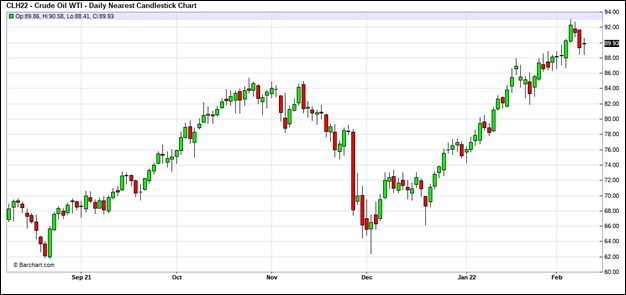
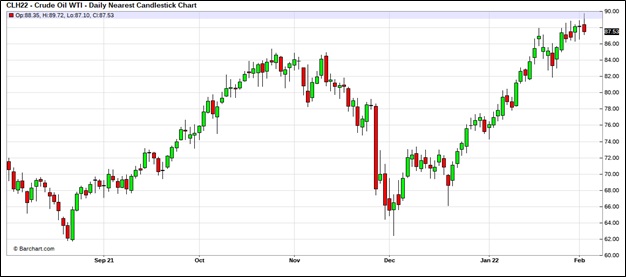
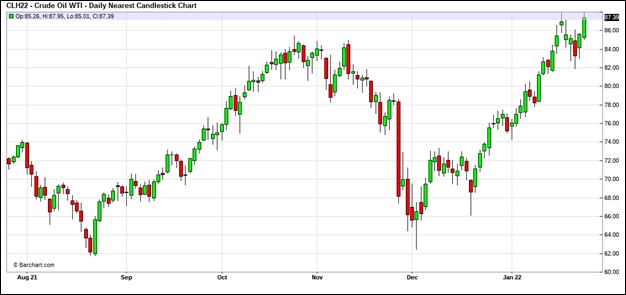
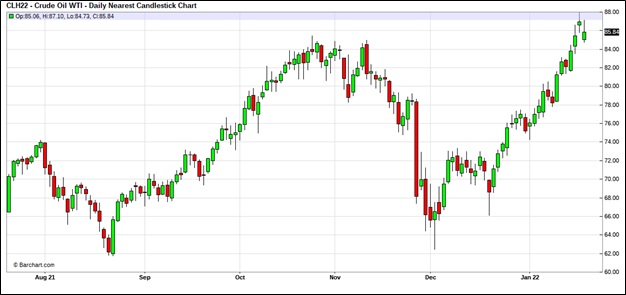
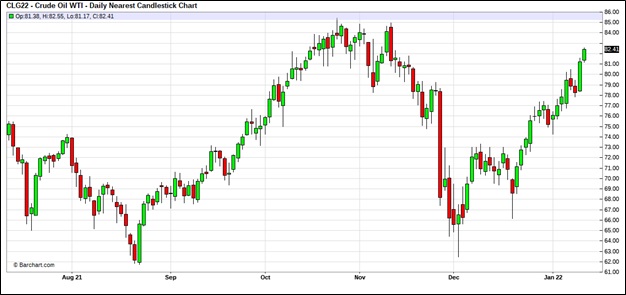
Crude oil prices have moved higher this week, touching technical resistance at $115 per barrel.

(Source: Barchart.com)

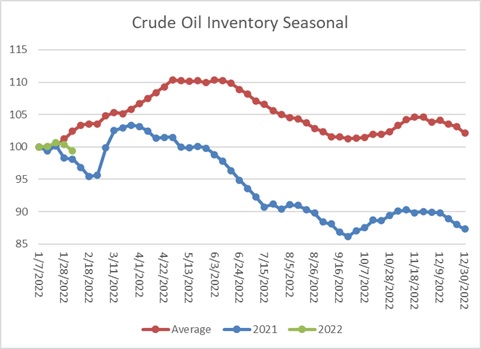
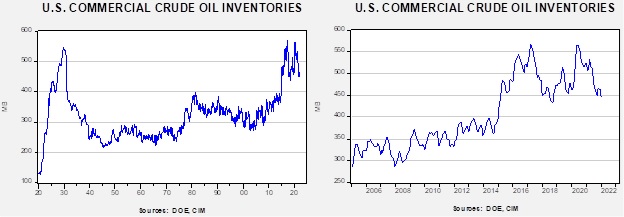
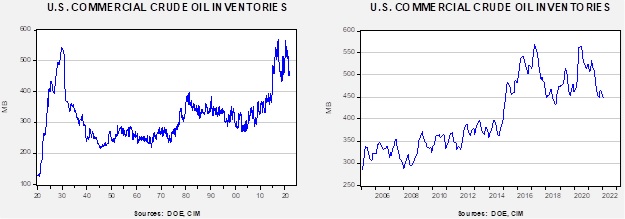
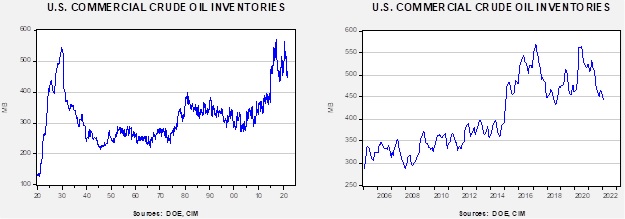
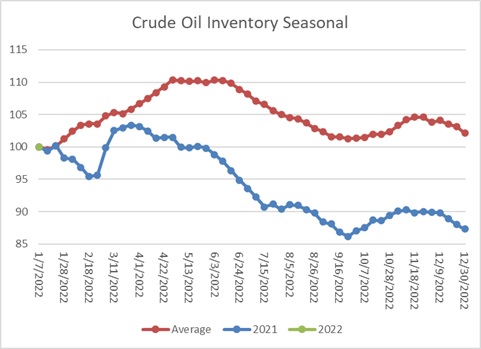
Crude oil inventories unexpectedly fell 3.4 mb compared to a 1.6 mb build forecast.  The SPR declined 5.0 mb, meaning the net draw was 8.4 mb.

In the details, U.S. crude oil production rose 0.1 mbpd to 11.9 mbpd.  Exports rose 0.6 mbpd, while imports rose 0.3 mbpd.  Refining activity rose 1.8% to 91.8% of capacity.

(Sources: DOE, CIM)

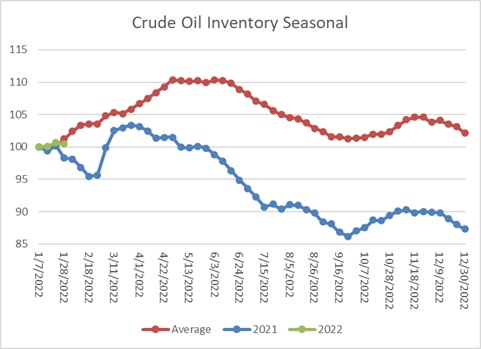
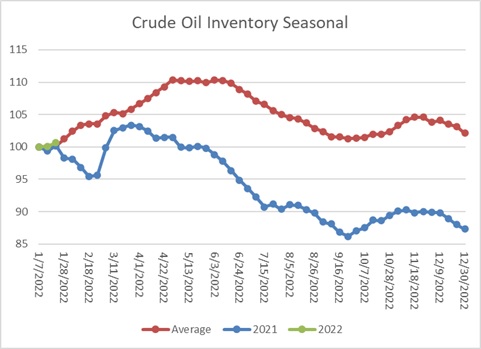
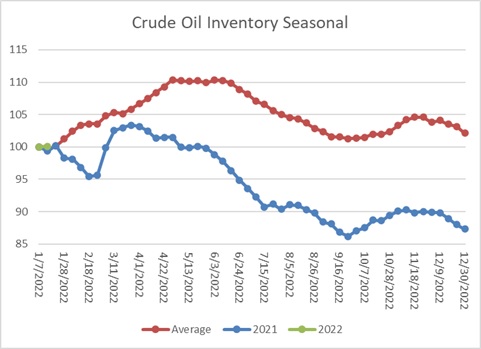
The above chart shows the seasonal pattern for crude oil inventories.  This week’s report shows a partial reversal of last week’s rise, with rising crude oil exports and increased refinery activity offsetting the continued draw from the SPR.  Seasonally, the draw begins in earnest in June.

Refinery utilization is ramping up early this year, reflecting attractive refining margins.

Seasonally, refining activity reaches its peak in early June and remains elevated into Labor Day.  We expect strong demand for product to keep refinery activity at peak levels through the summer.

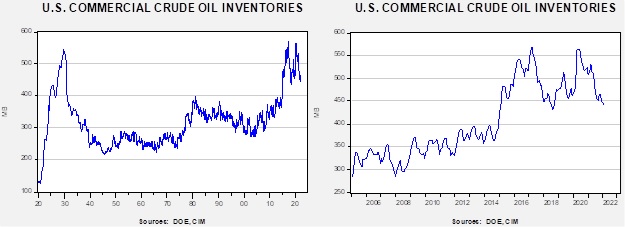
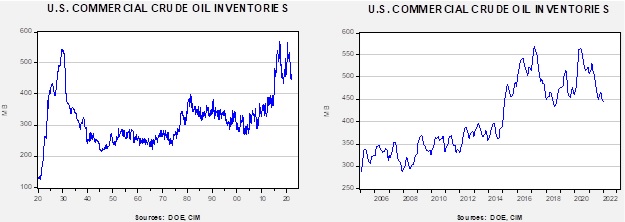
Since the SPR is being used, to some extent, as a buffer stock, we have constructed oil inventory charts incorporating both the SPR and commercial inventories.

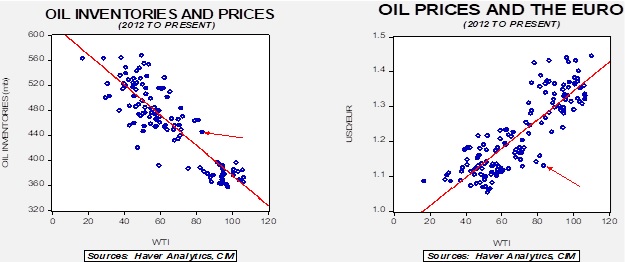
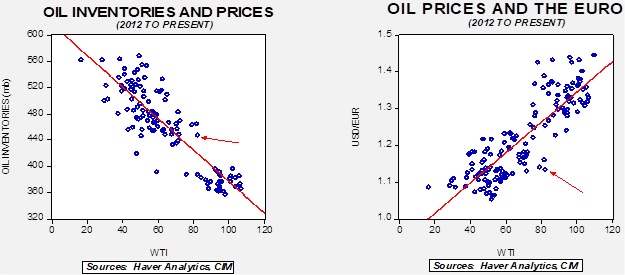
Total stockpiles peaked in 2017 and are now at levels seen in late 2008.  Using total stocks since 2015, fair value is $89.15.

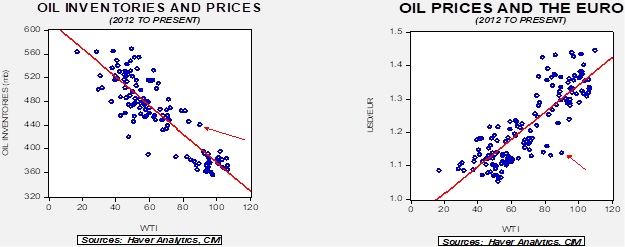
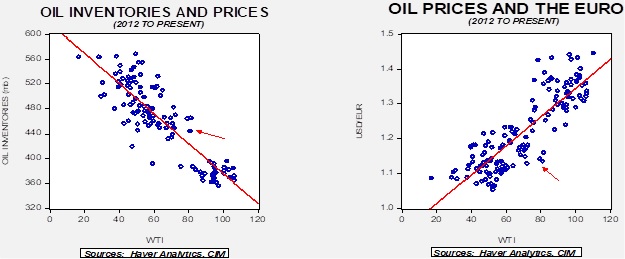
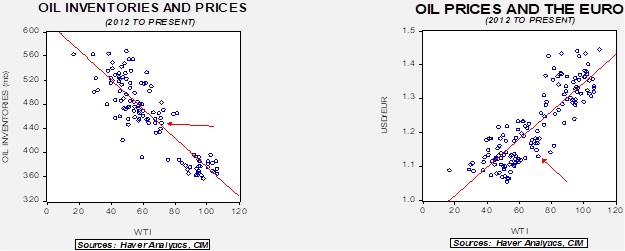
With so many crosscurrents in the oil markets, we see some degree of normalization.  The inventory/EUR model suggests oil prices should be around $60 per barrel, so we are seeing about $40 of risk premium in the market.

Market news:

 Geopolitical news:

 Alternative energy/policy news:

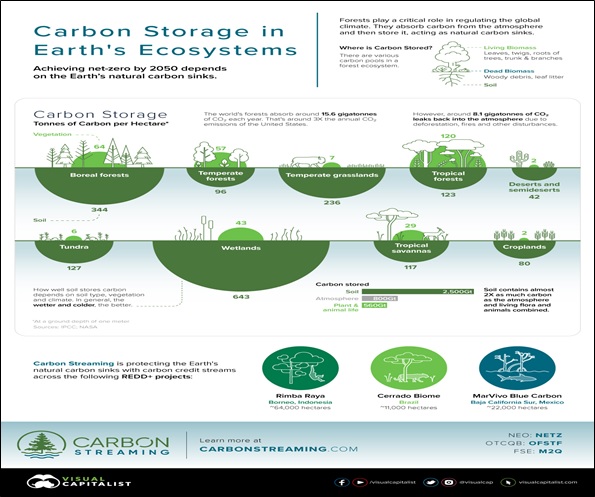
  • As CO2 concentrations continue to rise, it is becoming clear that mere reduction programs probably won’t be enough to slow accumulations of the gas. One area attracting attention and funding is carbon capture and storage.  This process takes the CO2 generated by various processes, captures it at the source, and sends it into underground storage or some other disposal method.  BP (BP, USD, 31.49) and Linde (LIN, USD, 371.18) announced a venture to capture greenhouse gases in Houston.
  • Another potential action is geoengineering, which can cover everything from directly cooling the earth to other forms of carbon storage. However, governments are leery of private actors or other governments essentially conducting climate experiments that may have uncertain outcomes.
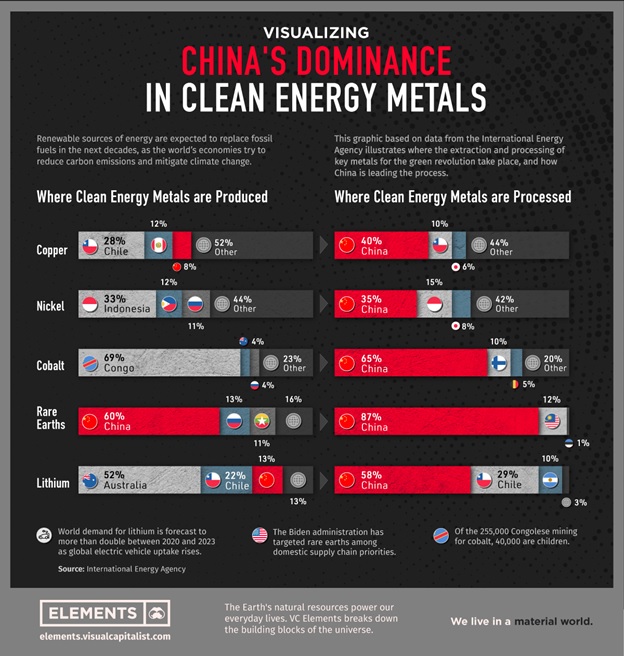
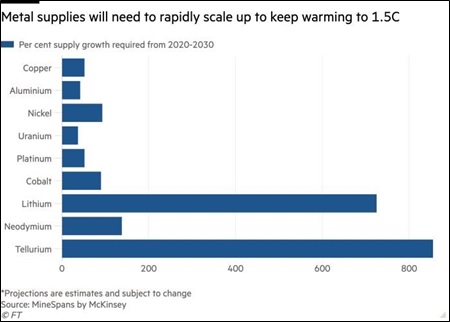
  • Although commodity demand will always be cyclical, the structural demand for metals required for transitioning to EVs will likely support prices for an extended period. EVs are starting to have an impact on easing demand for gasoline.
  • EU companies are supporting a measure that would outlaw the sale of new gas and diesel vehicles by 2035. Policies such as these have a dampening effect on oil and gas investment.
  • One solution to expanding hydrogen use is to send the gas, along with natural gas, using existing natural gas pipelines.

  View PDF

Daily Comment (May 18, 2022)

by Patrick Fearon-Hernandez, CFA, and Thomas Wash

[Posted: 9:30 AM EDT] | PDF

Our Comment opens with an update on the Russia-Ukraine war, where Russian President Putin appears to be facing increasing popular discontent with the war.  We also provide a detailed discussion of the implications now that Sweden and Finland have formally applied for membership in NATO.  We next review a range of international and U.S. developments with the potential to affect the financial markets today.  We close with the latest news on the coronavirus pandemic.

Russia-Ukraine:  It appears that another of President Putin’s decisions has backfired on him.  With Russian military bloggers and pundits now openly criticizing the country’s poor performance in the war, the conditional surrender offered by Russia to the Ukrainian defenders at Mariupol’s Azovstal Steel Works has generated even broader shock and anger.  After months of government propaganda promising quick victory and the complete destruction of Ukrainian “nationalists,” many Russians can’t understand why their government (i.e., Putin, who almost certainly made the final decision) would let the Azovstal defenders live, perhaps to be sent home in a future prisoner exchange.  At the same time, Russian forces continue to make only minimal territorial gains in eastern and southeastern Ukraine, while the Ukrainian forces continue to mount successful counterattacks.  Now we know what that “Z” insignia on Russian vehicles really means, as shown in the cartoon below.

Source:  Financial Times

  • Throughout the war, we have seen unverified reports of mounting opposition to President Putin within Russian leadership circles, but this week’s open criticism in the media and public expressions of anger among politicians seem much more concrete.  We’ve thought all along that a failed war would likely drive Putin from power.  Now that anger at the war is becoming more noticeable, we’ll be watching closely for any sign that Putin is losing his grip on power and, if so, who might take his place.
  • In another example of how Putin’s war has backfired, EU leaders continue working toward a ban on Russian oil imports.  As the EU leaders work to find a way to overcome Hungary’s resistance, U.S. Secretary of State Yellen has thrown her weight behind a proposal to impose a price cap or tariffs against Russian petroleum products.
    • Separately, Italian energy firm Eni (E, $29.20) said it would open a ruble account at Russian bank Gazprombank to make an upcoming payment for Russian gas, but EU officials are warning the move would violate existing EU sanctions.
    • The various sanctions against Russian energy continue to buoy global oil and gas prices.  At this writing, Brent crude is trading at $113.93, up 1.8% so far today.
  • Meanwhile, Sweden and Finland formally applied for membership in NATO today, in a move that will transform Europe’s security situation.  Considering the countries’ previous doctrine of independence and not antagonizing Russia, their application to join NATO is the best example of how Putin’s invasion of Ukraine has backfired on him.
    • Sweden and Finland now must complete a multistep process before they officially enter NATO.  The first step will be a series of meetings with NATO experts in Brussels to ensure the preconditions for membership have been met.
    • Then, all member states must ratify accession protocols permitting the countries to join the Washington Treaty, which forms the legal basis for NATO.
  • The accession of Sweden and Finland into NATO should make the alliance stronger generally, but especially in Northern Europe.  Reflecting that, the commander of Estonia’s armed forces, Lt. Gen. Martin Herem, said adding Sweden and Finland to NATO would profoundly improve the Baltic countries’ security, in part by transforming the Baltic Sea into something approaching a NATO lake (see map below) and improve operational awareness of the skies over the region.
    • Just as important, Herem suggested that if Russia ever attacked the Baltic states, the new NATO could blockade St. Petersburg and force Russia to relieve its exclave of Kaliningrad on the ground through the Suwalki Gap.
    • The statement about blockading St. Petersburg illustrates just how aggressive and energetic the Eastern European members of NATO are.  Countries like Poland, the Czech Republic, and the Baltics may take a lead role in the revitalized NATO in the coming years, ensuring that it remains vigilant against Russia.

Source:  Wikipedia

China:  To help boost birth rates, the government of Jiangsu province has promised to reimburse firms for 50% to 80% of maternity leave costs for employees having their second or third child.  The move illustrates how China still has not been able to boost its birth rates to address its looming demographic crisis, even after abandoning its controversial one-child policy.

Sri Lanka:  The country is expected to formally default on its foreign debt today as the grace period for recent missed payments expires, and the country has essentially run out of foreign reserves.  Sri Lanka’s total foreign debt is reportedly about $50 billion.

U.S. Monetary Policy:  At a conference yesterday, Federal Reserve Chair Powell used his toughest language yet to underscore his commitment to fighting inflation even if it means a slower economy and higher unemployment.  According to Powell, “Restoring price stability is a nonnegotiable need. It is something we have to do . . . There could be some pain involved.”

  • Powell signaled policymakers would hike the benchmark fed funds rate by 50 basis points again in both June and July.
  • In a sign that he would be willing to tolerate a recession and significantly higher joblessness to bring inflation down, Powell also said the unemployment rate consistent with stable inflation “is probably well above 3.6%,” the current level.
  • In response to the tough talk, bond yields rebounded, with the yield on the 10-year Treasury note jumping to a one-week high of 2.988% and the yield on the 2-year yield rising to 2.699%.

U.S. Stock Market:  For a second straight day, a major retailer issued a significant earnings miss attributable largely to surging costs.  After a big miss yesterday by Walmart (WMT, $131.35), today Target (TGT, $215.28) posted lower quarterly earnings and said it would absorb higher costs this year rather than raise its prices.  The company’s management said fuel and freight costs would be $1 billion higher this year than expected, with little sign of their easing throughout 2022.  After Walmart’s stock fell over 11% yesterday, pre-market trading suggests Target’s stock will fall more than 20% today.

COVID-19:  Official data show confirmed cases have risen to  524,767,762 worldwide, with 6,281,461 deaths.  The countries currently reporting the highest rates of new infections include the UK, Germany, the U.S., and France.  (For an interactive chart that allows you to compare cases and deaths among countries, scaled by population, click here.)  In the U.S., confirmed cases rose to 82,727,079, with 1,000,205 deaths.  In data on the U.S. vaccination program, the number of people considered fully vaccinated now totals 220,682,023, equal to 66.5% of the total population.

Virology

  • As yet another wave of infections seems to be hitting the U.S., newly reported cases are on the rise again.  The seven-day average of newly reported cases has now reached 100,732, up 61% from two weeks ago.  However, hospitalization and death rates are still rising much more slowly.  The seven-day average of people hospitalized with confirmed or suspected COVID-19 in the U.S. came in at 22,642 yesterday, up 27% from two weeks earlier.  New COVID-19 deaths are averaging just 318 per day, down 7% from two weeks earlier.

Economic and Financial Market Impacts

View PDF

Daily Comment (May 17, 2022)

by Patrick Fearon-Hernandez, CFA, and Thomas Wash

[Posted: 9:30 AM EDT] | PDF

Today, we open our Comment with an update on the Russia-Ukraine war, where the Russian offensives still seem to be stalled, and Ukraine continues to build its momentum.  We next review a range of international and U.S. developments with the potential to affect the financial markets.  Finally, we have the latest news on the coronavirus pandemic.

Russia-Ukraine:  Russian forces apparently failed to make any significant territorial gains in either eastern or southeastern Ukraine yesterday.  Indeed, the Ukrainian forces’ counteroffensive around Kharkiv has reportedly pushed the Russian troops there all the way to the Russia-Ukraine border.  Perhaps just as important, Russian military bloggers and pundits are now openly criticizing Russia’s performance in the war.  That could potentially lead to a broader social disenchantment with the war and growing political problems for President Putin.  At the same time, Ukrainian leaders have been emboldened and are now forming more expansive war aims, including a stretch goal of regaining control over Crimea and the areas in eastern Ukraine that were seized by Russian forces in 2014.  A particular worry is that Russia could first try to annex those territories de facto into Russia itself.  Any Ukrainian counterattack could then be deemed an attack on Russia itself and potentially trigger nuclear retaliation from the Kremlin.

European Central Bank:  Dutch central bank chief Klaas Knot, one of the top inflation hawks on the ECB’s policy committee, warned the body may hike its benchmark interest rate by an aggressive 50 basis points in July rather than the 25 basis points suggested by ECB President Lagarde.  The statement has pushed the euro up more than 1% to $1.0537 so far this morning.

France:  President Macron has named Élisabeth Borne as his new prime minister.  The choice of Borne, a technocrat who previously served as Macron’s labor minister, shows the pro-business president is tacking leftward before voters head to the polls in mid-June to elect members of the National Assembly.

  • Borne was once chief of staff to Ségolène Royal, a Socialist Party heavyweight, who mounted a high-profile yet unsuccessful presidential campaign in 2007.
  • Macron’s party is expected to win a majority of the 577 seats in the legislature in the election, but some potential supporters have been drifting toward leftist candidates.

China Equity Markets:  Analysts at JPMorgan (JPM, $118.26) upgraded seven major Chinese technology companies to “overweight” recommendations after cutting them “underweight” in March.  The analysts upgraded several other Chinese stocks to “neutral” from “underweight.”  The upgrades are particularly notable because JPMorgan had called a swath of the Chinese tech sector “uninvestable” just two months ago.

  • In that instance, draft analyst reports had called dozens of the tech firms uninvestable.
  • When compliance officials asked to soften those assessments, the analysts inadvertently let several of the reports get published with the “uninvestable” language unchanged.

Global Cryptocurrency Market:  New data show investors have yanked $7 billion from Tether since the world’s biggest stablecoin briefly lost its peg against the U.S. dollar last week.  The data show Tether’s market value has fallen by 9% since May 12, to $76 billion, as tokens have been removed from circulation to meet redemption requests.  Coupled with last week’s collapse of stablecoin TerraUSD after it “broke the buck,” the figures point to continued concerns that stablecoins may be more “runnable” than previously realized.

Global Market for Traditional Currencies:  Against the backdrop of geopolitical tensions, high inflation, differing interest-rate trajectories in different countries, and volatile bond markets, an index measuring swings in currencies linked to the Group of Seven countries has jumped more than 70% this year. One measure of volatility in the euro has more than doubled since November, picking up mostly in March.  The increased volatility, in part, reflects how many currencies have been losing value as the dollar strengthens.

U.S. Baby Formula Market:  Responding to the mass shortage of baby formula following the shutdown of a key production plant in February for sanitation issues, officials at the FDA said they are taking steps to ease imports of foreign formula.  Foreign manufacturers will first have to apply with the FDA to be able to ship their formula to the U.S., and then the agency will have to conduct a review to assure quality control and safety.  The FDA and Abbott Labs (ABT, $109.71) also reached an agreement allowing the shuttered formula plant to reopen.

COVID-19:  Official data show confirmed cases have risen to  522,144,155 worldwide, with 6,267,417 deaths.  The countries currently reporting the highest rates of new infections include Germany, the U.S., France, and South Korea (For an interactive chart that allows you to compare cases and deaths among countries, scaled by population, click here.)  In the U.S., confirmed cases rose to 82,613,620, with 999,842 deaths.  In data on the U.S. vaccination program, the number of people considered fully vaccinated now totals 220,618,615, equal to 66.4% of the total population.

Virology

  • The seven-day average of people hospitalized with confirmed or suspected COVID-19 in the U.S. came in at 22,075 yesterday.  The tally of people hospitalized with COVID-19 is now up 26% from two weeks earlier, although it remains relatively low.
  • Yesterday, the FDA authorized the first nonprescription test that can detect COVID-19, influenza, and respiratory syncytial virus, or RSV.
    • The test, by Laboratory Corporation of America (LH, $242.38), can be sold directly to consumers online or at retail.  Consumers collect a nasal-swab sample themselves before sending the sample to Labcorp for analysis.
    • The test kit costs $169 but comes at no upfront cost to those who meet clinical guidelines and have insurance. People without insurance would have to pay in advance when ordering a kit.
  • In China, the latest wave of infections remains tiny compared with many other countries, but President Xi’s strict “zero-COVID” policies continue weighing on economic activity and even sparking some protests.
    • While Shanghai’s falling infections allowed the local government to ease some lockdown restrictions yesterday, authorities in Beijing are tightening that city’s restrictions.
    • Over the weekend, dozens of students at Beijing’s prestigious Peking University protested after barricades were erected without notice at an off-campus residence hall, restricting their space for movement and access to the compound’s gate.
    • Posts about the incident were quickly deleted, and key search words related to the protest were blocked from Chinese social media.
  • In North Korea, new “fever” cases—a proxy for COVID-19 infections—totaled 390,000 on Sunday alone, bringing the official total to over 1.2 million since the first fever cases were reported a week ago.  Health experts say that without vaccines and testing capacity, the country risks being overwhelmed by a health crisis not seen since it suffered a famine that killed over a million people in the 1990s.

Economic and Financial Market Impacts

  • China’s latest draconian lockdowns have led to a shortage of a dye widely used in medical scans, prompting U.S. hospitals, including the Mayo Clinic, to ration supplies, postpone procedures, or switch to less optimal imaging.
    • The world’s supply of the dye comes from a single plant in Shanghai, and the authorities had shut that plant for several weeks during the spring as it locked down the city in an effort to contain the spread of COVID-19.  The plant has since been reopened, but it is still only operating at 50% of its capacity.
    • The reckless reliance on a single plant for the dye reflects the ethos of globalization after the Cold War.  Factors like geopolitics, populism, and the pandemic have now shown that the world may not be as peaceful or stable as necessary for hyper-efficient supply chains and just-in-time inventories.

View PDF

Daily Comment (May 16, 2022)

by Patrick Fearon-Hernandez, CFA, and Thomas Wash

[Posted: 9:30 AM EDT] | PDF

Our Comment today opens with an update on the Russia-Ukraine war.  Russian forces remain undermanned and largely stalled out, while Ukrainian forces are launching even more aggressive counterattacks.  We next review a range of international and U.S. developments with the potential to affect the financial markets today, including updated EU economic forecasts that show how the war and galloping energy prices are weighing on growth.  We wrap up with the latest news on the coronavirus pandemic, including a discussion of how China’s strict lockdowns are creating yet another major headwind for the global economy and financial markets.

Russia-Ukraine:  Russian forces continue to scale back their ambitions; their primary focus is now on a minor encirclement of Ukrainian troops in the eastern region of Luhansk and the annexation of occupied areas in southeastern Ukraine.  With President Putin reluctant to formally declare war and announce a slow, politically disruptive general mobilization, the Russian military has been limited to a “stealth mobilization” of reservists that has done little to alleviate its shortfall in available troops.  The Ukrainian military may have high casualties just like the Russian military, but its increasing ability to field modern, technologically advanced equipment from NATO is giving it increased advantages by the day.  The latest reports suggest Ukrainian forces are mounting a strong counterattack against Russian forces around the eastern city of Izyum in an effort to disrupt the supply lines that Russia needs to carry out its effort to take control of the entire Donbas region.

Global Wheat Market:  Wheat prices are surging today after India said it would ban exports of the grain to maintain food security and control prices.  After a bumper crop last year, India had been expected to use its ample stockpiles to help fill the gap left by the cutoff of Russian and Ukrainian supplies because of the war.  With that option now off the table, prices have surged some 5% today to more than $12.40 per bushel.

European Union:  Today, the European Commission issued updated forecasts showing it now expects both the broader EU and the Eurozone to post economic growth of just 2.7% in 2022, well short of the 4.0% growth in the previous forecast.  Growth is expected to fall further to 2.3% in 2023.

  • EU Economics Commissioner Gentiloni attributed the slower growth mostly to the Russia-Ukraine war, which has caused energy prices to spike in Europe and further disrupted supply chains.
  • In a scenario where the supply of natural gas from Russia is cut off completely, the forecast said economic activity would grow just 0.2% this year and 1.3% next year.

Germany:  Over the weekend, Chancellor Scholtz’s Social Democratic Party (SPD) suffered a humiliating defeat in an election in North Rhine-Westphalia, Germany’s most populous state and once an SPD stronghold.  The results illustrate how Scholtz has been damaged by his dithering on German support for Ukraine, especially compared to the tough stand taken by Foreign Minister Baerbock of the Greens.

  • The SPD won just 26.7% of the vote, down more than 4% from the last election in 2017.
  • The two big winners were the opposition Christian Democrats, who won with 35.7%, up nearly 3% from 2017, and the Greens, whose share of the vote nearly tripled to 18.2%.

China:  To help revive the flagging real estate sector, top regulatory agencies said they would let banks cut the minimum mortgage interest rate for first-time homebuyers by 20 basis points.  However, we suspect many Chinese will remain reluctant to buy as long as the government keeps trying to rein in the country’s highly indebted real estate developers.  Chinese real estate firms continue to face high regulatory risk, and more are likely to face bankruptcy or financial difficulties in the near term.

U.S. Economy:  Lloyd Blankfein, former chief executive and current Chairman of Goldman Sachs (GS, $306.99), yesterday said there is a “very, very high risk” that the U.S. economy is heading towards a recession because of factors such as high inflation and the Federal Reserve’s big interest-rate hikes.  According to Blankfein, “If I were running a big company, I would be very prepared for it. If I was a consumer, I’d be prepared for it, [although] it’s not baked in the cake.”

U.S. Stock Market:  Recent regulatory filings indicate that Warren Buffett’s Berkshire Hathaway (BRK-A, $465,011) has deployed tens of billions of dollars into the stock market over the past few months.  The filings show big additions to the company’s holding of major oil companies, such as Occidental Petroleum (OXY, $64.08), and select technology firms, such as Apple (AAPL, $147.11).

The Omaha-based company bought 901,768 shares of Occidental Petroleum Corp. OXY 8.21% last week, according to a regulatory filing. The move likely makes Occidental, in which Berkshire began buying shares in late February, one of its 10 biggest holdings.

U.S. Bond Market:  In an interview with the Financial Times, PIMCO’s chief investment officer said that the recent sell-off in debt markets is creating a buying opportunity, and investors should get ready to snap up oversold corporate obligations.

  • With PIMCO being such a major presence in the bond market, the official is clearly “talking his book.”  The Fed is still clearly intent on tightening monetary policy aggressively, so it’s important to remember that bonds could fall further.
  • All the same, we have been warning that the Fed’s aggressiveness could reveal financial fragilities and slow the economy quicker than expected.  If that happens and the Fed is forced to stop hiking rates, rebounding bonds could indeed become attractive again.

COVID-19:  Official data show confirmed cases have risen to  521,544,771 worldwide, with 6,264,097 deaths.  The countries currently reporting the highest rates of new infections include Germany, the U.S., South Korea, and France.  (For an interactive chart that allows you to compare cases and deaths among countries, scaled by population, click here.)  In the U.S., confirmed cases rose to 82,468,652, with 999,602 deaths.  In data on the U.S. vaccination program, the number of people considered fully vaccinated now totals 220,597,701, equal to 66.4% of the total population.

Virology

Economic and Financial Market Impacts

  • As shown in the tables below, new Chinese data show the government’s strict pandemic lockdowns are weighing dramatically on economic activity.  April retail sales were down 11.1% year-over-year, almost twice as bad as expected and far worse than the 3.5% decline in the year to March.  Industrial production in April was down 2.9% on the year.
    • Since U.S. investors are so focused on domestic inflation, Fed interest-rate hikes, and the war in Ukraine, they may be overlooking the economic threat from China’s lockdowns.
    • Not only are the new lockdowns further snarling global supply chains and helping keep inflation high, but they are also weighing on global demand.  As weaker Chinese demand starts to affect companies around the world, growth is likely to slow, profits may weaken, and financial markets may remain under pressure.

View PDF

Asset Allocation Bi-Weekly – The FOMC Speaks (May 16, 2022)

by the Asset Allocation Committee | PDF

On May 4th, the FOMC announced its policy changes.  The Fed moved its fed funds target by 50 bps, the fastest increase in 22 years; the last hike of this amount was in May 2000.  In the press conference, Chair Powell scotched the notion of a greater than 50 bps rate hike.  He did, however, suggest that similar 50 bps rate hikes will be likely for at least the next couple of meetings.

One way to look at the future path of policy is to compare the level of inflation to unemployment.  This is the classic Phillips Curve idea; although the FOMC has seemingly jettisoned this concept, history suggests that policy has been aligned with this relationship.

The upper line on the chart shows the level of fed funds along with the target; Haver Analytics has estimated the policy rate target beginning in 1982.  The lower line shows the spread of yearly change in overall CPI and the unemployment rate. From the late 1960s into the early 1980s, inflation regularly exceeded the unemployment rate, forcing policymakers to lift the policy rate aggressively to contain inflation.  These tightening cycles led to four recessions over 12 years.  After that experience, the FOMC took steps to move rates high once the spread between inflation and unemployment approached zero.  This policy stance could be called “preemptive”.

However, in the current expansion, the Fed has allowed inflation to exceed the unemployment rate by a wide margin.  On the above chart, we have made forecasts for data unavailable for April and May (the yellow shaded area on the chart).  We expect inflation to begin slowly falling, but the unemployment rate to remain low.  To normalize rates, the unemployment rate will need to rise above CPI.  The tone of Powell’s press conference suggests the FOMC is moving in the direction of achieving this target at a deliberate pace; it is likely the Fed hopes inflation will fall as supply constraints ease and thus wants to give the economy more time to adjust to tighter monetary policy.

The other major announcement was that the Fed will begin to reduce the size of the balance sheet.  Quantitative tightening (QT) will start in earnest in June.  The impact of changes to the balance sheet remains controversial; the expected outcome from quantitative easing (QE) was to lower long-term interest rates.   Interestingly enough, QT and QE have tended to lift long-term rates, whereas a stable balance sheet led to lower interest rates.

On the other hand, periods of QT tended to narrow credit and mortgage spreads.  On the chart below, periods of QE are in green, and QT in tan.

Finally, the relationship of the Fed’s balance sheet to equities is also controversial.

The S&P 500 often tracks higher during periods of QE and stalls when the balance sheet stabilized…until late 2016.  Equities forged higher even with QT, but the positive relationship between the balance sheet and equities returned during the most recent QE period.  The model would suggest that QT will have a modestly adverse effect on equities.  The biggest risk to equities is likely the business cycle. Recessions tend to bring bear markets in stocks.  But, QT on its own is probably not a bearish event.

So, to recap, tighter monetary policy, which includes higher policy rates and balance sheet reduction, increases recession risk.   Recessions are inclined to affect risk assets adversely. We expect credit spreads to widen and equities to weaken if recession odds rise.  Longer duration yields generally decline, although in periods of elevated inflation, the declines are often simultaneous with the onset of the downturn.   Although we do not expect a recession in 2022, the likelihood in 2023 is rising.

View PDF

Daily Comment (May 13, 2022)

by Patrick Fearon-Hernandez, CFA, and Thomas Wash

[Posted: 9:30 AM EDT] | PDF

Good morning! Today’s report begins with updates on stablecoin and the war in Ukraine. Next, we go over the latest U.S. economic and policy news, including a discussion about Fed Chair Powell’s Senate confirmation for a second term. We then review international news, focusing on the USDA’s wheat production outlook. We end with our daily pandemic coverage.

Stablecoin

 After a rough few days, the crypto market is showing signs of improving. Tether, the world’s biggest stable coin, was able to regain its peg to the dollar, to the relief of many of its investors. Meanwhile, Bitcoin is now trading above $30,000 after falling below $25,000 a day prior. That being said, crypto remains risky. Terra Blockchain has halted the trading of its tokens. Meanwhile, crypto.com and Binance have suspended the trading of several other digital tokens. So far, there are no signs that U.S. money markets were affected by the recent turmoil in stablecoins. Although some stablecoins are backed by assets like U.S. Treasuries and commercial paper, the recent redemptions have not caused havoc in the financial system. The resiliency of money markets suggests that market conditions remain stable. However, we still suspect that the recent crypto panic will lead to calls for more oversight within the crypto markets in the future.

Russia-Ukraine update

On the war front, Russia and Ukraine remain at a stalemate. Ukrainian forces have had some success in pushing back Russian troops. Still, some areas within Ukraine remain firmly under Russian control. Talks between leaders of both sides are infrequent. In a phone call with German Chancellor Olaf Scholz, Putin stated Kyiv has essentialy blocked peace talks.

  • Finland announced its intention to join NATO. The country’s admission into the military alliance would place a NATO ally along the Russian borders. Moscow has argued that NATO expansion is what provoked its decision to invade Ukraine. In response to Finland’s potential bid, Russia announced it would send troops along its shared border once it formally applies.
  • European gas prices soared 10 percent on Thursday after Vladimir Putin reduced the amount of natural gas going into Germany. The cut in supplies was in retaliation for sanctions. The move will likely force the EU to take more significant measures to reduce its dependency on Russian energy.
  • Chinese officials are becoming more vocal about their dismay with Russia. A Retired Chinese diplomat, who served in Kyiv and Moscow, gave a speech questioning Russia’s value to China. He argued Russia was in historical decline and the war proved that Beijing exaggerated Putin’s leadership skills. Even though there is no evidence that China will abandon Russia, the diplomat’s speech hints that elites in China are growing restless with the ongoing war.

U.S. economic policy news

 The Senate confirmed Federal Reserve Chair Jerome Powell for a second term. He received an overwhelming majority of votes (80-19), suggesting the Senate still trusts Powell to decrease inflation.

    • In an interview, Powell showed signs of regret for not raising rates sooner but maintained that officials were making decisions based on the data available at the time. His remarks prove he may give up hope that inflation is transitory. If true, it could mean the Fed may become more hawkish.
  • The White House is hosting a group of Southeast Asian countries on Friday. The meeting is designed to build closer trade and military ties between the U.S. and Indo-Pacific countries. The Biden administration is currently holding discussions with Southeast Asian countries as his administration looks to rewrite trade standards. The U.S. courtship of these countries is another example of its rising competition with China. Integration of Indo-Pacific countries could boost trade and bring down inflation in the long run.

International News

 In Europe, Spain and Portugal are passing legislation that will put a cap on gas prices. The EU permitted the two countries to act outside the bloc’s common market price-setting rules. Although there are ongoing discussions about implementation, the move could pave the way for more price controls within Europe as countries try to tame inflation.

  • Qatar has stepped in to try to help the U.S. and Iran come to revive the nuclear pact signed in 2015. The deal was close to being settled in March, but at the last minute, Iran demanded the removal of the Islamic Revolutionary Guard Corps, its elite security force, from the U.S. Foreign Terrorist Organizations list.
  • The latest World Agricultural Supply and Demand Estimates report showed that the global stockpile of wheat would fall to a six-year low in the upcoming season. The report attributes the lack of production to the war in Ukraine and drought in major wheat-producing countries. Food inflation will probably be a problem due to this lack of production.
    • In Indonesia, the spread of foot-and-mouth disease in cattle threatens the country’s beef supply. The outbreak could boost beef imports, especially in July when the Eid al-Adha festival starts.

COVID-19:  The number of reported cases is 519,936,669, with 6,259,865 fatalities. In the U.S., there are 82,325,687 confirmed cases with 999,111 deaths. For illustration purposes, the FT has created an interactive chart that allows one to compare cases across nations using similar scaling metrics. The CDC reports that 734,783,455 doses of the vaccine have been distributed, with 580,514,653 doses injected. The number receiving at least one dose is 257,707,346, the number of second doses is 220,461,007, and the number of the third dose is 102,011,446. The FT has a page on global vaccine distribution.

View PDF