

Weekly Energy Update (February 10, 2022)

by Bill O’Grady, Thomas Wash, and Patrick Fearon-Hernandez, CFA | PDF

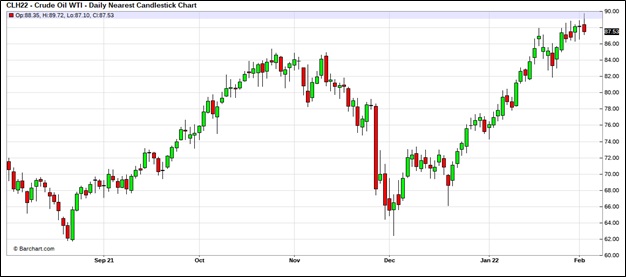
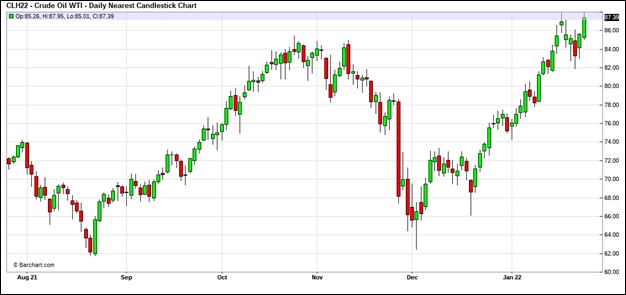
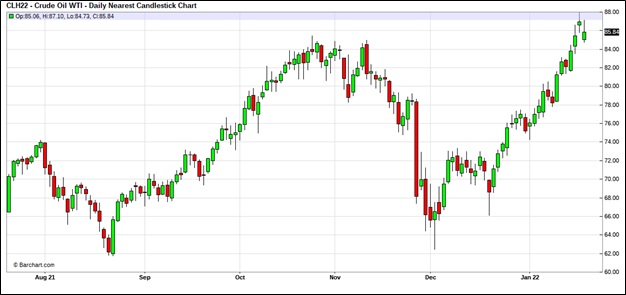
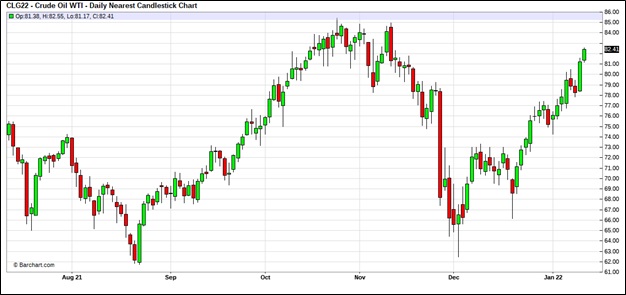
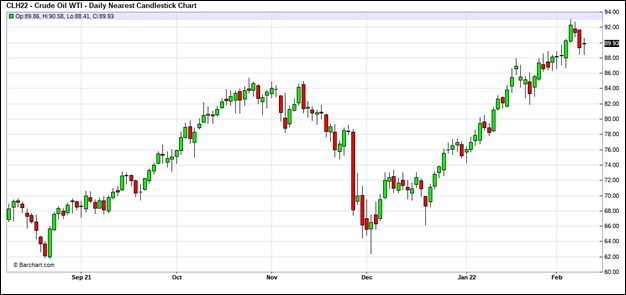
After breaking above $90 per barrel late last week, prices have modestly retreated.
(Source: Barchart.com)

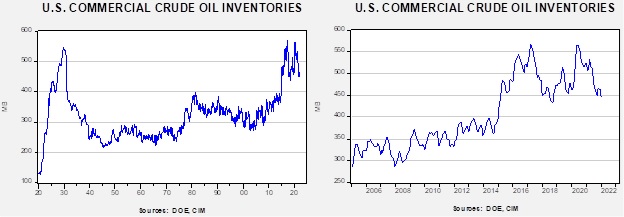
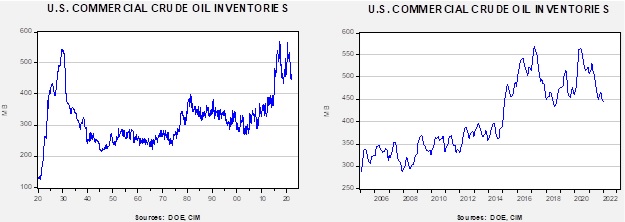
Crude oil inventories unexpectedly fell 4.8 mb compared to a 1.4 mb build forecast.  The SPR declined 1.4 mb, meaning the net draw was 6.2 mb.
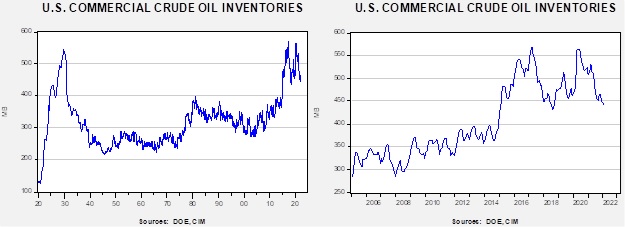
In the details, U.S. crude oil production rose 0.1 mbpd to 11.6 mbpd.  Exports rose 0.7 mbpd while imports fell 0.7 mbpd.  Refining activity jumped 1.5%.
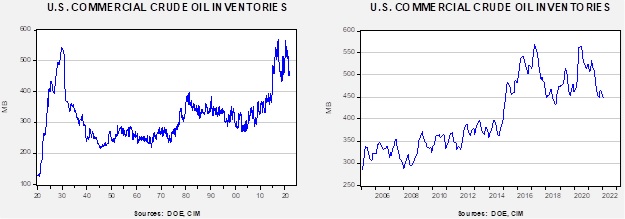
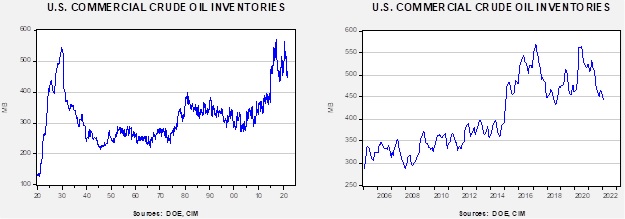
(Sources: DOE, CIM)

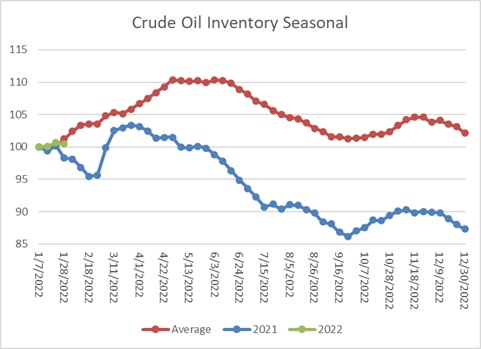
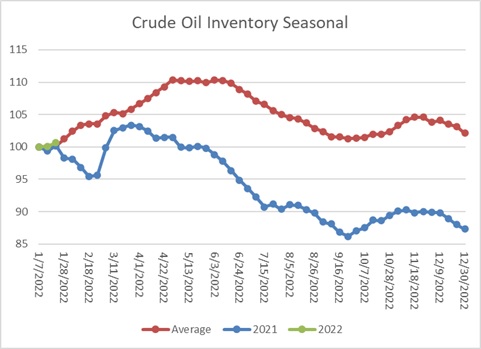
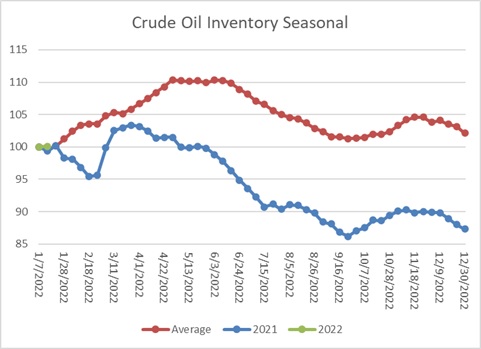
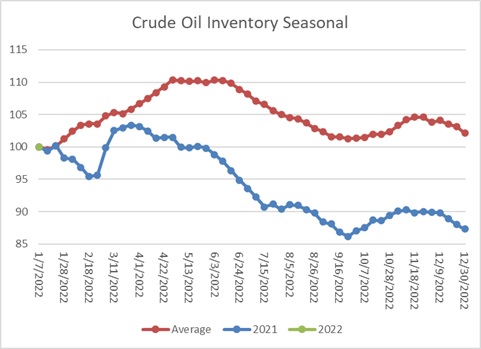
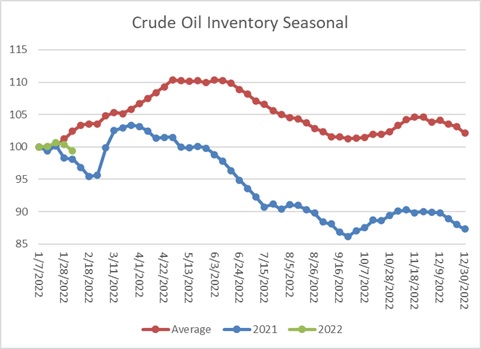
This chart shows the seasonal pattern for crude oil inventories.  This week’s report shows a definitive shift towards tracking last year.  If that continues, we can expect falling oil inventories for the next three weeks.
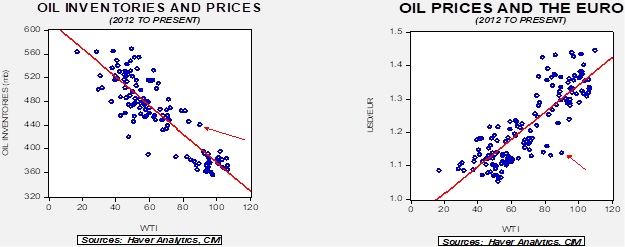
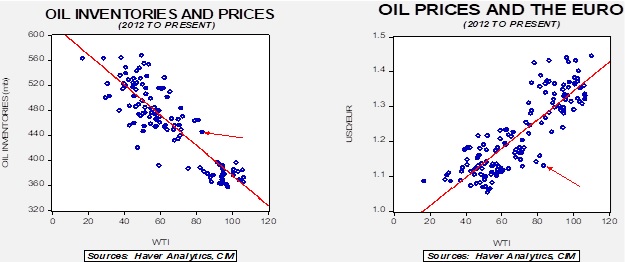
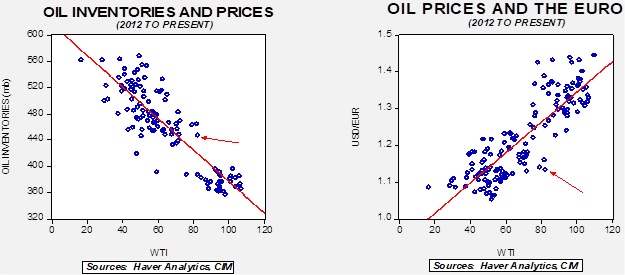
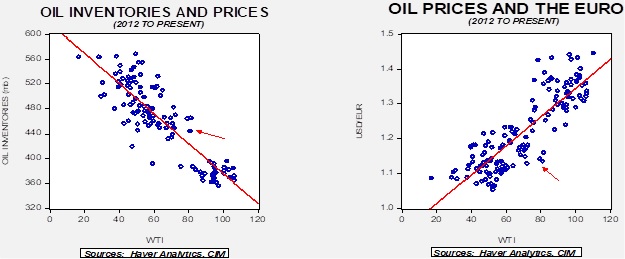
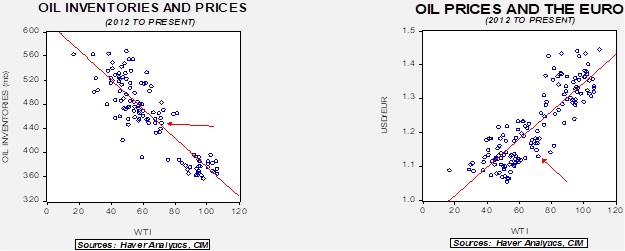
Based on our oil inventory/price model, fair value is $71.33; using the euro/price model, fair value is $55.34.  The combined model, a broader analysis of the oil price, generates a fair value of $64.08.  Current prices exceed our model projections by a wide margin, but price momentum and worries about future supply constraints will like keep prices elevated.

 Market news:

  • Oil prices have been correcting this week as the market discounts a potential deal between Iran and the U.S. to restart the JCPOA; we discuss the detail in the Geopolitical news section.  Technically, oil prices were elevated and ripe for a bout of profit-taking.
  • The Permian Basin may see a surge in production.  One advantage to shale oil drilling is that there is a short time between investment and production.  The decline rates are rapid, meaning the payoff comes rather quickly.  In an era of long-term uncertainty, these characteristics make the region attractive.  However, it should be noted that a side effect of fracking, the process used to extract oil from shale, is an increase in seismic activity.  Such increases and related regulations may undermine future production.
  • There is an uptick in anti-oil litigation at the state level, which may add to costs or reduce future production.
  • For reference, here is a site that tracks power outages across the country.

Geopolitical news:

  • There is growing hope that the U.S. and Iran will return to the 2015 nuclear deal. Negotiators suggest that talks are entering their “final stages.”  If any deal is struck, it will mostly be a matter of convenience.  Iran has made important progress in generating nuclear materials to the point where it is unlikely it will return fissile inventories back to 2015 levels.  Thus, the U.S. would simply have to accept that this part of the deal won’t be maintained.  One reason for optimism is that the U.S. has allowed Iran access to funds it holds in Iraq, a good-faith gesture.  The U.S. has also rescinded a sanction on third-party firms working on nuclear non-proliferation and safety projects in Iran.  Easing sanctions would likely bring a modest increase in oil supplies.  Given the political pressure that comes with high oil prices, any reduction would be a welcome relief.  At the same time, there is no political benefit in the U.S. for appearing “soft” on Iran.  On the Iranian side, there is a deep distrust of the U.S. and opposition to any sort of agreement.  Meanwhile, the Iranian economy has suffered greatly from sanctions and the pandemic, and internal tensions are increasingLeaks from hacks suggest rising internal dissension within the regime as well.  It is possible Iran will take a deal to reduce pressure.
    • Nonetheless, the idea that easing sanctions will dramatically increase global supplies is probably misplaced. Iran has been seeing oil surreptitiously for some time, and the chance that a new U.S. administration could reverse the current government’s policy on Iran is high.  Thus, it is unlikely that new foreign investment will be forthcoming.
  • Mongolia has large solar and wind capacity, which may eventually reduce demand for Russian natural gas.
  • Australia is supporting rare earths mining within its borders to reduce China’s market power over these key metals. However, it isn’t clear if processing capacity will expand, which is another area where China dominates rare earth metals.
  • Turkey has been taking a mediating and supportive role in the Russian/Ukraine situation. Turkey is also trying to improve relations with Iraq.
  • The EU is considering steps to shield households from a spike in natural gas prices if a war in Ukraine breaks out.
  • The U.S. bombed a house where the leader of IS, Abu Ibrahim al-Hashimi al-Qurayshi, was residing. The leader of the insurgent group died in the exchange.  Although removing the leader of IS is favorable news, it probably won’t curtail the group’s activities.

Alternative energy/policy news:

  View PDF

Asset Allocation Bi-Weekly – Gold: An Update of Current Conditions (February 7, 2022)

by the Asset Allocation Committee | PDF

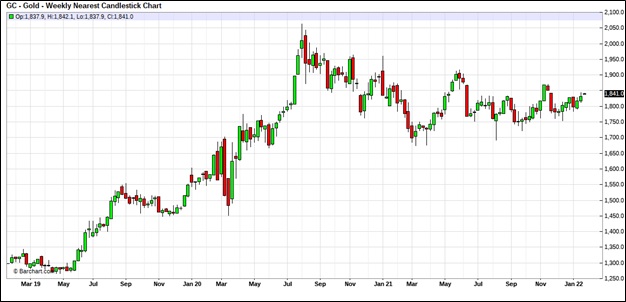
Gold moved steadily higher from the late summer of 2018 into August 2020.  Prices then declined toward $1,700 and have since traced out a trading range between $1,700 and $1,900.  In this report, we will update our views on the metal.

(Source: Barchart.com)

We have been holding gold in our asset allocation portfolios since 2018, although we have diversified our commodity holdings by adding a broader commodity ETF alongside our gold position.

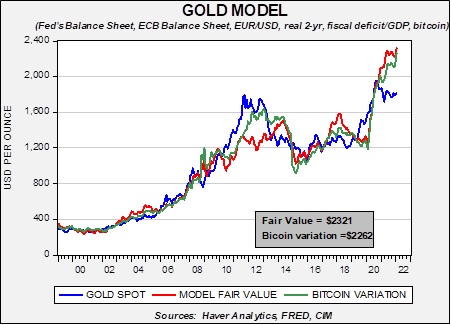
The long-term outlook for gold remains positive.  Our basic gold model, which uses the balance sheets of the Federal Reserve and the European Central Bank, the EUR/USD exchange rate, the real two-year T-note yields, along with the U.S. fiscal deficit relative to GDP, suggests prices remain undervalued.  To account for the impact of bitcoin, we have added a variation to our gold model to take the cryptocurrency into consideration.  In both variations, gold remains undervalued.

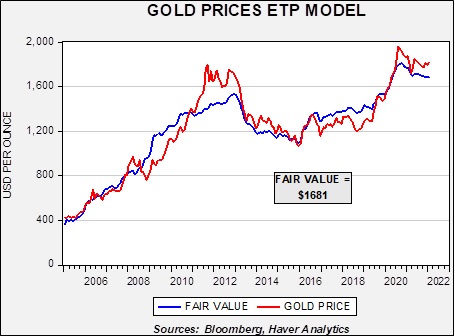
So, what is keeping gold undervalued?  We believe it is mostly due to short-term factors.  First, investor flows are not high enough to lift gold to our long-term models’ fair value.  The chart on the left overlays the price of gold and the fair value based on flows to gold exchange-traded products.  Flows suggest gold is actually overvalued.  Why are investors shunning gold?  Last year, it appeared crypto-currencies were siphoning off investor flows that traditionally would have gone to gold.  But with cryptocurrencies falling in price, gold has not benefited, at least not yet.  Most likely, fears of FOMC policy tightening are weighing on gold.

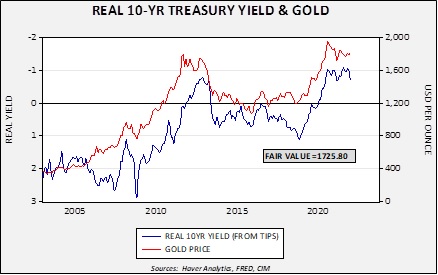
Second, real interest rates, measured by the TIPS spread, suggest gold is overvalued.  Real 10-year yields have risen sharply recently, reducing the fair value of gold to $1,725.80.[1]  So far, gold has not reacted to the rise in real yields, but it could pressure gold prices in the coming weeks.

In our most recent asset allocation rebalancing, we reduced our exposure to gold, using some of the allocation to increase our position in broader commodities.  Concerns about short-term weakness in gold prices played a role in that decision.  In addition, we expect some commodities, such as energy, to rally if a geopolitical event occurs in Europe or Asia.  At the same time, we remain long-term gold bulls, and thus, we want to maintain an allocation to the metal.

View PDF


[1] On the chart, the scaling for the real yield is inverted.

Weekly Energy Update (February 3, 2022)

by Bill O’Grady, Thomas Wash, and Patrick Fearon-Hernandez, CFA | PDF

Since troughing in early December, oil prices have been steadily rising due to tightening supplies.  We are approaching the highs set in November.

(Source: Barchart.com)

Crude oil inventories unexpectedly fell 1.0 mb compared to a 1.8 mb build forecast.  The SPR declined 1.9 mb, meaning the net draw was 2.9 mb.

In the details, U.S. crude oil production fell 0.1 mbpd to 11.5 mbpd.  Exports fell 0.4 mbpd while imports rose 0.8 mbpd.  Refining activity fell 1.0%.

(Sources: DOE, CIM)

This chart shows the seasonal pattern for crude oil inventories.  This week’s report shows a pattern more consistent with average and less with last year.  Last year, we had a sharp drop in stockpiles in a period where inventories usually accumulate.  So far, it looks like we will see inventories rise rather than decline.

Based on our oil inventory/price model, fair value is $69.62; using the euro/price model, fair value is $53.34.  The combined model, a broader analysis of the oil price, generates a fair value of $61.72.  Current prices exceed our model projections, but price momentum is likely to push prices higher.

 Market news:

Geopolitical news:

Alternative energy/policy news:

  View PDF

Business Cycle Report (January 27, 2022)

by Thomas Wash | PDF

The business cycle has a major impact on financial markets; recessions usually accompany bear markets in equities.  The intention of this report is to keep our readers apprised of the potential for recession, updated on a monthly basis.  Although it isn’t the final word on our views about recession, it is part of our process in signaling the potential for a downturn.

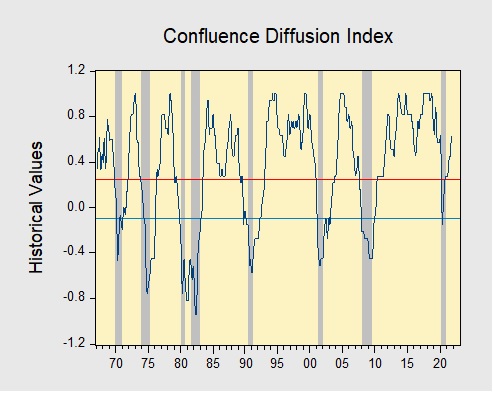
In December, the diffusion index rose further above the recession indicator, signaling that the economy is still in expansion. In the financial markets, equities cooled following indications from the Fed that it was going to tighten monetary policy in 2022. Meanwhile, construction and manufacturing activity improved as supply chain disruptions showed signs of easing. Lastly, the labor market appears to be strong, with the unemployment rate falling for the eighth consecutive month. That being said, ten out of the 11 indicators are in expansion territory. The Diffusion Index rose from +0.7576 to +0.8182, remaining well above the recession signal of +0.2500.

The chart above shows the Confluence Diffusion Index. It uses a three-month moving average of 11 leading indicators to track the state of the business cycle. The red line signals when the business cycle is headed toward a contraction, while the blue line signals when the business cycle is moving toward recovery. On average, the Diffusion Index is currently providing about six months of lead time for a contraction and five months of lead time for a recovery. Continue reading for a more in-depth understanding of how the indicators are performing, and refer to our Glossary of Charts at the back of this report for a description of each chart and what it measures. A chart title listed in red indicates the indicator is signaling recession.

Read the full report

Weekly Energy Update (January 27, 2022)

by Bill O’Grady, Thomas Wash, and Patrick Fearon-Hernandez, CFA | PDF

Since troughing in early December, oil prices have been steadily rising due to tightening supplies.  We are approaching the highs set in November.

(Source: Barchart.com)

Crude oil inventories unexpectedly rose 2.4 mb compared to a 1.0 mb build forecast.  The SPR declined 1.3 mb, meaning the net build was 1.1 mb.

In the details, U.S. crude oil production fell 0.1 mbpd to 11.6 mbpd.  Exports rose 0.2 mbpd while imports fell 0.5 mbpd.  Refining activity fell 0.4%.

(Sources: DOE, CIM)

This chart shows the seasonal pattern for crude oil inventories.  This week’s report shows a pattern consistent with average and last year.  Next week has a clear divergence between average and last year.  We had a massive cold snap last year, so it is more likely we will see inventories follow the average instead of last year.

Based on our oil inventory/price model, fair value is $70.04; using the euro/price model, fair value is $53.89.  The combined model, a broader analysis of the oil price, generates a fair value of $69.30.  Current prices exceed our model projections, but price momentum is likely to push prices higher.

 Market news:

  • Despite promises to increase output, OPEC+ is running almost 0.8 mbpd below target.  The shortfall does not appear to be driven by deliberate actions to reduce output, but by production problems among some smaller member producers.  In addition, as we note below, both the UAE and the KSA have been suffering from missile and drone attacks, which may affect output as well.
  • Bitcoin mining consumes massive amounts of power.  Miners get the right to verify transactions by cracking complicated puzzles and are rewarded with bitcoin for their efforts.  To solve these puzzles, tremendous computing power is required. The rating agency Fitch (HTV, USD, 108.35) warns that as mining activity rises in the U.S., utilities could struggle to meet the demand for power.

Geopolitical news:

Alternative energy/policy news:

  • The fossil fuel industry is facing an increasingly hostile investment and regulatory environment.  However, it is important to note that the industry is not without allies, and a pushback against the aforementioned trend is developing.  For example, the state treasurer of West Virginia is ceasing its use of a Blackrock (BLK, USD, 813.34) investment fund for banking transactions.  Blackrock has been vocal about reducing investment in fossil fuels, which triggered the action by West Virginia.  And, the state is not alone; 15 other states are joining the effort to oppose curtailing investment in the industry.
  • Although the action by the states may slow the regulatory and investment measures to reduce fossil fuel consumption and production, generationally, the industry is likely fighting a losing battle.  The young in the developed world oppose the industry and will become more powerful over time.
  • Nuclear power remains a controversial issue.  While Germany continues its phaseout of nuclear power, there is increasing investment elsewhere.
  • At the same time, we are seeing roadblocks developing for solar power.  Rooftop or distributed solar power usually relies on subsidies and, in some cases, generous programs to purchase excess power from homeowners.  A coalition of utilities and labor unions is looking to curtail these incentives in California.  Without careful structuring of incentives to benefit utilities and their workers, these elements of the industry are natural enemies against distributed power.
  • An unsung area that can reduce carbon emissions is improved consumption efficiency.  Although building emissions are not the largest source of carbon, it is an important area and one that has not shown appreciable improvement.  The administration is drafting new rules to incentivize improved efficiency in heating, lighting, and cooling commercial buildings.
  • General Motors (GM, USD, 53.52) announced it will make a $7 billion investment in Michigan for battery production for EVs.
  • Hydrogen is an old alternative to fossil fuels.  To some extent, it has been the “fuel of the future and always will be.”  In other words, it has been difficult to create and actually build out a hydrogen-based economy.  Hydrogen has some attractive features; fuel cells, which use the fuel, are highly efficient.  The gas can, in theory, be distributed through the existing fulling station network.  Unfortunately, at present, most hydrogen is produced from using fossil fuels, making this a less attractive option.  Notably, both Canada and China apparently are considering the development of hydrogen as an alternative fuel.
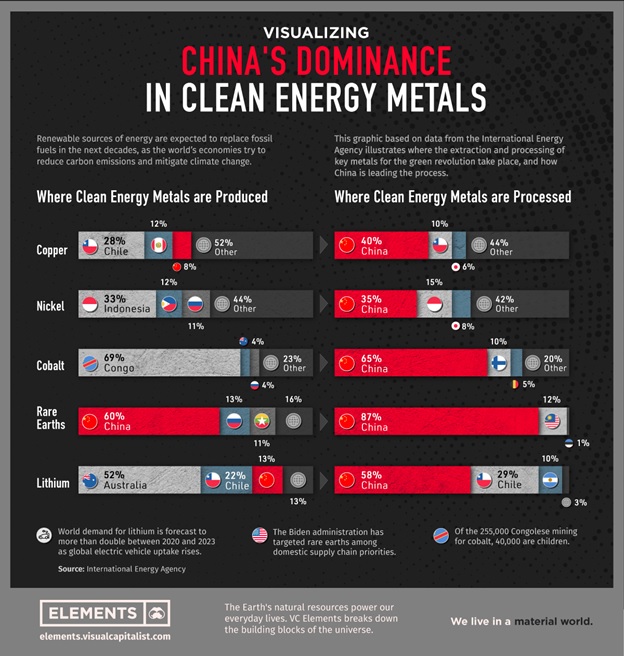
  • Although China is a major source of key metals used in clean energy, it dominates the processing.

(Source: Visual Capitalist)

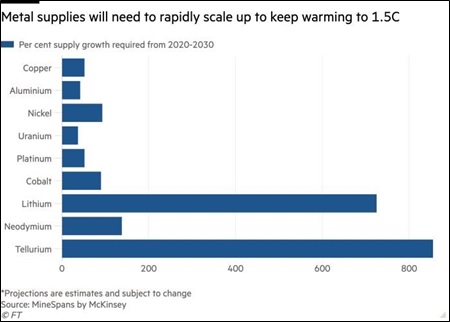
The chart below shows that demand for these metals will likely be robust, meaning that without strong investment, China will continue to dominate metals processing.  It should be noted that processing these metals can be environmentally “dirty.”  It may be difficult to process these metals in developed economies.

(Source:  FT)

  View PDF

Asset Allocation Bi-Weekly – Real Income versus the Wealth Effect; What is Driving Consumption? (January 24, 2022)

by the Asset Allocation Committee | PDF

One of the debates within economics is whether consumption is driven by income or wealth.  The outcome of this debate is important for policymakers; if the goal of policy is lifting or constraining growth, knowing which factor is more important to consumption is critical.  For example, if the goal is lifting economic activity and incomes are more important to consumption, transfer payments and tax cuts to lower-income households would be effective.  On the other hand, if the wealth effect[1] has a stronger impact, the same goal might be better achieved with capital gains tax cuts and interest rate reductions.

Until the mid-1990s, the evidence strongly suggested that income was much more important than the wealth effect.  But, since the mid-1990s, consumption has been much more sensitive to net worth.

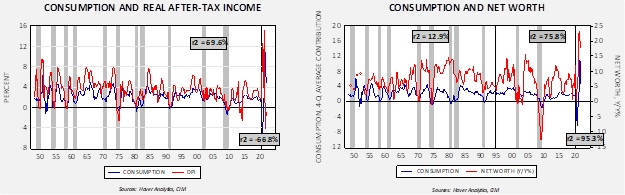
We measure consumption by the contribution to real GDP on a rolling four-quarter basis.  Disposable real income is the yearly change to overall income on an inflation-adjusted basis on an after-tax basis.  Net worth is the yearly change in assets less liabilities.  From 1947 through 2019, the correlation between consumption and real disposable income was 69.6%.  Comparing that to the impact of net worth, from 1947 through 1994, changes in net worth had only a modest positive impact on consumption; the two variables only were correlated by 12.9%.  However, from 1995 through 2019, the correlation jumped to 75.8%.

Why did net worth become more important to consumption?  We suspect there were at least two significant factors that changed the impact of the wealth effect.  The first was the expansion of defined contribution pension plans.  Households rarely saw the wealth they were accumulating under defined benefit plans.  Only at retirement would they see what they would receive from their years of saving.  Thus, rarely did they have knowledge of their accumulating wealth.  But, under defined contribution plans, households could easily see the wealth they were accumulating.  As a result of the bull markets in stocks and bonds in the 1990s, households felt “richer” and thus adjusted their spending to their expanding retirement accounts.  Second, for most households, the largest asset they hold is their homes.

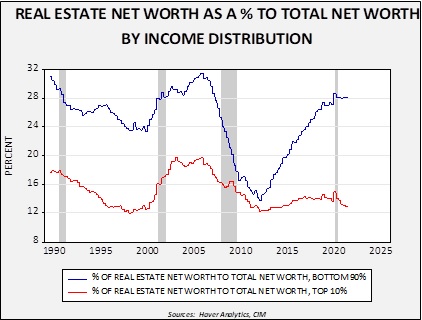
This chart shows real estate net worth compared to total net worth for the top 10% of households in the income distribution compared to the bottom 90%.  Note that 90% of households have a much higher percentage of their net worth tied to residential real estate.

Until the mid-1980s, it was difficult to access the wealth in a home until the financial services industry made refinancing a simpler process.  The ability to tap home equity is partly related to home prices.  Although amortization will gradually increase the homeowner’s share of equity, immediate changes in home prices would have a bigger impact on the net worth from real estate.  And, since in the early years of a mortgage most of a mortgage payment is applied to interest, weakening home values can have a detrimental impact on the wealth effect.  Mortgage lending is leveraged; a “prudent” loan is 80% loan to value, so small changes in home prices can have outsized effects on the net worth of the bottom 90% of households.


Returning to the first chart, we have isolated the period after the pandemic.  What is remarkable is that the relationship between real disposable income and consumption has become negative; this is likely a fluke, a function of a rapid increase in income in the form of transfer payments at a time when spending was limited due to the pandemic.  As more goods and services became available, spending has recovered.  Meanwhile, fewer transfer payments have led to falling real disposable income.  This situation will eventually normalize but still suggests that, in the short run, policies that affect real disposable income may not have much impact on consumption.  At the same time, the relationship between net worth and consumption has risen to 95.3%.  This rise may represent the fact that the aforementioned savings found a home in the asset markets.  This outcome, too, may be a decline to pre-pandemic levels, but we expect the relationship to remain strong.


Although the current relationships between real disposable income, net worth, and consumption may be temporary, for now, we can only assume they will remain dominant.  This means that policymakers face a potential risk as they move to tighten policy.  If rising interest rates weaken asset markets, the impact on consumption could be stronger than expected.  It might even lead investors to hold even more liquidity in part due to (a) fears of further declines in asset values and (b) due to the higher compensation for holding cash.  Given that 90% of households will probably be more sensitive to home prices, actions that affect home values may have an unexpectedly large impact on economic behavior.


Although our outlook for 2022 assumed no rate hikes, comments from FOMC members suggest our position is probably wrong, and policy tightening is coming.  We will be watching the path of home prices especially, but asset prices in general, to gauge the effects on consumption.  Given the FOMC’s sensitivity to asset prices, weakness in housing prices or equities could cool the ardor to tighten policy.

View PDF


[1] The wealth effect measures how much consumption is affected by changes in net worth.

Weekly Energy Update (January 21, 2022)

by Bill O’Grady, Thomas Wash, and Patrick Fearon-Hernandez, CFA | PDF

Since troughing in early December, oil prices have been steadily rising due to tightening supplies.  We are approaching the highs set in November.

(Source: Barchart.com)

Crude oil inventories unexpectedly rose 0.5 mb compared to a 2.0 mb draw forecast.  The SPR declined 1.3 mb, meaning the net draw was 0.7 mb.

In the details, U.S. crude oil production was unchanged at 11.7 mbpd.  Exports and imports both rose 0.7 mbpd.  Refining activity fell 0.3%.

(Sources: DOE, CIM)

This chart shows the seasonal pattern for crude oil inventories.  This week’s report shows a pattern consistent with average and last year.

Based on our oil inventory/price model, fair value is $70.04; using the euro/price model, fair value is $54.12.  The combined model, a broader analysis of the oil price, generates a fair value of $62.32.  Current prices exceed our model projections, but price momentum is likely to push prices higher.

Market news:

  • Oil prices have surged recently.  The combination of tight supplies, rising demand, and geopolitical tensions are all conspiring to move prices higher.  So far, the supply response has been modest, which means that price volatility remains elevated.  However, we are starting to see some rumblings of supply from the U.S. shale sector.  Other production areas remain stagnant, likely worried about stranded investment.
  • Disinvestment has weighed on the energy sector, but recent comments from some major financial firms suggest the trend isn’t universal.  One issue that has been raised is that divestment could simply shift production from publicly held to privately held firms that may have lower environmental standards.  Essentially, the idea of reducing fossil fuel use by supply restrictions may not solve the problem and may cause higher prices and little environmental improvement.
  • The recovery in energy demand in 2021 has led to higher emissions.

Geopolitical news:

Alternative energy/policy news:

  • The key to expanding the EV market is batteries.  Not only do supplies need to increase, but the technology will likely need to improve.  Solid-state batteries hold the promise of quicker charging and a farther range.  QuantumScape (QS, USD, 18.48) announced a plan to build batteries for stationary applications, e.g., storage for wind and solar.
  • Transportation is not the only area where reducing carbon emissions is important.  Cement and steel are also large emitters.  There has been some recent progress in producing “green steel.”
  • Although there is some debate on the issue of climate change and the best way to address it, one area we watch closely is the behavior of insurers.  If insurance providers require various steps to be taken before providing coverage, or simply decide not to provide coverage at all, changes in economic activity will result.  It is possible the decisions made by insurance companies may lead to changes to address climate change.  Along with banks, decisions from the finance industry could have a bigger impact than regulation.

  View PDF

Weekly Energy Update (January 13, 2022)

by Bill O’Grady, Thomas Wash, and Patrick Fearon-Hernandez, CFA | PDF

Since troughing in early December, oil prices have been steadily rising due to tightening supplies.  We are approaching the highs set in November.

(Source: Barchart.com)

Crude oil inventories fell 4.6 mb compared to a 1.7 mb draw forecast.  The SPR declined 0.3 mb, meaning the net draw was 4.9 mb.

In the details, U.S. crude oil production declined 0.1 mbpd at 11.7 mbpd.  Exports fell 0.6 mbpd, while imports rose 0.2 mbpd.  Refining activity unexpectedly fell 1.4%.

(Sources: DOE, CIM)

This chart shows the seasonal pattern for crude oil inventories.  This week, we reset the chart for 2022, adding 2021 as a reference.  The key element to watch is to determine whether inventories follow the usual seasonal pattern, repeat last year’s path.

Based on our oil inventory/price model, fair value is $70.20; using the euro/price model, fair value is $53.68.  The combined model, a broader analysis of the oil price, generates a fair value of $62.18.  Current prices exceed our model projections, but price momentum is likely to push prices higher.

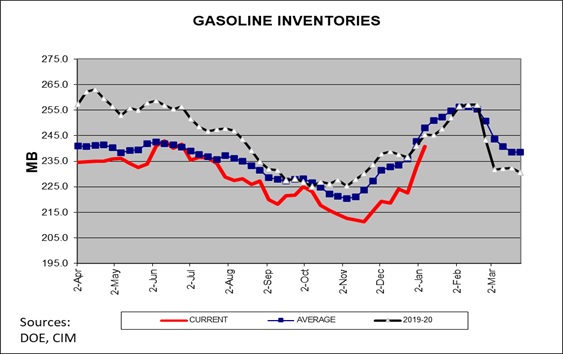
Although gasoline inventories have been rising rapidly, we note the rise is consistent with seasonal patterns.

We would expect gasoline stockpiles to rise another 12-15 mb by early February.

 Market news:

Geopolitical news:

Alternative energy/policy news:

  • The transportation sector is working to boost fuel efficiency to control costs and reduce carbon emissions.  One experiment is that ships are deploying kites to allow wind energy to reduce fuel consumption.
  • EVs are becoming more popular; one reason is that automakers are beginning to electrify pickup trucks.
    • A recent Deloitte report details that Japan and South Korea are leading the world in consumer attitudes in favor of EVs or other alternative vehicles.
  • Germany has closed three of its six remaining nuclear power plants.
  • One theme we have been watching is the oil to metals trend in electrifying the transportation sector.  BHP (BHP, USD, 66.58) is making a major investment in Tanzania to secure nickel supplies.

  View PDF

Asset Allocation Bi-Weekly – The Path of Monetary Policy (January 10, 2022)

by the Asset Allocation Committee | PDF

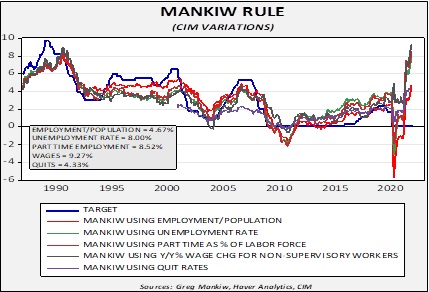
Our expectation of no policy rate hikes this year is an out-of-consensus call in our 2022 Outlook: The Year of Fat Tails.  There are a couple of factors that suggest rate hikes this year.  First, financial markets have factored in rate hikes.  Fed funds futures suggest a greater than 50% likelihood of a rate hike beginning with the March 2022 meeting and have discounted the same likelihood for four 25 bps rate hikes by December.   Second, the Mankiw Rule, a derivation of the Taylor Rule, indicates the FOMC is hopelessly behind the curve in terms of rate hikes.

We have created five variations of the Mankiw rule, which calculates a fair value policy rate from core CPI and various measures of the labor market.  The most conservative measure puts the recommended fed funds rate at 4.33%; the most radical is 9.27%.

So, given this strong evidence, what is the argument for steady policy?    Part of the reason the Mankiw variations are so high is due to elevated inflation.  Base effects alone should lead to lower readings on inflation by mid-year, which should cool the impetus for policy tightening.  Although the labor markets show signs of being tight, the labor force remains well below pre-pandemic levels.  It may give FOMC members pause, worried that tightening could be premature.

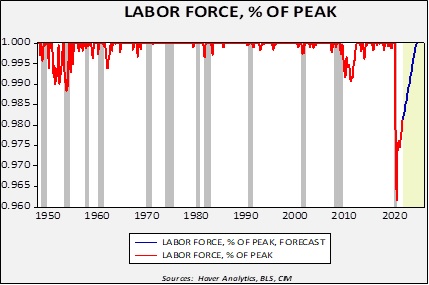
This chart compares the three-month average of the labor force relative to its most recent peak.  The drop in the labor force seen during the pandemic was unprecedented in the post-war era.  It is uncertain whether the labor market has been permanently impaired by the pandemic.  It may never return to pre-pandemic levels.  It is also possible that as the pandemic steadily shifts to endemic, workers will return.  Thus, tightening could prematurely put this return at risk.

Another characteristic of the FOMC since Greenspan has been the attention paid to financial markets.  The concept of the “Greenspan put,” which has been attributed to every Fed chair since Greenspan, suggests a pattern where monetary policy is eased to quell turmoil in financial markets.

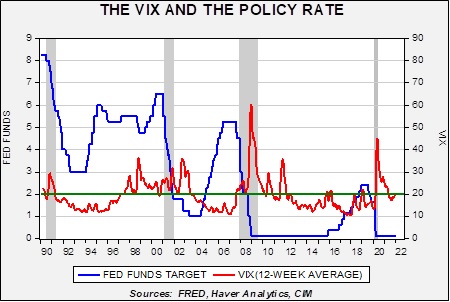
One clear measure of financial stress is the VIX, which measures the implied volatility of the S&P 500.  In general, the FOMC tends to avoid tightening when the 12-week average of the VIX is above 20.  For example, after the Fed raised rates in late 2015, policy remained on hold until the VIX fell decidedly.  With the VIX currently holding around 20, we expect the FOMC to delay any moves to raise rates until market volatility eases.

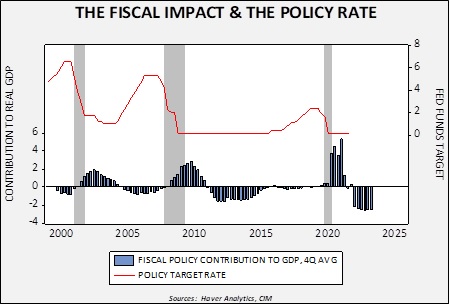
Finally, we suspect financial markets are underappreciating the degree of fiscal tightening that will occur this year.

Fiscal spending during the pandemic was extraordinary.  However, as that support winds down, it will act as a drag on economic growth.  If the FOMC tightens into this austerity, economic growth could weaken more than expected.  The consensus real GDP growth for 2022 is 3.9%.  That could be at risk if the Fed tightens into falling fiscal support.

Obviously, we could be wrong on our monetary policy call, and if we are, we will adjust.  For now, we think there is a case that the market is overestimating the degree of monetary policy tightening that will occur.  If we are correct, it’s likely supportive for equities, short-duration fixed income, commodities, and bearish for the dollar.

View PDF