

Daily Comment (February 26, 2026)

by Patrick Fearon-Hernandez, CFA, and Thomas Wash

[Posted: 9:30 AM ET] | PDF

Our Comment opens with an analysis of the market’s reaction to Nvidia’s earnings before turning to the ongoing negotiations between the US and Iran. We continue with a brief overview of the Cuban attack on a US-registered vessel, the White House’s push to advance the president’s retirement proposal, and our take on the Texas primary. We conclude with a summary of key economic data from US and global markets.

AI Uncertainty: Despite another strong quarter, Nvidia’s results did little to dispel lingering concerns about the AI trade. The chipmaker reported quarterly revenue of $68.1 billion, topping expectations of $66.2 billion, and guided to $78 billion for the current quarter, well above the consensus of $72.1 billion. The stock initially moved higher on the news but quickly gave back gains, underscoring persistent worries about the broader AI and semiconductor sector.

  • The market continues to closely track Nvidia, whose semiconductors remain in heavy demand among the major players driving the AI boom. Investors view the company’s performance as a key gauge of capital expenditure trends across the industry. During the quarter, Microsoft, Google, Amazon, and Meta collectively announced plans to invest around $650 billion in coming years. The sheer scale of these commitments has become a central source of market anxiety over the sustainability of AI‑related spending.
  • The shift in sentiment underscores a marked change in how markets view tech firms, from a “build, baby, build” mentality to a “show me the money” mindset. Investors, once content with ambitious growth narratives, are now scrutinizing the massive capital commitments big tech has made to AI infrastructure and other long-horizon projects. The focus has turned to how quickly these investments can deliver measurable, durable returns, especially amid rising political and regulatory pushback.
  • Although Nvidia recently caught a break after the White House approved limited sales of some H200 chips to China, other tech companies may soon face fresh headwinds. President Trump is reportedly preparing to require major tech firms to pledge to supply their own energy for data centers. While this move could help defuse political backlash over the sector’s heavy resource usage, it would also likely push project costs higher by forcing companies to invest more heavily in dedicated power infrastructure.
  • Given the significant demand for AI, which shows no signs of abating, and with optimism in the sector beginning to reaccelerate, the underlying growth story remains intact. However, this renewed momentum is accompanied by considerable uncertainty, suggesting that volatility will remain a defining feature of the market. In this environment, investors may benefit from adding selective international exposure to help balance regional risks and reduce concentration within their portfolios.

Iran-US talks: As the March 1-6 deadline for an agreement with Iran approaches, the two sides appear to be moving closer to a deal. Reports on Thursday indicated that negotiators were holding a third round of indirect talks in Geneva, with Oman acting as mediator. The discussions remain tense, with each side pressing for additional concessions while seeking to avoid open conflict. Financial markets have been closely tracking the negotiations to assess the likelihood of a broader war and its potential impact on asset prices.

  • Going into the latest round of talks, Iran appears to believe it has already shown sufficient flexibility for a deal to be reached in the coming days. A representative of the Iranian delegation has reiterated that the country intends to maintain its uranium enrichment program for peaceful purposes. However, Iran is reportedly willing to make significant economic concessions, including potential investments in the US in areas such as oil, mining, and aircraft purchases, in an effort to secure an agreement.
  • That said, the United States appears determined to secure as many concessions as possible and to ensure that any agreement has real staying power. US officials continue to press for limits on Iran’s ballistic missile program, despite Tehran’s resistance. Meanwhile, White House envoy Steve Witkoff has indicated that he wants any deal to avoid a “sunset clause” that would allow key provisions to lapse over time, a feature that was widely criticized in the 2015 Iran agreement.
  • Although talks are ongoing, there is a growing sense in the markets that conflict remains a real possibility. The United States has deployed more than 150 aircraft to bases in Europe and the Middle East, in what officials describe as the largest regional buildup since the 2003 Iraq war. At the same time, Iran has warned that it is prepared to retaliate both militarily and through asymmetric means, including potential cyberattacks, if it is targeted by a US strike.
  • Our base case remains one of cautious optimism, assuming that geopolitical tensions ultimately will deescalate. Nevertheless, the risk of a direct conflict cannot be ruled out. In the near term, this backdrop is likely to favor commodity markets, supporting energy and precious metals. Conversely, meaningful deescalation would likely see that premium unwind, allowing prices to normalize. In this context, we continue to advocate for maintaining gold exposure in portfolios as a hedge against geopolitical uncertainty.

Cuba Strikes: Cuban forces shot and killed several passengers on a US registered speedboat headed for the island. According to Cuban security officials, the confrontation began when border patrol agents approached the vessel and the passengers opened fire. The United States has launched an investigation to verify Cuba’s account of the incident. The episode threatens to raise tensions between the two nations as the US continues to pressure the Cuban government into negotiations regarding its regime.

New Retirement Plan: US Treasury Secretary Scott Bessent on Wednesday provided further details on the White House’s new retirement proposal. He indicated that the president’s plan to extend to all Americans access to the type of retirement accounts currently available to federal workers could be advanced through the budget reconciliation process, allowing it to pass the Senate with a simple majority. If enacted, the measure would likely expand market participation which could support equity prices.

Texas Primary: The largest red state is emerging as one of the most consequential Senate battlegrounds of the midterm cycle. Incumbent John Cornyn now trails Ken Paxton in the Republican primary, while Representative Jasmine Crockett leads State Senator James Talarico on the Democratic side. Cornyn would likely be favored in a general election, but a primary loss could suddenly put a traditionally safe Republican seat in play and reshape the broader battle for Senate control.
View PDF

Asset Allocation Bi-Weekly – The ECB Dilemma (July 11, 2022)

by the Asset Allocation Committee | PDF

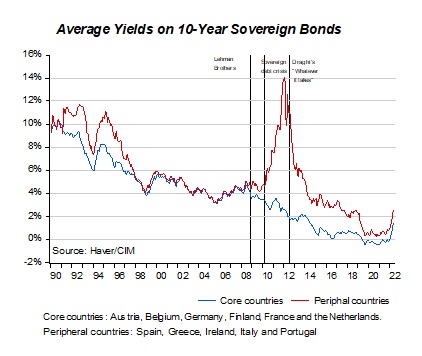
When the Eurozone project began, investors assumed that the credit risk for individual countries would be shared equally among the group’s members. This notion unraveled after the collapse of Lehman Brothers set off a chain of events that triggered the European Sovereign Debt Crisis in 2010. As the chart below shows, the average yield on 10-year sovereign bonds for peripheral and core countries was nearly the same from 1998 to 2008. Thereafter, interest rates diverged as investors realized that core governments would not bail out peripheral countries if they ran into trouble. Following Mario Draghi’s “whatever it takes” speech, in which he reassured investors that the ECB was willing to intervene in markets to prevent yield spreads from widening, bond spreads started to converge. However, the fundamental issue of who will ensure the credit risk of peripheral countries was never actually addressed.

By purchasing bonds and expanding its balance sheet, the ECB was able to place a cap on bond yields. Although this measure disproportionately benefits peripheral countries, the action is a form of monetary stimulus, which can increase inflation. Initially, when the ECB implemented its bond purchasing program, inflation was well below its 2% target, making its decision relatively risk-free. However, now that inflation has hit 8% for the first time in the Eurozone’s history, continuing the program may contribute to the price pressures. In short, the ECB is using the same tool to fight two contending issues. As a result, the central bank has to choose between containing inflation or allowing financial fragmentation. Nobel-winning economist Jan Tinbergen predicted this dilemma when he posited that a central bank would need an equal number of policy tools to tackle an equal number of policy problems.

Following the market’s reaction to its decision to tighten monetary policy, which saw yield spreads widen, the ECB announced it had created a new anti-fragmentation tool. The bank is expected to reinvest maturing bonds from its pandemic emergency purchase program on its balance sheet, but it isn’t clear how this mechanism could work. Theoretically, they could use the funds to invest only in periphery countries, but this would likely anger core European countries like Germany, who would interpret the move as a bailout. Another possibility is that the ECB uses an updated version of Outright Monetary Transactions (OMT). This action would allow the central bank to purchase the bonds of vulnerable countries in the secondary market on the condition they meet specific fiscal guidelines, a requirement that could trigger a political backlash in the periphery nations. The central bank is expected to iron out the details of the anti-fragmentation tool at its July 21 meeting.

Although the recent narrowing of the interest spread between Italian and German 10-year bonds suggests that the market has confidence the bank will come to a satisfactory resolution, we remain skeptical. The ECB has an explicit goal to maintain price stability and an implicit aim of preserving the Eurozone. Neither choice has a desirable outcome. If it tackles inflation, investors will push up the borrowing cost for peripheral countries like Italy. The rise in borrowing costs could trigger a fiscal crisis and force a government to abandon the euro. On the other hand, if it chooses to keep bond spreads narrow to preserve the euro, it may risk raising inflation expectations along with higher inflation. The most likely outcome of this uncertainty is euro weakness.

View PDF

Weekly Energy Update (June 30, 2022)

by Bill O’Grady, Thomas Wash, and Patrick Fearon-Hernandez, CFA | PDF

(N.B.=> due to Independence Day, the next report will be issued on July 14.)

The DOE has resolved its systems issues and released weekly data for 6/17/22 and 6/24/22.  We update the data below.

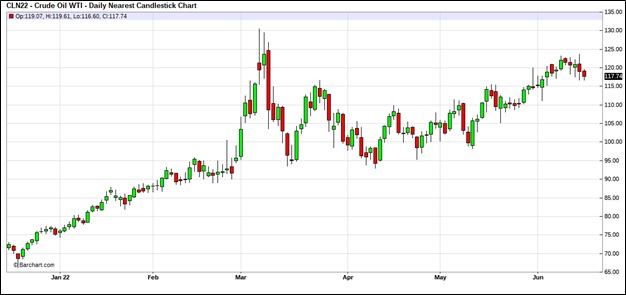
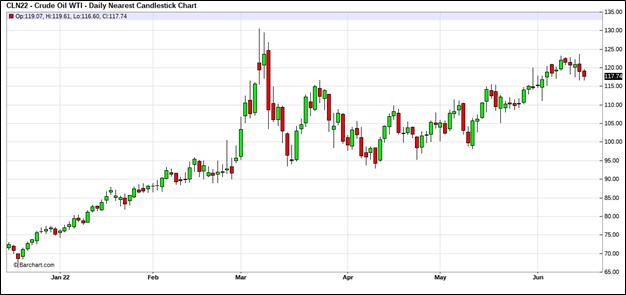
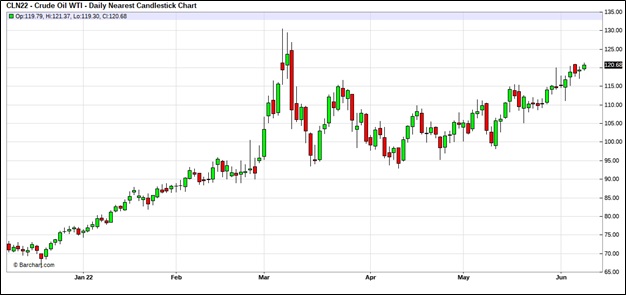
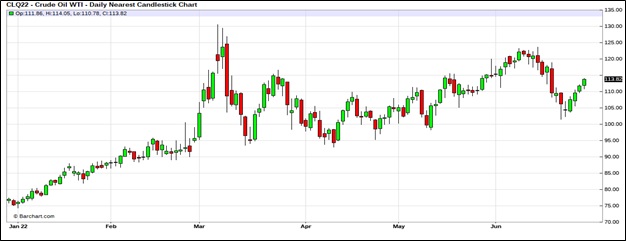
After a sharp correction on recession worries, crude oil prices are recovering.

(Source: Barchart.com)

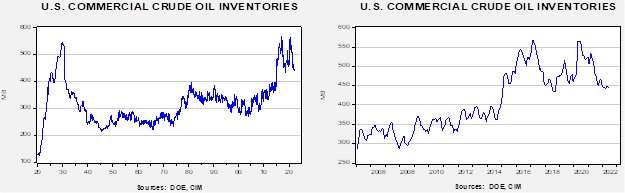
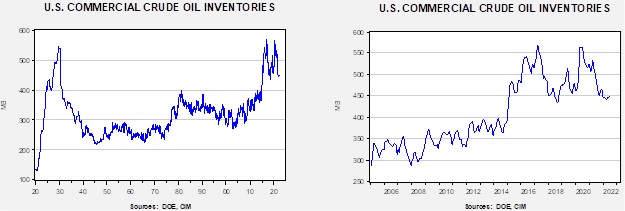
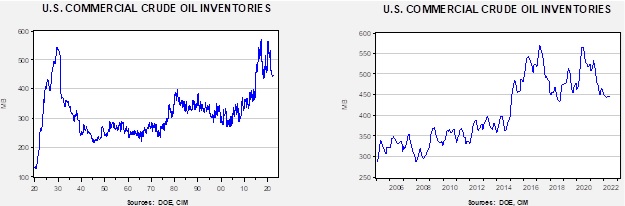
Crude oil inventories fell 2.8 mb compared to a 1.0 mb draw forecast.  The SPR declined 7.0 mb, meaning the net draw was 9.8 mb.

In the details, U.S. crude oil production rose from 0.1 mbpd to 12.1 mbpd.  Exports and imports both fell 0.2 mbpd.  Refining activity rose 1.0% to 95.0% of capacity.

(Sources: DOE, CIM)

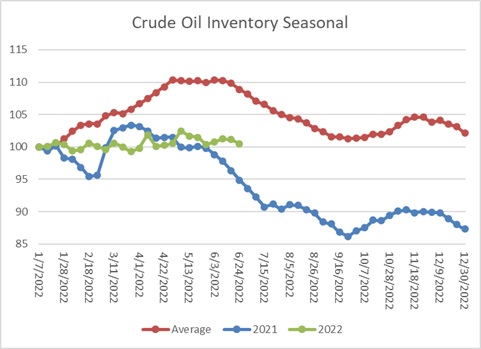
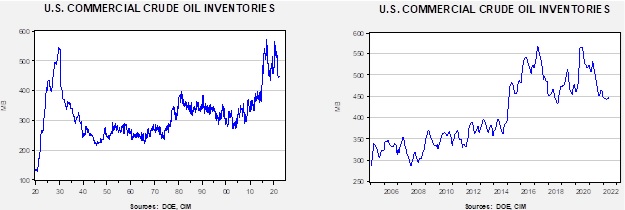
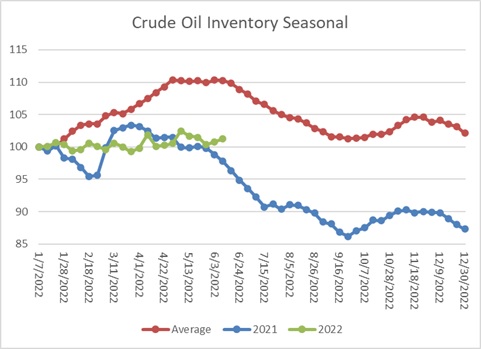
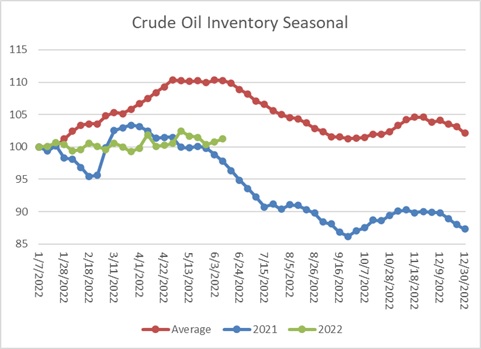
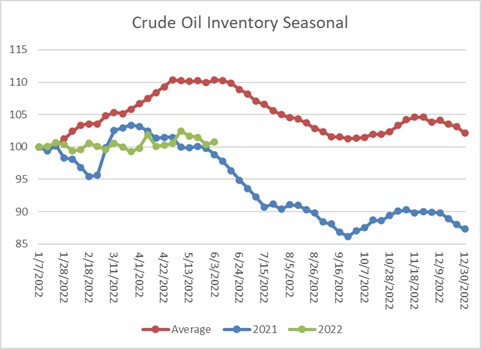
The above chart shows the seasonal pattern for crude oil inventories.  This week’s report hints we are starting the usual seasonal decline in inventory that should last into early September.  We are not seeing declines similar to last year but something more like the average path.

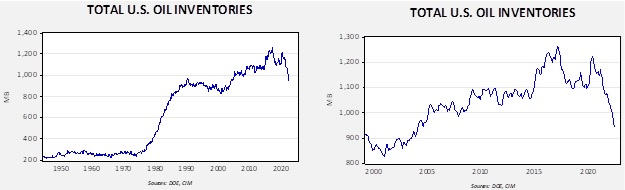
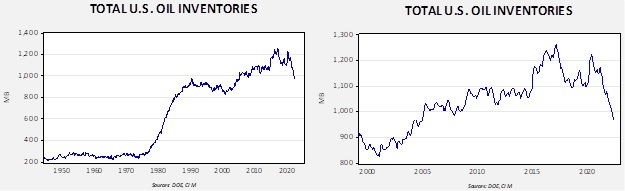
Since the SPR is being used, to some extent, as a buffer stock, we have constructed oil inventory charts incorporating both the SPR and commercial inventories.

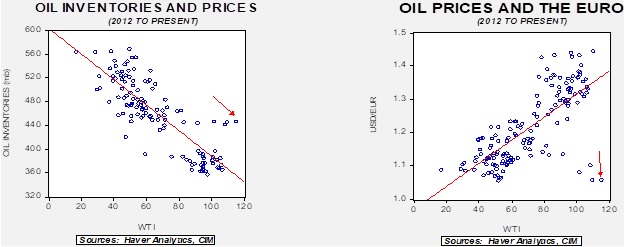
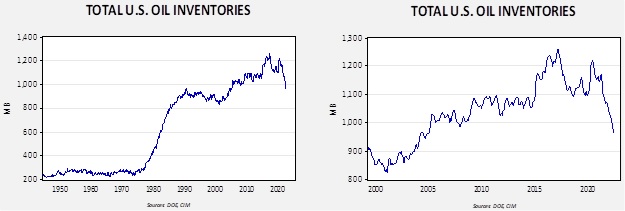
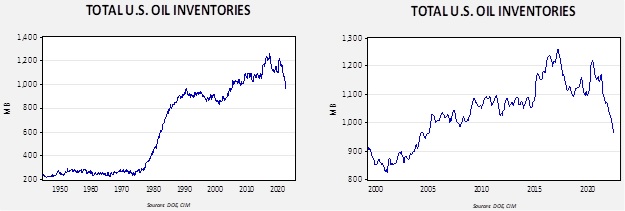
Total stockpiles peaked in 2017 and are now at levels seen in 2004.  Using total stocks since 2015, fair value is $100.86.

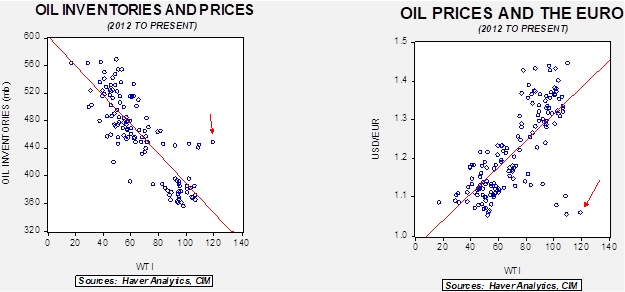
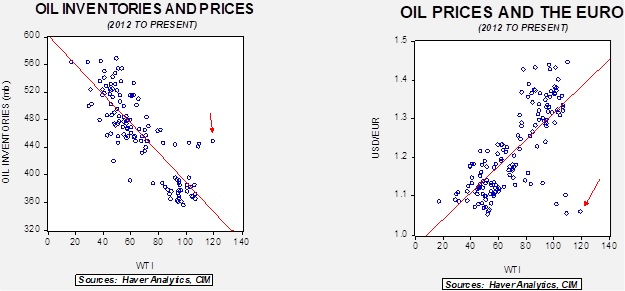
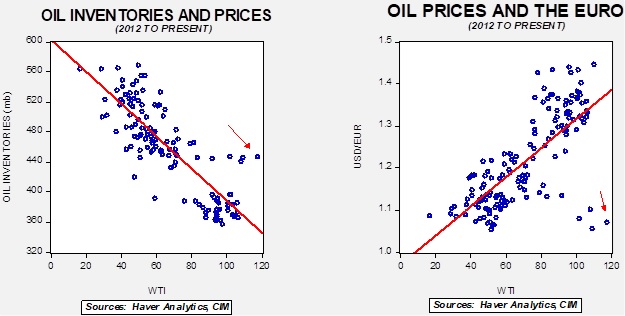
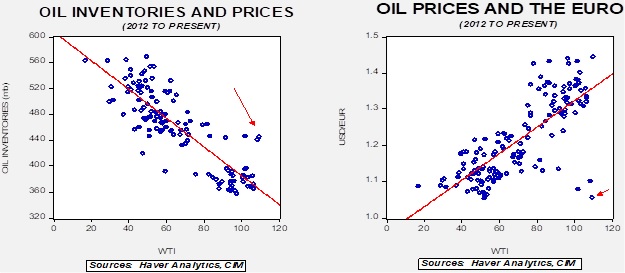
With so many crosscurrents in the oil markets, we see some degree of normalization.  The inventory/EUR model suggests oil prices should be around $65 per barrel, so we are seeing about $50 of risk premium in the market.

 Market news:

  • Last week, Energy Secretary Granholm met with energy executives. Although the runup to the meeting suggested a “woodshed” moment, in reality, the government really can’t do much to get more product supply to market.  Refineries are running around 95% of capacity, and short of nationalizing the industry and running at a loss, there isn’t much that can be done to ease prices.  It seems the meeting was cordial.  Perhaps the administration realizes (finally!) that lambasting the industry isn’t conducive to cooperation.
    • In a sense, the administration wants the oil and gas industry to expand furiously in the short run, only to strand the assets in the long run. That isn’t likely to work.
    • The White House has proposed a gas tax holiday for the summer. Not surprisingly, Congress seems unlikely to act.  Cutting the tax only to reinstate it in September, about nine weeks before the midterms, won’t be attractive to any incumbent facing election.
    • It’s not just high crude oil prices that have boosted gasoline prices; high corn prices have also boosted ethanol costs..
    • When an oil well is drilled, it is unusual to completely drain all the available hydrocarbons. Most of the oil is tapped through natural pressure.  As pressures fall, oil companies have various techniques to further pull oil out of the ground.  Water and carbon dioxide injections are commonly used to “enhance” production.  Even shale oil is, in a sense, derived from a technique to further wring oil out of existing fields.  Now, oil companies are “re-fracking” existing frack wells to pull out more oil.  This process has lower costs, in part, because all the well infrastructure is in place.
  • The Dallas FRB has released its Q2 survey of oil and gas firms in its district. The key takeaway—94% of firms report they are suffering from supply chain issues, and nearly 70% don’t see them getting resolved in less than a year.  The biggest shortages are in equipment and personnel.
  • The DOE estimates the global excess capacity for crude oil is below four mbpd. French President Macron says that the leaders of the UAE and KSA have told him their ability to expand production is severely limited.  Javier Blas of Bloomberg examines the notion that Saudi Aramco (2222, SAR, 39.20) can actually sustain production at 12.0 mbpd.  The level hasn’t been tested in a while, and, quietly, some officials suggest this number may represent a temporary peak, but it’s not a sustainable level.
  • The European Parliament is considering a plan that would obligate EU nations to fill their natural gas storage to a level of 80% by winter. As supply turmoil continues, various EU nations are calling on European consumers to reduce consumption now to allow for a supply replenishment.
  • Although the public usually believes “oil is oil,” in reality, there are differences. In general, oil is either heavy or light, sour or sweet.  The first group refers to viscosity; some oil flows easily (shale oil, for example) while others are thick (Canadian tar sands, Venezuelan Orinoco).  The second group refers to sulfur contents.  Refineries tend to specialize in these differences.  A refinery constructed to refine sweet/light won’t easily be able to process sour/heavy.  Over the past 20 years, U.S. refineries increasingly invested in the ability to process heavy/sour crude oil on the idea that as production dwindled, the most plentiful oil would be of that grade.  Shale oil upended that forecast, which is why the U.S. mainly exports shale oil and imports heavy/sour crude.  The SPR has both types, but in the most recent release, the government has primarily been selling the heavier/sour grades, which U.S. refineries can process most efficiently.  It is estimated that at the end of October, when this phase of the SPR release ends, the U.S. will only have 179 mb of the heavier/sour crude oilThis will make the SPR a much less effective price buffer going forward.

 Geopolitical news:

  • The G-7 is meeting this week to discuss the Ukraine situation and the energy crisis. As we note below, the climate change agenda has clearly taken a back seat to trying to avoid an energy crisis.  The G-7 has made this switch abundantly clear.  The group admits fostering new investment in oil, gas, and coal may be necessary.
  • Although the EU continues to try to revive the Iran nuclear deal, we still contend the odds of success are nil. Still, our take isn’t curbing the desire of the EU to make a deal.  To some extent, the Biden administration seemed to want this, too, although we have doubted the president really wants to use political capital for this mission.  We note Special Envoy Robert Malley is traveling to Qatar to engage in backchannel discussions with Tehran. The main sticking points remain.  Iran wants guarantees that a future administration will not renege on this arrangement (which is not possible as an administration cannot easily bind a future one), and Iran wants the Islamic Revolutionary Guard Corps removed from the U.S. designation as a Foreign Terrorist organization (which would be politically costly for the Biden administration).
  • Meanwhile, there are increasing worries that Israel, backed by its new partners in the Abraham Accords, may attack Iran’s nuclear facilities. Israel successfully destroyed nuclear facilities in Iraq and Syria, but the hardened facilities in Iran were thought to be strong enough to prevent Israel from successfully doing the same.  However, that was before Israel was allied with the Persian Gulf states.  Earlier assessments assumed Israeli warplanes would fly from Israel across semi-hostile territory to strike Iran.  The length of the trip would limit the number of sorties and reduce the chances of success, but if Israel’s warplanes could use bases in the Persian Gulf states, it is likely there would be multiple days, if not weeks, of air operations.  Of course, if the Persian Gulf states cooperated with Israel, it would open them up to Iranian retaliation.  So far, energy markets are mostly ignoring this risk.  Given the political risks that President Biden is taking by traveling to the region, we suspect that the war situation may be the reason for the visit.
  • South America is facing turmoil caused by the energy situation:

 Alternative energy/policy news:

  View PDF


[1] Strictly speaking, the BIRC isn’t a formal organization, so it isn’t obvious how one “applies.”

Asset Allocation Bi-Weekly – The Selling of Austerity (June 27, 2022)

by the Asset Allocation Committee | PDF

Politics is the art of the possible…

Otto Von Bismarck

Although there have been attempts to treat it as a science (hence the study of political science), the necessary art of politics is to convince people to accept policies that may be contrary to their best interest.  This quote sums up the problem succinctly.

We all know what to do, but we don’t know how to get re-elected once we have done it.

Jean-Claude Juncker

Policy actions are sold.  Merely telling the public that a difficult policy mix is necessary doesn’t work very well.  So, policymakers create narratives to justify and explain why something difficult won’t be all that bad or won’t affect anyone you know.  For example, higher taxes on upper-income households are packaged as “paying one’s fair share.”  Windfall profit taxes are there to “share the pain.”

The Federal Reserve faces a similar problem.  Merely indicating that policy needs to be tightened is unpopular.  So, major policy changes must be couched in a manner that the public will accept.  Alan Greenspan realized that monetary policy could reduce equity prices; in 1996, he hinted, with the term “irrational exuberance,” that equity prices were too strong relative to earnings.  The blowback was severe enough that he never mentioned it again.  Federal Reserve policy on this topic is that market bubbles cannot be determined in real-time, and if one occurs, it is easier to address the damage afterward.[1]

Another example is Paul Volcker’s shift to money supply targeting from interest rate targeting.  Money supply targeting allowed the Fed to raise rates to unprecedented levels.  Targeting a 19.1% fed funds rate (for the record, in June 1981) would have been impossible politically.  But having that rate occur “naturally” by constraining the money supply led to the necessary outcome in a politically possible manner.

We may be seeing the Powell Fed attempting something similar.  Although the Philips Curve has been mostly disavowed by the Fed, in reality, the spirit of the relationship remains; to contain inflation, the Fed has to slow the economy down enough to create slack in the economy.  In simple terms, it means the Fed must create unemployment to bring inflation down.  Even under conditions of low unemployment, such a policy is politically unpalatable.

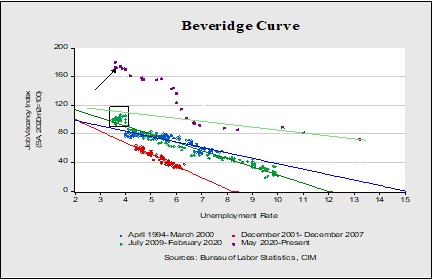
So, both Chair Powell and Governor Waller have suggested that instead of raising unemployment, it may be possible to reduce the “froth” in the labor markets by decreasing the number of job openings.  That idea is tied to a concept called the “Beveridge Curve.”

The Beveridge Curve looks at the relationship between job openings and unemployment.  This curve attempts to show the efficiency between job openings and filling those openings.  In general, moving away from the origin suggests less efficiency.  The slope of the curve is also important.  A flatter slope suggests greater efficiency because it takes relatively fewer job openings to lower unemployment.  We have created curves for the last four business cycles, starting in 1994.  After the 2001 recession, the efficiency of the labor market improved as the curve moved toward the origin.  Although, the slope did steepen.  In the expansion of 2009 through 2020, efficiency fell.  That was offset partially by a flatter slope.

The points in the box show the end of the last expansion.  Note how the slope essentially steepened.  As job openings rose, it became harder to fill them.  And then the pandemic hit.  The current curve has steepened dramatically; the most recent data point is shown with an arrow.  Essentially, the Powell/Waller position is that wage pressures could ease if openings fell back to the slope of the green line running from 2020 into early 2021.  In other words, we could see slack develop without a significant rise in the unemployment rate.  Waller argues that if hiring efficiency improves, we might be able to ease inflation pressures without a recession.

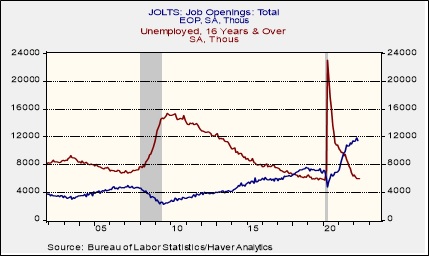
This chart is another way of looking at the data.  It measures the number of unemployed to the number of job openings.  Note that from 2018 to 2020, openings briefly exceeded the unemployed; at that time, the Beveridge curve slope started to steepen.  Pre-pandemic, the difference between the above chart and wage growth for non-supervisory workers does show a +70% positive correlation with the difference leading wage growth by about a year.  So, if job openings decline, over time, it should ease wage pressures.

However, the pandemic has upended the job market to some extent.  This event led to an increase in older workers leaving the workforce; so far, robust wages have not been enough to draw them back into the labor force.  It seems more likely that bringing down job openings will probably require some rise in unemployment.  But by focusing on job openings instead of increasing unemployment, the FOMC may buy some degree of political cover to weaken the labor market.

View PDF


[1] This is similar to Bob Uecker’s advice on how to catch a knuckleball…” wait until it stops rolling and pick it up.”

Weekly Energy Update (June 24, 2022)

by Bill O’Grady, Thomas Wash, and Patrick Fearon-Hernandez, CFA | PDF

Crude oil prices continue to rise in an orderly fashion.

(Source: Barchart.com)

Crude oil inventories rose 2.0 mb compared to a 2.0 mb draw forecast.  The SPR declined 7.7 mb, meaning the net draw was 5.8 mb.

In the details, U.S. crude oil production rose from 0.1 mbpd to 12.0 mbpd.  Exports rose 1.5 mbpd, while imports rose 0.8 mbpd.  Refining activity fell 0.5% to 93.7% of capacity.

(Sources: DOE, CIM)

The above chart shows the seasonal pattern for crude oil inventories.  This week’s report is consistent with the average pattern.  Note the average pattern shows declines into September.

Since the SPR is being used, to some extent, as a buffer stock, we have constructed oil inventory charts incorporating both the SPR and commercial inventories.

Total stockpiles peaked in 2017 and are now at levels seen in 2005.  Using total stocks since 2015, fair value is $97.79.

With so many crosscurrents in the oil markets, we see some degree of normalization.  The inventory/EUR model suggests oil prices should be around $65 per barrel, so we are seeing about $50 of risk premium in the market.

Market news:

  • Want a well-crafted primer on why the oil industry is struggling to lift production in the face of high prices? Check out this Odd Lots Podcast, as Joe Weisenthal and Tracy Alloway interview Peter Tertzakian about the hurdles in place that are preventing a greater expansion of output.  The interview makes it perfectly clear that supply problems will be with us for a long time.
  • Last week, the IEA warned that global supplies for oil will likely be tight through 2023. Perhaps the biggest issue facing oil markets is that OPEC+ may be close to producing at capacity.  Capacity numbers in OPEC+ are a mixed bag. Throughout history they have usually been inflated because the cartel used capacity data to allocate production quotas.  The higher a nation’s capacity, the more they were allowed to produce.  OPEC+ is expected to allow producers to expand output to pre-pandemic levels in August, but capacity has fallen since then.  By August, it appears only the KSA and UAE will have available capacity, perhaps about 1.6 mbpd.  However, these producers may decide it is unwise to lift output further.  For most of the oil market’s history, there has been a cartel body limiting production.  This situation has led to prices higher than would have existed in a fully free market but with less volatility due to the supply buffer.  If OPEC+ uses up all its capacity, the only buffers will be strategic reserves, which are already being used.
  • A couple of weeks ago, a fire at a U.S. LNG facility cut U.S. exports by up to 20%. Although initial reports suggested there would be a three-week outage, it now looks like full throughput won’t return until at least September.  Shortly after this news, Russia announced that gas flows to the EU would be curtailed due to the lack of repair parts, allegedly caused by sanctions.  Several European sources confirm that supplies have been reduced.  In addition, rising temperatures are boosting natural gas demand, making it difficult to build storage.
  • The EU has increased sanctions on ensuring Russian oil and gas shipments. The U.S. is becoming increasingly concerned that this measure may be too effective, reducing supplies further.  Insurance companies may not have the capital to bear the risk of sanctions, meaning shipments may simply not occur.  The Treasury is trying to “thread the needle” of ensuring adequate oil supplies while preventing Russia from benefiting.  That outcome may not be possible.
  • As high energy prices weigh on the political fortunes of the party in power, the administration is scrambling to determine ways to reduce energy costs. The Secretary of Energy met yesterday with energy executives.  A gasoline tax holiday has been proposed. Also under consideration are fuel export limits, although such measures would be a foreign policy disaster as they would force the EU and other global consumers to bear higher costs.
    • Relations between the administration and the energy sector are at a low state. The petroleum industry wants regulatory relief.  Environmentalists have been quite successful in blocking pipeline projects, in particular.  The industry wants the processes for building pipelines changed to reduce the ability of the courts to prevent expanding pipelines and other facilities.  Unfortunately, for the president, the environmental wing of the party understands that, due to the marginal cost structure of such facilities, once built, they will be used for decades.[1]  So far, the White House is trying to reduce gasoline prices by badgering the industry, most likely because it has concluded that blaming the industry is better politically than disappointing the environmental wing.
    • One oddity of the current oil market is that while U.S. refining capacity is running above 90%, China is sitting on lots of unused capacity. China manages its refineries primarily for domestic supply.  With the Chinese economy sluggish, product demand has been soft.  So far, China hasn’t shown much interest in lifting product exports.
    • U.S. gasoline prices have eased modestly, just before the July 4 weekend.

 Geopolitical news:

(Source:  Bloomberg)

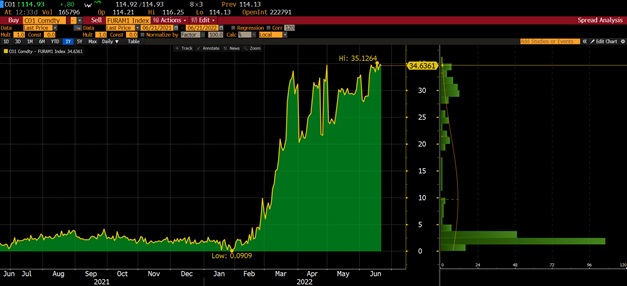
This chart shows the nearest contract for the Brent/Urals spread.  Before the war, Brent enjoyed roughly a $2 premium on Urals.  It is now around $35 per barrel and, so far, has shown little evidence of narrowing.  In general, if more buyers are able to purchase the cheaper Urals product, one would expect the price to rise, narrowing the spread.  Although we know India and China have been buyers of Russian oil, there still isn’t much evidence to suggest other buyers are participating.  In other words, we know sanctions are being violated, but for now, the degree of violation hasn’t been enough to bring lower oil prices.

Alternative energy/policy news:

  • The FAA has announced new emission rules on commercial aircraft.
  • The U.S. and several other nations have entered an agreement designed to secure critical minerals for the energy transition.
  • If wind and solar power are going to replace fossil fuels, the issue of energy storage is critical. Currently, these renewables require fossil fuel or nuclear backup capacity, requiring redundant investment.  It is becoming clear that lithium-ion batteries are probably not the best solution for this need; this report discusses other metals and batteries being tested for this role.
  • Environmental groups have used the courts to create environmental standards. That avenue is under threat from a group of state AGs.  As the U.S. pulls back from its hegemonic role, Congress may move to gain power over the regulatory apparatus.
  • The problem of sourcing key metals for batteries has created a global scramble to find supplies. One answer could be recycling; Toyota (TM, USD, 156.80) announced a partnership designed to recycle batteries from its cars.
  • The oil and gas industry is teaming up with the geothermal industry in what could prove to be an important expansion of the latter industry using the technology of the former.
  • Although the Texas-Louisiana region is a key oil and gas producing region, it will likely also become an important hub for hydrogen.

  View PDF


[1] The initial costs are high, but the marginal costs are low, meaning that once built, the throughput is cheap.

Weekly Energy Update (June 16, 2022)

by Bill O’Grady, Thomas Wash, and Patrick Fearon-Hernandez, CFA | PDF

Crude oil prices continue to rise in an orderly fashion.

(Source: Barchart.com)

Crude oil inventories rose 2.0 mb compared to a 2.0 mb draw forecast.  The SPR declined 7.7 mb, meaning the net draw was 5.8 mb.

In the details, U.S. crude oil production rose from 0.1 mbpd to 12.0 mbpd.  Exports rose 1.5 mbpd, while imports rose 0.8 mbpd.  Refining activity fell 0.5% to 93.7% of capacity.

(Sources: DOE, CIM)

The above chart shows the seasonal pattern for crude oil inventories.  This week’s report is consistent with the average pattern.  Note the average pattern shows declines into September.

Since the SPR is being used, to some extent, as a buffer stock, we have constructed oil inventory charts incorporating both the SPR and commercial inventories.

Total stockpiles peaked in 2017 and are now at levels seen in 2005.  Using total stocks since 2015, fair value is $97.79.

With so many crosscurrents in the oil markets, we see some degree of normalization.  The inventory/EUR model suggests oil prices should be around $65 per barrel, so we are seeing about $50 of risk premium in the market.

Natural Gas Update:

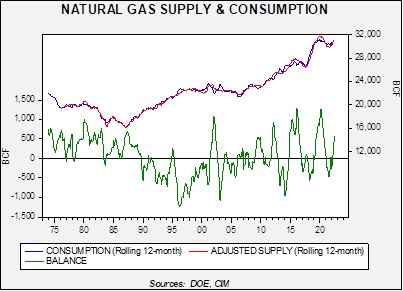
As we head into summer, we wanted to look at current natural gas fundamentals.  First, on a rolling 12-month basis, supply exceeds consumption.

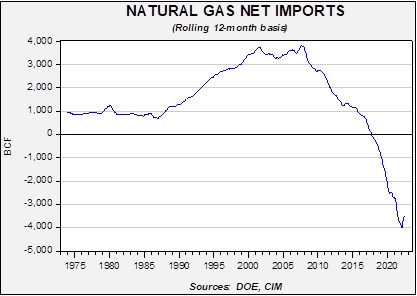
The improved supply situation for the U.S. is partly due to rising production; however, we have also seen lower exports.  Given the U.S. promises to Europe, we look for exports to rise as the summer wears on.

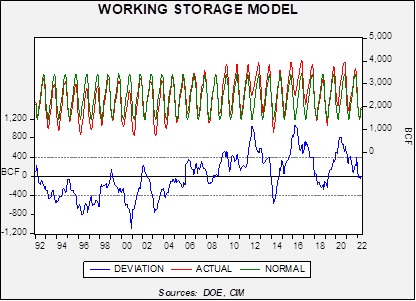
For now, inventories are balanced as we move into summer.  We are in the injection season and thus, expect inventories to rise into November.

This model compares working storage to the estimated normal level.  We will be watching this model closely over the summer.

Market news:

 Geopolitical news:

 Alternative energy/policy news:

  View PDF


[1] For background on this issue, see here and here.

Asset Allocation Bi-Weekly – Homebuilders Versus Apartment Builders (June 13, 2022)

by the Asset Allocation Committee | PDF

After two years of press reports about skyrocketing home prices, we assume investors are well aware that the housing market has been hot.  However, “housing” includes at least two main asset types: single-family homes and apartment properties.  A deep dive into the data reveals significant differences between these two submarkets in terms of their current conditions and future outlooks.  As we show in this article, the economic environment is currently worsening for the builders and sellers of single-family homes, even if the longer-term position looks bright.  In contrast, conditions look favorable for apartment owners in the near term, but they may face future problems from overbuilding.

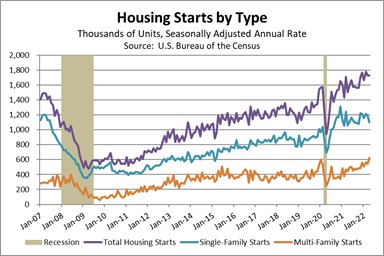
As shown by the purple line in the chart below, new U.S. home construction began to accelerate late in the previous economic expansion, around the start of 2019.  Homebuilding plunged when the pandemic hit in early 2020, but it quickly recovered and accelerated further in response to the Federal Reserve’s dramatic interest-rate cuts, the federal government’s massive fiscal support to individuals, and people’s desire for more “work from home” space.  What many people miss is that the jump in single-family home construction was a one-time event.  Groundbreakings for single-family homes jumped from an annual rate of 1.003 million just before the pandemic to a rate of 1.308 million in December 2020 but have plateaued at an average rate of 1.139 million since then (the teal line in the chart).  The situation has looked much better for multi-family developers.  Their groundbreakings were little changed in the first year after the pandemic hit, but they’ve been on a steady uptrend since early 2021 (the orange line in the chart).  In the first four months of this year, single-family housing starts were up just 4.8% from the same period one year earlier, while multi-family starts were up 27.7%.

Over the coming year or so, we think these trends will continue to diverge.  Rising mortgage interest rates and sky-high prices are already cutting into the demand for single-family homes.  Sales transactions have started to fall, and we are even seeing a slowdown in price appreciation.  These dynamics are a key reason we recently eliminated our overweight to the stock market’s Homebuilder sector in our asset allocation strategies.  At the same time, we think high prices for single-family homes and low inventories of homes for sale will keep pushing people into the apartment market, driving up rents, and prompting companies to develop many new properties.  But does that mean we’re on the hunt for investments in the apartment sector?  Not necessarily.

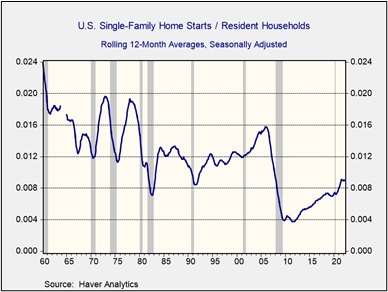
We think the longer-term outlook for single-family homebuilders remains bright despite the near-term challenges.  After all, single-family home construction in the U.S. has still not recovered from its steep drop after the housing bubble burst.  In the three decades just before that crisis, U.S. homebuilders each year broke ground for approximately 1.2 new single-family homes per 100 existing households.  By 2011, they were breaking ground for just 0.4 new homes per 100 households, and the figure only recovered to 0.9 per 100 last year (see chart below).  This implies that the U.S. has an enormous deficit of modern single-family homes.  Reaching the previous 1.2-per-100 standard now would require firms to build and sell more than 1.5 million new single-family homes this year, versus their recent pace of about 1.1 million homes.  Reaching the 1.2-per-100 standard plus making up the post-bubble shortfall over the next decade would imply building and selling about 2.5 million new homes each year.

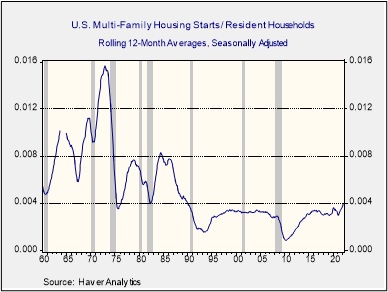
In contrast, today’s strong apartment building suggests that sector could eventually return to the overbuilding of the past, with its falling rents, reduced profitability, and weaker stock prices.  Outside of recession periods, multi-family developers over the last three decades have typically built about 0.3 apartment units per 100 households.  They are now consistently building 0.4 units per 100 households for the first time since the late 1980s (see chart below).

Admittedly, future single-family home construction could still be constrained to some extent by the new dominance of big, publicly traded homebuilders, the banking system’s strict post-bubble standards on construction loans, and challenges in finding buildable land.  The sector could also face some headwinds from demographic changes like weaker population growth, population aging, and people’s increased preference to stay in their homes longer.  Nevertheless, we think single-family homebuilders will have plenty of opportunities for profitable new business and higher stock prices once we get past the Fed’s current rate-hiking cycle and construction costs moderate again.  In contrast, the risk of apartment overbuilding and the difficulty in finding suitable apartment-focused investments discourages us from trying to jump into that sector.  We think the best strategy right now is to avoid the entire housing sector temporarily until we see a new buying opportunity in single-family homebuilders in the future.

View PDF

Weekly Energy Update (June 9, 2022)

by Bill O’Grady, Thomas Wash, and Patrick Fearon-Hernandez, CFA | PDF

Crude oil prices continue to rise in an orderly fashion.

(Source: Barchart.com)

Crude oil inventories rose 2.0 mb compared to a 3.3 mb draw forecast.  The SPR declined 7.3 mb, meaning the net draw was 5.2 mb.

In the details, U.S. crude oil production was unchanged at 11.9 mbpd.  Exports fell 1.8 mbpd, while imports fell 0.1 mbpd.  Refining activity rose 1.6% to 94.2% of capacity.

(Sources: DOE, CIM)

The above chart shows the seasonal pattern for crude oil inventories.  This week’s report is consistent with the average pattern.  However, we note that this week we had a decline in crude oil exports, which probably won’t be repeated.  Thus, we would expect a larger decline in stocks next week.

Since the SPR is being used, to some extent, as a buffer stock, we have constructed oil inventory charts incorporating both the SPR and commercial inventories.

Total stockpiles peaked in 2017 and are now at levels seen in 2005.  Using total stocks since 2015, fair value is $96.41.

With so many crosscurrents in the oil markets, we see some degree of normalization.  The inventory/EUR model suggests oil prices should be around $65 per barrel, so we are seeing about $50 of risk premium in the market.

Market news:

 Geopolitical news:

  • Although President Biden has pushed off his Middle East trip until July, elevated oil prices are forcing the president to improve relations with the KSA. As we noted last week, OPEC+ agreed to lift output above its announced intentions.  However, the market is highly skeptical OPEC+ can make a difference, as most cartel producers are at capacity.
    • The political optics of going to Riyadh for oil and not reducing regulations to foster domestic production are unfavorable. But, in reality, given the president’s political coalition, there are no good outcomes here.
    • After promising more oil production, the KSA raised contract oil prices to Asia.
  • As the world splits apart, the global oil trade is rapidly becoming regional. This development will lead to regional price differences and increase the potential for spot shortages.  We could see a return to the 1970s, where various designations of the source of different hydrocarbons carried different prices, taxes, and restrictions.  Running afoul of these laws led to Marc Rich fleeing the U.S.
  • As we have discussed recently, the U.S. and Venezuela have been opening a dialogue. At the Summit of the Americas meeting this week, Cuba, Nicaragua, and Venezuela have not been invited.  Venezuelan opposition leader Juan Guaidó will attend but only as an observer.  If the Biden administration moves to normalize relations with Venezuela, it is likely Guaidó will be sidelined.

 Alternative energy/policy news:

  • At long last, the Biden administration has clarified its position on imported solar panels. The U.S. will waive tariffs on solar panels from Southeast Asia for two years.  The U.S. has implemented tariffs on China, which is the world’s largest producer.  Domestic producers of the panels wanted tariff protection widened because they feared Chinese manufacturers were shipping panels to non-tariffed states, giving them access to the U.S. market without the import tax.  Installers feared that widening the tax would discourage demand.  Although the situation isn’t fully resolved, at least for now, imports from Southeast Asia should continue.
    • The administration is also invoking the Defense Production Act to boost the production of various clean energy products.
  • CO2 levels measured at the Mauna Loa observatory have reached a new record level, more than 50% higher than pre-industrial levels.
  • As the world scrambles to adjust to the disruption caused by the Ukraine war, environmentalists fear that climate goals are being ignored.

  View PDF

Weekly Energy Update (June 3, 2022)

by Bill O’Grady, Thomas Wash, and Patrick Fearon-Hernandez, CFA | PDF

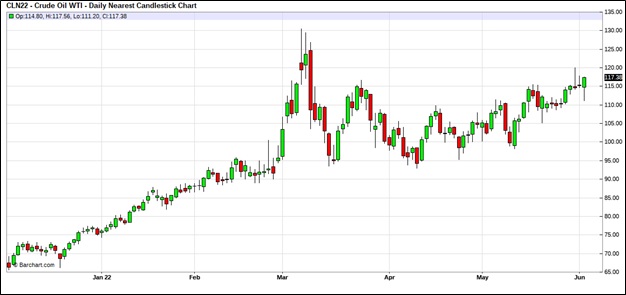
Crude oil prices continue to grind higher despite reports of OPEC+ production increases and record SPR sales.

(Source: Barchart.com)

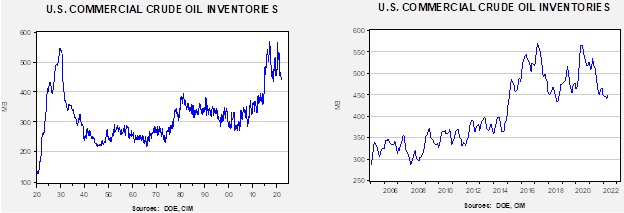
Crude oil inventories fell 5.1 mb compared to a 3.0 mb draw forecast.  The SPR declined 5.4 mb, meaning the net draw was 10.5 mb.

In the details, U.S. crude oil production was unchanged at 11.9 mbpd.  Exports fell 0.3 mbpd, while imports fell 0.4 mbpd.  Refining activity declined 0.6% to 92.6% of capacity.

(Sources: DOE, CIM)

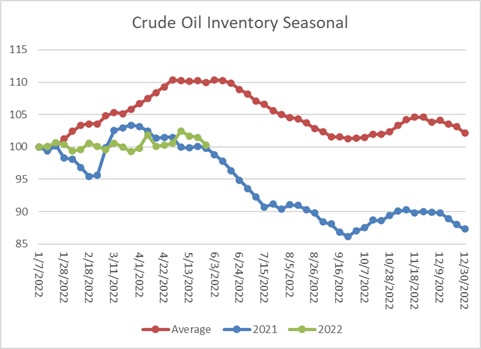
The above chart shows the seasonal pattern for crude oil inventories.  This week’s report is consistent with last year’s pattern.  If that becomes the path for the next six weeks, a 10% decline in commercial stockpiles is in the offing.

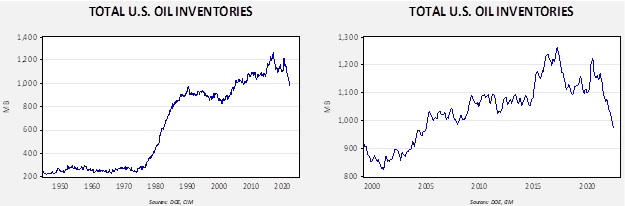
Since the SPR is being used, to some extent, as a buffer stock, we have constructed oil inventory charts incorporating both the SPR and commercial inventories.

Total stockpiles peaked in 2017 and are now at levels seen in 2005.  Using total stocks since 2015, fair value is $92.85.

With so many crosscurrents in the oil markets, we see some degree of normalization.  The inventory/EUR model suggests oil prices should be around $60 per barrel, so we are seeing about $40 of risk premium in the market.

Market news:

Geopolitical news:

Alternative energy/policy news:

  View PDF