

Weekly Energy Update (April 28, 2022)

by Bill O’Grady, Thomas Wash, and Patrick Fearon-Hernandez, CFA | PDF

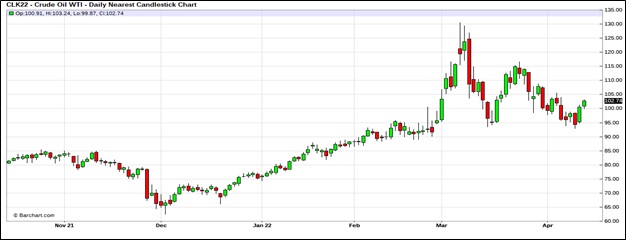
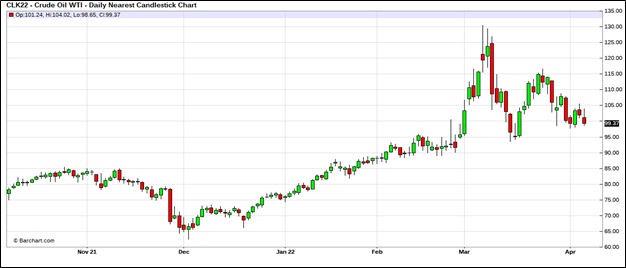
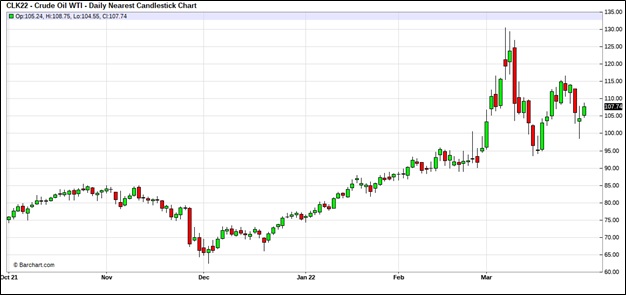
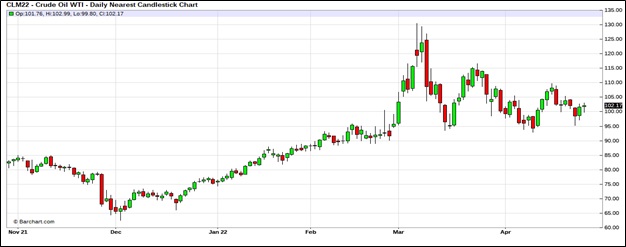
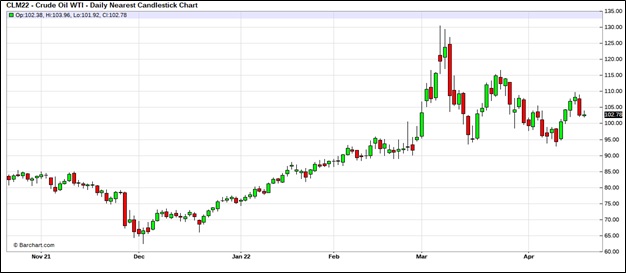
It appears oil prices are attempting to create a trading range between $105 to $95 per barrel.  That may hold until the SPR release is complete.
(Source: Barchart.com)

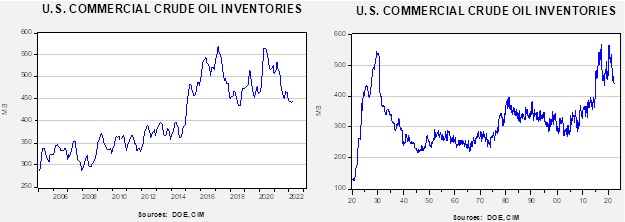
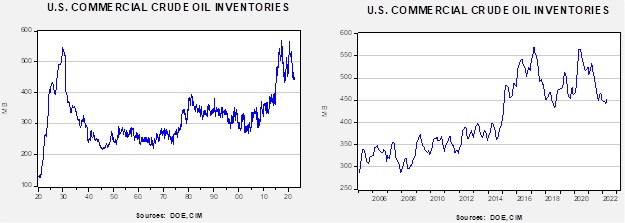
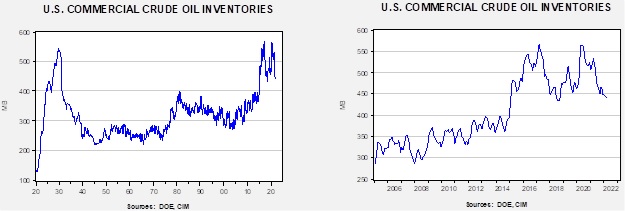
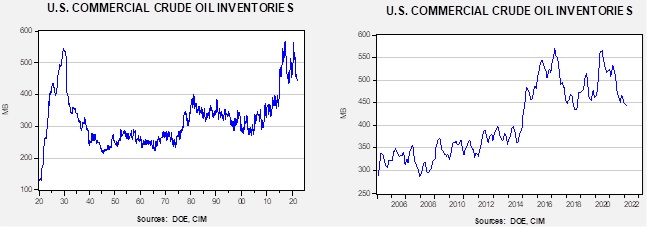
Crude oil inventories unexpectedly rose 0.7 mb compared to a 0.3 mb draw forecast.  The SPR declined 2.9 mb, meaning the net draw was 2.2 mb.
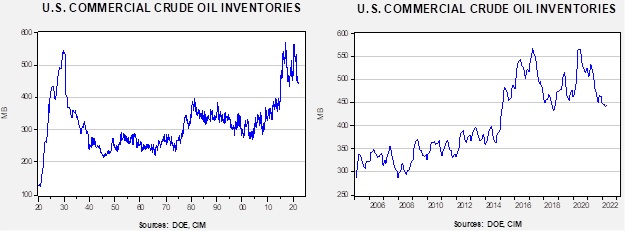
In the details, U.S. crude oil production rose 0.1 mbpd to 11.9 mbpd.  Exports rose 2.1 mbpd, while imports declined 0.2 mbpd.  Refining activity increased 1.0% and is now 91.0% of capacity.  This week’s large and unexpected draw was mostly due to rising exports, although the increase in refinery operations contributed to the draw.
(Sources: DOE, CIM)

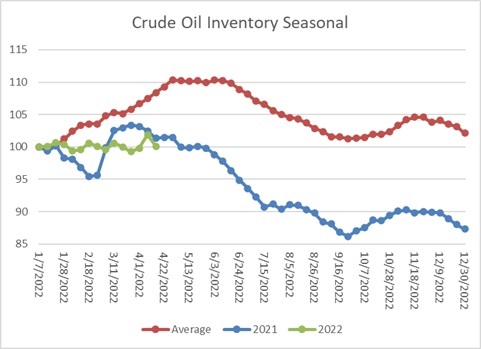
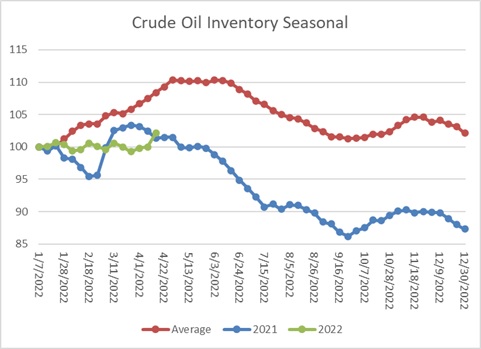
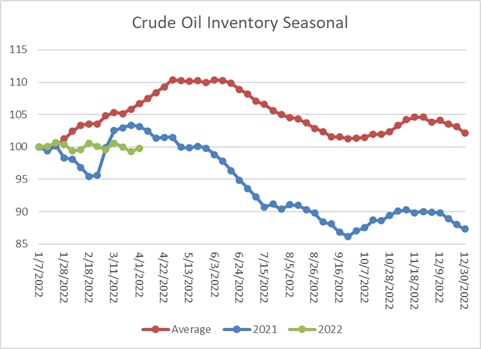
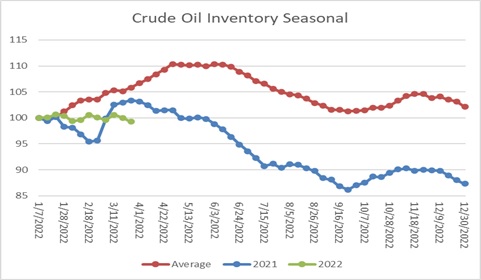
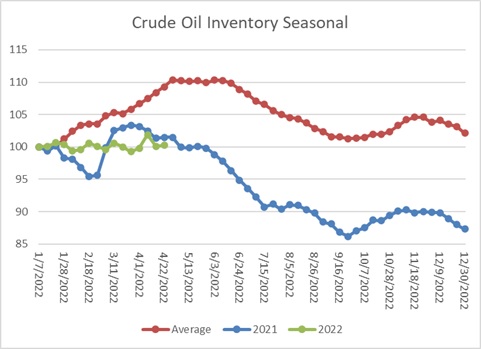
This chart shows the seasonal pattern for crude oil inventories.  This week’s report is consistent with last year; also, note that in the average data, we are at the point where the seasonal build period has ended.  Over the next few weeks, we will see if we follow the average path or track last year.

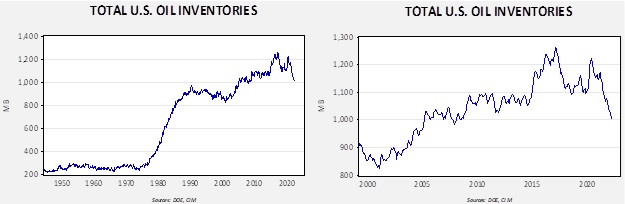
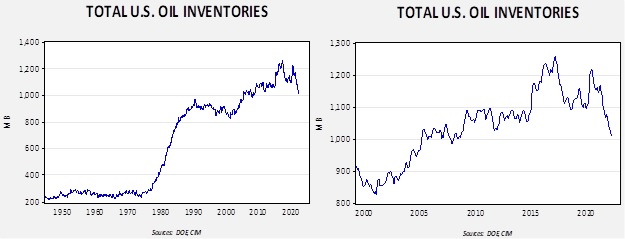
Since the SPR is being used, to some extent, as a buffer stock, we have constructed oil inventory charts incorporating both the SPR and commercial inventories.
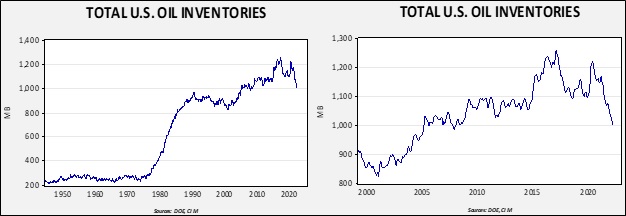
Total stockpiles peaked in 2017 and are now at levels seen in late 2008.  Using total stocks since 2015, fair value is $85.50.
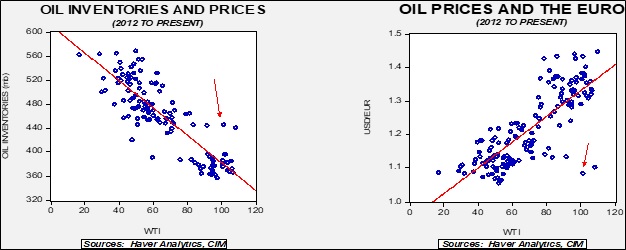
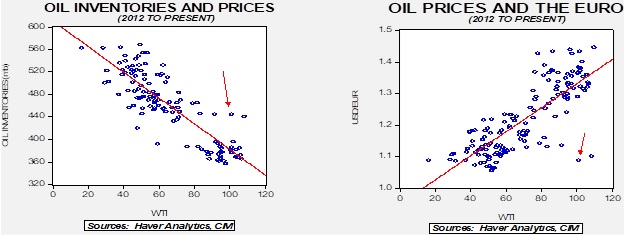
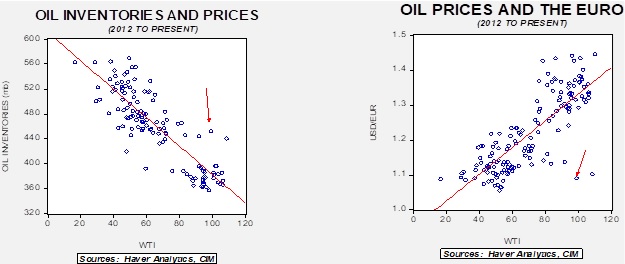
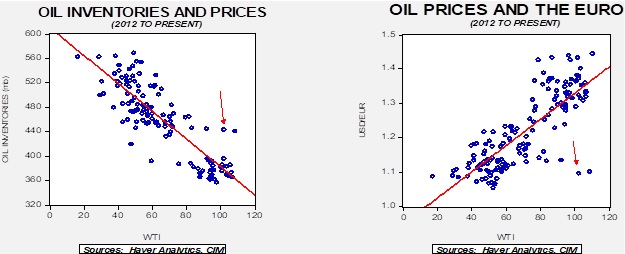
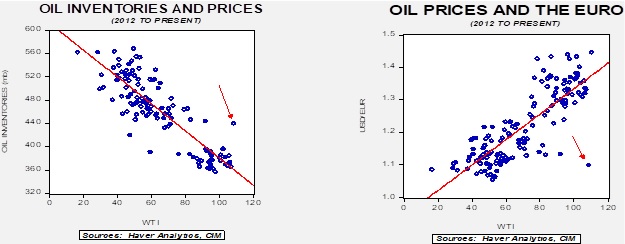
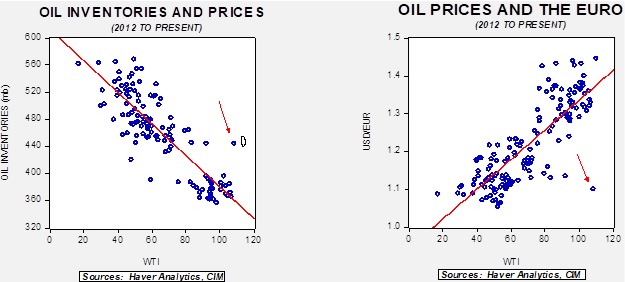
With so many crosscurrents in the oil markets, we see some degree of normalization.  The inventory/EUR model suggests oil prices should be around $60 per barrel, so we are seeing about $40 of risk premium in the market.

Market news:


Geopolitical news:

Alternative energy/policy news:

  • President Biden entered office with an aggressive climate agenda. As energy prices have soared, he has been steadily retreating from the position.  The withdrawal makes political sense, but it is not without costs.  Polls suggest he is rapidly losing support among younger voters, which may adversely affect his party in November’s midterms.
  • We have reported that financial firms have been restricting lending activity to fossil fuel companies. That resistance may be starting to wane.
  • Until batteries become reliable (and cheap) enough to store wind and solar power during generation periods when the winds are calm and the sun isn’t out, backup capacity tends to undermine the business case for alternative energy. Even though the administration is trying to streamline the process for making batteries, much of the mineral processing remains in China and is a potential block to expanding battery capacity.  The EU faces similar capacity shortages.
  • Modular nuclear reactors are a potential solution to filling the electricity gap as EVs expand.
  • While Germany’s decision to end the use of nuclear power is considered a major mistake, there is little evidence the country is considering changing its stance.
  • Geothermal energy is clean and abundant, but the initial investment can be daunting. There is a movement to use abandoned oil wells already drilled to get a “head start” on tapping this source.
  • Although Mexico’s President Andrés Manuel López Obrador remains friendly to traditional oil, he has recently nationalized the lithium industry. It’s hard to see how the move will support Mexico’s ability to expand this resource.
  • The U.S. solar panel industry is seeking protection from Chinese imports. The installers are opposing these efforts.
  • Canada has set up an exchange for carbon credits. Activity is expanding rapidly.
  View PDF

Weekly Energy Update (April 21, 2022)

by Bill O’Grady, Thomas Wash, and Patrick Fearon-Hernandez, CFA | PDF

Oil prices did break out of a descending triangle, which is bullish, but for the most part, we look for prices to be rangebound for the next six months during the SPR withdrawal.

(Source: Barchart.com)

Crude oil inventories unexpectedly fell 8.0 mb compared to a 3.0 mb forecast.  The SPR declined 4.7 mb, meaning the net draw was 12.7 mb.

In the details, U.S. crude oil production rose 0.1 mbpd to 11.9 mbpd.  Exports rose 2.1 mbpd, while imports declined 0.2 mbpd.  Refining activity increased 1.0% and is now 91.0% of capacity.  This week’s large and unexpected draw was mostly due to rising exports, although the increase in refinery operations contributed to the draw.

(Sources: DOE, CIM)

This chart shows the seasonal pattern for crude oil inventories.  This week’s large draw is reflected in the chart.  If we follow last year’s pattern, we will see a rather rapid decline in commercial stocks in the coming weeks.

Since the SPR is being used, to some extent, as a buffer stock, we have constructed oil inventory charts incorporating both the SPR and commercial inventories.

Total stockpiles peaked in 2017 and are now at levels seen in late 2008.  Using total stocks since 2015, fair value is $85.06.

With so many crosscurrents in the oil markets, we see some degree of normalization.  The inventory/EUR model suggests oil prices should be around $60 per barrel, so we are seeing about $40 of risk premium in the market.

Natural Gas Update:

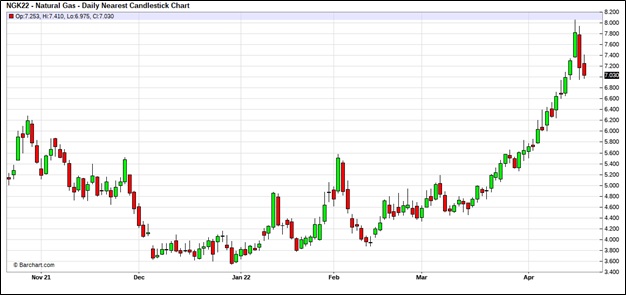
Natural gas prices have been strong.

(Source:  Barchart)

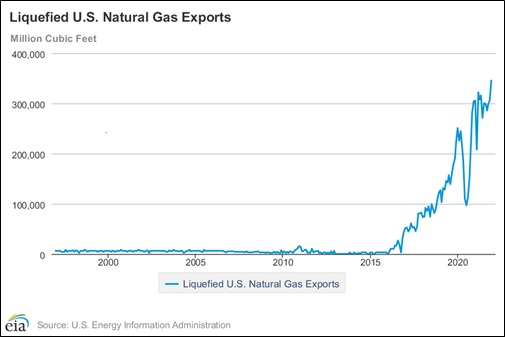
Robust demand from U.S. LNG is pushing prices higher.

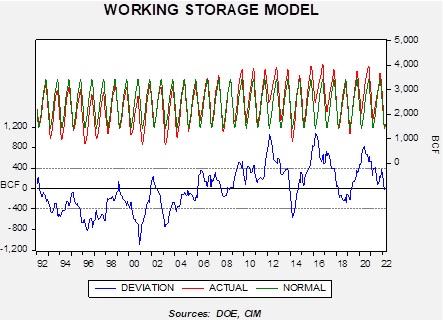
Current stockpiles, on a seasonally adjusted basis, are normal.  This model seasonally adjusts inventory back to 1992.  Note, however, that there is an upward shift in the deviation after 2008, when shale gas production began to expand.

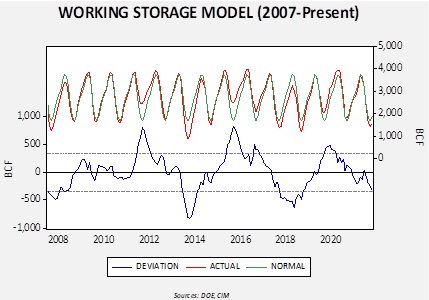
 If we shorten the model to account for the advent of shale, we are currently a bit short at the end of this heating season.

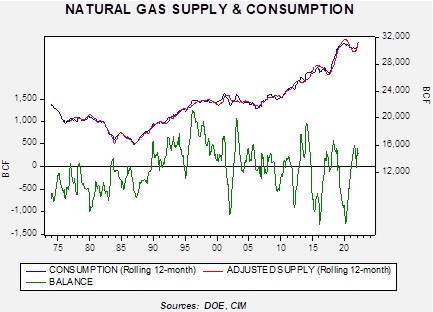
As consumption has increased, so has production.

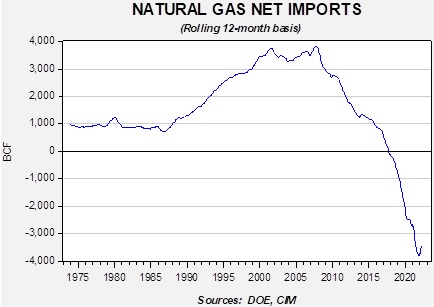
But, with the U.S. now a net exporter, the domestic market will likely remain tight, which will support prices over the summer.

Market news:

  • Markets and policymakers are all wrestling with high energy prices. Under normal circumstances, high prices usually create conditions to address that problem.  In other words, high prices tend to stimulate supply and constrain demand, eventually bringing prices lower.  However, we haven’t really seen that occur this time around in oil and gas.  There are myriads of reasons.  After years of “burning” investor capital, investors are forcing production discipline on oil producers, which has reduced drilling.  ESG has discouraged oil firms from large projects with long development times; the fear is that this investment will be stranded.  The problem, of course, is that in the here and now, high energy prices are taking a toll on the economy, lifting inflation and depressing consumer sentiment.
  • Meanwhile, the state of the Russian oil industry remains uncertain. There is a rising likelihood that Russia is running out of storage space.  If Russia is forced to shut in production due to the lack of demand for their oil, restarting this production may be close to impossible.  Complicating matters is that major Western oil servicing companies have mostly abandoned the country.  The longer the war goes on, the greater the likelihood that production will be permanently lost.
  • The U.S. is investing to expand its LNG production. Natural gas liquefaction plants are usually large facilities that take years to complete.  However, often overlooked are smaller-scale LNG plants for both liquefaction and gasification, which add to capacity.

 Geopolitical news:

  • The Ukraine War continues to be the most significant geopolitical event in the energy markets. So far, Russian oil continues to flow, but as we detail in our upcoming Bi-Weekly Geopolitical Report, the payments part of the supply chain is mostly ruptured, which may lead to an effective embargo on Russian oil and gas.
  • As oil prices rose, the White House has asked OPEC to increase production. That call has mostly been rebuffed due to deteriorating relations between the Biden administration and Crown Prince Salman.  House Democrats are pushing for information about that relationship.  Our position is that the U.S. is reducing its influence in the Middle East and, thus, America’s ability to influence OPEC behavior is declining.
  • Despite German reluctance, the EU is moving to embargo Russian oil.
  • Mexican President Andrés Manuel López Obrador supported a change to the constitution, which would have reserved 54% of Mexico’s electricity market for the state company. The legislature rejected this measure.
  • Despite nuclear talks with the West, Iran vows to avenge the assassination of Qasem Soleimani. This stance could undermine U.S. support for the deal.
  • After a seven-month hiatus, talks between Iran and the KSA are scheduled to resume. On the one hand, we don’t expect much progress.  On the other, the fact the talks are happening at all reflects expectations the U.S. will be less involved in the region, forcing the parties to adjust.
  • Elements within Iran are calling for a closure of the Straits of Hormuz to South Korea shipping. Seoul has frozen Iranian assets, and Iran wants to punish it.  As part of this effort, Tehran wants to ban U.S. shipping in the area as well.

Alternative energy/policy news:

  • South Korea has reversed its phaseout of nuclear power in the face of rising oil prices and energy insecurity. The U.S. is also creating support for extending the life of current nuclear power facilities.
  • A major part of the energy transition away from fossil fuels is effectively a swap toward metals and away from hydrocarbons. Unfortunately, the Ukraine War is reducing supplies of key metals required for the transition.
  • Although we doubt E-15 (a 15% ethanol blend) will have much impact on gasoline prices, this report offers more detail on the fuel. Bottom line:  it’s a bit cheaper but less energy efficient.

  View PDF

Asset Allocation Bi-Weekly – The Bank of Japan Cocks the Trigger (April 18, 2022)

by the Asset Allocation Committee | PDF

In Hollywood movies, the classic device to convey a menacing threat is to have the tough-guy cop pull back the hammer on his revolver and cock the trigger.  It’s not enough that the cop just points his gun at the criminal.  Once you hear that “click,” you know the threat is imminent.  You know it would only take a pull of the finger, and the bad guy is history. What you may not know is that Bank of Japan Governor Kuroda gave just this kind of “Are ya’ feeling lucky, punk?” performance last month.  But as we discuss here, the big gun that Kuroda cocked was strictly financial—yield-curve control instead of a Smith & Wesson—and the opponent who got weak in the knees and fell to the ground wasn’t a petty thief, but the Japanese yen.

Since 2013, the BoJ has had an agreement with the government to work together on defeating deflation and bringing annual consumer price increases up to 2%.  Shortly after Prime Minister Kishida’s election in 2021, the central bank renewed that commitment.  The central bank’s effort initially focused on holding short-term interest rates very low and implementing massive asset purchases to pump funds into the economy.  However, Japanese inflation remained stuck near 0%.  In 2016, the BoJ, therefore, expanded its approach also to include “yield curve control,” in which it keeps short-term interest rates slightly negative (currently -0.1%) and commits to capping 10-year Japanese government bond yields at “around 0%.”

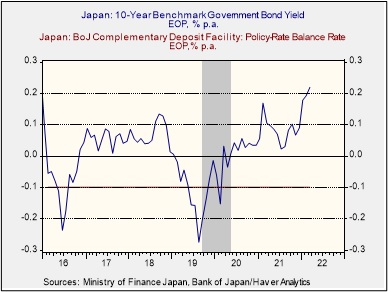
While the BoJ’s yield-curve control policy has been in place for six years, slow economic growth and low inflation around the world meant its commitment to hold long-term yields near 0% was never really tested.  Even when the U.S. economy strengthened enough to prompt a series of Federal Reserve rate hikes from 2016 to 2018, the yield on 10-year JGBs only rose to about 0.1%, well within the range that seemed consistent with “around 0%” (see chart below).  With 10-year JGB yields so well behaved, the BoJ’s yield-curve control policy seemed little more than an uncocked gun: concerning but not necessarily menacing.

The problem is that the global economic and financial landscape has changed dramatically over the last year.  Galloping inflation in many countries outside of Japan has prompted central banks ranging from the Fed to the Bank of England to start hiking their benchmark interest rates.  In fact, multiple Fed officials have signaled that their next move in early May might be an aggressive hike of 0.50% rather than the more usual hike of 0.25%.  The policymakers’ scurry to hike rates has driven up government bond yields around the world, including in Japan.  By late March, the 10-year JGB yield had jumped above 0.20% and was well on its way to 0.25%.  Anything above that level would be hard to characterize as “around 0%,” so it was clear that the first real test of the BoJ’s yield-curve control policy had arrived.

And what did the BoJ do?  At its March 18 policy meeting, it reiterated its commitment to buy whatever amount of JGBs necessary to keep the 10-year yield near 0%.  In other words, it said that even if the other major central banks are hiking their interest rates to rein in inflation, it would buy an unlimited amount of government bonds to keep yields steady.  So, it pulled back the hammer on its revolver and let the world hear an enormous financial “click.”

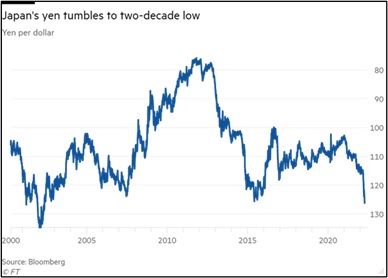
As shown in the chart below, the BoJ’s unexpected recommitment to loose policy has driven a series of considerable drops in the value of the yen.  In late February, the currency fell to a seven-year low of 123.66 per dollar ($0.00809), down 6.9% from the end of 2021 and 16.6% from the end of 2020.  What explains these gigantic declines?  The BoJ’s promise to buy unlimited amounts of bonds and unleash unlimited funds into the economy equates to a threat of currency debasement.  Essentially, it amounts to the threat of a limitless supply of money in the economy, with the result that the value of that money would be in question.

The implications of the BoJ’s stance are important for investment strategy.  Given the historically high levels of debt weighing on major countries worldwide and growth challenges like falling birth rates, we think the Fed and other major central banks could also be tempted to adopt yield-curve control in the coming years.  If their current efforts to fight inflation aren’t successful and longer-term bond yields start to drift higher, the central banks may decide they can’t afford to acquiesce.  Like the BoJ, they could decide to sit on yields, implying that they would also have to be open to unlimited bond purchases and money creation.  Currency values in those countries would be at risk. Many investors fearful about inflation would likely try to hedge their bets by purchasing physical stores of value such as gold, silver, and other commodities.  This is a key reason we favor a significant exposure to such commodities in several of our asset allocation strategies.  For those investors who don’t take steps to hedge against currency debasement, we would only ask, “Are ya feeling lucky?”

View PDF

Weekly Energy Update (April 14, 2022)

by Bill O’Grady, Thomas Wash, and Patrick Fearon-Hernandez, CFA | PDF

Oil prices appear to be settling into a trading range.

(Source: Barchart.com)

Crude oil inventories rose 9.4 mb compared to an unchanged forecast.  The SPR declined 3.9 mb, meaning the net build was 5.5 mb.

In the details, U.S. crude oil production is unchanged at 11.8 mbpd.  Exports fell 1.5 mbpd, while imports declined 0.3 mbpd.  Refining activity dropped 2.5% and is now 90.0% of capacity.  This week’s large and unexpected draw was due to the decline in refinery operations and exports.  We don’t expect these factors to continue.

(Sources: DOE, CIM)

This chart shows the seasonal pattern for crude oil inventories.  This week’s large build is reflected in the chart.  If this continues, we could reach the normal seasonal high in the coming weeks.  However, in this week’s report, we noted a large decline in refinery operations and exports, so we probably won’t see builds at this level in the near future.

Since the SPR is being used, to some extent, as a buffer stock, we have constructed oil inventory charts incorporating both the SPR and commercial inventories.

Total stockpiles peaked in 2017 and are now at levels seen in late 2008.  Using total stocks since 2015, fair value is $82.44.

With so many crosscurrents in the oil markets, we see some degree of normalization.  The inventory/EUR model suggests oil prices should be around $60 per barrel, so we are seeing about $40 of risk premium in the market.

Market news:

 Geopolitical news:

 Alternative energy/policy news:

  View PDF

Weekly Energy Update (April 7, 2022)

by Bill O’Grady, Thomas Wash, and Patrick Fearon-Hernandez, CFA | PDF

Oil prices remain volatile, moving on war news.  The SPR release will likely be bearish for prices.  Technically, the oil chart appears to have a descending triangle, which is often a bearish pattern.

(Source: Barchart.com)

Crude oil inventories rose 2.4 mb compared to a 2.9 mb draw forecast.  The SPR declined 3.7 mb, meaning the net draw was 1.3 mb.

In the details, U.S. crude oil production rose again this week by 0.1 mbpd to 11.8 mbpd.  Exports rose 0.7 mbpd, while imports were unchanged.  Refining activity rose 0.4% and is now 92.5% of capacity.

(Sources: DOE, CIM)

This chart shows the seasonal pattern for crude oil inventories.  Last year, oil stocks peaked in early April and fell steadily into September.  With the announcement of the SPR release (see below for details), we should see rising commercial stocks in the coming weeks.  However, the actual pattern will depend on the logistics of the sale.

With so many crosscurrents in the oil markets, we see some degree of normalization.  For the time being, we would expect oil to fluctuate between $105 to $90 per barrel, with a bias to the downside in the short term.  However, we doubt the SPR release will be a long-term bearish factor, and if the war drags on, there is a growing likelihood the price will rise and return to recent highs.

The SPR Release

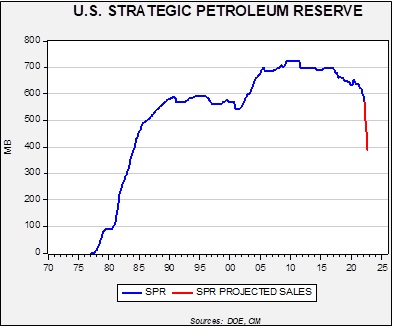
Last week, the administration announced the largest sale from the Strategic Petroleum Reserve in its history.  The plan is to release 1.0 mbpd for 180 days.  The chart below shows the projected sale’s effect on the SPR.

The IEA announced other nations would join in the sale, although amounts were unspecified.  There are a number of reasons and features for the sale.  Here are the points we found interesting:

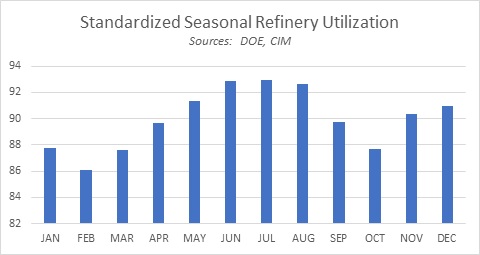
  • The White House made it clear that the goal of the release was to lower gasoline prices. To a great extent, the success of that outcome will be dependent on several variables.  For example, this week’s refinery utilization report shows that 92% of capacity is currently in use.  That is elevated relative to seasonal norms.

This chart shows standardized seasonal refinery utilization.  As the chart shows, refineries engage in maintenance in the winter and autumn.  Our current reading for utilization is 92.5%, which is near the usual peaks seen in summer.  Although run rates in excess of 95% are not unprecedented, they only occur about 9.4% of the time.  The bottom line is this: although increasing the availability of crude oil will help reduce gasoline prices, gasoline supplies depend on refining.  With capacity approaching levels we consider constrained (any reading above 95%), the impact of the additional oil will likely be lessened by the lack of excess refining capacity.

  • Policymakers of all stripes tend to miss second-order effects. Often, they don’t anticipate the reactions of consumers and producers that can thwart the goals of a policy action.  In this case, the unknown is how oil producers will react to the announced SPR release.  In a nutshell, it would make sense for producers to reduce output and investment in the face of the release.  Essentially, the administration wants oil producers to increase output while the SPR policy is designed to lower prices.  Economic theory would suggest this isn’t likely.
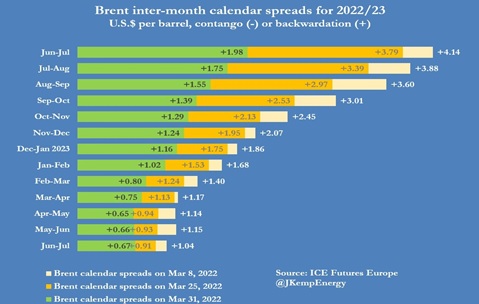
  • The administration is promising the oil sold will be replaced at some point in the future. That assertion has led calendar spreads to narrow; deferred contract prices rose in anticipation of government buying to replenish the SPR.

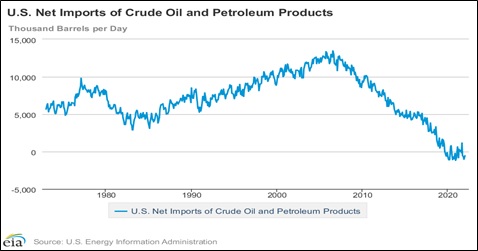
We harbor serious doubts this oil will ever be replenished.  As the SPR chart above shows, with the exception of a modest rebuilding in mid-2020, stocks have been drawn down since peaking in 2011.  Buying oil requires a budget decision, and there is always something else that a government would rather spend money on.  In addition, given that the U.S., on balance, is a small net exporter, it isn’t obvious why an SPR exists.  After all, the IEA requires OECD nations to hold 90 days of net oil exports.  The U.S., by this measure, is over reserved.

Perhaps a more important issue is that the goal of climate change policy (see below for recent reports on the topic) is to reduce fossil fuel consumption dramatically.  If it is successful, the SPR could become a stranded asset.  Thus, refilling it seems like an exercise in futility.
  • Finally, although the SPR system is designed to move 4.4 mbpd out of storage, and the current withdrawal is less than a quarter of that maximum, there could be logistical issues. The SPR has never been drawn down at this level before.  The pipeline system has changed over time, and the pipelines connected to the salt caverns in Texas and Louisiana also move shale oil.  It is possible that the SPR oil will displace shale, leading to declines in production or other snags.  We do expect that after a few weeks, the kinks will be worked out.  But market participants should not be surprised if there are problems initially, so it may take more time than our chart above suggests.

 Market news:

 Geopolitical news:

  • As the Russian withdrawal from the areas around Kyiv reveals atrocities, European nations are facing increasing pressure to embargo Russian fossil fuels. The EU appears ready to ban Russian coalLithuania announced it has cut off Russian natural gas imports.  Germany has been reluctant to embargo Russian oil and gas, but recent research suggests the impact may not be as negative as feared.  However, Britain has continued imports of Russian diesel; Russia supplies about 20% of the U.K.’s diesel fuel.
  • As sanctions encourage disinvestment, we are starting to see foreign asset seizures. Germany announced it was taking control of Gazprom’s (GAZP.MM, RUB, 252.90) Germania, a storage, transmission, and trading firm that operates in Germany.
  • Russia has a problem. It can sell natural gas and oil to Europe and, under its contractual arrangements, receives euros.  However, due to financial sanctions, there is little Russia can do with these funds.  Essentially, Russia is selling fossil fuels to Europe for nothing.  In response, Russia is demanding “hostile nations” pay for energy in rubles.   In theory, this change isn’t all that important, because a buyer like Germany, for example, could go to the bank, buy rubles, and pay for the gas.  But Russia doesn’t necessarily want rubles as much as it wants Western goods (e.g., semiconductors, aircraft parts, etc.)  Putin could force Europeans to sell such items to Russia to obtain rubles that could be used to buy fossil fuels.  The EU is balking.  Russia’s plan has led the German government to lay out emergency measures to deal with a shortage of natural gas.
  • Although negotiations seem eternal, there are reports that the U.S. and Iran are near a deal on reviving the 2015 nuclear deal.
  • The Brazilian state oil company Petrobras (PBR, USD, 14.91) remains without a CEO after the most recent appointee, Adriano Pires, turned down the job. Rising fuel prices have led Brazilian President Bolsonaro to fire the last two heads of the company.  Pires, an energy consultant, concluded he would have conflicts of interest if he took the position.

Alternative energy/policy news:

  View PDF

Asset Allocation Bi-Weekly – Latin America’s Day in the Sun (April 4, 2022)

by the Asset Allocation Committee | PDF

As we’ve previously described in many of our publications, the Russian invasion of Ukraine has changed the world in profound, long-lasting ways.  We have defined how it will further cleave the world’s nations into at least two major geopolitical blocs with limited commercial and financial ties.  We have explained how governments and companies will now favor short, secure supply chains, even if they’re less efficient and more costly than the global supply chains of the last three decades.  In this article, we focus on what is likely to be a persistent change in world financial markets.  Specifically, the Latin American stocks that have often underperformed in recent years show signs of being much better performers in the new era.

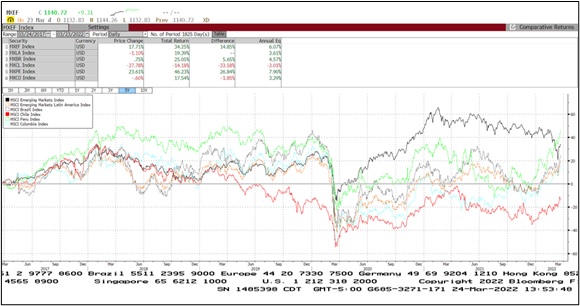
Stock market returns in the less-developed “emerging markets” have often failed to keep up with the U.S. and other developed markets in recent years, but Latin America has fared especially poorly.  While the broad MSCI Emerging Market Index provided a total return of 34.3% in the five years to late March (illustrated by the solid black line in the chart below), the MSCI Emerging Markets Latin America Index (the dashed orange line) returned just 19.4%.  The chart also shows the stock indexes for Brazil, Chile, Peru, and Colombia.  These countries are popular with U.S. investors and are considered highly investible, but they all lagged the broad emerging markets index for much of the last five years.  The recent poor returns for Latin American stocks can be traced to a range of factors, such as political and governance issues, slow economic growth compared with the commodity boom years of the early 2000s, and the impact of the coronavirus pandemic.

Source: Bloomberg

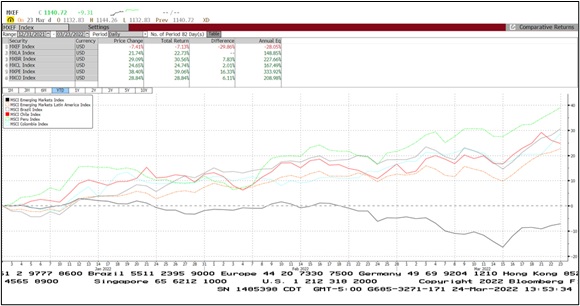
Even a cursory look at these indexes over the last few months suggests something fundamental has changed.  As shown in the following chart, the overall emerging markets index lost more than 7% in the first three months of 2022, reflecting, in part, the steep declines in Chinese and Russian stock values.  In contrast, the Latin America index provided a positive total return of almost 23%.  Some Latin American markets, such as Mexico, have changed little, but our four highlighted markets outperformed.  Peru’s market returned nearly 40%, and Brazil’s market returned almost 30%.  The strong performance in these markets is especially notable because all face elections or other political events that could push economic policy leftward, which would ordinarily be a major headwind for stocks.

Source: Bloomberg

What’s behind the big gains for these Latin American markets?  Our analysis indicates that each of these markets is highly correlated to global prices for oil and other commodities, while China, Russia, and the many emerging markets closely tied to them are correlated negatively with oil and other commodities.  Even though these Latin American countries sell a lot of oil, commodities, or other goods to the Chinese and Russian blocs, we suspect investors appreciate their relative geopolitical independence and the fact that they may be in a good position to strengthen their future trade ties with the U.S.-led bloc centered on North America and Western Europe.  In any case, these Latin American stock markets are well-positioned to benefit from the skyrocketing commodity prices touched off by the Russia-Ukraine war.

We think the Latin American stock resurgence could persist.  Even before the war, loose monetary and fiscal policies in the U.S. and other developed countries were pushing up prices, especially in the context of supply disruptions brought on by the coronavirus pandemic.  Monetary and fiscal policies are now being tightened in many countries, which should help reduce demand, but the war is causing severe new supply disruptions in commodities such as oil, wheat, and fertilizers.  The supply disruptions are even prompting hoarding behavior, from companies boosting their raw material inventories to countries imposing export bans on key commodities.  Such hoarding can spark a persistent upward spiral in prices, even while drought discourages crop planting in some regions.  Finally, the Western countries’ financial sanctions on Russia are likely to prompt some countries to shift their foreign reserves from Western currencies to purchase physical commodities.  Of course, a major escalation of the war or a global recession sparked by high inflation or tighter policy could eventually bring commodity prices down again, dragging Latin American stocks with them.  For now, however, we think both commodity prices and Latin American stocks have room to rise further.

View PDF

Weekly Energy Update (March 31, 2022)

by Bill O’Grady, Thomas Wash, and Patrick Fearon-Hernandez, CFA | PDF

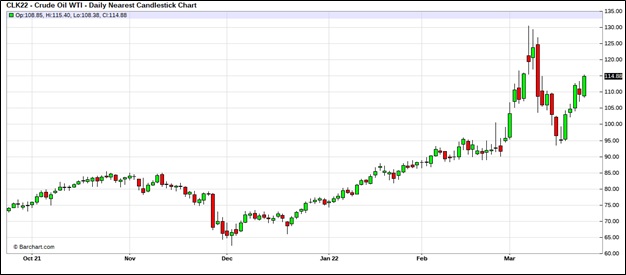
Oil prices remain volatile, moving on news regarding the Russia-Ukraine war.

(Source: Barchart.com)

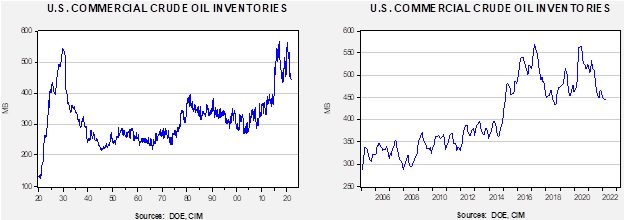
Crude oil inventories fell 3.4 mb compared to a 2.2 mb draw forecast.  The SPR declined 3.0 mb, meaning the net draw was 6.5 mb.

In the details, U.S. crude oil production rose 0.1 mbpd to 11.7 mbpd.  Exports fell 0.9 mbpd, while imports declined 0.2 mb.  Refining activity rose 1.0% and is now 92.1% of capacity.

(Sources: DOE, CIM)

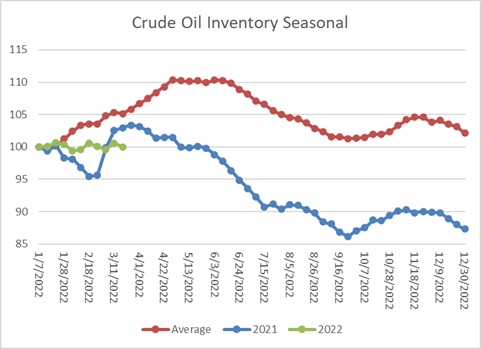
This chart shows the seasonal pattern for crude oil inventories.  Last year, oil stocks peaked in early April and fell steadily into September.  This year’s pattern hints that we may have already peaked stockpiles, meaning commercial inventories may decline for the next several months. Even though the current oil price far exceeds the level that the inventory model below would indicate, the divergence may narrow in the coming weeks if we see continued seasonal declines in oil stocks.

Clearly the relationship between the EUR and oil prices has fallen apart.  Just using the oil inventory model, the current fair value is $71.80.  To justify the current monthly average of around $180 per barrel, commercial inventories would need to decline to 387 mb.  Is that conceivable?  Yes.  If we see stockpiles decline in a similar fashion to last year, by mid-September, commercial inventories will be around 375 mb.  So, at present, the current price has discounted further tightening in supply, but based on last year’s inventory behavior, the current price isn’t unreasonable.

 Market news:

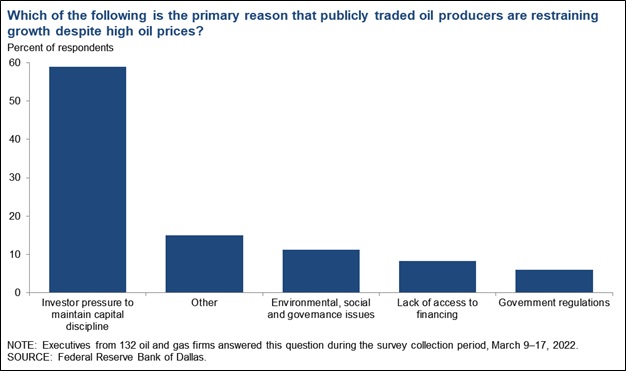
  • When studying history, there is a constant tension between simplifying and detailing. In other words, it is rare that a historical event has a single cause, but identifying a large number of causal factors makes it difficult to determine what analysts should focus on when creating a historical analog.  Learning the lessons from history is difficult if common factors can’t be isolated.  This issue even applies to recent history.  On the question of “why aren’t U.S. oil companies pumping more oil,” there are several identifiable reasons.  Fortunately, the Dallas FRB has conducted a survey of oil producers in its district, and the clear answer is that the financial industry is pressuring oil firms to maintain capital discipline.  Simply put, the hurdle for new production is higher because it makes it difficult to source financing.

Although government regulation does play a role, as does ESG, their investors’ demand for returns is restraining growth.  The oil and gas industry has traditionally experienced booms and busts; it appears financial firms are trying to contain that cycle.  The shift to encourage expanded oil and gas production is boosting the shares of energy companies.  It should also be noted that the survey suggests oil and gas executives do not see a promising future, which is also likely curtailing investment.

Geopolitical news:

Alternative energy/policy news:

  View PDF

Business Cycle Report (March 31, 2022)

by Thomas Wash | PDF

The business cycle has a major impact on financial markets; recessions usually accompany bear markets in equities.  The intention of this report is to keep our readers apprised of the potential for recession, updated on a monthly basis.  Although it isn’t the final word on our views about recession, it is part of our process in signaling the potential for a downturn.

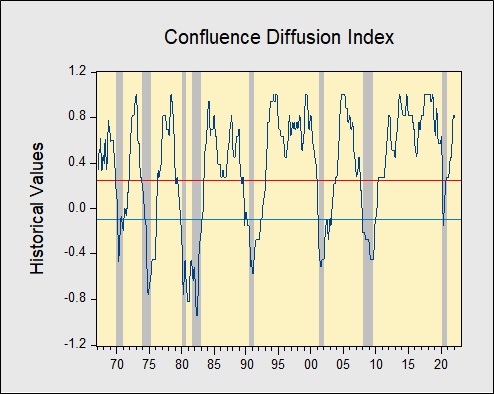
In February, the diffusion index rose further above the recession indicator, signaling that the economy remains in expansion. In financial markets, higher yields on Treasuries have weighed on equities. Meanwhile, manufacturing data suggests that supply chains are improving. Finally, the labor market appears to be strong, with nonfarm payrolls surprising on the upside. That being said, ten out of the 11 indicators are in expansion territory. The diffusion index remained unchanged at +0.8182, remaining well above the recession signal of +0.2500.

The chart above shows the Confluence Diffusion Index. It uses a three-month moving average of 11 leading indicators to track the state of the business cycle. The red line signals when the business cycle is heading toward a contraction, while the blue line signals when the business cycle is moving toward a recovery. On average, the diffusion index currently provides about six months of lead time for a contraction and five months of lead time for a recovery. Continue reading for a more in-depth understanding of how the indicators are performing and refer to our Glossary of Charts at the back of this report for a description of each chart and what it measures. A chart title listed in red indicates that the indicator is signaling recession.

Read the full report

Weekly Energy Update (March 24, 2022)

by Bill O’Grady, Thomas Wash, and Patrick Fearon-Hernandez, CFA | PDF

After falling last week, oil prices have moved steadily higher on continued tensions in Ukraine.

(Source: Barchart.com)

Crude oil inventories fell 2.5 mb compared to a 0.5 mb draw forecast.  The SPR declined 4.2 mb, meaning the net draw was 6.7 mb.  The withdrawal from the SPR was near the surge maximum of 4.4 mbpd, which suggests the government is moving aggressively to lower oil prices.

In the details, U.S. crude oil production was unchanged at 11.6 mbpd.  Exports rose 0.9 mbpd, while imports rose 0.1 mb.  Refining activity rose 0.7% and is now 91.1% of capacity.

(Sources: DOE, CIM)

This chart shows the seasonal pattern for crude oil inventories.  We are seeing inventories continue to diverge from the usual seasonal pattern.

These charts make evident that the normal relationships between the dollar, inventory, and oil prices are currently broken.  However, the chart on the left indicates the degree of overvaluation has narrowed.  The first report after the war started is represented by the circle; we have seen prices move in (the average daily price during the month of March is used for this dot).  Overall, the market is consolidating after the major war spike.  We look for continued consolidation, although we note that the situation with Ukraine remains fluid, and prices could move strongly in either direction on war news.

 Market news:

But not all of this gas will go to Europe unless pricing supports those flows.  Recent pricing has been supportive of flows going to Europe, but that may change if Asia also tries to lift inventories.  The U.S. has relaxed some trading rules recently that may help lift LNG exports to the EU.  But, there is one problem looming in this scenario; it appears we will have a “back-to-back” la Niña, which raises the chances for extended drought and a hotter-than-normal summer.  The last time this sort of event occurred was in 2012.  The summer of that year, for the region east of the Rockies, was quite hot.  July of that year was the second hottest on record in terms of population-weighted degree days, and June was the 12th hottest.  If the U.S. has a hot summer, it may not be possible for America to boost LNG supplies to Europe.

 Geopolitical news:

  Alternative energy/policy news:

  View PDF