

Asset Allocation Bi-Weekly – The Problem of Financial Conditions (May 31, 2022)

by the Asset Allocation Committee | PDF

Among the financial pundit class, there has been a growing call to weaken financial conditionsWhat are financial conditions?  They include credit spreads, the level of interest rates, the level of equities, the level of market volatility, the dollar’s exchange rate, etc.  Weaker financial conditions mean that borrowing costs rise, and the perceived risk of investment increases.  By increasing the costs of investment and borrowing, market participants (households, firms, etc.) will often exert greater caution, and this practice will tend to slow growth in the economy.  Essentially, the argument is that with inflation running “hot,” using weaker financial conditions to slow investment and consumption will eventually lead to less inflation.

However, managing financial conditions isn’t a straightforward process.  Once financial conditions begin to deteriorate, they can almost take on “lives of their own.”  In a sense, financial panics are evidence of rapidly deteriorating financial conditions.  A modest weakening in financial conditions might reduce “frothiness” in markets and lessen risk.  Nevertheless, containing a decline in financial conditions can be challenging.
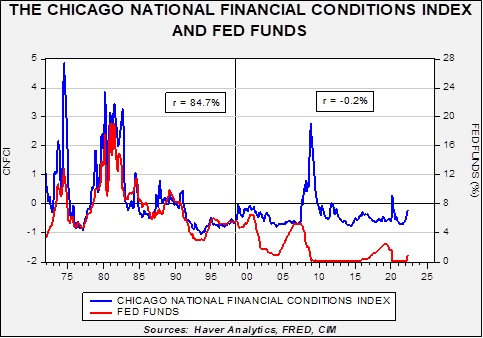
Although there are several financial conditions indexes, we prefer the one generated by the Chicago Federal Reserve Bank.  This index has 105 variables, including various interest rate spreads, volatility measures, and the levels of several indexes and interest rates.  The index is updated weekly.  A rising index suggests increased financial stress (deteriorating financial conditions).  From 1973, when the index began, to mid-1998, there was a tight correlation between the level of fed funds and financial conditions.  For the most part, policymakers could use financial conditions as a “force multiplier” to enhance policy.  When the policy rate rose, financial conditions worsened in lockstep.  When the policy eased, they rapidly relaxed.

But, after mid-1998, the two data series became almost uncorrelated.  What happened?  A couple of factors likely affected this relationship.  The first was the passage of the Gramm-Leach-Bliley Act, which eliminated the difference between commercial and investment banking.  This bill changed the financial system, leading to more financial activities occurring outside the traditional banking system.  In other words, the non-bank banking system was fostered by this bill.  Why is that important?  To illustrate, instead of borrowing from a bank, firms could issue debt or do collateralized borrowing in a much less regulated environment.  Raising the policy rate didn’t necessarily lead to reduced borrowing because the financial markets have more ways to provide liquidity due to the changes in regulation.

The second factor was greater transparency in monetary policy.  Even in the late 1980s, the FOMC acted in secret.  “Fed watchers” tried to divine if a policy change had occurred by monitoring money supply data or bank reserve changes.  But by the mid-1990s, the FOMC started announcing when the policy rate changed, and over the years, it has been increasingly transparent about its policy expectations.  In general, society tends to treat transparency as a good unto itself.  But by making its policy direction clear, markets could adjust and thus had little to fear from “surprises.”  In the non-bank banking system, participants could use derivatives to insulate their positions from policy changes, rendering them less effective.

So, due to changes in the financial markets and increased openness, the FOMC has lost its ability to use financial conditions as an effective policy tool.  For example, on the above chart, the FOMC steadily lifted rates from 2004 to 2006.  During this time, financial conditions didn’t move.  Then, in 2007-08, when financial conditions deteriorated rapidly, aggressive rate cuts had little ability to improve them.  It took years of “zero-rate policy” and rounds of Quantitative Easing (QE) to finally improve financial conditions to a level in line with the pre-Great Financial Crisis period.

Recent history shows that when financial conditions weaken, it takes aggressive and swift action by the FOMC to reduce it.  In March 2020, financial conditions deteriorated rather quickly, and not only did the FOMC cut rates rapidly, but it implemented a broad intervention into the financial markets to support their function.  In addition, the balance sheet was expanded at a pace not seen outside of wartime.  Clearly, the pandemic was part of the policy response, but widening credit spreads and other signs of financial stress were also part of the Fed’s actions.

Although the call for purposely undermining financial conditions is understandable, the above chart shows it could trigger unforeseen outcomes.  We are no longer in a world where financial conditions deteriorate in lockstep with changes to the policy rate.  Instead, over the past 24 years, these conditions have shown a tendency to ignore policy tightening, only to deteriorate rapidly with little warning.  A modest weakening of financial conditions might be welcome, increasing the potency of tighter policy.  However, a sudden spike, as seen in 2008 and 2020, could be destabilizing, forcing the FOMC to rapidly reverse its current policy path.  Sadly, such events are almost impossible to predict in advance, although we can say that they seem to occur after tightening cycles.

It is possible that 2008 and 2020 may reflect the immaturity of the non-bank financial system, and markets may have evolved to a point where such market events have become less likely.  The backstops offered by the Fed during March 2020 might serve as a blueprint for containing financial crises.  Therefore, allowing financial conditions to deteriorate is less risky.  However, it appears to us the burden of proof lies with proving that tightening won’t “break something.”  And so, we remain vigilant, watching for funding issues that could trigger a run on liquidity and force the FOMC to ease.
View PDF

Business Cycle Report (May 26, 2022)

by Thomas Wash | PDF

The business cycle has a major impact on financial markets; recessions usually accompany bear markets in equities.  The intention of this report is to keep our readers apprised of the potential for recession, updated on a monthly basis.  Although it isn’t the final word on our views about recession, it is part of our process in signaling the potential for a downturn.

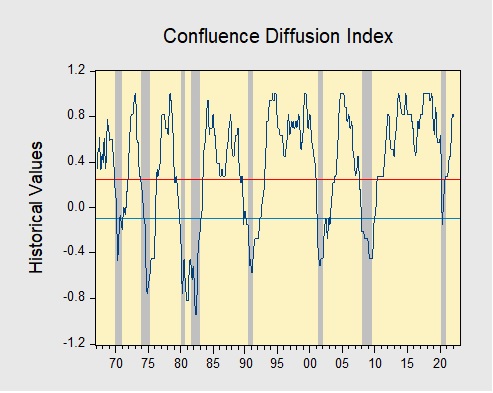
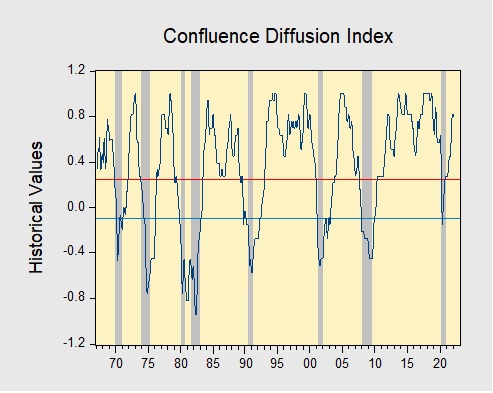
The Confluence Diffusion Index hit a post-recession high; however, several indicators have deteriorated. In April, elevated inflation and hawkish Fed policy weighed on financial market indicators, leading to a flatter yield curve and a deceleration in the annual change in the stock market index. In the labor market, indicators show firms are reluctant to lay off workers because of concerns of a worker shortage. Lastly, manufacturing and construction indicators suggest that supply chains are still a problem for firms. Consequently, the latest report showed that all 11 benchmarks are in expansion territory. The diffusion index rose from +0.8789 to +0.9394, remaining well above the recession signal of +0.2500.

The chart above shows the Confluence Diffusion Index. It uses a three-month moving average of 11 leading indicators to track the state of the business cycle. The red line signals when the business cycle is headed toward a contraction, while the blue line signals when the business cycle is in recovery. The diffusion index currently provides about six months of lead time for a contraction and five months of lead time for recovery. Continue reading for an in-depth understanding of how the indicators are performing. At the end of the report, the Glossary of Charts describes each chart and its measures. In addition, a chart title listed in red indicates that the index is signaling recession.

Read the full report

Weekly Energy Update (May 26, 2022)

by Bill O’Grady, Thomas Wash, and Patrick Fearon-Hernandez, CFA | PDF

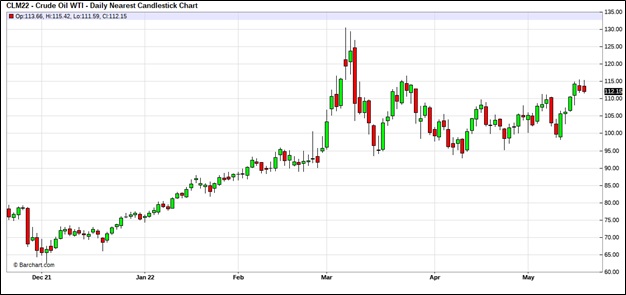
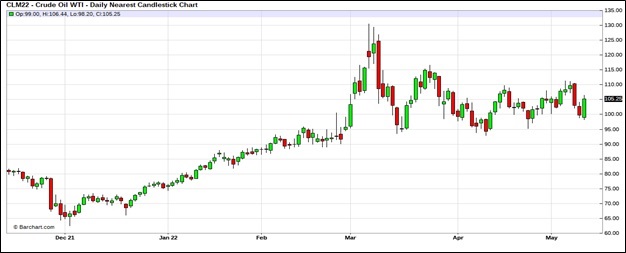
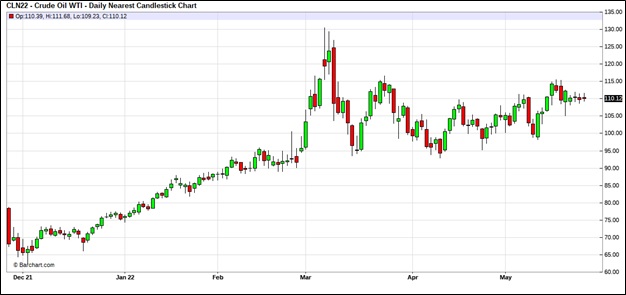
Crude oil prices have been mostly holding steady this week.

(Source: Barchart.com)

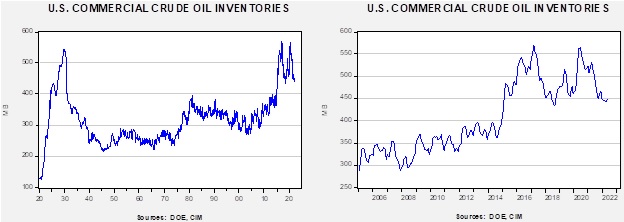
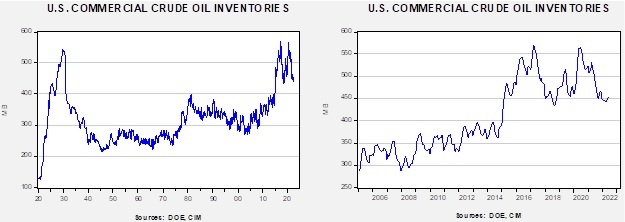
Crude oil inventories fell 1.0 mb compared to a 2.1 mb draw forecast.  The SPR declined 6.0 mb, meaning the net draw was 7.0 mb.

In the details, U.S. crude oil production was unchanged at 11.9 mbpd.  Exports rose 0.8 mbpd, while imports fell 0.1 mbpd.  Refining activity rose 1.4% to 93.2% of capacity.

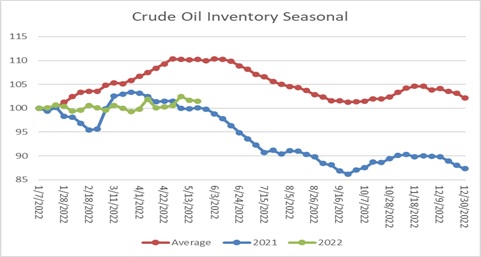
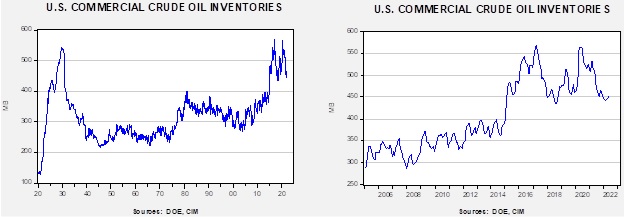
(Sources: DOE, CIM)

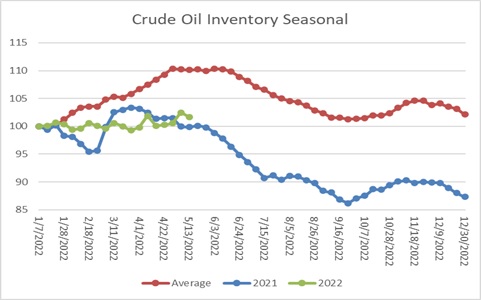
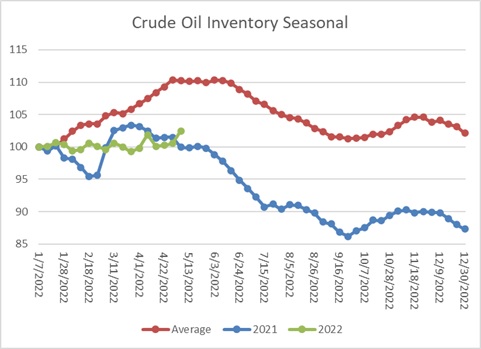
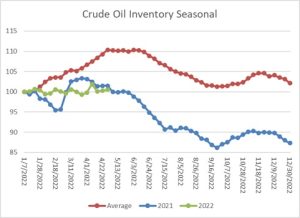
The above chart shows the seasonal pattern for crude oil inventories.  This week’s report is consistent, showing a partial reversal of last week’s rise, with rising crude oil exports and increased refinery activity offsetting the continued draw from the SPR.  Seasonally, the draw begins in earnest in June.

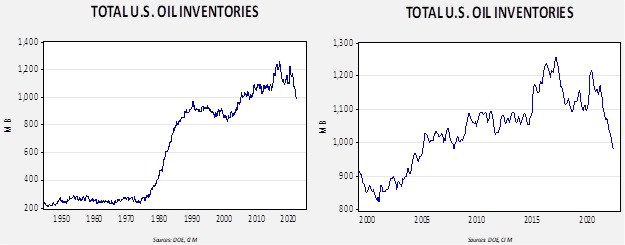
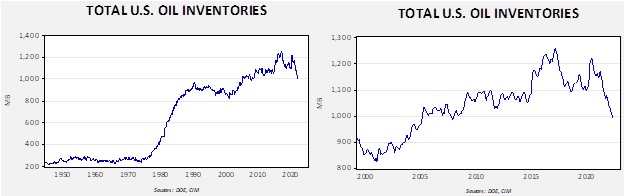
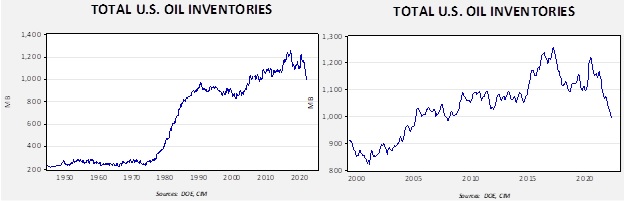
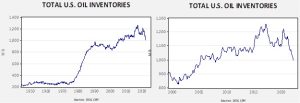
Since the SPR is being used, to some extent, as a buffer stock, we have constructed oil inventory charts incorporating both the SPR and commercial inventories.

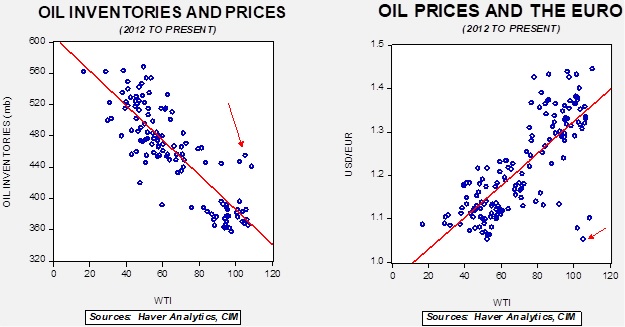
Total stockpiles peaked in 2017 and are now at levels seen in late 2008.  Using total stocks since 2015, fair value is $90.65.

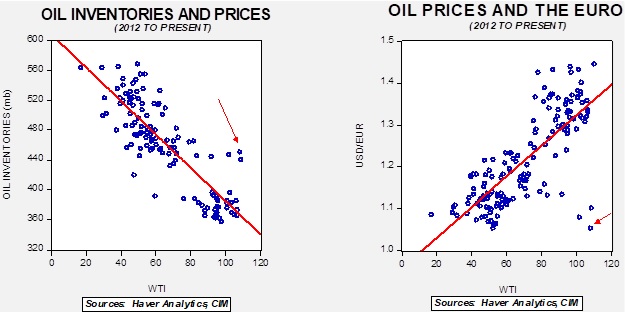
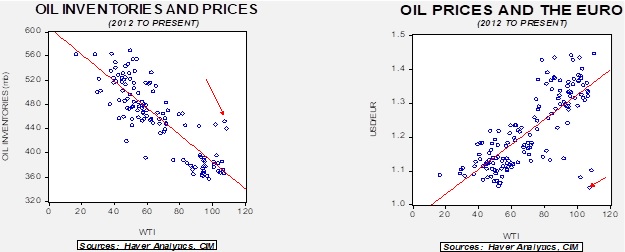
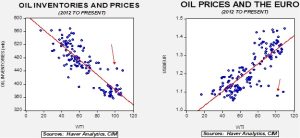
With so many crosscurrents in the oil markets, we see some degree of normalization.  The inventory/EUR model suggests oil prices should be around $60 per barrel, so we are seeing about $40 of risk premium in the market.

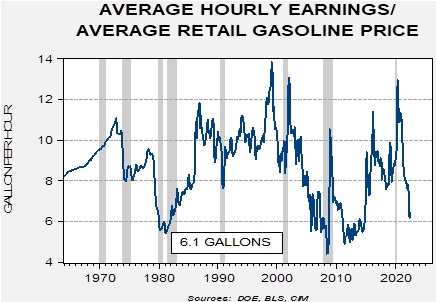
To scale the impact of high gasoline prices, we calculate the number of gallons a non-supervisory worker can purchase with one hour of work at the average national retail price of gasoline.

As the chart shows, we are approaching six gallons, which isn’t the all-time low but getting close to that level.  In general, low readings tend to track consumer confidence and presidential approval ratings.

Market news:

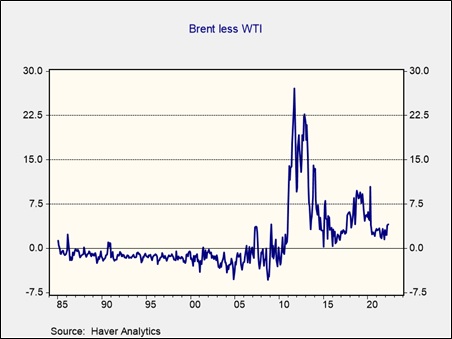
This chart shows the long-term history of the Brent-WTI spread.  Until the shale revolution, WTI regularly was priced higher than Brent.  Restrictions on exports and the explosion of shale production led the spread to flip violently around 2011.  As the U.S. increased oil exports, the spread narrowed, but Brent tended to hold its premium over WTI. The recent narrowing is likely signaling rising export demand from the U.S.

  • Despite high oil prices, U.S. production growth has been slow. Although there are many reasons for this lack of output (e.g., high input costs, labor shortages, unfriendly regulatory environment), one particular reason is that oil executives are being paid based upon profitability and less on production.
  • Meanwhile, U.S. natural gas prices are elevated in a period where prices are usually weaker. Seasonal demand usually weakens in the spring and falls as temperatures moderate.  This year, prices are elevated, in part, due to LNG exports.  The LNG isn’t quite as global as oil, but it continues to expand.
  • The North American Electric Reliability Corporation released its Summer Reliability Assessment. The risks of outages this summer are elevated.
  • Another factor limiting energy supplies is the skyrocketing cost of transportation.

 Geopolitical news:

  • The U.S. is facilitating talks between Egypt, the KSA, and Israel over the sovereignty of two small islands near the Gulf of Aqaba. The islands are controlled by Egypt but would be returned to their original owner, Saudi Arabia.  But, for this action to occur, Israel would have to approve.  The thinking is that if Israel signs off, it will create a framework for normalizing relations between Israel and the KSA.  Such an event would further expand the Abraham Accords.
    • This may be part of an attempt by the administration to heal relations with the KSA.
  • UAE President Sheikh Khalifa bin Zayed Al Nahyan died earlier this month. The leader is credited with the UAE’s economic development but has been mostly a figurehead since his stroke in 2014.  Crown Prince Mohammed bin Zayed Al Nahyan will take over as president.  Like the KSA, the founder of the UAE intended to pass leadership through his sons.  However, as this first generation ages, there is increasing speculation that MBZ, as he is known, will pass power to his son, one of the grandsons of the founder.  Like in KSA, this generational transition is fraught with risk, because the pool of potential leaders is large, and thus, there are many who will be disappointed.  This worry isn’t imminent; MBZ is only 40 and could easily rule for three decades.
  • Despite high oil prices and fears of insufficient supply, the KSA signaled it would not increase production beyond the current plan. The KSA also reiterated support for Russia, highlighting the growing rift between the U.S. and the KSA.
  • Finland’s decision to apply for NATO membership has prompted Russia to halt natural gas flows to the Nordic nation.
  • China is said to be increasing its purchases of Russian crude to build its strategic reserve by “quietly” buying Russian crude oil at deep discounts. These purchases would seem to violate sanctions, but the S. is giving Beijing a pass, perhaps wanting to avoid a confrontation with China.
  • We consider the negotiations to revive the Iran nuclear deal as dead, much like the Monty Python skit, yet talks, mostly fostered by the EU, continue. Even the Europeans acknowledge the talks are nearing their end. The Iranians deny they have made any concessions, increasing the odds the deal isn’t going to happen.
  • Hassan Sayad Khodayari, an officer of the Iranian Revolutionary Guard Corps, was assassinated at his home in Tehran over the weekend. Although no one has claimed responsibility, the general suspicion is that this is the work of the Israelis.  Israeli media is reporting that Khodayari was involved in planning attacks against Israelis, including kidnappings.
  • Yet another CEO of Petrobras (PBR, USD, 14.51) has been sacked, the third in recent months. Jose Mauro Ferreira Coelho has been replaced by Caio Mario Paes de Andrade.  Why is President Bolsonaro so angry with the company?  Because fuel prices keep rising and he wants the company to fix prices and lose money.
  • Even though the U.S. has been in talks with the Venezuelan regime, Caracas continues to work with Iran. In fact, the Iranians are working to repair Venezuela’s largest refinery.  The Paraguana refinery complex, which has a capacity of 955 kbpd) is only producing at 17% of capacity; it is unclear if Tehran has the expertise or the funds to fully restore production.
  • The EU is struggling to build a consensus on embargoing Russian oil, with Hungary being the major stumbling block. However, there are reports that the state oil firm MOL (MOL, USD, 4.14) is taking at least initial steps to process non-Russian oil.
  • The U.S. is making it clear that one of its policy goals is to “cripple” Russia’s oil industry. As part of this goal, the U.S. is considering secondary sanctions on buyers of Russian oil.  The Russian economy continues to struggle.

 Alternative energy/policy news:

  View PDF

Weekly Energy Update (May 19, 2022)

by Bill O’Grady, Thomas Wash, and Patrick Fearon-Hernandez, CFA | PDF

Crude oil prices have moved higher this week, touching technical resistance at $115 per barrel.

(Source: Barchart.com)

Crude oil inventories unexpectedly fell 3.4 mb compared to a 1.6 mb build forecast.  The SPR declined 5.0 mb, meaning the net draw was 8.4 mb.

In the details, U.S. crude oil production rose 0.1 mbpd to 11.9 mbpd.  Exports rose 0.6 mbpd, while imports rose 0.3 mbpd.  Refining activity rose 1.8% to 91.8% of capacity.

(Sources: DOE, CIM)

The above chart shows the seasonal pattern for crude oil inventories.  This week’s report shows a partial reversal of last week’s rise, with rising crude oil exports and increased refinery activity offsetting the continued draw from the SPR.  Seasonally, the draw begins in earnest in June.

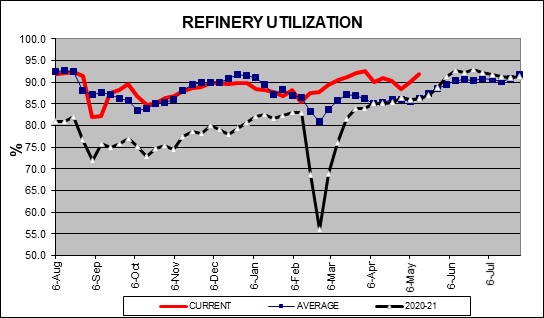
Refinery utilization is ramping up early this year, reflecting attractive refining margins.

Seasonally, refining activity reaches its peak in early June and remains elevated into Labor Day.  We expect strong demand for product to keep refinery activity at peak levels through the summer.

Since the SPR is being used, to some extent, as a buffer stock, we have constructed oil inventory charts incorporating both the SPR and commercial inventories.

Total stockpiles peaked in 2017 and are now at levels seen in late 2008.  Using total stocks since 2015, fair value is $89.15.

With so many crosscurrents in the oil markets, we see some degree of normalization.  The inventory/EUR model suggests oil prices should be around $60 per barrel, so we are seeing about $40 of risk premium in the market.

Market news:

 Geopolitical news:

 Alternative energy/policy news:

  • As CO2 concentrations continue to rise, it is becoming clear that mere reduction programs probably won’t be enough to slow accumulations of the gas. One area attracting attention and funding is carbon capture and storage.  This process takes the CO2 generated by various processes, captures it at the source, and sends it into underground storage or some other disposal method.  BP (BP, USD, 31.49) and Linde (LIN, USD, 371.18) announced a venture to capture greenhouse gases in Houston.
  • Another potential action is geoengineering, which can cover everything from directly cooling the earth to other forms of carbon storage. However, governments are leery of private actors or other governments essentially conducting climate experiments that may have uncertain outcomes.
  • Although commodity demand will always be cyclical, the structural demand for metals required for transitioning to EVs will likely support prices for an extended period. EVs are starting to have an impact on easing demand for gasoline.
  • EU companies are supporting a measure that would outlaw the sale of new gas and diesel vehicles by 2035. Policies such as these have a dampening effect on oil and gas investment.
  • One solution to expanding hydrogen use is to send the gas, along with natural gas, using existing natural gas pipelines.

  View PDF

Asset Allocation Bi-Weekly – The FOMC Speaks (May 16, 2022)

by the Asset Allocation Committee | PDF

On May 4th, the FOMC announced its policy changes.  The Fed moved its fed funds target by 50 bps, the fastest increase in 22 years; the last hike of this amount was in May 2000.  In the press conference, Chair Powell scotched the notion of a greater than 50 bps rate hike.  He did, however, suggest that similar 50 bps rate hikes will be likely for at least the next couple of meetings.

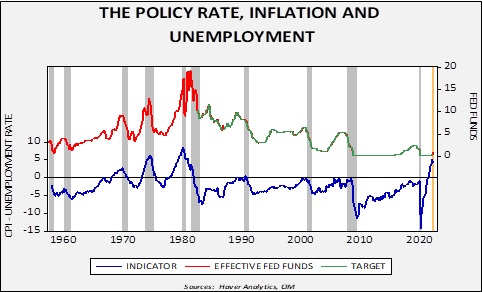
One way to look at the future path of policy is to compare the level of inflation to unemployment.  This is the classic Phillips Curve idea; although the FOMC has seemingly jettisoned this concept, history suggests that policy has been aligned with this relationship.

The upper line on the chart shows the level of fed funds along with the target; Haver Analytics has estimated the policy rate target beginning in 1982.  The lower line shows the spread of yearly change in overall CPI and the unemployment rate. From the late 1960s into the early 1980s, inflation regularly exceeded the unemployment rate, forcing policymakers to lift the policy rate aggressively to contain inflation.  These tightening cycles led to four recessions over 12 years.  After that experience, the FOMC took steps to move rates high once the spread between inflation and unemployment approached zero.  This policy stance could be called “preemptive”.

However, in the current expansion, the Fed has allowed inflation to exceed the unemployment rate by a wide margin.  On the above chart, we have made forecasts for data unavailable for April and May (the yellow shaded area on the chart).  We expect inflation to begin slowly falling, but the unemployment rate to remain low.  To normalize rates, the unemployment rate will need to rise above CPI.  The tone of Powell’s press conference suggests the FOMC is moving in the direction of achieving this target at a deliberate pace; it is likely the Fed hopes inflation will fall as supply constraints ease and thus wants to give the economy more time to adjust to tighter monetary policy.

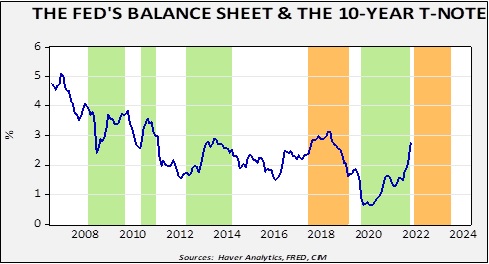
The other major announcement was that the Fed will begin to reduce the size of the balance sheet.  Quantitative tightening (QT) will start in earnest in June.  The impact of changes to the balance sheet remains controversial; the expected outcome from quantitative easing (QE) was to lower long-term interest rates.   Interestingly enough, QT and QE have tended to lift long-term rates, whereas a stable balance sheet led to lower interest rates.

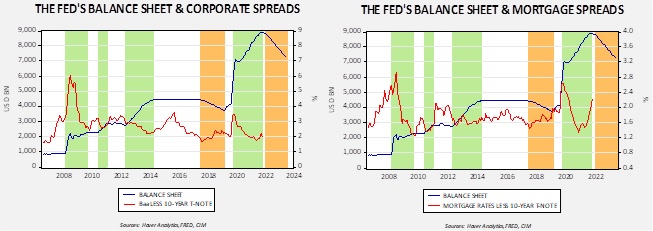
On the other hand, periods of QT tended to narrow credit and mortgage spreads.  On the chart below, periods of QE are in green, and QT in tan.

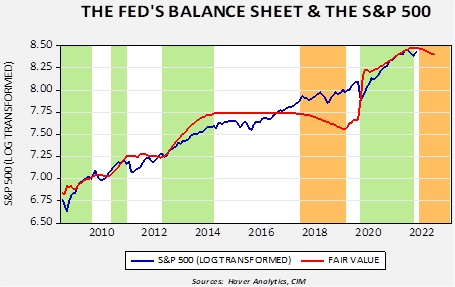
Finally, the relationship of the Fed’s balance sheet to equities is also controversial.

The S&P 500 often tracks higher during periods of QE and stalls when the balance sheet stabilized…until late 2016.  Equities forged higher even with QT, but the positive relationship between the balance sheet and equities returned during the most recent QE period.  The model would suggest that QT will have a modestly adverse effect on equities.  The biggest risk to equities is likely the business cycle. Recessions tend to bring bear markets in stocks.  But, QT on its own is probably not a bearish event.

So, to recap, tighter monetary policy, which includes higher policy rates and balance sheet reduction, increases recession risk.   Recessions are inclined to affect risk assets adversely. We expect credit spreads to widen and equities to weaken if recession odds rise.  Longer duration yields generally decline, although in periods of elevated inflation, the declines are often simultaneous with the onset of the downturn.   Although we do not expect a recession in 2022, the likelihood in 2023 is rising.
View PDF

Weekly Energy Update (May 12, 2022)

by Bill O’Grady, Thomas Wash, and Patrick Fearon-Hernandez, CFA | PDF

Oil prices have been volatile over the past few days.  A number of factors have been at play. However, the chart suggests a price range is developing between $100 to $110 per barrel.

(Source: Barchart.com)

Crude oil inventories unexpectedly rose 8.5 mb compared to a 1.0 mb draw forecast.  The SPR declined 7.0 mb, meaning the net build was 1.5 mb.  This draw from the SPR is the largest single-week withdrawal in history.

In the details, U.S. crude oil production fell 0.1 mbpd to 11.8 mbpd, although the decline is somewhat exaggerated due to rounding.  Exports fell 0.1 mbpd, while imports declined 0.7 mbpd.  Refining activity rose 1.6% to 90.0% of capacity.

(Sources: DOE, CIM)

The above chart shows the seasonal pattern for crude oil inventories.  This week’s report shows a sharp rise, reflecting the large draw in the SPR.  As refining operations expand, the SPR sales should prevent a large draw in commercial stocks.  Seasonally, the draw begins in earnest in June.
Since the SPR is being used, to some extent, as a buffer stock, we have constructed oil inventory charts incorporating both the SPR and commercial inventories.

Total stockpiles peaked in 2017 and are now at levels seen in late 2008.  Using total stocks since 2015, fair value is $87.23.

With so many crosscurrents in the oil markets, we see some degree of normalization.  The inventory/EUR model suggests oil prices should be around $60 per barrel, so we are seeing about $40 of risk premium in the market.

Market news:

(Source:  Bloomberg)

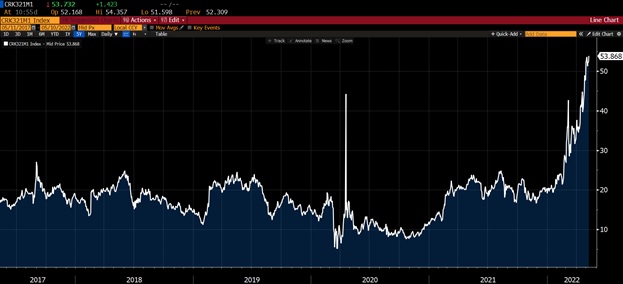
Complicating matters further is that product demand has been robust as much of the developed world emerges from the COVID-19 pandemic.  High gasoline prices are a politically sensitive issue.  This report is a primer on the gasoline market and why efforts to bring prices down will likely be less effective than hoped.

  • Part of the goal of the SPR release was to boost oil exports to support EU efforts to curtail Russian imports. However, the U.S. export infrastructure is being stretched by the surge in supply.
  • Last week, the Biden administration surprised the market by announcing a plan to refill the SPR. The DOE has released some details on the refill plan. We still harbor doubts this oil will ever be restored.
  • Although Europe is still struggling to create a unified policy concerning Russian oil and gas (see below), the expected demand for U.S. LNG has boosted American natural gas prices. We are in a “shoulder period” for demand; as summer temps rise, demand for natural gas generated electricity will rise.  The fact that prices are high now is not a good sign for consumers.
  • The restrictions on Russian oil flows are starting to affect production. Russia has limited ability to store oil, and once there is no room to ship, wells will be shut in.  In many cases, these wells will never be reopened.  Russia is attempting to reorient oil exports away from the EU (India is a favored destination), but, of course, these other destinations lack the pipeline infrastructure that has been constructed in Europe.
  • German/Qatar talks on boosting LNG supplies have become strained. Germany is demanding long-term contracts, while Qatar, wanting to take advantage of favorable market conditions, is balking at this idea.
  • China’s COVID-19 lockdowns have weakened energy demand.
  • Fuel shortages have led Nigeria to ground flights.
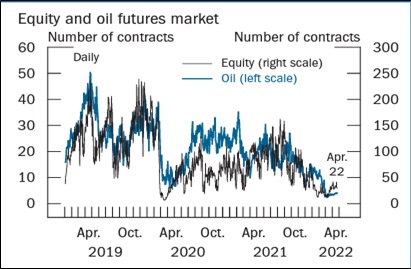
  • One area of concern has been the financing of oil and gas production and shipping. Reports suggest energy hedgers face massive trading losses due to market volatility.  Some of these losses will probably be recouped in the future, but the immediate need for cash could crimp available supplies.  There is also evidence suggesting market depth in oil futures is under strain due to price volatility.

(Source:  Federal Reserve)

Geopolitical news:

  • The EU is failing to formulate a plan to embargo Russian oil and gas. The EU structure requires unanimous approval for most measures, and Hungary has objected to sanctioning Russian oil.  Although we expect some sort of restrictions to be developed, it isn’t going to occur in the near term.  A plan to effectively ban Russian oil shipments by denying tankers insurance has also failed due to objections from Greece.
    • It should be noted that bans would adversely impact Europe. Germany could see a 12% decline in GDP if Russian natural gas is banned.
  • The odds of an Iran deal appear to be lengthening. There is rising pressure in Congress to raise obstacles to an agreement, and the overall political costs are increasing.  In addition, the benefits of a thaw are falling; more Iranian crude oil is leaking into the global economy as India and China increase purchases.  Our position has been that a deal would never occur.  Increasingly, it appears one won’t.
    • Iranian President Raisi has announced subsidy cuts on bread. As wheat prices have risen, the costs of subsidies have soared.  However, such cuts are risky.  Most of these subsidies offer sustenance to the poor.  Cutting subsidies could trigger civil unrest if inflation rises further.

 Alternative energy/policy news:

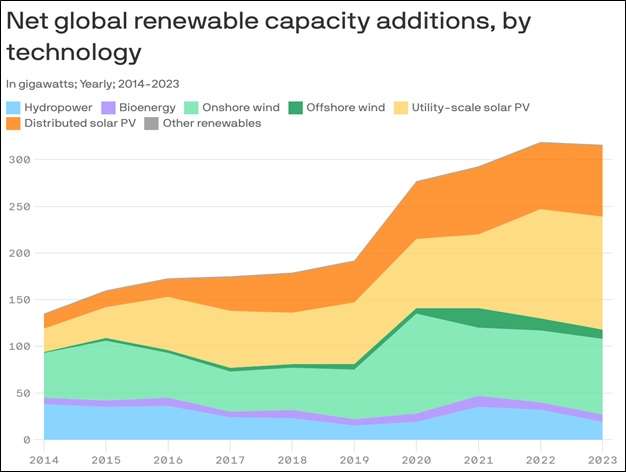
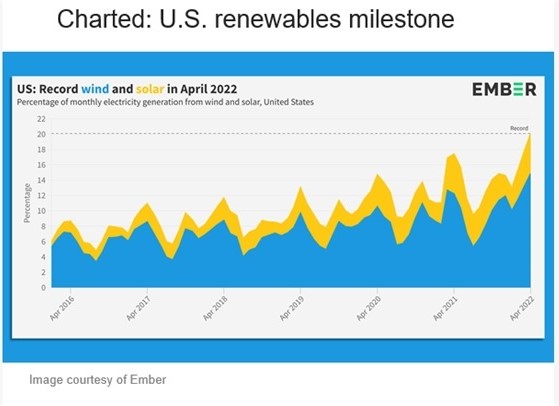
  • Renewable energy output continues to expand. A recent IEA report shows how renewables are slowly offsetting conventional energy.

(Source:  Axios)

  View PDF


[1] This spread is (2 gasoline * 42 + 1 heating oil * 42)- 3 crude oil.  Multiplying by 42 converts the gallon price to a barrel.  This spread roughly mimics the output of a U.S. refinery.

Weekly Energy Update (May 5, 2022)

by Bill O’Grady, Thomas Wash, and Patrick Fearon-Hernandez, CFA | PDF

It appears oil prices are attempting to create a trading range between $105 to $95 per barrel.  That may hold until the SPR release is complete.

(Source: Barchart.com)

Crude oil inventories unexpectedly rose 1.3 mb compared to a 0.2 mb draw forecast.  The SPR declined 3.1 mb, meaning the net draw was 1.8 mb.

In the details, U.S. crude oil production was unchanged at 11.9 mbpd.  Exports fell 0.1 mbpd, while imports rose 0.4 mbpd.  Refining activity slipped 1.9% to 88.4% of capacity.  The decline in refinery operations is a surprise and will likely be reversed in the coming weeks.

(Sources: DOE, CIM)

This chart shows the seasonal pattern for crude oil inventories.  This week’s report is consistent with last year.  Also, note that in the average data, we are at the point where the seasonal build period has ended.  Over the next few weeks, we will see if we follow the average path or track last year.

Since the SPR is being used, to some extent, as a buffer stock, we have constructed oil inventory charts incorporating both the SPR and commercial inventories.

Total stockpiles peaked in 2017 and are now at levels seen in late 2008.  Using total stocks since 2015, fair value is $85.90.

With so many crosscurrents in the oil markets, we see some degree of normalization.  The inventory/EUR model suggests oil prices should be around $60 per barrel, so we are seeing about $40 of risk premium in the market.

Market news:

 Geopolitical news:

 Alternative energy/policy news:

  • Nuclear power has a bad reputation. Three disasters—Chernobyl, Three Mile Island, and Fukushima—have made nuclear power unpopular.  Despite this reputation, it is undisputable; nuclear power emits no greenhouse gases.  Environmentalists are noticing that when nuclear power plants close, they tend to be replaced with “dirty” fuels.  We note Gov. Newsom (D-CA) is apparently “reconsidering” closing the Diablo Canyon nuclear plant, scheduled for closure in 2025.
  • In China, we are seeing a resurgence in coal consumption and plans for nuclear power expansion. The country is also the world’s largest importer of LNG.  Solar installations appear to be lagging.
  • Temperatures in India have been reaching unbearable levels, triggering rising electricity demand. This factor is lifting the demand for coal.
  • Hydrogen has been something of the “Holy Grail” of clean fuels. Having no carbon associated with the gas, it is very clean and efficient.  Nevertheless, producing it can be problematic.  “Green” hydrogen is usually made from electrolysis from clean energy, e.g., solar or wind.  “Blue” hydrogen is usually derived from natural gas.  “Gray” hydrogen comes from using electrolysis from conventional electricity.  However, less talked about is the lowest cost “gold” hydrogen.  This gas occurs naturally and can be captured similarly to natural gas.  It isn’t clear how much gold hydrogen is available, but exploration efforts are beginning.
  • The major U.S. political parties are forced coalitions. They house disparate groups that may not have many characteristics in common.  The GOP is generally considered more friendly to extractive industries, but there is an emerging Conservative Climate Caucus that wants to modify the perception of Republicans on environmental issues.  Some of this new group could be based on age; younger voters tend to be more supportive of climate issues.
  • Rising input costs are hurting the earnings of battery manufacturers.
  • The U.S. solar power industry is divided between manufacturers, who want tariffs on Chinese imports, and installers, who want to have the foreign product available. The lack of policy clarity is “freezing” the industry.  A number of senators are calling for an end to the solar study.
  • Fidelity (FNF, USD, 39.29) has decided to support bitcoin in 401(k) accounts. The company faces criticism due to the massive energy consumption that occurs in the mining process.
  • Although ethanol is considered “green” because it is made from renewable inputs, the process of fermentation creates a surprising level of CO2. This report discusses efforts to capture the gas and pipeline it to disposal sites.  Interestingly enough, plans to build pipelines for the gas have struggled to get approved.
  • The Niskanen Center argues that tax credits for EVs are targeting the wrong drivers. Instead of a system that seems to be attractive to higher-income drivers (who tend to opt for greater fuel efficiency anyway), the think tank argues the incentive should target high-mileage drivers.  In other words, the EV credits should go to drivers who have long commutes.
    • Volkswagen (VWAGY, USD, 21.54) announced its EVs are “sold out.”
  • Manchin (D-WV) is considering supporting carbon tariffs on high carbon imports.
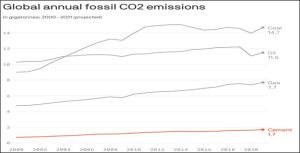
  • Entrepreneurs are working on “green” cement. Cement is a surprisingly high contributor to greenhouse gases.

(Source:  Axios)

  View PDF

Asset Allocation Bi-Weekly – The Tale of Two Surveys (May 2, 2022)

by the Asset Allocation Committee | PDF

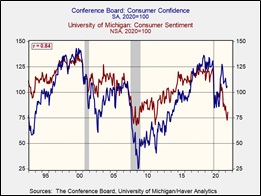
The Conference Board Survey of Consumer Confidence and the University of Michigan Survey of Consumer Sentiment are two closely followed reports about the American consumer. Domestic consumption makes up about two-thirds of the U.S. economy, so insights into consumer attitudes may predict changes in the business cycle. The latest reports from the Michigan Survey and the Conference Board showed the surveys have started to diverge in recent months. In this report, we discuss why this discrepancy exists and what these surveys tell us about the economy.

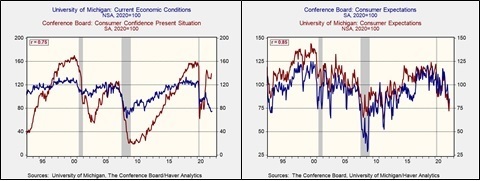
As the chart above shows, the University of Michigan Survey has fallen much faster than the Conference Board report.  The divergence between the surveys is driven by differing views regarding how consumers view the current state of the economy. Over time, the two surveys have tended to move in tandem; thus, the recent divergence is interesting. Although it isn’t clear why these differences exist, we suspect they may be related to the questions asked in each survey. The Conference Board survey focuses on broad questions regarding business conditions and employment, while the Michigan Survey focuses on a wider variety of issues ranging from inflation and the current state of the economy to spending habits and investment performance. Consequently, the optimism in the Conference Board survey may reflect consumer views of the labor market, and the pessimism of the University of Michigan survey may pick up inflation-related issues.

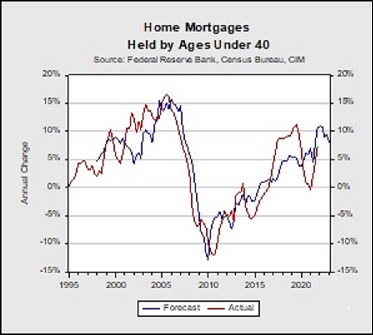
Both surveys have a current situation component and a future expectations component.  Despite the differences in the short-term outlooks, both surveys indicate consumers are becoming increasingly jaded about the future of the economy. We suspect that the decline in economic outlook has been driven largely by inflation concerns. Over the last few months, rising inflation has led consumers to change their budgetary habits and, in some cases, reduce their real consumption. When adjusting for inflation, retail sales in March fell, on an annual basis, for the first time since June 2020.  Although it is tempting to argue that a decline in consumer outlook may lead to a decrease in overall consumption, our research suggests there doesn’t seem to be a strong relationship between the two variables; the March report could be an outlier. That being said, we have found that consumer expectations provide insight into whether young adults, people under age 40, decide to take out a loan to purchase a home. Our model suggests that consumer expectations and single-family housing starts explain about 70% of the variation in the annual change in home mortgages for these young adults. The model predicts that as consumer expectations fade, young adults will probably be more reluctant to take out loans to purchase homes. Assuming our model is correct, the rise in home prices could slow by the end of the year.

View PDF

Business Cycle Report (April 28, 2022)

by Thomas Wash | PDF

The business cycle has a major impact on financial markets; recessions usually accompany bear markets in equities.  The intention of this report is to keep our readers apprised of the potential for recession, updated on a monthly basis.  Although it isn’t the final word on our views about recession, it is part of our process in signaling the potential for a downturn.

In March, the diffusion index rose further above the recession indicator, signaling that the economy remains in expansion. Higher yields on Treasuries and the Russian invasion have weighed heavily on equities. Meanwhile, manufacturing data suggests that supply chains are improving. Lastly, the labor market appears strong, with initial weekly claims falling to near historic lows. The latest report showed that all 11 indicators are in expansion territory. The diffusion index rose from +0.8182 to +0.8789, remaining well above the recession signal of +0.2500.

The chart above shows the Confluence Diffusion Index. It uses a three-month moving average of 11 leading indicators to track the state of the business cycle. The red line signals when the business cycle is headed toward a contraction, while the blue line signals when the business cycle is in recovery. The diffusion index currently provides about six months of lead time for a contraction and five months of lead time for recovery. Continue reading for an in-depth understanding of how the indicators are performing. At the end of the report, the Glossary of Charts describes each chart and its measures. In addition, a chart title listed in red indicates that the indicator is signaling recession.

Read the full report