

Business Cycle Report (June 25, 2026)

by Thomas Wash | PDF

The business cycle has a major impact on financial markets; recessions usually accompany bear markets in equities.  The intention of this report is to keep our readers apprised of the potential for recession, updated on a monthly basis.  Although it isn’t the final word on our views about recession, it is part of our process in signaling the potential for a downturn.

The US economy continued to expand in May, with signs that growth is holding steady. Our proprietary Confluence Diffusion Index remained in expansionary territory for the sixteenth consecutive month. That said, several areas warrant closer monitoring. Financial conditions are showing some signs of tightening, although liquidity remains ample. Firms are still investing; however, households remain concerned about rising inflation. Meanwhile, hiring continues to pick up but is still below levels consistent with a solid expansion.

Financial Markets

Bond and equity markets showed signs of cooling as investors braced for rising geopolitical tensions in the Middle East. Equities were notably volatile throughout the month, driven in part by intermittent negotiations between the United States and Iran over reopening the Strait of Hormuz. At the same time, the yield curve experienced a bearish steepening, reflecting an increased willingness by the Federal Reserve to tighten policy in response to persistent inflation. This shift was reinforced by several Fed officials advocating for the removal of language signaling an easing bias in the policy outlook.

Goods Production & Sentiment

Signals from the production and sentiment side of the economy were mixed. Business investment remains resilient, supported largely by continued spending on AI infrastructure and defense. However, there are emerging signs of strain in other sectors. Housing starts declined, partly due to rising materials costs. Meanwhile, both consumer and business sentiment have softened amid concerns about the Middle East conflict and its implications for prices. This is particularly evident among households, which continue to express concerns about their current financial situation compared to a year ago, even as forward-looking expectations have modestly improved.

Labor Market

May employment data came in stronger than expected, offering renewed evidence of firm labor demand. Payroll growth significantly exceeded expectations, more than doubling consensus forecasts. Job gains were concentrated in leisure and hospitality, healthcare, and local government, with early signs of a pickup in construction employment as well. Layoffs remain subdued, with the unemployment rate holding steady and initial jobless claims declining the previous month. Overall, the data suggests that labor market momentum may be strengthening.

Outlook & Risks

The economy appears well positioned to sustain the current expansion. Recent data indicates that the economic impact of the Iran conflict has been largely contained, with inflation being the primary transmission channel. Growth continues to be supported by robust capital expenditure in AI and ample credit availability, which has enabled households to maintain spending despite rising prices. While a potential hawkish shift by the Federal Reserve presents a risk to both markets and growth, it may be premature to draw firm conclusions about the policy path given the ongoing leadership transition at the central bank. On balance, near-term economic conditions remain constructive, and the outlook over the next 12 months has improved alongside easing geopolitical tensions.

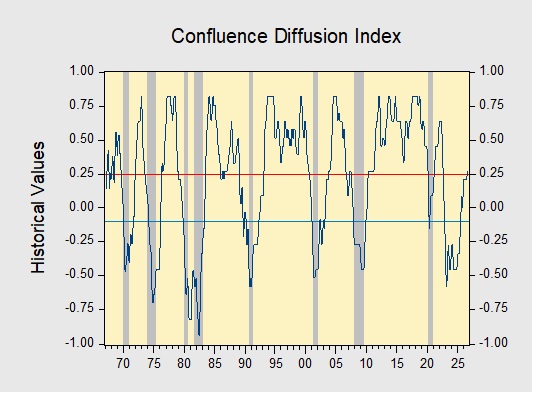
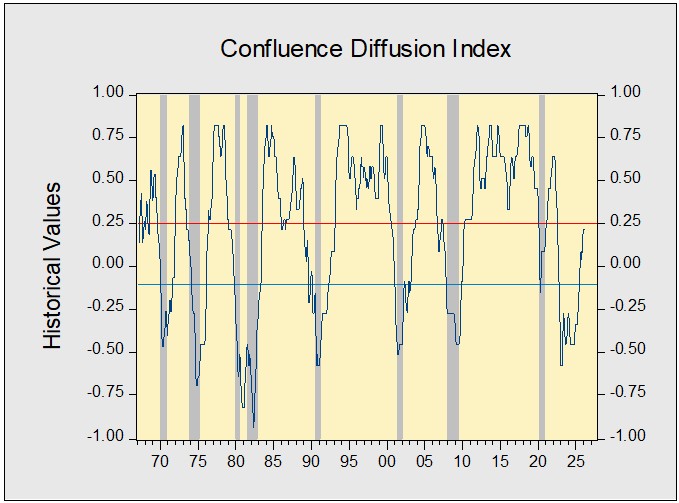
The Confluence Diffusion Index for June, which provides a composite view of the economy based on 11 benchmarks, remains in expansionary territory based on May data. The index’s value was unchanged at +0.2121, well above the recovery signal threshold of −0.1000. The index shows that the economy remains resilient in the face of geopolitical shocks. Only four of the 11 benchmarks are in contraction, up one from last month.

  • Expectations of tighter monetary policy led to a flatter yield curve.
  • Inflation expectations continued to weigh on consumer sentiment.
  • Hiring is showing signs of gaining momentum.

The chart above shows the Confluence Diffusion Index. It uses a three-month moving average of 11 leading indicators to track the state of the business cycle. The red line signals when the business cycle is headed toward a contraction, while the blue line signals when the business cycle is in recovery. The diffusion index currently provides about six months of lead time for a contraction and five months of lead time for recovery. Continue reading for an in-depth understanding of how the indicators are performing. At the end of the report, the Glossary of Charts describes each chart and its measures. In addition, a chart title listed in red indicates that the index is signaling recession.
Read the full report

Business Cycle Report (May 29, 2026)

by Thomas Wash | PDF

Note: This report was delayed due to severe data lags caused by the government shutdown. Although data for the missing months will not be released, the report is written as if no disruption occurred.

The business cycle has a major impact on financial markets; recessions usually accompany bear markets in equities.  The intention of this report is to keep our readers apprised of the potential for recession, updated on a monthly basis.  Although it isn’t the final word on our views about recession, it is part of our process in signaling the potential for a downturn.

The US economy continued to expand in April, with overall conditions improving. Our proprietary Confluence Diffusion Index remained in expansionary territory for the fifteenth consecutive month, with no indicators entering or exiting contraction, leaving three of 11 signals in warning territory. That said, several areas warrant closer monitoring. Financial conditions point to ample liquidity — particularly within the technology sector — while signals from the real economy remain mixed. Business investment is holding up, but households and firms are increasingly concerned about higher inflation. Meanwhile, labor market momentum has strengthened.

Financial Markets

AI continues to support equities, with related stocks benefiting from sustained capital expenditure by large technology firms. Much of the improved sentiment since April has been driven by strong corporate earnings and expectations of de-escalation in the US-Iran conflict. This rebound in risk appetite comes roughly a year after the “Liberation Day” shock, with markets increasingly confident in their ability to look through geopolitical disruptions. At the same time, rising debt levels and renewed inflation concerns have pushed up both long-term yields and short-term rates, even as fiscal support continues to flow into the economy.

Goods Production & Sentiment

April’s economic data presented a mixed picture, as the war-driven energy shock weighed on both households and firms. Residential construction edged lower but remained resilient, with homebuilders navigating higher energy costs and borrowing rates. New orders strengthened as firms built inventories to get ahead of the potential supply chain disruptions tied to the conflict in Iran. Consumer confidence was the weakest component, easing from the prior month as households increasingly began to anticipate higher inflation for the months ahead.

Labor Market

The US labor market showed further signs of improvement, with hiring picking up modestly. Nonfarm payroll growth has resumed at a moderate pace, led by continued strength in healthcare, while transportation and warehousing are also gaining momentum. The unemployment rate edged higher and remains above levels seen two years ago. However, layoffs are still relatively contained, with initial jobless claims only slightly higher than the previous month.

Outlook & Risks

The economy remains on solid footing, supported by strong underlying fundamentals that were in place before the conflict in Iran escalated. We continue to expect the AI investment boom to support both growth and asset prices, as sustained capital spending underpins economic activity. However, we are increasingly concerned about the direction of monetary policy. The Federal Reserve has turned more hawkish in recent weeks, raising the risk of tighter credit conditions. This shift could become a headwind, particularly as firms and households grow more reliant on credit to finance investment and consumption. Still, the near-term outlook remains firm, while the medium- to longer-term trajectory is more cautiously optimistic.

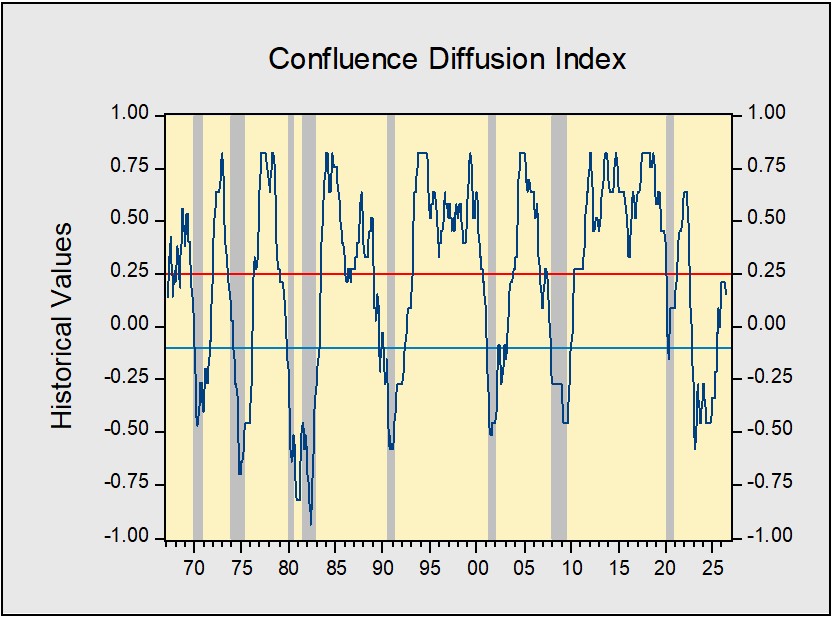
The Confluence Diffusion Index for May, which provides a composite view of the economy based on 11 benchmarks, remains in expansionary territory according to April data. The index’s value was unchanged at +0.2121, well above the recovery signal threshold of -0.1000. The index shows that while the overall economic outlook is solid, we have not seen the full impact from the conflict in Iran. This is further evidenced by the fact that only three of the 11 benchmarks are in contraction, unchanged from last month.

  • Rising inflation fears have led to a steeper yield curve.
  • Consumer sentiment is being weighed down by inflation concerns.
  • The labor market appears to be gaining momentum.

The chart above shows the Confluence Diffusion Index. It uses a three-month moving average of 11 leading indicators to track the state of the business cycle. The red line signals when the business cycle is headed toward a contraction, while the blue line signals when the business cycle is in recovery. The diffusion index currently provides about six months of lead time for a contraction and five months of lead time for recovery. Continue reading for an in-depth understanding of how the indicators are performing. At the end of the report, the Glossary of Charts describes each chart and its measures. In addition, a chart title listed in red indicates that the index is signaling recession.
Read the full report

Asset Allocation Bi-Weekly – When the Financial System Finds a Cockroach (November 3, 2025)

by Thomas Wash | PDF

No one likes finding a cockroach, especially in a place that should be clean, like the financial system. Last month, JPMorgan CEO Jamie Dimon issued a warning, suggesting that isolated loan failures — the “cockroaches” — are pointing to a much broader credit risk problem. He specifically flagged risky loan assets held by specialized lenders such as TriColor, stating that their poor performance is likely evidence of a generalized decay in loan quality across the consumer sector.

The deterioration in loan quality appears to reflect a mounting consumer debt burden that is now leading to significant household financial strain. Credit card delinquencies have surged to their highest level since the 2008 financial crisis, underscoring this pressure. In response, lenders are tightening underwriting standards and curbing new card issuance, particularly to subprime borrowers. This defensive shift indicates that the rise in defaults is largely concentrated among existing borrowers rather than driven by a fresh wave of risky lending. Yet, there is more to the story.

The recent rise in delinquencies can be partially traced to the massive expansion of consumer credit since 2019, especially among lower-income households. Credit availability for the bottom half of cardholders has surged nearly 60%, allowing many to maintain consumption amid persistent inflation. While this expansion has inevitably increased overall debt burdens, it has also enabled households to preserve spending power by spreading purchases into smaller, more manageable payments rather than paying the full cost upfront, even as real incomes have struggled to keep pace.

This surge in consumer credit has been a key mechanism sustaining consumption during recent periods of economic uncertainty. Despite repeated recession warnings over the last three years (citing the 2022 market contraction, 2023 failure of Silicon Valley Bank, and fleeting 2024 Sahm Rule alarm), aggregate consumption has remained remarkably resilient. While recent tariffs have slowed consumption compared to the previous year, the overall pace remains consistent with the strong trend that was set over the last four years.

While pockets of consumer weakness are evident, the broader systemic risk still appears to be limited. Subprime borrowers, despite the expansion of credit, hold a relatively small share of total household debt. According to Moody’s Analytics, subprime loans stood at $2.63 trillion in September, or about 15.3% of household debt. That’s a far cry from 2007 when subprime exposure reached $3.38 trillion and accounted for 28.2% of the total. The current, much smaller concentration suggests that today’s risks are more contained.

Furthermore, the immediate impact of weakness in the consumer credit market on the broader economy is likely to be muted. This continued stability in the economy is rooted in the labor market, where unemployment remains relatively low. Firms have largely retained staff, even while curtailing new hiring. The persistence of high employment means households should still be able to meet the minimum payments on credit cards and other consumer loans, suggesting their financial perseverance may last longer than many observers anticipate.

In addition, the overall US economy and total consumption expenditures are currently disproportionately dependent on high-income households. For example, the top 20% of earners account for approximately 40-50% of all consumer spending (depending on the specific measure and source). This significant concentration means that while low-income households may be forced to reduce spending due to financial strain, the overall momentum of the economy can be sustained by the resilience of the wealthiest earners.

As noted by JPMorgan, the appearance of “cockroaches” in consumer credit confirms a structural weakness. However, we conclude that this distress is a medium-term challenge, not a short-term systemic threat. This assessment is rooted in three factors: the resilience of the high-income consumer, the contained nature of subprime debt, and the strength of the jobs market. We therefore remain confident in projecting continued economic momentum and even an acceleration in economic growth next year, which should directly support strong corporate earnings and sustained broad-based support for equity markets.

View PDF

Don’t miss our accompanying podcasts, available on our website and most podcast platforms: Apple | Spotify 

Business Cycle Report (September 25, 2025)

by Thomas Wash | PDF

The business cycle has a major impact on financial markets; recessions usually accompany bear markets in equities.  The intention of this report is to keep our readers apprised of the potential for recession, updated on a monthly basis.  Although it isn’t the final word on our views about recession, it is part of our process in signaling the potential for a downturn.

The US economy continued to expand in August, though warning signs are starting to appear. Our proprietary Confluence Diffusion Index remained out of contraction territory for the seventh straight month. Three indicators slipped back into contraction, raising the total number of warning signals to five out of 11. Despite these concerns, both stock and bond markets were bolstered by optimism regarding a potential shift in monetary policy. Signals from the “real economy” remain mixed, with business spending holding up, while households and firms continue to express concerns about the impact of tariffs. The labor market showed a notable slowdown, with firms hiring fewer workers, indicating a weakening in labor demand.

Financial Markets

Investors broadened their focus beyond the Information Technology sector. This shift is supported by growing optimism about the wider economy, driven by strong corporate earnings. Leading the performance charge were the Health Care and Materials sectors. In the bond market, yields have begun to fall as recent economic data suggests the Federal Reserve will prioritize maximum employment over price stability. This change in sentiment is largely due to evidence that the hiring slowdown was more significant than initially estimated, while inflation, though still elevated, has remained roughly in line with expectations.

Goods Production & Sentiment

August’s economic data presented a mixed picture. While new orders continued to show signs of strength, the housing market painted a different story. Housing starts fell last month, in an indication that homebuilders remain hesitant to begin new projects due to ongoing uncertainty in the market. At the consumer level, households expressed growing apprehension about the labor market and persistent concerns over rising prices. Conversely, the business outlook, while still subdued, showed signs of improvement as deliveries have picked up, driven by firms actively rebuilding their inventories.

Labor Market

The US labor market showed further signs of deterioration in August, with hiring slowing to a critical level. For the first time since the pandemic, the number of payrolls has dipped into “contraction” territory, a clear signal that labor demand has weakened. While the unemployment rate remains low, it did tick up slightly from the previous month. Nevertheless, initial jobless claims have remained relatively subdued, suggesting that firms are still reluctant to lay off workers. The shift toward a “low-hiring, low-firing” labor market is a notable trend.

Outlook & Risks

The economy may have lost some of its momentum, but it remains in a good state. The possibility of easier monetary policy and continued investment in AI should provide a lift. We believe the markets will continue to focus on monetary policy and corporate earnings as investors seek reassurance that the economy is not being negatively impacted by tariffs. Consequently, we are cautiously optimistic about risk assets, given the strong underlying fundamentals, but we are waiting for confirmation that this growth is sustainable for the medium term.

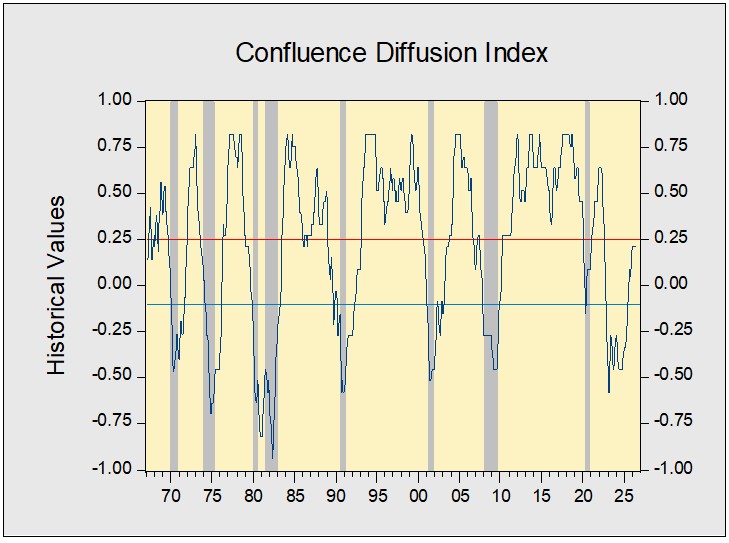
The Confluence Diffusion Index for September, which provides a composite view of the economy based on 11 benchmarks, remains in expansionary territory according to August data. The index’s value fell from +0.1515 in July to +0.0909 in August, but it is still well above the recovery signal threshold of −0.1000. This shows that while the economy continues to expand, the breadth of that expansion is narrowing. This is further evidenced by the fact that five of the 11 benchmarks are now in contraction, an increase from just two last month.

  • Job growth concerns led to a flattening of the yield curve.
  • Consumer sentiment is being weighed down by job uncertainty.
  • The labor market appears to be in a phase of “low hiring and low firing.”

The chart above shows the Confluence Diffusion Index. It uses a three-month moving average of 11 leading indicators to track the state of the business cycle. The red line signals when the business cycle is headed toward a contraction, while the blue line signals when the business cycle is in recovery. The diffusion index currently provides about six months of lead time for a contraction and five months of lead time for recovery. Continue reading for an in-depth understanding of how the indicators are performing. At the end of the report, the Glossary of Charts describes each chart and its measures. In addition, a chart title listed in red indicates that the index is signaling recession.
Read the full report

Business Cycle Report (August 28, 2025)

by Thomas Wash | PDF

The business cycle has a major impact on financial markets; recessions usually accompany bear markets in equities.  The intention of this report is to keep our readers apprised of the potential for recession, updated on a monthly basis.  Although it isn’t the final word on our views about recession, it is part of our process in signaling the potential for a downturn.

The US economy sustained its expansion in July, and our proprietary Confluence Diffusion Index stayed out of contraction territory for the sixth straight month. Two indicators entered expansion territory, which helped lift the overall diffusion index. Despite initial concerns, the equity markets were positively affected by the reduction in trade uncertainty. Bond markets, however, showed concern about the potential removal of Federal Reserve Chair Powell. Signs of improvement were also seen in the real economy, with both business spending and construction showing growth. The labor market remained stable but did show some signs of weakening.

Financial Markets

Equity markets are proving resilient, with the ongoing trade friction having little apparent impact on investor sentiment. This optimism has spurred a rally, led by strong performances in the Utilities and Information Technology sectors. In the bond market, yields are rising, a reflection of growing investor unease over a potential threat to the Federal Reserve’s independence. The concern is that if its autonomy is compromised, the Fed could be pressured to prioritize maximum employment over its core mandate of price stability, an outcome that would have significant implications for monetary policy.

Goods Production & Sentiment

July brought encouraging signs of resilience across key economic sectors. The goods production and sentiment segments notably improved, marked by the first expansion in our indicator that tracks the three-month average of new orders for core nondefense capital goods since 2022. This industrial strength was complemented by a significant jump in housing starts, driven by a pivot toward larger multi-family projects. Furthermore, consumer confidence rebounded noticeably as expectations began to normalize following earlier tariff-related shocks, although the indicator remains in contraction territory.

Labor Market

The labor market was the sole category exhibiting signs of weakness, but conditions remain broadly healthy. A slight increase in the unemployment rate weighed on the index, pulling it further into contraction territory. However, downward revisions to July’s nonfarm payrolls pushed the indicator to just above the contraction threshold. Some of this weakness is attributable to firms adopting a more risk-averse approach amid ongoing trade uncertainties; this should improve as greater policy clarity emerges.

Outlook & Risks

The economy is on solid footing, with some metrics reaching post-pandemic highs. This trend is expected to continue, provided policy remains predictable. Markets are likely to focus on the potential for monetary easing. While lower rates could mitigate the impact of tariffs on businesses, they also risk fueling inflation by stimulating consumption. Consequently, we are cautiously optimistic on risk assets due to strong fundamentals but await confirmation that this growth is sustainable for the medium term.

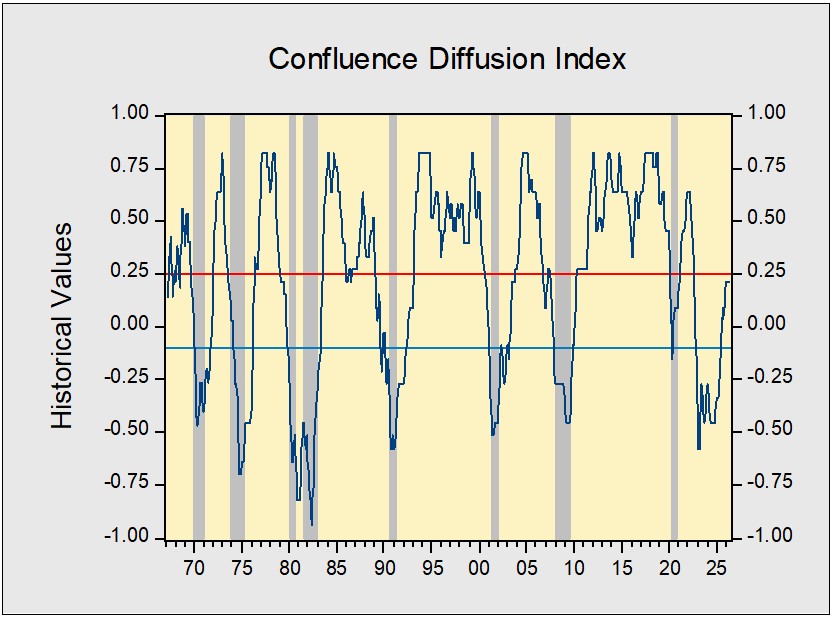
The Confluence Diffusion Index for August, which encompasses data for July, remains well above the recovery indicator. However, two of the 11 benchmarks remained in contraction territory from last month. Using July data, the diffusion index rose from -0.0303 to +0.1515, above the recovery signal of -0.1000.

  • Equities softened due to trade tensions but remain elevated.
  • Business spending showed signs of picking up.
  • Revisions hurt job numbers but not enough to enter contraction territory.

The chart above shows the Confluence Diffusion Index. It uses a three-month moving average of 11 leading indicators to track the state of the business cycle. The red line signals when the business cycle is headed toward a contraction, while the blue line signals when the business cycle is in recovery. The diffusion index currently provides about six months of lead time for a contraction and five months of lead time for recovery. Continue reading for an in-depth understanding of how the indicators are performing. At the end of the report, the Glossary of Charts describes each chart and its measures. In addition, a chart title listed in red indicates that the index is signaling recession.
Read the full report