Asset Allocation Weekly (February 14, 2020)

by Asset Allocation Committee

The data on U.S. residential real estate has been improving in recent months.  Housing tends to have an outsized effect on the economy.  Not only do housing purchases trigger follow-on buying of consumer durable goods (e.g., furniture and furnishings, etc.) but non-durables as well (e.g., basic household items).  A house is an asset and there is a wealth effect that affects future spending as well.  The direct impact on GDP is rather modest; the average contribution to GDP from residential real estate is only 0.08% per quarter.  However, there is evidence that a weak housing market has been a precursor to recession.

This chart shows the four-quarter rolling contribution to GDP from residential real estate.  We have applied a Hodrick-Prescott Filter to the data to establish the underlying trend.  Since 1980, with one exception, a negative reading on the trend has been a warning of eventual recession.  The only exception was the 2001 recession which was an unusually mild downturn.  In Q1 of last year, the trend indicator turned negative.  Although it can take a long time from signal to recession (it turned negative in Q1 2005, for example), it has been a reliable signal of economic weakness.  However, some housing indicators have shown notable improvement recently, which may lead to the trend rising later this year.  Here are a couple indicators we are watching.

Home ownership rates have been rising rapidly.

In 1995, the government began to aggressively support home ownership.  Credit restrictions were eased, and refinancing was encouraged.  The home ownership rate peaked at 69.3% of occupied homes in 2004.  The housing crisis led to a collapse in this metric, reaching a trough of 63.1% in 2015.  As the chart shows, the homeownership rate has been rising rapidly since, reaching a new cycle high of 64.9%.  The rise in home ownership rates has increased the most among households earning less than median family income.

Although there is a potential credit quality issue with less affluent home buyers, the rise should be supportive for economic growth.

The only “fly in the ointment” has been that home prices have been rising rapidly.  Although it hasn’t adversely affected affordability due to low mortgage rates, it will make the housing market increasingly sensitive to interest rates.

Ideally, rising prices for existing homes should spur new building.  Housing starts are beginning to accelerate, which is a good sign.  If housing continues to accelerate, our estimates for GDP this year may be overly conservative.

View the PDF

Weekly Geopolitical Report – Investment Implications of Changing Demographics: Part I (February 10, 2020)

by Patrick Fearon-Hernandez, CFA

(Note: Due to the President’s Day holiday, our next report will be published on February 24.)

In the 1960s and 1970s, people worried a lot about rapid population growth.  According to the United Nations, the world’s population was growing at an average annual rate of more than 1.9% during those decades, jumping from 3.0 billion in 1960 to 4.5 billion in 1980.  That created a lot of concern about the implications for the environment, social stability, and the economy.  However, many people don’t realize that population growth has slowed dramatically since then.  The global population is expected to grow only about 1.05% in 2020, and growth is projected to slow all the way to zero by 2200.  This dramatic slowing and the associated aging of the population are already having a big impact on society.

In theory and practice, population trends should affect investment returns, even if it’s hard to separate their impact from other, shorter-term economic and financial factors.  This three-part series aims to lay out the broad contours of today’s global population story, with a focus on last year’s updated forecasts from the UN Population Division.

Part I of the report will focus on the broad contours of today’s global population trends and what they mean for relative geopolitical power in the coming decades.  In two weeks, Part II will focus on specific demographic trends in the United States.  The following week, Part III will examine the economic impact of these trends.  Many other forces will have a greater impact on investments in the short run, but Part III will conclude with a discussion of how these demographic trends are likely to affect the financial markets in the long run.

View the full report

Asset Allocation Weekly (February 7, 2020)

by Asset Allocation Committee

The Commerce Department recently released its first iteration of Q4 GDP.  The overall growth rate, at 2.1%, was mostly on forecast but the composition of the growth showed some unexpected developments.  In this week’s report, we will examine the most interesting changes and what it may be telling us about future economic activity.

To analyze the data, we focus on a set of statistics called “contributions to GDP growth.”  These datapoints show how much various parts of GDP contributed to overall growth.  Here is a chart of the data.

The largest positive contributor to growth was net exports; although it is not unprecedented, outside of recessions, net exports are usually a drag on growth.  It is important to note that this data is looking at the rate of change of the change, so a smaller deficit will contribute positively to growth.

Net exports are the sum contribution of gross imports and exports.  Usually, during expansions, the contribution from gross imports is negative.  But, during recessions or when growth falters, imports fall and contribute positively to growth.

This chart shows the four-quarter moving average of the contribution of gross imports to GDP.  A positive contribution tends to be consistent with recession.  So, is that the case this time?

It might be, but there are two reasons why this event might be a false positive.  First, the trade wars have probably had some impact on reducing imports.  Since WWII, the general trend in tariffs has been downward.  The recent reversal in this trend is a new factor that may be shifting consumption to domestic goods and away from imports.  In some respects, this is the goal of the administration’s trade policy.  Second, there is evidence that U.S. firms accumulated inventories in the months prior to the Phase One trade deal with China.  This was likely done to buy goods that might be the target of future tariffs.  As a deal was made, it would make sense for firms to reduce inventories.  The act of selling down inventories would reduce imports.

We will be watching the gross import data with great interest this year to see if (a) we are seeing a structural change in the economy where imports decline, or (b) we are on the cusp of a recession.  For now, the most likely explanation is that the swing in gross imports was affected by trade policy uncertainty.  But, if other economic data begins to corroborate the recession signal from gross imports, we would recommend that investors reduce portfolio risk.

View the PDF

Weekly Geopolitical Report – The U.S.-China “Phase One” Trade Deal: Part II (February 3, 2020)

by Bill O’Grady

In Part I of this report, we offered a detailed examination of “Phase One” of the recent trade agreement between the U.S. and China.  This week, in Part II, we will examine the ramifications of the deal and conclude the report with market effects.

China appears to be the “loser” in this deal.  Our careful reading of the report does support the notion that China gave up more than it got in this arrangement.  All leaders of governments try to avoid looking weak; Chinese leaders especially worry about appearing fragile to avoid comparisons to the Opium War era.  So, if this take is accurate, what led to this outcome?

View the full report

Asset Allocation Weekly (January 31, 2020)

by Asset Allocation Committee

Last week, we updated our thoughts about a melt-up in equity markets.  We observed that retail flows had diverged from equity market performance and noted that if sentiment shifts and retail investors come into equities, the market could rise rapidly to levels that may not be sustainable.  This week, we are dealing with the opposite problem—a potential “black swan” from the Wuhan virus and the subsequent decline in risk assets.

The Wuhan virus is a coronavirus that recently emerged in the Chinese city of Wuhan in the Hubei province.  It likely originated in wild animals and “jumped” the species barrier to become a human infection.  Since the virus is evolving rapidly, we won’t cover the details of the disease in this report.[1]  In this report, we will discuss how the virus could affect financial markets and how investors should handle it.

Pandemics[2] can have lasting and significant effects.  The Black Death, transmitted by a flea-borne bacterium, killed about 25% of the world’s population.  The subsequent population reduction led to a 3.5x jump in real wages in Britain from 1310 to 1450.[3]  However, modern medicine has tended to reduce the economic impact of pandemics.  The worst influenza pandemic, the Spanish Influenza of 1918, infected 500 million and killed up to 100 million globally.  The economic impact was notable but rather short; within a couple of years, the U.S. economy had recovered.

The Spanish Influenza is shown in yellow.  The pandemic did have an impact on output but was dwarfed by the post-WWI recession of 1921.

The current situation is being compared to the SARS epidemic of 2003, which mostly affected China.  Using data from Capital Economics,[4] the disease clearly had an adverse effect on the Chinese economy.

(The dates on the circle portion of the chart are clearly mislabeled—they should read Q2 2003 through Q2 2004.)

What did financial markets tell us about SARS?  This is a chart of the Hang Sang Index from November 2, 2002, to July 31, 2003.

If this event follows roughly the same pattern as SARS, then Chinese equities could see a 15% decline.  It should be noted that SARS was first detected in November 2002 but was not reported to the WHO until February.  Beijing is acting much faster this time around so the timing could be compressed.  It is also important to note that by June the Hang Seng had recovered most of its losses.  Such recoveries are typical from these events.

What should investors take from this analysis?  First, these sorts of events usually have a three- to five-month period during which they have a significant impact on financial markets.  There is always fear that this one will be different and it is possible that it will be.  But, more than likely, the Wuhan virus will peak in the next six weeks and the recovery will start.  Second, it’s important to note that the operative factor affecting financial markets from this virus is fear.  The CDC estimates that between 291k to 646k die each year from influenza.  If the world has 8k cases of the Wuhan virus and a 10% lethality rate (which would be roughly in line with SARS), then we are looking at about 800 fatalities worldwide, with the majority in China.  That is notable but far less than the number of likely fatalities from influenza this year.  Still, the element of the unknown will tend to lead markets to overshoot to the downside which may open opportunities for a recovery in the spring.

View the PDF


[1] Interested readers can follow the evolving details in our Daily Comment.

[2] Pandemic is an epidemic with global proportions.

[3] Scheidel, W. (2017). The Great Leveler: Violence and the History of Inequality from the Stone Age to the Twenty-First Century. Princeton, NJ: Princeton University Press, p. 303.

Business Cycle Report (January 30, 2020)

by Thomas Wash

The business cycle has a major impact on financial markets; recessions usually accompany bear markets in equities.  We have created this report to keep our readers apprised of the potential for recession, which we plan to update on a monthly basis.  Although it isn’t the final word on our views about recession, it is part of our process in signaling the potential for a downturn.

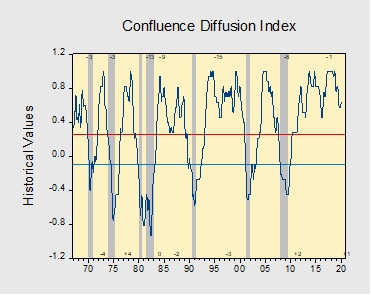
December brought a wave of positive news about the economy. U.S. large and mid-cap equities ended the year at record highs largely due to strong performance in the Technology sector.[1] Moreover, the U.S. and China announced an agreement for the “Phase One” trade deal. Additionally, strong retail sales around the holiday break offered reassurance that U.S. consumption, which is the largest contributor to GDP, remains strong. However, not all was positive. The manufacturing sector continued to show signs of weakness that will likely persist into 2020. Last month, Boeing (BA, 323.89), arguably the largest U.S. manufacturing exporter, announced that it will suspend production of its Boeing 737 Max starting in January. It is estimated that the production cut will reduce annualized GDP by 30 to 50 bps. That being said, our diffusion index has remained unchanged from the previous month with nine out of 11 indicators in expansion territory. The reading for this month came in at +0.575.

The chart above shows the Confluence Diffusion Index. It uses a three-month moving average of 11 leading indicators to track the state of the business cycle. The red line signals when the business cycle is headed toward a contraction, while the blue line signals when the business cycle is headed toward a recovery. On average, the diffusion index is currently providing about six months of lead time for a contraction and five months of lead time for a recovery. Continue reading for a more in-depth understanding of how the indicators are performing and refer to our Glossary of Charts at the back of this report for a description of each chart and what it measures. A chart title listed in red indicates that indicator is signaling recession.

View the complete PDF


[1] The basis used is the S&P 500 and S&P 400.

Keller Quarterly (January 2020)

Letter to Investors

You don’t need me to tell you this, but 2019 was an unusually good year for the public financial markets.  Virtually every market rebounded nicely from the sharp sell-offs that occurred in late 2018.  How broad was the advance?  Confluence Investment Management’s Asset Allocation team tracks 12 major asset classes globally, consisting generally of domestic and foreign stocks, domestic bonds, real estate, commodities, and cash.  In 2018 only two of these asset classes had positive total returns: U.S. Treasury bonds and cash.[1]  2019 was a different story entirely: all 12 asset classes had positive returns in the calendar year.  In fact, only three of the 12 asset classes failed to provide a total return of at least 10% (U.S. Treasury bonds, commodities, and cash).  Yes, 2019 was truly an unusual year.

Such a year raises expectations for the following year, inasmuch as most investors seem to peg their expectations to the market.  So, what’s ahead for 2020?  If you read my October 2019 letter, you know I can’t answer that question.  We cannot predict the future.  As I noted in that last quarterly letter, it seems odd to have to say that, but so many people seem to believe that investing is all about making accurate forecasts of future events.  We believe that to invest according to a prediction of the future is pure speculation.  Rather, we hold that investing in an uncertain world does not depend upon a prediction, but upon a process.  It is our view that a successful investment process is one that enhances the probability of favorable outcomes.

Confluence has recently begun producing podcasts, which are available on our website.  I would particularly encourage you to listen to podcast episodes #5 and #6, which discuss the importance of utilizing a repeatable investment process in order to enhance the probability of success in an uncertain investment world.  At Confluence, we have worked hard over the years to create processes that we believe improve the probabilities of good investment returns.  We work equally hard to consistently apply those processes day after day, year after year.

In episode #6, I liken a good investment process to that of a good batter in baseball.  Good batting form and approach improve the odds of success, but don’t guarantee it.  (Indeed, an excellent batsman still fails in about 70% of his at-bats!)  Likewise, in investing, a good process improves the odds of success, but doesn’t guarantee it.

The reason there are no guarantees in investing is that randomness is always with us.  (Statisticians say randomness for what most of us call luck.)  A good batter may put a good swing on a pitch and hit the “daylights” out of the ball yet hit it right at a fielder.  But, often, a good batting approach will result in a hit.  We seek to do the same in investing.  A good investment process may still result in a less-than-good outcome due to the vagaries inherent in the world of investing, but we believe the probabilities of good outcomes are enhanced by a consistently applied process.

Thus, even though we don’t know what will happen in 2020, we feel confident that consistent adherence to good processes will improve the probabilities of good outcomes.  We don’t know whether the economy will fall into a recession this year or who will be elected president in November, but we must manage client assets regardless of how these events unfold.  Success, or the lack thereof, will not depend on whether we “guessed right,” but on whether we stuck to our processes.  That’s how we look at the coming year.  It may not be as exciting as a newsworthy forecast, but, unlike predicting the future, it is something we can do.

We appreciate your confidence in us.


Gratefully,

Mark A. Keller, CFA
CEO and Chief Investment Officer

View the PDF


[1] This and all other references to asset class performance in this letter are based on total returns of generally accepted market indices for each asset class.

Weekly Geopolitical Report – The U.S.-China “Phase One” Trade Deal: Part I (January 27, 2020)

by Patrick Fearon-Hernandez, CFA

After months of negotiations, the U.S. and China signed “Phase One” of what is expected to be a multiple-phase trade deal.  After noting media response to the agreement, we were struck by the dismissive consensus narrative that has developed.  Our careful review of the document seemed to suggest a much more substantial arrangement had been struck and the general analysis missed a good deal of nuance.  In this report, we will offer a detailed recap of the official agreement.  We usually don’t engage in this sort of point-by-point analysis but, in this case, we feel it is necessary because points may have been overlooked.  Next week, in Part II, we will examine the implications of the deal, and, as always, close with market ramifications.

Intellectual Property
Even though President Trump has touted China’s commitment to ramp up U.S. imports under the deal, and media analysts have emphasized the U.S. promise to postpone or roll back its tariffs against China, the first 16 pages of the 94-page agreement focus on protecting intellectual property.  That suggests U.S. Trade Representative Lighthizer’s top priority was to rein in China’s longstanding efforts to soak up foreign technology and industrial secrets by hook or by crook.  It probably also signals the U.S. intention to pursue fundamental changes in China’s legal system and industrial structure over time.  The key provisions agreed upon include:

View the full report