Letter to Investors
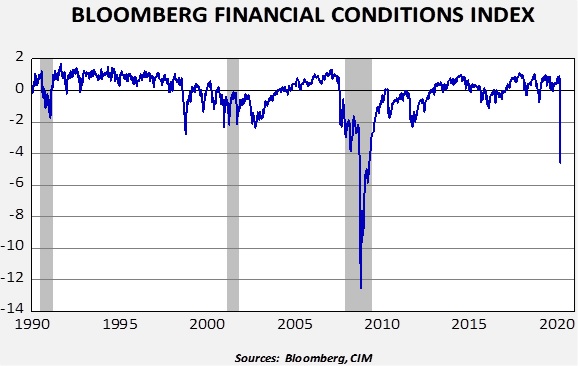
The last three weeks of financial market turbulence have been among the most harrowing I’ve ever seen. To my memory it’s been a combination of October 1987 and October 2008, two months I’d prefer to forget. While the stock market was dropping sharply and quickly, U.S. Treasury bonds were soaring almost as fast.[1] In my last two quarterly letters I’ve noted the impossibility of seeing into the future. I think we’ve now established beyond a reasonable doubt that neither we nor anyone else can forecast future events. Within a surprisingly short period of time, the U.S. economy (and the global economy) has moved from a period of steady growth and low unemployment to a position of great vulnerability. How did this happen? Three things have quickly conspired to bring us to this point. The first two were both new and invisible until quite recently. The third was a known concern lurking out of sight (but always there in a long economic expansion). These three causes of our troubles are:
- The coronavirus known as SARS-CoV-2, which produces a serious and sometimes fatal disease known as COVID-19, has spread around the world. This virus began in China in December 2019 and began moving across that country in the first two months of this year. From there the virus moved east and west across the world (as almost all viruses do). This virus has proven to be particularly dangerous because it is virtually as contagious as the common cold but has a mortality factor somewhat worse than seasonal influenza. Our chief market strategist, Bill O’Grady, and his team have been tracking the path of this virus since January. As it has neared the U.S. it has become apparent that it will cause an economic slowdown here, since the most effective way to combat this virus is social isolation, which translates to much lower economic activity. Because the virus seems to have an arc of virulence roughly two to three months in length, it has been our view that the virus alone was not enough to cause a recession here or cause lasting economic damage. Over the last week, that view has changed due to the second causal factor.
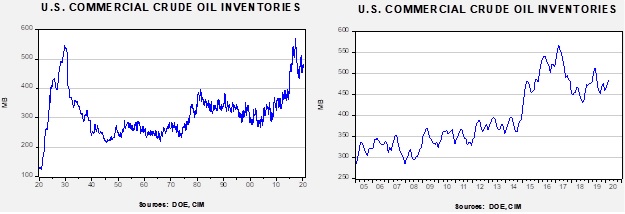
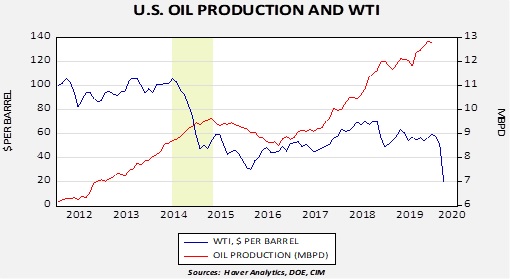
- An oil price war has broken out between OPEC, led by the Kingdom of Saudi Arabia (KSA), and the Russian government. Both governments are oil-dependent and thus benefit from higher (but not too high) oil prices. This mutual goal has been frustrated in the last decade by increasing oil supplies from outside of OPEC and Russia, mostly from the United States. In a meeting that concluded on March 7, the KSA tried to convince Russia to agree to a set of production cuts that would keep prices high. Russia declined to reduce oil production and instead announced its intention to increase production to drive prices down. The KSA has since also announced production increases. These two petrostates appear to be intent on driving prices down in order to: a) maintain and grow market share in China, the world’s #1 importer, and b) reduce U.S. shale producers’ share of world markets by moving oil prices below their costs of production. Once relieved of the U.S.’s large oil production, they hope that prices will rise more permanently. This is a high-stakes game, where the loser is the U.S. oil industry. If the U.S. government cannot force the end of this price war quickly, the probability of a recession in the U.S. rises substantially when combined with the virus-related slowdown. It so happens that right now the U.S. is vulnerable to a recession for a very ordinary reason, our third factor.
- Private sector debt always grows as an economic expansion ages. The reason for this is that investors and businesspeople become more bold as an expansion gets old. The further a recession recedes into the rear-view mirror, the more people believe it won’t happen again. Thus, they become bolder in their investments. We are fortunate that, unlike 2008, the debt growth this time is not concentrated in the consumer sector like it was then. Twelve years ago, residential mortgage debt was the big problem. This time the debt problem is corporate debt. This has been something we’ve been monitoring for a while. Both our Market Strategy team and our Asset Allocation team have noted a heightened probability of economic difficulties in their recent publications.[2] Much of this debt, especially that below-investment grade, is tied to the energy industry. Thus, the price war in oil has increased the probability of financial troubles in the oil patch and on Wall Street. Much of this debt is outside of the U.S. banking system. Post-2008 reforms required U.S. banks to hold higher levels of equity capital and reserves, reducing their ability to lend. The demand for debt capital grew, however, as both the economy and the energy industry grew. Non-bank lenders grew dramatically over this decade to meet the demand for money, with the result that financial risk also grew. The “staying power” of energy companies through this likely oil price “valley” is thus reduced by their debt loads, and the lenders who serve them could become impaired as well.
In my opinion, any one of these factors would have been unlikely to produce a recession. For instance, factor #2 did occur just five years ago, when oil prices declined from near $100 per barrel to about $30 over 15 months. While the oil industry suffered its own recession, the U.S. avoided a general recession. The coincidence of all three of these factors within the same short time frame raises substantially and quickly the probability of a recession.
Bill O’Grady publishes every Friday an Asset Allocation Weekly report that is appended to the end of the Confluence Daily Comment. This past Friday Bill published one of the most important pieces he’s ever written.[3] In this report Bill explained why, within the space of a week, the probability of a recession this year has risen from low to high. In a lengthier 2020 Outlook Update published today we explain how the three factors noted above have changed our base case for the year to one of recession.[4] The sharp sell-off in the stock market and the rise in the treasury bond market were not simply due to panic about the coronavirus. We presume that we were not alone in ratcheting up dramatically our expectation of a recession last week. The result is that the U.S. stock market, basis the S&P 500, has dropped 27.0% from its top-tick on February 19 to its bottom tick on March 12. It presently stands at 2711, or 20.1% below its high. Bill’s work (in the AAW report noted) indicates a likely low of about 2300, which is 15.2% below our current level. This estimate presumes a recession of normal length and depth, which is our current expectation. Given that estimate, the market would appear to have, in a period of about three weeks, sold off roughly two-thirds of what we would have expected for the entire cyclical bear market. This is consistent with market behavior over the last few decades, wherein market discounting for rapid changes in expectations has become an extremely quick affair.
What is Confluence doing? Confluence provides both equity strategies (utilizing individual stocks) and asset allocation strategies (utilizing exchange-traded funds, or ETFs). Our equity strategies are fully invested strategies with low turnover, which we believe provide long-term investors (those with a greater than five-year time horizon) the best opportunity to build wealth. We do not asset allocate within an equity portfolio, which means we do not target cash to “time the market.” We don’t do that because we deem it impossible to do so successfully and consistently. This means that our equity portfolios do usually decline in price when the general market heads south. Our goal is not to sit out bear markets, but to survive them by owning shares in companies that not only survive recessions but come out of them with stronger competitive positions. For long-term taxable investors, this strategy is especially valuable, in our opinion.
While we always emphasize company quality according to specific and proprietary guidelines, as the probability of a recession rises, we test each position again regarding its survivability in the sort of recession we anticipate. Any companies that concern us are removed and replaced, even if bought in recent months. In other cases, shares of outstanding businesses we do not own because of prohibitively high valuations become available to us at what we consider to be bargain prices. Thus, again, we will sell shares of companies we consider to be lesser businesses and replace them with what we believe is a quality upgrade. Investors are sometimes troubled when we sell a stock in a down market, even at a loss, but when we do so we have the eventual economic recovery in mind. The goal is to put the portfolio in an optimal position to benefit from that recovery. As a wise old investor once said, “The goal in a falling market is to own tennis balls rather than tomatoes.” Economies and stock markets do recover. We aim to both give up as little as possible on the downside and to pick up as much as possible on the upside.
Confluence’s asset allocation strategies take a medium-term view of investing, that is, a three-year forward time frame. In an era when changes in market prices occur quickly and severely as economic outlooks change, asset allocation is an investor’s best tool to protect oneself. This is a preventative, rather than tactical, maneuver, but it’s by far the most effective. An investor should set a balance between asset classes that fits his or her risk profile when markets are tranquil. After markets have adjusted dramatically, such as at present, it makes sense to reevaluate the asset allocation. If an investor’s risk profile is unchanged, it makes sense for most investors to rebalance the asset allocation.
For clients in our asset allocation and balanced strategies, an investor, with the counsel of their financial advisor, can select the appropriate asset allocation at the outset. If personal circumstances change, the asset allocation can be changed by giving us instructions. Otherwise, we manage the asset allocation according to our investment team’s outlook. When markets move dramatically, the rebalancing occurs automatically in our asset allocation and balanced portfolios.
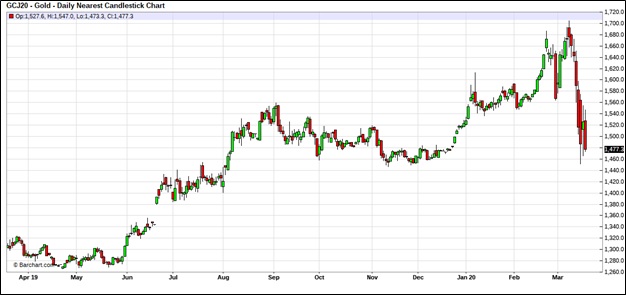
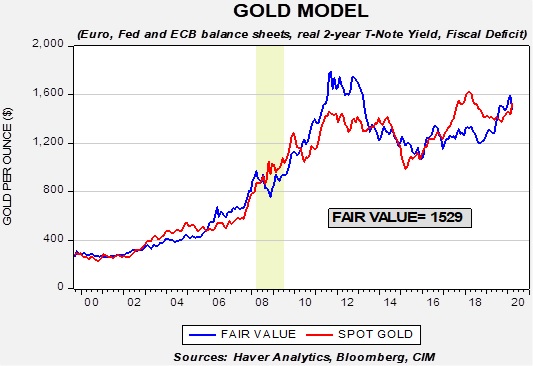
Given an increasingly dour outlook in recent quarters, we increased the relative duration and investment quality of our fixed income allocations and have increased our allocations to gold in those strategies for which commodity allocations are appropriate. These allocations have cushioned some, but not all, of the downside in the equity allocations. At some point in the economic cycle, we expect to reverse some of those moves. Until that time, rebalancing asset allocations will still occur.
Regardless of the strategy, our investment teams are attentive to the rapid changes that have occurred and are occurring. As noted above, we cannot forecast the future, but new and, sometimes, unexpected changes are par for the course. When dramatically new challenges occur, we react accordingly, if necessary. We encourage you to stay in touch with the changing investment landscape by reading our Daily Comment and other publications on our website.
We appreciate your confidence in us.
Gratefully,
Mark A. Keller, CFA
CEO and Chief Investment Officer
View the PDF
[1] This is a reminder, by the way, of the value of utilizing both stocks and bonds in a portfolio.
[2] 2020 Outlook: Storm Watch (12/19/2019); Asset Allocation Quarterly (Q1 2020)
[3] Asset Allocation Weekly (3/13/2020)
[4] 2020 Outlook Update: Storm Warning (3/16/2020)