As the S&P 500 steadily rises to new highs, concerns about a correction will likely increase. Since 1987, major market pullbacks have been associated with recessions and there isn’t much evidence to suggest the business cycle is set to turn. In the absence of a recession, we tend to look for factors that could trigger a market decline.
The first factor we are watching is liquidity.
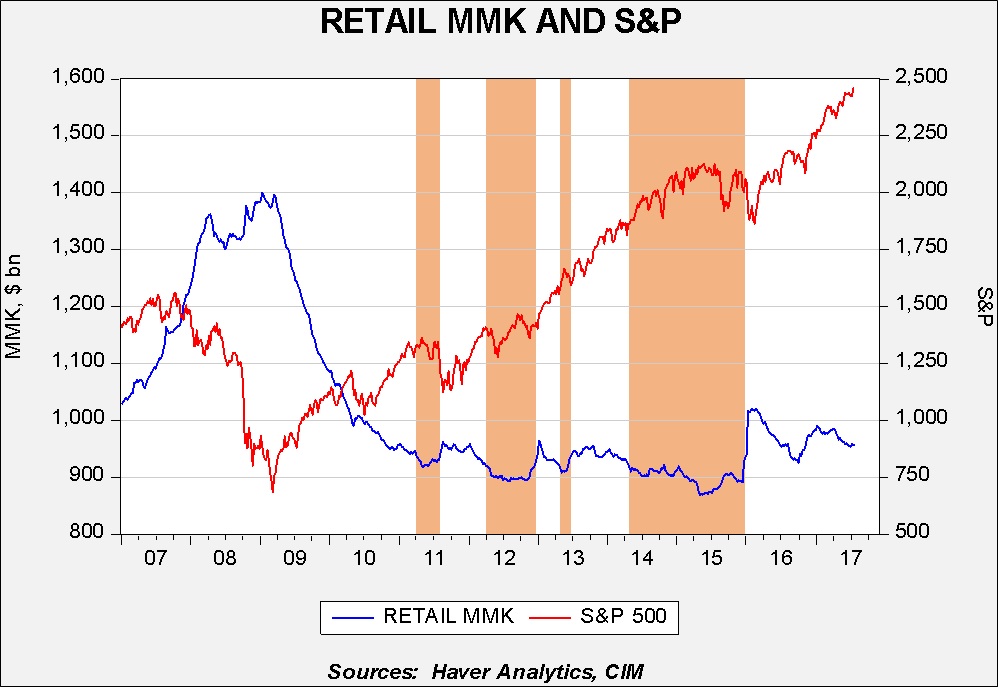
This chart examines the S&P 500 on a weekly close basis compared to the level of retail money market funds. Since the Great Financial crisis, equity markets have tended to trend upward until money market fund levels fall to around $900 bn. These periods are shown in orange on the above chart. It appears that households are uncomfortable with cash levels much below this level and buying tends to “dry up” once money market assets fall to around $900 bn. Current cash levels appear ample which will probably support steady gains in equities.
Exogenous events are another factor. These can be political, social, geopolitical, etc. There is a myriad of potential events that could undermine investor sentiment, including instability in the Middle East, an escalation of tensions with North Korea, a debt ceiling crisis or disappointment on tax reform, to name a few. In terms of the usual political cycle, we are rapidly approaching a period where “disenchantment” sets in.
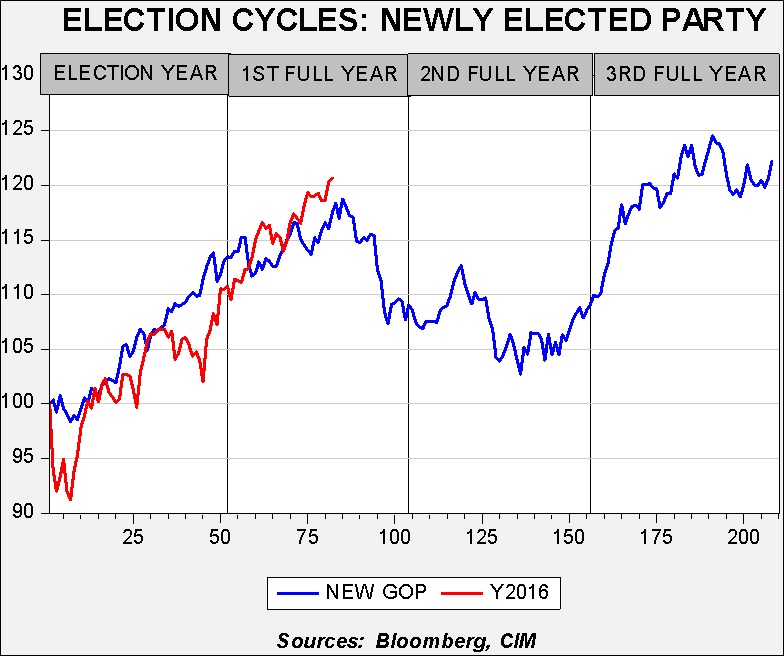
This chart shows the performance of the S&P 500 on a weekly close basis, indexed to the first weekly close of the election year. Our study begins in 1928. We have segregated new GOP administrations in the average and compared market action to the current administration. Although the fit isn’t perfect, the general direction of the market under Trump is reasonably consistent with past incoming Republican presidents. If the pattern continues, this study would suggest a period of weakness is in the offing. We use these studies more for signals of trend, not necessarily as pure forecasts. And, because they are historical studies, their relevance is somewhat questionable in that the issues surrounding each administration are different. Still, the chart does suggest that a GOP win initially raises investor sentiment but this sentiment appears to deteriorate sometime in late summer of the first year in office, as the difficulties of legislating become more obvious. With the current turmoil in Washington, not to mention a broad set of geopolitical issues, a period of market turbulence would not be a shock.
Combining the two studies would suggest that there is enough available liquidity to prevent a significant pullback as suggested by the election year chart. We would not be surprised to see a few weeks of market consolidation, especially if tax reform talks stall or other issues arise. However, there is nothing in the data that suggests a recession is imminent and thus pullbacks in equities will probably be modest.
It’s terribly hot here in the Midwest. It wouldn’t be a normal Missouri summer if it didn’t touch 100 degrees for a week or two. As uncomfortable as it is, what makes it tolerable is the knowledge that in a couple of months the brutal heat will have left us and a beautiful autumn will be beginning. We know this will happen because we think cyclically about the weather. We know that the weather runs in cycles and that when it reaches extremes, we can rest in the knowledge that it will revert back to the mean again, and then back to the other extreme. We have learned to think cyclically about the weather because: 1) we have learned by experience that the seasons run in cycles, and 2) the cycles are regular enough that we know to expect a reversal when the temperatures reach 100.
It’s my observation that very few people think that way about the economy or the financial markets. Most people think about the economy and the stock market in a linear fashion, that is, they believe that the economy moves in a straight line indefinitely, usually upward sloping. If it goes down substantially, the conventional wisdom is that something very bad has happened, or that something like a financial accident has occurred. Usually, people look for someone on whom to blame this financial disaster. Even more amazing, once a downtrend is in place, many people begin to think of that linearly as well. “The market is going down and it will never get better,” they think. The possibility that financial ups and downs are cyclical, perhaps not as regular as the seasons, but cyclical nonetheless, rarely enters the mind.
It’s not just average people who think linearly about the economy and the financial markets, many professionals, including economists, think this way as well. When the next recession comes along, just watch how many economists are introduced to tell us exactly who is at fault for allowing this terrible thing to happen. Here at Confluence we are big fans of the late economist Hyman Minsky (1919-1996), and not just because he taught at Washington University in St. Louis for 25 years. At a time when many economists thought that the economy could and should be managed for optimal and long-lasting growth, and that recessions could be avoided, Minsky taught what he called the financial instability hypothesis. Essentially, he taught that financial instability was inherent in the system, “that the financial system swings between robustness and fragility and these swings are an integral part of the process that generates business cycles.” In other words, the swings between strength and fragility in the financial system are normal and cyclical.
The idea is really quite simple: the longer times are good, the more people will begin to think the economy will always be good, and the more likely they will make financial decisions that are inherently risky, such as take on additional debt. Eventually all these risky actions accumulate as a great burden on the economy, people can’t pay their debts and the economy cycles in the other direction for a little while. Once excessive debt is liquidated, the economy starts back the other way. Because the economic and market cycles are not as regular as the seasons, people have a hard time recognizing them. Because policy-makers in Washington (such as the Fed) try to ameliorate the cycles and make the good times last longer, people begin to think that economic cycles have been “outlawed.”
We think that the cyclical nature of people’s behavior and, thus, the economy, is baked into the way the financial world works. Therefore, we analyze the cyclical nature of the economy, and the effect of those cycles on various asset classes and on the stocks of various companies. This doesn’t mean we can predict the future, but we believe that approaching the economy and the markets under the correct framework (cyclical versus linear) is essential to mitigating the risk of being wrong.
We appreciate your confidence in us.
Gratefully,
Mark A. Keller, CFA CEO and Chief Investment Officer
Last week, we began an analysis of Michael Mandel and Bret Swanson’s paper[1] which is a response to Robert Gordon’s argument that the West is doomed to a prolonged period of slow productivity growth.
In Part I of this report, we examined the productivity issue and discussed Mandel and Swanson’s analysis of the situation, focusing on their specific division of industries. This week, we will look at six sectors of the economy that appear poised to digitize and how that could change the economy. We will also discuss the conditions necessary for Mandel and Swanson’s position to be correct. As always, we will conclude with market ramifications.
The Six Sectors
Mandel and Swanson’s six sectors are transportation, energy, education and training, retail and wholesale distribution, manufacturing and health care. We will discuss them in that order.
In the past few years, we have generally avoided allocations to non-U.S. markets for our asset allocation portfolios due to two primary concerns. First, the dollar was rising as a result of an improving U.S. economy and policy divergences between the U.S. and the rest of the world. The Federal Reserve was raising rates and tapering its balance sheet while the majority of the other nations were still adding monetary stimulus. Second, we have had secular concerns about the stability and attractiveness of foreign investing in a world where the U.S. is seemingly reducing its hegemonic role.
This quarter we have added foreign allocations into our portfolios. The primary reason is that we believe the dollar’s bull market is probably coming to a close. On a relative valuation basis, the dollar has become rather expensive.
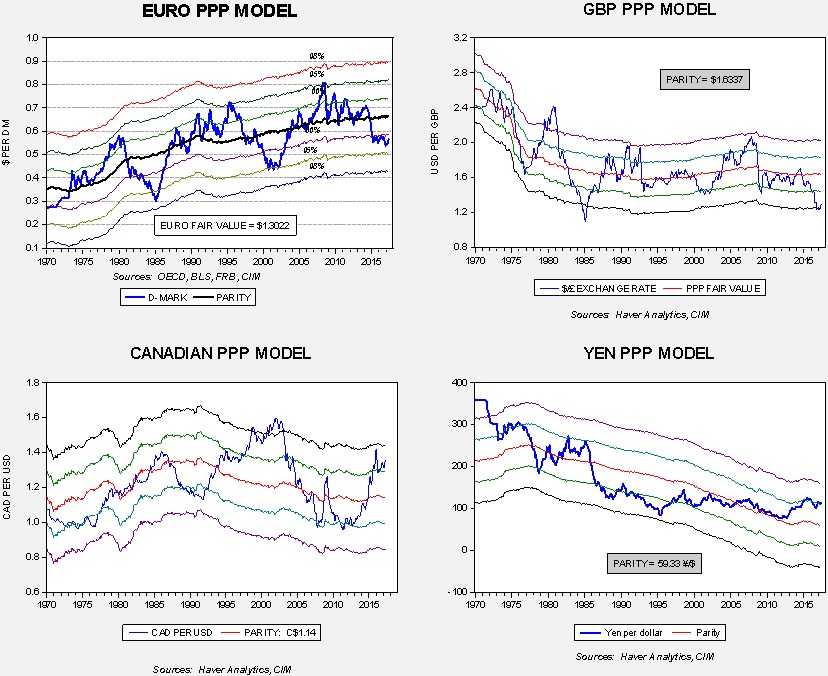
This chart shows four purchasing power parity models for the euro, yen, British pound and Canadian dollar. In all four cases, the dollar is trading “rich” by more than one standard error, and in two cases, nearly two standard errors from parity. Purchasing power parity uses relative inflation to value currencies. As the models show, currencies are rarely at parity. Although purchasing power parity is the oldest way to value currencies, it isn’t the most accurate. However, it tends to be useful at extremes, and exchange rates tend to move around the parity measure. In other words, parity is something of an anchor around which the actual exchange rate vacillates.
History also suggests that exchange rates can diverge from parity for long periods of time, which usually means that a catalyst is required to move currencies from extremes of under-and over-valuation. For example, in the above euro and pound models, the deep undervaluation in the mid-1980s ended with the Plaza Accord. Yen overvaluation in the early 1990s was ended by the Halifax Accord. Changes in policy or governments can trigger an end to valuation extremes as well.
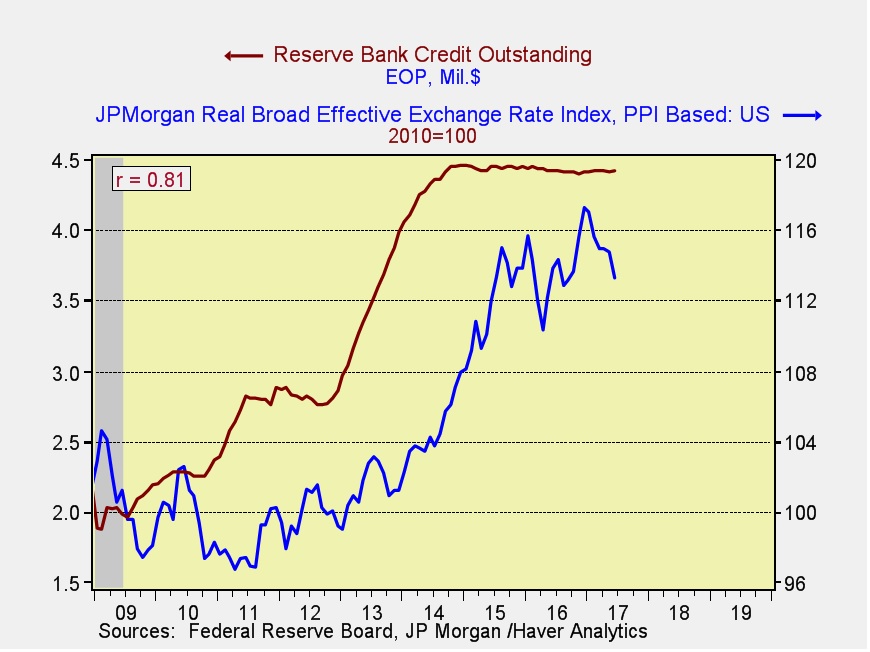
This leads us to two additional reasons for this repositioning. We believe there are two catalysts which will pressure the dollar in the coming quarters. First, the Federal Reserve appears to be hedging on future tightening. Although the dots charts still indicate rising rates, a number of FOMC members have raised worries about raising rates while inflation remains depressed. Chair Yellen appears to be offering a trade to the hawks on the committee; instead of raising rates, balance sheet reductions can act as policy tightening. It is possible reducing the balance sheet will be dollar bullish. However, that isn’t supported by the data.
Although economic theory would suggest that boosting the size of the balance sheet should depreciate a currency, all else held equal, the pattern on the above chart developed likely because QE raised hopes of stronger growth. Our expectation is that reducing the balance sheet probably won’t matter, but if the pattern is consistent, balance sheet reduction may actually be dollar-bearish. So, we expect the anticipated monetary policy trade of fewer rate hikes for balance sheet shrinkage to be bearish for the dollar.
The second catalyst is policy disappointment from the Trump administration. Earlier this year, we were worried about the dollar’s overvaluation. And, proposed tax cuts and fiscal expansion from the Trump administration would have been dollar bullish, even at lofty valuations. However, the likelihood of major policy actions have declined and each month that passes without a policy adjustment means that political capital is being lost and it becomes less likely anything will pass. As disappointment grows, we would expect the dollar to retreat.
Although we retain our secular concerns about the stability and attractiveness of foreign investing in a world where the U.S. is seemingly reducing its hegemonic role, these concerns are overshadowed by the changing dynamics of monetary stimulus. Essentially, the near-term effects of policy and the exchange rate outweigh our secular concerns.
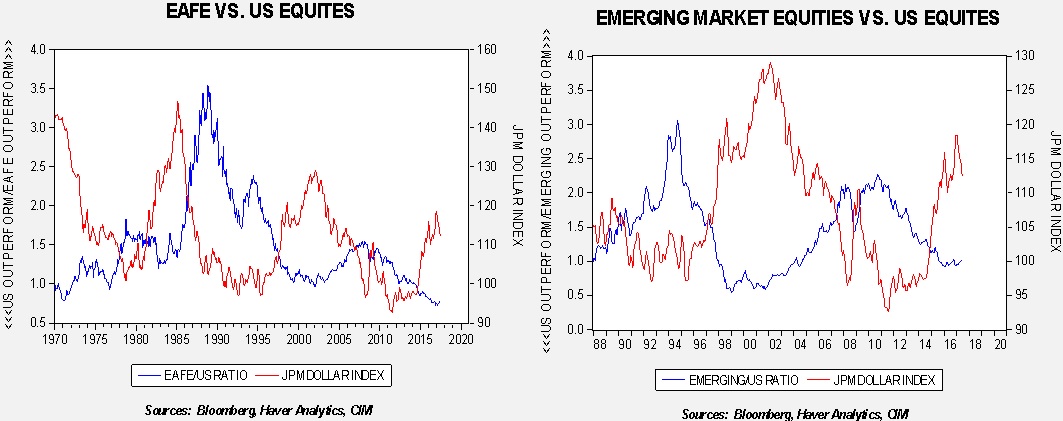
Finally, the issue of recent performance needs to be addressed. Both emerging and foreign developed equity markets have performed very well this year and there is a concern that we may be shifting too late into these asset classes. Although possible, if our expectations of a weaker dollar are accurate, history would suggest a longer period of foreign outperformance.
The red line on both charts shows the JP Morgan real dollar index. The blue line on the left chart is the ratio of dollar-denominated EAFE and the S&P; on the right chart, it’s the dollar-denominated ratio of emerging markets and the S&P. Both have been rebased to their respective start periods. On both charts, a lower ratio indicates U.S. equity outperformance relative to foreign markets; a rising ratio shows the opposite. In both cases, periods of dollar strength coincide with domestic outperformance. Thus, even with good foreign performance this year, a weaker dollar may result in a longer period of foreign outperformance.
Economic data remain supportive and the inflation outlook is currently benign.
Though the economic expansion is elongated, we do not anticipate a near-term recession.
Fed policy is expected to tighten in terms of rising short-term rates and the reduction in the size of the Fed’s balance sheet.
We expect the Fed to commence the reduction of its $4.5 trillion balance sheet with a $10 billion monthly run-off by the end of this year.
Expectations for a softer U.S. dollar combined with attractive valuations overseas have encouraged us to include non-U.S developed and emerging market equity exposure, the former with a tilt toward Europe.
Overall allocations to bonds are intact, though with a heavier presence in intermediate-term bonds. Speculative grade bonds remain supportive for income objectives.
Our growth/value even weight of 50/50 remains unchanged from last quarter.
ECONOMIC VIEWPOINTS
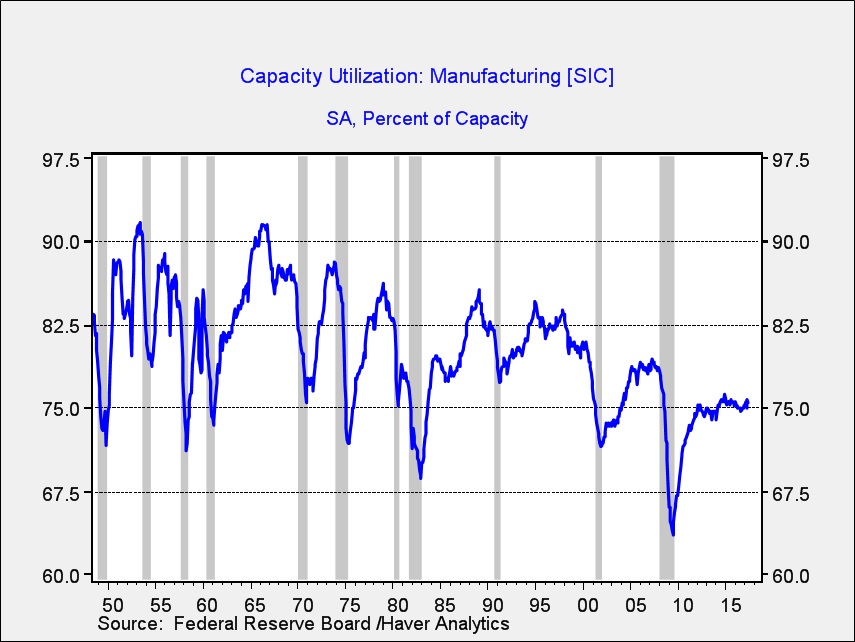
The themes present at the start of the year continue unabated, with inflation and unemployment at low levels and both consumer and business sentiment remaining elevated. Although the U.S. is now 97 months into an expansion, closing in on the second longest on record, there are pockets of softness. For example, consumption is slower than historical experience as measured by PCE, investment is muted and capacity utilization is running at 75%, as evidenced in the accompanying chart. In addition, government spending, inclusive of the contributions of states and municipalities, is very low as a percentage of real (inflation-adjusted) GDP. These measures all factor into our belief that a recession is not on the near-term horizon and the economy holds solid potential for continued expansion despite its current length.
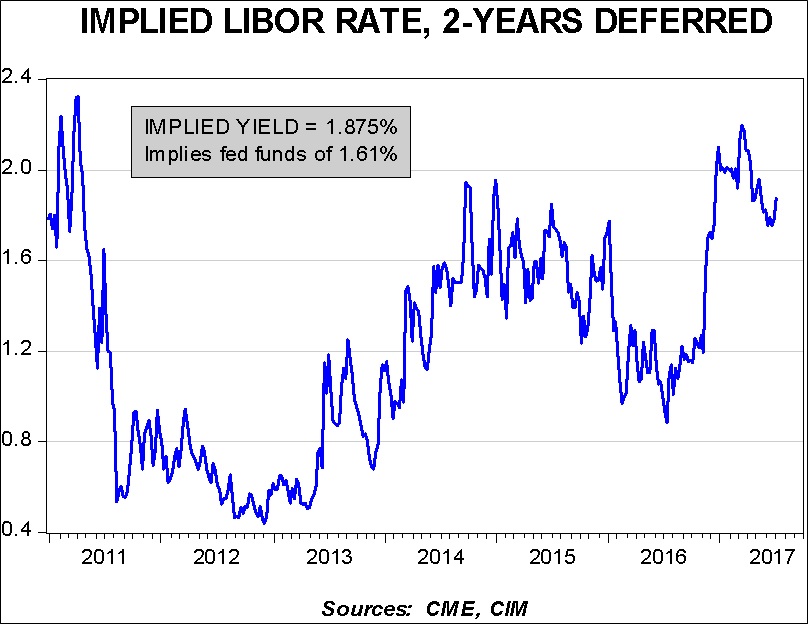
Although members of the FOMC are signaling further monetary tightening through an increase in the fed funds rate as well as a reduction in the reinvestment of balance sheet proceeds, markets anticipate that the Fed won’t be as hawkish as the current trajectory implies. For example, the Fed’s much-publicized dot plots indicate a fed funds rate of 2.25% by this time next year, while the markets, as measured by LIBOR, provide an implied rate of 1.61%, as exhibited in the below chart.
The Fed appears mollified by the improvement in unemployment figures and the lack of deflationary pressure, providing the latitude to move rates higher and commence some withdrawal of stimulus by reducing the reinvestment of proceeds from its $4.5 trillion balance sheet. However, uncertainties abound regarding not only the path of balance sheet reduction and its concomitant effect on the U.S. banking system and the availability of credit, but also the complexion of the Fed’s Board of Governors with its three vacancies and the prospect of a new Fed Chair. As mentioned in our last quarter’s report, it remains unclear as to whether the Trump administration will be appointing members who are hawkish or populist. While the issues surrounding the complexion of the Fed and its amount of monetary accommodation remain unresolved, the pace of tightening thus far has been appropriate and there are no indications that they have raised the prospect of thrusting the economy into a recession
Our view is that the issues that create headlines, such as current Congressional activity surrounding healthcare and the potential modifications to the tax code, are more distracting than influential at this juncture. Until, or unless, legislation is advanced or the Fed missteps, we retain the perspective that equity markets carry fair value on the traditional metric of Price/Earnings with a benign level of inflation. In addition, the intermediate and long portions of the bond market provide positive inflation-adjusted returns. The greater near-term investment significance for U.S.-based investors include expectations that nascent U.S. dollar weakness relative to foreign currencies will continue, particularly versus the euro and the basket of emerging market currencies. The Trump administration’s encouragement of a weaker dollar is a marked departure from the policies of prior administrations and consistent with our belief that U.S. economic hegemony is waning.
STOCK MARKET OUTLOOK
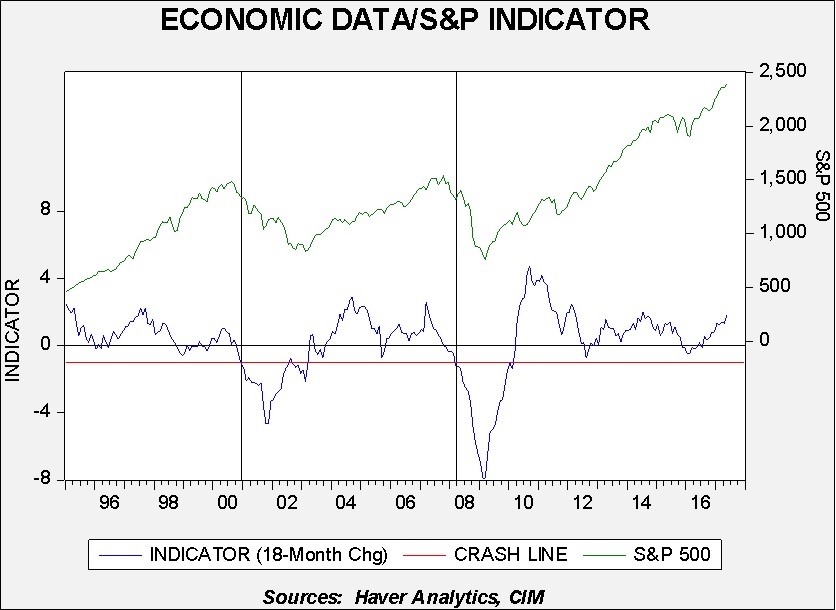
The economic landscape has proven favorable for U.S. equities and we find that the current economic environment remains healthy. However, signals of policy tightening from the Fed advise a degree of caution and bear continued scrutiny. In addition, recent readings of small business optimism exhibit softness compared to earlier in the year. Nevertheless, factors that are typical of elevated downside risk are noticeably absent, as shown on the accompanying chart. This graph depicts the monthly average for the S&P 500 Index versus our conflation of initial jobless claims, the Conference Board’s Consumer Confidence data and the CRB commodity index using adjusted standardized data.1 Though this shows that the U.S. economy is well advanced in the economic cycle, near-term concerns are not evident. Valuations have certainly advanced over the past year, but we believe that they can be persistent and are not untenable at this stage. Large cap, mid-cap and small cap equities have all enjoyed solid returns and traditional valuation metrics of Price/Earnings, Price/Book, and Price/Cash Flow have advanced accordingly. In contrast, non-U.S. equities, while enjoying positive returns this year, are generally priced below U.S. counterparts on traditional valuation metrics. Furthermore, given our views of a softer U.S. dollar environment, we are shifting some U.S. exposure to foreign equities. Much of this shift is being pulled from U.S. mid-cap exposure as pricing is more elevated and therefore expected returns are more muted. Among foreign domiciles, we tilt toward Europe in developed countries and also introduce exposure to emerging markets for more growth-oriented strategies.
1 For a full description of the standardization of data, please refer to our Asset Allocation Weekly, 6/30/17.
Among U.S. large cap sectors, we favor healthcare and industrials and continue to underweight telecom and consumer staples. We reduce our previous overweight of financials and utilities to even-weight. REITs continue to be positioned in two strategies for their diversification benefits and potential for modest appreciation. Our growth/value style bias remains evenly balanced at 50/50, reflecting our views toward sectors and industries.
BOND MARKET OUTLOOK
The Treasury yield curve has flattened over the course of this year, reflecting tighter monetary conditions at the Fed. Though the duration of the bond exposure in the more income-oriented strategies remains consistent with our prior exposures, it is now attained through a greater allocation to the intermediate segment as opposed to the former bar-belled overweights to short- and long-term bonds.
The exposure to long-term bonds has proven beneficial, but the current outlook has encouraged a more cautious positioning for the months ahead, especially as the Fed begins to engage in some normalization of its balance sheet. We maintain our favor to investment grade corporate bonds over Treasuries and mortgage-backed securities as the spreads continue to be attractive and supported. We also retain exposure to speculative grade bonds given our outlook for contained default and recovery rates.
OTHER MARKETS
Despite a more favorable outlook for commodities, we have concluded that introducing exposure at this time may be premature. In an environment of faster economic growth and/or a surge in inflation expectations, commodities would prove helpful to a diversified portfolio. However, we harbor no expectations of either environment over the near term. Accordingly, there remain no allocations to commodities in the strategies.
The Market
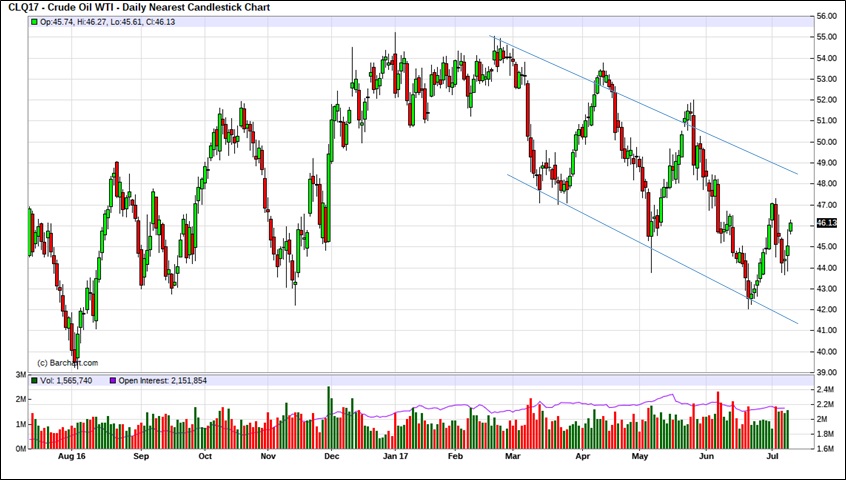
Oil prices peaked in March around $55 per barrel. There have been a series of lower highs and lower lows, as shown by the lines on the chart.
(Source: Barchart.com)
This obvious downtrend has led to a general bearish tone to the market. We don’t necessarily share that level of pessimism; as we will show below, dollar weakness and falling inventories are supportive for oil prices. On the other hand, there are legitimate concerns that Saudis may reverse production restrictions after next year’s initial public offering for Saudi Aramco.
Robert J. Gordon is a well-known economist and a professor at Northwestern University. A member of the National Bureau of Economic Research, his most notable work is in the area of productivity. His 2016 book[1] argued that the best years of American productivity are behind us—highlighted by the introduction of steam power to industry, the mechanization and biological revolution in agriculture, the electrification of the country, the communications revolution of telegraph, telephone and television, and the transportation revolution of automobiles and airplanes. He suggests that the technology revolution would never be able to replicate the growth spawned from these events. Sadly, ecological damage, rapidly aging populations and the peaking of educational attainment mean that economic stagnation would be the order of the day for the Developed World economies.
We examined the geopolitical ramifications of Gordon’s position in an earlier report.[2] Stagnation could easily lead to geopolitical problems. For example, industrialization and the spread of democracy occurred at nearly the same time; it is generally believed that democracy supports economic development but it is possible the direction of causality occurs in the opposite direction. If so, it may mean that a certain degree of economic growth is necessary to maintain democracy. If growth stagnates, it may become difficult to maintain societal order. In addition, it is intuitive that an expanding economy makes distribution issues easier; it’s a lot more difficult to determine distribution if it appears to be a zero-sum environment. In such a world, one group improves only at the expense of others. That scenario creates conditions of conflict.
Michael Mandel and Bret Swanson recently published a paper[3] rebutting Gordon’s position, suggesting that productivity is poised to expand and support stronger economic growth. In Part I of this report, we will examine the productivity issue, discuss Mandel and Swanson’s analysis of the situation, and focus on their specific division of industries. Next week, we will look at six sectors of the economy that appear poised to digitize and how that could change the economy. We will also discuss the hurdles to Mandel and Swanson’s projection. As always, we will conclude with market ramifications.
[1] Gordon, R. (2016). The Rise and Fall of American Growth: The U.S. Standard of Living Since the Civil War. Princeton, NJ: Princeton University Press.
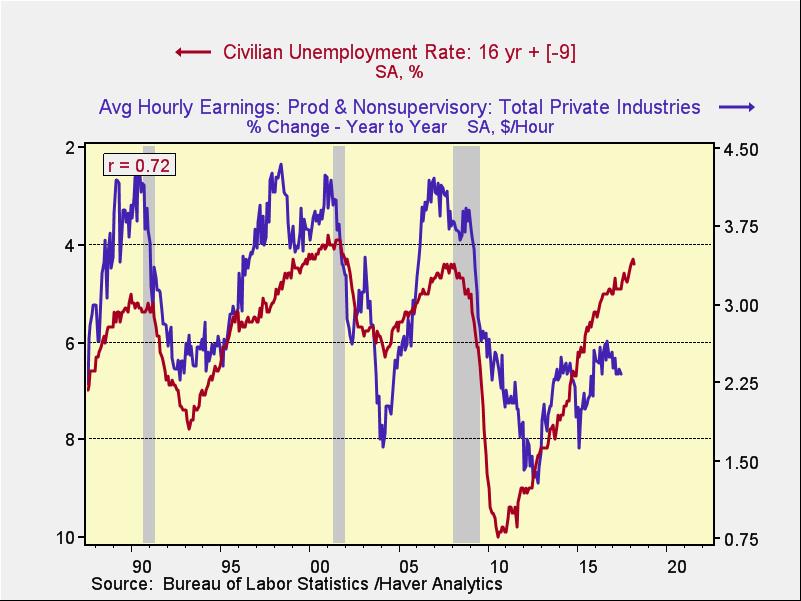
One of the mysteries of this expansion has been the slow pace of wage growth. Despite the plethora of evidence that labor markets are tight, including hires-to-openings ratio below one, low unemployment, low initial claims and a low unemployment rate, wage growth has remained stunted. The chart below is one we have used often in the past; it suggests with unemployment at current levels, previous episodes would have brought wage growth closer to 4% compared to the current growth of 2.3%.
One of our thoughts was that, perhaps, the national unemployment rate was masking pockets of high regional unemployment. In other words, if there was a wide dispersion of labor market activity, the weak regions of the country could be holding down wage growth.
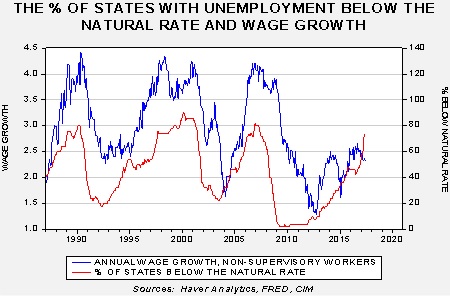
To test this, we looked at the level of state unemployment relative to the Congressional Budget Office’s calculation of the natural rate of unemployment.[1] We calculated the number of states with unemployment below the natural rate. What we found is consistent with the above graph. In other words, it doesn’t appear that regional issues were holding down wages.
Since 1987, average wage growth is 2.98%; in the periods where the percentage of state unemployment rates below the natural rate exceeds 65%, wage growth was 3.89%. The current combination is unusually low.
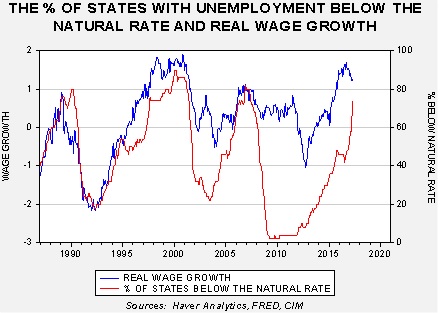
However, as part of this research, we did find another interesting factor. There has been speculation that low inflation rates may be affecting wage growth. To test that thesis, we subtracted annual wage growth for non-supervisory workers against the three-year average of the yearly change in CPI. Our reason for using the average is that businesses and workers tend to react to the recent trend in inflation and not necessarily the most current number. We found results that were more consistent with this theory.
Over the same time frame, real wage growth was 0.26%, but when the percentage of states with unemployment below the natural rate exceeds 65%, real wage growth is 1.04%. As the chart shows, real wage growth is consistent with tight labor markets as defined by the percentage of state unemployment rates below the national natural rate.
So, the puzzle of why wage growth is slow may simply be due to low inflation. The three-year average of inflation may act as an anchor in the wage bargaining process and wage growth will probably remain stalled without rising inflation. A cursory glance at the annual rate of inflation relative to the three-year average suggests that the average rate will likely remain stable for the foreseeable future. Thus, wage growth will probably remain stable, increasing the risk that tightening monetary policy will have an adverse impact on the economy and markets. Of course, the wage issue is a matter of debate within the FOMC which could mean that the path of tightening is slow and measured, more in line with the financial market’s expectations surrounding future policy.
[1] This rate is sometimes called the Non-Accelerating Inflation Rate of Unemployment, or NAIRU. The idea is to determine what level of unemployment is the lowest rate attainable before higher inflation is triggered.
As is our custom, we update our geopolitical outlook for the remainder of the year as the first half comes to a close. This report is less a series of predictions as it is a list of potential geopolitical issues that we believe will dominate the international landscape for the rest of the year. It is not designed to be exhaustive; instead, it focuses on the “big picture” conditions that we believe will affect policy and markets going forward. They are listed in order of importance.
We use cookies to ensure that we give you the best experience on our website. If you continue to use this site we will assume that you are happy with it.