Asset Allocation Weekly (May 19, 2017)

by Asset Allocation Committee

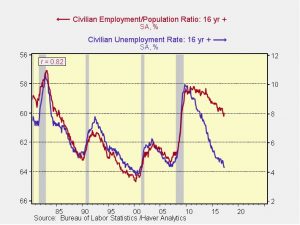
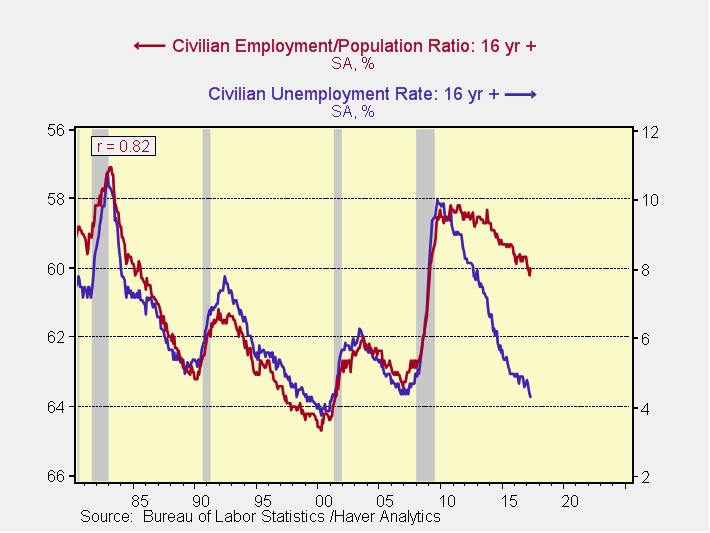
One of the significant “known/unknowns” is the true condition of the labor market.  The below chart highlights the issue.

The blue line is the unemployment rate, while the red line is the employment/population ratio (scale inverted).  From 1980 until 2010, these two series closely tracked each other.  During the period since the last recession, the two have clearly diverged.  The current unemployment rate is 4.4%; if the relationship from 1980 to 2010 had held constant, the unemployment rate would be approximately 7.5%.

For policymakers, the problem is determining which measure of the labor market best characterizes the degree of slack in the economy.  If the employment/population ratio is correct, then ample slack exists and policymakers should keep policy accommodative.  If the unemployment rate is the better measure, then labor markets are tight and the FOMC needs to be raising rates.

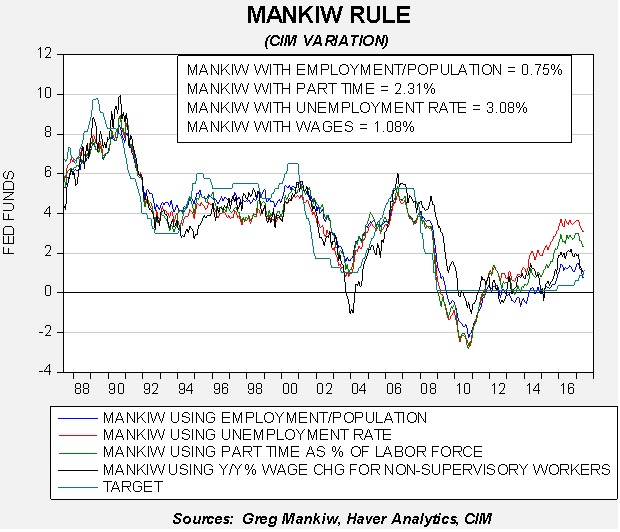
To determine the degree of accommodation, we use four variations of the Mankiw Rule.  The Mankiw Rule models attempt to determine the neutral rate for fed funds, which is a rate that is neither accommodative nor stimulative.  Mankiw’s model is a variation of the Taylor Rule.  The latter measures the neutral rate using core CPI and the difference between GDP and potential GDP, which is an estimate of slack in the economy.  Potential GDP cannot be directly observed, only estimated.  To overcome this problem with potential GDP, Mankiw used the unemployment rate as a proxy for economic slack.  We have created four versions of the rule, one that follows the original construction by using the unemployment rate as a measure of slack, a second that uses the employment/population ratio, a third using involuntary part-time workers as a percentage of the total labor force and a fourth using yearly wage growth for non-supervisory workers.
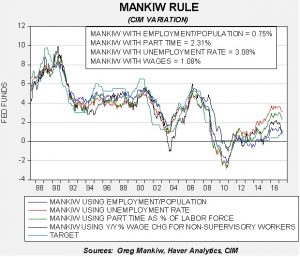
Using the unemployment rate, the neutral rate is now 3.29%.  Using the employment/population ratio, the neutral rate is 1.13%.  Using involuntary part-time employment, the neutral rate is 2.60%.  Using wage growth for non-supervisory workers, the neutral rate is 1.15%.  Note that for two of the variations, wage growth and the employment/population ratio, the FOMC is already near the neutral rate.  The fact that policymakers appear driven to lift rates further suggests they believe that some other measure is a proper measure of slack.

Since the Great Financial Crisis, it has been unclear which measure of employment accurately characterizes the labor market.  Because the Fed had been conducting very easy monetary policy, the debate was mostly academic; that isn’t the case anymore.  If the most accurate measure is actually the employment/population ratio or wage growth, but the Fed thinks either the unemployment rate or involuntary part-time employment is the correct indicator of slack, then policymakers could run the risk of overtightening and potentially risking a recession.

This chart shows the issue; this is the Mankiw model variation using wage growth.  The lower line on the chart shows the deviation from the neutral rate as projected by the model.  When the rate is below zero, policy is leaning toward accommodative.  Note the parallel lines on the lower part of the chart; these lines measure a standard error on either side of the neutral rate.  When the deviation is within the parallel lines, it suggests policy is mostly neutral.  Thus, based on wage growth, we are close enough to neutral policy that the Fed could stand pat until either wage growth accelerates or core CPI rises.

Thus, the coming months will be key.  If this model is the most accurate measure of slack then the Fed needs, at most, one more hike.  Policy would be tight at a fed funds target of 2.40%, so there is some margin for error.  Based on the dots chart, we would be at this level by the end of next year.  Simply put, we could be approaching a period where monetary policy shifts to a headwind.

The path of monetary policy has been a key element in the asset allocation committee’s analysis of the economy and markets.  We are moving into a more critical phase where the potential for a policy error is rising.  By year’s end, we could have a fed funds rate that would be modestly higher than neutral using at least two of the four variations of the Mankiw Rule model.  That would increase the potential for a recession which we would expect to have a negative impact on equity markets.  Thus, this is an issue we will be closely monitoring into the second half of 2017.

View the PDF

Weekly Geopolitical Report – Reflections on Trade: Part III (May 15, 2017)

by Bill O’Grady

This week, we continue our discussion on trade by examining the reserve currency issue.

What is the reserve currency?
When a country runs a trade surplus, it creates excess saving that must be either invested overseas or held as foreign reserves.  If a gold standard is being used, the excess saving/foreign reserves can be held as gold (or other precious metals).  In theory, reserve managers can hold just about any asset as foreign reserves.  However, if the ultimate goal of generating saving is to build the productive capacity of the economy, then the best foreign reserve assets should be safe and easily convertible, with broad acceptability in markets.

Here is an example we often use to describe why the reserve currency is important.  Imagine that a chocolatier in Paraguay wants to purchase a ton of cocoa beans.  He calls a dealer in Côte d’Ivoire for a price; the seller offers $1,800 per ton.  The buyer in Paraguay notes he does not have U.S. dollars but does have Paraguayan guaraní.  The seller does not want the Paraguayan currency because it would limit his purchases to Paraguay because the guaraní isn’t widely accepted.  The seller in Côte d’Ivoire would be able to buy a wider variety of goods (or have wider avenues for investment) from selling cocoa if he receives U.S. dollars instead.

So, how does the chocolatier in Paraguay get dollars?  The most efficient way would be to export chocolate to a U.S. buyer, then use the dollars he receives to buy cocoa beans from Côte d’Ivoire.  Because the reserve currency has widespread acceptance, non-reserve currency nations have an incentive to run trade surpluses with the reserve currency nation to accumulate the reserve currency, which allows them to pay for imports from around the world.

View the full report

Asset Allocation Weekly (May 12, 2017)

by Asset Allocation Committee

Slow economic growth has plagued the West.  Although the concern has been acute since the Great Financial Crisis (GFC), worries about slowing growth predated that event.  Perhaps the most important factor contributing to sluggish growth has been tepid productivity growth.

This chart shows the five-year change in productivity; we use this longer term rate of change to more clearly show the trend in productivity growth.  As the chart indicates, productivity growth is remarkably weak; in fact, in the postwar era, only the weakness seen in the depths of the 1981-82 recession recorded lower productivity growth by this measure.

Economic theory holds that production comes from the combination of land, labor, capital and entrepreneurship.  Most models focus on capital and labor.  The Cobb-Douglas production function[1] is a canonical expression of how economists think about forecasting output.  Production is the combination of capital and labor, scaled by productivity.  If productivity is constant, growth comes by adding capital (investment in plant and equipment, etc.) and workers (or, specifically, hours worked).  If an economy increases its productivity, more output is gained for each additional unit of labor and capital.  That’s why falling productivity is such a problem; it means that additional labor and capital resources must be deployed just to keep production steady.

Productivity is something of the holy grail of economics.  Theories of what boosts productivity abound; deregulation and competition are thought to increase it, supporting entrepreneurship with low taxes could be a factor, education and immigration could support increases and, of course, technological progress is a necessary ingredient.  However, no economist has yet been able to definitively say what causes productivity to universally rise under all conditions.

However, we can say that an economy with weak productivity growth will struggle.  Capital and labor essentially divide total output and low productivity makes that division difficult.  On the other hand, rising productivity can allow both capital and labor to enjoy a rising absolute share of output.  Social peace is much easier to achieve with rising productivity.  It is probably no accident that the rise of populism in the West has coincided with weak productivity growth.

From the mid-1970s into the GFC, the relationship between corporate profits and the five-year growth rate of productivity was fairly consistent.

This chart shows pre-tax corporate profits, on a national income product accounts basis, as a percentage of GDP along with the five-year growth rate of productivity.  From the mid-1970s into 2007, the two series were highly correlated at 75.8%, with trend productivity leading profits by four years.  Since 2007, the two are inversely correlated at the 53.3% level.  Clearly, profits have remained elevated despite weak trend productivity, which begs the question—how did profits hold up in the face of falling productivity?

What has occurred is that relative labor compensation has fallen.

The upper line on this chart shows pre-tax profits as a percentage of GDP.  The lower line shows labor’s share of output along with a time trend calculated from 1947 to 2004.  From 1947 through 2004, the share held fairly steady; although there was a clear downtrend, the slope was fairly benign.  Clearly after 2004 the share fell well below trend, and the labor share plummeted after the GFC.  It has recovered some of its losses since 2015 but the data is still well below trend.  A falling share to labor has allowed firms to overcome weak productivity trends and retain high margins.

Why has labor’s share of output declined?  The media discusses a litany of reasons…technology and globalization have given firms market power over labor and allowed companies to keep wages contained despite tightening labor markets.  Although this condition has been a boon for profit margins, it has been difficult for workers and we suspect the rise of populism is a direct result of wage pressures.

As the first chart shows, because of the lagged effect of trend productivity, the effects of weak productivity will become acute starting around mid-2018.  Without a decline in the labor share of output, profit margins will come under growing pressure.  Using a simple regression of trend productivity and labor share, to maintain pre-tax profits of 12% would require the labor share to fall to 55% by the end of 2018.  If the labor share remains constant, profit margins will decline to 9.6% of GDP.  This level is still historically high but, given market expectations of continued strong profit margins, even this decline will be problematic.

The Trump administration continues to straddle the line between a traditional GOP stance that favors business and capital and a populist variant that calls for trade protection and immigration restrictions.  If President Trump decides to favor his working class supporters, which would likely boost the labor share, profit margins would come under even more pressure.  This is a factor we will be monitoring closely as the year progresses.

View the PDF

_______________________________

[1] P(L, K) = bLαKβ, where:  • P = total production (the monetary value of all goods produced in a year) • L = labor input (the total number of person-hours worked in a year) • K = capital input (the monetary worth of all machinery, equipment and buildings) • b = total factor productivity • α and β are the output elasticities of labor and capital, respectively.  These values are constants determined by available technology.

Weekly Geopolitical Report – Reflections on Trade: Part II (May 8, 2017)

by Bill O’Grady

In this multi-part report, we offer several reflections on trade that we hope can provide some insight into how to use macroeconomics to judge the veracity of certain claims.  In Part I, we laid out the basic macroeconomics of trade.  This week, in Part II, we will discuss the impact of exchange rates and examine the two models of economic development, the “Japan Model”[1] and the “American Model.”[2]

The Japan Model of development calls for policies that drive up household saving.  This is usually done through financial repression and wage suppression.  This model is designed to provide cheap investment funds to build up the productive capacity of the country.

In contrast, the American Model of development relies on foreign investment.  In this arrangement, the trade deficit is an import of foreign saving for investment.

As a review from Part I of our report, the following saving identity means that the private investment/savings balance (I-S) plus the public spending balance (Govt-Taxes) is equal to the trade account, M-X (Imports less Exports).

(M – X) = (I – S) + (G – Tx)

If a nation’s saving equals its investment and it runs a balanced fiscal budget, then it will run a balanced trade account.  It doesn’t matter what the exchange rate is or what trade policy is in place; if the private and public sector balances, there will also be balanced trade.

View the full report

___________________________________

[1] We call this the Japan Model because it has been adopted by Asian nations for development.

[2] We call this the American Model because it is how the U.S. acquired saving during its industrial revolution, which began in earnest in 1870.

Asset Allocation Weekly (May 5, 2017)

by Asset Allocation Committee

In our most recent quarterly asset allocation meetings, our analysis determined that emerging markets would not be added to the portfolios.  Since this asset class has been this year’s best performer, some explanation is in order.  One of the primary reasons we have refrained from adding emerging markets is the dollar’s strength.

The blue line on this chart looks at the relative performance of emerging markets to the S&P 500.  When the line is rising, the S&P is outperforming emerging markets.  The red line is the JPM real dollar index.  The two series are positively correlated at 80.8%, meaning that a stronger dollar tends to reflect the S&P 500 outperforming the emerging markets.  This correlation has weakened modestly recently, but is still quite elevated.

The second reason we have been reluctant to add emerging markets is because the relative outperformance is occurring with weaker commodity prices.

Although the correlation isn’t as strong as with the dollar, rising commodity prices tends to coincide with stronger relative emerging market performance.  Although commodities are off their lows, they remain depressed. Thus, the current level of commodity prices seems to support weaker relative emerging market equities.

This chart shows a model of the emerging market/S&P 500 relative performance regressed against the JPM dollar index, the CRB index and fed funds (advanced six months).  Currently, the model is suggesting that emerging market equities are overvalued relative to the S&P against these three independent variables.

Despite this overvaluation, it is possible that the strong relative performance of emerging markets is anticipating a recovery in commodities, a slowing of monetary policy tightening or a weaker dollar.  The dollar lifted on expectations of tighter policy and if the FOMC does not raise rates as much as expected or if foreign central banks reverse their current easy policy stances, then the dollar could weaken.  However, this model suggests that emerging market equities have already discounted that outcome.  Thus, we are concerned that emerging market equities may be ahead of the fundamentals.  If this is true, the current strong performance of emerging markets could stall even with dollar weakness, rising commodities or a stall in Fed tightening.  And, if the dollar rises, commodities fall further or the FOMC raises rates according to the “dots plot,” emerging markets could be quite vulnerable.  For now, we believe the risks exceed the potential return from these levels.

View the PDF

Weekly Geopolitical Report – Reflections on Trade: Part I (May 1, 2017)

by Bill O’Grady

Donald Trump ran on a platform opposing free trade.  Although Congressional support for free trade has been waning for some time, the general consensus among economists is that free trade makes the economy more efficient and supports global stability.

However, the steady erosion of manufacturing jobs in the U.S. and the shrinking of the middle class[1] have called the consensus view into question.  It is clear that President Trump’s anti-trade rhetoric resonated with voters and was one of the factors that led to his election.

Since the election, there have been a number of assertions made about trade, both positive and negative, that appear to us to be only partially true and perhaps designed to support a particular position.  Trade can be negative for participants facing competition from abroad; for the overall economy, it does seem to bring more variety and lower prices.

In this multi-part report, we will offer several reflections on trade that we hope can provide some insight into how to use macroeconomics to judge the veracity of certain claims.  It is our goal to present a fair reading of economic theory that will help readers make sense of what the media reports.  This topic is worthy of a geopolitical report because American trade policy has been a critical element in how the U.S. manages its superpower role.  In Part I, we will lay out the basic macroeconomics of trade.  In Part II, we will discuss the impact of exchange rates and further examine the two models of economic development.  Part III will analyze the reserve currency’s effect on trade.  Part IV will look at some real world examples and conclude with market ramifications.

View the full report

___________________________________

[1] https://www.nytimes.com/2017/04/24/business/economy/middle-class-united-states-europe-pew.html?_r=0

Asset Allocation Weekly (April 28, 2017)

by Asset Allocation Committee

Last week, we discussed the impact of reducing the size of the Federal Reserve’s balance sheet on stocks and bonds.  This week we will discuss the effects of QE on monetary policy.

The FOMC dropped rates to near zero by January 2009.  Although European central banks (including the ECB) have since taken policy rates below zero, in 2009, the “zero lower bound” was considered to be the lowest rates could fall.  Thus, when the Fed wanted to stimulate further, it felt it could not lower rates below zero.  The U.S. central bank was left with nothing but unconventional policy.  The two policy tools employed at this point were forward guidance and QE.  The former was a clear signal from the Fed that rates would be kept low for the foreseeable future.  The latter was the expansion of the balance sheet.

The problem was that it was difficult to determine how much stimulus these tools generated.  One attempt to answer this question came from the Atlanta FRB.  To estimate the impact of unconventional policy, Wu and Xia used the yield curve to measure the impact on borrowing rates.

Based on their analysis, QE and forward guidance were the equivalent of negative nominal rates of nearly -3.0%.  As tapering set in, the “shadow” rate rose rapidly.  The bank has discontinued calculating the rate, suggesting that once the fed funds target rate leaves the zero floor, the applicability of the shadow rate is reduced.  Essentially, they argue that once rates lift off the zero bound, the shadow fed funds rate is no longer applicable.

Using the shadow rate as a guide, we can get a feel for how much policy has tightened relative to earlier cycles.

This chart shows the effective fed funds rate from 1957 to 1982, the estimated and actual target from 1982 to 2009, the shadow rate (shaded in yellow on the chart) from 2009 to 2015 and a return to the target rate after 2015.  We have then calculated the trough and peak in fed funds tied to the end of each expansion from 1960 through 2008 along with the current cycle using the shadow rate.

(Source: Haver Analytics, CIM)

We have highlighted the current cycle in yellow and excluded it from the average.  To reach the average level that has preceded recessions in the past, the FOMC will need to make around seven more rate hikes of 25 bps.  Excluding the Volcker money-targeting regime years would reduce the average by roughly 125 bps, meaning that the Yellen Fed will be flirting with recession with only two more rate hikes.(Source: Haver Analytics, CIM)

We are quite concerned about this situation because of an unresolved policy debate.  It is unclear if QE stimulation is a function of the level or the change in the balance sheet.  If it’s the level, the balance sheet is quite large; however, if it’s the change that matters, then reducing the balance sheet could create unanticipated risks for the economy and markets.

The balance sheet, scaled to GDP, is off its all-time highs but, at 23.4%, is well above the pre-QE level of 5.8%.  If level is the key determinant of stimulus, then the FOMC can reduce the balance sheet substantially.  On the other hand, the Wu-Xia shadow rate seems to follow the yearly changes in the balance sheet.

Comments from Fed officials clearly signal that policymakers believe the level is the key indicator of stimulus; last week’s report, which compared equity markets to the level of the balance sheet, would support that contention.  However, as the above chart suggests, a case can be made that the change in the balance sheet has an impact as well.

By 2018, it is quite possible the FOMC will have raised rates by another 50 bps and will have started the process of reducing the balance sheet.  The latter policy could tighten monetary policy by an unknown amount.  And, as we noted above, excluding the early Volcker years, two rate hikes may be getting us closer to recession levels than generally believed if the shadow rate accurately represents the actual trough in the policy rate.  It should be remembered that forward guidance was part of the policy as well.  Simply indicating that hikes will occur in the future affects financial markets today.  Although this isn’t an immediate concern, it appears we are gliding into a period of enhanced risk by autumn.  Adding to this issue is that both Chair Yellen and Vice Chair Fischer are expected to leave the FOMC in January.  Depending on who President Trump appoints, we could have a change in the policy stance of the central bank.

We will be watching financial markets closely in the coming months to see how these issues we have raised over the past three weeks will affect the economy and financial markets.  Our concern is that policymakers and markets have never experienced a sustained drop in the Fed’s balance sheet; it may be innocuous or it may be a problem.  History will be of only modest use and thus the potential for a mistake will be elevated.

View the PDF

Keller Quarterly (April 2017)

Letter to Investors

Perhaps you’ve heard it or felt it, but fear of financial market decline has become palpable among the public.  It’s not just fear as reflected by TV shows or internet social media I’m talking about, but fear reflected by real people in conversation.  I travel rather extensively, speaking to both advisors and their clients, and hear directly from the public such fear of a stock market collapse.  The advisors report, and the clients confirm, that it’s the norm for their clients to hold more than 20% of their investable assets in cash.  Considering that cash now earns sub-1% yields, there really isn’t an investment reason to hold such a high proportion of one’s investments in cash unless one fears a financial panic.

Is such a panic likely? Well, I cannot predict the future, but as one who has been advising investors for over 38 years and studying the stock market for longer, market declines rarely begin with such prevalent pessimism.  Major stock market declines proceed from periods of extraordinary optimism about the future, when seemingly no one can imagine that the economy and the market do anything but surge ahead.  Public sentiment clearly is not at that point.

But didn’t the market recently hit an all-time high? Yes, but that’s not a predictor of market decline. The stock market’s price regularly hits all-time highs because the economy is growing virtually every year.  It was Warren Buffet who once noted that a bank certificate of deposit whose interest is compounded daily hits an all-time high every day!  The market should be marching ahead similarly, as long as the economy and the businesses undergirding it are growing, and they are.

But isn’t the market’s price-to-earnings (P/E) ratio rather high? Yes, as it has been for most of the last 20 years. The reason for the high P/E ratio (and other high valuation measures) is that inflation is very low.  Inflation “steals” away investment returns by paying you back in dollars that are worth less than you originally invested.  Thus, in a rising inflation environment, the market eventually corrects for this “theft” by valuing stocks at lower P/E ratios.  On the flip-side, when inflation is low (as it has been for over 20 years), after-inflation returns are better than expected because very little of this “theft” occurs.  Therefore, stocks adjust by trading up to higher P/E ratios because investors become confident that they’ll actually get to keep their returns.  We wrote last quarter of some things that make us worry about inflation, but we are not seeing it “perk up” yet.

So, we’ve got nothing to worry about? No, there are always things to worry about, but economic disaster is usually not a high probability item, and we don’t think it is today, either. But all the financial markets are the products of human decisions and, as a result, emotions can become embedded in those decisions and thus into prices.  A 5 to 10 percent decline in stock prices never surprises us any more than a similar rise; it happens every year.  The “sentiment pendulum” of optimism/pessimism can swing rather widely and quickly, much more quickly, in fact, than the economy moves.  Rather than being “swung around” by this pendulum, a wise investor should take advantage of the swings.  This is what we seek to do: take advantage of excessive pessimism and optimism in the markets.

We appreciate your confidence in us.


Gratefully,

Mark A. Keller, CFA
CEO and Chief Investment Officer

View the PDF

Weekly Geopolitical Report – Between a Rock and a Hard Place: The Gibraltar Dilemma (April 24, 2017)

by Thomas Wash

Days after Theresa May triggered Article 50 of the Lisbon Treaty, Brussels issued a nine-page document outlining its guidelines for Brexit negotiations. One of the guidelines gave Spain the authority to veto any deal between Gibraltar and the European Union (EU). The U.K. is currently recognized as holding sovereignty over Gibraltar and thus took exception to this provision, vowing to defend the will of the people of Gibraltar.

The provision is likely the result of heavy lobbying by the Spanish government, who would like to end this 300-year dispute once and for all. A war of words between Spain and the U.K. has already started in response to the announcement. Former Tory leader Michael Howard stated that the U.K. is willing to fight for Gibraltar. Although not responding to the threat, Spain has hinted that it would not block Scotland if it were to apply to the European Union upon a potential Scexit.[1]

Despite the bravado, it is likely that the two countries will come to some sort of agreement as they have deep trade ties. In fact, Spain has been the most vocal backer of a soft Brexit. That being said, the people of Gibraltar are stuck at a crossroads regarding the dispute. On the one hand, they voted 96% to remain in the EU, but on the other hand, they voted 99% against joint sovereignty with Spain. The situation becomes even murkier when its economy is taken into account. Gibraltar is dependent upon the U.K. for trade and Spain for labor. Nevertheless, it is unlikely that Gibraltar would have emerged from Brexit unscathed as its labor force is dependent on the free movement of immigrants permitted under the EU. Ironically, it was the free movement of immigrants that mostly caused British voters to leave the EU.

In this report, we will focus on the significance of Gibraltar, its historical context and the impact of the current dispute. We will conclude with possible market ramifications.

View the full report

__________________________________

[1] During the run-up to the Scottish referendum, it was believed that Spain would oppose any immediate transition by Scotland into the EU if it decided to leave the U.K. because it could encourage Catalonia to move toward independence as well.