(Due to the Labor Day holiday, the next report will be published on September 11.)
Last week, we began our series on nationalism. In Part I of this report, we discussed social contract theory before and after the Enlightenment. We examined three social contract theorists, Thomas Hobbes, John Locke and Jean-Jacques Rousseau. This week, in Part II, we will recount Western history from the American and French Revolutions into WWII. From there, we will analyze America’s exercise of hegemony and the key lessons learned from the interwar period.
In two weeks, in Part III, we will begin with an historical analysis of the end of the Cold War and the difficulties that have developed in terms of the post-WWII consensus and current problems. We will discuss the tensions between the U.S. superpower role and the domestic problems we face. From there, an analysis of populism will follow, including its rise and the dangers inherent in it. As always, we will conclude with market ramifications.
When President Trump was elected, there were expectations that fiscal policy would become more stimulative, which would lead to faster growth, tighter monetary policy and dollar strength. There were also promises of regulatory relief. In November, soon after the election, financial markets, exercising their usual pattern of discounting the future, immediately began to react to these expectations. This week, we want to look at how these expectations have fared thus far.
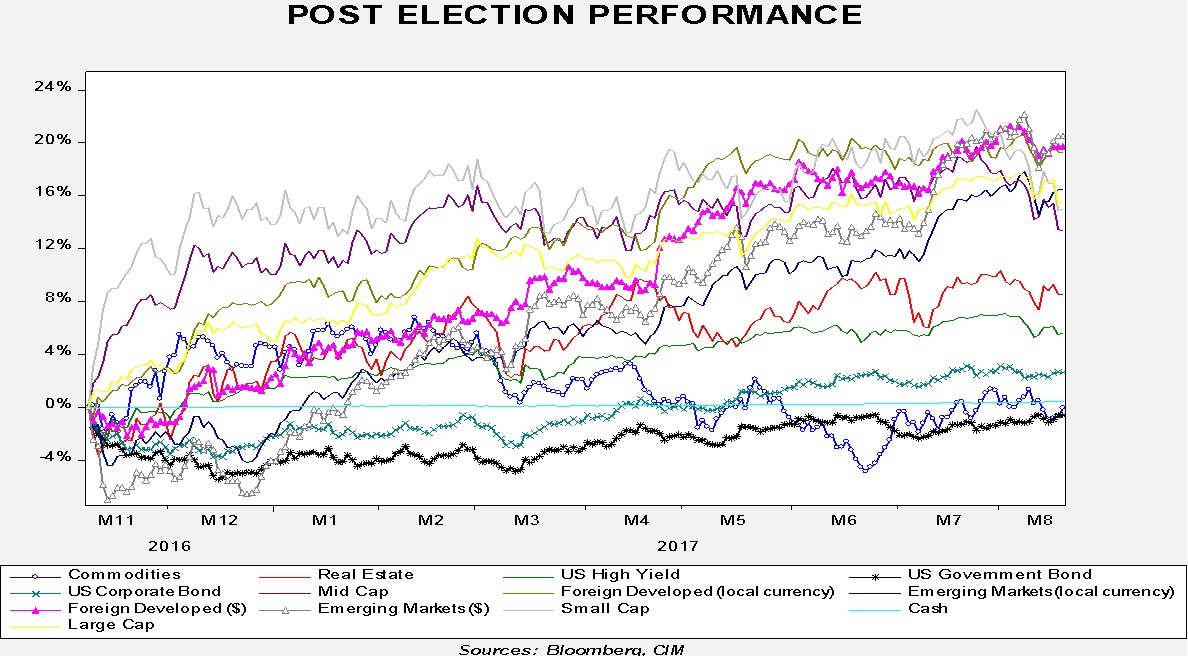
We begin by looking at the 12 asset classes that we monitor in our Daily Comment to see how they have performed. We indexed the data to the close on Election Day.
The best performing asset classes have been emerging market and foreign developed equities, denominated in dollars. U.S. large caps have generally performed in line with both of these asset classes in local currency terms, but dollar weakness has led to foreign outperformance. The weakest performing asset classes have been U.S. government bonds and commodities. Bonds have steadily recovered from the December lows as Trump’s policy agenda continues to stall.
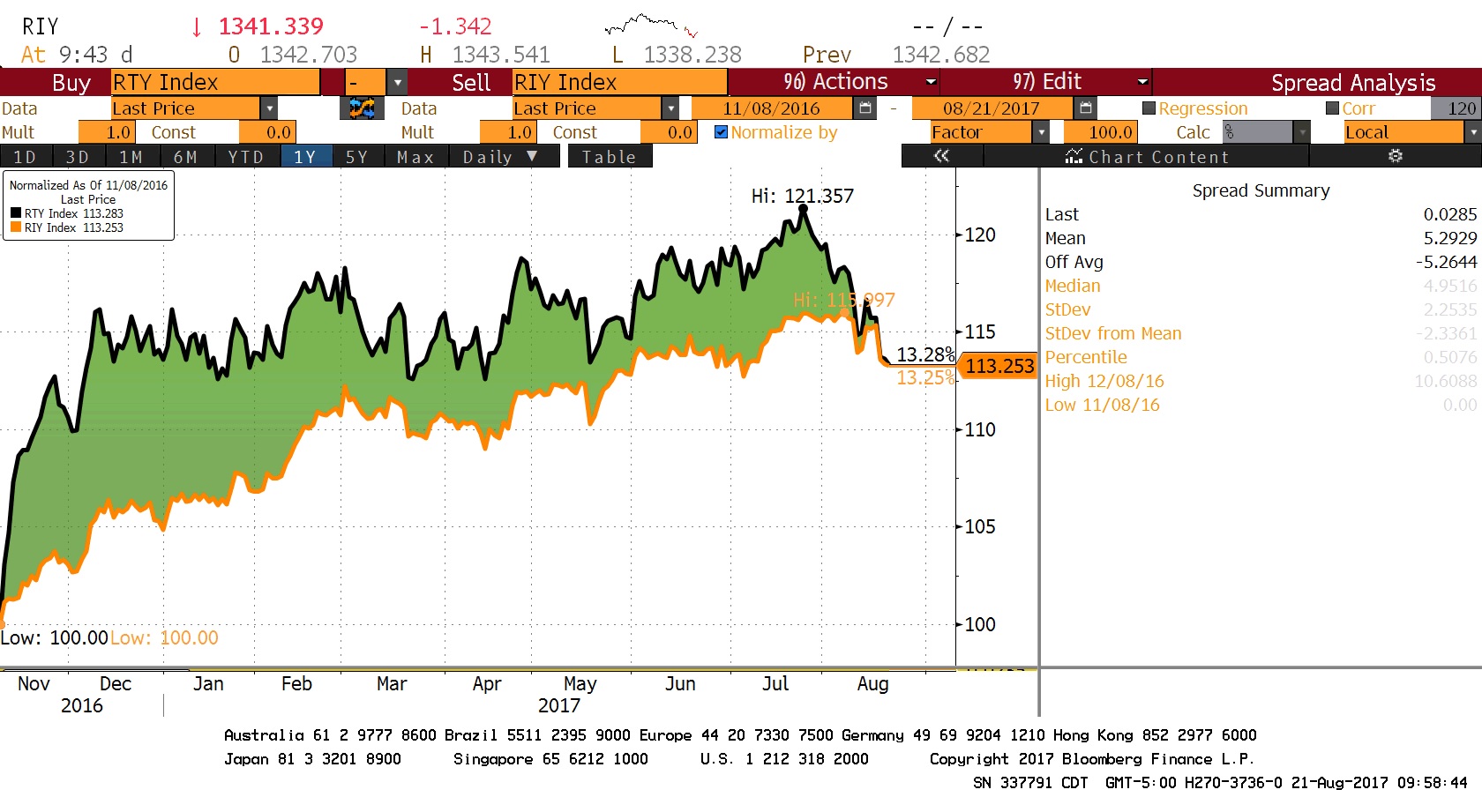
A couple of individual charts are worth noting. First, small cap stocks, which jumped after the election, have begun to roll over. The Affordable Care Act weighed heavily on smaller firms and hopes of a repeal likely boosted small cap stocks due to expectations of easing regulatory burdens.
(Source: Bloomberg)
This chart shows the relative performance of the Russell 2000 and the Russell 1000 Indexes, or small cap versus large cap stocks, indexed to Election Day. After a strong rally following the election, small cap stocks have clearly weakened. We suspect much of this is due to disappointment with the path of policy.
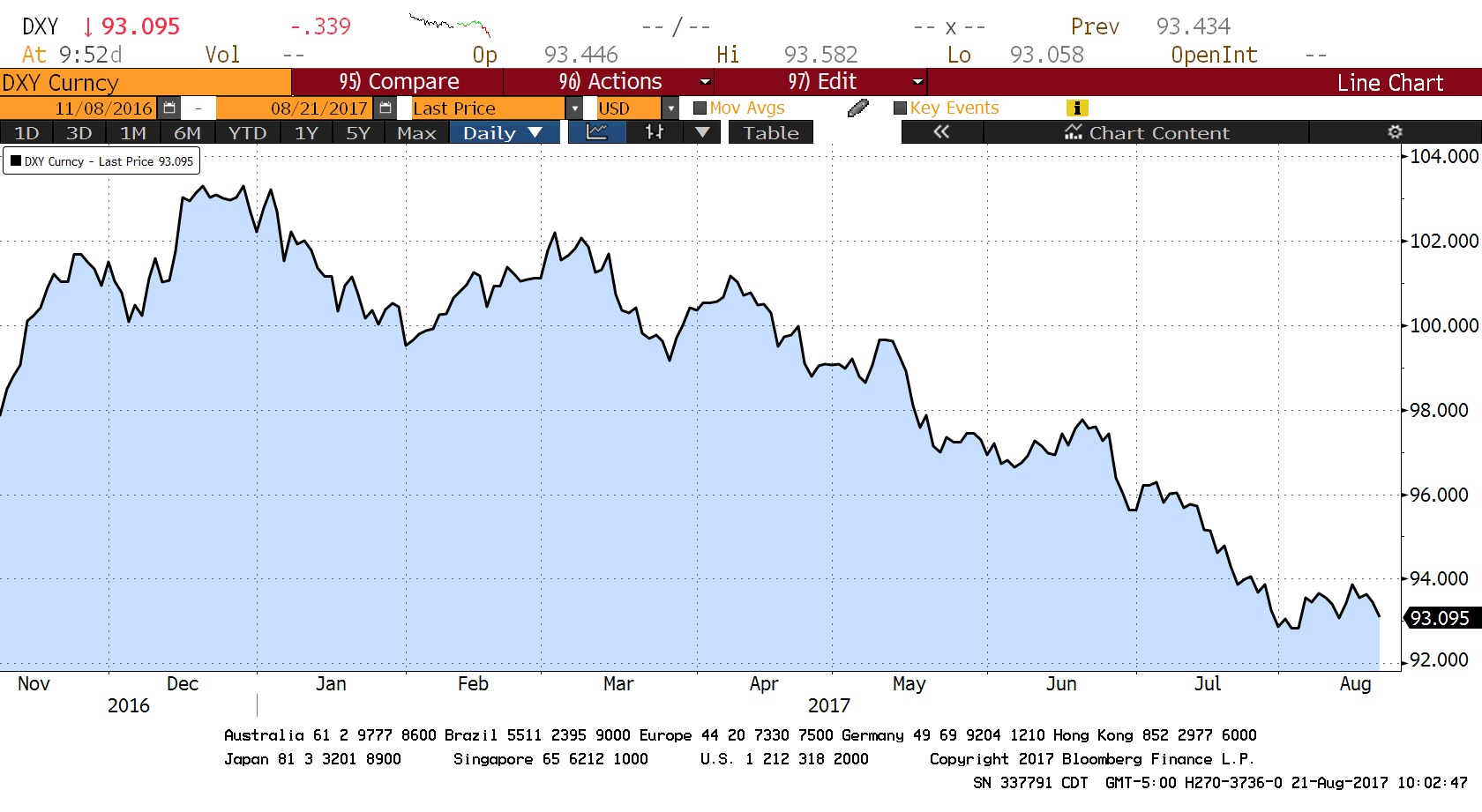
The other item we want to highlight is the path of the dollar.
(Source: Bloomberg)
This chart shows the G-10 dollar index, again from Election Day to the present. The dollar rose after the election and peaked about 4% from Election Day. As the Trump agenda has stalled, the dollar has come under pressure and has fallen about 5% below the level seen at the election. If the full GOP agenda had been legislated, it would have been dollar bullish. Fiscal stimulus, including tax cuts and infrastructure spending, would have boosted demand and likely prompted monetary policy tightening from the FOMC. At the same time, the border adjustment tax, which would have acted as a tax on imports and a subsidy on exports, would have also boosted the dollar. Sluggish economic growth and the Republicans’ inability to pass legislation, along with low inflation, have slowed the pace of monetary policy tightening. The dollar has weakened, in part due to fiscal policy disappointment and the use of short dollar positions to protect against the erratic behavior of the Trump government.
Perhaps the bigger surprise has been the relatively weak performance of commodities despite dollar depreciation. There is growing evidence that commodity price performance is becoming more sensitive to China. This year, the Chinese economy has been a bit choppy due to policy uncertainty surrounding October’s Communist Party meetings, which will select the personnel for Chairman Xi’s second term. Thus, we will be watching to see what Chairman Xi focuses on for his second term. Will he try to address China’s debt problem through slower growth and a bias toward the household sector, or will he go for growth? If he picks the latter, commodities will benefit. If not, they will likely languish. Slowing the rise in debt is probably the right choice over the long run; however, it is a risky proposition in the short run. Thus, the safer bet is that he will continue to keep growth elevated which will lead to higher levels of debt.
Over the last decade, the West has seen a series of tumultuous events. Of course, ten years ago the world was trying to cope with the Great Financial Crisis which raised fears of a repeat of the Great Depression. Although that outcome was avoided, deep underlying problems remain. Southern Europe faced a series of debt crises, which were followed by a refugee crisis. Global economic growth has stagnated. A steady drumbeat of civil unrest continues in the U.S. Terrorist acts have been occurring in Europe.
As these problems festered, unrest has been expressed through a series of electoral surprises, including Donald Trump in the U.S., Brexit in Europe, Macron in France and nationalist parties in Hungary and Poland. Meanwhile, Russia has become more aggressive, using hybrid tactics to expand its influence.
In the face of widespread turmoil, it appears appropriate to offer some reflections on one of the key elements of the modern era—the rise of the nation state and how it has evolved to the present day. This evolution is part of how humans organize themselves. Human beings are both social creatures and individuals, and how we manage both sides of our nature is a constant tension expressed throughout history.
In Part I of this report, we will begin with a discussion of social contract theory prior to the Enlightenment period, focusing on Thomas Hobbes. From there, we will examine the two key thinkers of social contract theory during the Enlightenment, John Locke and Jean-Jacques Rousseau. Part II will recount Western history from the American and French Revolutions into WWII. We will analyze America’s exercise of hegemony and the key lessons learned from the interwar period. Part III will begin with a historical analysis of the end of the Cold War and the difficulties that have developed in terms of the post-WWII consensus and current problems. We will discuss the tensions between the U.S. superpower role and the domestic problems we face, followed by an analysis of populism, including its rise and the dangers inherent in it. As always, we will conclude with market ramifications.
A number of market commentators have suggested current conditions are similar to 1987. Complacency, shown by the low level of volatility and an elevated P/E, is rampant. On the other hand, there is no evidence a recession is looming and, although monetary policy is tightening, the Federal Reserve has been raising rates at a slow pace and financial conditions remain at low stress levels.
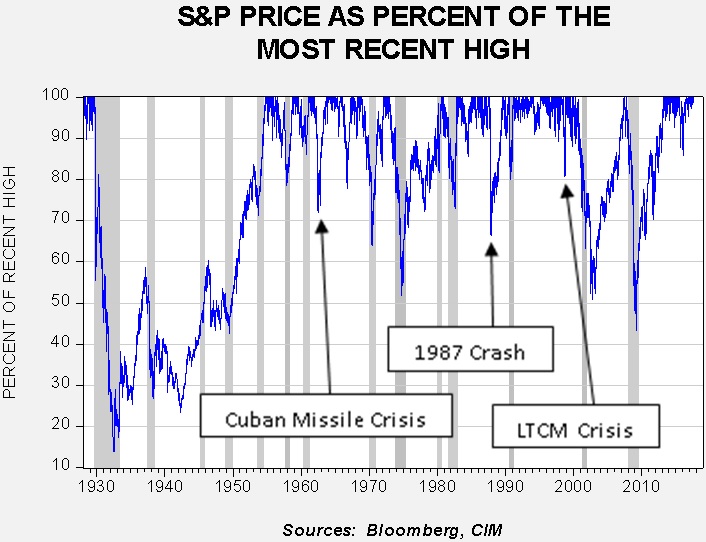
This chart can help us examine the potential for a correction.
To create this chart, we looked at the daily close for the S&P 500 Index starting on the first trading day of 1928. Each subsequent close is measured against the most recent closing high. A reading of 100% means a new high has been attained. Recessions, shown by the gray bars, tend to have a negative impact on equities; the effect was most obvious during the Great Depression. We have also noted a few events of interest on the chart.
There are currently two areas of concern. The first is that the North Korean situation could escalate; clearly, if we have a military event that includes nuclear weapons, then we are in uncharted territory and none of the above history is relevant. However, we do have the Cuban Missile Crisis as an analogue. From the S&P 500’s recent closing high of 2490, a repeat of that crisis would trigger a pullback to 1785. Although that would be sizeable, note that the market recovered quickly. At present, tensions have cooled and we don’t expect a military event in the near future.
The second area of concern is tied to market complacency. Market volatility has been very low and investors have been shorting volatility successfully for some time.
(Source: Bloomberg)
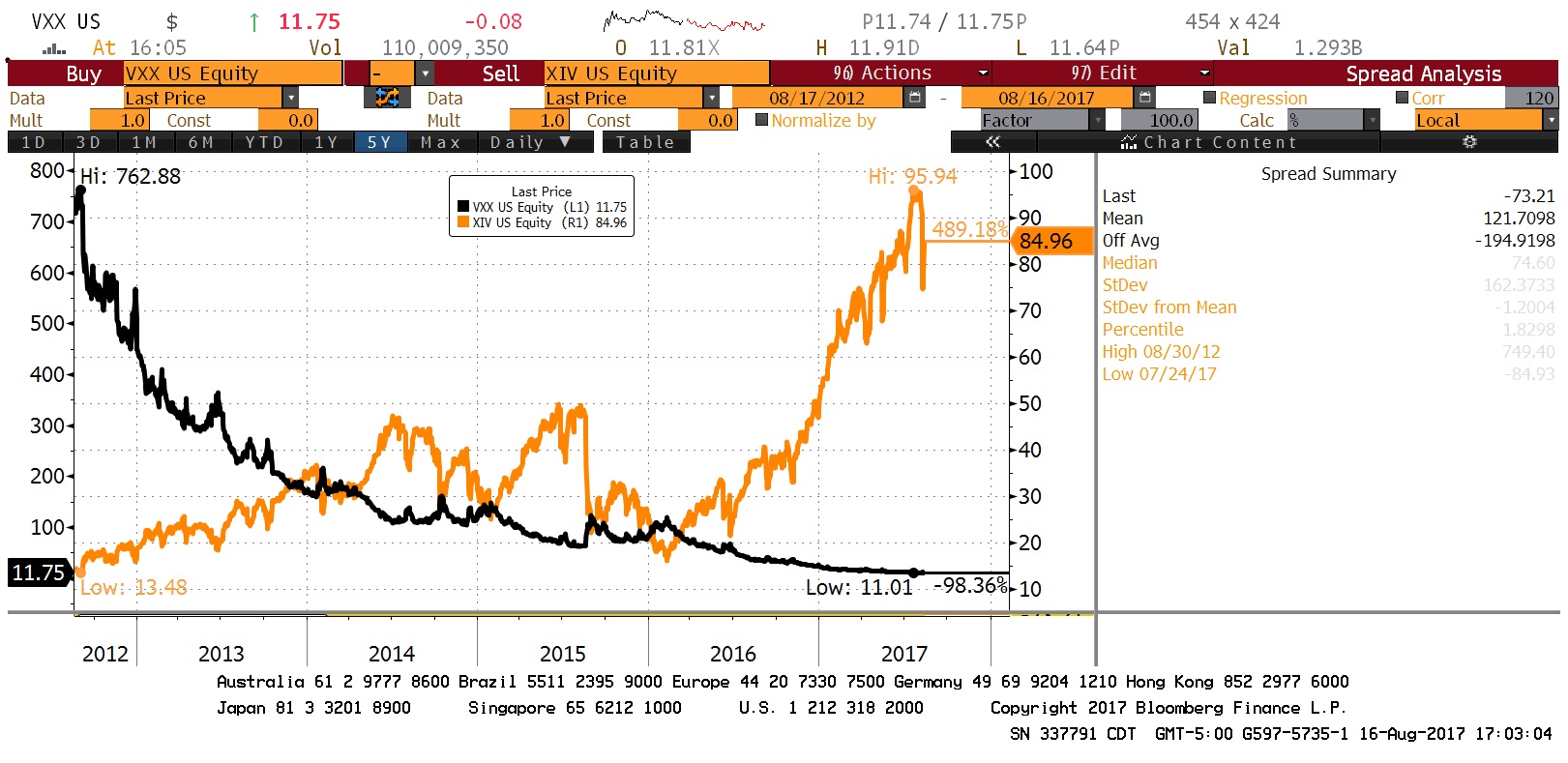
This chart shows the VIX ETF (VXX, 11.75) and the inverse VIX (XIV, 84.96). This five-year chart shows that those who have been long volatility have suffered steady losses, while those short volatility have generally done well. However, the gains on being short volatility have accelerated over the past two years. There have been reports that portfolio managers have been using short volatility in a fashion similar to portfolio insurance in the 1980s. Portfolio insurance was one of the causal factors of the 1987 Stock Market Crash, shown on the above chart. Short volatility has become a crowded trade. If investors reverse these positions quickly, it could create conditions similar to 1987. A repeat of that outcome yields an S&P of 1636.
It is important to note that in both the 1962 and 1987 events, the economy avoided recession and equities recovered quickly. Clearly, past performance doesn’t guarantee future outcomes, but as long as a market correction event isn’t driven by a recession then we would expect the decline to be short-term in nature.
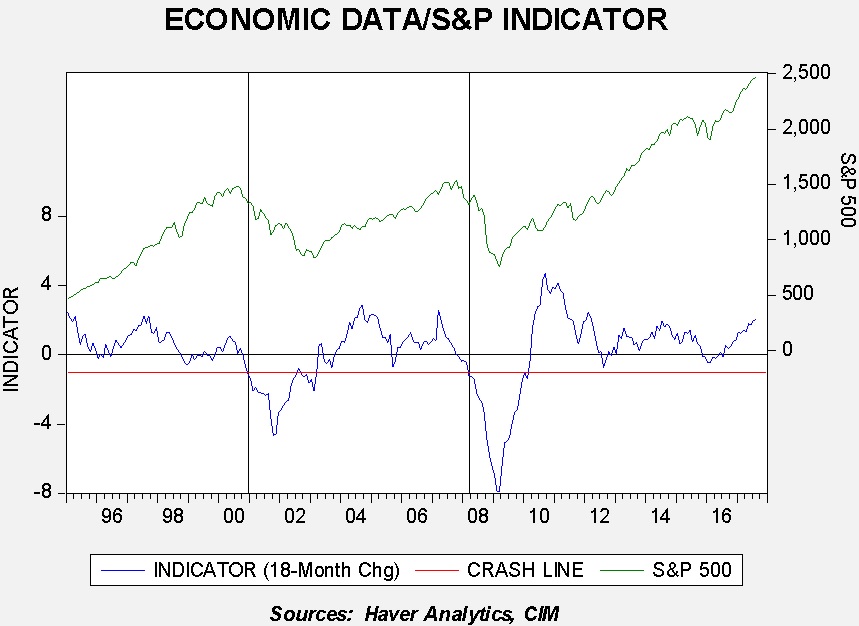
Recently, we introduced an economic data/S&P indicator.[1] It does not suggest a recession-driven market drop is imminent.
The green line is the monthly average for the S&P 500; the blue line is an indicator built of three economic numbers—initial claims, the CRB commodity index and the Conference Board’s Consumer Confidence data. We have standardized the economic data and created an indicator, shown on the bottom of the graph. In general, a positive reading is generally bullish for equities. We have placed vertical lines on the chart to indicate when the indicator turned negative with persistence. These are usually periods of falling equities. This model would tend to suggest that a pullback caused by economic weakness isn’t in the offing, and so an event-driven pullback, though potentially painful, would probably be short-term in nature.
Last week, we discussed a short history of Qatar and its geopolitical imperatives. This week, we will analyze the events precipitating the blockade, the blockade itself, the GCC’s demands and the impact thus far on Qatar. We will examine how the situation has reached a stalemate and, as always, we will conclude with market ramifications.
The Precipitating Events
As we discussed last week, a combination of conditions have allowed Qatar to avoid domination by Saudi Arabia, the generally recognized leader of the GCC. Qatar has powerful allies outside the region, friendly relations with Iran, is demographically unified and has an economy that isn’t dependent on oil, all of which have allowed Qatar to follow independent policies. This situation has persistently angered Saudi and UAE leaders. Beneath these national concerns are also long-standing tribal rivalries.
However, these differences have been in place for a long time. It appears that there were three events that led the GCC, Egypt, Yemen and Sudan to react and initiate the blockade.
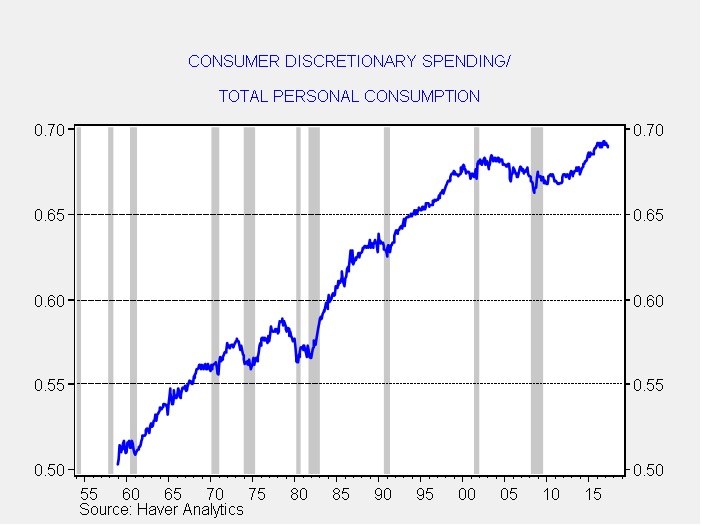
Although measuring “malaise” is more art than science, overall feelings of wellbeing or the lack thereof affect markets, politics, etc. One less common way to measure this is the ratio between discretionary spending compared to overall spending. Discretionary spending is defined as total spending less what is spent on food, clothing, energy and housing. In other words, if a household is able to spend more on other items besides these goods, one would expect “happier” people. Spending more on necessities, on the other hand, can make households feel as if they “can’t get ahead.”
This chart shows the ratio of consumer discretionary spending to total personal consumption. A higher ratio means that households are spending more on discretionary items and less on food, clothing, gas, heat and rent. Although the ratio has generally increased since the late 1950s, there have been two periods when the pace of improvement slowed, in the 1970s and since 2000.
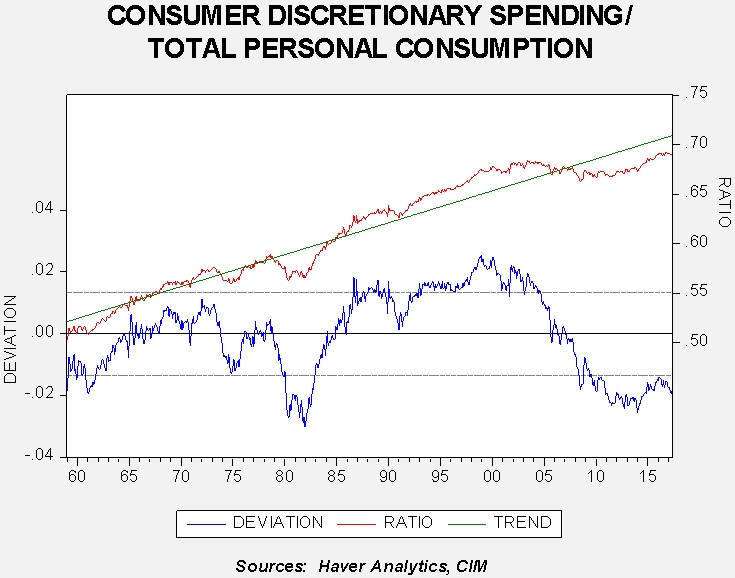
To better analyze the behavior of this ratio, we regressed the ratio against a time trend.
There have been four periods when this ratio was significantly below trend. The first was in the early 1960s. John F. Kennedy’s presidential campaign promised to get America moving again after the somnolent 1950s. The second occurred during the deep 1973-75 recession, which coincided with the first energy crisis. The third occurred during the late 1970s into the early 1980s; this period featured a “double dip” recession and another energy crisis. The 1970s also had major political problems, including the Nixon resignation and the difficult presidency of Jimmy Carter.
The most recent event has been the longest. The major recession of 2007-09 coupled with a slow recovery and stagnant income growth has led to a period where necessities are taking up a bigger share of spending relative to trend. It coincides with deep political divisions and a fear among many Americans that stagnation is never-ending.
To some extent, this is an imperfect measure of sentiment. After all, the trend will eventually reach 100%, which would mean that spending on the four necessities would need to fall to zero (either we stop eating, wearing clothes, driving and living in homes or apartments) or the cost of these goods would approach zero. Neither scenario is likely. Still, the fact that spending on necessities is higher than trend relative to other spending has proven, historically, to signal social and political problems. As one who lived through President Carter’s “malaise” speech, the feeling in the late 1970s was rather bleak. Ronald Reagan’s optimism was key to lifting the country out of this funk. The fall in inflation that allowed households to spend less on necessities did the rest.
So far, this period of below-trend spending on discretionary goods has not adversely affected financial markets. However, it is clearly having an impact on the current political situation and, at some point, it could affect market confidence. We monitor these conditions closely and are somewhat heartened by the recent improvement in this ratio. However, this time around, falling prices for energy and food probably won’t be enough to raise this ratio. Rising wages for the bulk of American households is probably the only way to lift this ratio back to trend.
On June 6th, several members of the Gulf Cooperation Council (GCC)[1] announced a sweeping blockade of Qatar, also a member of the GCC. The GCC members enforcing the blockade, led by Saudi Arabia, issued a list of 13 demands which Qatar rejected.
Since the blockade was implemented, Qatar has managed to replenish basic foodstuffs that were initially stripped from store shelves as households rushed to hoard necessities. The emirate state has managed to fly in dairy cows from abroad which are now contentedly supplying milk from air conditioned barns in Qatar.
In the first part of this report, we will offer a short history of Qatar and examine its geopolitical imperatives. Next week, in Part II, we will analyze the events precipitating the blockade, the blockade itself, the GCC’s demands and the impact thus far on Qatar. We will examine how the situation has reached a stalemate and, as always, we will conclude with market ramifications.
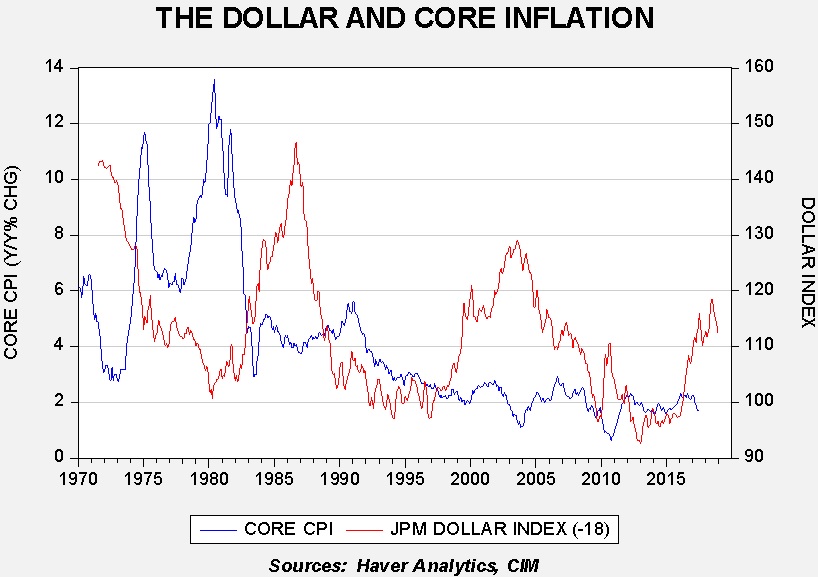
Two weeks ago, we detailed our expectations for a weaker dollar. If we are correct, one of the potential effects could be inflation. A weaker dollar has two price effects. First, it directly raises import prices. Second, it gives pricing power to domestic firms competing with imports as price pressures should dissipate as import prices rise. The Federal Reserve has struggled with continued low inflation rates as the Phillips Curve models have consistently overestimated inflation. Perhaps dollar weakness will come to the FOMC’s rescue and lift price levels, allowing the Fed to raise its policy rate.
This chart shows the yearly change in core CPI with the JP Morgan dollar index, which is advanced 18 months. A cursory view of the chart does suggest that a rising dollar seems to depress inflation, while a falling dollar seems to have the opposite effect. And, the idea that the dollar’s impact takes place over time is consistent with theory. This is because foreign firms will initially try to maintain market share by holding prices steady and face margin compression in a weak dollar period and will only move prices higher over time. The opposite tends to occur during periods of dollar strength as domestic firms attempt to maintain their market share.
However, as much as our eyes see the above pattern, the statistical impact is actually rather weak. The correlation is only a mere 5%. There are clearly other factors that are keeping core inflation low; we believe the long-term effects of deregulation and globalization play a much more important role. Thus, as we discussed two weeks ago, the dollar should have an important impact on foreign equity performance but probably only a modest effect on core inflation.
On June 20th, King Salman of Saudi Arabia announced that his son, Prince Mohammed bin Salman (MbS, as he is affectionately known), would be the new crown prince, replacing Prince Mohammed bin Nayef. Although the move was momentous, it was not necessarily unexpected. MbS’s stature in the kingdom had been rising since he was appointed as deputy crown prince in 2015, while Prince Nayef, who had been appointed as crown prince at the same time, held a lower profile and was generally overshadowed by his younger cousin.
However, over the past two weeks, details of the change emerged in the major U.S. media.[1] Although the initial reports suggested the change was consensual, recent articles, referenced below, make it clear that Prince Nayef was ousted.
In this report, we will discuss the history of the succession of Saudi kings to highlight how the eventual ascension of MbS will represent a major break with history. We will then examine the details of the ouster and the potential for opposition to MbS taking power. We will analyze what the eventual kingship of MbS might mean for the region. As always, we will conclude with market ramifications.
We use cookies to ensure that we give you the best experience on our website. If you continue to use this site we will assume that you are happy with it.