The Market
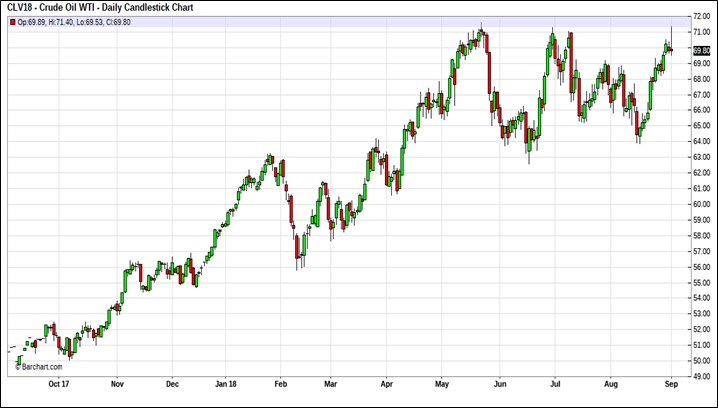
Since mid-Q1, oil prices have ranged from a low of around $64 to a high of $71 per barrel.
(Source: Barchart.com)
Prices remain elevated, supported by OPEC production discipline, production problems in several OPEC nations, fears of new Iran sanctions and stable global oil demand.
Prices and Inventories
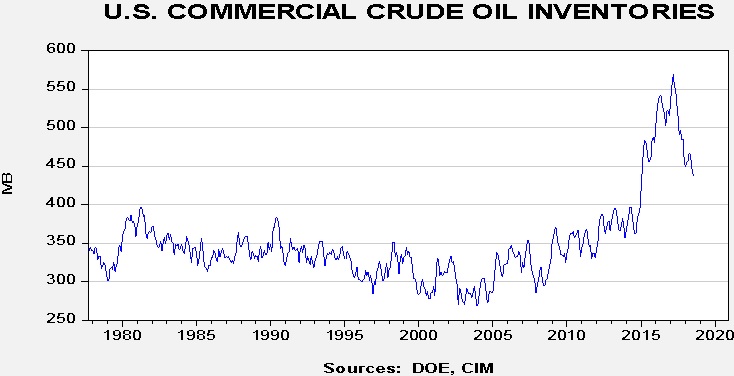
Inventory levels remain elevated but have clearly declined from last year’s peak.
From the late 1970s into mid-2014, U.S. commercial crude oil inventories ranged between 275 mb and 400 mb. However, from mid-2014 into 2017, rising U.S. production led to a major increase in stockpiles.
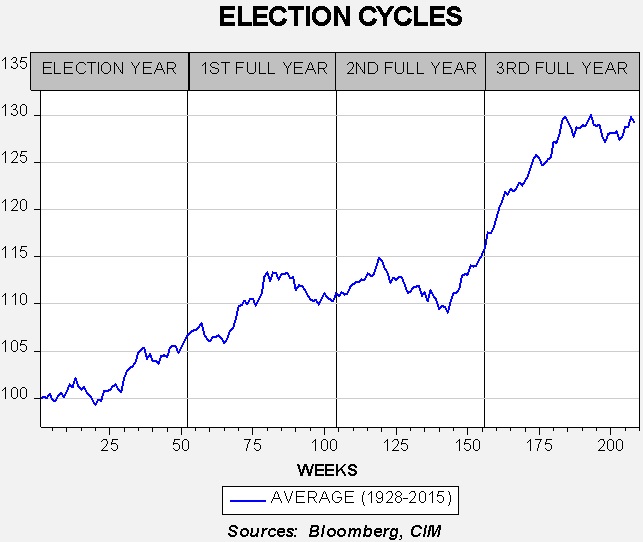
Traditionally, the election season kicks off with Labor Day so, with last Monday’s holiday, the election cycle is upon us. The midterm election year tends to be lackluster for equities until Q4, when a strong rally usually develops.
The data for this chart is developed by taking the weekly closes for the S&P 500, beginning with the first Friday close in 1928. We index the data over the next four years and then average each week across each four-year cycle. Thus, this graph represents 22 cycles. The election occurs around week 48 in the election year. On average, the euphoria surrounding the election lasts until week 80 (into the summer of the year after the election) when equities become range-bound. Some of this pattern is probably due to the inevitable disappointment that a new administration can’t implement all the changes it promised. By the midterm year (third full year), equities test the low end of the range into October then begin a multi-month rally that persists into the middle of the year after the midterms. Another range-bound pattern develops into the election year.
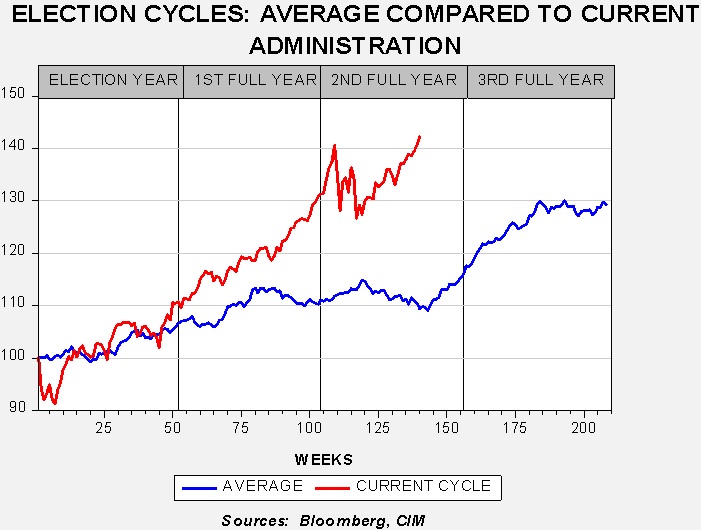
The following chart shows how the current administration compares to the average.
Clearly, the Trump administration has been popular with investors, especially during the first full year after the election. The tax cuts boosted equity prices into Q1 of this year. However, concerns about trade, tightening monetary policy and worries about the midterms have all likely conspired to bring a period of consolidation. Equities have improved recently, making new highs. The range-bound pattern that has emerged this year is consistent with the average election cycle pattern, albeit from a higher level.
The key question is whether we will see the typical midterm rally in Q4 through next summer. As we discussed last week, although there are worries about political turmoil in the wake of a potential change in power in Congress, the political situation, by itself, probably won’t derail the bull market. The primary threat to the bull market is recession and the most likely culprit would be overly tight monetary policy. Given the current pattern of tightening, we don’t expect that to be a problem until H2 2019. Thus, the pattern will probably hold but, given the recent strength in equities, we would not necessarily expect the usual 20% rise seen after the midterms. However, a more pedestrian rally of 5% to 10% would not be a surprise. To conclude, we do expect a post-midterm rally, perhaps less vigorous than average but a stronger equity market nonetheless.
In light of the recent conviction of Paul Manafort and the guilty pleas by Michael Cohen, along with the upcoming midterm elections, we have been receiving questions about the political landscape going into winter. In this report, we will discuss our baseline expectations for political trends and their potential effect on financial markets.
Our expectations:
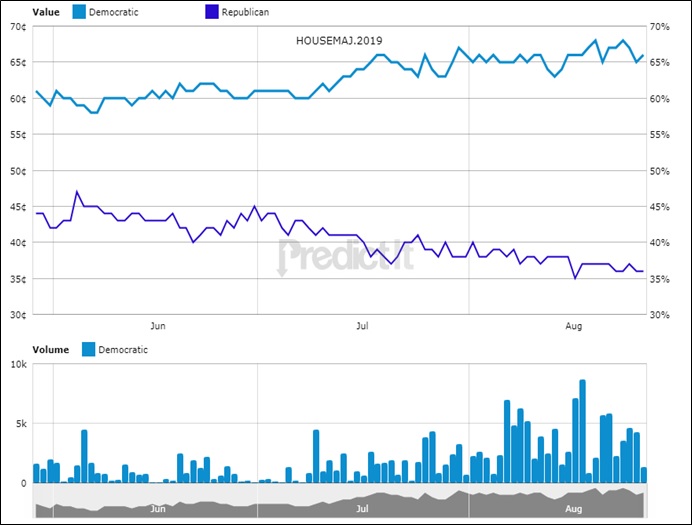
We expect the Democrats to win the House in November but the GOP will hold the Senate. Current prediction market wagers are the primary basis for this expectation.
(Source: PredictIt.com)
For the House, the prediction market has been consistently indicating a 65% likelihood that House control changes parties. At the same time, the same group shows the likelihood that the GOP retains control of the Senate is above 70%.[1]
A divided legislature will lead to gridlock. We expect a Democrat-controlled House to use its subpoena power to investigate any potential corruption in the Trump White House. According to Axios,[2] there will be a plethora of potential areas to examine. Because of this distraction, we doubt the White House will be able to muster any significant legislative achievements. This outcome isn’t all that unusual. Normally, the peak of a president’s power is in the first 18 months of his first term. Any political capital that isn’t spent in this period is lost. By summer of the second year in office, midterm elections are looming and Congress is distracted by the upcoming vote. Often, the president’s party loses seats in Congress after the midterms and legislative progress grinds to a halt. This usual pattern, coupled with the likelihood of perpetual investigations, probably means not much will get done.
Will the Democrats impeach President Trump? Much of this will depend on what the House investigations unearth. Although articles of impeachment might be approved, there is very little chance that two-thirds of the Senate would vote to remove Trump from office.
How will financial markets react to these baseline forecasts?
Equity markets: There have only been two impeachment events during modern market conditions, in the early 1970s under Nixon and the late 1990s under Clinton. In the former event, equities declined but the Watergate scandal was probably nothing more than a minor contributing factor. The economy was in a deep recession in 1973-74, and the world economy was reeling from the end of Bretton Woods and the Arab Oil Embargo. Simply put, there was a lot going wrong and the Nixon resignation was only part of the overall turmoil. In the latter case, equity markets were in the midst of the great tech bubble and mostly ignored the political news.
In general, equity markets will be sensitive to the business cycle and policy. We don’t expect a recession over the next three to four quarters. If the Fed overtightens, which will be an increasing risk next year, a recession is possible. For now, we expect the FOMC to move slowly on rates and avoid a policy error. In terms of fiscal and regulatory policy, the equity markets have already received support in the form of corporate tax cuts, additional spending and deregulation. At the same time, we have seen some weakness develop on fears of a wider trade war. If congressional investigations slow the trade conflict, we could see the bull market in equities not only continue but gain strength.
Debt markets: If trade impediments don’t increase and the Fed continues to raise rates, the odds of higher interest rates will increase. Political turmoil may lead to some flight-to-safety buying for Treasuries, but credit spreads could widen as a result. Overall, we could see the 10-year Treasury yield move toward 3.15% but would not expect it to move much above that level.
Currencies: The dollar is probably the most vulnerable of all the asset classes. On a parity basis, the dollar is overvalued (our parity against the EUR is approximately $1.3050) and has been rallying mostly on trade worries. If the U.S. puts up broad trade barriers, we would expect foreign nations to depreciate their currencies in order to offset the price increases triggered by the tariffs. When President Trump appeared ready to apply trade restrictions globally, the dollar rallied. However, the recent deal on NAFTA and the détente with the EU suggests that the administration’s real goal may be to contain China. If so, the dollar could weaken; political turmoil might accelerate that trend. A weaker dollar would tend to benefit international investments, U.S. large caps and commodities.
The political situation will not be the only factor affecting market behavior. For equities, earnings and the overall economy will still be significant. Political peace coupled with a recession would still be bearish for stocks. The above discussion addresses the likely impact of the unfolding political situation. The bottom line is that our position, for now, is that the current political situation, by itself, probably won’t be a major market-moving event.
(N.B. Due to the Labor Day holiday, the next report will be published on September 10.)
Last week, we covered Turkey’s geopolitics and history.[1] This week, we complete the series, starting with a discussion on Turkey’s economy with a focus on the changes brought by the Justice and Development Party (AKP), led by President Erdogan. We will also examine how foreign debt affects Turkey’s economy and financial system, highlight the impact of the 2016 coup and analyze the causes of the current crisis in Turkey. From there, we will discuss the debt problem and Turkey’s options for resolving the crisis. As always, we conclude with market ramifications.
What is price stability? The working definition for the Federal Reserve was crafted by Alan Greenspan in 1994, when he suggested that price stability has been achieved when “…households and businesses need not factor expectations of changes in the average level of prices into their decisions.”[1] In other words, a central bank has achieved its price objective not necessarily when it has reached 0% inflation but when households and firms no longer take inflation (or deflation) into account when making purchase or investment decisions. This is probably the best answer to those who complain that 2% inflation is still inflation; although true, we have observed that no one seems to care about inflation around this level. Once the perception of price stability has been achieved, firms and households react to price increases by assuming the rise is due to particular factors in a specific market, not because of overall inflation. If prices rise in one market but economic actors don’t believe it’s due to an overall increase in the price level, then they are less likely to react to that specific price change by assuming they should buy other goods before prices increase there as well.
Assumptions surrounding price stability change how financial markets operate. If investors fear inflation, or, more accurately, when expectations of price stability are absent, then anything that increases the fear of inflation, such as currency weakness, will force the central bank to raise rates to offset that concern. The increase in interest rates will slow economic activity and weaken financial asset prices. Fiscal expansion can cause similar fears. On the other hand, when investors expect price stability, fiscal or monetary expansion is welcomed because it will support the economy and lift asset prices.
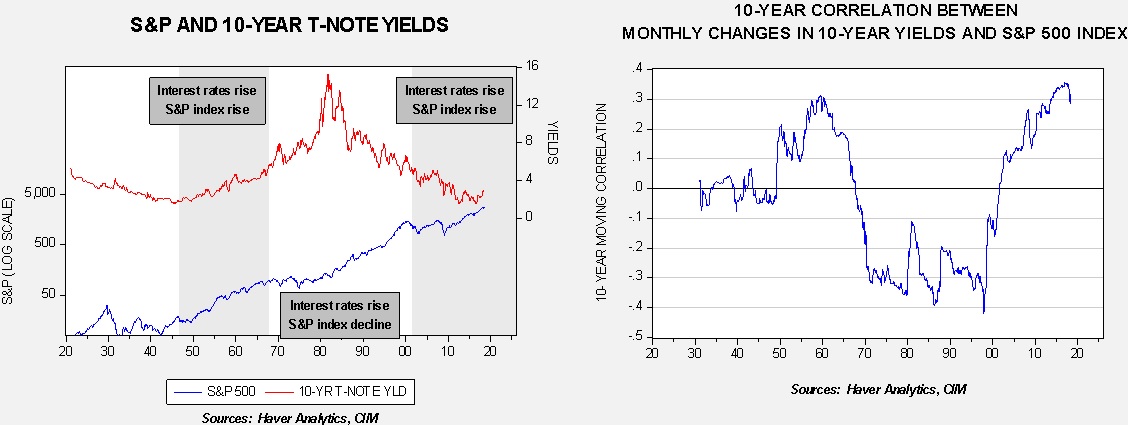
The chart on the left shows the 10-year T-note yield and the S&P 500 Index; the latter is on a log scale. The chart on the right is the focus of this analysis. Here we examine the 10-year moving correlation between the monthly change in the S&P 500 and the 10-year yield. Note that the change in the two series was positively correlated from 1946 into 1967; in other words, when the S&P rose, so did long-duration interest rates. From an investor’s perspective, the 10-year Treasury could act as a partial hedge to an equity portfolio. Because bond prices fell when rates rose, a portfolio holding bonds and stocks would tend to have lower risk. Under conditions of rising equity values, an investor would expect his bonds to fall in value and vice versa, meaning the same investor could expect his bond values to rise when equity values fell.
From 1967 into 2001, this correlation reversed its sign. When rates rose, the S&P fell. Thus, a portfolio of bonds and stocks, in terms of price, moved in the same direction. Now, as the chart on the right shows, in terms of overall direction, there was a bull market in both bonds and stocks from roughly 1985 to 1990. But, since we are examining this on a monthly change basis, there was still a tendency for rising interest rates to trigger equity weakness. The 1987 crash is an example.
Since 2002 into the present, the correlation sign has reverted back to the 1946-67 condition. This means that holding long-duration bonds in a portfolio will act as an effective hedge to an equity portfolio. In other words, when equity prices fall, the prices within the fixed income portion of the portfolio will tend to rise.
Modern portfolio theory postulates that holding two less than perfectly correlated assets will offer some degree of risk-adjusted outperformance. And, it is worth noting that the rolling correlation shown above isn’t ever all that strong, maxing out at around 0.4. So, even during the late 1960s into the early aughts, holding bonds did offer some diversification effect. However, when the correlation between bond prices and equities is inverse, it allows an investor to “hide” in fixed income during bear markets in equities. That tactic wasn’t available to investors from the late 1960s through the mid-1980s.
The key to the relationship between bonds and stocks involves expectations surrounding price stability. Price stability, in our opinion, rests on three legs. The first is globalization. By allowing firms and consumers to scour the globe for the best places to build productive capacity and source goods, price pressures are contained. The second is deregulation. Allowing firms to introduce new technologies and techniques into the economy without government interference supports efficiency and productivity. And, central bank independence is the third pillar. Allowing central banks to peruse the most appropriate monetary policy without political interference gives investors, consumers and firms confidence that inflation will not be allowed to erupt regularly for short-term political gain. We monitor the viability of these three legs constantly. Currently, the first is under fire and the third is facing threats as well. If these components continue to face pressure, expectations of price stability could erode and proper asset allocation will change, too. For now, we still expect price stability to be maintained but the threats are growing. If the threats rise to a level that undermines price stability, we will act accordingly.
Over the past few months, Turkey has become a major topic of interest. Recep Erdogan won re-election to the presidency in June 2018. This event was important because a referendum on a new constitution in 2017 gave the office of the president sweeping powers; the previous constitution was based on a parliamentary model which gave more power to the prime minister. According to the referendum, Erdogan could only exercise these new presidential powers after winning a new election.
Even before the election, there were signs the economy was overheating. Inflation was increasing and the central bank was not raising rates in a manner consistent with quelling the inflationary pressure. Since the election, an economic crisis has developed, with falling financial asset prices and a sharp decline in the Turkish lira (TRY). In addition, Erdogan has found himself in a contest of wills with President Trump over Americans detained in Turkey. This has led to punitive trade tariffs and threats of additional sanctions.
The goal of this report is to place the current crisis within the context of Turkey’s evolution and development. Part I will examine Turkey’s geopolitics and history. Part II will discuss economic factors, including the impact of foreign debt on Turkey’s economy and financial system. We will highlight the impact of the 2016 coup and analyze the causes of the current crisis in Turkey. From there, we will offer a discussion on the debt problem and Turkey’s options for resolving the crisis. As always, we will conclude with market ramifications.
Last week, the Bureau of Labor Statistics released the CPI data for July. Inflation continues to rise; the overall rate rose 2.9% and the closely watched core rate (the rate less food and energy) rose to 2.4%, the highest rate since September 2008. Rising inflation raises policy concerns. In this week’s report, we will analyze these concerns.
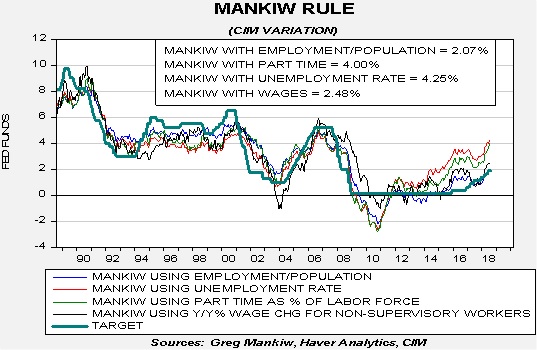
The rise in interest rates will support the Federal Reserve tightening stance. To determine what the fed funds target rate “should” be, we use the Mankiw Rule model. The Mankiw Rule model attempts to determine the neutral rate for fed funds, which is a rate that is neither accommodative nor stimulative. Mankiw’s model is a variation of the Taylor Rule. The latter measures the neutral rate using core CPI and the difference between GDP and potential GDP, which is an estimate of slack in the economy. Potential GDP cannot be directly observed, only estimated. To overcome this problem with potential GDP, Mankiw used the unemployment rate as a proxy for economic slack. We have created four versions of the rule, one that follows the original construction by using the unemployment rate as a measure of slack, a second using the employment/population ratio, a third using involuntary part-time workers as a percentage of the total labor force and a fourth using yearly wage growth for non-supervisory workers.
Using the unemployment rate, the neutral rate is now 4.25%, up from last month’s estimate of 4.00%, reflecting the fall in the unemployment rate and the rise in inflation. Using the employment/population ratio, the neutral rate is 2.07%, up from 1.84%. Using involuntary part-time employment, the neutral rate is 4.00%, up from the last calculation of 3.68%. Using wage growth for non-supervisory workers, the neutral rate is 2.48%, roughly unchanged from the last report of 2.41%. All the variations show a rise in the neutral rate; two of them, the traditional one with the unemployment rate and the rate using involuntary part-time employment, are 4.00% or above. The other two calculations are showing more slack in the economy, although both still suggest the FOMC needs to raise rates further. The model based on the employment/ population ratio suggests one more hike of 25 bps to reach neutrality and three more times to achieve that level for the wage growth variation.
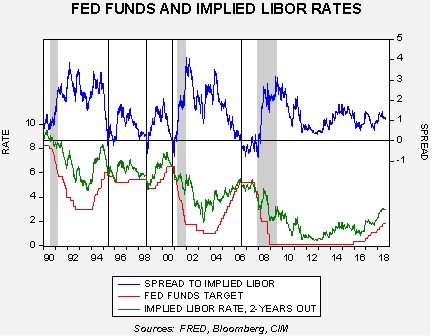
To determine the market’s projection for policy, we use the implied three-month LIBOR rate from the two-year deferred Eurodollar futures market. In the past, it has been a reliable measure of the terminal fed funds rate.
The top line on the chart shows the spread between the implied LIBOR rate and the fed funds target. We have placed vertical lines where the spread inverts and gray bars for recessions. In the 1990s, Chair Greenspan faced two periods when the spread inverted; both times he cut rates[1] and was able to extend the expansion. He was unable to avoid recession in 2001 despite aggressive cuts to fed funds, but that recession was considered to be unusually mild. The Bernanke Fed did not lower rates when the spread inverted in 2006, leading to a period of extended policy tightness which may have increased risk to the economy.
Despite the rise in inflation, the implied three-month LIBOR rate from the two-year deferred Eurodollar futures market did not rise; in fact the most recent reading is 2.95%, suggesting the FOMC should stop raising rates when the target reaches 3.00%. That still means five rate hikes are being discounted by the financial market. Assuming two more this year, the Eurodollar futures are suggesting three hikes would be on tap for 2019.
The differences in the Mankiw Rule variations mean that the projected 3.00% rate would likely signal recession if the proper measure of slack is either the employment/population ratio or wage growth variation. On the other hand, if the true measure of slack is the unemployment rate or involuntary part-time variation, then the Fed is running the risk of either triggering an inflation problem or inflating an asset bubble. How do we know which is the best measure of slack? There really is no good way to know for sure but if forced to choose we would select the wage growth variation as probably the best gauge. Why? Because overly tight labor markets should push wages higher and the fact that wage growth remains sluggish probably means there are “pockets” of workers still being drawn into the labor force. The fact that the labor force is continuing to expand confirms this notion. The argument against the wage growth variation is the idea that the labor market has become an oligopsony, meaning that firms have market power over labor and are holding down wages despite the lack of workers. Although this is possible, we doubt this factor can hold down wages indefinitely.
If the wage growth variation is the correct measure of slack, we are still three tightening events away from neutrality. Thus, for the time being, the risk of the FOMC overtightening and triggering a recession is low. Nevertheless, the danger will rise by early next year and the risks of recession will rise appreciably by the second half of next year, assuming the Fed continues to ratchet rates higher. We continue to closely monitor this dynamic into next year.
The Trump administration withdrew from the Iranian nuclear deal earlier this year and plans to implement sanctions on the country in two phases, the first of which went into effect in early August with a second round in November. In Part I of this report, we introduced this topic and covered the first two potential responses from Iran, which were restarting the nuclear program and projecting power. Last week, we covered the threat to the Strait of Hormuz. This week, we will conclude with a discussion on the potential for Iran to deploy a cyberattack against the U.S. or use allies to end sanctions, along with the likelihood that Iran would enter into direct negotiations with Washington. We will conclude with market ramifications.
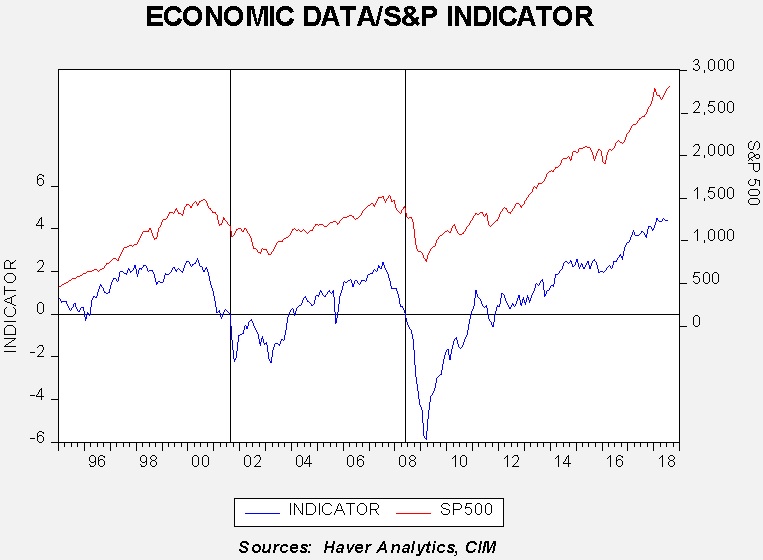
Last year, we introduced an indicator of the basic health of the economy and added it to the many charts we monitor to gauge market conditions. The indicator is constructed with commodity prices, initial claims and consumer confidence. The thesis behind this indicator is that these three components should offer a simple and clear picture of the economy; in other words, rising initial claims coupled with falling commodity prices and consumer confidence is a warning that a downturn may be imminent. The opposite condition should support further economic recovery. In this report, we will update the indicator with the July data.
This chart shows the results of the indicator and the S&P 500 since 1995. The updated chart shows that the economy is doing quite well. We have placed vertical lines at certain points when the indicator falls below zero. Although it works fairly well as a signal that equities are turning lower, there is a lag. In other words, by the time this indicator suggests the economy is in trouble, the recession is likely near or underway and the equity markets have already begun their decline.
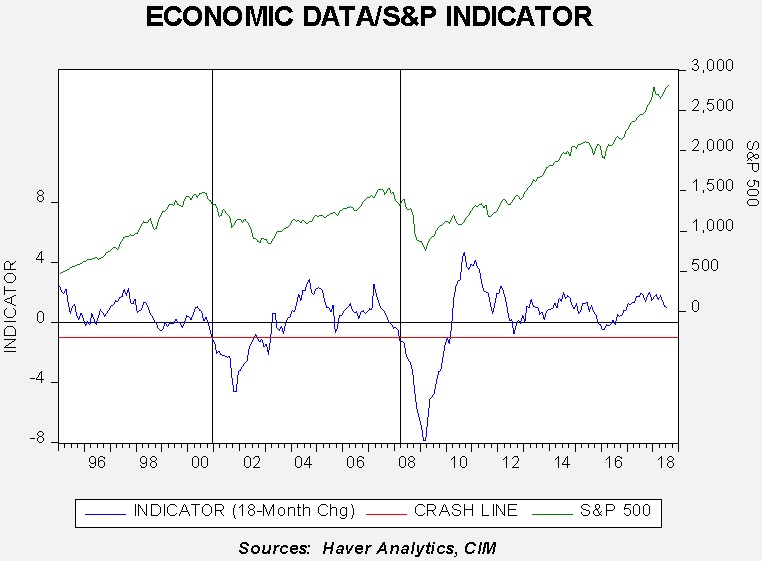
To make the indicator more sensitive, we took the 18-month change and put the signal threshold at -1.0. This provides an earlier bearish signal and also eliminates the false positives that the zero threshold generates. Notwithstanding, we will pay close attention when the 18-month change approaches zero.
What does the indicator say now? The economy is healthy and currently supportive for equity markets, although the second chart does show that momentum is starting to slow, albeit from a very high level of activity. The second chart shows that the indicator is still comfortably above the point of concern. Thus, for now, there is no economic evidence to support a major correction; if one is to occur, it will mostly likely be generated by a geopolitical event.
We use cookies to ensure that we give you the best experience on our website. If you continue to use this site we will assume that you are happy with it.