Weekly Geopolitical Report – Russia’s Local Elections (July 15, 2019)

by Patrick Fearon-Hernandez, CFA

Although Russia hasn’t been in the Western news very much recently, there’s been plenty of action “under the radar” related to the country’s regional and municipal elections this fall. On September 8, governors will be elected in 16 of the country’s 85 regions, including the important city of St. Petersburg.  Legislative assemblies will also be elected in 14 regions, the capitol Moscow, and many other municipalities.  In this week’s report, we’ll review the Russian government’s security goals and show how domestic political security is one of its most important priorities.  We’ll also discuss the domestic political challenges faced by the government and how it is attempting to control the regional and local elections to ensure President Putin and his United Russia Party retain power.  As always, we’ll conclude with market ramifications.

Russia’s Traditional Security Goals
In recent years, we’ve explored Russia’s security concerns in detail (see our Weekly Geopolitical Report from February 8, 2016).  We’ve emphasized that Russian security concerns stem largely from the fact that the country has few natural defenses and is essentially landlocked.  Russia’s European territory is open to invasion through the northern European plain, as illustrated by the invasions of Napoleonic France and Nazi Germany.  Meanwhile, Russia’s primary outlets to the sea can be blocked with relative ease.  Such landlocked isolation, restrained foreign trade, and limited arable land have left Russia relatively insular and poor, with an economy focused on natural resources.

View the full report

Asset Allocation Weekly (July 12, 2019)

by Asset Allocation Committee

The recent testimony from Chair Powell to Congress made it quite clear that the U.S. central bank is likely to cut rates at the end of July.  For the equity markets, the key issue is whether the shift away from tightening to easing will be enough to avoid recession.  If the rate cut(s) in the coming months reduce the odds of recession, we could see the expansion continue and the Fed may have engineered a rare “soft landing.”  On the other hand, it is quite possible that monetary authorities have raised rates too much and have waited too long to ease policy; if so, then a recession may be unavoidable.

This chart shows two business cycle indicators, one from the New York FRB and the other from the Atlanta FRB.  The former predicts the business cycle a year ahead and is based on the yield curve; the latter is coincident and based on GDP.  We overlay the two, using the New York number as a warning and the Atlanta index as confirmation.  The New York number has crossed the 30 threshold, which has been a signal of recession in the past with no false positives.  And, even rate cuts haven’t prevented recession once the 30 threshold has been crossed.  At the same time, we have not seen confirming data in the national accounts (GDP) data.  Thus, recession may be in the cards, although the risk isn’t imminent; the downturn may still be two years away and it is possible it could be avoided.  After all, every cycle is unique.

This chart shows the dilemma for equity investors.  In this chart we examine the average total return for the S&P 500 on a yearly basis, with the data indexed to the first rate cut, a year in advance of the cut and two years subsequent.  The data shows that equities tend to perform very well if recession is avoided, roughly earning 20% in the first year after the cut and nearly 50% over two years.  However, if a recession occurs, declines in excess of 20% are possible.

Although the NY Fed’s indicator has a strong track record, each business cycle is different, and it is possible that a recession can be avoided.  This analysis does suggest caution, although most safety assets have performed very well already, thus it may be too soon to fully de-risk portfolios.  In the immediate term, however, there is little cause to exit the equity markets, but vigilance is clearly necessary.

View the PDF

Asset Allocation Weekly (July 5, 2019)

by Asset Allocation Committee

Although it’s not official,[1] it appears the current expansion has reached a new record.

(Source: NBER)

This chart shows expansions by months since 1850.  The current expansion just reached 121 months, exceeding the 1991-2001 expansion, which was previously the longest.

Part of the reason this expansion has lasted so long is because economic growth has been rather slow.

This chart shows the average GDP for expansions since 1960; we have also isolated the average contribution from the components of GDP.[2]  Not only has this expansion had the slowest average GDP growth, but two of the components, net exports and government, were negative contributors.  That had never happened over this time frame before.

Because the expansion was slow, the bottlenecks that often develop in a long expansion have not become evident in this cycle.  Inflation remains tame, with the overall PCE deflator below 2.5%.  In previous recessions this measure of inflation had exceeded 2.5%, which would tend to trigger policy tightening.

Recessions are usually triggered by either policy tightening or a geopolitical event.  The former tends to occur when policymakers are facing rising inflation.  With current inflation tame, excessive tightening would be a major mistake.   The potential for a geopolitical risk is elevated at this time but not high enough to suggest a significant defensive position.

So, until inflation rises or a geopolitical event occurs, there is no reason that the current expansion can’t last longer.  And, as long as the expansion continues, equities should continue to perform relatively well. 

View the PDF


[1] The National Bureau of Economic Research, a private body, is the official arbiter of business cycles.  When it dates the onset of recession, it is usually months after the downturn has occurred.  Thus, it is possible (but not likely) that the group could determine that a recession began before July.  We won’t know for certain that the current expansion is the longest until the next recession starts.

[2] We break out fixed investment to eliminate the impact of inventories.  The actual calculation is GDP = Consumption + Investment + Government + Net Exports.

Asset Allocation Weekly (June 28, 2019)

by Asset Allocation Committee

Gold prices have been strong recently, supported by perceptions of easing monetary policy and oblique statements from the White House hinting at supporting a weaker dollar.  Lower interest rates and dollar weakness are generally bullish for gold prices.

Our coincident gold price model suggests the recent rally is merely “catching up” from an undervalued condition.

This model uses the balance sheets of the Federal Reserve and the European Central Bank, the EUR/USD exchange rate, the fiscal account as a percentage of GDP and the real two-year Treasury yield.  The model has been suggesting that gold was undervalued for the past two years.  The recent rally has closed the gap; however, as the dollar weakens and the central banks return to expanding their balance sheets, the model’s forecast will rise and support gold prices.

On a longer term basis, the unscaled level of the deficit does tend to suggest a favorable environment for gold.

This chart shows the Congressional Budget Office’s level of the deficit (on an inverted scale) and forecast to 2025.  The body is suggesting the deficit will worsen in the coming years which has tended to be supportive for gold prices.  Interestingly enough, the mere level has the biggest effect on prices compared to scaling the fiscal account to GDP.  Most likely, the level is easier for gold buyers to understand.

With inflation low and Modern Monetary Theory becoming popular, the likelihood of rising deficits is elevated.  A position in gold is one way investors can position for a secular trend in rising deficits.

View the PDF

Business Cycle Report (June 26, 2019)

by Thomas Wash

The business cycle has a major impact on financial markets; recessions usually accompany bear markets in equities.  We have created this report to keep our readers apprised of the potential for recession, which we plan to update on a monthly basis.  Although it isn’t the final word on our views about recession, it is part of our process in signaling the potential for a downturn.

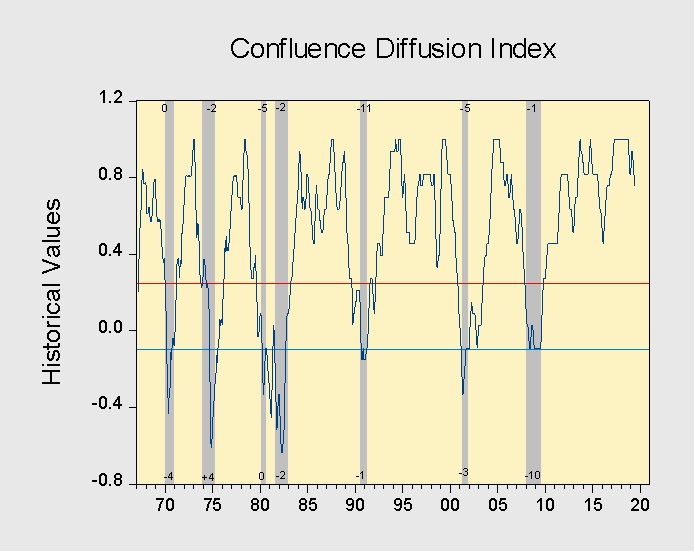
Economic data released for May suggests the economy remains strong but is showing some signs of weakness. Currently, our diffusion index shows that 10 out of 11 indicators are in expansion territory, with several indicators approaching warning territory. The index currently sits at +0.818.[1]

The chart above shows the Confluence Diffusion Index. It uses a three-month moving average of 11 leading indicators to track the state of the business cycle. The red line signals when the business cycle is headed toward a contraction, while the blue line signals when the business cycle is headed toward a recovery. On average, the diffusion index provides about seven months of lead time for a contraction and three months for a recovery. Continue reading for a more in-depth understanding of how the indicators are performing.

View the complete PDF


[1] The diffusion index looks slightly different from last month due to adjustments we made to the formula and revisions in certain data sets.

Weekly Geopolitical Report – The Mid-Year Geopolitical Outlook (June 24, 2019)

by Bill O’Grady

(Due to the Independence Day holiday and a short summer hiatus, the next report will be published July 15.)

As is our custom, we update our geopolitical outlook for the remainder of the year as the first half comes to a close.  This report is less a series of predictions as it is a list of potential geopolitical issues that we believe will dominate the international landscape for the rest of the year.  It is not designed to be exhaustive; instead, it focuses on the “big picture” conditions that we believe will affect policy and markets going forward.  They are listed in order of importance.

Issue #1: Deglobalization

Issue #2: Election Meddling

Issue #3: Iran

Issue #4: China

View the full report

Asset Allocation Weekly (June 21, 2019)

by Asset Allocation Committee

In 2017, we introduced an indicator of the basic health of the economy and added it to the many charts we monitor to gauge market conditions.  The indicator is constructed using commodity prices, initial claims and consumer confidence.  The thesis behind this indicator is that these three components should offer a simple and clear picture of the economy; in other words, rising initial claims coupled with falling commodity prices and consumer confidence is a warning that a downturn may be imminent.  The opposite condition should support further economic recovery.  In this report, we will update the indicator with May data.

This chart shows the results of the indicator and the S&P 500 since 1995.  The updated chart shows that the economy did slip late last year but has recovered in 2019.  We have placed vertical lines at certain points when the indicator fell below zero.  It works fairly well as a signal that equities are turning lower, but there is a lag.  In other words, by the time this indicator suggests the economy is in trouble, the recession is likely near or already underway and the equity markets have already begun their decline.

To make the indicator more sensitive, we took the 18-month change and put the signal threshold at -1.0.  This provides an earlier bearish signal and also eliminates the false positives that the zero threshold generates.  Notwithstanding, we will pay close attention when the 18-month change approaches zero as it did in January.

What does the indicator say now?  The economy has decelerated but is not yet at a point where investors should become defensive.  Breaking below the red line would be our signal to expect a broader downturn.  Most likely, we are going through a period similar to what we experienced in 2016.  If this is the case, and the economic data begins to improve, then equities should remain supported into H2.

View the PDF

Weekly Geopolitical Report – War with Iran? (June 17, 2019)

by Bill O’Grady

Over the past year, U.S. relations with Iran have deteriorated.  In May 2018, President Trump announced he would withdraw from the Joint Comprehensive Plan of Action (JCPOA), a multinational treaty that was designed to slow, but not eliminate, Iran’s nuclear development.  As part of exiting the JCPOA, the U.S. reapplied sanctions that have reduced Iran’s oil exports.  Since the U.S. has taken this action, the Iranian economy has suffered, with inflation rising to dangerous levels.

This chart shows the yearly change in Iran’s CPI.  We have placed a vertical line at the point where the U.S. pulled out of the JCPOA.  Note that inflation has jumped from a yearly increase of 10% to over 50%.

Sanctions have dramatically reduced Iran’s oil exports, shown on the following chart.  Before the U.S. withdrawal, Iran was exporting around 2.5 mbpd of crude oil.  That number has declined to 0.3 mbpd.

(Source: Bloomberg)

Iran has been threatening to retaliate in the face of a weakening economy.  In a previous report last year, we examined potential responses by Iran.  These included restarting the nuclear program, projecting power into the Middle East, closing the Strait of Hormuz, deploying a cyberattack, building a coalition against the U.S. and renegotiating the JCPOA.

Some of the actions that Iran might take could escalate into a hot war with the U.S.  In this report, we will begin with an examination of the geography and geopolitics of Iran.  Using this information, we will discuss what a war with Iran might look like.  We will also reflect on the very nature of war and alternatives to the use of military force within the context of Iran.  As always, we will conclude with market ramifications.

View the full report

Asset Allocation Weekly (June 14, 2019)

by Asset Allocation Committee

Establishing when “the” yield curve inverts is a bit of guesswork as there are a plethora of permutations one can use to calculate the spread.  One yield curve we like is the same one the Conference Board uses in its index of Leading Economic Indicators, namely, the 10-year T-note less fed funds yield.  As we show below, this particular spread has inverted this month.  Because of the time it takes to fully accumulate all the data points in the leading indicators, the inverted yield curve won’t be in the index until August.  But, the inversion will start to act as a drag on the leading indicators and likely start signaling a slowdown in the economy.

Here is a chart of the 10-year/fed funds yield curve.

This spread didn’t become a reliable indicator of the economy until the 1960s.  It isn’t perfect; it has had two false positives (shown as a black lines on the above chart).  In the 1981-82 recession, the curve didn’t invert until the recession was underway.  We have shown the current inversion as a black line, but we will change this if, or when, the recession develops.

This table shows the time period from the inversion to recession.  Although there is variation, the average is 12 months.  Using the range, a recession would be due at the earliest in February 2020 or the latest at February 2021.

So, with inversion, what should investors do?

These two charts show equities (the S&P 500) and long-duration bonds (10-year T-notes total return index), indexed to the yield curve inversion (shown as a vertical line on the chart).  We looked at the data 12 months before the inversion and 24 months after the inversion, excluding the 1982 inversion since the recession was already underway.  We also calculated the average for the seven events.  These calculations show that the financial markets don’t always treat inversions as bearish.  Under low inflation conditions, long-duration interest rates tend to perform well.  Equities decline about 10% or less after inversion the majority of the time; however, in three cases, they actually continued to rise.  Furthermore, during the 2005 inversion, the real bear market didn’t start until two years after the yield curve turned negative.

There are two key issues for investors.  First, it is possible that the current inversion is a false positive.  If the FOMC moves quickly to cut the fed funds rate, the slope of the curve could return to positive so remaining fully invested is recommended.  Second, even if this inversion is a harbinger of recession, there were several events where equities performed quite well for some time after the inversion.  This is especially true when the inversion predated the recession by more than a year.  At the same time, investors are now on notice that if the Fed doesn’t react soon to unwind this inversion then the odds of recession are rising, thus it would be prudent to build a plan to become defensive.

View the PDF