Weekly Geopolitical Report – Reflections on Tiananmen (June 10, 2019)

by Bill O’Grady

Thirty years ago, on June 4, troops from the People’s Liberation Army (PLA) descended upon Tiananmen Square to forcibly remove protestors who had been using the space for about two months.  The protestors were agitating for democracy, an end to corruption and a more inclusive political system.

Details of the incident remain unsettled.  There are no doubts that hundreds of students were killed or injured.  Arrests were made.  But, the Communist Party of China (CPC) has studiously avoided publishing a full account of the Tiananmen Square events.

Since Western media has offered numerous accounts of the events on June 3-4, 1989, we are not going to present a history of the protests or the harsh reaction of the CPC leadership.  Instead, we will offer various insights into the aftermath of the event itself and how it affects policy and relations today.  As always, we will conclude with market ramifications.

View the full report

Asset Allocation Weekly (June 7, 2019)

by Asset Allocation Committee

Monetary policymakers are facing divergent trends that complicate future policy actions.

Financial markets are signaling that the policy rate needs to be cut immediately.

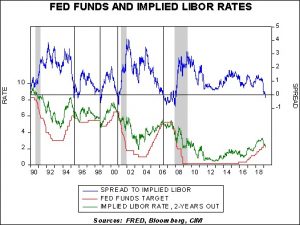
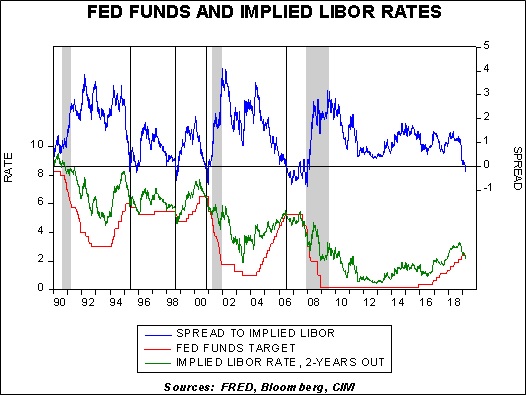
The chart on the left shows the implied three-month LIBOR rate, two-years deferred, from the Eurodollar futures market.  Last October, the implied rate was around 3.30%; it has fallen sharply to 1.625%, a decline of nearly 70 bps.  The chart on the right compares that implied rate to the fed funds target.  History shows the Fed has tended to cut the target rate when the implied rate inverts relative to the policy rate (shown on the upper line).  The spread has widened considerably, meaning the Fed should be moving to cut rates soon.  This data would suggest the longer policymakers wait, the higher the probability of a recession.

Current economic conditions probably don’t warrant a rate reduction.

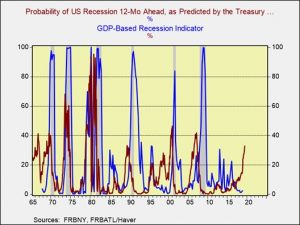
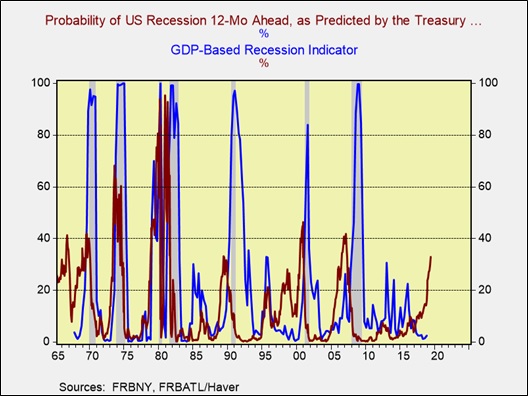
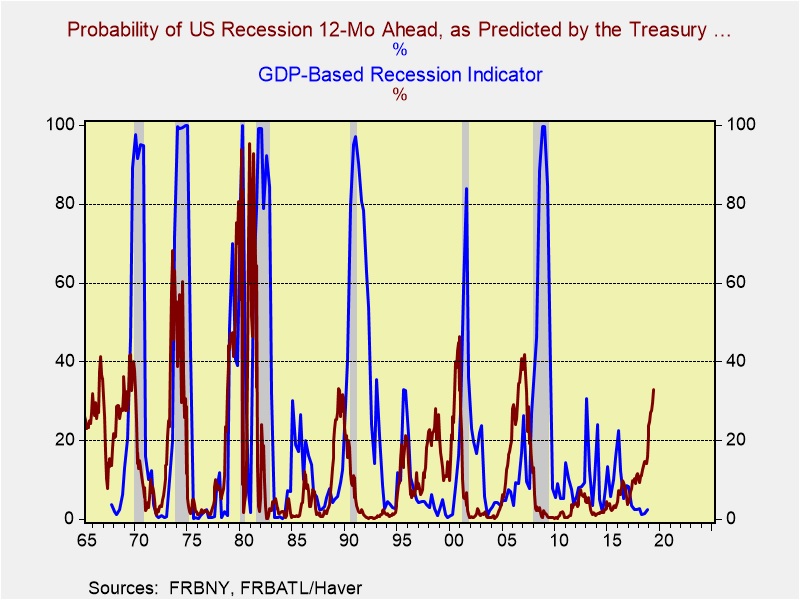
This chart shows the NY FRB recession indicator, which projects the odds of recession 12 months out and the Atlanta FRB GDP-based recession indicator.  In general, combining the two indicators reduces the chance of a false positive, namely, predicting a recession that doesn’t occur.  We use the 20% threshold as a warning sign; if both indicators are above 20% then a recession warning is warranted.  The only false positive that was triggered with the 20% threshold was in 1995 and that event was considered a rare “soft landing.”  As the first chart shows, in 1995, the Greenspan Fed did cut rates and this action probably extended the expansion.  The current reading of these two indicators suggests caution, but the economic data is not signaling that a downturn is imminent.  And, as a cautionary tale, we had a similar configuration in the data in 1997-98.  The Fed did ease in that event, in part driven by the LTCM Crisis, and that easing is often blamed for stoking the tech bubble in 1999.

Inflation remains controlled, but tariffs could affect prices.

This chart compares the ISM Manufacturing Index to core CPI.  The ISM index tends to lead inflation by two years.  Comparing core CPI to the ISM Manufacturing Index suggests that inflation might lift in the coming months but should not overshoot by a wide margin.  However, it is important to note that tariffs are a form of consumption tax.  While the incidence of the tax does not automatically fall to the consumer (the producer or importer could absorb the cost, cutting profit margins, or the dollar could appreciate and offset the tariff), there is the possibility of an unexpected rise in inflation.

These three issues will likely keep the FOMC on hold in the near term.  If that analysis is correct, the chances of recession will tend to rise in the coming months.

View the PDF

Weekly Geopolitical Report – Rare Earths (June 3, 2019)

by Bill O’Grady

(NB: To improve readability, we are now linking references to media reports and articles directly in the text via hyperlinks. Footnoting will be reserved for documents to which we can’t link or to provide additional clarity on a topic.)

Since early May, the trade tensions with China have morphed into a broader conflict.  Not only is the U.S. trying to change the trade relationship with China, but it is also attempting to change Beijing’s industrial policy.  The U.S. has been using two tracks to accomplish this goal.  The first uses tariffs to narrow the U.S. trade deficit with China.  The second involves various tools, including legal actions and regulations on foreign investment and technology transfers and sales, to affect Chinese industrial policy.  The 2018 arrest of Meng Wanzhou, the chief financial officer of Huawei (002502, CNY 3.67), was the opening salvo in the second element of the administration’s policy toward China.  Recent actions to limit the sale of technology to Chinese firms is another example to that effect.

China has started to retaliate.  It has applied its own tariffs on U.S. exports, which has hurt the U.S. agricultural sector.  In response to the technology policy, China is making an implied threat to prevent the export of rare earth products.  In a highly publicized tour, Chairman Xi visited a magnet factory that uses rare earth elements in production, highlighting the potential threat.  Using rare earths as a form of intimidation is nothing new; China embargoed rare earth metal exports to Japan in 2010 over a maritime dispute.

In this report, we will offer a brief outline of China’s structural economic problems and the U.S. response to provide context for the threatened rare earths embargo.  Following this section, we will detail what rare earths are, their importance and discuss the rise of China’s dominance in this area.  From there, we will offer our analysis of the likelihood that China follows through with this threat and the probability of its success if implemented.  As always, we will conclude with market ramifications.

View the full report

Asset Allocation Weekly (May 31, 2019)

by Asset Allocation Committee

There are three factors that tend to cause recessions—inventory misadjustments, policy errors and geopolitical events.  The first in the series has become less of a factor over time.  Inventory management has improved dramatically since the end of WWII, and excess inventory leading to falling output has become less of an issue.  Therefore, we tend to focus on the latter two factors.  Since fiscal policy changes tend to occur more slowly, monetary policy is where we spend most of our efforts.  With regard to geopolitical events, we write a weekly report on that issue.

Monetary policy is facing a serious signaling problem.   One of the signals we use for monetary policy is the implied LIBOR rate from the two-year deferred Eurodollar futures.  That rate is an indication of what the financial markets are thinking.  As we will show below, it has generally been a good indicator for when policy tightening should stop.  The implied LIBOR rate has declined significantly.

Since peaking at 3.30% last October, the rate has declined to 1.90%, a drop of 140 bps.

The lower lines show the implied LIBOR rate with the fed funds target.  Note that the FOMC has tended to stop raising rates when the spread inverts.  During the Greenspan years, easing tended to follow shortly after inversion.  The Bernanke Fed did stop raising rates after inversion but didn’t ease, which may have contributed to the severity of the 2007-09 recession.

To compare how the financial market signs compare to economic signals, we have overlaid the fed funds target/deferred LIBOR rate with two of the Mankiw Rule variations, one using core CPI and the unemployment rate and the other using core CPI and the employment/population ratio.  The Mankiw Rule is a simplified version of the Taylor Rule, which estimates the fed funds rate based upon core inflation and GDP relative to potential GDP.  Because potential GDP isn’t directly observable, Mankiw’s original research replaced GDP with the unemployment rate.  We have created our own variations as well (not shown).

The lower lines on the chart show the implied LIBOR rate, with the fed funds target and the two aforementioned estimated Mankiw Rule rates.  Aside from the Mankiw Rule variation using the unemployment rate, all other variations are suggesting the Fed should be cutting rates.  However, in each of the prior inversion events (shown by the vertical lines on the above chart), the estimates for the fed funds target from the Mankiw Rule variations were below the target rates.

This has been a consistent issue during this expansion; essentially, it has been difficult to determine the degree of slack in the economy.  Fortunately for policymakers, this problem of estimating slack has not been a serious issue until recently.  Given the current divergence in signals, the most likely outcome is for the FOMC to maintain a steady posture.  The lack of a clear signal between the financial markets and the interest rate markets increases the odds of a policy mistake.  Although the FOMC’s official stance is neutral, we suspect the next move will be to lower the policy rate.

View the PDF

Business Cycle Report (May 29, 2019)

by Thomas Wash

The business cycle has a major impact on financial markets; recessions usually accompany bear markets in equities.  We have created this report to keep our readers apprised of the potential for recession, which we plan to update on a monthly basis.  Although it isn’t the final word on our views about recession, it is part of our process in signaling the potential for a downturn.

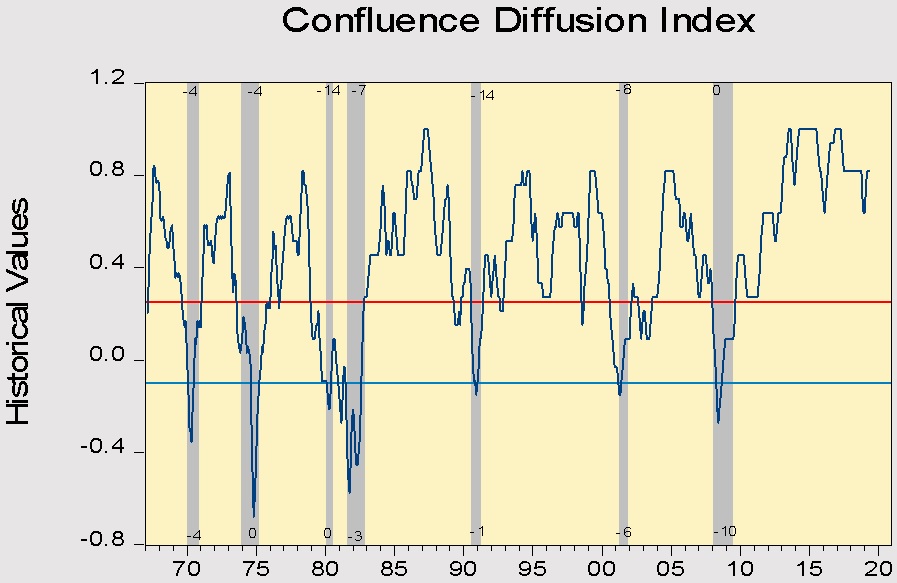
Economic data released for April suggests the economy remains strong but is showing some signs of weakness. Currently, our diffusion index shows that 11 out of 11 indicators are in expansion territory, with several indicators approaching warning territory. The index currently sits at +0.939.

The chart above shows the Confluence Diffusion Index. It uses a three-month moving average of 11 leading indicators to track the state of the business cycle. The red line signals when the business cycle is headed toward a contraction, while the blue line signals when the business cycle is headed toward a recovery. On average, the diffusion index provides about eight months of lead time for a contraction and one month for a recovery. Continue reading for a more in-depth understanding of how the indicators are performing.

View the complete PDF

Asset Allocation Weekly (May 24, 2019)

by Asset Allocation Committee

How important have mergers, buybacks, etc. been to equity market performance?  Several analysts have attempted to answer this question by focusing on buybacks alone.  However, there is a more straightforward method of looking at this question and including all the factors that affect the number of shares available—the index divisor.

This chart shows the divisor for the S&P 500.

The divisor adjusts the S&P for membership changes (either by mergers or index adjustment), new share issuance or repurchases, or special stock-related transactions.  So, it isn’t a pure look at buybacks but isolating buybacks alone may overstate the impact of the activity if new shares are being issued or it may ignore the impact of membership adjustments.  In general, a rising divisor tends to depress the index and vice versa.  In the most recent data, the divisor peaked in Q3 2011; the decline in the divisor is partly due to buybacks, but merger activity has affected it as well.

To calculate the impact of the divisor, we would use the following formula:

Divisor * S&P Index = S&P Market Capitalization

Rearranging terms leads to this formula:

S&P Index = S&P Market Capitalization/Divisor

And so, if we take the market capitalization and hold the divisor fixed at this peak in Q3 2011, we can estimate what the S&P 500 would have been without the decline in the divisor.

At the end of Q1, the S&P 500 was at 2824.44; if the divisor had held at its previous peak, it would have been 2593.63, or 8.2% lower.

The more important question is if or when the trend in the divisor might reverse.  In general, history suggests that elevated equity market values tend to trigger equity issuance.  However, that has not been the case since 2000.

This chart shows the divisor and the S&P 500 Index since 1964.  From that year to Q1 2000, the two series were positively correlated at the 69.5% level.  However, since then, the correlation between the two series has not only flipped to inverse but strengthened.  During this century, for the most part, the equity markets appear less critical to raising capital.  Overall, we expect the divisor to continue to decline as firms continue to shrink the number of shares available; if we are correct, the equity markets have a modest tailwind going forward.

View the PDF

Weekly Geopolitical Report – Venezuela: An Update, Part II (May 20, 2019)

by Bill O’Grady

(N.B.  Due to the Memorial Day holiday, the next issue will be published June 3.)

In Part I of this report, we provided readers with a short history of Venezuela to bring some context to the current situation.  This week, Part II, will examine the attempts by the opposition to oust Maduro, the problems the opposition faces in removing the current leader and the interests of foreign players.  As always, we will conclude with market ramifications.

Attempts to Remove Maduro
Maduro remains in control despite 50 nations declaring Guaido the legitimate leader of Venezuela.  Guaido has made three attempts to seize power.  Soon after his appointment in January, he called on the people and the military to rise up and oust Maduro.  The security services remained loyal to Maduro.  In late February, Guaido attempted to bring in convoys of humanitarian goods across the Colombian and Brazilian borders.  His goal was to show impoverished Venezuelans that he could bring much needed food and medicine into the country.  However, Maduro’s forces prevented the goods from crossing the border.

The most serious attempt occurred on April 30.  In the early morning hours, Leopoldo Lopez, an opposition leader and mentor to Guaido who had been under house arrest, emerged on social media, free and surrounded by his captors.  The security forces assigned to him had set him free.

View the full report

Asset Allocation Weekly (May 17, 2019)

by Asset Allocation Committee

Foreign exchange economics has become something of a backwater in economic theory.  There are four predominant valuation methodologies; if one were any good, the others wouldn’t exist!  The four are purchasing power parity, real equilibrium theory, interest rate differentials and productivity equalization (unit labor cost equalization).   The general idea is that under flexible exchange rates, currency values adjust to eliminate differences between nations.  The oldest of the four is purchasing power parity, which assumes exchange rates move to equalize prices across nations.  Real equilibrium theory suggests the exchange rate adjusts to equalize real current account differences.  Interest rate differentials suggest the exchange rate adjusts to equalize interest rates, and productivity equalization normalizes unit labor costs (labor costs adjusted for productivity) across nations.

In practice, the macro data used to calculate fair value for exchange rate models is usually not granular enough to capture differences between nations.  For example, with purchasing power parity, all goods and services in an inflation index are not tradeable and so these non-traded products cannot be adjusted via exchange rates.  And so, all the models tend to be useful only at extremes.  In other words, wide deviations from calculated fair value can offer useful signals, but, like all valuation models in finance, they are not helpful for timing.[1]  At the same time, long-term investors can find value in such models in that they do signal when a relationship is cheap or rich.  This is helpful but only if (a) the investor is truly patient, and (b) something significant hasn’t changed.

Our favorite model is purchasing power parity because long-term inflation histories are usually easy to access and, theoretically, inflation is a very important variable.  As we have been noting for some time, the dollar is expensive based on these models.  For example:

This is a parity model for the EUR, using German inflation against U.S. inflation.  The fair value exchange rate is $1.3008 compared to the current rate of $1.1200.  This deviation from fair value, which in historical ranges is where reversals usually occur, has led to the belief that, at some point, the dollar will weaken.  The model also suggests that once a reversal occurs it is common that the exchange relationship will overshoot.  Thus, a turn in the exchange rate is an important event; in markets, for U.S. investors, foreign stocks and commodities are two areas where one can historically find outperformance.

But, the Trump administration has moved to the use of tariffs to combat persistent trade deficits.  The use of tariffs had fallen out of favor, in part because the U.S. fostered open trade, and because tariffs tend to be less effective under flexible exchange rates.  Why?  Because the nation targeted by tariffs can simply allow its currency to weaken, offsetting the price effect of the tariff.  For example, if China is a target for tariffs, the expected response would be CNY depreciation.

This chart shows how tariffs have become less of a factor.

As the chart shows, after the 1920s, the U.S. has steadily abandoned tariffs…until now.

If the administration continues down this path of using tariffs on a widespread basis, our position on future dollar weakness has to be reconsidered.   Although the tariff policy may not last once Trump leaves office, one cannot necessarily assume that to be the case.  Of course, the U.S. could act against depreciation too, but that might prove difficult to stop.

At some point, we expect the administration (or some future administration) to realize that tariffs are a poor tool for reducing the trade deficit.  Currency weakness is more effective but the most effective method is capital controls.  The reason the U.S. runs persistent trade deficits is because the dollar is the reserve currency.  If the U.S. denied access to the U.S. capital markets, then foreigners would have less reason to engage in policies to promote exports.  Would there be collateral damage from such policies?  Yes, but we may be approaching a point where Americans are willing to accept those side effects in order to reduce inequality and lift domestic wages.

View the PDF


[1] Or, said another way, “markets can stay stupid longer than you can stay solvent.”

Weekly Geopolitical Report – Venezuela: An Update, Part I (May 13, 2019)

by Bill O’Grady

On May 10, 2018, Nicolas Maduro was reelected as president of Venezuela.  However, there were numerous irregularities during the vote and, as such, the U.S. and the Organization of American States (OAS) refused to view the election as legitimate.  Shortly after Maduro was officially inaugurated on January 10, 2019, the National Assembly, which is controlled by Maduro’s opposition, declared Maduro’s election illegitimate and, following the Venezuelan constitution, installed Juan Guaido as the interim head of state until new elections are called.  More than 50 nations have acknowledged that Guaido is the legitimate head of state; however, Maduro, supported by China, Nicaragua, Russia, Turkey and Cuba, remains in Miraflores Palace, the official residence of the Venezuelan president.

As a result, since late January, Venezuela has had two leaders.  The U.S. has increased sanctions on Venezuela, including the overall economy and on individuals in the Maduro government.  However, the impact of sanctions is somewhat limited given the terrible state of the Venezuelan economy.  In addition, Venezuela has become something of a proxy conflict between the U.S. and Russia, with both sides allied with other nations.  In a sense, Venezuelans have lost some degree of control over their destiny, complicating matters.

In Part I of this report, we will offer a short history of Venezuela to give readers some context to the current situation.  In Part II, we will examine the opposition’s attempts to oust Maduro, the problems the opposition faces in removing the current leader and the interests of foreign players.  As always, we will conclude with market ramifications.

View the full report