

Daily Comment (December 20, 2018)

by Bill O’Grady and Thomas Wash

[Posted: 9:30 AM EDT] 

[N.B.  The Daily Comment will go on holiday from December 24 to January 2.  From all of us at Confluence, but especially Thomas and me, thanks for reading and have a Merry Christmas and Happy New Year!]

On Friday, December 14, we published our 2019 Outlook: Red Sky at Morning report.  If you missed it, you can find the report linked here or on our website.

There isn’t a whole lot going on this morning; most of the market commentary is a post mortem on the Fed.  We offer our views on the U.S. central bank below.  Equity markets are trying to rally this morning but oil prices are testing recent lows.  Here are the updates:

The Fed: Yesterday, we offered four outcomes from the Fed meeting.  Essentially, the FOMC split the difference between outcomes #3 and #4.  To recap, #3 was a hike with a clear signal of no further increases, while #4 was no change in the previous policy path.  What we actually got was a hike with a reduction in the path forward.
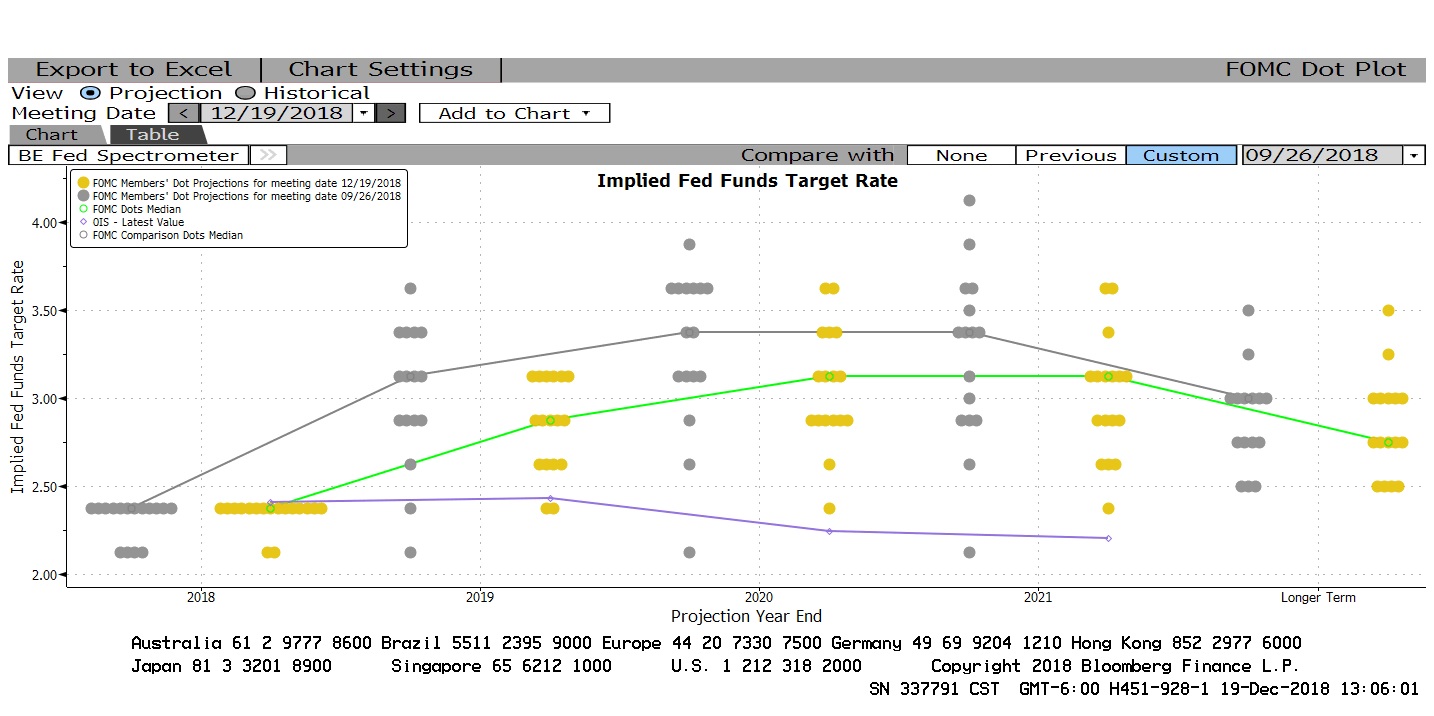
(Source: Bloomberg)

The yellow dots show yesterday’s meeting, while the gray dots show the meeting from September, the last time we had a dots plot.  The lines show the median rate path.  Note that there has been a cut of about 25 bps in the path for next year and 2020.  The statement had few changes, with the most significant being an acknowledgement of monitoring global and financial market conditions.  The economic projections were mostly unchanged; there was a modest increase in forecast GDP growth for next year to 2.5% from September’s 2.3%, while core PCE is expected at 2.0%, down from 2.1% in September.

Clearly, financial markets were disappointed.  The yield curve (2yr/10yr Treasury) flattened further.
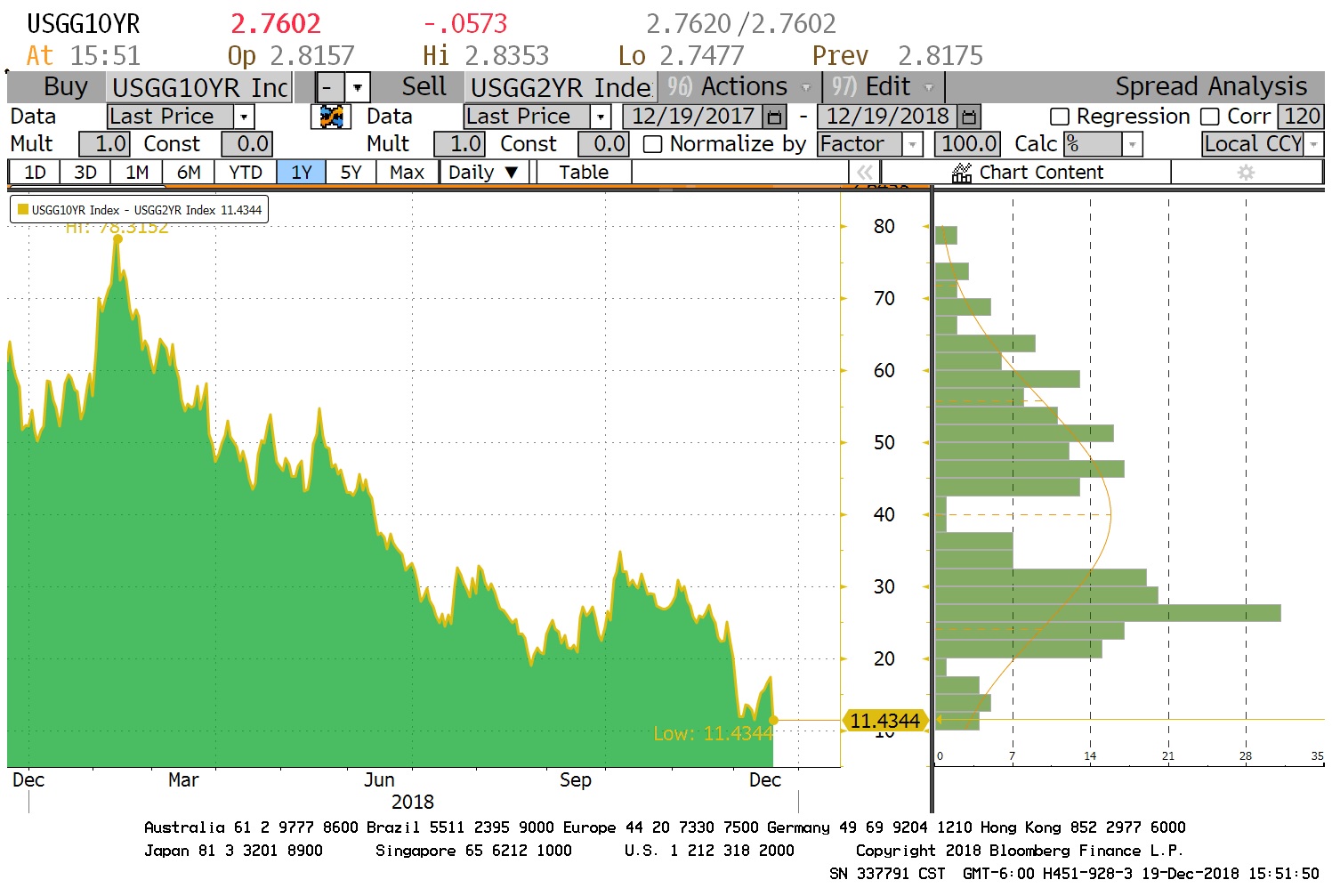
(Source: Bloomberg)

The spread narrowed to just over 11 bps.  Equity markets fell; the decline from peak to yesterday’s low has now reached about 15.4%.  In general, a correction is 10% and a bear market occurs at 20%.  The latter is usually associated with recession.  Sentiment indicators are reaching levels that usually signal a washout.  If recession is avoided, the chances are elevated for a rally in equities.

At the same time, financial markets were clearly disappointed.  The Fed is dealing with what has been called the “Tinbergen dilemma,” named for the economist Jan Tinbergen, who first described it.  The dilemma describes when a policymaker faces two policy problems but only has one policy tool.  It is sometimes described as “trying to shoot two bad guys with one bullet.”  The Tinbergen dilemma can only be resolved if the two policy problems can be fixed by the same solution.  The Fed is facing an economy that is still rather strong (though momentum is clearly weakening), which supports tighter policy, and financial markets that are signaling increasing stress, which begs for easing.  What has the financial markets so upset is that there is evidence that, in the past, the Fed has tended to placate the financial markets when facing a similar Tinbergen dilemma.
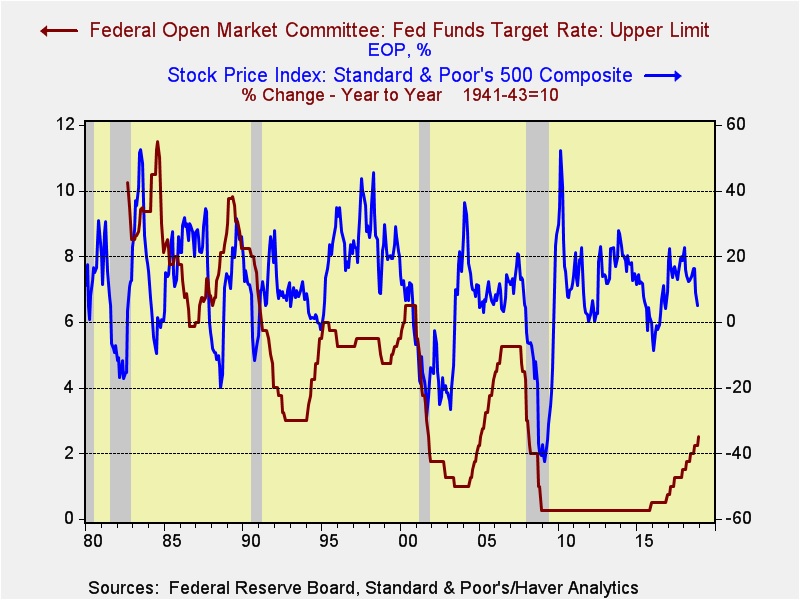
This chart shows the fed funds target with the yearly change in the S&P 500.  When the yearly growth in the S&P becomes negative, the Fed has tended to take notice.  Perhaps the clearest evidence of the Fed favoring financial markets was in 2000-04 when the Greenspan Fed kept cutting rates to what were historic lows at the time, even though the economy was recovering.
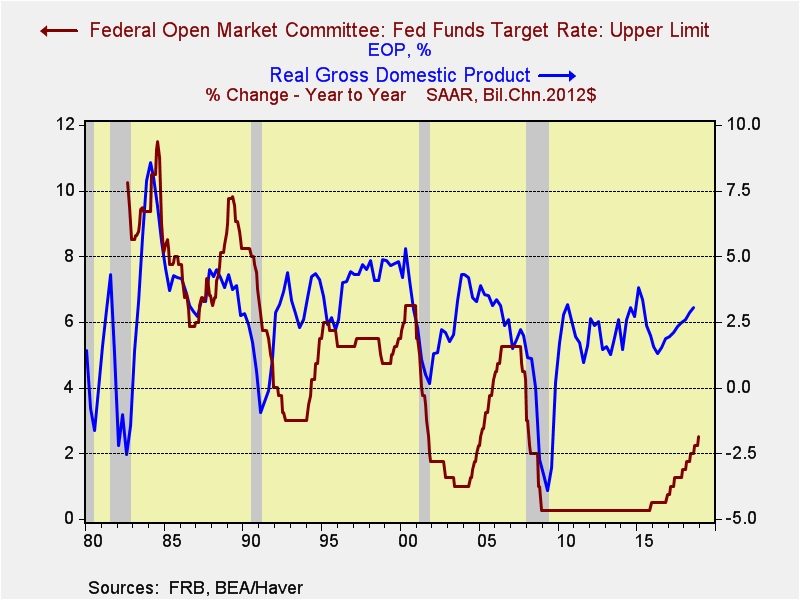
This chart shows the yearly change in real GDP.  Greenspan didn’t start raising rates even with GDP growth exceeding 4% in 2003, most likely due to continued weakness in equities.  In 2016, Yellen paused on rates as equities fell, but the economy has softened, too.

Essentially, financial markets have become accustomed to being favored when the aforementioned Tinbergen dilemma exists.  Powell is trying to weave a path that addresses both but, in reality, it looks like the Fed is more concerned about the economy overheating than it is about a weak stock market or a flattening yield curve.  This position increases the likelihood of a policy mistake, one of our four potential threats to the expansion we discussed in our 2019 Outlook.

So, what happens now?  Equity market valuations are improving and sentiment is becoming increasingly negative.  Both tend to favor a bounce at some point.  The proverbial “Santa Claus Rally” probably won’t happen this year, but we would expect a January bounce.

U.S. out of Syria: President Trump announced that the 2,000 U.S. troops in Syria will be leaving very soon.  The foreign policy and military establishment[1] is horrified at the prospect of having no influence in this part of the world.  The winners in this decision are Iran, Russia, Turkey and Assad.  The losers are Israel (due to the improvement in Iran’s position), Europe (will likely see a rise in refugees) and the Kurds.  The Kurds are especially harmed; they have supported U.S. efforts in this part of the world since the early 1990s when the U.S. began protecting northern Iraq with a no-fly zone.  However, now they will be subject to the tender mercies of President Erdogan.  The reaction from Washington is actually rather interesting; populists are applauding the president.  Even some former Obama officials are supporting Trump.  Meanwhile, establishment figures on both sides of the aisle oppose the move.[2]

What are the ramifications?  We will likely see the powers in the region turn on each other.  Iran will try to maintain its “Shiite arc” from Tehran to Beirut, while Turkey will attempt to contain the Kurds.  There will be conflict points between these two.  Israel will try to prevent Iran from projecting power.  Russia will likely try to manage the parties but we would not be surprised to see Moscow caught in a trap of maintaining peace.  Meanwhile, the likely chaos will help Islamic State revive.  Iraq will also be threatened by the ensuing conflict.  The problem for the U.S. is that the commitment is never-ending.  Trump, like a true Jacksonian, sees no reason why the U.S. should concern itself with the region.  The consequence is that the region will likely descend into chaos.

At the same time, it is important to remember that the last three presidents have struggled to craft a working policy for the Middle East.  President Bush made a critical error by removing Saddam Hussein from power without being able to replace him, creating a power vacuum in the region that still hasn’t been filled.  President Obama tried to extricate the U.S. from the region by putting Iran in charge; although a defensible policy, it was far from ideal.  President Trump reversed the Obama-era Iran policy but found that none of the other parties in the region can stabilize it.  It appears that U.S. policy is now to allow the chips to fall where they may.  This policy will allow one of the three frozen conflict zones to thaw; how this works out is anyone’s guess but we doubt it will be smooth.  The primary market beneficiary will likely be oil.

Energy update: Crude oil inventories fell 0.5 mb last week compared to the forecast decline of 3.3 mb.
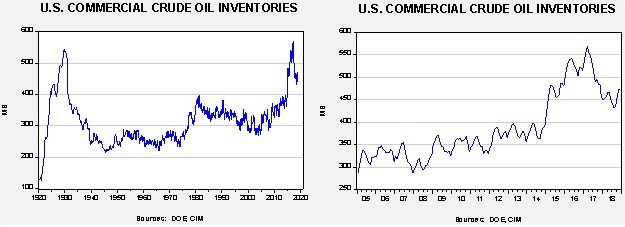
In the details, estimated U.S. production was unchanged at 11.6 mbpd.  Crude oil imports and exports were essentially unchanged, while refinery runs rose a modest 0.4 mbpd.
(Source: DOE, CIM)

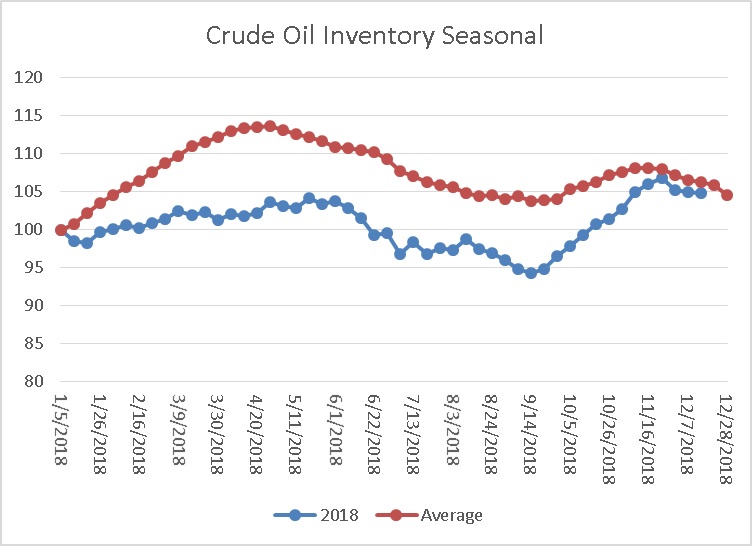
The seasonal chart suggests the usual easing of inventory accumulation into year’s end is underway.  Inventories usually decline into the new year.
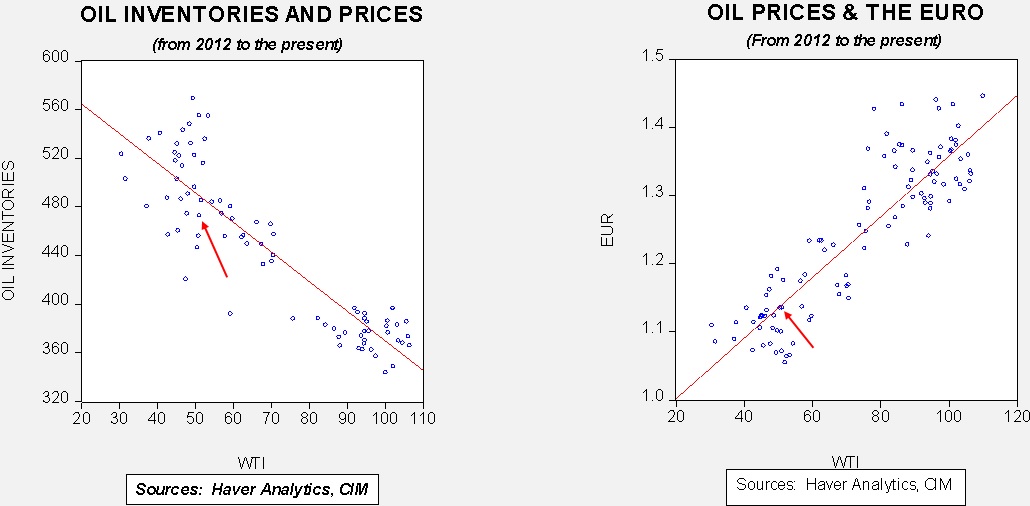
Based on oil inventories alone, fair value for crude oil is $60.35.  Based on the EUR, fair value is $54.30.  Using both independent variables, a more complete way of looking at the data, fair value is $55.70.  By all measures, current oil prices are undervalued.  Although fears of a weaker global economy do play a role in price weakness, it appears that even modest action by OPEC to restrict output should lift prices to the mid-$50s in the coming weeks.

View the complete PDF


[1] https://www.washingtonpost.com/opinions/2018/12/19/trump-undermines-his-entire-national-security-team-syria/?noredirect=on&utm_term=.9cf4f85a3cda&wpisrc=nl_todayworld&wpmm=1

[2] https://www.axios.com/trump-syria-troops-withdrawal-isis-6ccb1c80-b702-4ae0-8087-546830c02158.html
Daily Comment (December 19, 2018)

by Bill O’Grady and Thomas Wash

[Posted: 9:30 AM EDT] 

[N.B.  The Daily Comment will go on holiday from December 24 to January 2.  From all of us at Confluence, but especially Thomas and me, thanks for reading and have a Merry Christmas and Happy New Year!]

BREAKING NEWS: The U.S. is preparing to make an immediate and full withdrawal of troops from Syria.  We will discuss the ramifications in tomorrow’s comment.

On Friday, December 14, we published our 2019 Outlook: Red Sky at Morning report.  If you missed it, you can find the report linked here or on our website.

It’s Fed day!  Equity markets are trying to rally this morning and oil prices are steady despite bearish API data.  Here is what we are watching today:

The Fed: There are four likely outcomes from today’s meeting.  Here is the lineup:

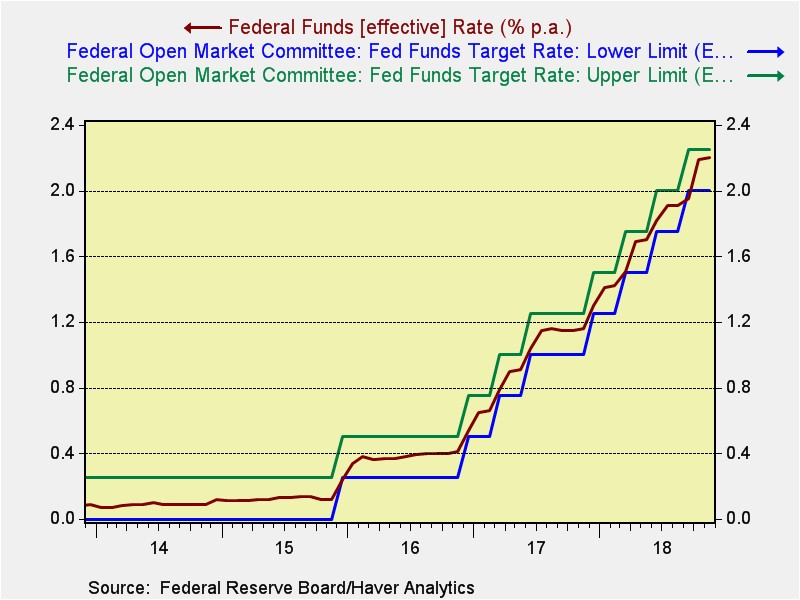
  1. The Fed hikes rates but signals a slowdown of the balance sheet reductions (most bullish for equities).  Although the impact of the balance sheet remains in debate, market participants have begun to focus on the balance sheet and suggest it is tightening conditions more than expected.  Here is why that idea is gaining traction—QE created a massive amount of excess reserves in the banking system.  When the reserves were injected into the banking system, in reality, it was an asset swap.  Banks gave up loans, commercial paper, bonds, etc., for cash.  The cash stayed on balance sheets.  But, to keep control of those reserves, the Fed started paying interest on reserves, something it hadn’t done in the past.  The fed funds target used to be a single rate but in the wake of QE it is now a 25 bps range; that “rate” we talk about is really the upper bound.  Thus, actual fed funds trade in a range between the upper and lower limit.  However, as the chart below shows, the fed funds rate has been remarkably sticky at the upper end of the rate, so much so that the Fed has put a ceiling on the interest on reserves at 5 bps below the upper limit of fed funds.  And, interestingly enough, the rate has been staying very close to that ceiling.  This seems to show that there is some scarcity of reserves in the system, meaning banks would prefer to hold more reserves, perhaps for regulatory purposes or as a reaction to 2008, and thus are demanding the highest rate allowed.  This has led some analysts to argue that the balance sheet reduction is “biting” much sooner than expected.  However, it could also reflect a structural imbalance in the system, where large banks are awash in reserves but smaller banks are not and thus the larger banks are able to demand the highest rate on reserves.   Therefore, a slowdown in “quantitative tightening” (QT) would be seen as very bullish.

  1. The Fed hikes and signals the cycle has ended (very bullish for equities).  This doesn’t end the tightening, as the balance sheet would continue to contract, but it would be a clear signal that the Fed is trying to engineer a soft landing.  This outcome is consistent with only one of the Mankiw Rule variations, the one using the employment/population ratio.
  2. The Fed hikes and signals a pause, but still shows at least one hike in 2019 (neutral to bullish for equities).  This is the most likely outcome and is consistent with the uncertainty surrounding the neutral rate.
  3. The Fed hikes and signals no real change in policy path (bearish for equities).  This outcome would essentially ignore warning signs from the financial markets and focus solely on the economy.

The highest probability outcome is #3, although we would not discount a fairly high probability of #2.  Here’s why:

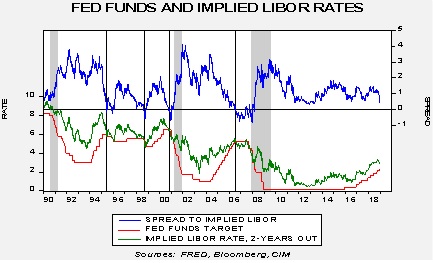
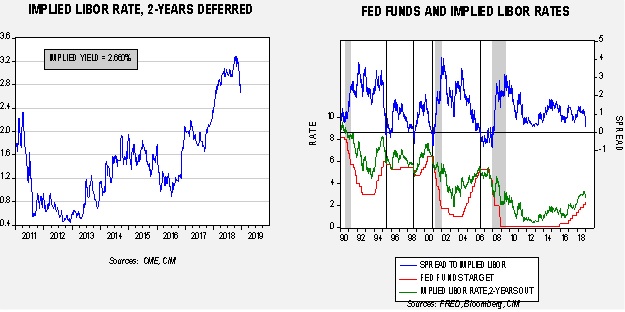
The chart on the left shows the implied three-month LIBOR rate, two-years deferred, from the Eurodollar futures market.  Note how the rate has fallen sharply since peaking in late October (around the time Chair Powell said we were “a long way from neutral”).  The chart on the right shows that this rate tends to act as a policy marker.[1]  When the fed funds target is higher than the implied LIBOR rate shown on the right, the Fed tends to stop raising rates.  Alan Greenspan was able to extend the 1991-2001 expansion by deftly adjusting to this implied LIBOR rate (there is no evidence that he actually used this rate in setting policy, but it is uncanny how close it was followed).  The spread has narrowed from 125 bps in late September to 29 bps now, implying one hike after today.  And, the implied LIBOR rate is falling rapidly, which could mean even that rate might be scuttled.  The above chart should signal to the FOMC that they are close enough to neutral so as to pause.

So, stay tuned…

Italy makes a deal:Italy has come to a deal with the EU, averting the potential for a crisis.[2]  This agreement reduces the odds of an immediate crisis but the underlying issues have not been resolved.  Thus, we will revisit this issue again.  But, for now, this is good news.

View the complete PDF


[1] We have assumed a 25 bps rate hike today in the spread calculation.

[2] https://www.ft.com/content/ca7a713e-037c-11e9-9d01-cd4d49afbbe3

Daily Comment (December 18, 2018)

by Bill O’Grady and Thomas Wash

[Posted: 9:30 AM EDT] On Friday, December 14, we published our 2019 Outlook: Red Sky at Morning report.  If you missed it, you can find the report linked here or on our website.

U.S. equity futures are lifting this morning after another hard decline yesterday.  Oil prices are falling, with WTI trading under $50 per barrel.  Here are the details:

Equities (again!): We are seeing a bit of a bounce this morning but there are no guarantees it will hold.  The pattern for the past six weeks has been that rallies have mostly failed; investors appear to be using every rally to reduce equity exposure.  As we showed in yesterday’s comment, retail investors have been rapidly building cash levels.  We see two immediate worries—a policy error by the FOMC and a trade war.  Although the first worry is legitimate, it does appear the FOMC is aware of its situation and is likely to signal a pause in its policy path after a rate hike tomorrow.  There has been much focus recently on the balance sheet reduction.  Our position has been that the primary impact of the balance sheet expansion was psychological.  It signaled that the central bank was not out of policy tools even at the zero bound of interest rates.  But, most of the expanded balance sheet went to banks in the form of excess reserves.  Withdrawing those reserves shouldn’t have much actual impact.  Still, if the FOMC signals any slowing of the balance sheet contraction, it would be taken as a bullish signal.

The second issue is a serious concern as well.  The trade war with China is a symptom of the much larger trend of deglobalization.  To a great extent, the rise of populism is a visceral reaction against global integration in all its forms, including trade, immigration and social relations.  Although understandable, the problem is that globalization was a key component of inflation suppression.  If the world moves away from economic integration, inefficiency will rise and inflation will as well.  Rising inflation may be a cost that the majority of citizens in the West are willing to pay for regaining control over their lives but, over time, the cost will prove to be substantial.

However, in the short run, we expect a truce of sorts on deglobalization.  President Trump would likely prefer reelection (presidents rarely turn down the chance for a second term), so making peace with China for the next year makes sense.

Given the degree of weakness seen in equities, we would expect a recovery in the next few weeks.  As the money market chart from yesterday showed, the lift could be rather robust if sentiment shifts.  Overall, the U.S. economy is doing fine; we look for slower growth in 2019 but no recession appears likely.  The world economy is sluggish and that issue probably remains next year.

China: China is celebrating its 40th anniversary of market reforms started by Deng.  In a speech[1] at the meeting, Xi pressed the centrality of the Communist Party of China (CPC), giving no indication of any relaxation of policy to expand market reforms.  The CPC under Xi will maintain control even as the economy slows; reports suggest the growth target for 2019 will be between 6.0% and 6.5%, down from the current target for this year of “around 6.5%.”  There was hope Xi would unveil economic stimulus.  It wasn’t mentioned in the speech, suggesting China won’t take steps to boost the economy over current measures.

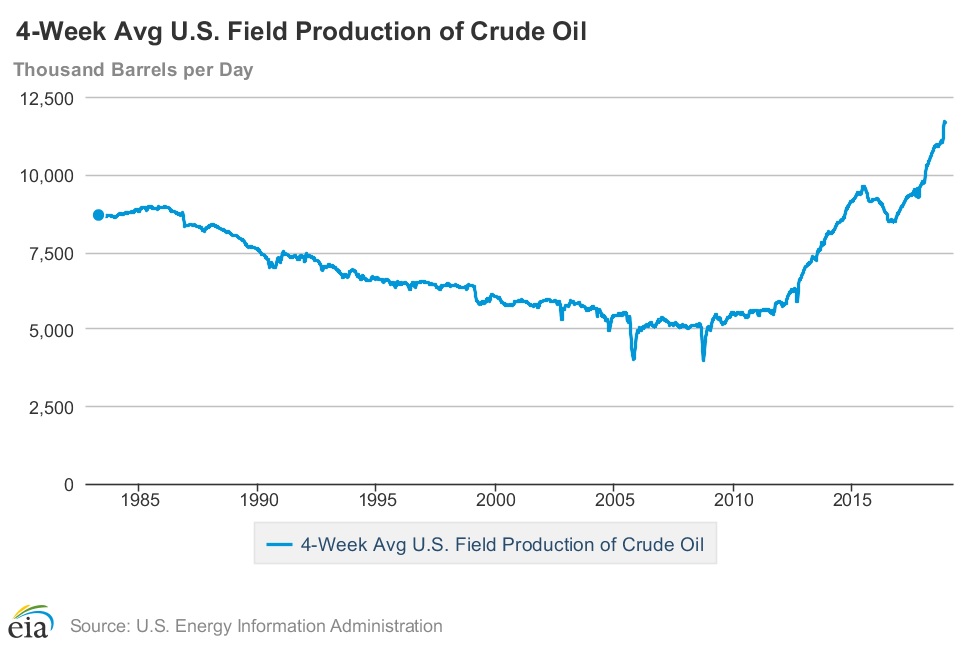
Crude oil: Oil prices have come under further pressure.  We suspect three issues are weighing on prices.  First, U.S. oil production continues to rise.

U.S. oil production is now up to 11.6 mbpd.  Although the recent drop in oil prices will eventually lead to reduced output, the process will take a while.  In recent years, there is about a 10-month lag between price changes and changes in production.  Thus, the recent drop in prices will tend to affect production in the summer of 2019.  Second, worries about demand are surfacing due to weakness in the global economy.[2]  China’s lack of new stimulus, noted above, adds to this concern.  Third, oil is considered a risk asset; as equities decline, oil prices have been similarly affected.

On the other hand, the U.S. isn’t the only producer in the world.  OPEC is cutting output and Russia has indicated it will reduce output, too.[3]  Global growth is a worry but if the U.S. avoids recession, as we expect, then demand should not fall precipitously.  Finally, oil prices should participate if risk assets rally.  Based on inventories and the dollar, oil prices should be in the mid-$50s at a minimum.  Therefore, we view the drop in oil prices as overdone and a recovery in the coming weeks is likely.

View the complete PDF


[1] https://www.cnbc.com/2018/12/18/amid-trade-war-xi-jinping-says-china-must-stay-the-course-on-reform.html

[2] https://www.ft.com/content/85ad16fe-0284-11e9-99df-6183d3002ee1

[3] https://finance.yahoo.com/news/russia-signals-oil-output-decline-2019-10-years-084212503.html

Weekly Geopolitical Report – The 2019 Geopolitical Outlook (December 17, 2018)

by Bill O’Grady

(N.B.  This will be the last WGR of 2018.  Our next report will be published January 7, 2019.)

As is our custom, we close out the current year with our geopolitical outlook for the next one.  This report is less a series of predictions as it is a list of potential geopolitical issues that we believe will dominate the international landscape in the upcoming year.  It is not designed to be exhaustive, but rather it focuses on the “big picture” conditions that we believe will affect policy and markets going forward.  They are listed in order of importance.

Issue #1: China

Issue #2: European Politics

Issue #3: Rising Western Populism

Issue #4: Saudi Succession

View the full report

Daily Comment (December 17, 2018)

by Bill O’Grady and Thomas Wash

[Posted: 9:30 AM EDT] On Friday, December 14, we published our 2019 Outlook: Red Sky at Morning report.  If you missed it, you can find the report linked here or on our website.

The big event this week is the FOMC meeting that ends on Wednesday.  Equity markets continue to face pressure.  Here are the details:

FOMC preview: There is great anticipation for Wednesday’s meeting.  Financial markets are hoping for some indication that the Fed will pause after this hike and perhaps signal that it is closer to ending this tightening cycle.  We note this morning that a former Fed governor and a prominent hedge fund manager are begging calling for the U.S. central bank to not only stop raising rates but to end balance sheet reduction as well.[1]

We do expect the FOMC will signal a potential pause by emphasizing its decisions are “data dependent” and will downplay forward guidance.  Of course, that will make explaining the dots chart difficult.  On that item, we would expect the FOMC to signal only two hikes next year.

This chart shows fed funds against the implied three-month LIBOR rate from the two-year deferred contract in the Eurodollar futures market.  In general, the Fed has tended to end tightening cycles when the two rates invert.  We are assuming a 25 bps hike on Wednesday.  This hike, coupled with a recent contraction in the implied rate, has led to a sharp narrowing of the spread.  This chart would still imply two more rate increases of 25 bps next year.  At the same time, it does indicate we are rapidly coming to the end of this tightening cycle.  It’s also interesting to note that Yellen paused when the spread reached this level in 2016.

Next month we will have a new set of voting members for the FOMC.

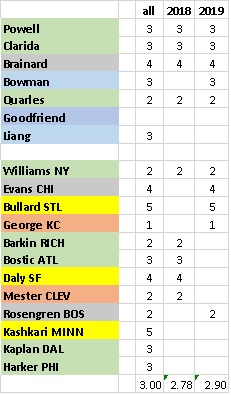
This is from our analysis of the various members of the FOMC; we rate them 1-5, with 1 being most hawkish and 5 most dovish.  Governors are on top and always vote.  We assume the governors will be a bit more dovish next year with the addition of Bowman.  The average estimate for this year was 2.78 (anything < 3 leans hawkish); therefore, next year, we are looking for a modestly easier voting mix.  The mix of Bullard and George will likely be an offset and they will mostly cancel each other out.  Although Evans has traditionally been a dove, he has been calling for tighter policy recently to reduce financial speculation.  Thus, he may be more hawkish than we are characterizing him.  On the other hand, the flattening of the yield curve may have eased his concerns about excessive “froth” in the financial markets.

Overall, we expect the FOMC to follow expectations—look for a hike with a mostly dovish statement and press conference.  If this doesn’t happen, we could see further weakness in the equity markets.

Equity markets: The S&P 500 has dipped back into correction territory as liquidation continues.  Friday’s weakness didn’t have any particular catalyst; it was sort of a “Seinfeld” market.[2]  There are rising worries about the economy and it is clear that international economies are coming under pressure.  But, none of this is new; what has clearly changed is investor sentiment.

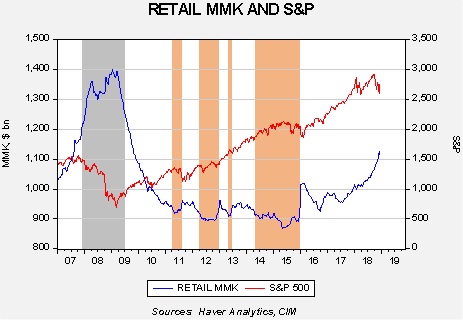
The blue line on the chart shows the level of cash held in retail money market funds, while the red line shows the S&P 500 (weekly close).  The gray area shows the Great Recession; the orange areas show when retail money market funds fell below $920 bn.  In this bull market, we note that when money market funds have fallen below $920 bn, the equity markets have tended to stall.  It’s a bit like the equity markets ran out of liquidity and had to rebuild cash levels before making another advance.  In 2007, and now, we saw a similar increase in money market funds.  There is clearly an increasing preference for liquidity which is, in part, coming out of equities.

It is important to note that money market funds exceeded $1.3 trillion in 2008 and equities, though under pressure, were not in a free fall.  From the peak to mid-summer, the S&P was off around 20%, a bear market but not a crash.  And, we were in recession.[3]  The real downdraft for equities occurred after the Lehman failure that exposed problems in the money market funds and in the derivative markets.

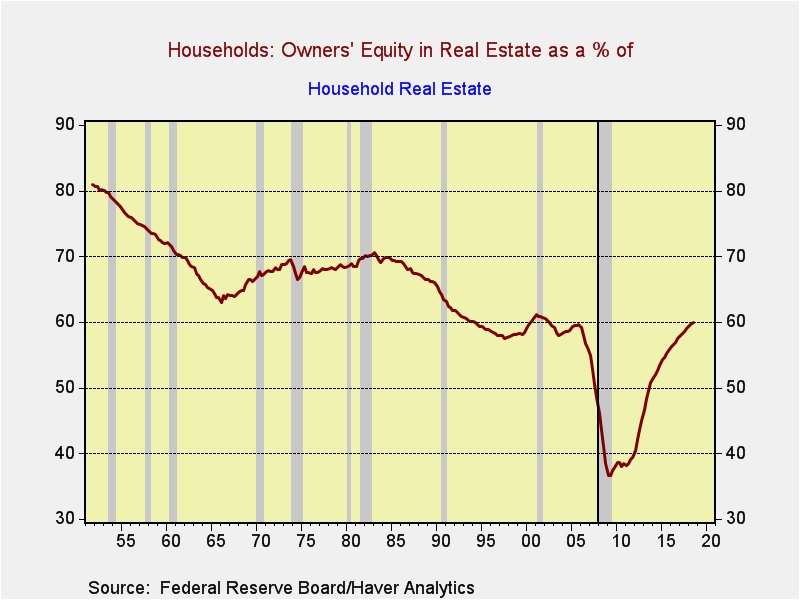
So, what does this chart tell us?  First, the rapid accumulation of cash is important as it shows households are clearly worried about the future and want to hold more liquidity.  Second, in 2007, when we saw a similar rise in liquidity, economic conditions were markedly worse.  The housing market was imploding from a wildly overleveraged level.  As the chart below shows, homeowners’ equity in their houses had fallen to 47% by the onset of the recession in Q4 2007; it is currently at 60%, which is essentially normal.  And, as we noted above, there was clear evidence that a recession was underway.

It is important for investors to remember that the 2008 bear market was really a two-part event.  The first was the 20% pullback driven by a “garden variety” recession; the second leg, which led to the full 40%+ decline, was a financial crisis.  It is not unreasonable to fear another financial crisis but the odds are not all that high.  Yes, there are areas of concern.  Private equity has become rather frothy, for example.  But, one of the major factors that led to the collapse in 2008 was the undermining of the money market funds.  When important funds “broke the buck,” it led to panic.  Although one can never say that such an event isn’t possible again, these events are rare and we don’t think it is in the cards.

Third, if a recession is avoided, the level of money market funds suggests ample liquidity and the potential for a strong equity recovery.  Avoiding recession will take some luck and skill.  The Fed will need to engineer that rarest of outcomes, the “soft landing.”  Although one could argue that the Fed has made four soft landings in the past 60 years, in reality, it has only occurred twice as two of these events were due to exogenous factors.  One occurred when the Fed lowered rates during Nixon’s wage/price freeze and the other occurred when the Fed dropped rates in 1985 when oil prices rolled over.  Still, if the Fed does become data dependent going forward, the odds of a soft landing improve.  The other issue is trade.  Recession odds increase if the administration maintains a hard line on trade with China.  Although we think that U.S. policy toward China is now hostile, we would not be shocked to see the administration go soft in 2019 to improve the odds of Trump’s reelection.

So, this is where we are.  We are seeing a high degree of caution from investors, in part due to memories of 2007-09.  This fear is completely understandable.  However, it is important to note that conditions are quite different from that period and thus worries may be excessive.  If we avoid recession in 2019, a rally in the S&P into the 2950/3000 area is reasonable.

Brexit: PM May is facing pressure to test different versions of Brexit in Parliament to see what will pass.[4]  These could include a hard Brexit and a second referendum.  May isn’t keen on the idea.  First, a version of Brexit that would be acceptable to the MPs probably won’t pass the EU.  Second, another referendum is fraught with risk.  How the choices are listed on the ballot could swing the vote in unexpected ways.  May has staked her political future on either the deal she negotiated or chaos.  Thus, she is fighting against other deals.  In reality, her plan won’t pass Parliament and the MPs likely believe that the EU will blink if faced with the choice between another plan more acceptable to the U.K. or a hard Brexit.  That’s probably a mistake but this seems to be where we are heading…at least for today.

View the complete PDF


[1] https://www.wsj.com/articles/quantitative-tightening-not-now-11544991760 It is worth noting that Mr. Warsh’s policy stance used to be much more hawkish: https://www.cnbc.com/2017/10/03/kevin-warsh-would-take-a-hammer-to-the-fed-but-he-wouldnt-break-it.html

[2] https://www.youtube.com/watch?v=jUWiv5r_CZw

[3] Although, to be fair, the recession issue was a raging debate at the time.  There were a number of economists who disputed the claim and in the August 2008 FOMC meeting transcripts policymakers were leaning toward starting rate hikes in the autumn, fearing they had overreacted to the problems in financial markets earlier in the year.  It should be noted, however, that most of our indicators were in recession territory; for example, the Chicago National Activity Index, even on a six-month average, signaled recession by January 2008 and the unemployment rate compared to its rate two years earlier had inverted by December 2007.

[4] https://www.ft.com/content/8e240890-0119-11e9-99df-6183d3002ee1

2019 Outlook: Red Sky at Morning (December 14, 2018)

by Bill O’Grady & Mark Keller |PDF

Summary:

  1. Economy grows at 2.7%.
  2. Expansion makes a new duration record; no recession expected in 2019, although the risk of a downturn will be increasing.
  3. Core inflation max is 2.5% next year.
  4. Dollar weakens, although the direction is mostly dependent on administration trade policy. We expect preparations for the 2020 elections will lead to a less aggressive trade policy compared to 2018.
  5. S&P earnings for 2019 will be $160.93 on an S&P basis (6.25% of GDP); using the Thomson/Reuters methodology, the reading would be $171.20.
  6. Assuming a P/E of 18.6x, using the S&P earnings projection, our expectation for the S&P is 2994.04.
    a. The key to this forecast will be the P/E.
    b. The multiple has been weakening on trade fears.
  7. If we underestimate the S&P next year, it will likely be due to the election cycle; the year before the election tends to be most favorable, with the usual gain up 16%.
  8. Mid-caps are unusually cheap and would be most favored. Small caps have also suffered recently and are favored as well, although less than mid-caps.
  9. Growth has greatly outperformed value, a trend that has been mostly driven by multiple expansion. If the multiple stabilizes as we expect, value should be equally weighted.
  10. International is favored on our assumption that the dollar weakens.
  11. Our terminal expectation for fed funds is 3.00% to 3.25%.
  12. We expect the 10-year yield to peak at 3.25% next year.
  13. Investment grade bond spreads should stabilize; high yield bonds are overvalued and should be underweighted.
  14. Commodities should do better next year if our dollar forecast is correct.

Risks to the Forecast:

    1. Primary risk: Fed policy mistake. The Fed raises rates in excess of our expectation and triggers a recession.
    2. Italy brings down the Eurozone. Italy refuses to control its deficits, leading to a financial crisis in the Eurozone.
    3. Trade war with China. In reaction to continued tariff pressure, the PBOC pushes the CNY lower, which triggers capital flight and a debt crisis in China, bringing a global downturn.
    4. Inflation expectations become unanchored. Although the least likely of the risks, it would be the most devastating, leading to higher interest rates, falling P/Es and a weaker dollar. If the Fed remains independent, cash would become the best performing asset class. If the Fed’s independence is undermined, gold, real estate and commodities will have the best performance. We do expect this event to occur somewhere in the next 10-20 years.

Although our base case calls for no recession, moderate inflation and continued modest gains in equities, there are growing risks of recession. We will detail the four “known/unknowns” near the conclusion of this report.

Read the full report

Asset Allocation Weekly (December 14, 2018)

by Asset Allocation Committee

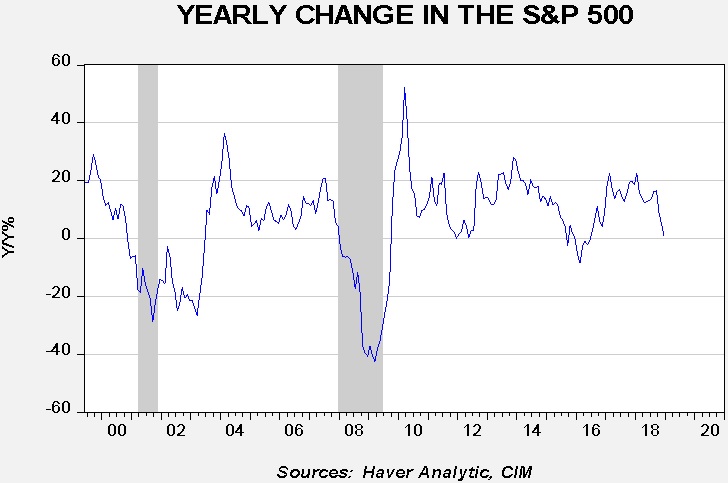
Equity markets have come under pressure this autumn.  The weakness has gained momentum in recent weeks.

This chart shows the yearly change in the S&P 500 Index on a monthly average basis.  We have added recession shading; in general, recessions tend to trigger bear market declines of 20% or more.  In fact, every decline of this magnitude has been associated with a downturn in the business cycle since the 1987 Crash.

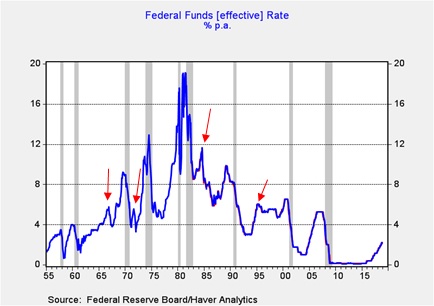
There have been two sources of recent weakness.  The first is fear that the Federal Reserve will make a policy error and trigger a recession.  These fears are not unfounded.  Since the mid-1950s there have been 13 tightening cycles; only four have resulted in a “soft landing,” a cycle that didn’t trigger a recession.

This chart shows the path of fed funds since 1955, shortly after the central bank became independent of the Treasury.  We have placed arrows where tightening cycles didn’t bring a downturn.  As the chart shows, it’s rare for the Fed to avoid a downturn.  It should be noted that the second arrow coincided with the Nixon price and wage freeze; Chair Burns likely lowered fed funds in response to the price freeze.  Thus, we can make the case that there were only three soft landings that were independently engineered by the Fed.

The second concern is over trade policy.  The administration’s trade policy threatens to disrupt supply chains tied to China which could lead to shortage and higher prices for various goods.  The impact of this outcome is very difficult to estimate; we haven’t had an aggressive policy of trade impediments since the 1920s.  At the same time, it should be noted that trade frictions are partly a negotiating stance.  These issues can be adjusted given the economic and political climate.  Since next year is the last full year before elections, we would not be surprised to see some moderation of the Trump administration’s stance on trade policy.

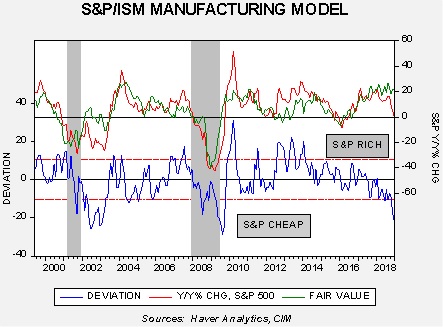
If the FOMC does manage to bring a fifth soft landing and we see some moderation of trade policy, the equity market may be poised for a recovery.  Since the late 1990s, the ISM manufacturing index has been a reasonably good indicator of the S&P 500.

This chart compares the yearly change in the S&P 500 Index monthly average against the ISM Manufacturing Index.  The equity index, relative to the perspective of U.S. manufacturing purchasing managers, should be up 22.1% from last year; that would put the index at 3259.27.  Not only that, but the current reading is at levels consistent with recession.  This analysis suggests that if recession is avoided in 2019 then the equity market could be poised for a strong recovery.  Essentially, this model is saying there is a disconnect between the economy and equities.  These disconnects occur occasionally but the current one stands out as extreme.  Therefore, there may be more risk to reducing equity exposure in the current turmoil.

View the PDF

Daily Comment (December 14, 2018)

by Bill O’Grady and Thomas Wash

[Posted: 9:30 AM EDT] It’s a risk-off Friday; global equity markets are slumping, economic data from China and Europe looked weak and PM May got rebuffed by EU leaders.  As noted, equities are lower, the dollar is up and Treasury yields are down.  Here are the details:

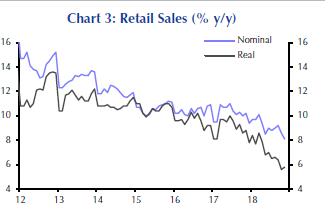
Global data: In China, retail sales hit a 15-year low as car sales[1] are on track to have their first annual sales decline since the 1990s.[2]

(Source: Capital Economics)

Since the 2008 crisis, China has maintained growth by increasing infrastructure spending and increasing debt.  Policymakers are suggesting that similar actions are coming but the nagging fear is that we have reached the level where additional debt isn’t leading to stronger growth.

Meanwhile, in Europe, the flash PMI data was soft as the Eurozone manufacturing index dipped to 51.4, a 31-month low.  Services also came in at 51.4, well below the forecast.  Much of the weakness came from France, where protests led the composite index (combination of manufacturing and services) to fall to 49.3, below the expansion line of 50.

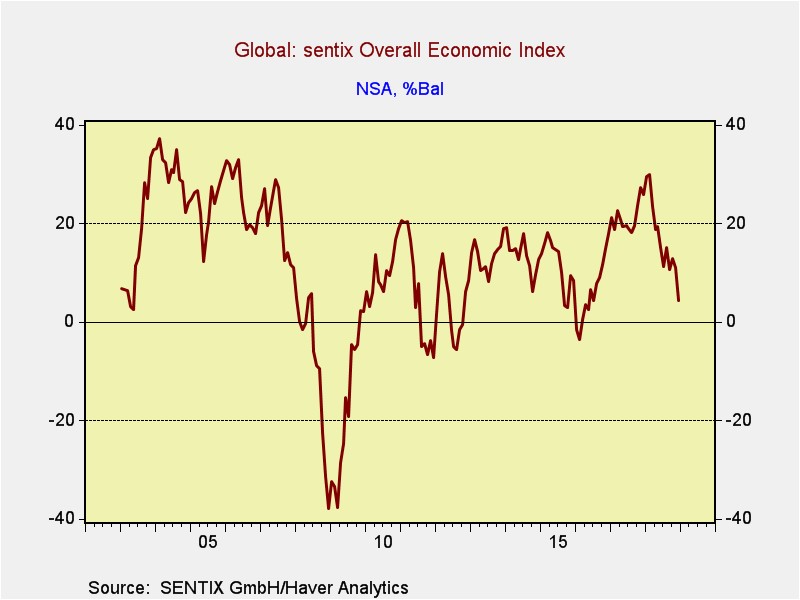
In some respects, today’s data is simply part of a trend that has been in place for over a year.

Sentix is a German economic research group that conducts surveys of economic sentiment.  As the chart above shows, sentiment has been coming under pressure since peaking in January.  Governments are aware of this weakness and have been increasing fiscal spending.  Although we don’t expect a recession in the U.S. next year, global growth remains soft and the disparity between the U.S. and the rest of the world has supported a stronger dollar.

Brexit: PM May went to Brussels looking for help.  As expected, she received nothing.[3]  The most common complaint from EU ministers is that May didn’t know what she wanted.  This sentiment is probably not completely accurate—she wants the EU to give concessions to appease MPs that the EU simply isn’t prepared to offer.  The lack of progress sent the GBP lower this morning, although it should be noted that the dollar is higher across the board.  Thus, this issue may not be all that important to the movement of the currency.

To reiterate, the majority of MPs do not want a hard Brexit, which would be a sudden ending of relations on March 31 that would sever EU trade relations with the U.K.  At the same time, the negotiated deal May has created will not pass Parliament.  Absent a referendum, it isn’t clear what the path forward is, although we do note that a hard Brexit is on the calendar if nothing else happens.  It is possible May simply can’t make a deal to avoid a hard Brexit but it isn’t obvious if anyone else can, either.  Labour’s Corbyn would like elections but he didn’t have the courage to call for a full no-confidence vote, which would have likely brought down the government.  Corbyn’s reluctance to trigger a confidence measure suggests he doesn’t have any better ideas on how to move forward.

Our working assumption is that a hard Brexit is unlikely because no party really wants that outcome.  However, each day that passes without progress increases the odds of that result because it is the only outcome determined by the calendar alone.  If nothing happens by the end of March, the U.K. leaves on WTO rules.  We still expect another referendum but that could require May to step down since she continues to argue that it’s her deal or nothing, which isn’t quite true.  However, the strong Brexiteer fantasy that a better deal can be negotiated simply isn’t going to happen.  So, we are looking at either (a) a new referendum that keeps the U.K. in the EU, (b) May’s deal, or (c) a hard Brexit.  The middle choice looks unlikely so it is either a new vote or hard out.  And, by the way, a referendum may simply lead to the same outcome as the first.  In the end, we will probably need to approach the deadline in order to focus all parties into actually doing something.  However, waiting increases the chances of a “sleepwalk” into disaster.

Senate rebuffs Saudi Arabia: The Senate[4] voted to withdraw American support for the Saudi-led war in Yemen.  The vote is mostly symbolic since it won’t pass in the House.  But, it is a rejection of the administration’s policy and a rare legislative defeat for the White House.  In our view, the U.S. can’t sever relations with Saudi Arabia without risking a wider breakdown in the Middle East.  At the same time, guiding the kingdom to find a new crown prince should be supported.

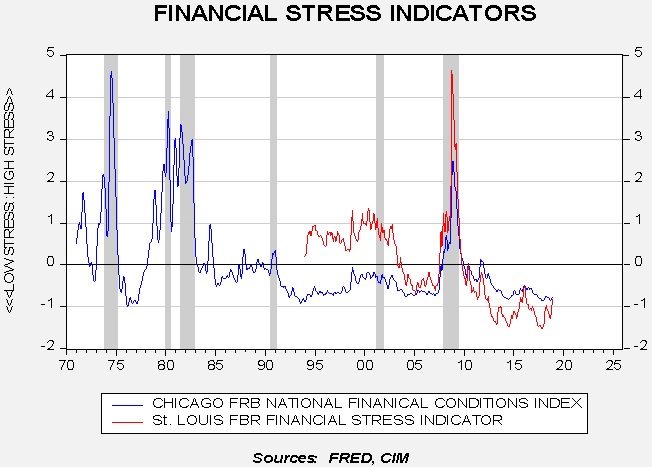
Stress monitor: With concerns rising in the financial system, it should be noted that the stress indices are holding on rather well.

We mostly rely on the Chicago FRB number because it has a much longer history, but we monitor the St. Louis report as well.  The latter has ticked higher recently but we usually don’t worry about stress until we see readings above zero.

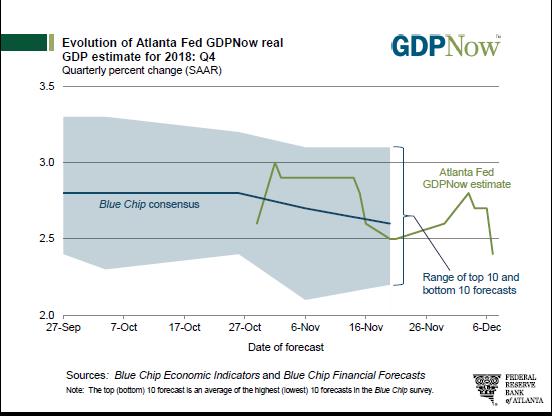
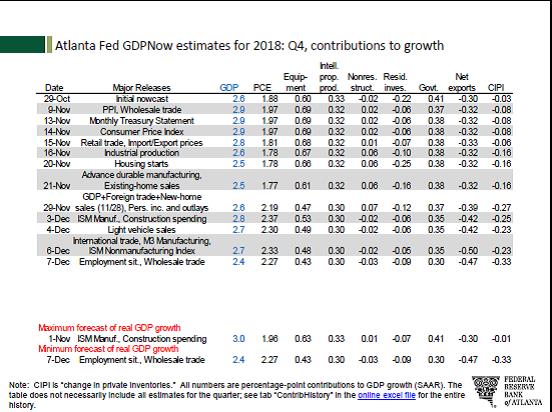
Slowdown in Q4: The Atlanta FRB GDPNow reading is down to 2.4% for Q4.

Here are the estimated contributions to growth.

The data projections show that consumption is generally holding its own but combined investment is expected to add a mere 28 bps to growth in Q4 compared to 252 bps in Q3.  Net exports is expected to be a drag on growth but much less than the 191 bps decline seen in Q3.  Finally, government is expected to add 30 bps to growth compared to 44 bps in Q3.  Overall, the sluggishness projected should support a Fed pause if the central bank is so inclined. 

View the complete PDF


[1] https://www.ft.com/content/8cd439fa-fd41-11e8-aebf-99e208d3e521

[2] https://www.ft.com/content/717636be-ff43-11e8-aebf-99e208d3e521?segmentId=a7371401-027d-d8bf-8a7f-2a746e767d56

[3] https://www.ft.com/content/5a649ddc-ff0a-11e8-ac00-57a2a826423e?emailId=5c1335f7189c4b0004f8cb1a&segmentId=22011ee7-896a-8c4c-22a0-7603348b7f22

[4] https://www.reuters.com/article/us-usa-saudi-yemen/u-s-senate-hands-trump-historic-rebuke-on-saudi-arabia-idUSKBN1OC2S3

Daily Comment (December 13, 2018)

by Bill O’Grady and Thomas Wash

[Posted: 9:30 AM EDT] Risk markets are mixed this morning with the pattern of fading overnight equity futures rallies continuing.  Here is what we are watching:

ECB:  The ECB is meeting today and has released a statement indicating that QE is ending[1] but the balance sheet will be maintained for the foreseeable future.  That means the ECB will continue to invest in new bonds as old bonds expire.   Interest rates were not changed.  Overall, this outcome was mostly expected.  The European economy has been weakening this year despite currency weakness and policy accommodation.  Thus, we don’t expect the central bank to begin raising rates anytime soon.  In the press conference, ECB President Draghi noted the weakness of recent data, which suggests policy won’t really tighten anytime soon.

May wins—now what?  As expected, PM May won her leadership challenge and, based on Tory party rules, cannot face another internal party leadership challenge for a year.  The vote was closer than expected, 200/117, which is disappointing.   May had to promise not to run for PM in the next election, which is a bit of a humiliation. [2] On the other hand, she probably has no chance anyway.  So, for now, May will lead the government into Brexit.

This is what we see going forward.  First, there is little chance the EU will make material changes to the current agreement.  Although there is nearly universal dislike for what May has negotiated, she was in a really weak position and was mostly forced to take whatever mercies the EU was willing to grant.  Second, there is no stomach for a hard Brexit.  It is now common knowledge that a hard Brexit will lead to serious economic disruption.  Imagine the U.S. making a sudden stop to trade with Canada and Mexico.  Grocery stores would quickly run out of some products (no guacamole!) and car production would halt as parts flow hit a sudden stop.  Over time, the supply chains would adjust but the change would be painful and almost certainly inflationary.  Although the BOE has made brave talk about raising rates to fight stagflation, in reality, a central bank facing inflation and recession will tend to fight the latter.  Only under unique circumstances, like we saw in the late 1970s, will the first be the primary policy focus.  Third, if our analysis is correct, the next likely step is a second referendum.  Although this outcome is fraught with risk, there is no real middle ground between impossible new negotiations and a hard Brexit.  Thus, a referendum to at least delay implementation might make sense and it’s possible a second referendum could reverse the outcome of first.   Although there is grumbling about the elites re-running the vote until they get the outcome they want, one could argue that a second vote would be more informed because now the parameters are clearer.  It should also be noted that holding multiple votes isn’t unprecedented; separation referendums have been held on multiple occasions in Quebec and Scotland.  In the end, at a minimum, we think a hard Brexit will be avoided and the deadlines will be extended.  And, “calling the whole thing off” is a clear possibility.

China trade:  Negotiations continue and, actually, the situation appears to be improving.  The Meng issue remains; in fact, a second Canadian was arrested in China yesterday.[3]   On this issue, the Xi government is pressing Canada hard but is studiously avoiding taking actions against Americans…so far.  If Meng is extradited, that could change.  But, for now, China appears willing to restrict aggressive steps against Canada alone.

Meanwhile, trade talks continue and China is taking steps to improve the optics for the situation,[4] making high profile announcements.  For example, China announced large purchases of U.S. soybeans.[5]   The timing is important, as farmers are struggling to find storage space for the recent harvest, especially with steel tariffs driving up the price of silos.[6]  China is moving to cut tariffs on U.S. autos from 40% to 15%.[7]  It has asked for high level trade talks.[8]   It is even offering to change its “China 2025” program to increase foreign participation.[9]  We suspect that Xi is betting that Trump will accept a trade truce to improve sentiment going into 2019 to raise the odds of re-election.  We doubt China has any intention to actually meet U.S. demands.  From China’s perspective, the Plaza Accord of 1985 (which drove up the value of the JPY) and Reagan-era “voluntary” car export restrictions on Japanese car exports (interestingly enough, negotiated by none other than Robert Lighthizer), paved the road for Japan’s 30 years of economic stagnation.  That isn’t exactly true, because Japan could have taken policy measures to adjust more quickly, but U.S. policy undermined Japan’s ability to export to the U.S. and made the adjustment process more difficult.  Beijing fears the U.S. has similar plans for China.  At the same time, offering concessions can buy China time, especially when the Chinese economy is slowing.

The unknown is the reaction of the Trump administration.  If it is taking a long-term view, it should continue to press its advantage and force China to make significant concessions.  However, that path would keep financial markets under pressure.  Holding the line might be the best long-term policy but will reduce the president’s chances of re-election.  We suspect the administration will soften to improve market sentiment.

Italian budget news:  Yesterday, there were reports the Italian government was giving in to EU demands, offering an adjusted budget with a mere 2% deficit/GDP.[10]  Although the reports were initially downplayed, in fact, it appears the reports were accurate.[11]  Italian bonds have rallied strongly on the news.  We suspect the bond market forced the Italian government to offer concessions.

More on tech:  Apple (APPL, 169.10) has announced a significant investment plan in the U.S., boosting American employment by 20k by 2023.  It is unclear if any of this $1.0 bn on new investment will bring production back to the U.S. (that seems unlikely for now).  The high profile investment spending will improve its political profile.[12]

View the complete PDF


[1] https://www.ft.com/content/bc0a5184-fd44-11e8-ac00-57a2a826423e?emailId=5c11f0b0859321000480fa79&segmentId=22011ee7-896a-8c4c-22a0-7603348b7f22

[2] https://www.nytimes.com/2018/12/12/world/europe/theresa-may-no-confidence-brexit.html?emc=edit_mbe_20181213&nl=morning-briefing-europe&nlid=567726720181213&te=1

[3] https://www.reuters.com/article/us-china-icg/china-says-second-canadian-being-probed-for-harming-state-security-idUSKBN1OC0A4

[4] https://www.nytimes.com/2018/12/12/business/china-trade-war.html?emc=edit_mbe_20181213&nl=morning-briefing-europe&nlid=567726720181213&te=1

[5] https://www.reuters.com/article/us-usa-trade-china-soybeans/exclusive-china-makes-first-major-buy-of-u-s-soybeans-since-trump-xi-meet-idUSKBN1OB29S

[6] https://www.ft.com/content/2387f97c-fd7e-11e8-aebf-99e208d3e521?segmentId=a7371401-027d-d8bf-8a7f-2a746e767d56

[7] https://www.scmp.com/news/china/diplomacy/article/2177536/trade-talk-movement-china-agrees-slash-tariffs-us-auto-imports

[8] https://www.scmp.com/news/china/diplomacy/article/2177358/trade-war-chinas-liu-he-and-us-steven-mnuchin-and-robert and https://www.reuters.com/article/us-usa-trade-china/china-commerce-ministry-would-welcome-u-s-trade-delegation-visit-idUSKBN1OC0R7

[9] https://www.wsj.com/articles/china-is-preparing-to-increase-access-for-foreign-companies-11544622331

[10] https://www.bloombergquint.com/onweb/italy-to-propose-new-fiscal-targets-to-european-union-wednesday#gs.YKz3mng

[11] https://www.ft.com/content/18d29fbe-fe19-11e8-ac00-57a2a826423e?emailId=5c11f0b0859321000480fa79&segmentId=22011ee7-896a-8c4c-22a0-7603348b7f22

[12] https://www.axios.com/apple-to-expand-in-austin-00c6c2a5-2e5d-4444-a5a7-4d117879cfe3.html