

Weekly Energy Update (January 6, 2022)

by Bill O’Grady, Thomas Wash, and Patrick Fearon-Hernandez, CFA | PDF

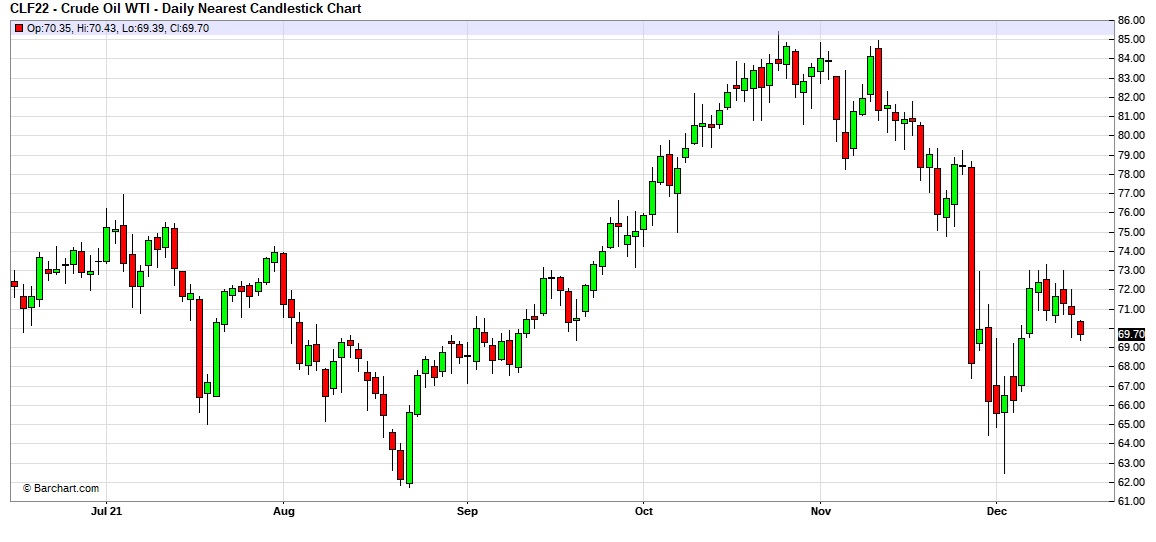
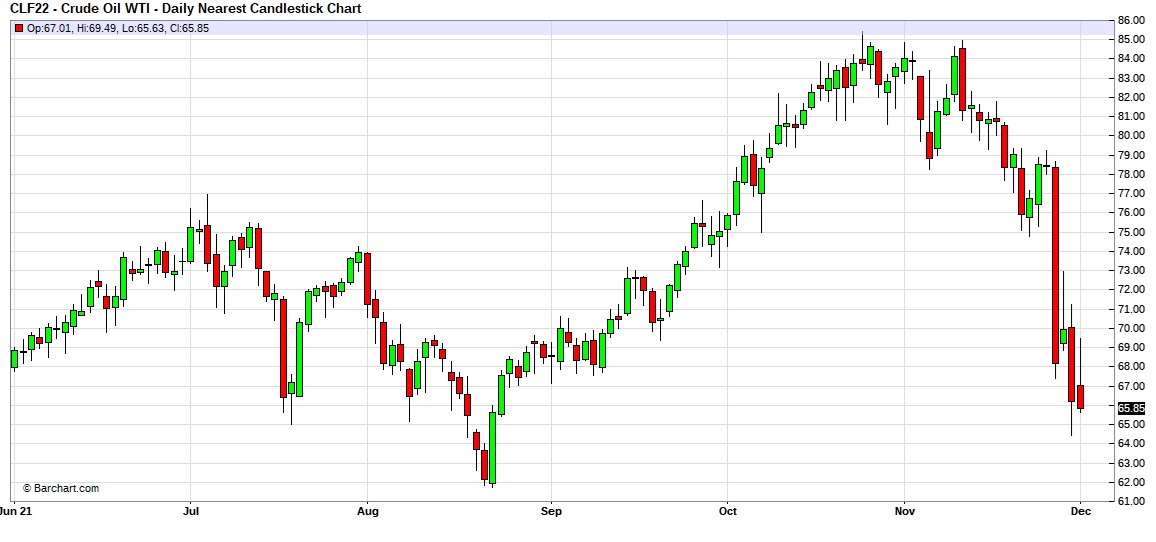
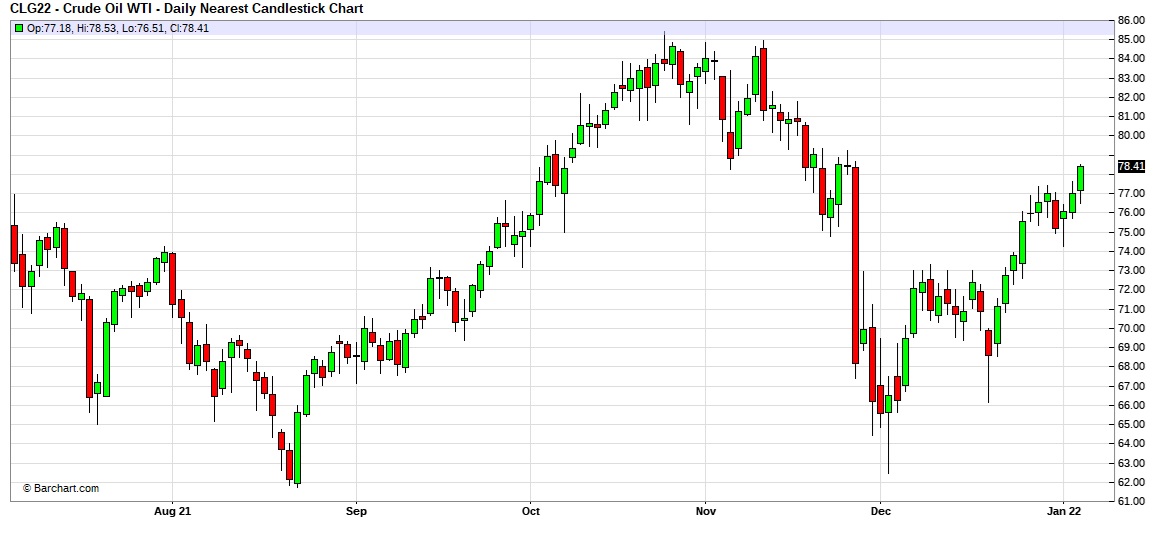
Since troughing in early December, oil prices have been steadily rising due to tightening supplies.
(Source: Barchart.com)

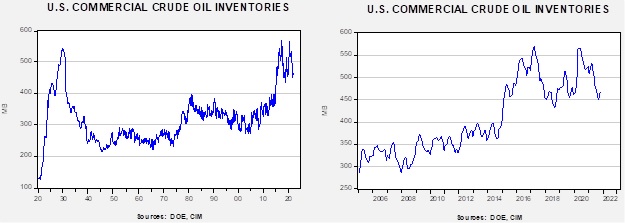
Crude oil inventories fell 2.1 mb compared to a 3.4 mb draw forecast.  The SPR declined 1.3 mb, meaning the net draw was 3.5 mb.
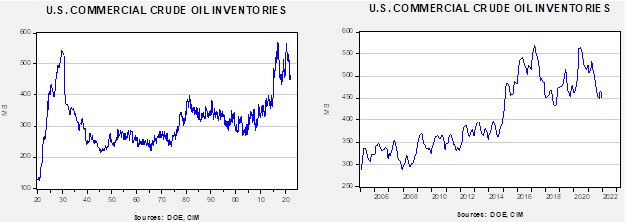
In the details, U.S. crude oil production was unchanged at 11.8 mbpd.  Exports fell 0.4 mbpd, while imports declined 0.9 mbpd.  Refining activity rose 0.1%.
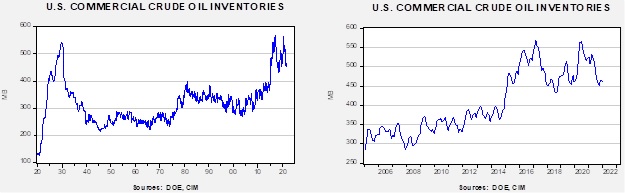
(Sources: DOE, CIM)

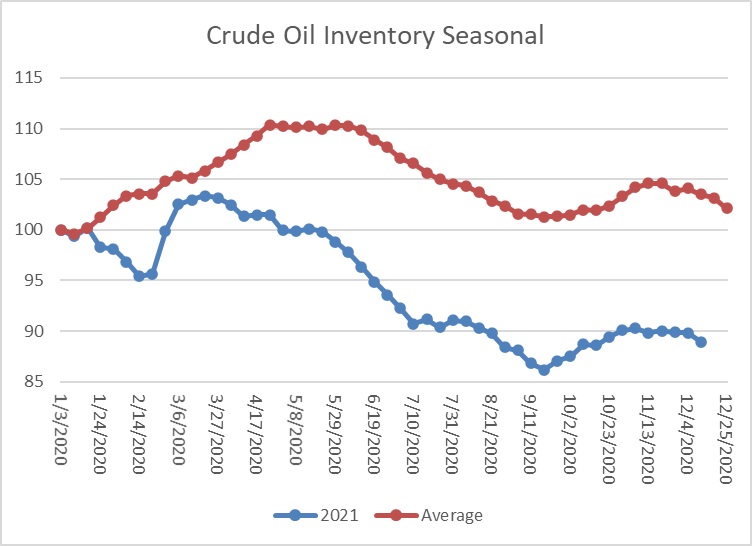
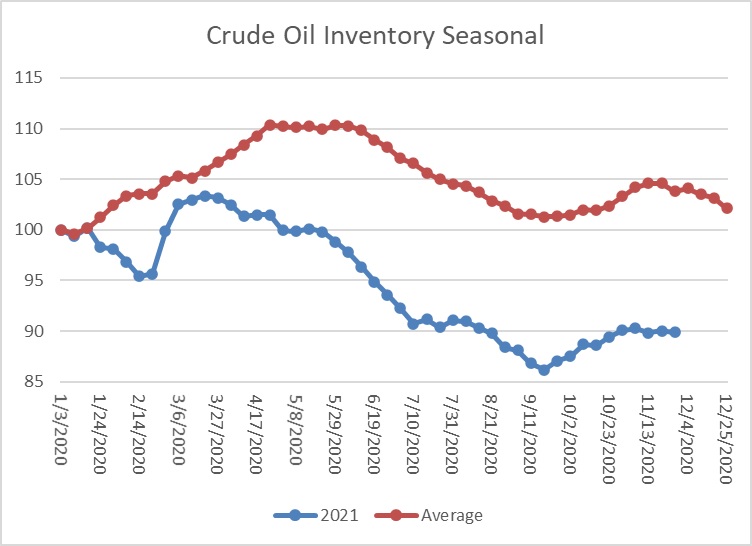
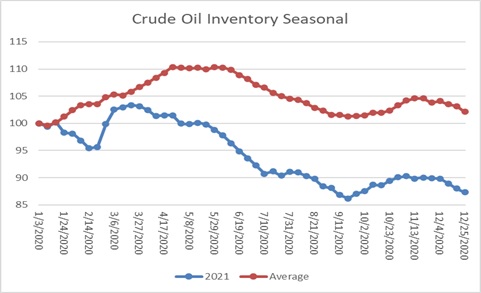
This chart shows the seasonal pattern for crude oil inventories.  Next week, we will reset the chart for 2022.  The key element to watch is to determine whether inventories follow the usual seasonal pattern, or, like last year, stockpiles decline and even “catch up” to usual levels of inventory.
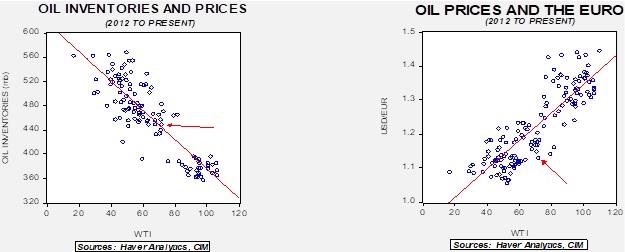
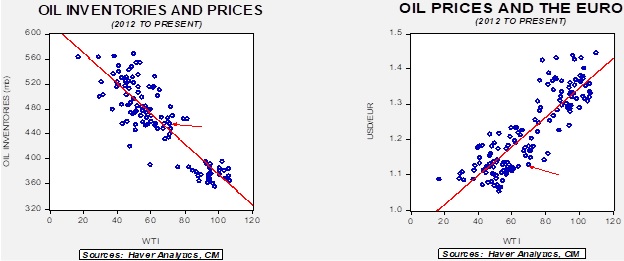
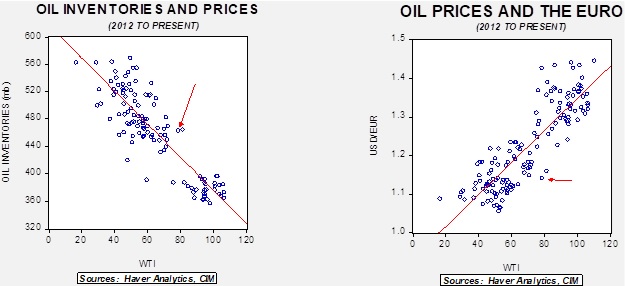
Based on our oil inventory/price model, fair value is $68.64; using the euro/price model, fair value is $52.64.  The combined model, a broader analysis of the oil price, generates a fair value of $60.51.  The recent decline in oil prices has brought the market closer to fair value.  Dollar strength remains a bearish factor, and the SPR release has eased the bullish pressure from falling stockpiles.  Fears of future supply tightness remain a bullish factor.

 Market news:

(Source:  FT)

  • OPEC+ has agreed to boost production by 0.4 mbpd next month, assuming the omicron variant won’t dent demand significantly.
  • The U.S. adjusted the auto fleet standards to an average of 55 mpg by 2026, up from 43 mpg previously.  These goals tend to be adjusted from administration to administration, so a GOP-led White House could reduce them in the future.  For automakers, there is a risk of not making the investment to boost mileage and, regardless of who is in power, we expect cars to see steadily improved mileage standards.
  • We also note that car company stocks seem to react positively to news of firms expanding EV capacity.  If the surges hold up, it will incentivize firms to expand production capacity further.

Geopolitical news:

  • The war in Yemen continues.  So far, it hasn’t led to lasting disruption of oil supplies, but the risk of such an event remains a possibility.  In 2021, the Houthis, who oppose the KSA’s intervention in the Yemen civil war, doubled their attacks on Saudi Arabia.  Iran supports the Houthis; the U.S. Navy has seized weapons bound for Yemen to support this group.
  • The KSA has started making ballistic missiles with China’s aid.  Iran has been developing such missiles for years.  However, the Saudis, likely fearing the steady withdrawal of the U.S. from the region, have apparently decided they need their own ballistic missile capacity to offset Iran’s capability.
  • Turkey’s economy is under stress. Rising inflation and heterodox policy responses raise worries that the country could spiral into hyperinflation.  A major element of Turkey’s economic problem is persistent current account deficits, which are funded by draining foreign reserves or by attracting foreign investment.  The “textbook” response to Turkey’s problem is to raise interest rates, which not only depresses domestic consumption (usually narrowing the current account deficit), but the higher interest rates can attract foreign investment.  President Erdogan has made it clear he won’t support higher interest rates, which is a factor in the current turmoil.  One way to resolve this problem is to attract foreign investment by some other means.  The current problems in Turkey, coupled with the heterodox economic policies, likely limit private investment to only the bravest and risk tolerant. Nevertheless, foreign government investors might respond to Erdogan for geopolitical reasons rather than merely economic ones.  We note that, despite the murder of Jamal Khashoggi in Turkey, which infuriated Erdogan, the Turkish president is traveling to Riyadh next month to woo investment from Saudi Arabia.  Why the thaw?  We suspect that nations in the region are trying to build a united front against Iran and thus are willing to overlook earlier animosities.

Alternative energy/policy news:

  • The EU is considering naming natural gas and nuclear power as “sustainable” fuels.  German Greens oppose this label.  This is important because if these fuels do get the sustainable moniker, it would support expanded investment.
  • Hydrogen remains a potential replacement for fossil fuels.  Unfortunately, at present, most hydrogen comes from fossil fuels (natural gas is the largest source).  Namibia is laying claim that it could become a source of green hydrogen.  Most high school chemistry classes show students how to crack water to derive hydrogen and oxygen.  But, to use electrolysis to derive hydrogen from water requires significant levels of energy.  If one can generate this energy from renewable sources, such as wind or solar energy, it might be possible to create hydrogen cleanly.  Namibia has ample sunlight (300 days per year on average) and strong prevailing winds that could make the country a low-cost producer of green hydrogen.
  • Bolivia has the potential to become a major source of lithium, currently a key element in EV batteries.  However, local politics and competing outside interests have tended to thwart development.
  • We have been tracking developments in geoengineering for some time.  Geoengineering is the process of using interventions to achieve a climate goal.  One example would be to disperse particles into the atmosphere to mimic a volcanic eruption; the particles would reflect sunlight into space, cooling the planet.  There are other potential interventions as well.  Geoengineering is controversial.  No one knows for sure whether it works or what side effects it might cause, but an experiment is being considered as soon as mid-2022 to see if geoengineering works.
  • Another technological fix would be carbon capture; the goal would be to “suck” CO2 out of the atmosphere.  So far, current technologies are not large enough to make a difference.  There are also worries among some environmentalists that the promise of carbon capture would discourage strong actions to reduce fossil fuel consumption.
  • Battery storage is expanding rapidly as a way to smooth out electricity flow from renewables.
  View PDF

Asset Allocation Weekly – What’s Causing the Yield Curve to Flatten? (December 17, 2021)

by the Asset Allocation Committee | PDF

A note to readers: The Asset Allocation Weekly will go on holiday hiatus following today’s report and return as a bi-weekly publication, now on Mondays, beginning January 10, 2022.  From all of us at Confluence Investment Management, we wish you a Merry Christmas and Happy New Year!  See you in 2022!

Bond yields—and the relationships between them—can be some of the most important economic and financial indicators an investor can watch, and yields today are telling an important story.  The “yield curve,” which graphs market yields by maturity, has recently been flattening as the difference between long-term yields and short-term yields has gotten narrower.  It is the first time such a flattening has happened in almost five years, so this article takes a close look at what that flattening is telling us about the economy going forward.

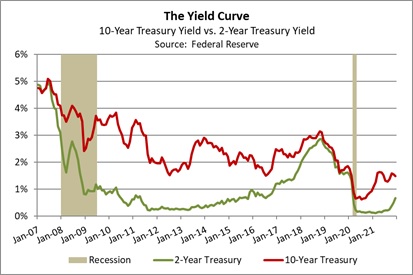
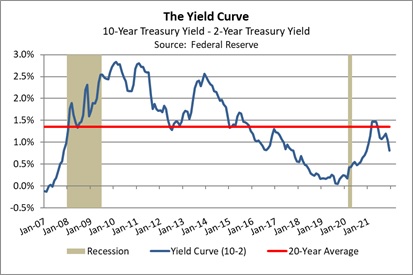
A complete yield curve would plot the yields for all maturities at a given point in time.  A quick summary of the yield curve and its evolution is provided by simply graphing the yield on the 10-year Treasury note minus the yield on the 2-year Treasury note over time, as shown in the chart below.  Over the last two decades, the yield on the 10-year Treasury has typically been 1.35% higher than the yield on the 2-year Treasury.  When the economy is recovering from a recession or otherwise starting to accelerate, investors often anticipate higher inflation and improved opportunities in equities off into the future, so they buy fewer longer-term obligations.  That pushes their prices down and boosts their yields relative to shorter-term obligations.  The yield curve then steepens.  As shown in the chart below, that is exactly what happened during the year after the coronavirus pandemic first slammed the U.S. economy in early 2020.  By the spring of 2021, the difference between the 10-year Treasury yield and the 2-year Treasury yield widened to 1.47%, surpassing its 20-year average for the first time in half a decade.

More recently, however, the yield curve has started to flatten again.  The 10-year yield currently stands just 0.80% above the 2-year yield.  What explains this dramatic reversal?  We think it reflects two closely related expectations among investors.  First, price inflation has worsened throughout 2021 and is showing no signs of being as short-lived or “transitory” as Fed policymakers expected.  Investors rightly guessed that sticky inflation would scare the Fed into tightening monetary policy sooner than originally planned.  Last month, the Fed began to taper its bond purchases, and it has recently signaled it will soon accelerate its taper enough to stop all bond buying by early 2022.  That would position the Fed to begin hiking its benchmark short-term interest rate in the first half of 2022.  Buying enthusiasm for short-term obligations consequently weakened, driving up their yields.  This is seen clearly in the sharp increase in 2-year Treasury yields (see the green line on the chart below).

Just as important, we think the market action shows that investors have also adopted a more pessimistic view of longer-term economic performance.  Investors appear to expect a return to sluggish growth, perhaps because they think the Fed will tighten monetary policy too sharply over the coming months.  Not only have shorter-term yields jumped, but the chart shows that longer-term yields have plateaued well below their typical level during the previous expansion (see the red line in the chart above).  In fact, the yield on the 10-year Treasury note is currently below its minimum level from 2008 to 2019.  Expecting bond yields to be that low over the next decade implies an expectation for very weak economic growth and low inflation.

What could cause such an outcome?  It might result from the global economy reverting to its pre-pandemic state, in which growth and inflation were held in check by big, structural headwinds, such as slowing birth rates, population aging, high-income inequality, excessive debt, expanding globalization, and new technologies.  However, some of those headwinds, such as globalization, appear to be retreating.  We believe that much of the plateauing in longer-term yields reflects a fear among investors that the Fed will tighten monetary policy too much.  Such a policy mistake by the Fed could short-circuit the budding economic expansion and produce a new recession, especially considering much of the federal government’s pandemic fiscal stimulus will be withdrawn over the next year.  For near-term asset allocation strategy, any further flattening in the yield curve would, therefore, suggest increased caution regarding risk asset

View PDF

Weekly Energy Update (December 16, 2021)

by Bill O’Grady, Thomas Wash, and Patrick Fearon-Hernandez, CFA | PDF

(The Weekly Energy Update will go on hiatus until January 6, 2022.  To all our readers, Merry Christmas and Happy New Year.)

After recovering last week, oil prices have started to drift lower.  Worries about rising production and weakening demand due to the Omicron variant, in addition to monetary policy tightening, are pressuring prices.

(Source: Barchart.com)

Crude oil inventories fell 4.6 mb compared to a 2.3 mb draw forecast.  The SPR declined 2.0 mb, meaning the net draw was 6.5 mb (difference due to rounding).

In the details, U.S. crude oil production rose 0.1 mbpd to 11.7 mbpd.  Exports rose 1.4 mbpd, while imports were unchanged.  Refining activity was steady.

(Sources: DOE, CIM)

This chart shows the seasonal pattern for crude oil inventories.  Inventories usually decline in December, so last week’s draw was normal.  Note that stocks are significantly below the usual seasonal trough.  Our seasonal deficit is 75.3 mb.

Based on our oil inventory/price model, fair value is $65.32; using the euro/price model, fair value is $52.49.  The combined model, a broader analysis of the oil price, generates a fair value of $58.50.  The recent decline in oil prices has brought the market closer to fair value.  Dollar strength remains a bearish factor, and the SPR release has eased the bullish pressure from falling stockpiles.  Fears of future supply tightness remain a bullish factor.

Market news:

Geopolitical news:

Alternative energy/policy news:

  View PDF

Asset Allocation Weekly – The Omicron Problem (December 10, 2021)

by the Asset Allocation Committee | PDF

Over the Thanksgiving holiday, news broke that a new variant of COVID-19 had been isolated in South Africa.  This new variant has an usually high number of mutations, which increases the likelihood that current immunity will be compromised.  In other words, prior infection or inoculation will probably be less effective in preventing infections.

Financial and commodity markets did not take the news well.  The major equity indices sold off.  Crude oil fell over 12% on the day after Thanksgiving.  It is still too soon to know the impact of this new variant.  Early comments suggest it may be less lethal than earlier variants.  That would be a pattern often seen with infectious diseases.  But there are reasonable worries that the new variant will have a disruptive effect on the global economy.

However, an added complication is the reaction of policymakers.  Last week, Chair Powell took a hawkish stance in testimony before Congress, suggesting that the Fed could taper its balance sheet purchases faster and may move to tighten policy before the labor markets fully normalize.  He also jettisoned the “transitory” description of inflation.

His statements led to a shift in market expectations over the path of monetary policy.   What changed for the Chair to move toward tighter policy?  As we discussed a few weeks ago, the composition of the FOMC next year will be much more hawkish unless the president moves quickly to fill the remaining three vacancies on the FOMC.  Without these vacancies being filled, Powell could face some close votes to keep policy steady.  His stance may reflect the fact that the committee’s composition is changing.

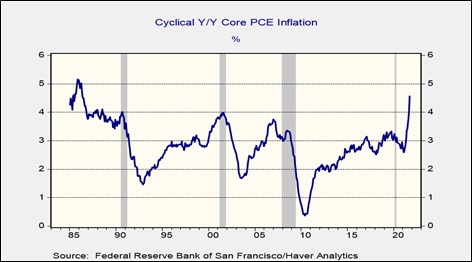
Another factor affecting Powell’s position is that cyclical inflation has jumped recently.  The San Francisco FRB has a measure that separates the cyclical and acyclical components of the core personal consumption deflator, the most favored inflation measure of the FOMC.  In general, there is little point for the Fed to change policy if acyclical inflation is rising because it is unlikely that such inflation will be sensitive to monetary policy.  On the other hand, cyclical inflation should be sensitive to monetary policy.  Over the past three months, cyclical inflation has jumped, which has likely caught the attention of policymakers.

Until September, this index was still within its historic norms, but the rise since then suggests that (a) cyclical prices are rising and (b) monetary policy should have some effect on bringing this inflation down.

At the same time, the recent jump in financial volatility will likely affect the decision to raise rates.

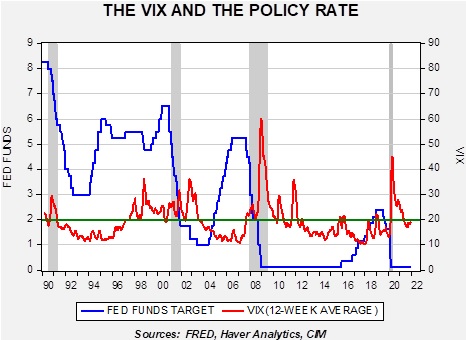
This chart shows the policy rate target along with the 12-week average of the VIX.  We have placed a line at 20 for the VIX.  Over the past two decades, the Fed has tended to avoid raising rates when this measure of the VIX exceeds 20.  Although the current reading is below 20, it is close to that level, so recent market volatility could easily push the VIX above 20 in the coming weeks.

The key unknown is the path of inflation.  Due to the disruptions brought by the pandemic, forecasting inflation is unusually difficult at present.  Yet, the same base effects that have lifted inflation this year will likely have the opposite effect in 2022.  Overall, we expect the Fed to end its balance sheet expansion next year, but the first-rate hike will probably be in late 2022 at the earliest and more likely in Q1 2023.

View PDF

Weekly Energy Update (December 9, 2021)

by Bill O’Grady, Thomas Wash, and Patrick Fearon-Hernandez, CFA | PDF

Oil prices fell sharply on SPR sales and due to the Omicron variant of COVID-19.

(Source: Barchart.com)

Crude oil inventories fell 0.9 mb compared to a 1.4 mb build forecast.  The SPR declined 1.9 mb, meaning the net draw was 2.9 mb (due to rounding).

In the details, U.S. crude oil production rose 0.1 mbpd to 11.6 mbpd.  Exports and imports both rose 0.1 mbpd.  Refining activity rose 0.2%.  This build season usually ends in mid-November.

(Sources: DOE, CIM)

This chart shows the seasonal pattern for crude oil inventories.  As we head into December, inventories usually decline.  Note that stocks are significantly below the usual seasonal trough.  Our seasonal deficit is 71.9 mb.

Based on our oil inventory/price model, fair value is $63.81; using the euro/price model, fair value is $54.68.  The combined model, a broader analysis of the oil price, generates a fair value of $58.67.  The recent decline in oil prices has brought the market closer to fair value.  To generate a larger rally, we would either need to see falling stockpiles, which will be hard during conditions of SPR sales, or dollar weakness.  The dollar’s strength has surprised us, but as long as worries about inflation remain elevated, it is unlikely policymakers will try to push the greenback lower.

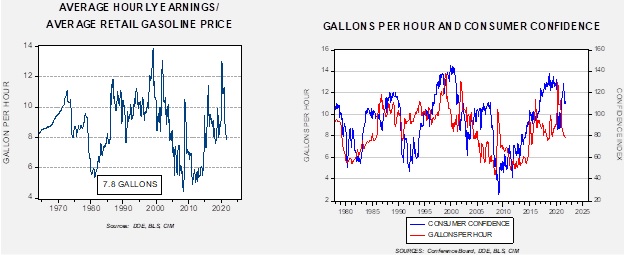
Gasoline prices are politically sensitive; our preferred way to look at gasoline is by comparing prices to wages for non-supervisory workers.  Specifically, we like to look at how many gallons of gasoline a worker can purchase with one hour’s wages.

Although the price of gasoline has increased recently, so have hourly wages.  Currently, a worker can purchase 7.8 gallons at the hourly wage.  That is a bit below the long-term average of 8.6 gallons but still not unusually low.  On the above chart, the right side shows there is a relationship between this measure of gasoline prices and consumer confidence.  In general, if workers can buy more fuel for an hour of work, confidence tends to improve.  Overall, if the ratio of gasoline and wages continues to fall, we would expect lower future confidence readings.  However, the recent decline in oil prices will likely bring lower gasoline prices.  We assume wage growth will remain strong, which should support higher confidence levels.

Market news:

Geopolitical news:

  • The most important geopolitical news is that the U.S. and Iran are entering indirect talks about restoring the JCPOA.  Iran has made its opening requirement a removal of sanctionsAli Bagheri Kani is the lead negotiator.  He is a hardliner, setting a harsh tone to the discussions.  The U.S. wants Iran to return to the agreement’s restrictions on its nuclear activities, which is unlikely.  The stance Iran has taken will put the Biden administration in a bind.  Iran is unpopular in the U.S.  The U.S. administration would need to use political capital to return to the agreement.  Given the legislative agenda, there isn’t much room to use its influence on this issue.  At the same time, if the talks fail, it will tend to be modestly bullish for crude oil prices.  Our take is that the recent decline in oil prices will likely undermine the chances of a return to the JCPOA, and the other legislative goals of the administration will probably mean that President Biden won’t expend the effort to bring a new agreement.  Nevertheless, Iran has no guarantee that a future administration wouldn’t leave a new deal anyway.  We don’t expect success.
    • If the talks fail, we expect Israel to increase hostile acts against Iran.  In the short run, this will likely be cyber-attacks and assassinations, but if Iran demonstrates it can build a nuclear weapon, direct military action is possible.
  • Iran has moved to repress protests over water rights.

Alternative energy/policy news:

  View PDF

Asset Allocation Weekly – An Update on Gold (December 3, 2021)

by the Asset Allocation Committee | PDF

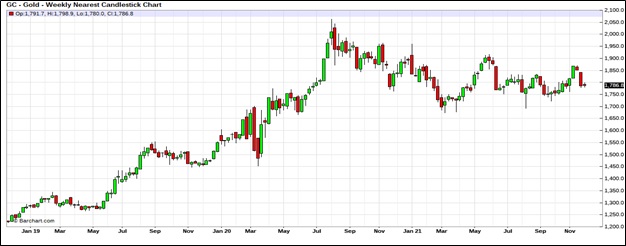
Gold moved steadily higher from the late summer of 2018 into August 2020.  Prices then declined toward 1,700 and have since traced out a trading range between 1,700 and 1,900.  In this report, we will update our views on the metal.

(Source: Barchart.com)

We have been holding gold in our asset allocation portfolios since 2018, although we have diversified our commodity holdings by adding a broader commodity ETF alongside our gold position.

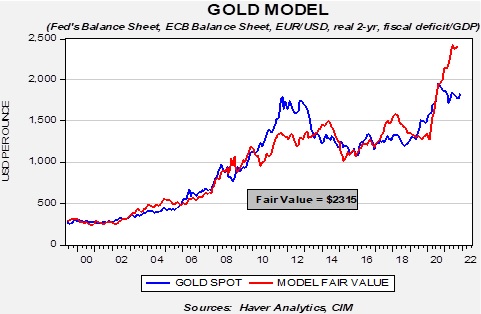
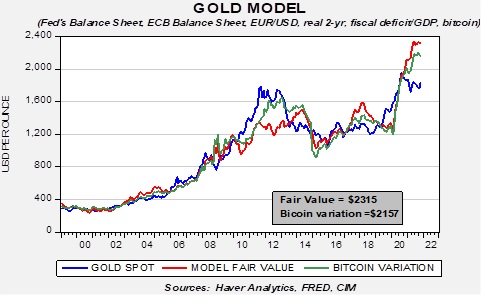
The long-term outlook for gold remains positive.  Our basic gold model, which uses the balance sheets of the Federal Reserve and the European Central Bank, the EUR/USD exchange rate, the real two-year T-note yields, along with the U.S. fiscal deficit relative to GDP, suggests prices remain undervalued.

Gold prices started deviating from the model around July 2020.  When a model starts to “go wrong,” it makes sense to see if something has changed.

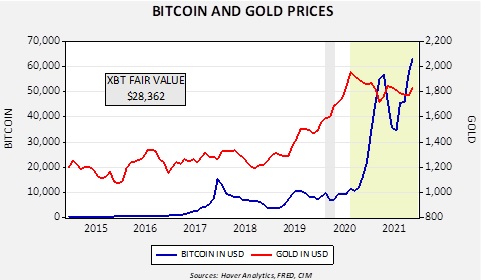
We noted earlier this year that in August 2020, the correlation between bitcoin and gold “flipped” from positive to negative.

Cryptocurrencies share a similar characteristic with gold; they both provide a store of value.  They are somewhat positively correlated since 2015 (+66%) but beginning in August 2020 (shown in light green on the chart), gold and bitcoin are inversely correlated to the tune of 83.7%.  This change of sign suggests that the two are now seen as competing products.

Through some data adjustments, we added bitcoin to the base model for gold.  The results still suggest gold is undervalued but is less so compared to the base model.

The bitcoin’s coefficient sign is negative, suggesting that falling bitcoin prices would be bullish for gold prices.  The other takeaway from the model is that even with the addition of bitcoin, gold is attractive at current levels.  Given the risk of a regulatory crackdown on bitcoin, there is a risk that bitcoin prices could decline, which should be supportive of gold.

View PDF

Weekly Energy Update (December 2, 2021)

by Bill O’Grady, Thomas Wash, and Patrick Fearon-Hernandez, CFA | PDF

Oil prices fell sharply on SPR sales and due to the Omicron variant of COVID-19.

(Source: Barchart.com)

Crude oil inventories fell 0.9 mb compared to a 1.4 mb build forecast.  The SPR declined 1.9 mb, meaning the net draw was 2.9 mb (due to rounding).

In the details, U.S. crude oil production rose 0.1 mbpd to 11.6 mbpd.  Exports and imports both rose 0.1 mbpd.  Refining activity rose 0.2%.  This build season usually ends in mid-November.

(Sources: DOE, CIM)

This chart shows the seasonal pattern for crude oil inventories.  As we head into December, inventories usually decline.  Note that stocks are significantly below the usual seasonal trough.  Our seasonal deficit is 71.9 mb.

Based on our oil inventory/price model, fair value is $63.81; using the euro/price model, fair value is $54.68.  The combined model, a broader analysis of the oil price, generates a fair value of $58.67.  The recent decline in oil prices has brought the market closer to fair value.  To generate a larger rally, we would either need to see falling stockpiles, which will be hard during conditions of SPR sales, or dollar weakness.  The dollar’s strength has surprised us, but as long as worries about inflation remain elevated, it is unlikely policymakers will try to push the greenback lower.

Gasoline prices are politically sensitive; our preferred way to look at gasoline is by comparing prices to wages for non-supervisory workers.  Specifically, we like to look at how many gallons of gasoline a worker can purchase with one hour’s wages.

Although the price of gasoline has increased recently, so have hourly wages.  Currently, a worker can purchase 7.8 gallons at the hourly wage.  That is a bit below the long-term average of 8.6 gallons but still not unusually low.  On the above chart, the right side shows there is a relationship between this measure of gasoline prices and consumer confidence.  In general, if workers can buy more fuel for an hour of work, confidence tends to improve.  Overall, if the ratio of gasoline and wages continues to fall, we would expect lower future confidence readings.  However, the recent decline in oil prices will likely bring lower gasoline prices.  We assume wage growth will remain strong, which should support higher confidence levels.

Market news:

Geopolitical news:

  • The most important geopolitical news is that the U.S. and Iran are entering indirect talks about restoring the JCPOA.  Iran has made its opening requirement a removal of sanctionsAli Bagheri Kani is the lead negotiator.  He is a hardliner, setting a harsh tone to the discussions.  The U.S. wants Iran to return to the agreement’s restrictions on its nuclear activities, which is unlikely.  The stance Iran has taken will put the Biden administration in a bind.  Iran is unpopular in the U.S.  The U.S. administration would need to use political capital to return to the agreement.  Given the legislative agenda, there isn’t much room to use its influence on this issue.  At the same time, if the talks fail, it will tend to be modestly bullish for crude oil prices.  Our take is that the recent decline in oil prices will likely undermine the chances of a return to the JCPOA, and the other legislative goals of the administration will probably mean that President Biden won’t expend the effort to bring a new agreement.  Nevertheless, Iran has no guarantee that a future administration wouldn’t leave a new deal anyway.  We don’t expect success.
    • If the talks fail, we expect Israel to increase hostile acts against Iran.  In the short run, this will likely be cyber-attacks and assassinations, but if Iran demonstrates it can build a nuclear weapon, direct military action is possible.
  • Iran has moved to repress protests over water rights.

Alternative energy/policy news:

  View PDF

Business Cycle Report (November 30, 2021)

by Thomas Wash | PDF

The business cycle has a major impact on financial markets; recessions usually accompany bear markets in equities.  The intention of this report is to keep our readers apprised of the potential for recession, updated on a monthly basis.  Although it isn’t the final word on our views about recession, it is part of our process in signaling the potential for a downturn.

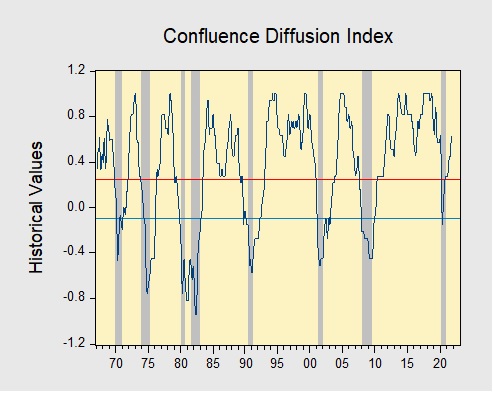
 In October, the diffusion index rose further above the recession indicator, signaling that the recovery continues. In the financial markets, strong earnings boosted equities, while higher inflation led to a sell-off in Treasuries. Meanwhile, construction and manufacturing activity slowed as material costs and labor shortages have hindered production. Lastly, the labor market has shown clear signs of improvement, as firms have ramped up hiring throughout the country. That being said, ten out of the 11 indicators are in expansion territory. The diffusion index rose from +0.5364 to +0.6364, remaining well above the recession signal of +0.2500.

The chart above shows the Confluence Diffusion Index. It uses a three-month moving average of 11 leading indicators to track the state of the business cycle. The red line signals when the business cycle is headed toward a contraction, while the blue line signals when the business cycle is headed toward a recovery. On average, the diffusion index is currently providing about six months of lead time for a contraction and five months of lead time for a recovery. Continue reading for a more in-depth understanding of how the indicators are performing and refer to our Glossary of Charts at the back of this report for a description of each chart and what it measures. A chart title listed in red indicates that indicator is signaling recession.

Read the full report

Asset Allocation Weekly – The Composition of the FOMC (November 19, 2021)

by the Asset Allocation Committee | PDF

(NB:  Due to the Thanksgiving holiday, the next report will be published on December 3.)

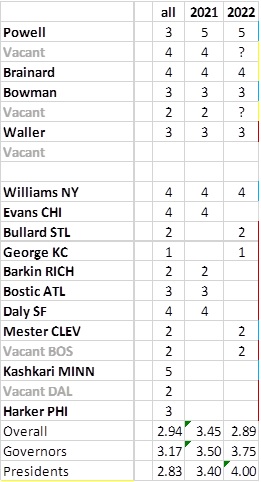
The FOMC now has at least three vacant governor positions and two regional bank president positions.  There is one vacancy that remains from the Trump administration.  Richard Clarida’s vice-chair position expires in January.  And, this week, Governor Quarles, who was vice-chair for supervision, announced he would be resigning at the end of the year.  Quarles’s term as governor extended to 2032, but it is customary for chairs and vice-chairs to resign if they are not reappointed to their positions.  This custom exists to avoid the uncomfortable situation where a former chair or vice-chair would be on the board under a different regime.  It’s a bit like the idea that former managers shouldn’t stay in the dugout.

(Source:  CIM)

On the above table, the top seven are governors and vote every meeting.  The bottom 12 are regional presidents, who vote every three years, with the exception of the NY FRB president, who is also a permanent voter.  This table shows the FOMC with our current estimate of policy stance, with 1 being most hawkish and 5 most dovish.  We average the entire FOMC in the “all” column; the estimate is based on this year’s voting members and next year’s roster.  The gray names are vacancies.  Assuming Powell is renominated (which isn’t a certainty), there are three governor seats to fill.  Until those seats are filled, the FOMC is going to have a hawkish tilt compared to 2021.  Although we believe the Fed won’t raise rates before tapering is complete, if these three vacancies aren’t filled by mid-2022, Chair Powell could face a recalcitrant committee, one where dissents will be more likely.

Regarding the vacant president positions, regional Fed banks consistently tend to appoint the same types to these roles.  After all, they are appointed by local boards of directors, which tend to be composed of similar characters.  There have been proposals to require Senate approval for regional Fed bank presidents—although we don’t expect that to occur, the mere idea will likely encourage the regional Fed bank boards in Boston and Dallas to select moderates.

So, who will get the open governor slots?  The past few years have shown that the Senate won’t approve an unorthodox candidate.  President Trump tried to pick a few—Judy Shelton, Herman Cain, Stephen Moore, and Marvin Goodfriend—who didn’t make it through the nomination process.  Each held an unorthodox position.  Shelton seemed to want a gold standard, Cain held some rather odd fiscal positions, Moore was a libertarian supply-sider, and Goodfriend supported negative nominal interest rates.  The only successful candidate Trump selected as a new governor was Christopher Waller, who was the lead economist at the St. Louis FRB.

The lesson here is that the Senate prefers orthodoxy.  Here are some names we would expect to be considered: Jason Furman, Jared Bernstein, Sarah Bloom Raskin, Neel Kashkari, and Raphael Bostic.  Furman is considered a centrist and was a chair of the Council of Economic Advisers (CEA) under President Obama.  Bernstein was an economic advisor to then Vice President Biden and is currently a member of the CEA.  Raskin is a former governor and should be easy to approve.  Kashkari, currently the president of the Minneapolis FRB, would be a reliable dove.  Bostic is also well regarded and the president of the Atlanta FRB. The bottom line is that although these names would likely lean dovish, they don’t harbor positions that would be so unorthodox as to unsettle Senate members.  At the same time, Bernstein has opined that the dollar’s reserve currency status is, on balance, negative for the economy, which is controversial.  Kashkari wants higher bank capital requirements, which would not be popular with banks.

Although there are other names that would delight the progressives—Claudia Sahm and Stephanie Kelton—these nominations would be considered too radical, in our opinion, to pass the Senate.  Given the makeup of the FOMC in 2022, the president needs to move quickly to fill the governor roles or face a more hawkish Fed.

View PDF