

Weekly Energy Update (June 17, 2021)

by Bill O’Grady, Thomas Wash, and Patrick Fearon-Hernandez, CFA | PDF

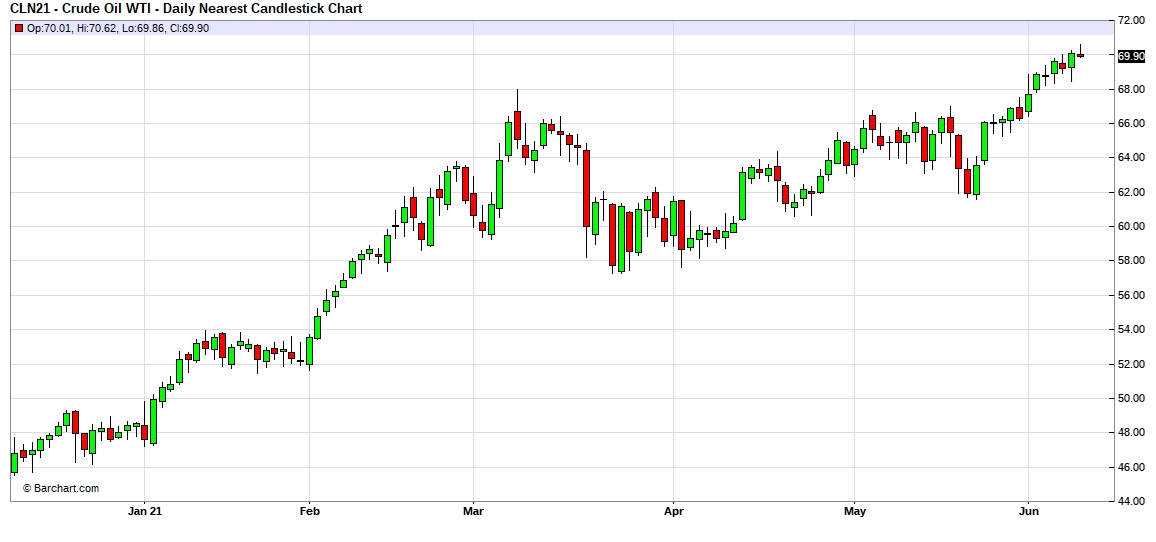
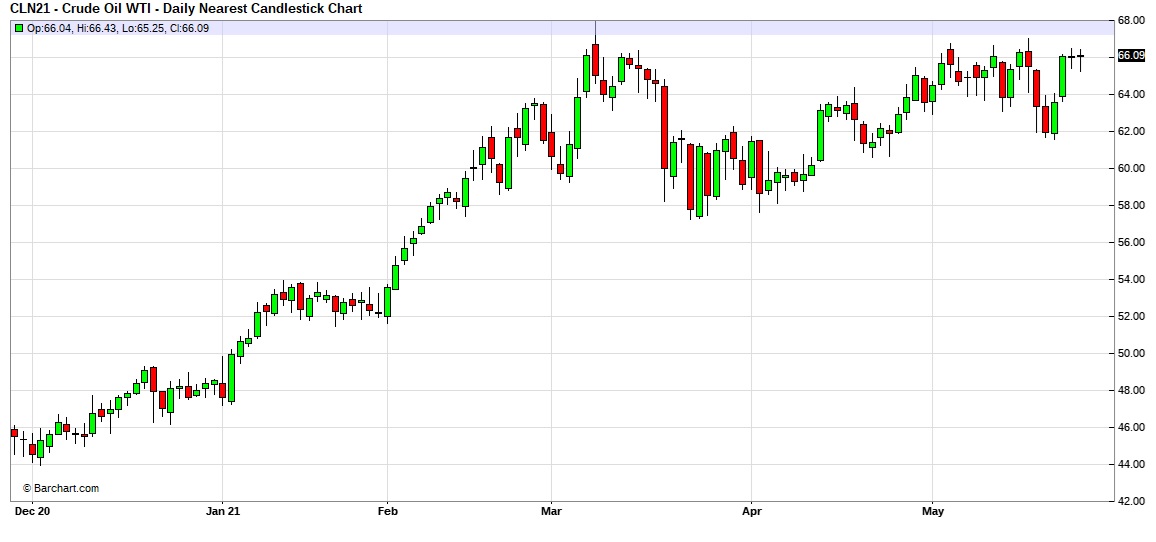
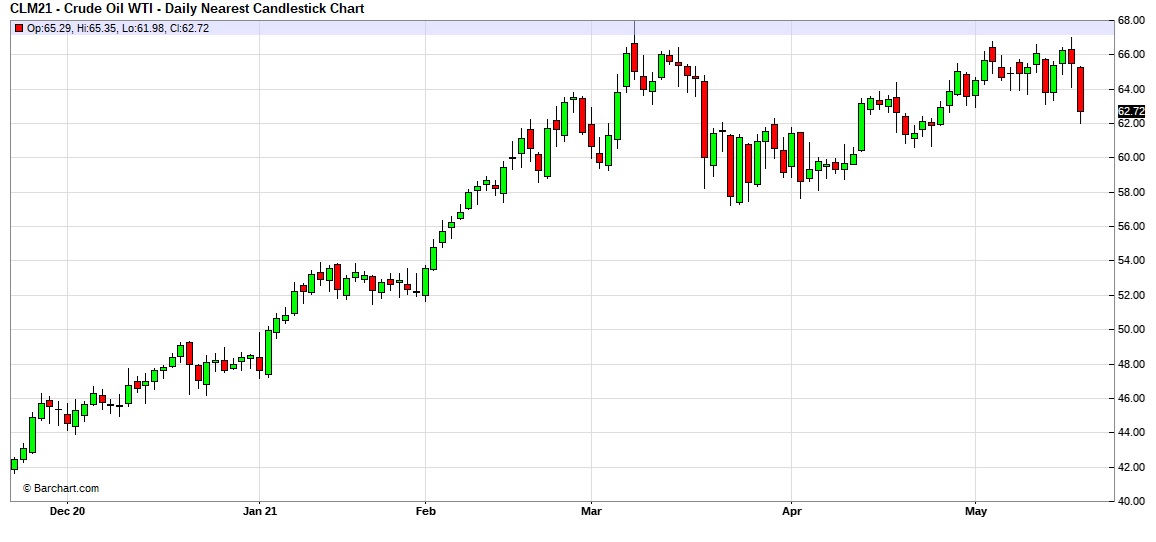
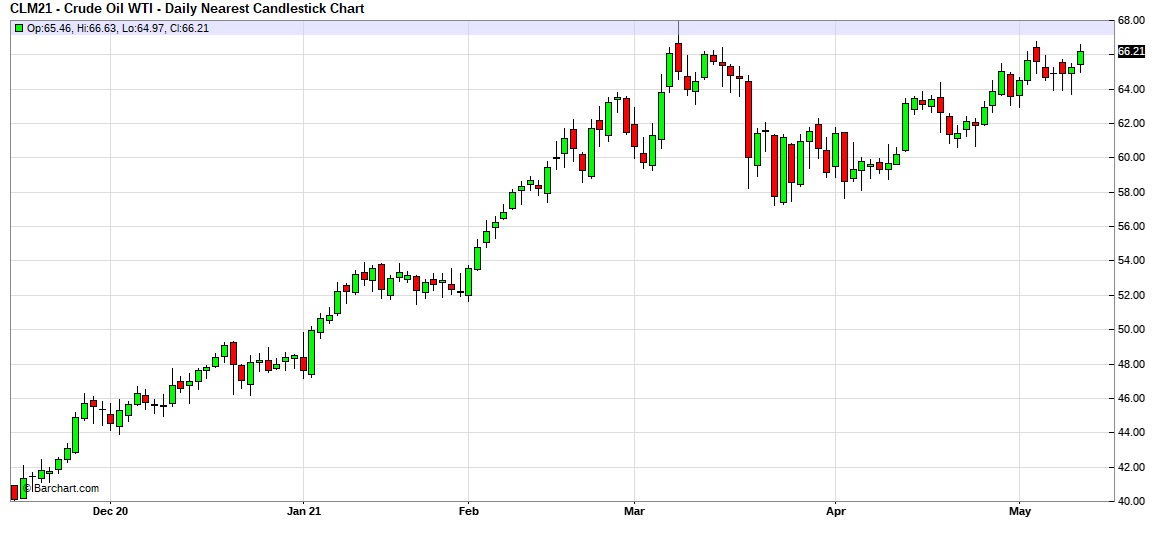
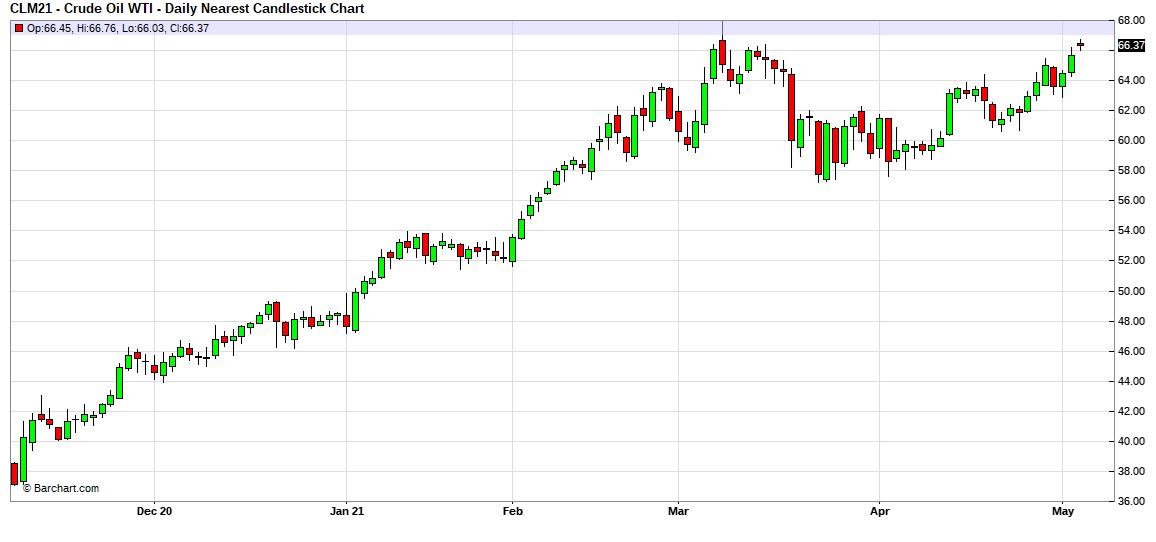
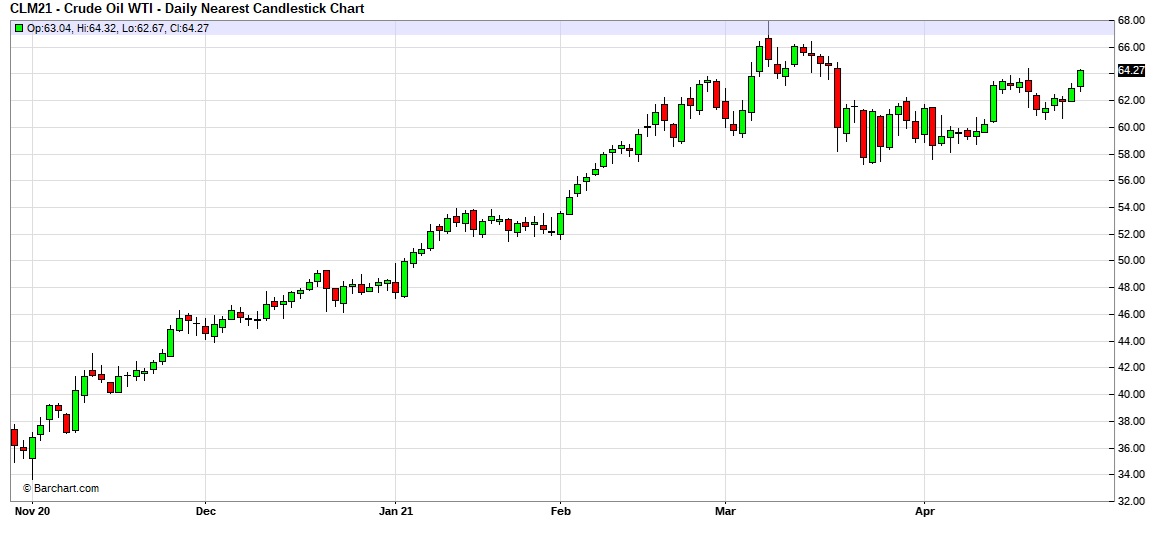
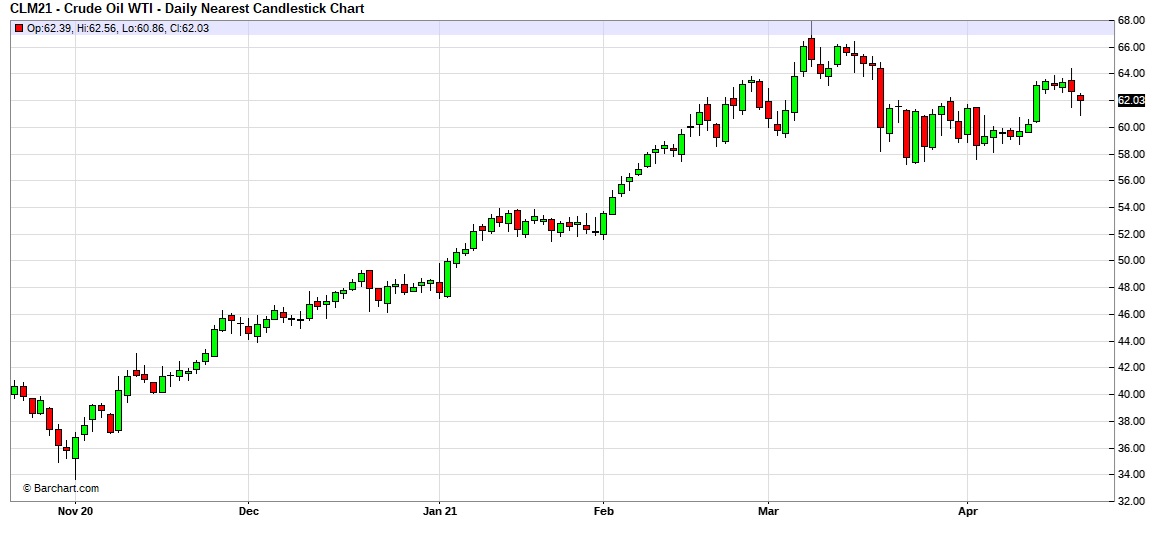
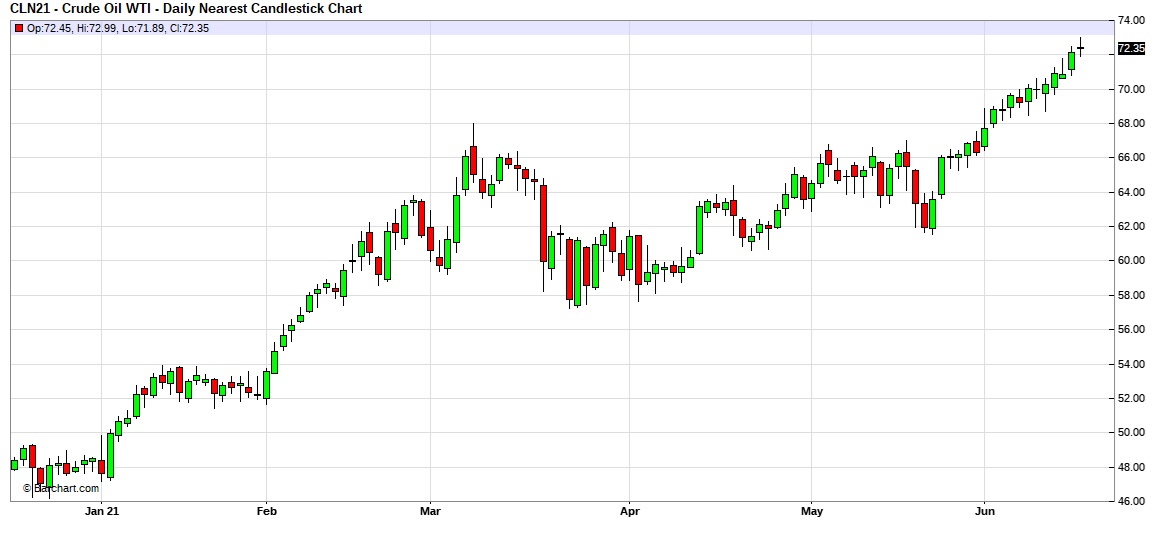
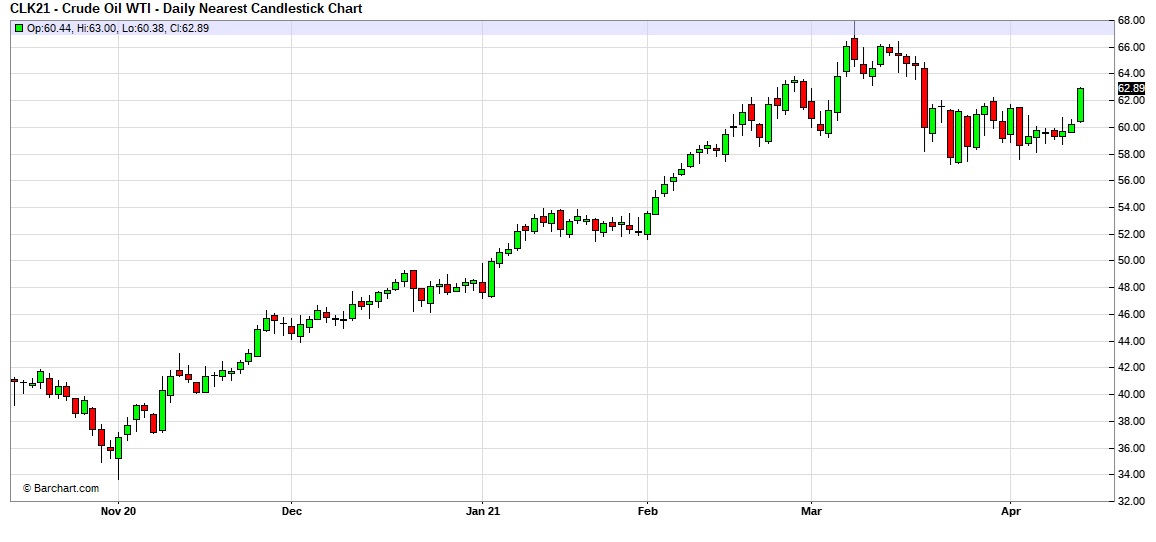
Oil prices are moving steadily higher in an orderly fashion.
(Source: Barchart.com)

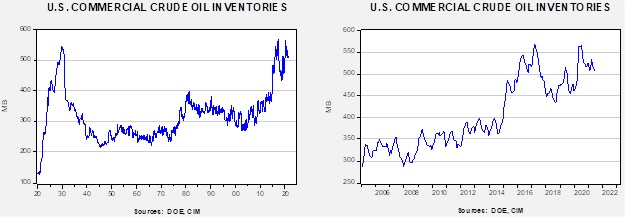
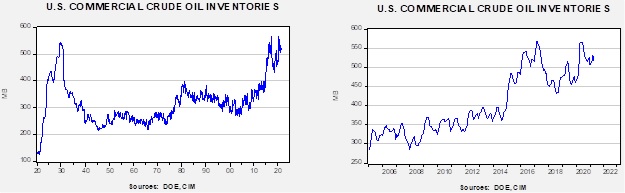
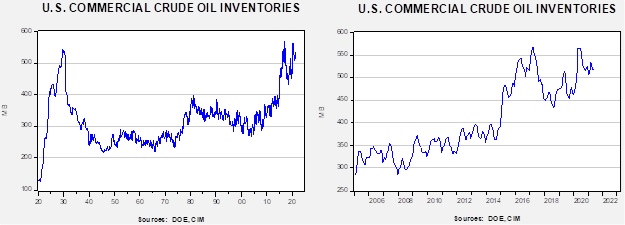
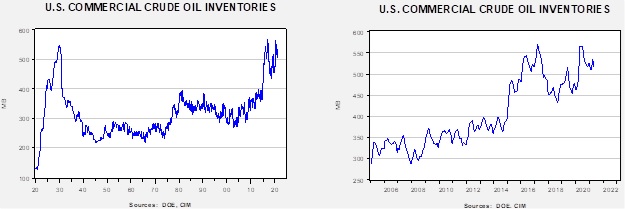
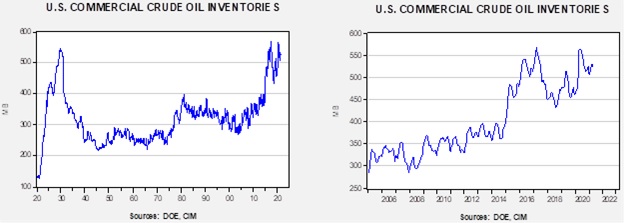
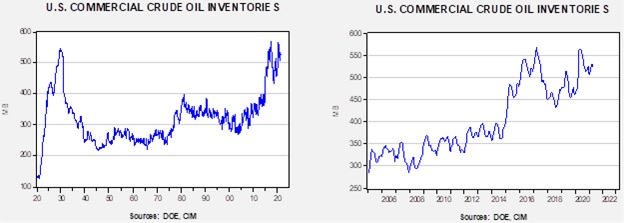
Crude oil inventories fell 7.4 mb compared to the 2.0 mb draw expected.  The SPR fell 0.9 mb, meaning without the addition from the reserve, commercial inventories would have declined 8.2 mb.  We note the SPR is at its lowest level since October 2003.
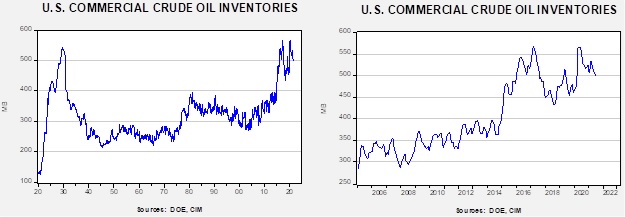
In the details, U.S. crude oil production rose 0.2 mbpd to 11.2 mbpd.  Exports rose 1.0 mbpd, while imports rose 0.1 mb.  Refining activity continued to rise, increasing 1.3%, exceeding expectations by 0.9%.  The rise in product inventories was due to an increase in refining.
(Sources: DOE, CIM)

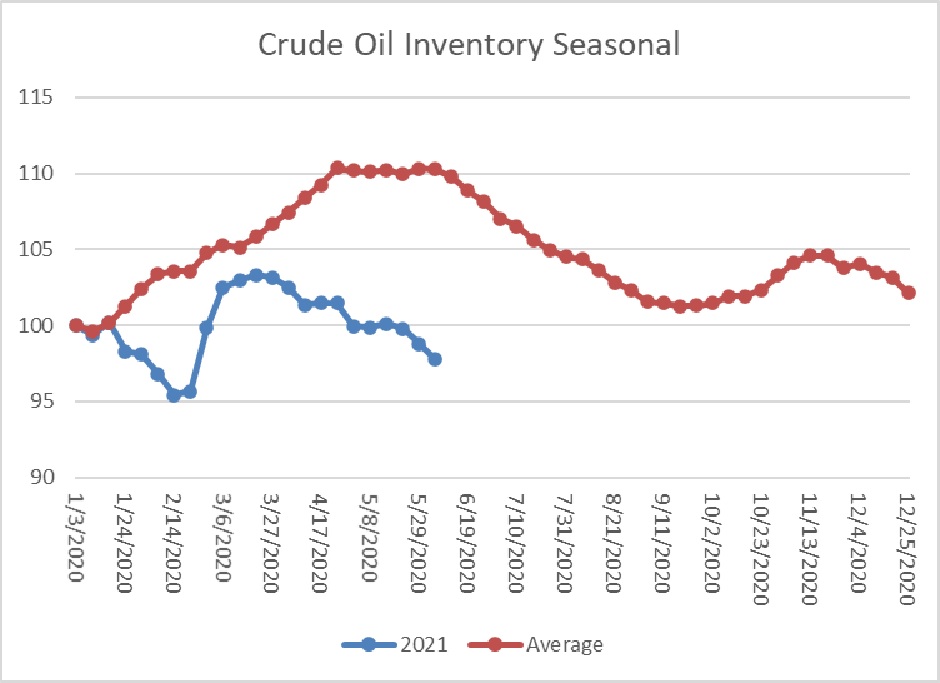
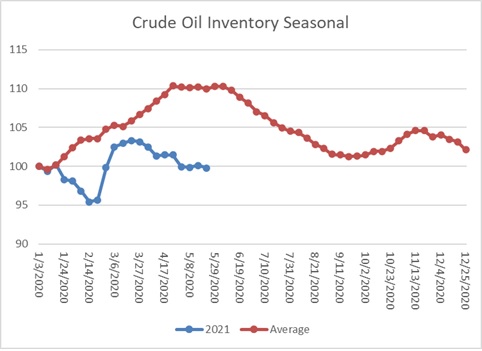
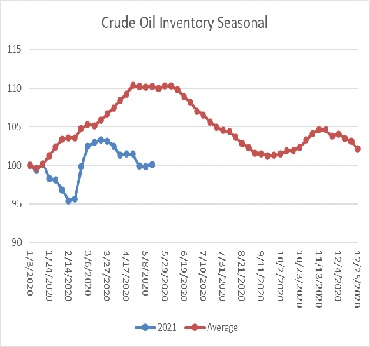
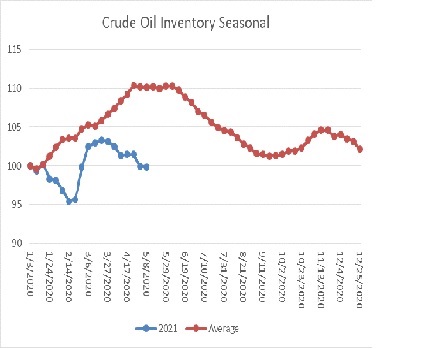
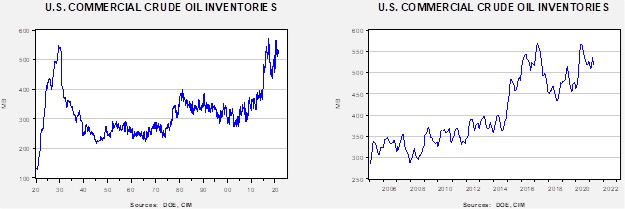
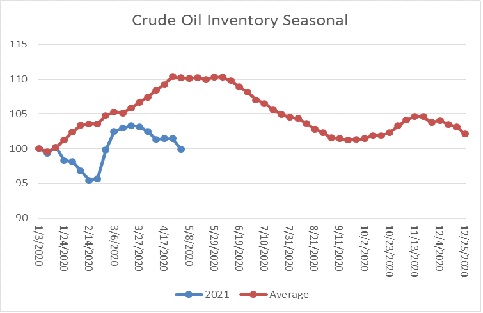
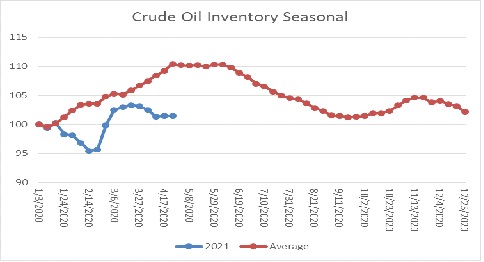
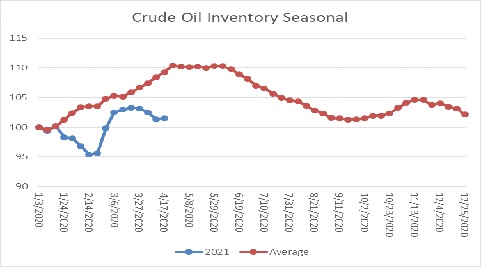
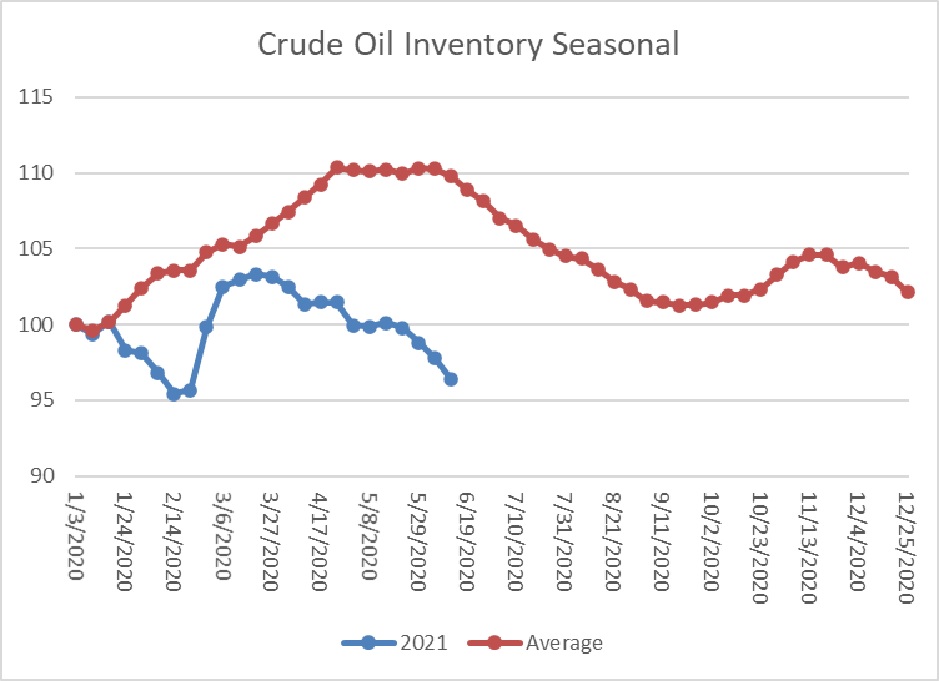
This chart shows the seasonal pattern for crude oil inventories.  We are beginning the summer withdrawal season.  Note that stocks are already below the usual seasonal trough seen in early September.  A normal seasonal decline would result in inventories around 465 mb.  Our seasonal deficit is 69.3 mb.
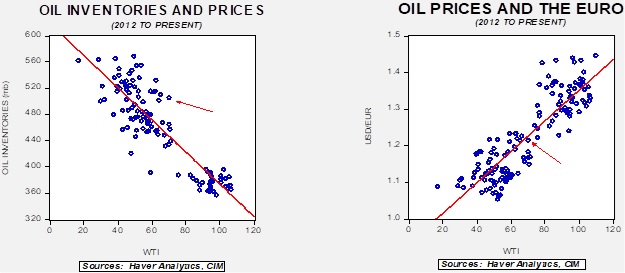
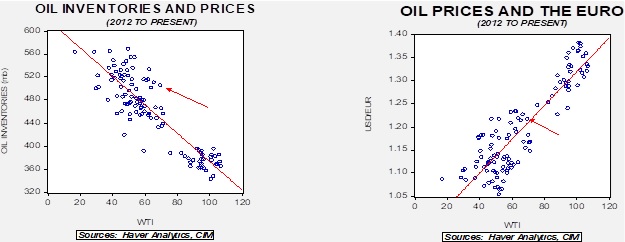
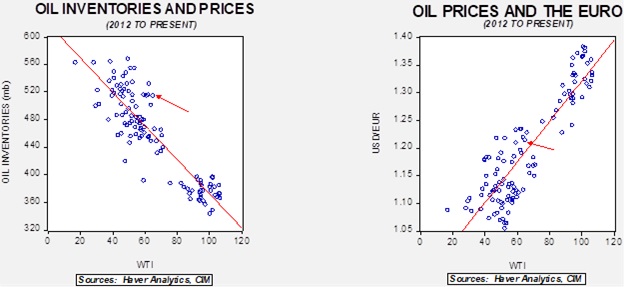
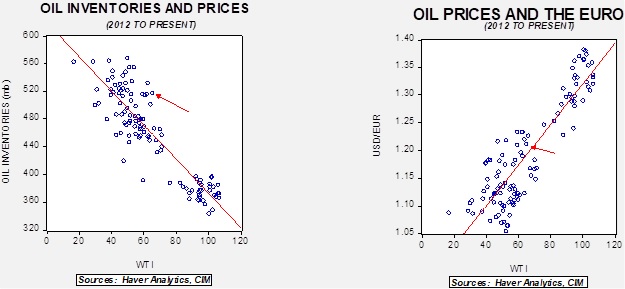
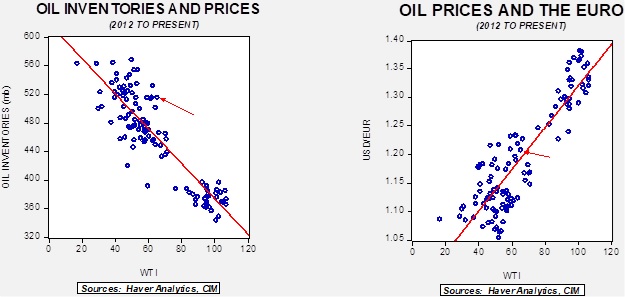
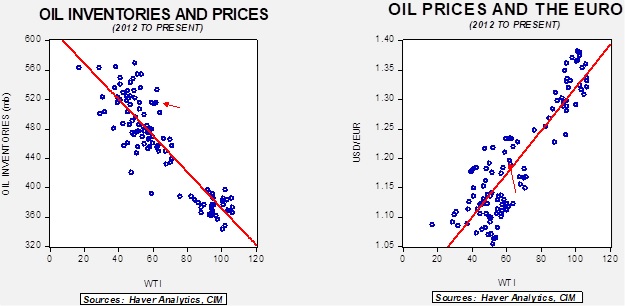
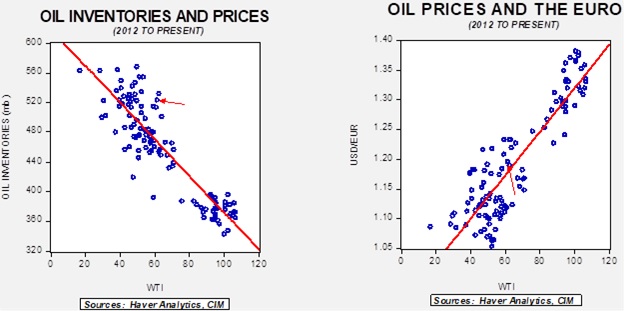
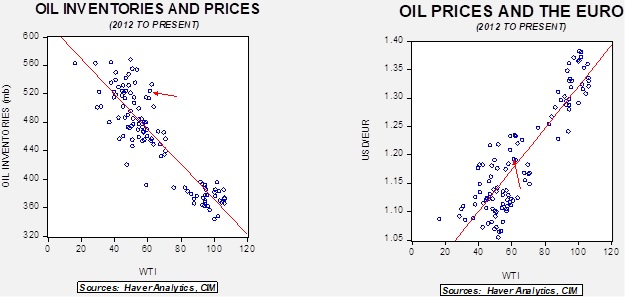
Based on our oil inventory/price model, fair value is $52.64; using the euro/price model, fair value is $70.16.  The combined model, a broader analysis of the oil price, generates a fair value of $61.12.  Oil prices are still “rich” relative to inventory levels but are in line with the dollar’s level.

Market news:

Geopolitical news:

Alternative energy/policy news:

View PDF

Weekly Energy Update (June 10, 2021)

by Bill O’Grady, Thomas Wash, and Patrick Fearon-Hernandez, CFA | PDF

Oil prices have moved above the $60 to $68 per barrel trading range and are testing $70 per barrel.

(Source: Barchart.com)

Crude oil inventories fell 5.2 mb compared to the 3.3 mb draw expected.  The SPR fell 1.3 mb, meaning without the addition from the reserve, commercial inventories would have declined 6.5 mb.

In the details, U.S. crude oil production rose 0.2 mbpd to 11.0 mbpd.  Exports rose 0.4 mbpd while imports rose 1.0 mb.  Refining activity jumped 2.6%, which accounts for the rise in product inventories.

(Sources: DOE, CIM)

This chart shows the seasonal pattern for crude oil inventories.  We are beginning the summer withdrawal season.  Note that stocks are already below the usual seasonal trough seen in early September.  A normal seasonal decline would result in inventories around 465 mb.  Our seasonal deficit is 64.4 mb.

Based on our oil inventory/price model, fair value is $50.31; using the euro/price model, fair value is $69.15.  The combined model, a broader analysis of the oil price, generates a fair value of $60.16.  Oil prices are outpacing inventory levels but are in line with the dollar’s decline.

Market news:

Geopolitical news:

Alternative energy/policy news:

View PDF

Weekly Energy Update (May 27, 2021)

by Bill O’Grady, Thomas Wash, and Patrick Fearon-Hernandez, CFA | PDF

(Due to staff vacation schedules, the next report will be published on June 10.)

 Oil prices continue to trade in a range from $60 to $68 per barrel.

(Source: Barchart.com)

Crude oil inventories fell 1.7 mb compared to the 1.0 mb draw expected.  The SPR fell 1.6 mb, meaning without the addition from the reserve, commercial inventories would have declined 2.3 mb.

In the details, U.S. crude oil production was steady at 11.0 mbpd.  Exports rose 1.5 mbpd while imports rose 0.9 mb.  Refining activity rose 0.2%.

(Sources: DOE, CIM)

This chart shows the seasonal pattern for crude oil inventories.  We are through the peak of the winter/early spring build season.  In the second half of June, stockpiles usually decline.  Note that stocks are already below the usual seasonal trough seen in early September.  Our seasonal deficit is 51.7 mb.

Based on our oil inventory/price model, fair value is $46.78; using the euro/price model, fair value is $69.77.  The combined model, a broader analysis of the oil price, generates a fair value of $57.58.  Although the slow decline in stockpiles is price supportive, the weakening dollar is much more important in lifting the model’s fair value.

Market news:

Geopolitical news:

Alternative energy/policy news:

View PDF

Weekly Energy Update (May 20, 2021)

by Bill O’Grady, Thomas Wash, and Patrick Fearon-Hernandez, CFA | PDF

Oil prices continue to trade in a range from $58 to $68 per barrel.

(Source: Barchart.com)

Crude oil inventories rose 1.3 mb compared to the 2.0 mb build expected.  The SPR fell 1.9 mb, meaning without the addition from the reserve, commercial inventories would have declined 0.6 mb.

In the details, U.S. crude oil production was steady at 11.0 mbpd.  Exports rose 1.5 mbpd while imports rose 0.9 mb.  Refining activity rose 0.2%.

(Sources: DOE, CIM)

This chart shows the seasonal pattern for crude oil inventories.  We are through the peak of the winter/early spring build season.  In the second half of June, stockpiles usually decline.  Note that stocks are already below the usual seasonal trough seen in early September.  Our seasonal deficit is 53.1 mb.

Based on our oil inventory/price model, fair value is $46.24; using the euro/price model, fair value is $69.19.  The combined model, a broader analysis of the oil price, generates a fair value of $56.99.  Although the slow decline in stockpiles is price supportive, the weakening dollar is much more important in lifting the model’s fair value.

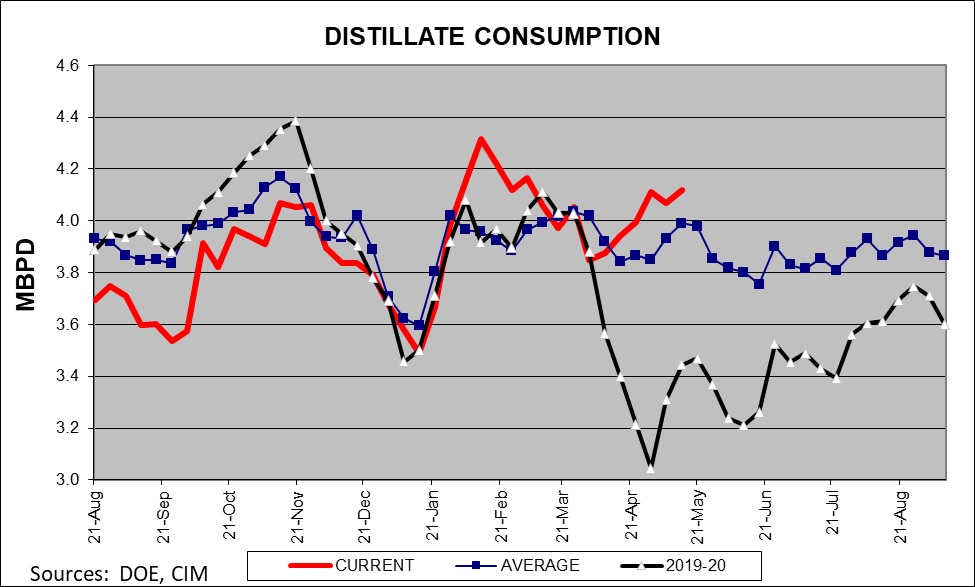
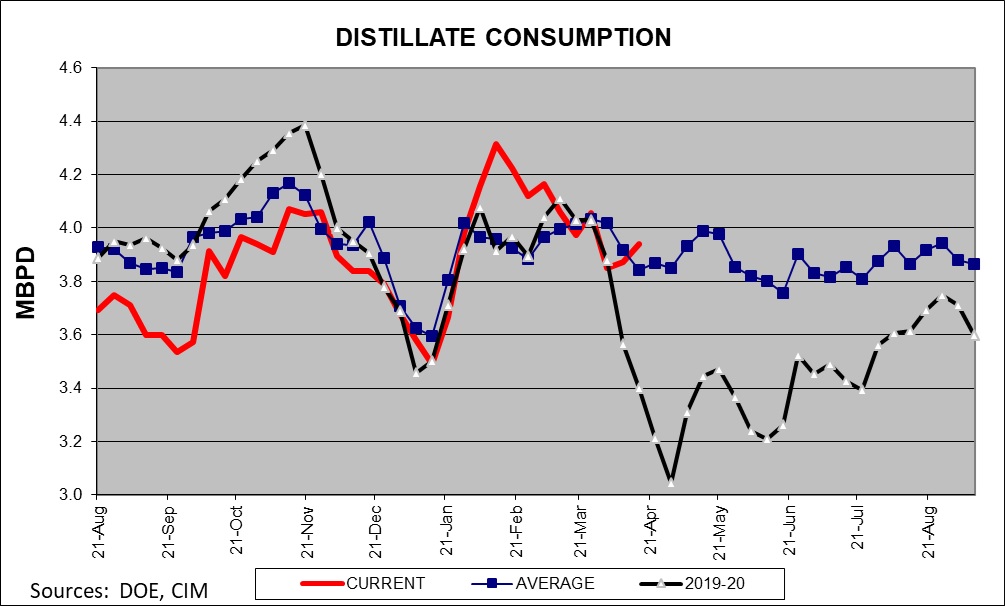
As the economy recovers, distillate demand is accelerating.

Market news:

Geopolitical news:

  • In a surprising development, the U.S. has decided to waive sanctions on the company and CEO involved in the Nord Stream 2 project.  The U.S. has been warning for months that it didn’t want to see the pipeline completed and was preparing to implement sanctions if the program wasn’t halted.  The Biden administration even appointed a special envoy to the project.  Instead, the administration will sanction the actual vessels involved but spare the CEO of the project, a former Stasi member who has close ties to Vladimir Putin, from direct sanctions.
    • The administration’s caving on this issue is remarkable.  First, it’s a major win for Russia.  The pipeline will allow Russia to bypass pipelines in Ukraine, removing a chokepoint for natural gas sales.  Second, although it protects Germany from Ukrainian disruptions, it makes Berlin more dependent on Russian energy.  The U.S. has wanted to sell LNG to Europe so completing the pipeline will reduce demand for American gas.  Third, it adds to fears in Eastern Europe that Germany is allying with Russia to their detriment.  Fourth, it makes the U.S. complicit in isolating Eastern Europe.
    • We suspect the administration wanted to curry favor with the Merkel government.  If so, this decision appears short-sighted.  Germany is holding national elections in September.  The Greens, who lead in current polls, oppose Nord Stream 2.  Therefore, if the administration had simply waited, it would likely have had a German government more aligned with its interests.
    • It is possible the Biden administration may rethink this position.  In other words, this action may be a trial balloon.  However, if the U.S. maintains this decision, it appears to us to be giving a major win to Russia, who, by the way, has provided support for the hackers who recently struck the Colonial pipeline.
  • Russia is facing carbon taxes on its energy exports to Europe; EU energy consumers are starting to complain.
  • As the Biden administration moves to return to the Iran nuclear deal, it is important to remember that the Obama administration considered it an intermediate step to establishing Iran as the regional hegemon.  It is also important to note that Iran, even in its current economic turmoil, spends an estimated $15 billion to $20 billion per year supporting its proxies in the region.  If sanctions are lifted, it will support the activities of its proxies.
  • The Maduro government has closed the last independent newspaper in Venezuela.

Alternative energy/policy news:

  • The Supreme Court gave a victory to the oil and gas industry this week.  The city of Baltimore has sued 20 major companies over climate change and wanted to try the case in Maryland’s state courts.  The highest court agreed with the industry that a more appropriate venue would be Federal courts.
  • To meet carbon stabilization, it is generally thought that carbon reduction will likely be necessary.  This process can be as simple as planting trees or as sophisticated as factories that pull CO2 out of the air.
  • One of the problems with solar and wind energy is that it is interrupted.  At sundown, or if the wind doesn’t blow, power is removed.  So far, the solution has been to have natural gas turbines that can be fired up when renewable energy is not available.  However, there is increasing investment in batteries that will store electricity during the daytime and when there is wind and discharge it when solar energy and wind energy are lacking.  If this becomes a trend, it will be a serious threat to natural gas demand.
  • Another element of using less carbon is the electrifying of the economy.
  • Although EVs continue to dominate the movement away from gasoline and diesel, hydrogen is still an alternative.

View PDF

Weekly Energy Update (May 13, 2021)

by Bill O’Grady, Thomas Wash, and Patrick Fearon-Hernandez, CFA | PDF

Tightening supplies have lifted crude oil prices toward the top of the recent trading range.

(Source: Barchart.com)

Crude oil inventories declined 0.4 mb compared to the 1.8 mb build expected.  The SPR fell 1.4 mb, meaning without the addition from the reserve, commercial inventories would have declined 1.8 mb.

In the details, U.S. crude oil production rose 0.1 mbpd to 11.0 mbpd.  Exports fell 2.3 mbpd while imports were unchanged.  Refining activity declined 0.4 mbpd.

(Sources: DOE, CIM)

This chart shows the seasonal pattern for crude oil inventories.  We are through the peak of the winter/early spring build season.  In the second half of June, stockpiles usually decline.  Note that stocks are already below the usual seasonal trough seen in early September.  Our seasonal deficit is 52.6 mb.

Based on our oil inventory/price model, fair value is $46.65; using the euro/price model, fair value is $68.54.  The combined model, a broader analysis of the oil price, generates a fair value of $56.86.  Although the slow decline in stockpiles is price supportive, the weakening dollar is much more important in lifting the model’s fair value.

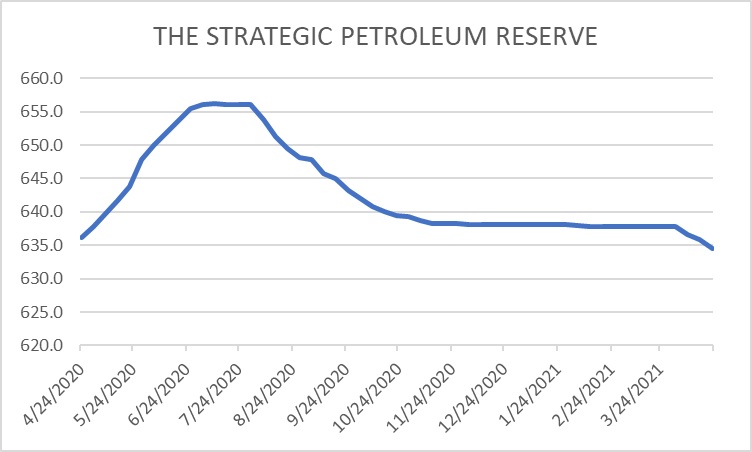
The DOE is continuing to reduce the SPR.

(Source:  DOE, CIM)

This action is a bearish factor for prices, but the gradual nature of the sale has not had much of an effect thus far.  We expect another 7.0 mb of sales to occur this year.

Market news:

(Source:  AP)

Local gasoline prices are rising rapidly.  Meanwhile, government officials are trying other forms of transportation to move the product to markets facing shortages.  This situation will affect the energy data for the rest of May.

  • Michigan is threatening to close a pipeline that runs from Canada to the U.S.  A portion of the pipeline passes across the Great Lakes, and there are fears a rupture could be catastrophic.  At the same time, the lines have run for over 70 years without incident.  The threat is raising tensions between the U.S. and Canada.  Trade is conducted through the USMCA, and thus, Ottawa may have legal remedies to halt the closure.  Meanwhile, Michigan Gov. Whitmer is threatening to seize profits from Enbridge (ENB, USD, 40.12), the pipeline operator, for continuing to operate the pipeline.  If this situation leads to a disruption, the timing could not be worse, given the turmoil caused by the Colonial pipeline situation.
  • We continue to see news on the Texas freeze-out.  During the crisis, state regulators implemented a program that pays industrial users to reduce their natural gas consumption.  Paradoxically, this led to the curtailment of natural gas as firms involved in the natural gas infrastructure were taken offline.

Geopolitical news:

Alternative energy/policy news:

View PDF

Weekly Energy Update (May 6, 2021)

by Bill O’Grady, Thomas Wash, and Patrick Fearon-Hernandez, CFA | PDF

Tightening supplies have lifted crude oil prices toward the top of the recent trading range.

(Source: Barchart.com)

Crude oil inventories declined 8.0 mb compared to the 2.0 mb draw expected.  The SPR fell 1.0 mb, meaning without the addition from the reserve, commercial inventories would have declined 9.0 mb.

In the details, U.S. crude oil production was steady at 10.9 mbpd.  Exports rose 1.5 mbpd while imports fell 1.2 mbpd.  Refining activity rose 1.1 mbpd.

(Sources: DOE, CIM)

This chart shows the seasonal pattern for crude oil inventories.  We are through the peak of the winter/early spring build season.  In the second half of June, stockpiles usually decline.  Note that stocks are already below the usual seasonal trough seen in early September.  Our seasonal deficit is 53.0 mb.

Based on our oil inventory/price model, fair value is $46.25; using the euro/price model, fair value is $66.02.  The combined model, a broader analysis of the oil price, generates a fair value of $55.09.

Market news:

Geopolitical news:

Alternative energy/policy news:

View PDF

Weekly Energy Update (April 29, 2021)

by Bill O’Grady, Thomas Wash, and Patrick Fearon-Hernandez, CFA | PDF

After the recent rally in prices, the market is consolidating recent gains and establishing a larger trading range between $68 to $58 per barrel.

(Source: Barchart.com)

Crude oil inventories rose 0.1 mb compared to the 1.0 mb draw expected.  The SPR fell 1.4 mb, meaning without the addition from the reserve, commercial inventories would have declined 1.3 mb.

In the details, U.S. crude oil production declined 0.1 mbpd to 10.9 mbpd.  Exports were also unchanged while imports rose 1.4 mbpd.  Refining activity rose 0.4 mbpd.

(Sources: DOE, CIM)

This chart shows the seasonal pattern for crude oil inventories.  We are now at the peak of the winter/early spring build season.  Until the Texas freeze, we were seeing a counterseasonal decline.  This week, stockpiles were mostly steady.  We are currently at a seasonal deficit of 40.6 mb.

Based on our oil inventory/price model, fair value is $43.72; using the euro/price model, fair value is $65.91.  The combined model, a broader analysis of the oil price, generates a fair value of $53.66.

(Sources:  DOE, CIM)

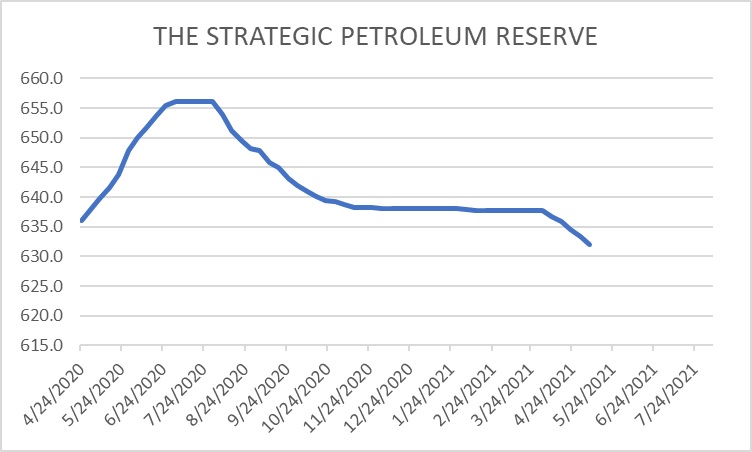
One of the factors that led to last year’s price collapse was the fear the market would run out of storage capacity.  To prevent that outcome, the U.S. purchased around 20 mb of crude oil from late April into early July.  Since peaking at 656.1 mb, the government reduced the SPR to 637.8 mb in February.  It held stocks at that level until three weeks ago when the government began to reduce the SPR again.  We note that current SPR levels are below the level where the pandemic affected the market.  In fact, this week’s reading is the lowest SPR level since 2003.

Congress has mandated a sale of 10 mb this year; so far, they have sold 3.6 mb of that mandate.  We have been a bit surprised at the speed of the sale.  However, it does appear that the plan is to move quickly to meet the mandate.  Longer-term, the SPR poses a problem.  If the U.S. holds on to the oil, and the world moves away from it, the reserve could become a stranded asset, similar to an oil company’s oil reserves when oil isn’t used.  This issue would suggest the government should sell the reserve down before it loses its value.  At the same time, the economy still consumes a significant amount of oil, and having the reserve in place protects the economy from a supply shock.  It is possible that environmentalists would protest the sale of the oil to prevent its consumption from lifting carbon emissions.  Another use could be to contain oil prices if the lack of investment by oil companies curtails supply and lifts the price.  The SPR will bear watching in the coming months; although another 7.4 mb will be sold, what the administration does after that could be important.

Market news:

Geopolitical news:

  • The KSA is planning to sell off additional parts of Saudi Aramco (2222, SAR, 35.80).  Ascertaining the motive for steadily selling off what used to be a strategic asset by the kingdom is not exactly clear.  It could be that CP Salman simply needs the money.  We suspect the KSA realizes the age of oil is coming to a close and, thus, monetizing the country’s biggest asset while it still has value makes sense.
  • CP Salman indicated that he wants to improve ties with Iran.  We have been watching the two nations take tentative steps to reduce tensions.  On the one hand, the KSA and Iran have aspirations to be the dominant regional power.  On the other, as the U.S. begins to back away from the region, these nations will need to figure out how to cope with the resulting power vacuum and may conclude that they will need some degree of cooperation to prevent chaos.
  • Total (TOT, USD, 44.92) declared force majeure on a $20 billion LNG project in Mozambique.  The project and the country have been under attack from Islamic insurgents.  This project is Africa’s largest private investment, and the declaration is a clear setback for the company and the region.
  • A leaked tape in Iran confirms what we have suspected for some time—the Iranian Revolutionary Guard Corps (IRCG) is the real power in the country.  We continue to watch to see if, when Ayatollah Khomeini dies, if the IRGC continues the fiction of the rule by clerics or simply takes power.
  • The U.S. is signaling to Iran that it will consider removing some sanctions to facilitate a return to the Obama-era nuclear deal.  It is unclear if this will be enough to entice Iran to reduce uranium enrichment.

Alternative energy/policy news:

  • Economists generally accept the notion that controlling carbon emissions will be best served by an appropriate carbon price.  Once a price on carbon emissions is put into place, the powerful market mechanism will be triggered, which will lead to society better balancing the need for energy against the adjusted environmental cost.  The market mechanism is efficient in securing outcomes, but its efficiency can be brutal.  One key problem is that the market pays little attention to who bears the burden of the cost, and it is often applied to those least able to handle it.  We note that President Biden’s climate policy says nothing about carbon pricing.  We doubt this isn’t due to economists around him not suggesting it should be part of it; instead, this is likely a political calculation.  So, despite the industry calling for carbon pricing, the president’s plan relies on less efficient mandates.
  • Although improving the power grid in the U.S. is peripherally associated with addressing climate change, the administration has allocated $8.0 billion in its climate package to this goal.  The U.S. electrical grid is substandard.  The Texas experience last winter made that evident.  There has been underinvestment in the grid for years.  If wind power is going to expand, a better grid will be necessary to bring that power from the rural areas where the wind blows to the urban areas where the power needs are the greatest.
    • The administration is also pushing for an expansion of offshore wind projects.  These have a certain allure; if they are over the horizon, no one on land sees them.  Yet, these projects face state regulations and other hurdles.  The administration has been arguing that green projects will spawn high-paying jobs, but that remains to be seen.  In fact, if high labor costs are part of the process, it may reduce the expansion of green energy.
  • The U.S. is considering a European plan to mandate climate risk exposures.  Although disclosures can be a powerful tool, it is also notable that annual reports are full of footnotes that often investors overlook.  It is quite possible that the goal of disclosures is a form of “greenwashing,” which will do little more than admit that there is a climate impact to a company’s activity but little more.
  • A U.N. study is calling for better management of methane leaks from oil and gas projects.  If the industry cannot control such leaks more effectively, it runs the risk of curtailing natural gas production, which, although not completely green, has much lower carbon emissions than other fossil fuels.  This is especially true in China.  Substituting natural gas for coal would have a marked effect on reducing greenhouse gas emissions.  It will need to get that gas from abroad, and if regulation due to methane reduces that supply, we may end up with the continued use of coal.
  • One problem with reducing the use of fossil fuels is that we are moving from dense to less-dense energy sources.  Although efficiency gains in consumption may offset some of this problem, the fact remains that much of the industrial revolution was built on getting more energy out of smaller sources.  One way to overcome this problem would be to apply the world’s most dense energy source, uranium.  We note that the industry has been enjoying a bit of a renaissance as environmentalists rediscover the benefits of nuclear power.

View PDF

Weekly Energy Update (April 22, 2021)

by Bill O’Grady, Thomas Wash, and Patrick Fearon-Hernandez, CFA | PDF

After the recent rally in prices, the market is consolidating recent gains and establishing a larger trading range between $68 to $58 per barrel.

(Source: Barchart.com)

Crude oil inventories rose 0.6 mb compared to the 3.4 mb draw expected.  The SPR fell 0.7 mb, meaning without the addition from the reserve, commercial inventories would have declined 0.1 mb.

In the details, U.S. crude oil production was unchanged at 11.0 mbpd.  Exports were also unchanged while imports fell 0.4 mbpd.  Refining activity was steady.

(Sources: DOE, CIM)

This chart shows the seasonal pattern for crude oil inventories.  We are about two weeks to the end of the winter/early spring build season.  Until the Texas freeze, we were seeing a counterseasonal decline.  This week, stockpiles were mostly steady.  We are currently at a seasonal deficit of 34.9 mb.

Based on our oil inventory/price model, fair value is $43.72; using the euro/price model, fair value is $65.05.  The combined model, a broader analysis of the oil price, generates a fair value of $53.19.

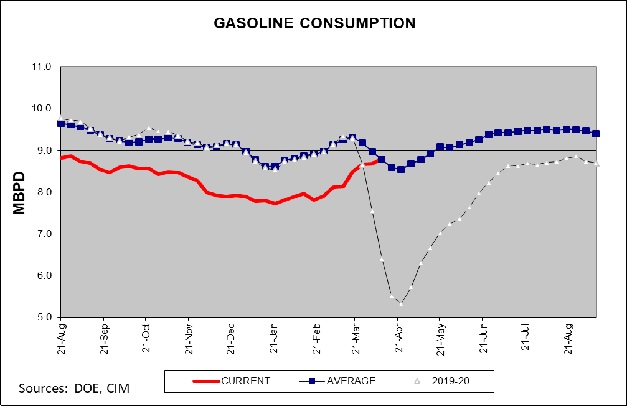
Gasoline consumption is now above the five-year average.

So is distillate demand.

It is also notable that demand is well above last year when the lockdowns were implemented.

Market news:

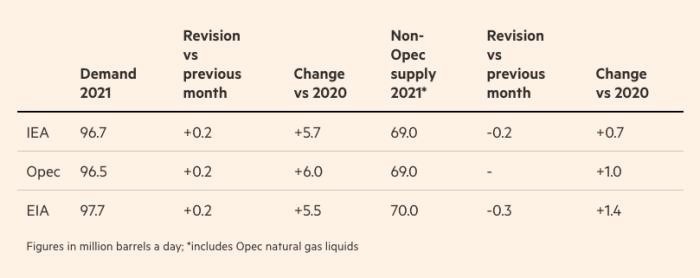
  • The primary forecasters for the oil markets have updated their forecasts.

For the most part, demand is expected to rise compared to last year.

  • One of the themes we have applied to our Asset Allocation has been that the oil and gas industry would be starved for capital due to ESG issues.  And so, the better place to invest isn’t in the industry but in the commodity itself.  Although energy stocks have done well this year, they have not done as well as the commodity overall.  We have further evidence that ESG concerns are affecting capital to the industry.  First, private equity, a source of funding for the industry, is drying up.  Second, the industry faces the problem that changes in demand and regulation could lead to stranded assets.  Therefore, a company with a development project runs the risk that by the time the fields start producing, the demand for that oil may not exist.  Large firms are starting to sell off these projects; smaller firms are taking the chance that the drop in demand may not materialize as soon as expected and are buying up these projects.

Geopolitical news:

Alternative energy/policy news:

  • Exxon (XOM, USD, 55.29) is proposing a $100 billion project to capture carbon among facilities in the Houston area.  Overall, environmental groups tend to oppose these measures, fearing that (a) they won’t work and (b) they encourage hope that society can continue to use fossil fuels and rely on carbon capture.  Despite these concerns, carbon capture technology will likely continue to be studied because it has political potency, and we may need it to control carbon that is removed from the atmosphere.
  • The administration is pushing a “clean jobs initiative” as part of its infrastructure package.
  • After carbon emissions fell last year due to the pandemic closures, emissions are rising rapidly as the economy reopens.  Emissions are set to rise 4.8% this year, the fastest growth since 2010.
  • Although lumber prices have been on a tear, trees have a competing use in absorbing and capturing carbon dioxide.  Carbon markets are offering tree growers an option to cutting down their forests, and some are using the carbon markets to postpone harvesting.  This situation, if it continues, could exacerbate lumber supplies.
  • One of the roles in oil and gas development is the “landman,” a person who scours county records to see who owns the mineral rights to land and then pitching the owner for the right to develop the asset.  Like many jobs in the commodity business, it is “boom and bust.”  When development is rapid, landmen could make an impressive living.  When the inevitable downturn occurred, they usually just scraped by.  But, one saving grace was that oil and gas was a depleting asset; as long as there was oil and gas drilling, there was the need for their services.  As the long-term outlook for oil and gas demand darkens, the landmen have moved to selling the wind and solar rights to land.  The problem is that these sources of energy are renewable, meaning the rights, once sold, probably won’t be needed again.  As the industry evolves, the occupations tied to it will adjust as well.
  • The EU continues to delay a decision on whether natural gas is “green” or not.  Although natural gas isn’t without emissions, it is much cleaner than coal or oil.  The delays are hampering the industry’s ability to adapt to policy changes.

View PDF

Weekly Energy Update (April 15, 2021)

by Bill O’Grady, Thomas Wash, and Patrick Fearon-Hernandez, CFA | PDF

After consolidating for a month, prices are starting to move higher.

(Source: Barchart.com)

Crude oil inventories fell 5.9 mb compared to the 2.4 mb draw expected.  The SPR fell 1.1 mb, meaning without the addition from the reserve, commercial inventories would have declined 7.0 mb.

In the details, U.S. crude oil production rose 0.1 mbpd to 11.0 mbpd.  Exports fell 0.9 mbpd, while imports fell 0.4 mbpd.  Refining activity rose 1.0%.

(Sources: DOE, CIM)

This chart shows the seasonal pattern for crude oil inventories.  We are about three weeks to the end of the winter/early spring build season.  Until the Texas freeze, we were seeing a counterseasonal decline.  This week, stockpiles declined more than forecast.  We are currently at a seasonal deficit of 30.3 mb.

Based on our oil inventory/price model, fair value is $43.89; using the euro/price model, fair value is $64.06.  The combined model, a broader analysis of the oil price, generates a fair value of $52.74.

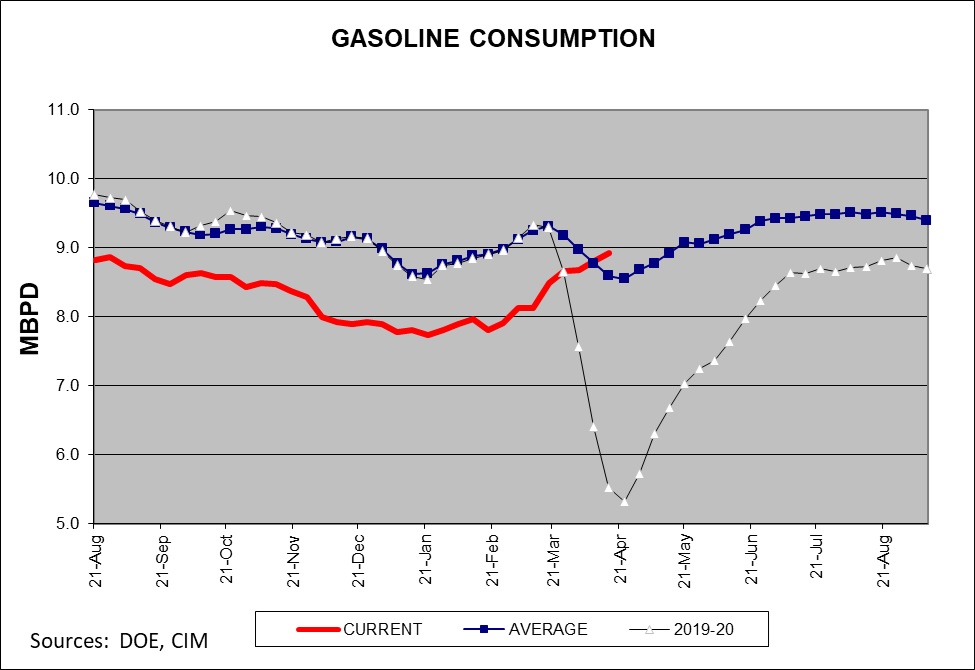
For the first time since December 2019, gasoline consumption has reached the five-year average, further evidence of economic recovery.

Market news:

Geopolitical news:

Alternative energy/policy news:

  • The state of New York is restricting pension investments in oil sands.  The goal of the state is to have its investments to net-zero greenhouse gas emissions by 2040.
  • The Biden infrastructure package has a $16 billion provision to fund the plugging of abandoned oil wells.  These abandoned wells often emit methane, a potent greenhouse gas.  Reception for the idea is mixed.  The oil industry is mandated to plug wells when they are abandoned.  The industry has a habit of selling older wells to smaller, less capitalized firms that often can’t afford to cap the wells.  Thus, they abandon them when the wells stop producing.  The worry is that if the government pays for them, the industry will have an even greater incentive to shirk its duties.  On the other hand, the program would employ former industry workers who often lack other attractive job opportunities, and the wells probably won’t be addressed through normal channels.  We would not be surprised to see an attempt to put a user tax on oil drillers to prevent the moral hazard this proposal creates.
  • There is an effort by the EU to create a law against “ecocide,” the deliberate and systemic destruction of the government.  If approved, it might create a movement to bring ecological destruction to the level of genocide, making it an international crime.
  • The U.S. is moving toward the electrification of its transportation system.  Making this change will require different materials than internal combustion engine vehicles.  Many of these materials fall into the category of “rare earth” minerals.  Although the U.S. does have some capacity in this area, China remains the primary source of these goods.  It will be years before the U.S. and others can overcome China’s dominance.

View PDF