

Asset Allocation Bi-Weekly – The Great Divergence (June 20, 2023)

by the Asset Allocation Committee | PDF

The S&P 500 is up 10% year-to-date and briefly reached the 4,200 level in late May. The recent rally in equity markets has been driven by the rise of generative artificial intelligence (AI), which has bolstered tech stocks. In fact, much of this strong performance has come from the five largest tech companies, which now account for 24.7% of the index’s value, a record high. This concentration has led some investors to fear that a bear market similar to the dot-com bubble burst of 2000 may be on the horizon. The pessimistic outlook is related to concerns that the underperformance of the broader index has generally followed previous periods of high market concentration.

The chart above shows the relative performance of the S&P 500 Market Capitalization and Equal Weight indexes over the past 30 years. During times of uncertainty, investors tend to pile into established companies with large market capitalizations. These firms are typically better positioned to weather a downturn as they have more resources and access to capital. In this environment, the Market Cap index generally outpaces its Equal Weight counterpart. However, this outperformance does not usually last long. When the market recovers, investors often go bargain hunting as the lesser names are likely to offer more value. Thus, the Equal Weight index can outperform the Market Cap index over an extended period. That said, the recent unevenness is different than in previous market rallies.

The 2020 tech rally was driven by monetary and fiscal stimulus. The Federal Reserve injected billions of dollars into the financial system, which lowered interest rates and encouraged investors to take on more risk. Additionally, many households had excess savings due to the COVID-19 pandemic stimulus, which increased the number of retail investors. Overall, tech stocks benefited as investors looked for better returns. However, the rally was not sustainable.

As the Federal Reserve began to tighten monetary policy in 2022, interest rates rose and investors became more risk-averse. This led to a sharp decline in tech stocks, which continued until early 2023, when people began to focus on the investments that Microsoft (MSFT, $346.10) had made in machine-learning company OpenAI. The investments signaled the company’s commitment to artificial intelligence and its potential to usher in a new technology wave.

The craze for AI reached new heights in May after chipmaker Nvidia (NVDA, $431.33) forecasted that strong demand for AI chips could help the company generate $110 billion in revenue in 2024. The news led to one of the biggest tech rallies in two decades as the tech-heavy Nasdaq Composite Index rose by more than 7% in May.

Analysts have compared the release of AI-related products such as ChatGPT to the advent of the internet browser, calling it a game-changer. Although still under development, the product has a wide range of potential uses, from content creation to task automation. The technology’s diverse applications have encouraged investors to purchase AI-related stocks at a premium as they are willing to pay for AI-related companies based on their future cash streams as opposed to current earnings.

Unlike the dot-com boom of the early 2000s, many of the companies developing AI technology are not startups. The major movers in AI are established tech giants, such as Microsoft, Amazon (AMZN, $126.50), Alphabet (GOOG, $124.77), Meta (META, $280.34), Baidu (BIDU, $148.19), Tencent (TCEHY, $45.55), and Alibaba (BABA, $92.13). These companies have proven track records of success, and they are unlikely to fail if the AI bubble goes bust. As a result, the recent rally in tech stocks poses significantly less risk than the internet mania of the early 2000s because the firms driving the rally are more stable and have better track records of profitability.

While the Market Cap index has outperformed recently, this outperformance is unlikely to last. Economic growth is expected to slow in the second half of the year, which could lead to a new down-leg in the market. As demand decreases, earnings will likely be negatively impacted, leading to a decline in stock prices. However, we do not expect the repricing of major tech companies to lead to a market crash. Instead, we believe other stocks within the S&P 500 will be less affected. Consequently, the Equal Weight index may recover against the Market Cap index toward the end of the year. Additionally, these companies could be very attractive once economic growth begins to pick up.

View PDF

Weekly Energy Update (June 15, 2023)

by Bill O’Grady, Thomas Wash, and Patrick Fearon-Hernandez, CFA | PDF

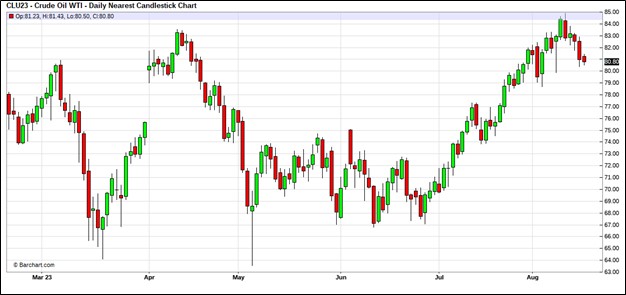
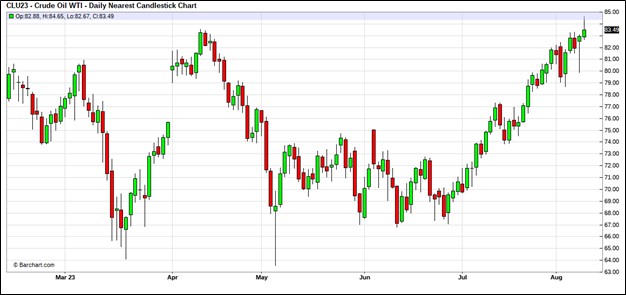
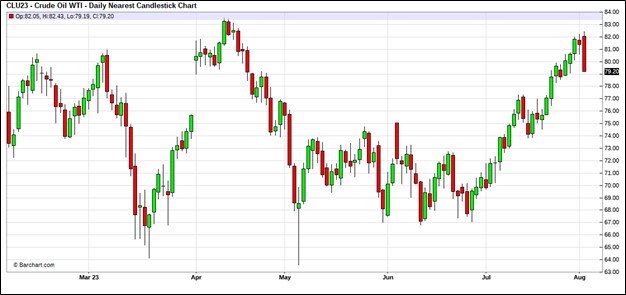
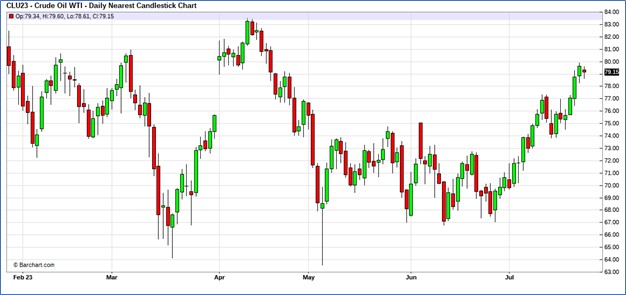
Oil prices may be establishing a new trading range between $67 and $75 per barrel.

(Source: Barchart.com)

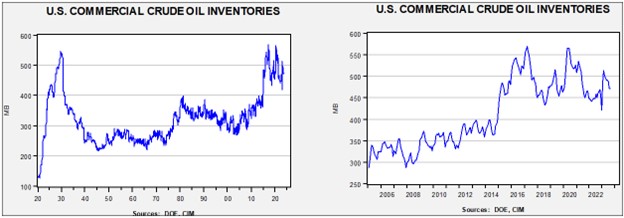
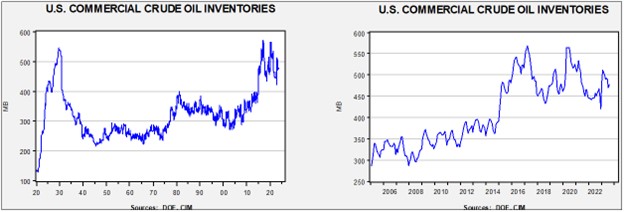
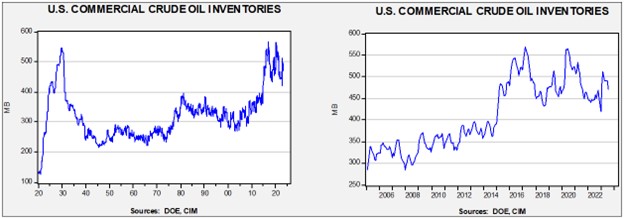
Commercial crude oil inventories rose 7.9 mb when compared to the forecast draw of 1.5 mb.  The SPR fell 1.9 mb, putting the total build at 6.0 mb.

In the details, U.S. crude oil production was steady at 12.4 mbpd.  Exports rose 0.8 mbpd, while imports were flat.  Refining activity declined 2.1% to 93.7% of capacity.

(Sources: DOE, CIM)

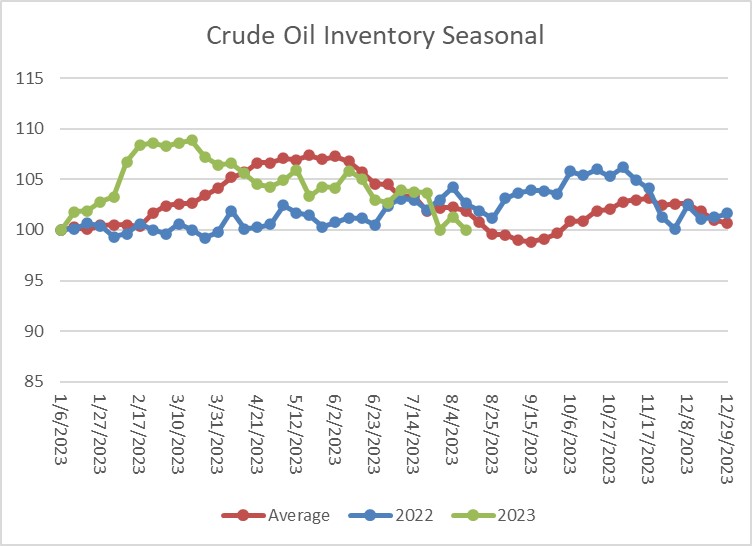
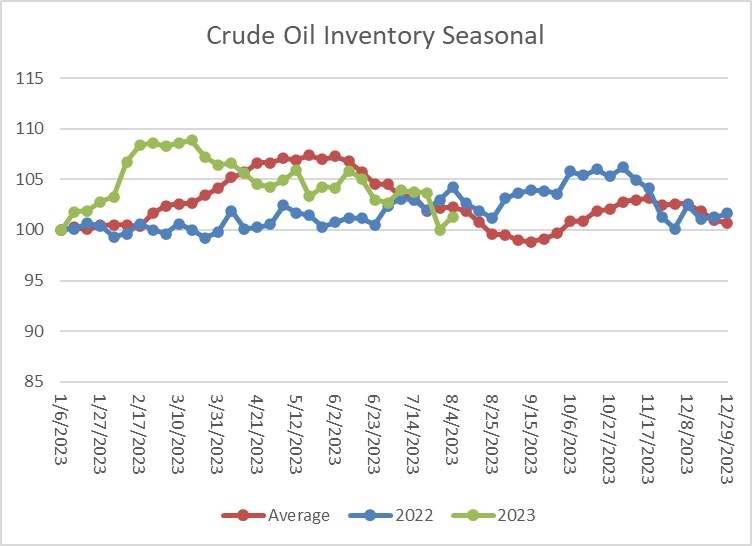
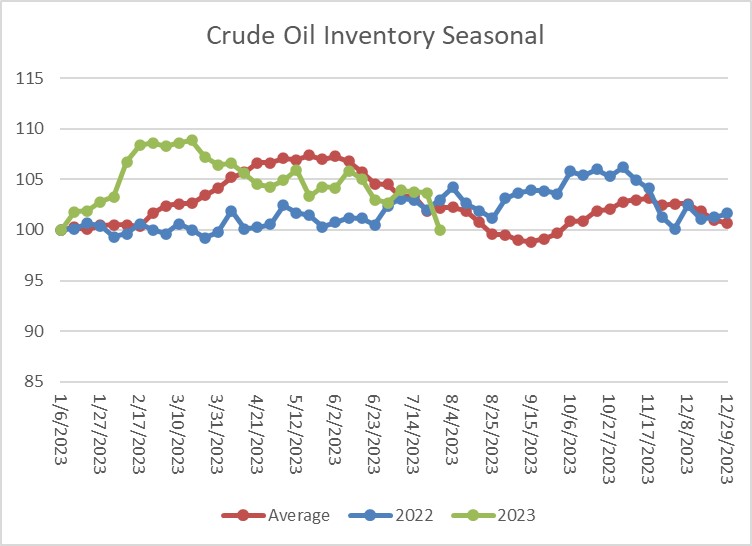
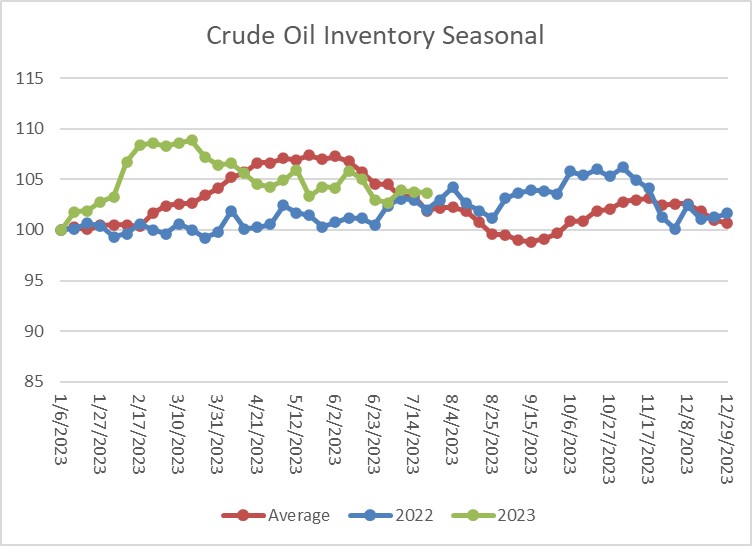
The above chart shows the seasonal pattern for crude oil inventories.  After accumulating oil inventory at a rapid pace into mid-February, injections first slowed and then declined.  This week’s outsized build puts inventories back at seasonal norms.  The seasonal pattern would suggest that stocks should fall in the coming weeks, but the seasonal pattern has become less reliable due to export flows.

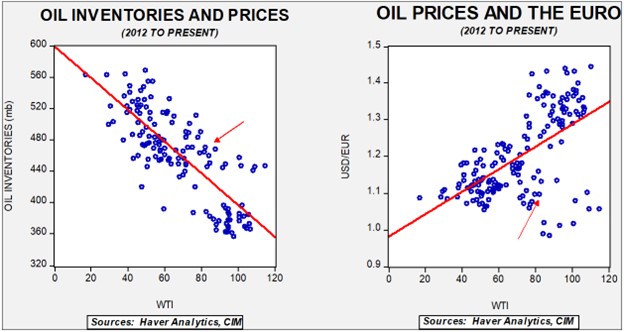
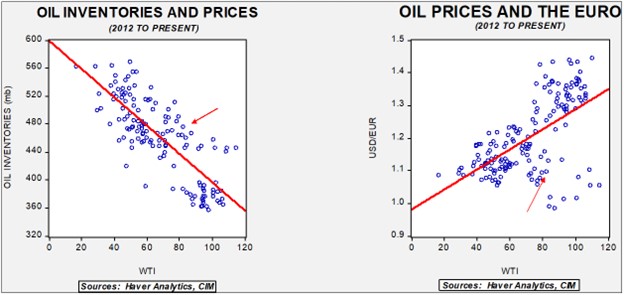
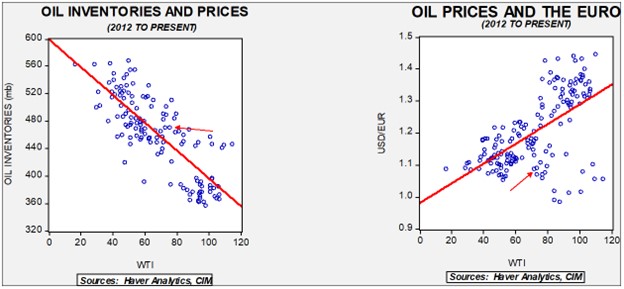
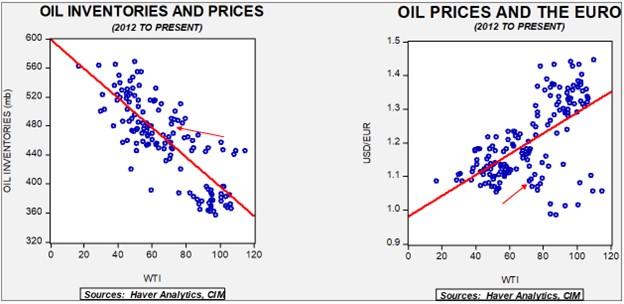
Fair value, using commercial inventories and the EUR for independent variables, yields a price of $57.11.  Commercial inventory levels are a bearish factor for oil prices, but with the unprecedented withdrawal of SPR oil, we think that the total-stocks number is more relevant.

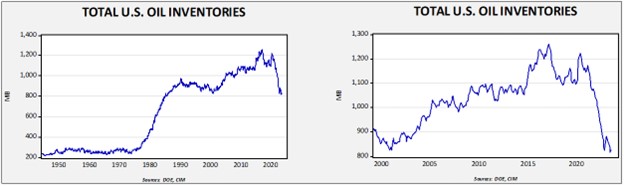
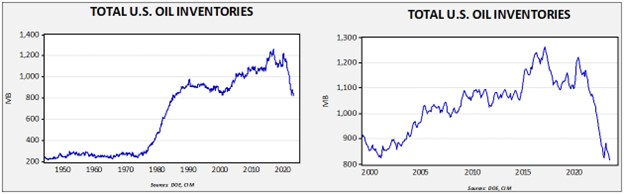
Since the SPR is being used, to some extent, as a buffer stock, we have constructed oil inventory charts incorporating both the SPR and commercial inventories.  With another round of SPR sales set to happen, the combined storage data will again be important.
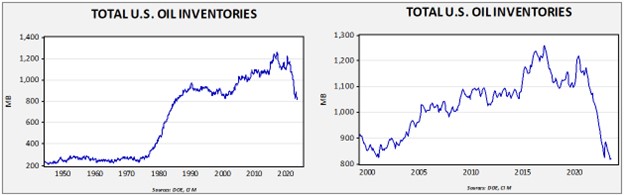
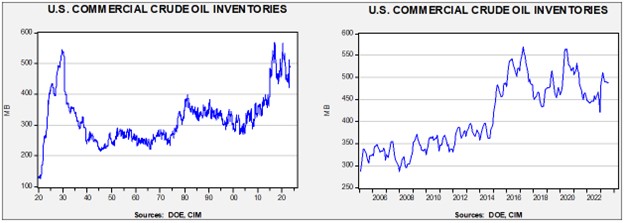
Total stockpiles peaked in 2017 and are now at levels last seen in 2002.  Using total stocks since 2015, fair value is $92.53.

Market News:

  • The IEA released its forecast for oil demand over the next five years. The group estimates that expanding EV usage will dampen gasoline demand and thus lead to a peak in global oil demand after an almost continuous rise for 80 years.

  • As the above chart shows, oil demand is forecast to fall dramatically mostly due to negative growth for road transportation.  We have serious doubts that this will actually occur, but oil producers, especially those beholden to shareholders, have to be aware of this forecast since it suggests that investment in new production is at risk of being stranded.  Therefore, shareholders are likely to demand a shareholder return instead of investment into new production, and it appears this trend is already beginning to happen.  This forecast is likely to add to bullish pressure for prices, especially if demand exceeds expectations.
  • Oil prices continue to mark time in the wake of the OPEC+ announcement. Our take is that the U.S. wants prices around $60 per barrel and the Saudis have a target of at least $80 per barrel.  Because of this, we are sitting in a netherworld between these two price points.  Worries about Chinese demand are acting as a bearish factor on prices and offsetting the supply cuts coming from OPEC+.
  • U.S. crude oil exports have been increasing, but we are starting to get close to capacity at some export facilities.
  • Natural gas production in the Permian Basin has hit a new record high.
  • There is always tension between commodity project development and environmental concerns. Oil drilling in the Amazon Delta is pitting oil drillers against environmentalists.
  • Much to our surprise, it looks like the U.S. will add 3.0 mb to the SPR. Of course, this injection pales in comparison to the sales over the past year.  We note the Biden administration wants to purchase another 12.0 mb over this coming year.
  • Venezuela has suffered falling oil production for years. However, we are starting to see a slow recovery in this area.  As Russian sanctions change global oil flows, the U.S. has begun easing sanctions on Caracas.

 Geopolitical News:

 Alternative Energy/Policy News:

  View PDF

The Case for Hard Assets: An Update (June 2023)

by Bill O’Grady & Mark Keller | PDF

Background and Summary

Secular markets are defined as long-term trends in an asset. There are both secular bear and bull markets. In most markets, there are also cyclical bull and bear markets, often tied to the business cycle, and in some markets, there are seasonal bull and bear markets that are usually tied to annual production or consumption cycles. For example, a secular bull market in bonds is characterized by falling inflation expectations that trigger steady declines in interest rates. A secular bear market in bonds is caused by the opposite condition―rising inflation expectations which lead to consistently rising interest rates. In comparison, a cyclical bull market in bonds is often related to the business cycle and monetary policy.

In general, secular cycles tend to last a long time. Using bonds as an example, we are likely concluding a four-decade secular bull market which encompassed several cyclical cycles. The length tends to be tied to specific characteristics of each market.

Commodity markets have secular cycles as well. Commodity demand is mostly a function of economic and population growth, whereas commodity supply comes from agriculture, ranching, mining, and drilling. As this chart shows, commodity producers face a serious secular headwind—capitalist economies tend to persistently improve their efficiency in producing finished goods from raw commodities. Commodity production is also subject to steady improvement in productivity.

Read the full report

Bi-Weekly Geopolitical Report – The Issue of the Terms of Trade (June 12, 2023)

Bill O’Grady | PDF

In a recent Bi-Weekly Geopolitical Report, we discussed the emergence of the petroyuan.  One of the important aspects of that report was that foreign nations were beginning to pay for oil in their own currencies.  As we noted in the report, George Shultz and Henry Kissinger negotiated a deal with the Saudis, where in return for providing security support, the Kingdom of Saudi Arabia agreed to price oil in U.S. dollars.  The ability to pay for oil in one’s own currency is powerful.  Essentially, a country can then print money for oil, but obviously, it’s not quite that simple.  If a country abuses that power, it could find itself losing its ability to do so.

In the aforementioned report, we noted that America’s aggressive use of financial sanctions was leading some countries to explore alternatives to the dollar-based reserve system.  After the U.S. sanctioned Iran and Russia, effectively isolating both nations from the global payments system, other nations worried about also running afoul of Washington and began to work on developing an alternative payment mechanism, which included the ability to pay for oil in a currency other than U.S. dollars.

What has surprised us, so far, is the absence of response from Washington to this development.  If the Nixon administration felt that paying for oil in dollars was important, if President Carter expanded the U.S. security role to include the Persian Gulf’s oil flows, and if President Bush liberated Kuwait, why hasn’t there been more of a pushback against denominating oil in other currencies?

Examining this question has led to an unexpected outcome—America’s terms of trade (TOT) have now changed due to the shale revolution, and that adjustment has changed the risk profile for the global economy.  Our assertion is that the U.S. realizes that, due to this change, insisting on pricing oil in U.S. dollars could foster financial instability.  And so, for now, Washington is willing to tolerate the pricing of oil in other currencies.

In this report, we will begin with an examination of U.S. TOT, including an analysis of its effect on the dollar.  Once this context is established, we will detail the risks that come from the dollar/oil relationship, which has led the U.S. to no longer insist on pricing oil in dollars.  We note the factors that have led to this change in the terms of trade may not be permanent, which could lead the U.S. to reverse its stance to allowing oil to be priced only in dollars.  We will close with market ramifications.

Read the full report

Don’t miss the accompanying Geopolitical Podcast, available on our website and most podcast platforms: Apple | Spotify | Google

Weekly Energy Update (June 8, 2023)

by Bill O’Grady, Thomas Wash, and Patrick Fearon-Hernandez, CFA | PDF

Oil prices continue to trade in the lower part of the trading range despite the Saudis’ announcement of a unilateral production cut.

(Source: Barchart.com)
Commercial crude oil inventories fell 0.5 mb when compared to the forecast build of 1.5 mb.  The SPR fell 1.9 mb, putting the total draw at 2.3 mb.

In the details, U.S. crude oil production rose 0.2 mbpd to 12.4 mbpd.  Exports fell 2.4 mbpd, while imports declined 0.8 mbpd.  Refining activity jumped 2.7% to 95.8% of capacity.

(Sources: DOE, CIM)

The above chart shows the seasonal pattern for crude oil inventories.  After accumulating oil inventory at a rapid pace into mid-February, injections first slowed and then declined.  As the average line shows, we are nearing the seasonal draw period, although that pattern has become less reliable with the U.S. exporting crude oil.

Fair value, using commercial inventories and the EUR for independent variables, yields a price of $59.61.  Commercial inventory levels are a bearish factor for oil prices, but with the unprecedented withdrawal of SPR oil, we think that the total-stocks number is more relevant.

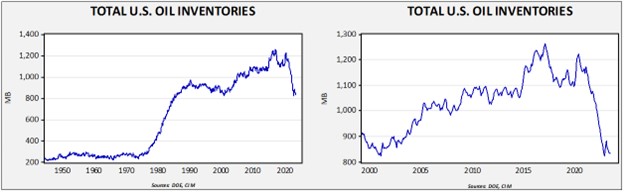
Since the SPR is being used, to some extent, as a buffer stock, we have constructed oil inventory charts incorporating both the SPR and commercial inventories.  With another round of SPR sales set to happen, the combined storage data will again be important.

Total stockpiles peaked in 2017 and are now at levels last seen in 2002.  Using total stocks since 2015, fair value is $93.27.

Market News:

 Geopolitical News:

 Alternative Energy/Policy News:

(Source: Capital Economics)

  • Hydrogen remains a potential replacement for hydrocarbons. However, the production of hydrogen can come from both “dirty” and “clean” production methods, which has led to a color coding of hydrogen.  The Biden administration is trying to create a regulatory path for fostering the development of the fuel that will go along with a subsidy program to boost production.  The subsidy program still requires decisions about what will be covered.  The industry wants loose standards, while environmentalists are pressing for only the “greenest” of sources.  Although we don’t know the outcome yet, this administration tends to try to split the middle on these issues, which will tend to please no specific group.

  View PDF

Asset Allocation Bi-Weekly – Weak Capital Investment by State and Local Governments (June 5, 2023)

by the Asset Allocation Committee | PDF

The standoff between the Biden administration and congressional Republicans over raising the federal debt limit has prompted us to think more deeply about some important longer-term issues regarding U.S. public spending.  As we discuss in this report, a key problem is that one particular type of government investment has only grown weakly in recent decades.  The apparent underinvestment has big implications for economic growth and inflation.

Despite the political rhetoric, government intrusion into the U.S. economy is rather modest compared with other countries.  Looking at the total government sector (federal, state, and local), U.S. public receipts totaled 34.1% of gross domestic product in 2022, and outlays totaled 38.2%, leaving a deficit of 4.1%.  As shown in the chart below, those shares were lower than in most of the other advanced nations in the OECD.  However, they were high compared to historical U.S. levels.  For example, federal receipts alone equaled 19.6% of U.S. GDP in 2022, close to their highest share since the 1950s.  Federal outlays equaled 25.1% of GDP, modestly exceeding the pre-pandemic peak of 24.3% set during the Great Financial Crisis in 2009.

Economists assign government spending to three different classes: consumption (for example, buying pharmaceuticals for the local VA hospital or paying for the services of police officers), investment (broadening an interstate highway or buying a printer for a court), and transfers (Social Security or Medicare benefits).  In this report, we focus on government consumption and investment, which together totaled $4.448 trillion in 2022 and is treated as a component of GDP.  As shown in the chart below, government consumption spending has been much bigger than investment spending for decades.  Since 1960, each type has risen at an average annual rate of 1.9% after stripping out inflation.  However, what the overall growth rate of 1.9% doesn’t show is that U.S. public-sector investment looks quite different depending on whether you’re looking at federal civilian investment, federal defense investment, or state/local investment.

Federal outlays on civilian facilities and equipment grew smartly at an average real rate of 3.8% per year from 1960 to 2022.  This spending grew especially fast from 1960 to 1980 as the federal government expanded its social programs.  During that period, federal nondefense investment grew 6.5% per year compared with annual GDP growth of 3.4%.  This spending has since slowed and is now growing at roughly the same rate as GDP.  In contrast, federal investment on defense projects like expanded military bases or new ships has grown at a rate of just 1.3% per year since 1960.  From 1960 to1980, it fell at an average rate of 0.4% per year, reflecting the end of the initial phase of the Cold War and the termination of the Vietnam War.  Defense investment then jumped 1.7% per year in 1980-2000 and 2.6% per year in 2000-2022 because of factors such as President Reagan’s military buildup and the War on Terror.

As shown in the chart, investment by state and local governments is bigger than all federal investment combined, but after growing quickly from 1960 to 2000, these outlays have been trending downward for the last two decades.  That’s important because state and local governments are responsible for the bulk of the economy’s basic infrastructure, including roads, highways, bridges, airports, water and sewer systems, and publicly owned facilities for power generation and transmission.  Sluggish investment in this type of infrastructure can be a problem because it leaves the economy with less capacity to grow.  Weak investment in infrastructure can also lead to bottlenecks in times of rising demand, thereby pushing prices higher, creating more inflation, and encouraging higher interest rates.  In many of our recent publications, we have warned that the fracturing of the world into relatively separate geopolitical and economic blocs will prompt companies to adopt shorter, less efficient supply chains, which will likely boost inflation and interest rates over time.  Separate from the fiscal squabbles at the federal level, our analysis in this report suggests that if state and local governments continue to underinvest in basic infrastructure, there could be even more upward pressure on inflation and interest rates, further undermining bond returns in the coming years.

View PDF

Weekly Energy Update (June 1, 2023)

by Bill O’Grady, Thomas Wash, and Patrick Fearon-Hernandez, CFA | PDF

Oil prices have been volatile in front of the OPEC+ meeting.

(Source: Barchart.com)

Commercial crude oil inventories fell a whopping 12.5 mb when compared to the forecast build of 1.5 mb.  The SPR fell 1.6 mb, putting the total draw at 14.1 mb.

In the details, U.S. crude oil production fell 0.1 mbpd to 12.2 mbpd.  Exports rose 0.4 mbpd, while imports rose 1.4 mbpd.  Refining activity rose 1.4% to 93.1% of capacity.

(Sources: DOE, CIM)

The above chart shows the seasonal pattern for crude oil inventories.  After accumulating oil inventory at a rapid pace into mid-February, injections first slowed and then declined.  As the average line shows, we are nearing the seasonal draw period, although that pattern has become less reliable with the U.S. exporting crude oil.

Fair value, using commercial inventories and the EUR for independent variables, yields a price of $59.17.  We will wait to see if OPEC+ (see Market News below) moves to push prices higher by cutting output.

Since the SPR is being used, to some extent, as a buffer stock, we have constructed oil inventory charts incorporating both the SPR and commercial inventories.  With another round of SPR sales set to happen, the combined storage data will again be important.

Total stockpiles peaked in 2017 and are now at levels last seen in 2002.  Using total stocks since 2015, fair value is $94.63.

Market News:

 Geopolitical News:

  • China continues to delay approval for another pipeline from Siberia. As we discussed last week, China appears to be getting remarkably cheap natural gas from the current Power of Siberia pipeline and is seemingly driving a hard bargain on funding a second pipeline.  Russia is in a tough spot on natural gas as its pipeline network is designed to send gas to Europe, but that market has been mostly lost due to sanctions (although not completely as Ukraine is still allowing Russian gas and oil to go through its territory).  Moscow needs to reroute pipelines away from Europe and toward Asia.  Beijing knows this, but despite promises of friendship, it isn’t willing to invest much to support Russia’s goal of moving its gas east.
  • The Kingdom of Saudi Arabia (KSA) is participating in the evasion of Western sanctions on Russia by importing Russian diesel and then re-exporting it.
  • One of the key benefits of a globalized world is that countries can specialize in what they most efficiently produce, which tends to lower inflation. As geopolitical tensions lead to a breakdown of globalization, nations may be forced to manufacture items that they might not be best at but still need to produce due to insecurity of supply.  China is especially vulnerable to food and energy deficiencies.  Due to its high population, limited arable land, and water constraints, China has tended to be a net importer of food.  With energy, China became a net importer in 1994.  As relations between the U.S. and China deteriorate, Beijing is vulnerable to the U.S. Navy’s ability to close off shipping lanes.  In response, China is considering new ways of securing food and energy.
  • Russia has always considered Central Asia to be in its sphere of influence. In fact, during the Soviet era, the “stans” were part of the union.  These areas are rich in natural resources.  China is openly competing with Russia for dominance in this area, in part to secure key resources, and in part to exercise dominance over Russia.
    • We also note a Russian scientist working on hypersonic missiles has been detained on charges that he was selling secrets to China.
  • German regulators are promoting heat pumps and looking to ban gas-fired boilers. The Greens support this idea, but other members of the ruling coalition oppose the measure.  This issue is fracturing the coalition, and although we doubt the government will fall over this measure, tensions within the coalition have been rising for some time.
  • Iran has launched an alternative to the S.W.I.F.T. network in a bid to circumvent U.S. financial sanctions.

 Alternative Energy/Policy News:

  • During the first decade of this century, ethanol was thought to be a way to reduce America’s dependency on foreign oil. Regulations at the time envisioned a steady rise in the ethanol fuel mix.  However, the shale revolution reduced U.S. dependence on foreign oil, undercutting the national security argument for corn-based fuels.  Complicating matters further was that geopolitical disruption boosted grain prices significantly; using corn for fuel is seen as boosting food prices.  The Bush-era ethanol mandate has expired and it looks like the industry is being forced to defend current sales rather than boosting future use.
  • From the outset of the environmental movement, there have been tensions between the “Buckminster Fuller” wing and the “Thomas Malthus” wing. The former leans on technological fixes to environmental problems, while the latter believes reliance on technology creates an endless “treadmill” of solutions that leads to new problems where the only real solution is a decline in living standards.  This division often emerges, and the most recent instance appears to be tied to the carbon-removal industry.  The UN released a report critical of carbon renewal, because it is fearful that relying on it will curtail the drive to deploy alternative energy.  However, industry experts indicate that without direct carbon capture, meeting temperature targets will be impossible.
    • German police raided the homes of climate activists on suspicions that they were planning attacks on oil pipelines.
    • One interesting sidenote with captured CO2 is what exactly to do with it. Although the gas has some industrial uses (in beer, for example), the amount of gas that is needed to be captured to make a difference far exceeds industrial demand.  However, one way the gas could be used, paradoxically, is to make synthetic natural gas.  By combining hydrogen with captured CO2, you can create a clean methane that would seemingly be carbon neutral.
    • Exxon (XOM, $102.61) has made a deal with steelmaker Nucor (NUE, $132.72) to build a carbon-capture program.
  • Resource nationalism is on the rise. Recently, we noted that South American commodity producers are considering nationalizing production of key metals, such as lithium and copper.  The Congo wants to change its royalty arrangements with foreign firms (mostly Chinese) on copper projects, in another example of resource nationalism.  This factor increases the attractiveness of key minerals in geopolitically safe places.  A new lithium development in Portugal has been especially welcomed.
  • Clean energy proponents are pressing to streamline projects, a complaint heard from fossil-fuel companies as well.
  • The president’s moratorium on solar panel tariffs survived a potential override of his veto.
  • As we noted last week, China continues to dominate in EV components. Chinese battery companies are beginning to invest in productive capacity outside of China, perhaps to avoid a deteriorating geopolitical environment between the U.S. and China.  Europe is a primary target for this investment.
  • When a new technology is developed, it takes a while for the industry to establish standards. Initially, there is a temptation for each firm to create its own standards with the hopes that they become dominant, as this adoption can create market power.  At the same time, widespread adoption usually requires a few standards so it’s easier for consumers to use the new technology.  The classic example is the VCR versus Betamax standard for videocassettes.  Although the latter was thought to be superior, the former dominated and eventually eclipsed Betamax.  Consumers would have otherwise needed two machines to handle the format.  This week, Ford (F, $12.13) announced that it would adopt the Tesla (TSLA, $197.40) NACS standard, which will allow Ford vehicles to use the 12k Tesla charging stations.  Other EV makers use the CCS standard.  By making this decision, Ford is increasing the odds that the Tesla standard will prevail.
  • A German startup has won funding for a new fusion energy machine.

  View PDF

Bi-Weekly Geopolitical Report – China’s New National Security Law (May 30, 2023)

Bill O’Grady | PDF

In late April, China released a new version of its national security law.  Shortly thereafter, some prominent U.S. firms were raided by national security operatives, and there were reports of database access being restricted.  In this report, we will discuss the new law and who has run afoul of the rules so far.  The context of this new law is important since China isn’t alone in increasing its focus on national security—the U.S. has been taking steps in this direction as well.  As always, we conclude with market ramifications, where we will examine how the shifting focus on national security could affect foreign investment and trade.

Read the full report

Don’t miss the accompanying Geopolitical Podcast, available on our website and most podcast platforms: Apple | Spotify | Google

Business Cycle Report (May 25, 2023)

by Thomas Wash | PDF

The business cycle has a major impact on financial markets; recessions usually accompany bear markets in equities.  The intention of this report is to keep our readers apprised of the potential for recession, updated on a monthly basis.  Although it isn’t the final word on our views about recession, it is part of our process in signaling the potential for a downturn.

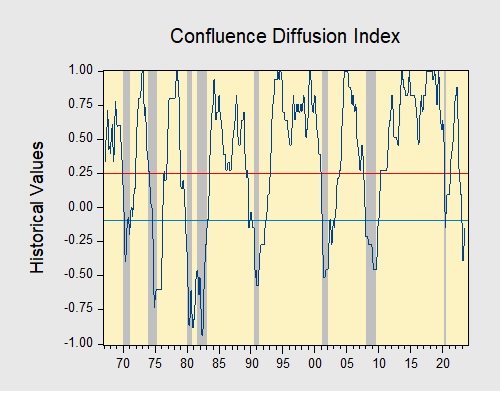
The Confluence Diffusion Index rose slightly in April but continues to signal that a recession is close. The latest report showed that seven out of 11 benchmarks are in contraction territory. The diffusion index rose from -0.3939 to -0.3424 but still sits well below the recession signal of +0.2500.

  • Financial market indicators received a boost due to improvements in the banking sector.
  • Homebuilding rose sharply last month, suggesting an increase in goods-producing activity.
  • The labor market showed signs of cooling but continues to provide evidence that the economy is in expansion.

The chart above shows the Confluence Diffusion Index. It uses a three-month moving average of 11 leading indicators to track the state of the business cycle. The red line signals when the business cycle is headed toward a contraction, while the blue line signals when the business cycle is in recovery. The diffusion index currently provides about six months of lead time for a contraction and five months of lead time for recovery. Continue reading for an in-depth understanding of how the indicators are performing. At the end of the report, the Glossary of Charts describes each chart and its measures. In addition, a chart title listed in red indicates that the index is signaling recession.

Read the full report