

Asset Allocation Weekly (August 30, 2019)

by Asset Allocation Committee

As various permutations of the yield curve invert, projections of recession are increasing.  One of our favorites, the 10-year T-note/fed funds yield curve, has been inverted for three months.

This chart shows the history of this yield curve; since 1960, every recession was preceded by an inversion of this indicator.  However, that isn’t to say that every inversion led to a recession. There were two false positives in the series, one in 1965 and another in 1998.  The former we consider a true false positive as the inversion lasted several months but a recession didn’t follow.  The latter event only lasted one month and was tied to the financial turmoil of the Asian Economic Crisis, the collapse of Long-Term Capital Management and the Russian debt default.  The fact that the inversion was short-lived weakens the case that it was a true inversion.

If this signal of recession holds, when does it arrive?  Here is a look at the timing:

On average, recessions occur 15 months after inversion; that would put the onset around next September.  The range is eight months to 18 months.  Using that range, the recession could begin as early as February 2020 or as late as February 2021.  Although this history offers some insight into timing, the reality is that the number of events is rather limited.  Thus, investors should treat the data as a guide.  The economic data remains mixed, but the preponderance of the evidence suggests that the U.S. economy is weakening but not in recession.

As we have noted before, recessions tend to have two causal factors, policy error and geopolitical events.  The 1973-75 and 1990-91 recessions are considered to be partly due to geopolitical factors; the former was affected by the Arab Oil Embargo and the latter by the Persian Gulf War.  However, both also had yield curve inversions.  It is quite possible that the geopolitical events caused the recessions to occur faster than they might have otherwise in the absence of these events.

We are watching the trade conflict with great interest because it might affect the timing of a downturn.  If the trade conflict worsens, lifting import prices and forcing the Fed to slow its path of lowering rates, the recession might occur sooner than it otherwise would.  A recession would certainly affect the 2020 elections; no incumbent has survived a recession since Calvin Coolidge.  We will likely begin to prepare for a downturn next year.  If the trade conflict worsens, the timing may be accelerated.

View the PDF

Business Cycle Report (August 28, 2019)

by Thomas Wash

The business cycle has a major impact on financial markets; recessions usually accompany bear markets in equities.  We have created this report to keep our readers apprised of the potential for recession, which we plan to update on a monthly basis.  Although it isn’t the final word on our views about recession, it is part of our process in signaling the potential for a downturn.

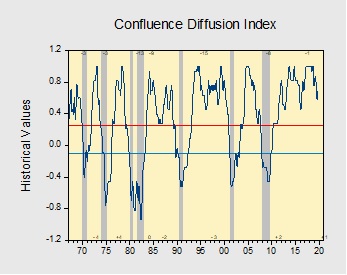
Data released for July suggests the economy is strong, but a slowdown in manufacturing and signals of financial weakness have been a drag on the index. Currently, our diffusion index shows that eight out of 11 indicators are in expansion territory, with several indicators approaching warning territory. The index has fallen from +0.757 to +0.636.[1]

The chart above shows the Confluence Diffusion Index. It uses a three-month moving average of 11 leading indicators to track the state of the business cycle. The red line signals when the business cycle is headed toward a contraction, while the blue line signals when the business cycle is headed toward a recovery. On average, the diffusion index is currently providing about seven months of lead time for a contraction and three months of lead time for a recovery. Continue reading for a more in-depth understanding of how the indicators are performing.

View the complete PDF


[1] The diffusion index looks slightly different from last month due to adjustments we made to the formula and revisions in certain data sets.

Quarterly Energy Comment (August 27, 2019)

by Bill O’Grady

The Oil Market
Since June, oil prices have held within a range of $50 to $60 per barrel.

(Source: Barchart.com)

After a sharp decline in prices from late May into early June, due in part to a contra-seasonal build in inventories, inventories fell and oil prices rebounded.  Rising tensions with Iran added to the lift in prices.  Since then, we have seen a retest of the lower end of the range and another bounce.  Unfortunately, we are heading into a weak demand period for crude oil as the summer vacation season comes to a close.  Therefore, the lower support level may get tested again.

A Tale of Two Variables
Although there are several variables that affect the price of oil, within the business cycle the two we focus on are the dollar and commercial crude oil inventories.  As with many situations, there are data accommodations that are necessary.  Oil inventories can be problematic because, throughout history, the correlation between stockpiles and prices can flip.

View the complete PDF

Weekly Geopolitical Report – Meet Boris Johnson (August 26, 2019)

by Patrick Fearon-Hernandez, CFA

(Due to the Labor Day holiday, our next report will be published on September 9.)

 The great forest fires that consumed swaths of the West in recent years have finally revealed the danger from a century of excessive fire suppression.  Humanity’s natural drive to control the environment has left forests overgrown with impenetrable underbrush and littered with brittle deadwood.

Often, it’s only after the conflagration that the true contour of the land is visible again and the forest floor is bathed anew in the light needed for growth.  Only then can green shoots poke up through the blackened soil on their way to becoming the mighty, majestic new redwoods and ponderosa pines and Douglas firs that will dominate the rejuvenated forest.

Just so, the Global Financial Crisis a decade ago consumed what was in many ways an overgrown, sclerotic, and brittle economic system within the developed countries of the world, revealing for all – both the elites and the non-elites who bore the brunt of the crisis – the true contours and contradictions of the modern economic landscape.  The conflagration destroyed many traditional politicians identified with the previous highly globalized economy, and it encouraged disruptive, populist leaders to put down roots and begin reaching for their place in the sun.  These new populist leaders, who took advantage of the destruction, include such luminaries as U.S. President Donald Trump and Italian Deputy Prime Minister Matteo Salvini.  On July 24, another disruptor, Boris Johnson, was named prime minister of the United Kingdom. In this report, we dissect who Johnson is and how he rose to power.  More importantly, we discuss what he is likely to do and accomplish as the leader of his country, and the likely ramifications for investors.

View the full report

Asset Allocation Weekly (August 23, 2019)

by Asset Allocation Committee

Recession worries have increased due to falling long-duration interest rates and the short-lived inversion of the two-year/10-year T-note spread.  Although this spread is important, it is merely one in a whole series of permutations of the yield curve.  Our preferred measure is the 10-year/fed funds spread because it measures the long end of the yield curve to the policy rate and thus should provide a clearer picture of whether or not the central bank policy is too tight.  It is also the same spread the Conference Board uses in its leading economic indicators.

This chart shows the aforementioned spread.  Since the 1970 recession, the spread has inverted before every recession.  It did have two false positives, one in 1966 and another in 1998.  The recent inversion could be a false positive as well, but it makes sense that investors should be concerned about a recession.  This is because equities often decline during recessions; in some cases, the drop is significant.

This chart shows the weekly Friday close for the S&P 500 on a log scale.  We have regressed a time trend through the data.  In nearly all recessions, some weakness in equities is observed, although often the decline in stocks predates the recession to some degree.

This chart shows the performance of the S&P 500 around inversions.  We took every inversion from 1966 forward, indexing the S&P to 100 at the month of inversion.

We added symbols to the 1966 and 1998 inversions as both were false positives for recession.  In the former case, equities fell in the first 10 months of inversion but rallied.  In 1998, there was a brief drop followed by a strong rally in stocks.  Generally speaking, false positives are buying opportunities.  All the other events were eventually followed by recessions.  However, as the data shows, the dispersion is remarkably wide.  It’s hard to ascertain a clear message with this much noise, but, in general, a case can be made that a delayed recession after inversion tends to support equity values.  The other message is that valuations and inflation issues do matter around inversions.  The worst performing markets in the two years after an inversion was 1973, a bear market that suffered from falling margins and multiples, and 2000, which was a highly overvalued equity market.  Other than these lessons, the data tends to support the idea that panic around an inversion is probably unwise, which is what the average of all the events tends to suggest.  Each inversion has specific characteristics that affect equity market performance.  In the current environment, we would be most concerned about profit margins; if a recession occurs, we would expect margins to contract which would likely trigger a notable bear market.  So far, margins have declined but remain historically elevated.  Margins will likely be the key to equity performance in the coming quarters.

View the PDF

Weekly Geopolitical Report – Weaponizing the Dollar: Part II (August 19, 2019)

by Bill O’Grady

Weaponizing the Dollar: Part I

In Part I, we began our analysis with a discussion of Mundell’s Impossible Trinity.  We also covered the gold standard model and Bretton Woods model.  This week, we will examine the Treasury/dollar standard and introduce what could be called Bretton Woods II.  Finally, we will conclude with market ramifications.

View the full report

Asset Allocation Weekly (August 16, 2019)

by Asset Allocation Committee

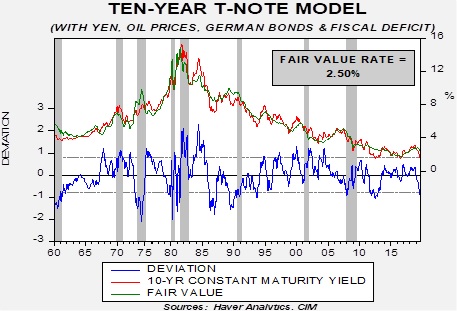
As the 10-year T-note yield tumbles, we are reaching a point where the market looks overvalued based on current fundamentals.

Our yield model uses fed funds and the 15-year average of the yearly change in CPI[1] along with the JPY/USD exchange rate, oil prices, the yield on 10-year German bunds and the fiscal deficit as a percentage of GDP.  The current yield on the 10-year T-note, dipping below 1.70%, puts the deviation from fair value at nearly a standard error below fair value.  Not every deviation from fair value is resolved through higher interest rates; sometimes the fair value yield declines.  The last time we saw this sort of event occur was in 2012 during the Euro crisis and the U.S. Treasury downgrade.  That proved to be an unsustainable low in yields.  We also saw a dip in early 2008; that issue was resolved by falling T-note yields due to the financial crisis.

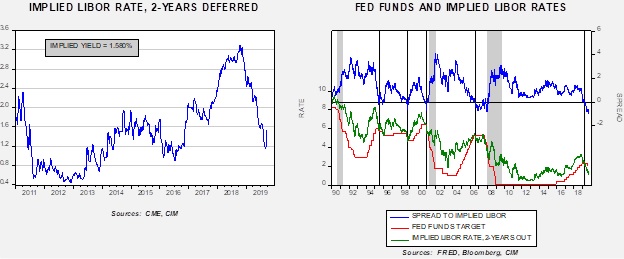
Isolating fed funds and assuming the rest of the variables remain steady shows that the bond market has factored in a fed funds of 10 bps, or essentially a return to ZIRP.  To be fair, it is also possible that the financial markets are lowering estimates of inflation.  The 5-year/5-year TIPS calculation[2] puts the forward inflation rate at 1.80%; our long-term average calculation is around 2.08%.  Applying that inflation rate expectation into the model means the current T-bond yield has discounted a 50 bps fed funds rate.

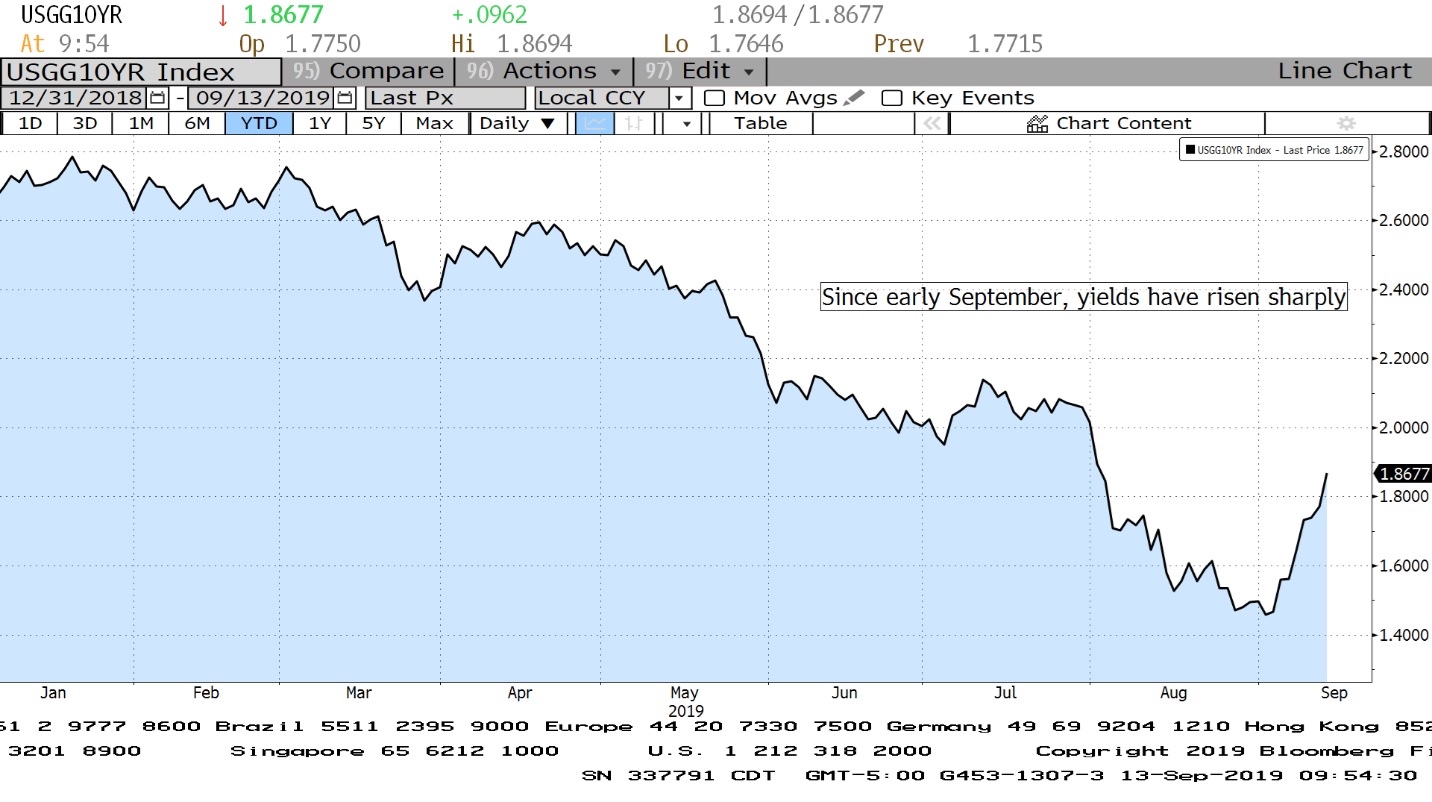
In any case the bond market is essentially making the case that a recession is likely.  If a recession is avoided, we would expect to see a significant rise in long-duration yields.  For now, the uncertainty surrounding trade and weakening global growth will probably continue to support a long-duration position.  But, given the mercurial nature of the trade discussions, a rapid reversal is not out of the question and thus requires close monitoring. 

View the PDF


[1] This variable acts as a proxy for inflation expectations.

[2] This series is a measure of expected inflation (on average) over the five-year period that begins five years from today.

Weekly Geopolitical Report – Weaponizing the Dollar: Part I (August 12, 2019)

by Bill O’Grady

Weaponizing the Dollar: Part I

In July 1944, 44 allied nations gathered at the Mount Washington Hotel in Bretton Woods, NH to develop the structure for the economic and financial systems for the postwar world.  The Bretton Woods agreement established a system of fixed exchange rates.  Exchange rates were pegged to the U.S. dollar and the dollar could be swapped for gold at a fixed price of $35 per ounce.  As part of this system, capital controls were widely deployed placing restrictions on the ability of investors to move funds overseas.  In the wake of the Great Depression, international bankers were held in low regard so international transactions were mostly to facilitate current account (trade) activity, while capital account transactions were restricted.

A large enough number of nations adopted the plan and the system lasted from 1945 until August 1971, when President Nixon ended the ability of foreign dollar holders to swap for gold.  Since 1971, most developed nations have adopted floating exchange rates and, over time, open capital accounts.

There is growing evidence that some policymakers in the U.S. are rethinking Nixon’s break with the Bretton Woods system and are considering a return to fixed exchange rates.  In Part I of this report, we will introduce the Mundell Impossible Trinity, which will provide the framework of discussion for the three historical models and the potential change.  In addition to the Impossible Trinity, we will discuss the gold standard and the Bretton Woods system.  In Part II, we will examine the Treasury/dollar standard and introduce what could be called Bretton Woods II.  We will discuss the strengths and weaknesses of each model.    As always, we will conclude with market ramifications at the end of Part II.

View the full report

Asset Allocation Weekly (August 9, 2019)

by Asset Allocation Committee

Since the end of WWII, there have generally been three factors that have caused recessions.  The first, and most important, is policy error.  Although fiscal tightening can cause recessions, major tax increases have become less common.  The usual source of policy error comes from the monetary side, where the central bank either raises rates too high or doesn’t move quickly enough to lower rates when business conditions weaken.  The second cause comes from geopolitical events.  The 1973-75 recession was triggered by the Arab Oil Embargo, a direct result of U.S. aid to Israel during the Yom Kippur War.  The 1990-91 recession was due to the Persian Gulf War.  The third cause is due to inventory mismanagement.  The third reason has become rare due to improved logistics technology.  Although inventory issues can affect sectors of the economy, it hasn’t led to a national downturn since the 1950s.

As a result, currently, there are two factors we watch most closely to predict recessions, monetary policy and geopolitical issues.  Although predicting recessions is difficult, at least with monetary policy, there are consistent indicators, such as yield curves, financial stress indexes, volatility indexes, Phillips Curve measures, etc.  Obviously, timing is difficult, even when the indicators flash warning signs, but at least there are fairly consistent indicators one can monitor.

Geopolitical indicators are far more idiosyncratic.  Global tensions are constant.  There are always geopolitical tensions so it is hard to parse the signal from the noise.  To some extent, this is always a problem with geopolitics.  It’s not that there is a lack of situations that could develop into a threat to the business cycle; it’s just that most don’t.

Perhaps a better way to think about geopolitics and theor impact comes from the book, Ubiquity: Why Catastrophes Happen.[1] In this book, Mark Buchanan makes the case that geopolitical events are much like sandpiles where grains rise steadily, making the structure increasingly unstable.  A final grain triggers a collapse and, due to the post hoc, egro propter hoc fallacy, that last “grain” becomes the “cause” of the collapse.  In reality, the structure had been losing stability for some time and the triggering event may not have led to the catastrophe under conditions of stability.

For example, the Persian Gulf War occurred mostly because Saddam Hussein miscalculated the reaction of the world to his invasion of Kuwait.  He probably would not have invaded Kuwait if the Kuwaitis had been willing to reduce production to allow Iraq to have a greater market share of world oil markets, something that Iraq felt it was owed from the Persian Gulf states due to its prosecution of the war against Iran.  In addition, if the Soviet Union hadn’t collapsed, Moscow would have probably not supported the invasion by its client state.  The trigger to the war, the reports that Kuwait was using horizontal drilling to tap Iraq’s oil fields, was the proximate cause of the war.  But, the mere act of taking the oil may not, by itself, have triggered the invasion without the other factors in play.

The current trade conflict with China has similar complicated characteristics.  The U.S. has been struggling to develop a consistent foreign policy since the end of the Cold War.  Policy toward China has mostly been to support its economic development on the idea that the richer it becomes, the more likely that it will democratize, following the path of other Asian nations.  Unlike Japan, South Korea and Taiwan, however, China was not as reliant on American security.  Those nations were directly protected by the U.S., whereas China only relied on America’s sea lane security.  In addition, China viewed its commitment to communism as something to be maintained.  The construct of the Trans-Pacific Partnership, which was designed to isolate China, showed that the U.S. was rethinking its relationship with China by 2008.

Under President Trump, the relationship with China has become increasingly contentious.  The application of tariffs and continued negotiations have caused increasing equity market turmoil.  Nevertheless, so far, the impact on the economy has been less dramatic.  However, we may be reaching the point where the trade conflict will begin to affect the economy.  The most recent decision by the Trump administration to apply 10% tariffs on $300 bn of imports, by itself, is probably not enough to trigger a downturn.  But, the culmination of earlier tariffs and the impact to technology restrictions may be creating conditions that lead to recession.

History suggests that recessions induced by geopolitical events are difficult to avoid even with stimulative economic policies.  The unknown is whether we are near a point where geopolitical risks are great enough to trigger a downturn.   At this point, we are probably not at that level but risks are escalating and the odds of a geopolitical mistake are rising.  Although it is probably too soon to position portfolios in a defensive manner, tactical planning is in order.

View the PDF


[1] Buchanan, Mark. (2000). Ubiquity: Why Catastrophes Happen. New York, NY: Three Rivers Press.