

Daily Comment (February 25, 2019)

by Bill O’Grady and Thomas Wash

[Posted: 9:30 AM EDT] It’s a risk-on day with China’s equities on a tear.  Here is what we are watching this morning:

It’s official—tariffs are delayed: Although anyone paying attention would not be surprised by this outcome, President Trump confirmed that the next round of tariffs on China will be delayed.[1]  Citing “substantial progress” on intellectual property and technology transfer, the president tweeted that a delay would be implemented.  The delay means that $200 bn of Chinese goods will not, for the time being, see a tariff hike from 10% to 25%.  Before this announcement, there was some concern about what appeared to be an open conflict between USTR Lighthizer and the president over the issue of the memorandums of understanding (MOU).  The president seemed to be indicating that the MOUs didn’t matter whereas Lighthizer views them as the structure of the trade agreement.  Since the administration isn’t planning a formal trade agreement (which would require congressional approval), the MOUs are the deal.[2]  The tiff between the president and the USTR is probably more about form than substance; the White House is arguing that the president was merely indicating he wanted a longer term agreement and seemed to misunderstand what an MOU meant.  The reason we highlight this discussion is because we view Lighthizer’s tenure at the administration as critical.  If he concludes that he is being impeded by the president from getting a substantive agreement because the White House needs a pre-election “win,” then we believe the USTR will resign.  Thus, the friction may be a sign of underlying tensions on this potential division.

So, despite what appeared to be an obvious direction in these talks, financial markets liked the delay in tariffs.  We note that although U.S. markets are stronger this morning, Chinese equities jumped,[3] suggesting less optimism outside the U.S.  Our positon remains unchanged—we will get a deal with China on trade but not the deal.[4]

Venezuela: The weekend ended in a stalemate.  The aid massed at the Venezuelan frontier mostly stayed out of the country.  There was significant violence and growing talks about outside intervention.[5]  We are not sure what outside intervention would look like; if an invasion is decided, we suspect the U.S. would want to lead a multilateral force that would unseat Maduro.  Getting Maduro out is probably doable; stabilizing the country is another matter.  The best way out would be for the military to turn on Maduro but, so far, that hasn’t happened.

Brexit: The drama continues.  PM May is delaying her final vote on her program until March 12[6] in a clear bid to push close to the deadline and bring Brexit supporters to her plan.  Meanwhile, later this week, Parliament will vote on a new plan that would preclude a hard Brexit.  An earlier plan failed but given how May is using the deadline to improve the odds of her arrangement, it might just pass this time.  At the same time, the EU has countered with a proposal to delay Britain’s exit by up to 21 months if a deal isn’t done.[7]  We suspect the EU is putting this long delay out there as a way to scare Brexiteers that if they don’t take May’s deal then it won’t mean hard Brexit but an eternal limbo of delay.  A long delay would be bullish for the GBP and would increase the odds of avoiding a hard Brexit.

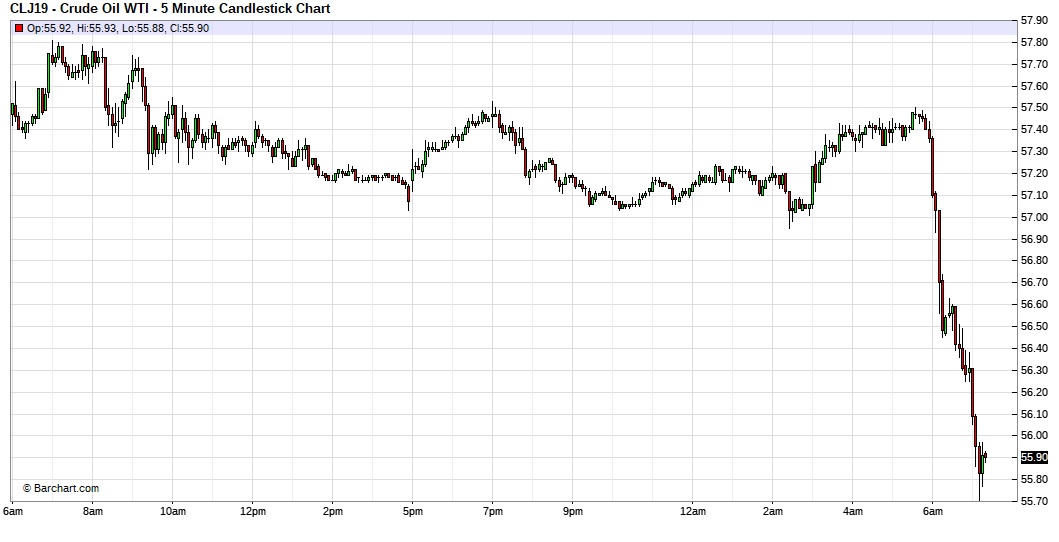
Trump on oil: The president is calling for lower oil prices; futures prices dropped on the news.
(Source: Barchart.com)

The president has been sensitive to the impact of oil prices on political popularity, although the impact of energy prices on consumer confidence is modest at best.  He is pressing OPEC to boost output.  We suspect, unlike what we saw last autumn, the cartel won’t help him this time.  In the fall, the White House pressed OPEC to increase production to offset Iranian sanctions.  However, the U.S. granted numerous countries waivers on Iranian purchases, leading to oversupply and a sharp drop in prices.  We doubt OPEC will heed the call of Washington this time around.  Thus, the drop today probably won’t hold.  In addition, we note that Mexico’s oil production has fallen to a three-decade low, which is reducing supply.[8]

The economy: The Chicago FRB released its National Activity Index today.  It’s one of our favorite indices, giving us a broad monthly look at the economy.  As the report below shows, the data isn’t pretty.  We smooth the data in the chart below to account for monthly volatility, but the report is a concern.  We note the Atlanta FRB’s GDPNow report is projecting a 1.4% increase in GDP for Q4.
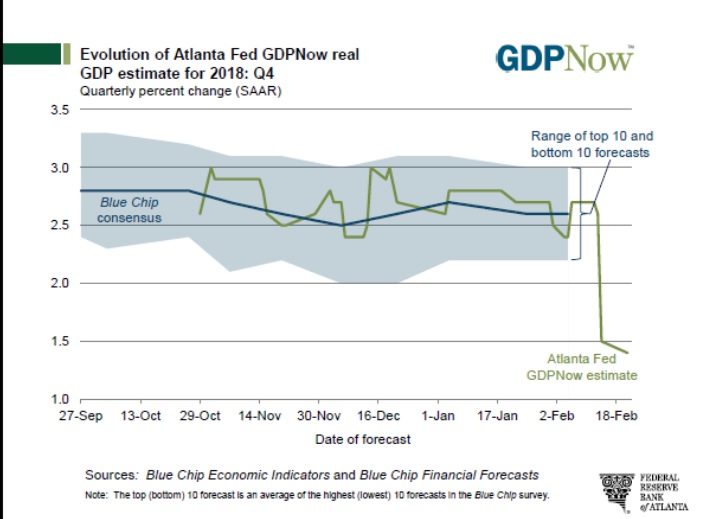
Here is the contribution table:
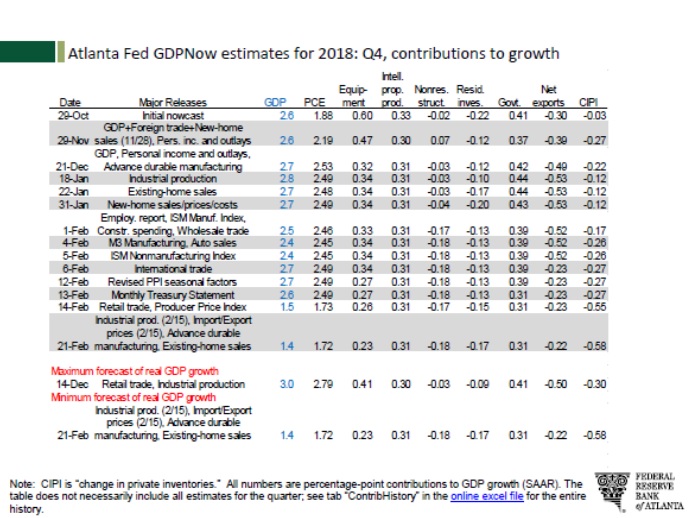
The mid-month data on retail sales, industrial production and durable goods lowered personal consumption expenditures by about 75 bps.  Falling inventories reduced it earlier by another nearly 30 bps.  We would expect Q1 to be soft as well; the FOMC’s pause appears to be well timed.

The Fed: We are in the midst of a generational change in policy management.  The 1970s were a period when the Fed accommodated inflation impulses to support full employment.  The Volcker reformation led to a focus on inflation reduction and the management of inflation expectations.  Now, there is a rethink going on at the central bank in light of the breakdown of the Phillips Curve model.[9]  New ideas include moving to an inflation target that is less fixated on short-term increases above target to targeting inflation over a longer period, which would allow for inflation “overshoots.”[10]

And, it’s not just the Fed.  We are seeing an inflation rethink across the economy.  The emergence of Modern Monetary Theory, which explicitly uses inflation to guide fiscal policy, is a sign that policymakers are thinking more broadly on deficits.  An op-ed in the NYT over the weekend suggests that deficits may not matter much anymore.[11]  Even Warren Buffet has backed down on deficits.[12]  This looks to us like the early stirrings of reflation.  In the short run, this turn won’t matter all that much but the past four decades of steadily falling inflation, falling interest rates and rising equity multiples may not be duplicated over the next four decades if this trend continues.

View the complete PDF


[1] https://www.wsj.com/articles/trump-to-delay-tariff-increases-on-chinese-imports-11551050187

[2] https://www.wsj.com/articles/officials-play-down-appearance-of-rift-between-trump-and-lighthizer-on-trade-11550974778

[3] https://www.ft.com/content/981da9c0-38ad-11e9-b72b-2c7f526ca5d0?emailId=5c737d6f8dee5d00047bf15c&segmentId=22011ee7-896a-8c4c-22a0-7603348b7f22

[4] https://www.scmp.com/news/china/diplomacy/article/2187578/cautious-optimism-beijing-us-china-trade-deal and https://www.ft.com/content/8abe631c-389b-11e9-b72b-2c7f526ca5d0?emailId=5c737d6f8dee5d00047bf15c&segmentId=22011ee7-896a-8c4c-22a0-7603348b7f22

[5] https://www.ft.com/content/e11a3f30-383f-11e9-b856-5404d3811663?emailId=5c737d6f8dee5d00047bf15c&segmentId=22011ee7-896a-8c4c-22a0-7603348b7f22 and https://www.wsj.com/articles/venezuela-opposition-calls-for-consideration-of-force-against-regime-11551040222

[6] https://www.ft.com/content/ac3aedc8-382b-11e9-b72b-2c7f526ca5d0?emailId=5c737d6f8dee5d00047bf15c&segmentId=22011ee7-896a-8c4c-22a0-7603348b7f22

[7] https://www.bloomberg.com/news/articles/2019-02-24/eu-is-said-to-mull-idea-of-proposing-brexit-extension-to-2021

[8] https://www.reuters.com/article/us-mexico-oil-pemex/mexicos-pemex-crude-output-lowest-since-records-began-idUSKCN1QC00E

[9] https://www.stlouisfed.org/from-the-president/video-appearances/2019/bullard-cnbc-inflation-monetary-policy?utm_source=twitter&utm_medium=SM&utm_content=stlouisfed&utm_campaign=faf2b8b8-21c3-41a8-aded-4ac0fcea8dba&stream=business

[10] https://www.wsj.com/articles/fed-embarks-on-a-rethink-of-its-inflation-target-11551016801

[11] https://www.nytimes.com/2019/02/23/upshot/how-america-learned-to-stop-worrying-and-love-deficits-and-debt.html?utm_source=newsletter&utm_medium=email&utm_campaign=newsletter_axiosedge&stream=business

[12]http://www.berkshirehathaway.com/letters/2018ltr.pdf?utm_source=newsletter&utm_medium=email&utm_campaign=newsletter_axiosmarkets&stream=business, see page 14
Asset Allocation Weekly (February 22, 2019)

by Asset Allocation Committee

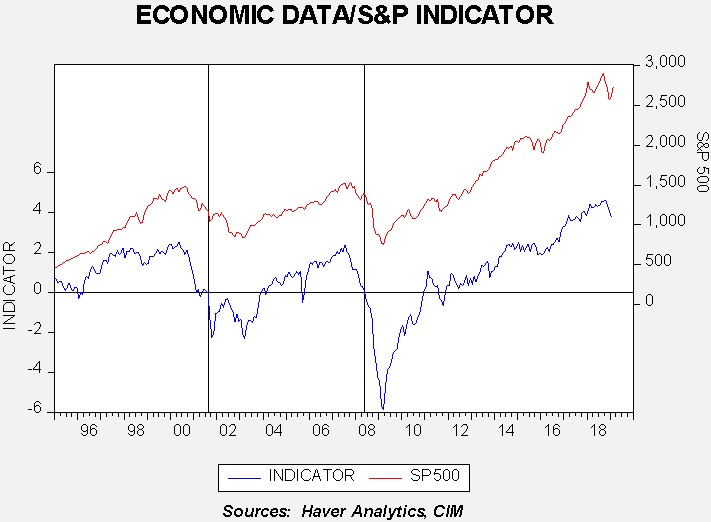
In 2017, we introduced an indicator of the basic health of the economy and added it to the many charts we monitor to gauge market conditions.  The indicator is constructed with commodity prices, initial claims and consumer confidence.  The thesis behind this indicator is that these three components should offer a simple and clear picture of the economy; in other words, rising initial claims coupled with falling commodity prices and consumer confidence is a warning that a downturn may be imminent.  The opposite condition should support further economic recovery.  In this report, we will update the indicator with January data.

This chart shows the results of the indicator and the S&P 500 since 1995.  The updated chart shows that the economy did slip late last year.  We have placed vertical lines at certain points when the indicator fell below zero.  Although it works fairly well as a signal that equities are turning lower, there is a lag.  In other words, by the time this indicator suggests the economy is in trouble, the recession is likely near or underway and the equity markets have already begun their decline.

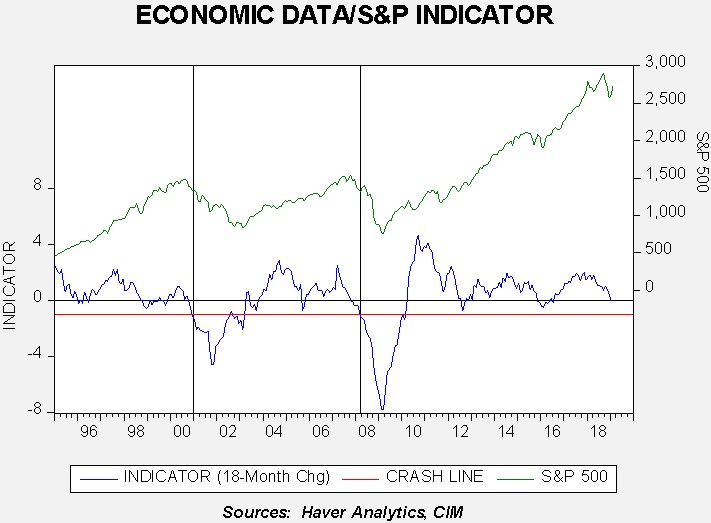
To make the indicator more sensitive, we took the 18-month change and put the signal threshold at -1.0.  This provides an earlier bearish signal and also eliminates the false positives that the zero threshold generates.  Notwithstanding, we will pay close attention when the 18-month change approaches zero as it did in January.

What does the indicator say now?  The economy has weakened but is not yet at a point where an investor should become defensive.  Breaking below the red line would be our signal to expect a broader downturn.  Most likely, we are going through a period similar to what we experienced in 2016.  If so, and the economic data begins to improve, then we should see equities turn higher in the coming months.

View the PDF

Daily Comment (February 22, 2019)

by Bill O’Grady and Thomas Wash

[Posted: 9:30 AM EDT] It’s a modest risk on day today in front of “mega Fed”—seven FOMC members will talk today.[1] Here is what we are watching this morning:

Fed minutes follow-up:  Yesterday, we noted two quotes lifted from the Fed minutes.

…several of the participants argued that rate increases might prove necessary only if inflation outcomes were higher than in their baseline outlook.

Several others indicated that if the economy evolved as they expected, they would view it as appropriate to raise the target range for the fed funds target later this year.

We argued that there appears to be a split on the board related to the relationship between inflation and growth.  Essentially, the two variables have become much less sensitive to each other.  Our take is that, due to globalization and deregulation, the aggregate supply curve has “flattened” or, technically speaking, has become more elastic, meaning that higher levels of output have only modest effects on price levels.  This change has made the conduct of monetary policy more difficult because the Fed no longer has a working model for the economy.  If supply constraints are less relevant, then the Fed has some difficult policy choices.  If faster growth doesn’t affect inflation significantly, then it would appear the Fed should only focus on inflation.  In fact, there are other important central banks in the world that operate with a single inflation mandate; the ECB is the most prominent.  However, there is a risk to this plan.  Because inflation is low, the Fed could provide too much liquidity to the economy that, instead of finding its way into the goods markets, ends up in the financial markets, creating asset bubbles.  The FOMC doesn’t have the mandate to target equity markets, although we can make a case that policy has become increasingly sensitive to volatility.[2]  But, so far, policymakers have been reluctant to aggressively use financial asset prices to set monetary policy (imagine a Fed chair testifying before Congress that “we raised rates because the P/E was too high”; although a defensible proposition, it would likely cause a political backlash).

At this juncture, we think there are three schools of thought developing at the Fed.  The first includes the diehard Phillips Curve advocates; they view the current low unemployment as a threat to price stability and argue for continued rate hikes.  They are only being pacified now due to recent economic weakness but would argue that the fed funds target should be around 3.5% to 4.0%.  The second are actually Phillips Curve advocates as well but ones who suggest the relationship has changed and we should be “patient”until we know what the new one is and allow inflation to actually develop.  We think Chair Powell is in this camp.  The third group argues that the Phillips Curve relationship was spurious, an accident of history, and therefore the Fed should target inflation alone with an eye on financial markets, either making excuses to raise rates when financial markets are frothy or pressing for macroprudential actions (e.g., raising margin debt requirements) when necessary.  What is important for our analysis is that there is no real consensus on policy right now and thus predicting the path of the fed funds target has become much more difficult.  Two articles today on this topic are worth a read.[3]

Venezuela: As noted yesterday, this weekend, the opposition is planning to move tons of donated aid across the Venezuelan borders.  Maduro has closed the border with Brazil[4] along with the sea lanes from three Caribbean islands.[5]  There could be violence.[6]  If there is, we will be watching to see how the Trump administration reacts.[7]  In other news, Hugo Carvajal, the former head of intelligence, has turned against the Maduro regime.[8]

Trade talks: President Trump will meet with China’s trade envoy, Liu He,[9] this afternoon.[10]  As we noted yesterday, there are hopes that the Memorandum of Understanding (MOU) will come at the culmination of talks.[11]

Brexit: PM May is trying to prevent other soft Brexit Conservatives from leaving her party to join the new centrist group.[12]  The departure of three MPs has complicated May’s ability to hold her coalition together; in some respects, the Tory Party is a bit more hard Brexit-leaning, especially since the DUP is critical to her majority.  As we have argued all along, May will likely have to decide if she either wants a soft Brexit and a generationally damaging split in the Conservative Party or a hard Brexit and party unity.  However, we may be wrong on this argument; May could end up losing both, ending up with a hard Brexit and the end of the Conservatives. [13]  There are rumors the EU will give May a 90-day extension; we don’t see how that will make conditions better but it does suggest the EU is equally worried about a hard Brexit.

Trouble down under: Yesterday, we discussed how China is putting pressure on both New Zealand and Australia.  There were reports that China’s Dalian port has banned Australian coal imports.[14]  China has indicated today that the ban news isn’t true.[15]  So, we will continue to watch this issue to see how it progresses.

Elections in Spain: PM Pedro Sanchez[16] has called for snap elections on April 28 after the Spanish Congress rejected his budget.[17]  However, the budget isn’t really the issue of this election—it’s Catalonia.  Sanchez tried a different tactic with Catalonian separatists compared to the previous conservative administration.  The latter used imprisonment to try to stop the movement; Sanchez tried negotiating.  Neither one worked.  This is the third election in Spain in three and a half years.  Spanish politics reflects what we are seeing across the West—parties and political alliances are fraying and new configurations are forming.  We doubt the upcoming elections will resolve these underlying tensions.

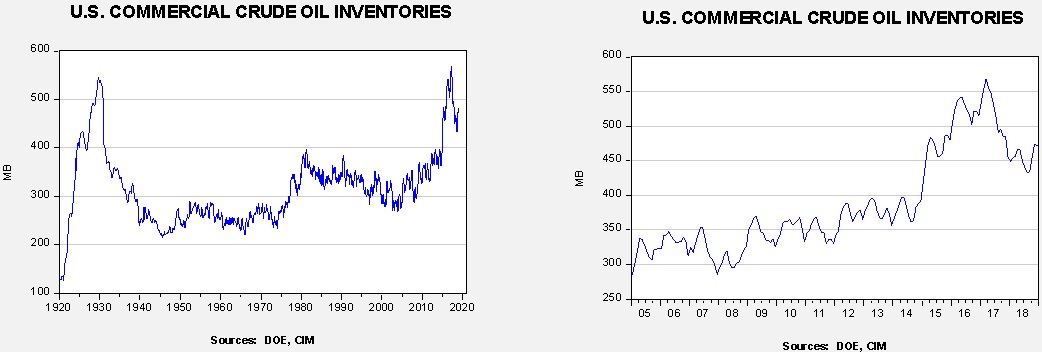
Energy update: Crude oil inventories rose 3.7 mb last week compared to the forecast rise of 3.1 mb.

In the details, estimated U.S. production rose 0.1 mbpd, reaching a new record of 12.0 mbpd.  Crude oil imports rose by 0.7 mbpd, while exports jumped 1.3 mbpd.  Refinery runs were unchanged, as forecast.

(Source: DOE, CIM)

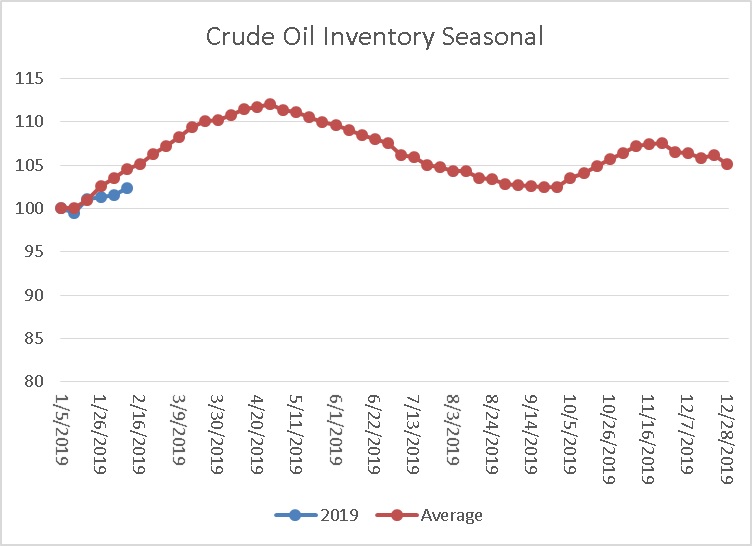
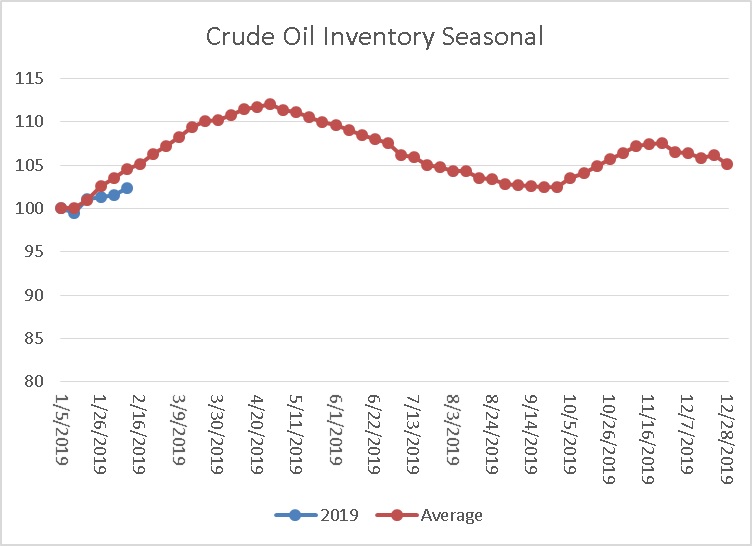
This is the seasonal pattern chart for commercial crude oil inventories.  We would expect to see a steady increase in inventories that will peak in early May; the pattern coincides with refinery maintenance.  Note that inventories are rising at a slower pace than normal.  This is mostly due to crude oil exports.  If this slow pace continues, it would be a bullish factor for oil prices.

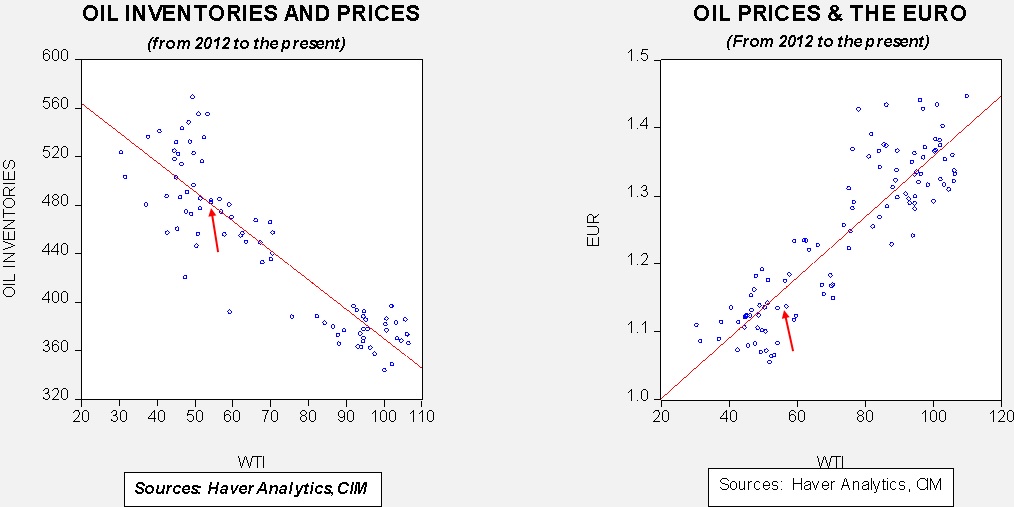
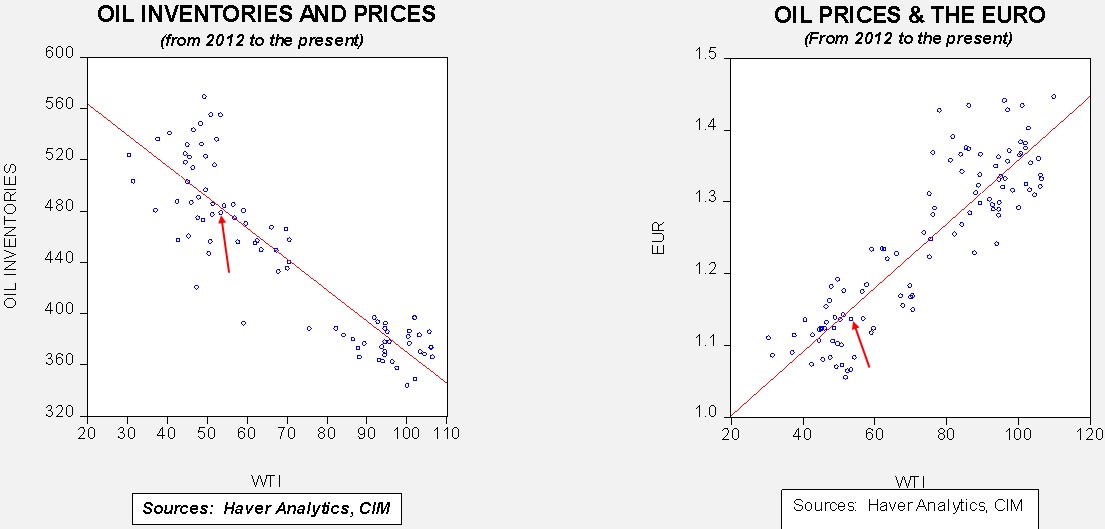
Based on oil inventories alone, fair value for crude oil is $57.10.   Based on the EUR, fair value is $53.97.  Using both independent variables, a more complete way of looking at the data, fair value is $54.22.  By all these measures, current oil prices are roughly in the area of fair value.  If inventories continue to rise, as the seasonal pattern would suggest, we might see oil prices correct modestly in the coming weeks.  But, we still look for $60 prices through the summer.

View the complete PDF


[1] https://finance.yahoo.com/news/fedspeak-frenzy-what-to-know-in-markets-friday-231055151.html

[2] See Asset Allocation Weekly, 1/11/2019.

[3] https://www.ft.com/content/66087f76-35f3-11e9-bd3a-8b2a211d90d5 and https://www.reuters.com/article/us-usa-fed-pivot-insight/a-fed-pivot-born-of-volatility-missteps-and-new-economic-reality-idUSKCN1QB0IK

[4] https://www.nytimes.com/2019/02/21/world/americas/venezuela-aid-block-brazil.html

[5] https://www.nytimes.com/2019/02/20/world/americas/venezuela-borders-aid.html?module=inline

[6] https://www.axios.com/newsletters/axios-am-bc3c4888-ea2b-4248-9e96-63848bdf9912.html?chunk=6#story6 and https://www.ft.com/content/8149fad0-34c2-11e9-bd3a-8b2a211d90d5 and https://www.crisisgroup.org/latin-america-caribbean/andes/venezuela/high-noon-over-humanitarian-aid-venezuelas-border?utm_source=Sign+Up+to+Crisis+Group%27s+Email+Updates&utm_campaign=6f7a3251b7-EMAIL_CAMPAIGN_2019_01_18_03_54_COPY_01&utm_medium=email&utm_term=0_1dab8c11ea-6f7a3251b7-359779305

[7] https://www.nytimes.com/2019/02/18/world/americas/venezuela-guaido-maduro-trump.html?module=inline

[8] https://www.nytimes.com/2019/02/21/world/americas/hugo-carvajal-maduro-venezuela.html

[9] https://www.wsj.com/articles/u-s-bets-on-chinas-special-envoy-in-trade-talks-11550795104

[10] https://www.bloomberg.com/news/articles/2019-02-21/trump-is-said-to-plan-meeting-with-china-s-trade-chief-on-friday

[11] https://www.scmp.com/news/china/diplomacy/article/2187195/new-round-us-china-trade-talks-begin-washington-eye-toward

[12] https://www.ft.com/content/51712a20-35b9-11e9-bb0c-42459962a812?emailId=5c6f6b5a71c75900040856cf&segmentId=22011ee7-896a-8c4c-22a0-7603348b7f22

[13] https://www.ft.com/content/b662b452-35e7-11e9-bd3a-8b2a211d90d5

[14] https://www.reuters.com/article/us-china-australia-coal-exclusive/exclusive-chinas-dalian-port-bans-australian-coal-imports-sets-2019-quota-source-idUSKCN1QA0F1

[15] https://www.reuters.com/article/us-china-australia-coal/china-says-australian-coal-imports-remain-normal-canberra-seeks-to-calm-investors-idUSKCN1QA2US

[16] Not this Pedro Sanchez https://www.youtube.com/watch?v=BD5F7KFhZfA

[17] https://www.politico.eu/article/spains-sanchez-calls-snap-election-on-april-28/

Daily Comment (February 21, 2019)

by Bill O’Grady and Thomas Wash

[Posted: 9:30 AM EDT] U.S. equity futures are steady this morning in quiet trading. There is some optimism, however, on the China/U.S. trade talks and on the Fed’s balance sheet.  European and Japanese PMIs were disappointing, suggesting weaker global growth, and the Philly Fed was very weak (see below).  Here is what we are watching this morning:

Fed minutes: Although the bulk of the market chatter seemed to be around the balance sheet, we view that discussion as mostly sterile—there isn’t much evidence to show that QE helped the real economy and there isn’t much to suggest that QT has impeded it either.  Here are the two items we find interesting, shown by these quotes:

…several of the participants argued that rate increases might prove necessary only if inflation outcomes were higher than in their baseline outlook.

Several others indicated that if the economy evolved as they expected, they would view it as appropriate to raise the target range for the fed funds target later this year.

Chair Powell now has a committee divided over a basic issue.  The first entry suggests that the FOMC should only pay attention to inflation and ignore the growth path.  These members probably hold the position that the Phillips Curve is no longer relevant and the central bank should only focus on inflation.  The members mentioned in the second entry likely still hold to a Phillips Curve model and thus stronger growth should trigger tighter policy even in the absence of rising inflation.  That’s because the Phillips Curve, at its core, maintains that the loss of slack in the economy will eventually lead to higher prices.  Although it makes intuitive sense, globalization and deregulation seem to have flattened supply curves to the point where even if the Phillips Curve relationship holds it isn’t very powerful.

We suspect Powell is in the former camp.  If so, he will likely press to keep policy steady until actual evidence of inflation occurs.  Usually, the chair has some sway with the committee and may be able to keep the number of dissents manageable, but divisions will be something to watch in the coming months.  As long as growth is lackluster and inflation tame, the divisions probably won’t be evident.  Still, they might develop at some point and then we may see a spate of dissents that could undermine Powell.

Venezuela: This weekend, the opposition is planning to move tons of donated aid on Saturday.  Maduro has closed the borders.  There could be violence.[1]  If there is, we will be watching to see how the Trump administration reacts.

On the issue of Venezuelan debt, according to a report from the FT,[2] the opposition leader in Venezuela, Juan Guaido, has approached Lee Buchheit, a sovereign workout specialist who recently retired from a major law firm that specializes in this area.  Buchheit proposed that the best way for Venezuela to work out of its debt situation is for the government to “ring fence” its petroleum-related assets in the U.S.  Venezuelan debt lacks collective action clauses so a small group of creditors could seize Venezuelan assets in the U.S. and effectively prevent any significant restructuring.  The U.S. and the U.N. did something similar with Iraqi debt after the fall of Saddam Hussein, with the UNSC issuing a directive forbidding all U.N. members from attaching or seizing any Iraqi assets.  President Bush also issued an Executive Order doing the same thing in 2004, and did so every year of his presidency.  President Obama followed Bush’s lead by extending the ban through 2014.

These orders were devastating for bondholders.  Essentially, bondholders received about 10 cents on the dollar for the Hussein-era debt they held.  Needless to say, Venezuelan creditors are cool to this plan, claiming that it will deny the new government access to capital.  Although it will do so for a while, in our experience,[3] new lenders always appear even after default and workout.  At first blush, if the U.S. were to implement such a plan, it would not get support in the UNSC because China and Russia can veto any proposals.  However, if the president were to sign an Executive Order preventing creditors from attaching Venezuelan assets in the U.S. and use the threat of military force to prevent foreign creditors from being physically able to control collateral assets in Venezuela, then it could force China and Russia to accept sharply reduced settlements on their debt.

Trade talks: There is evidence of progress on the U.S./China front.  This morning, there are reports that China will boost agricultural imports.  The two sides are putting together an outline of commitments on various issues in a Memorandum of Understanding (MOU).[4]  We suspect the outline and MOU will be out before the March 1 deadline, but we doubt this will be the culmination of talks.  Instead, the MOU will be a roadmap to further negotiations that will likely stretch into next year.  In the end, we doubt the substantial issues will ever be decided.[5]  At the same time, both sides need an immediate deal[6] even if it falls short of a comprehensive agreement.

On the EU front, it appears the Trump administration is turning up the pressure, threatening auto tariffs.[7]  Getting a deal with Europe will be difficult; the Europeans want to avoid auto restrictions, which would deeply hurt German automakers,[8] and the U.S. wants open trade on agriculture, which would disrupt the EU’s carefully negotiated Common Agricultural Policy.  At the same time, U.S. auto nameplates are protected by a 25% tariff on light trucks[9] that would go away under conditions of free trade.

Financial markets have mostly discounted a trade deal with China, but a resumption of trade hostilities with the EU isn’t currently in prices.  Thus, if this conflict heats up, it could put pressure on the current equity rally.

Brexit: Although there is nothing concrete, we may be seeing some movement on both sides of the Channel.[10]  The EU appears sensitive to U.K. concerns about the Irish backstop being temporary in name but eternal in practice.  It appears the goal is to show enough movement for Brexit supporters to go along with May’s original agreement but without so much change to force the EU to hold another vote.  Meanwhile, the splinter group has added another member, a Labour Party defector.[11]

Trouble down under: China is putting pressure on both New Zealand and Australia over the Huawei (002502, Shenzhen, CNY, 4.01) issue and other concerns.  China’s Dalian port has banned Australian coal imports,[12] and China has also threatened New Zealand.[13]  China is a key customer for both countries and it appears Beijing is using that position to influence policy in both nations.  Australia has been a favored destination for Chinese capital flight and the Xi government would probably like to press Canberra to extradite Chinese citizens trying to flee the clutches of the Communist Party of China.  It is important to note that Australia and New Zealand are members of the “five eyes” network, an alliance of English-speaking nations (U.S., U.K., Australia, New Zealand and Canada) that share intelligence.  The U.S. is particularly worried that any of these nations using Huawei equipment could be subject to hacking by the Chinese government, allowing it to gain access to the shared intelligence of the five eyes group.

The Mueller investigation: For the most part, we have not commented on the investigation because financial markets have mostly ignored it.  That doesn’t mean we haven’t been monitoring developments, but we didn’t believe it made sense to weigh in on a controversial topic that wasn’t affecting “our lane.”  However, there are reports that the investigation may be wrapping up soon[14] and a report could be issued to the DOJ in a few weeks.  We won’t speculate on what it may contain but it could have information that might affect market sentiment.  If so, we will address this issue once it becomes a market factor.

View the complete PDF


[1] https://www.axios.com/newsletters/axios-am-bc3c4888-ea2b-4248-9e96-63848bdf9912.html?chunk=6#story6 and https://www.ft.com/content/8149fad0-34c2-11e9-bd3a-8b2a211d90d5

[2] https://ftalphaville.ft.com/2019/02/19/1550575804000/A–nuclear-option–to-resolve-Venezuela-s-debt-woes/

[3] Bill was a country risk analyst at a bank that did international lending and was involved in the Brady bonds and debt/equity swaps in the late 1980s.  Most of the affected nations were able to access the credit markets within five years or less.

[4] https://finance.yahoo.com/news/exclusive-u-china-sketch-outlines-024419838.html

[5] https://www.ft.com/content/79d8e466-342f-11e9-bd3a-8b2a211d90d5?emailId=5c6e34726220f700040cf3c1&segmentId=22011ee7-896a-8c4c-22a0-7603348b7f22

[6] https://www.wsj.com/articles/warriors-on-trade-trump-and-xi-face-a-similar-challenge-at-home-11550709127

[7] https://www.wsj.com/articles/trump-continues-to-weigh-eu-auto-tariffs-11550693479

[8] https://www.ft.com/content/9aea1f38-352b-11e9-bd3a-8b2a211d90d5?emailId=5c6e34726220f700040cf3c1&segmentId=22011ee7-896a-8c4c-22a0-7603348b7f22

[9] https://en.wikipedia.org/wiki/Chicken_tax

[10] https://www.ft.com/content/5c0c3c70-3548-11e9-bb0c-42459962a812

[11] https://www.ft.com/content/c71397c0-352f-11e9-bd3a-8b2a211d90d5

[12] https://www.reuters.com/article/us-china-australia-coal-exclusive/exclusive-chinas-dalian-port-bans-australian-coal-imports-sets-2019-quota-source-idUSKCN1QA0F1

[13] https://www.nytimes.com/2019/02/14/world/asia/new-zealand-china-huawei-tensions.html

[14] https://www.washingtonpost.com/world/national-security/justice-department-preparing-for-mueller-report-in-coming-days/2019/02/20/c472691c-354b-11e9-af5b-b51b7ff322e9_story.html?utm_term=.c53d26a2710a

Daily Comment (February 20, 2019)

by Bill O’Grady and Thomas Wash

[Posted: 9:30 AM EDT] It’s mid-week (already!).  Global equities are stronger this morning and U.S. equity futures are flat.  Here is what we are watching this morning:

More U.K. defections: Yesterday, we reported that seven Labour MPs left their party to form a new centrist party, called the Independent Group.  Today, three Tory MPs left their party to join them.[1]  May’s coalition of Tories and the DUP gives her a narrow majority of two seats; her party holds 317 seats and the DUP 10.  The loss of three MPs actually puts her now in the minority and thus makes her vulnerable to a no-confidence vote.  However, given that she has survived one no-confidence vote already,[2] we doubt another one will come anytime soon.  But, for now, it does appear she is operating a minority government.

Brexit: May is on her way to Brussels for more negotiations.[3]  This looks to us as a “going through the motions” exercise but May is probably hoping for language on the Irish backstop that might mollify her coalition.  It isn’t likely.  On the backstop issue, May officially scotched a rather odd plan from Brexit Conservatives to create a high tech border control mechanism on the Ireland frontier that would act as an invisible customs monitor.[4]  Since the technology doesn’t currently exist, it was rather easy to put it to rest.  Brexit is steadily progressing toward next month’s deadline.  May’s tactics appear to be to run out the clock and leave MPs with one of two options, either her plan or a catastrophic hard Brexit.  The MPs are trying hard to avoid that difficult choice but they don’t have an alternative plan.  However, there is one increasingly obvious downside—businesses are quitting the U.K. on fears of a hard Brexit.[5]

Fed: The FOMC releases the minutes of its most recent meeting today.  We will pore over the report for any clues about policy but we don’t expect too much new information.  Although we expect some caution that the markets may have become too sanguine on rate expectations,[6] what we are hearing from Fed officials suggests the committee is rather comfortable with leaving rates about where they are now.[7]  In fact, most of the focus has now, for better or worse, shifted to the balance sheet.  Our position is that the balance sheet’s effect has mostly been psychological.

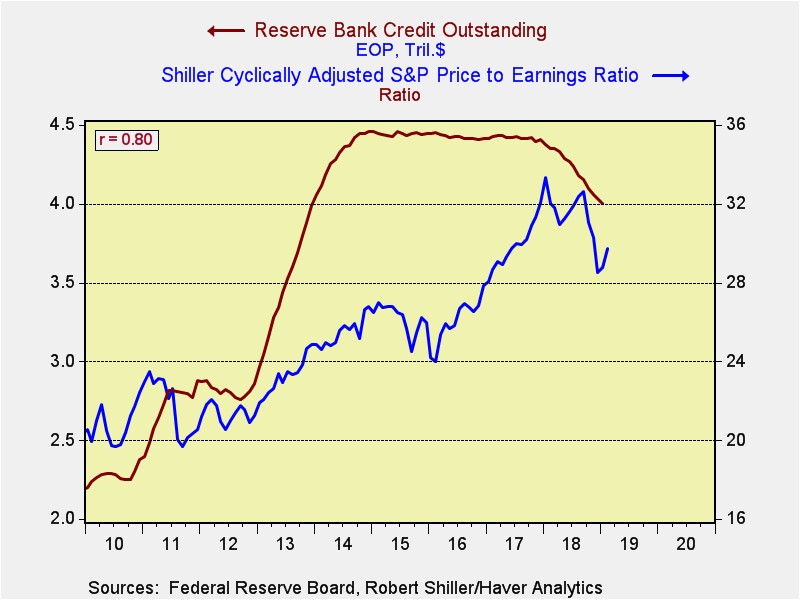
This chart overlays the CAPE with the Fed’s balance sheet.  Since the last recession, the two tended to track each other, although expectations of tax reform did lead to a large rise in the multiple in late 2016 through 2017.  Note that the P/E has declined as the balance sheet has contracted.  There are obviously other factors that contributed to the multiple contraction.  Fears of a trade war are part of the contraction and the CAPE, which uses the 10-year average of earnings, is rolling off the 2008 earnings drop, thus lifting the “E.”  But, we would argue that the balance sheet did contribute to weakening investor sentiment.  Thus, if the FOMC signals an end to QT, it would be reasonable to expect a rise in P/E.

Trade: According to reports, China’s lead negotiator, Vice Premier Liu He, is planning to discuss a memorandum of understanding (MOU) with U.S. negotiators.  Such a document would be a clear signal that an agreement was reached.  The fact that Liu was given the authority to make a MOU would suggest that China is serious about a deal.[8]  President Trump has signaled some flexibility by making the March 1 deadline somewhat optional.[9]  The U.S. is pressing China to promise to not use its exchange rate as a tool to manage its trade issues.[10]  However, former Fed Chair Yellen cautions that such promises may not be possible to keep.[11]

Huawei (002502, CNY 4.09) and the Europeans: The U.S. is working to prevent Huawei from selling its products to allies.  However, Europe is cool to cooperating with Washington.  The U.K. has indicated that it views the risks to using the Chinese company’s products for 5G as “manageable”[12] and Germany has indicated it may buy the company’s products.[13]  We expect this issue to become increasingly complicated.  The U.S. will likely threaten not to do a free trade deal with the U.K. after Brexit if London goes down this path and may use the car tariff threat against Germany to accomplish its goal with Huawei.

A curious report out of China: A Chinese blogger reports that local governments in China are banning price cuts on housing.  Price cuts on unsold inventory have been a source of unrest in China; households that bought at a higher price face an immediate decline in wealth if the prices on new homes fall.  Thus, local governments appear to be signaling to developers that they cannot engage in price cuts to clear inventory.[14]

Purges in the Hermit Kingdom: Reports indicate that Kim Jong-un has purged between 50 and 70 wealthy and high-ranking officials.  Some of this action appears to be a simple shakedown.  North Korea has been gradually and quietly using markets to boost the economy but the regime likely fears that if some people get too wealthy they may opt to gain political power.  In addition, the regime may need money and therefore the crackdown is a rather harsh form of taxation.  Some of the crackdown does appear to be aimed at critics who oppose talks with the U.S.  To some extent, the purges probably indicate that the regime does want to improve relations with the U.S. and Kim wants to ensure that he can make changes without opposition.[15]

And, finally:There are some pundits who don’t really offer any penetrating insights but are important for their signaling.  We tend to view Tom Friedman at the NYT in this light.  His insights are rarely penetrating but he says them well and we use them as signals of elite consensus.  In other words, he is almost never in front of anything, but when he says something it officially becomes common knowledge.  In today’s NYT, he has an op-ed suggesting that the U.S. now has four political parties.[16]  Friedman, a spokesman for the center-left elite, hammers the populist left in his article.  Of course, he hits at the populist right and the center-right as well.  The analysis in the article doesn’t break any new ground, but the fact that he wrote it is important—it is now common knowledge that the political system is split and the fragile populist/elite coalitions of the past four decades are no longer holding (and, for what it’s worth, in our opinion the divide began in 2008).

View the complete PDF


[1] https://www.ft.com/content/4bd129da-3500-11e9-bd3a-8b2a211d90d5

[2] https://www.nytimes.com/2019/01/16/world/europe/brexit-theresa-may-no-confidence-vote.html

[3] https://www.bloomberg.com/news/articles/2019-02-19/britain-targets-brexit-deal-within-days-as-may-heads-to-brussels

[4] https://www.ft.com/content/93745dd2-3476-11e9-bb0c-42459962a812

[5] https://www.politico.eu/article/the-day-project-fear-got-real/?utm_source=POLITICO.EU&utm_campaign=9cb3b43de9-EMAIL_CAMPAIGN_2019_02_20_05_44&utm_medium=email&utm_term=0_10959edeb5-9cb3b43de9-190334489

[6] https://www.wsj.com/articles/investors-sound-warning-about-markets-complacency-on-interest-rates-11550588400

[7] https://www.reuters.com/article/us-usa-fed-williams-exclusive/exclusive-feds-williams-says-new-economic-outlook-necessary-for-rate-hikes-idUSKCN1Q82KL

[8] https://www.scmp.com/news/china/diplomacy/article/2186735/chinese-vice-premier-liu-he-set-washington-talks-week-latest?li_source=LI&li_medium=home-top-picks-for-you

[9] https://www.reuters.com/article/us-usa-trade-china-deadline/trump-says-march-1-deadline-for-china-trade-talks-not-magical-date-idUSKCN1Q82HD

[10] https://www.bloomberg.com/news/articles/2019-02-19/u-s-said-to-press-china-for-stable-yuan-as-trade-talks-progress

[11] https://www.bloomberg.com/news/articles/2019-02-19/yellen-offers-caution-as-u-s-pushes-china-to-keep-yuan-stable?srnd=markets-vp

[12] https://www.ft.com/content/619f9df4-32c2-11e9-bd3a-8b2a211d90d5

[13] https://www.wsj.com/articles/in-rebuke-to-u-s-germany-considers-letting-huawei-in-11550577810

[14] http://investinginchinesestocks.blogspot.com/2019/02/big-trouble-in-china-housing-govt-bans.html

[15] https://www.wsj.com/articles/kim-jong-un-purges-north-korean-elite-in-violent-crackdown-11550593810

[16] We discussed the issues of identity and class in the WGR series, Reflections on Politics and Populism: Part I (7/16/2018) and Part II (7/23/2018).

Daily Comment (February 19, 2019)

by Bill O’Grady and Thomas Wash

[Posted: 9:30 AM EDT] Welcome back!  The three-day weekend is now past and it’s back to work.  Global equities are weaker this morning and U.S. equity futures are too.  Here is what we are watching this morning:

The world goes dovish: The FOMC is reconsidering its balance sheet policy[1] and it looks like the reduction will end sooner than originally planned.  It also appears the rate policy is on hold.  But, the Fed isn’t the only central bank considering easier policy.  The BOJ warns that a weaker JPY could trigger additional stimulus,[2] the ECB says it will react to slowing growth[3] and the PBOC is signaling further stimulus.[4]  Where will all this lead?  We wonder if the actions of foreign central banks are hinging on preventing dollar weakness.  If the world’s central banks all move to stimulate growth, we would expect gold to benefit.

Trade: Trade talks with China resume this week.  Although the administration’s policy is designed to change America’s trade relationship,[5] this goal is running into the issue of the 2020 elections.  A change in policy that puts up trade barriers to reduce inequality will have an adverse effect on the economy, at least initially, while the system recalibrates.  If that coincides with the election, it could doom the president’s hopes for reelection.  Thus, we expect the president to take a deal rather than the comprehensive agreement trade hawks are hoping for.  However, if we are wrong and the president stays the course, then the economy could face a shock that would weaken growth and undermine market confidence.

Taiwan tensions: Although they never really go away, we are seeing rising tensions between China and Taiwan.[6]  When the Nationalists fled to the island after Mao won the mainland, both governments maintained that they were the legitimate government of China.  However, as the years have passed, more people in Taiwan view themselves not as Chinese but as Taiwanese.  Beijing views Taiwan as a renegade province.  For the most part, both governments deploy strategic ambiguity to maintain peace.  But, Chairman Xi has made nationalism part of his governing strategy and thus he is becoming increasingly intolerant of Taiwan’s defiance.  We note the U.S. is increasing freedom of navigation patrols in the South China Sea,[7] which may be in response to the idea that Taiwan could be in peril.

Labour splinters: Although the numbers aren’t large, we note that a group of seven MPs broke off from the Labour Party over Corbyn’s policy on Brexit.[8]  The group isn’t big enough at this point to change Corbyn’s policy path, but it could grow, and it highlights the growing divergence in British politics between those who want to stay in the EU and those who wish to leave.  And, that divergence cuts across party lines.

Return of the populists: This morning, Vermont Senator Bernie Sanders announced he is running for president again in 2020.  This announcement came as a surprise to no one as it was widely speculated that he was going to run again after falling short against Secretary Hillary Clinton in 2016.  To say this time is different would be a bit of an understatement.  Last election cycle, Bernie Sanders’s brand of left-wing populism led many to label him as a fringe candidate.  Today, however, left-wing populism has become mainstream in the Democratic Party.  As of now, there are several candidates who have already announced or are presumed to be considering a run for the Democratic nominee.  The list includes Elizabeth Warren, Sherrod Brown, Kamala Harris, Joe Biden, Julian Castro, Amy Klobuchar, Corey Booker and Kirsten Gillibrand.  There is no clear favorite at this time, but Bernie Sanders is widely considered to be a front-runner.  It is possible there will be no centrist nominee for president in 2020; we doubt financial markets will take that outcome well.

View the complete PDF


[1] https://www.ft.com/content/14f833ee-3173-11e9-8744-e7016697f225

[2] https://www.bloomberg.com/news/articles/2019-02-19/kuroda-says-stronger-yen-could-force-boj-s-hand-on-stimulus

[3] https://www.bloomberg.com/news/articles/2019-02-18/praet-says-ecb-could-change-rate-guidance-if-outlook-worsens

[4] https://www.reuters.com/article/us-china-pboc-perpetuals/china-pledges-more-support-for-banks-perpetual-bonds-to-boost-lending-idUSKCN1Q80BG

[5] See WGRs, The Malevolent Hegemon: Part I (11/26/2018), Part II (12/3/2018) and Part III (12/10/2018).

[6] https://www.washingtonpost.com/opinions/2019/02/18/chinas-xi-jinping-is-growing-impatient-with-taiwan-adding-tensions-with-united-states/?utm_term=.3fd403ceec33

[7] https://www.scmp.com/news/china/diplomacy/article/2186461/us-steps-freedom-navigation-patrols-south-china-sea-counter

[8] https://www.ft.com/content/924b9286-335e-11e9-bb0c-42459962a812?emailId=5c6b85d15495b7000468513c&segmentId=22011ee7-896a-8c4c-22a0-7603348b7f22

Asset Allocation Weekly (February 15, 2019)

by Asset Allocation Committee

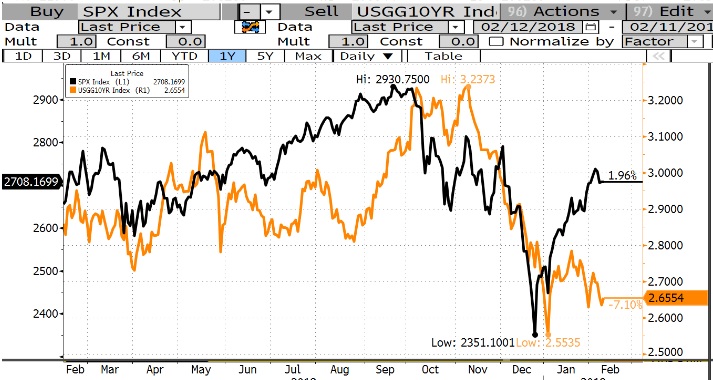
The pullback in equities in Q4 coincided with a sharp drop in long-duration Treasury yields.  However, the recovery seen in early 2019 has not led to a rise in yields.

(Source: Bloomberg)

This chart shows the S&P 500 (left axis) and the 10-year T-note yield (right axis).  Note that yields and the equity markets tended to rise together in the first three quarters of 2018.  More importantly, they tracked each other in the fourth quarter; as equity values fell, yields also declined.  However, as equities have recovered since late December, yields have not rebounded into the range where they were when the S&P was around 2700.

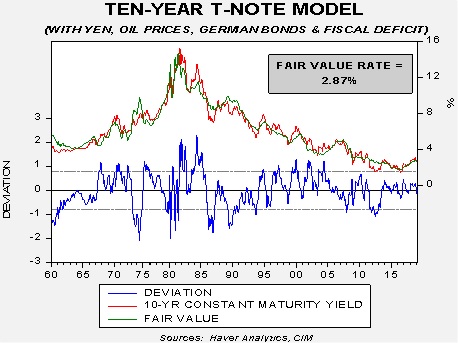
In part, yields are currently running below fair value.

This chart shows our bond model; the core variables are fed funds and the 15-year average of CPI.[1]  In addition to these variables, we add the JPY/USD exchange rate, crude oil prices, German 10-year sovereign yields and the Federal deficit/GDP ratio.  The market would not be “rich” in this model until yields approach 2.17% but they are modestly below fair value after being above fair value for most of last year.

There are thee variables that account for the decline in the 10-year T-note yield, fed funds, German sovereign 10-year yields and oil prices.  In October, the 10-year T-note yield was running around 3.15%.  That level had discounted oil prices at $60 per barrel, German yields at 20 bps and a terminal fed funds rate of 3.25%.  The decline in the fed funds estimate to 2.50% accounted for 30 bps in the decline in yield, while the remaining 3 bps to fair value came from the decline in oil prices to $55 per barrel and German 10-year sovereign yield declines to 14 bps.

The “undershoot” to 2.70, below the fair value of 2.87%, could be achieved with a fed funds of 2.12%.  Given that the actual target is the mid-point between the upper and lower bound of the fed funds target (the announced rate is actually the upper bound), this would imply a rate cut.  Or, a decline in inflation expectations to 1.8% from 2.1% could also account for the undershoot, assuming no change in fed funds.

We suspect the primary reason for the slide is that inflation expectations have probably fallen.  This is because there isn’t much in the data to support the FOMC cutting rates.

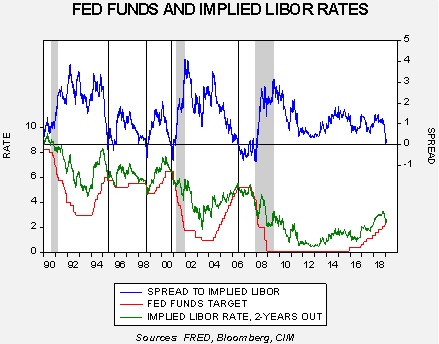
This chart compares the fed funds target to the implied three-month LIBOR rate from the two-year deferred Eurodollar futures contract.  History shows that policymakers tend to stop raising rates when the spread between these two rates invert.  As the spread line shows, the spread is near inversion which is consistent with a policy pause but would not be consistent with rate declines.  Policy cuts would be in order if the implied yield were to fall further, but that evidence doesn’t exist for now.

If inflation expectations are leading to the undershoot, then stronger economic growth could trigger a rise in inflation fears.   We would not be surprised to see a modest rise in yields in the coming weeks, but a rise beyond 3.00% on the 10-year T-note yield would likely require a return to policy tightening by the FOMC.  We would not expect such a shift until later this year, if then.

View the PDF


[1] Which is a proxy for inflation expectations.

Daily Comment (February 15, 2019)

by Bill O’Grady and Thomas Wash

[Posted: 9:30 AM EDT] U.S. equity futures are steady to higher this morning in quiet trading.  There is some optimism on the China/U.S. trade talks and on the Fed’s balance sheet.  Here is what we are watching this morning:

Trade talks: Although there isn’t much evidence of real progress (e.g., no memorandum of understanding emerged),[1] the two sides are continuing to talk[2] and President Trump has indicated that he is willing to extend the deadline.  Treasury Secretary Mnuchin described the talks as “positive,” which was seconded by Larry Kudlow.[3]  Both have been dovish on Chinese trade; no such characterization came from USTR Lighthizer, a trade hawk.  Chairman Xi also lauded progress on talks.[4]  There are reports that China will offer to end subsidies to Chinese exporters but, so far, such plans lack details.[5]  Other reports suggest China really hasn’t moved on exporter subsidies or forced technology transfers but is making the usual offer of large purchases in a bid to end trade pressure.[6]  Our expectation hasn’t changed.  President Trump needs to avoid a trade war with China because it will weaken the U.S. economy going into the critical election year in 2020.  Thus, we expect a deal but not the deal that would really change China’s behavior.

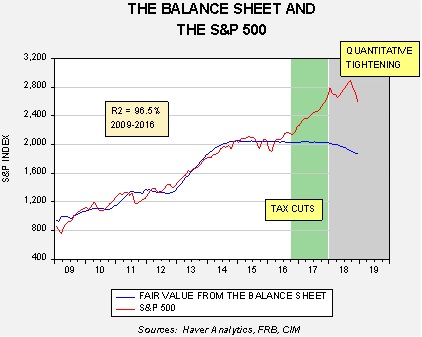
The balance sheet: The Fed’s balance sheet is a controversial topic.  There has been a good bit of market consternation about the reduction of the balance sheet, or quantitative tightening (QT).  Our research has suggested that the impact of quantitative easing (QE), or the expansion of the Fed’s balance sheet, was mostly psychological; if the FOMC was seen as out of tools after fed funds reached zero percent, the perception likely would have led to market panic.  However, the impact on the real economy (impact on interest rates, lending behavior) from QE was nil.  Still, it clearly did affect investor sentiment.[7]  This chart shows why QT has become such a hot topic.

This chart shows the S&P 500 along with the fair value from a regression where the S&P is the dependent variable and the balance sheet is the independent variable.  The match between the two series is very tight from 2009 to 2016, with an R2 of 96.5%.  Equities departed from the model during the discussion of tax cuts after President Trump’s election but now that the tax cuts have passed, the focus appears to have returned to the balance sheet just in time for QT.  Again, if the impact of the balance sheet is psychological, it makes sense that its reduction would have an impact on investor sentiment.

Governor Brainard indicated yesterday that the FOMC may be winding down QT much sooner than the markets expected.[8]  That news would be supportive for equities if true.

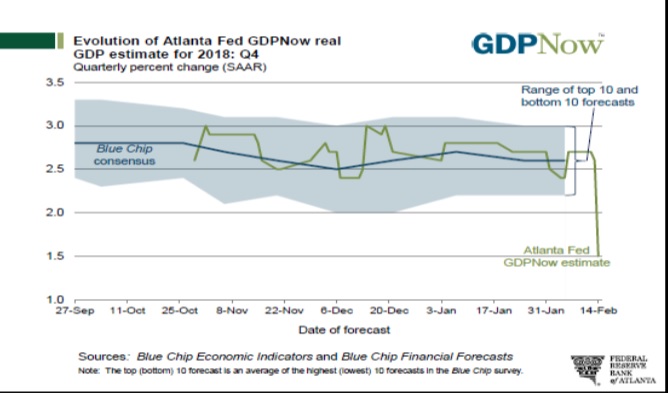
Q4 looking soft: The Atlanta FRB GDPNow forecast for Q4 has plunged to 1.5%, being hit by the soft retail sales data released yesterday.

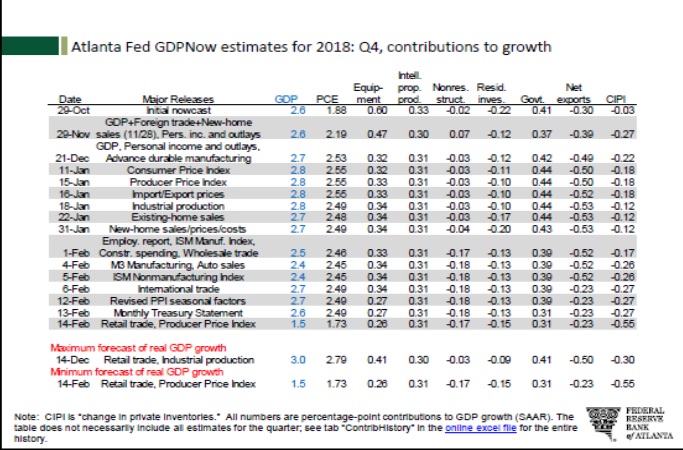
The contribution to growth table shows that the slide in consumption was the primary culprit for the forecast downgrade.

If this forecast holds, the odds of the Fed moving rates higher will likely be off the table until H2, if it occurs at all.  Today’s IP data (see below) will likely depress the forecast further.

Brexit:  In what appears to be a classic “own goal,” PM May suffered yet another Parliamentary defeat on a bill that was non-binding.  The bill was an endorsement of the government’s ability to negotiate with the EU and show EU negotiators that May had the support of the legislature.  May wanted the vote to show the EU that she could bring a deal to fruition if they were more flexible.  It failed 303-258.[9]  Financial markets still believe that a hard Brexit will be avoided.  If it is, it looks increasingly like it will take a MP revolt of lawmakers in both the Conservative and Labour parties to defy their leaders and force an extension or a second referendum.  Such a revolt may require new parties to emerge or destroy the existing ones.

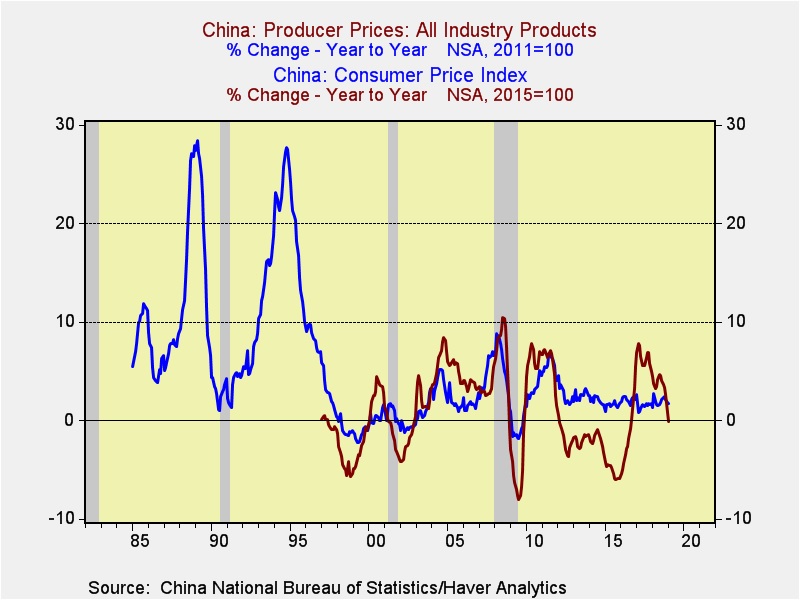
Chinese inflation data: CPI eased modestly from 1.8% to 1.7% on a yearly basis.  However, producer prices (which tend to reflect company profitability) fell into negative territory at -0.1%.

Weakening PPI will likely prompt the PBOC to consider further credit easing, which would be supportive for Chinese equities.

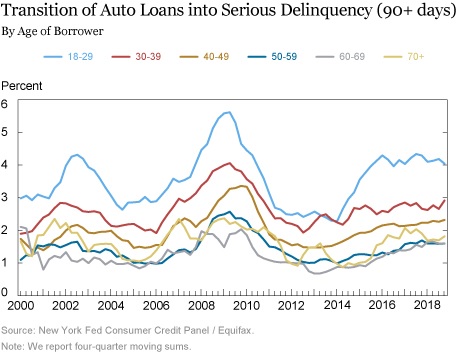
Correction: In Wednesday’s comment, we noted that car loan delinquencies were up for older Americans.  That isn’t really true.  A sharp-eyed reader noted that we were a bit colorblind on this chart.

We mistakenly thought the blue line showing the highest level of delinquencies represented the 50-59 age bracket.  To quote John McLaughin, “WRONG!”[10]  Our apologies.  The highest delinquency age bracket is actually 18-29.

View the complete PDF


[1] https://www.ft.com/content/c2783d84-30ce-11e9-8744-e7016697f225?emailId=5c6643dc26450200045b796d&segmentId=22011ee7-896a-8c4c-22a0-7603348b7f22

[2] https://www.wsj.com/articles/chinese-u-s-negotiators-expected-to-show-progress-on-trade-deal-framework-11550212318 and https://www.scmp.com/economy/china-economy/article/2186338/china-and-united-states-make-progress-beijing-trade-war-talks

[3] https://www.scmp.com/news/china/diplomacy/article/2186292/us-china-trade-talks-good-vibes-and-laughter-venue-rivals-work

[4] https://www.reuters.com/article/us-usa-trade-china/mnuchin-says-u-s-had-productive-trade-meetings-with-china-idUSKCN1Q40S0

[5] https://www.reuters.com/article/us-usa-trade-china-subsidies-exclusive/exclusive-china-offers-to-end-market-distorting-subsidies-but-wont-say-how-idUSKCN1Q32X6

[6] https://www.wsj.com/articles/china-seeks-to-lure-u-s-with-pledges-to-boost-chip-and-other-purchases-11550151263

[7] For a more in depth view, see Asset Allocation Weekly (1/4/2019).

[8] https://www.cnbc.com/2019/02/14/fed-gov-brainard-downside-risks-have-definitely-increased-on-the-economy.html and https://www.wsj.com/articles/fed-officials-near-plan-to-finish-portfolio-wind-down-11550180143

[9] https://www.nytimes.com/2019/02/14/world/europe/brexit-parliament-vote-theresa-may.html?emc=edit_mbe_20190215&nl=morning-briefing-europe&nlid=567726720190215&te=1

[10]https://www.nbc.com/saturday-night-live/video/mclaughlin-group/n9987

Daily Comment (February 14, 2019)

by Bill O’Grady and Thomas Wash

[Posted: 9:30 AM EDT] Happy St. Valentine’s Day!  U.S. equity futures are trending higher this morning in quiet trading.  Here is what we are watching:

White House calming markets: The president is reportedly considering pushing back the trade deadline by 60 days and backing a border security bill that would avoid another shutdown.  As we have mentioned in the past, the president, who is likely gearing up for reelection, will look to tie up loose ends going into 2020.  As a result, we expect market volatility to simmer down as the president is unlikely to push for legislation that could endanger his reelection chances.

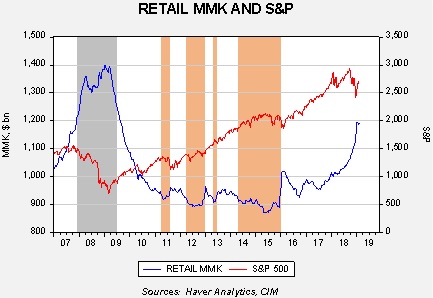
Money market fund levels remain elevated: Although equity markets have recovered, the level of retail money market funds remains elevated.

This chart shows the weekly close for the S&P 500 with the weekly level of retail money market funds.  Beginning in early 2018, money market funds have been rising rapidly, eerily tracking what we saw in 2007.  This suggests to us that some of this liquidity preference was being driven by investor fear.  It is true that money market yields have increased but we doubt they have moved up enough to account for this desire to hold cash.

During this bull market, the S&P has tended to stall when retail money market levels fall below $920 bn, suggesting the equity market “ran out of liquidity”; these events are shown by vertical orange bars.  At present, even with the rally we have seen in equities this year, money market funds remain high.  If investor sentiment shifts, we would expect equities to benefit substantially.

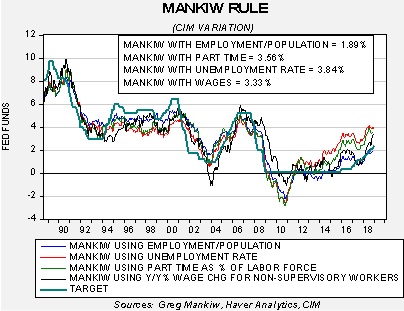
Mankiw Rule update: The Taylor Rule is designed to calculate the neutral policy rate given core inflation and the measure of slack in the economy.  John Taylor measured slack using the difference between actual GDP and potential GDP.  The Taylor Rule assumes that the Fed should have an inflation target in its policy and should try to generate enough economic activity to maintain an economy near full utilization.  The rule will generate an estimate of the neutral policy rate; in theory, if the current fed funds target is below the calculated rate then the central bank should raise rates.  Greg Mankiw, a former chair of the Council of Economic Advisors in the Bush White House and current Harvard professor, developed a similar measure that substitutes the unemployment rate for the difficult to observe measure of potential GDP.

We have taken the original Mankiw rule and created three other variations.  Specifically, our models use core CPI and either the unemployment rate, the employment/population ratio, involuntary part-time employment and yearly wage growth for non-supervisory workers.  All four compare inflation and some measure of slack.  Here is the most recent data:

Three of the models would suggest the FOMC is well behind the curve and needs to be increasing the policy rate.  However, the employment /population ratio does imply some slack in the economy and would suggest the Fed has already lifted rates more than necessary.  Until recently, the wage variation was also suggesting caution.  In September, it was signaling a neutral rate of 2.78%.  However, as the line shows, the projected rate has moved up sharply as wages have increased.  We suspect some of this wage increase has been mandated by various state and local increases in minimum wages.  If so, the rise in wages should slow later this year.

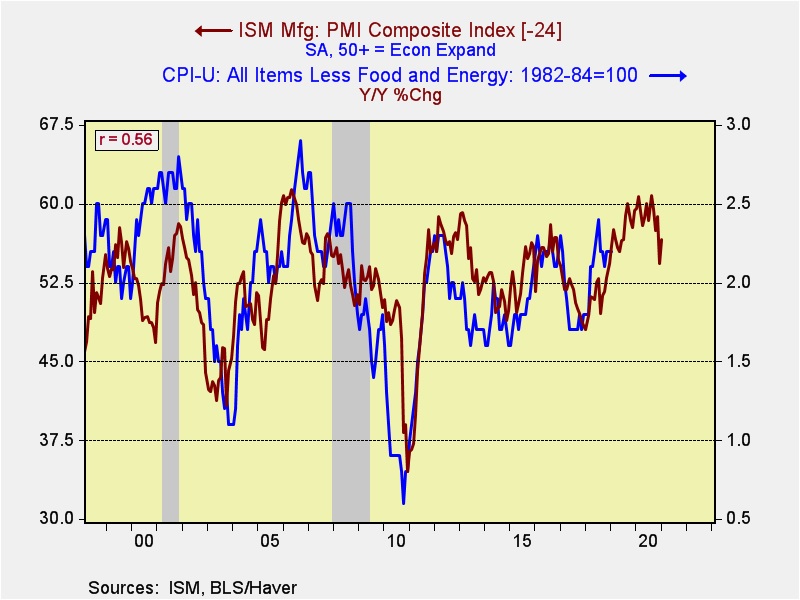
Overall, FOMC behavior seems to be tracking the employment/population ratio, which makes sense given the modest increases we are seeing in inflation.  If inflation follows the path of the manufacturing ISM, we could see a modest uptick in price levels later this year.

The current employment/population ratio with 2.5% core CPI would generate a neutral policy rate of around 2.5%, suggesting the FOMC should not raise rates further assuming the projected rise in inflation is correct.

Energy update: Crude oil inventories rose 3.6 mb last week compared to the forecast rise of 2.4 mb.

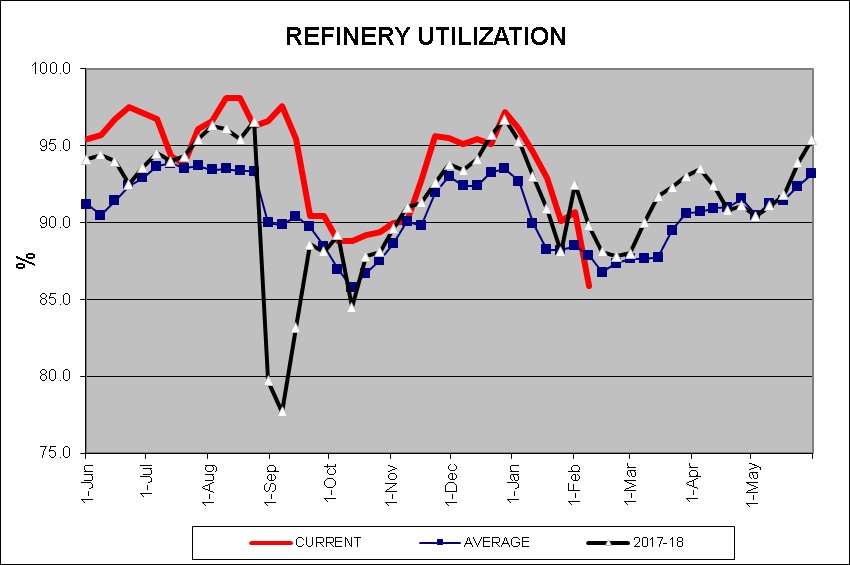
In the details, estimated U.S. production was unchanged at 11.9 mbpd.  Crude oil imports fell by 0.9 mbpd, while exports fell 0.5 mbpd.  Refinery runs fell sharply, by 4.8%, compared to expectations of a 0.9% decline.

The decline in runs was significant and is a clear signal that the refinery maintenance season is underway.

(Sources: DOE, CIM)

On average, refinery utilization should stabilize at these levels through most of March and then rise as spring comes to the Northern Hemisphere.  This will tend to reduce U.S. oil demand for the next several weeks and usually lead to rising crude oil inventories.

(Sources: DOE, CIM)

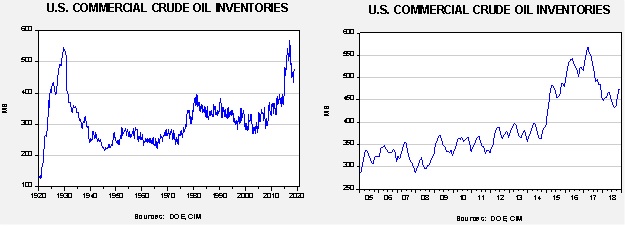
This is the seasonal pattern chart for commercial crude oil inventories.  We would expect to see a steady increase in inventories that will peak in early May; the pattern coincides with refinery maintenance.  Note that inventories are rising at a slower pace than normal.  This is mostly due to crude oil exports.  If this slow pace continues, it would be a bullish factor for oil prices.

Based on oil inventories alone, fair value for crude oil is $58.26.  Based on the EUR, fair value is $54.26.  Using both independent variables, a more complete way of looking at the data, fair value is $54.89.  By all these measures, current oil prices are generally in the neighborhood of fair value.  However, we still expect prices to move toward $60 later this year on rising oil exports.

View the complete PDF