

Daily Comment (March 5, 2019)

by Bill O’Grady and Thomas Wash

[Posted: 9:30 AM EDT] It’s a very quiet news morning.  When the Chinese National Party Congress dominates the news, you can tell things are slow.  Equity futures are steady after a drubbing yesterday.  Here is what we are watching this morning:

After the Chinese trade deal: Although negotiations continue, the U.S. is moving on to other areas.  Trade talks between the U.S. and EU will begin on March 6.  It appears the EU is planning to negotiate a series of discrete deals, perhaps with the idea that a series of “wins” might distract Washington from attempting broader negotiations.  The EU desperately wants to avoid opening up its agricultural market and facing tariffs on autos.  Thus, it appears the plan is to agree to a series of small, narrow pacts to avoid the ones that would be most problematic and then hope that a new regime comes to Washington.[1]

We also note that the U.S. is ending preferential trade treatment for Turkey and India.[2]  In a sense, this change, which gives better trade arrangements for developing nations, reflects India’s size.  In other words, India is now a big enough economy that the U.S. wants it to give up its trade barriers.  Meanwhile, the decision to drop Turkey from the program reflects continued tensions between the two nations.  Turkey and the U.S. had a dispute over a detained American pastor, disagreed over the Kurds and Syria and apparently came to different conclusions over the fate of Jamal Khashoggi.  The official reason given for removing Turkey from the program was, like India, based on the size of its economy.  Overall, these moves highlight a change in U.S. trade policy.  American trade policy during the Cold War was to tie allies to the U.S. economy through trade and the dollar.  President Trump is adjusting this policy stance away from geopolitical goals to economic ones.

Finally, on trade, there is a new realization of the fallout from bilateral agreements.  In another major change in U.S. trade policy, the Trump administration has moved from multilateral agreements to bilateral ones.  This move greatly favors the U.S.; America’s size and the dominance of the dollar mean every one-on-one negotiation is biased toward the U.S.  By design, the Cold War trade policy of multilateralism did not allow the U.S. to fully exercise its dominance which encouraged other nations to join such arrangements.  For other nations, it allowed them to trade on a favored basis with the U.S. and avoid being dominated.  However, in bilateral arrangements, what is won in one agreement may disadvantage a third nation.  For example, it appears that China will commit to large purchases of U.S. LNG.  This could crowd out Canadian and Australian producers.[3]   If this does become the trend, look for nations to rush to Washington to make deals because being the last nation to negotiate an agreement will put that nation at great disadvantage.

China meetings: As widely expected, China has lowered its growth forecast to 6.0% from 6.5%.[4]  Although the media tends to get all verklempt over China’s GDP, it should be noted that given the way China’s economy is structured it can generate any GDP it wants—it simply has to decide how much debt it wants to add to its growing pile.  So, the decline in the growth trajectory is a good sign; it shows that China is trying to slow the growth of its debt.  At the same time, we think the level of GDP that would not require higher debt is probably around 3%.  It does appear China is going to stimulate its economy but on a lower scale than seen in the past.

In another budget decision, China increased its military spending by 7.5%, making it the world’s second largest spender.[5]

We also note that the Xi regime remains cautious on market reforms.  A joint project of Beijing and the World Bank has been quashed.  It appears the Xi government was uncomfortable with the paper’s recommendation of State-Owned Enterprise (SOE) reform.[6]  It is also worth noting that China’s influence on the World Bank has increased as it pays more to the bank’s operations.

Venezuela: Opposition leader Juan Guaido returned to Venezuelan yesterday without incident.  European diplomats met him when he arrived, which may have calmed the situation.[7]  Although Guaido remains very popular, the military in Venezuela continues to support Maduro so, until that changes, the standoff will continue.  What is uncertain is which actor benefits from time.  Maduro may be waiting out Guaido on the assumption that the divided opposition will fold the longer Maduro continues to control the government.  Guaido may be betting that U.S. sanctions will begin to deprive Maduro of the funding necessary to maintain the military’s support, and the longer the money isn’t available the more vulnerable Maduro becomes.  If they both take these positions, the stalemate will continue.

Greece returns: Greece is issuing its first 10-year sovereign bond in a decade.  The spread appears to be around 340 bps over a similar German instrument.[8]

An equity market observation: In the Q4 correction, we noted there was a spike in retail money market levels.  The rise in money market funds was similar to what we saw in 2007-08 and suggested investor panic.  It is worth noting that the pace of increases in retail money market funds has slowed but is still increasing during the rally we have seen recently.  It appears the rally this year has had little retail participation.
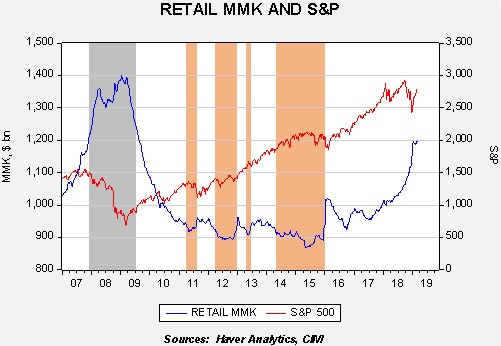
The blue line on the chart, read off the left axis, shows the level of retail money market funds; they are currently about $1.2 trillion.  Note that in 2007-08, the level rose over $1.3 trillion before equities rolled over.  A sustained rally in stocks from the 2009 lows coincided with a rapid deployment of retail money market liquidity.  The orange bars on the chart show when the level of retail money market funds fell below $920 bn.  In this cycle, this appears to be the equilibrium level; equity markets tended to stall when money market funds fell to this area.

It is remarkable that we have seen such a strong bounce with little evidence of retail investor participation.  This leads us to one of two conclusions.  First, if retail stays away, the rally will likely stall around this level and we will remain rangebound with 2800 on the S&P as “resistance,” or the upper bound of the range.  Second, if retail returns, a strong rally is possible that will likely take us above 3000 on the index.  Unfortunately, determining which outcome is more likely is nearly impossible.  It all comes down to those eternal drivers, fear and greed.  If the former wins out, we would not expect too much more upside this year.  If the latter wins, we have a good way to move higher.  Stay tuned… 

View the complete PDF


[1] https://www.reuters.com/article/us-eu-us-trade/eu-set-for-trade-talks-with-u-s-on-march-6-amid-concern-over-tariffs-idUSKCN1QL1BU?feedType=RSS&feedName=businessNews

[2] https://www.ft.com/content/80979472-3ee4-11e9-b896-fe36ec32aece?emailId=5c7e08d3ea828400040a8db1&segmentId=22011ee7-896a-8c4c-22a0-7603348b7f22

[3] https://www.wsj.com/articles/trumps-china-deal-could-punish-u-s-allies-11551697117

[4] https://www.ft.com/content/558d78d2-3eda-11e9-b896-fe36ec32aece?emailId=5c7e08d3ea828400040a8db1&segmentId=22011ee7-896a-8c4c-22a0-7603348b7f22

[5] https://www.ft.com/content/5956db00-3e28-11e9-b896-fe36ec32aece?emailId=5c7e08d3ea828400040a8db1&segmentId=22011ee7-896a-8c4c-22a0-7603348b7f22

[6] https://www.washingtonpost.com/world/asia_pacific/china-is-blocking-world-bank-report-that-calls-for-state-owned-enterprise-reform/2019/03/01/15607f9a-3b72-11e9-b10b-f05a22e75865_story.html?utm_term=.4c3c837da5d0

[7] https://www.washingtonpost.com/world/the_americas/juan-guaido-attempts-to-return-to-venezuela-risking-arrest/2019/03/04/ee51c78e-3dfa-11e9-85ad-779ef05fd9d8_story.html?utm_term=.21e65f1369d3&wpisrc=nl_todayworld&wpmm=1

[8] https://www.wsj.com/articles/greece-looks-to-borrow-amid-buoyant-markets-11551722073
Weekly Geopolitical Report – The Irish Question: Part II (March 4, 2019)

by Bill O’Grady

Last week, we examined the geopolitics of Britain and offered an abbreviated history of Irish/British relations.  This week, we will begin by analyzing the Good Friday Agreement, followed by an analysis of Brexit regarding the Irish question.  As always, we will conclude with market ramifications.

The Good Friday Agreement
By the late 1990s, conditions that had led to British colonization of Ireland and the need to maintain some degree of control there had changed.  Britain was no longer a major imperial power and had become a member of the European Union and NATO.  In fact, like the rest of the EU, it was outsourcing its defense to the U.S.  U.K. access to sea lanes had little to do with the power of the Royal Navy; instead, it was dependent on global and regional trade agreements and the U.S. Navy.  Thus, securing its western coast was no longer an imperative.

The three-decade guerilla conflict in Northern Ireland had become a drain on resources.  No longer was Northern Ireland a major industrial center.  Instead, it was a place that required constant support.  At the same time, the long war had steadily undermined the idea among Irish Republicans that unification could occur by force.

Out of these two realizations came the Good Friday Agreement.  There are five key elements to the agreement:

  1. The Status of Northern Ireland was acknowledged. The agreement begins with the claim that the majority of people in Northern Ireland wished to remain part of the U.K.  It also acknowledged that a substantial minority in Northern Ireland and the majority of those in Ireland supported unification.
  2. The Irish Constitution was amended to accept that Northern Ireland was part of the U.K. K. laws were amended to support unification.
  3. Both sides agreed that, at some unspecified point in the future, a referendum on the border would be held. If the majority in Northern Ireland agree on unification then both sides would honor the results of that vote.
  4. Citizens of Northern Ireland could carry passports from both the U.K. and Ireland.
  5. Paramilitary groups on both sides would be disarmed and decommissioned.

View the full report

Daily Comment (March 4, 2019)

by Bill O’Grady and Thomas Wash

[Posted: 9:30 AM EDT] Equities are moving higher this morning on hopes of a U.S./China trade deal.  China’s National Party Congress begins on Wednesday and the ECB meets on Thursday.  Here is what we are watching this morning:

Chinese trade: It appears the U.S. and China are nearing a trade agreement.  Reports suggest that in addition to lifting tariffs China is pledging to end some of its most onerous practices in terms of technology transfer.[1]  Some specific Chinese purchases of commodities also appear to be part of the mix.[2]  Although a deal isn’t done quite yet, it has been our position that both sides need a deal in the short term.  We have doubts the long-term issues will be resolved by this agreement, but it will relieve tensions and has already lifted equity markets.

In related Chinese news, the Xi government is planning a tax cut for manufacturers.[3]  We have seen China moving toward tax cuts instead of direct subsidies in recent months.  We are not exactly sure why this is the case, but it may be designed to appear less threatening to the West.

Trump and the markets: At CPAC, the president delivered broadsides against Chair Powell, and, interestingly, against the dollar’s strength.[4]  The push against Powell appears to be a scapegoating exercise; if the economy slumps, Powell will be assigned the blame.  We find the turn against the dollar much more interesting.  Last year, Treasury Secretary Mnuchin caused a stir at Davos when he argued for a weaker dollar.[5]  Although the president has, in the past, made comments about supporting dollar weakness, in this case, he rebuked his treasury secretary.[6]  We think at heart Trump is a reflationist, wanting to stimulate at all costs.  That would imply a weaker dollar as part of this policy.  So far, financial markets are not paying attention to the comment on the greenback; although the dollar did weaken overnight, it has recovered off the lows (taking precious metals lower as well).  We suspect financial markets want to see concrete action to weaken the dollar.  Intervention, which is rarely deployed, would be one way to accomplish this.

An interesting side note—today is Fed Independence Day!  On this day in 1951, President Truman reluctantly acquiesced to demands from the Federal Reserve to allow it to conduct monetary policy without the need to accommodate Treasury borrowing.  During the war years the Treasury would indicate what rate it wanted to pay for Treasuries and the Fed would buy up enough bonds to peg that rate.  Truman’s decision hasn’t always made presidents happy.  President Johnson was accused of assaulting William Martin,[7] the Fed chair at the time, and Nixon emasculated Arthur Burns by leaking lies about him.[8]  President Reagan ordered Paul Volcker not to raise rates in 1984.[9]  The relative peace that emerged due to Bob Rubin’s agreement with the White House during the Clinton administration has broken down under President Trump, but tension between presidents and Fed chairs is nothing new.

Huawei (002502, Shenzhen, CNY 4.26): Canada will proceed with extradition to the U.S. for Meng Wanzhou.[10]  We would expect China to ratchet up pressure on the Canadian government to prevent Meng from being sent to the U.S. to face charges.

Venezuela: Opposition leader Juan Guaido is returning to Venezuela amid signs that the opposition has become a bit more divided in his absence.[11]  Maduro may try to arrest Guaido on his return, although doing so would almost certainly trigger a harsh response from the U.S.  The president is a Jacksonian, thus dishonor always prompts a response.  The U.S. is considering emergency aid for the country if Maduro steps down.[12]

Brexit: Big votes loom next week.  On March 12, Parliament will vote again on PM May’s deal.  It will likely fail again given that it lost in historic fashion earlier this year.  The next day, Parliament will vote on whether it supports a hard Brexit.  That is unlikely as well.  On the 14th, a third vote supporting an extension of the deadline will be before legislators.  That will almost certainly pass (if the two earlier votes are rejected, it is the only logical conclusion).[13]  May has offered a spending increase targeted to areas that supported Brexit in what appears to be an open attempt to sway MPs.[14]  Overall, the odds of May’s Brexit deal are making a comeback as Brexiteers realize they either take her deal or face a long delay[15]; a sudden departure, the hard Brexit option, is pretty much dead.

Echoes of the Arab Spring?  We are seeing widespread protests in Sudan and Algeria.  In the former, years of misrule have led to rising protests; President Omar Hassan al-Bashir has reacted with increasingly harsh measures which have failed to end the unrest.[16]  Meanwhile, in Algeria, the ailing President Bouteflika has announced he will seek a fifth term.  Bouteflika is 82, paralyzed and in a wheelchair following a stroke in 2013.  He has not spoken in public for seven years.  In fact, he may not be in the country as he went to Switzerland earlier this year and has reportedly not returned.[17]  Despite harsh measures, the protests continue.  The government avoided participating in the first Arab Spring because it increased fiscal spending.  However, oil prices were near $100 per barrel in 2011 when the Arab Spring was in full swing.  With oil prices lower, the government can’t boost spending to placate the protestors.  Algeria is a major member of OPEC, producing around 1.3 mbpd and is an important natural gas exporter, mostly to Europe.  A crisis there could boost oil prices.

Debt ceiling: The U.S. officially hit the debt ceiling on Saturday;[18] the Treasury will begin instituting measures to keep the government running going forward.  The real crunch won’t hit until early Q4.

And, finally:Another issue that may have scuttled the U.S./North Korea talks is the fact that North Korea was engaging in widespread cyberattacks as the two leaders met.[19]

View the complete PDF


[1]https://www.apnews.com/9c86981b4a51493383c0d5249d54ad40?utm_source=newsletter&utm_medium=email&utm_campaign=newsletter_axiosam&stream=top

[2] https://www.wsj.com/articles/u-s-china-close-in-on-trade-deal-11551641540 and https://www.nytimes.com/2019/03/03/business/us-china-trade-deal-trump.html?action=click&module=Top%20Stories&pgtype=Homepage

[3] https://www.bloomberg.com/news/articles/2019-03-04/china-is-said-to-plan-90-billion-cut-in-vat-for-manufacturers

[4] https://www.bloomberg.com/news/articles/2019-03-03/trump-using-fed-strong-dollar-complaints-to-stir-voter-base?srnd=premium

[5] https://www.cnbc.com/2018/01/24/dollar-tanks-the-most-in-10-months-after-mnuchin-says-weak-dollar-is-good.html

[6] http://fortune.com/2018/01/25/donald-trump-steven-mnuchin-us-dollar-davos/

[7] https://www.npr.org/sections/money/2019/03/01/699546781/episode-898-happy-fed-independence-day

[8] Mallaby, Sebastian. (2016). The Man Who Knew: The Life and Times of Alan Greenspan. New York, NY: Penguin Books.

[9] https://www.washingtonpost.com/business/2018/10/24/we-have-serious-problem-paul-volcker-is-worried-about-something-worse-than-inflation/?utm_term=.a86bb7f90d80

[10] https://www.washingtonpost.com/world/canada-to-proceed-with-extradition-case-against-huaweis-meng-wanzhou/2019/03/01/ab59a970-3c55-11e9-b786-d6abcbcd212a_story.html?utm_term=.aa25948af6ad&wpisrc=nl_todayworld&wpmm=1

[11] https://www.reuters.com/article/us-venezuela-politics/venezuelas-guaido-says-he-will-return-home-monday-after-latin-american-tour-idUSKCN1QK0LP and https://www.nytimes.com/2019/03/03/world/americas/juan-guaido-venezuela.html?emc=edit_mbe_20190304&nl=morning-briefing-europe&nlid=567726720190304&te=1

[12] https://www.ft.com/content/fa61453e-3d2f-11e9-8c2f-30761f19a974?emailId=5c7ca1c07c8e5e0004c3ebf0&segmentId=22011ee7-896a-8c4c-22a0-7603348b7f22

[13] https://www.ft.com/content/7d973c06-39c5-11e9-b72b-2c7f526ca5d0 and https://www.washingtonpost.com/business/economy/trump-trade-official-says-a-us-china-deal-wont-fix-all-of-beijings-anti-trade-policies/2019/02/27/aeb569b0-3a11-11e9-aaae-69364b2ed137_story.html?utm_term=.102b4b94f888

[14] https://www.thesun.co.uk/news/8552886/theresa-may-brexit-labour-voters-opinion/?editorialView=yes&utm_source=POLITICO.EU&utm_campaign=e59e0376eb-EMAIL_CAMPAIGN_2019_03_04_05_27&utm_medium=email&utm_term=0_10959edeb5-e59e0376eb-190334489

[15] https://www.reuters.com/article/us-britain-eu-ireland-extension/irish-pm-sees-brexit-extension-to-june-as-very-likely-sunday-independent-idUSKCN1QK09J?feedType=RSS&feedName=worldNews

[16] https://www.washingtonpost.com/world/africa/omar-al-bashir-has-ruled-sudan-for-30-years-his-latest-crackdown-could-be-his-last/2019/03/02/61b290a8-3ae2-11e9-b10b-f05a22e75865_story.html?noredirect=on&utm_term=.21ee1c0bfcd8&wpisrc=nl_todayworld&wpmm=1

[17] https://www.nytimes.com/2019/03/01/world/africa/algeria-protests-bouteflika.html?wpisrc=nl_todayworld&wpmm=1

[18] https://www.wsj.com/articles/congress-faces-fall-deadline-to-address-debt-ceiling-11551467259

[19] https://www.nytimes.com/2019/03/03/technology/north-korea-hackers-trump.html?utm_source=newsletter&utm_medium=email&utm_campaign=newsletter_axiosam&stream=top

Asset Allocation Weekly (March 1, 2019)

by Asset Allocation Committee

Our cyclical position on foreign investing remains with a zero allocation; although the committee has not been negative on foreign, our work suggested that the risk/reward compared to small and mid-cap stocks warranted putting more assets in those areas.  However, we are continuing to pay close attention to foreign as an area that may be attractive in the future.

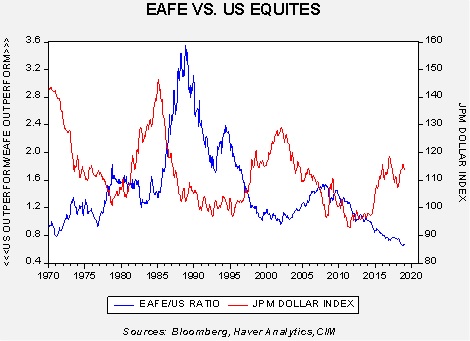
In the past, we have noted that relative performance between foreign developed and U.S. equities is sensitive to the dollar.  In general, during periods of dollar strength, U.S. equities tend to outperform (assuming both are denominated in dollars, which is the case for a U.S. investor).

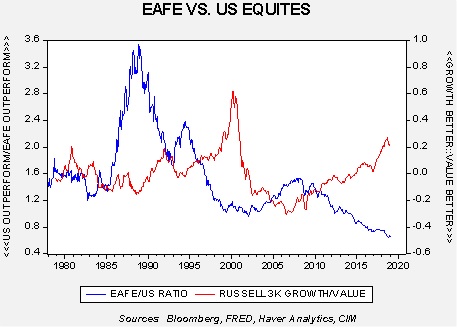
The blue line on the chart shows the ratio of performance between EAFE and the U.S., rebased to 1970.  When this line is rising, foreign stocks are outperforming.  The red line shows the JPM Dollar Index.  Note that a rising dollar tends to favor U.S. outperformance, while dollar weakness helps foreign market performance.   Although the dollar has remained strong, both on a purchasing power parity basis and a cycle basis, the dollar is extended and should begin to depreciate later this year.

However, in this business cycle, U.S. stocks have generally outperformed even during periods of dollar weakness.  This has led us to look for other factors that might account for this discrepancy.  It appears that the growth/value variation explains at least part of this divergence.

As in the first chart, the blue line shows the relative equity performance.  The red line shows the Russell 3000 Growth/Value divergence; a rising line suggests growth outperformance.  Growth stocks have outperformed in this bull market but are showing signs they may finally be starting to give way to value.  The primary driver of growth/value is the P/E ratio.  Significant multiple expansion isn’t all that likely, although a return to the 18x+ area would not be surprising.

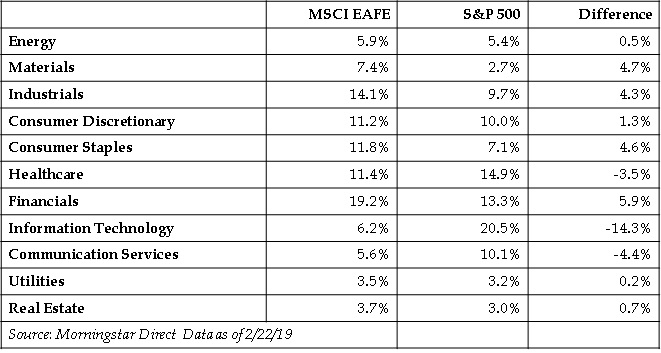
Why would the growth/value divergence affect foreign stocks?  The most likely reason is index construction.  U.S. indices will tend to have a greater weighting toward technology due to the size of that industry in the U.S. economy.  Foreign nations, for the most part, have less dominant tech industries.  With technology being considered a growth sector, a period of strong technology performance would tend to lead to outperformance by growth.  If foreign equity indices have less technology, they would likely underperform.  Consequently, when the growth/value balance shifts to the latter, we would anticipate foreign outperformance.  The table below provides a comparison of sector exposures.

Overall, we continue to monitor the relative performance of foreign compared to other asset classes.  If our risk/reward estimates change later this year, we could consider a return to international.

View the PDF

Daily Comment (March 1, 2019)

by Bill O’Grady and Thomas Wash

[Posted: 9:30 AM EDT] It’s a risk-on Friday with little news to account for the strength.  World PMIs (see below) remain rather soft, although several (including China) came in above depressed expectations.  Here is what we are watching this morning:

MSCI lifts China: The index provider MSCI has boosted its allocation of Chinese mid-cap stocks (the A-shares) in its broader emerging market indices.[1]  Chinese stocks will generally now represent about 40% of the index; adding the Taiwanese stocks, which tend to be influenced by China, the index is approaching 50%.  This strong weighting of China in the index will almost certainly lift investment flows into Chinese equities this year.  At the same time, it raises questions about index investing when one entity has such a large share.

Brexit: There isn’t too much new today.  We do note that inventories jumped in the PMI data as firms appear to be stockpiling just in case there is a hard Brexit.[2]  It is looking increasingly likely that Brexit will be delayed.  On March 12, Parliament will vote again on PM May’s deal.  Given that it lost in historic fashion earlier this month it will likely fail again.  The next day, Parliament will vote on whether it supports a hard Brexit.  That is unlikely as well.  On the 14th, a third vote supporting an extension of the deadline will be before legislators.  That will almost certainly pass (if the two earlier votes are rejected, it is the only logical conclusion).[3]

One of the hopes of Brexiteers is that the U.K. will be able to negotiate its own trade agreements and do better than it would inside the EU.  Perhaps this is true but it should be noted that trade agreements are a function of relative power.  The fact that the U.S., up until the Trump administration, usually engaged in multi-lateral trade agreements is evidence of America’s benevolent exercise of hegemony.  Given U.S. power, all nations are disadvantaged in bilateral agreements.  This administration’s shift to bilateral trade deals is evidence of a shift in U.S. hegemonic policy.[4]  The U.S. has put the U.K. on notice that the former will bargain from a position of strength and force the latter into uncomfortable concessions.[5]

Venezuela: The U.S. proposed a UNSC resolution that would support new elections and unfettered access to foreign aid in Venezuela.  Both China and Russia vetoed the resolution.[6]

Tax news: There are reports that 127 nations are near a pact to tax tech firms’ cross-border income.[7]  There is a bill in Congress that would tax all equity transactions 10 bps.  The goal of the legislation is to thwart high-frequency trading activity.[8]

China news: For the first time on record, China’s employment population declined, and for the seventh consecutive year, its working-age population (aged 16-59) fell.  It is 2.8% lower than it was in 2011.[9]  There are reports that Chinese investors are pulling out of overseas property markets.  It appears that regulation is the primary factor curtailing outbound investment.[10]  We may see a decision from Canada on the Meng Wanzhou extradition hearing today; if the court decides it has the authority to proceed, extradition proceedings will begin.[11]  If she is extradited to the U.S., it could affect trade negotiations.

PM Trudeau’s woes: A growing corruption scandal is threatening to end PM Trudeau’s administration.[12]  Perhaps the best signal that the PM is in trouble is that his foreign minister (and likely successor), Chrystia Freeland, has expressed “100% faith” in the PM.[13]  Although usually such events have little impact on U.S. markets, given that the NAFTA/USMCA deal hasn’t passed through Congress, a change at the top of the Canadian government could complicate negotiations.

Robots can’t intuit: Algorithmic trading models appear to have great promise as they can scan for past patterns much more effectively than humans can.  What they can’t do is understand that former patterns may no longer hold when initial conditions change.  Recent performance of these models has been abysmal as they struggle to manage money in an environment that is changing rapidly.[14]

And, finally:There are now more $100 bills in circulation than $1 bills.  The “Benjamin” is the favorite currency of the black economy, but also may have become popular with European households dealing with negative interest rates.[15]

View the complete PDF


[1] https://www.ft.com/content/2ce24a94-3ba5-11e9-b856-5404d3811663?emailId=5c78c51dc096ac0004382981&segmentId=22011ee7-896a-8c4c-22a0-7603348b7f22 and https://www.cnbc.com/2019/03/01/msci-to-quadruple-weighting-of-china-a-shares-in-global-benchmarks.html

[2] https://www.reuters.com/article/uk-britain-economy-pmi/uk-factories-slash-jobs-stockpile-at-record-pace-before-brexit-pmi-idUSKCN1QI46F?stream=business&utm_campaign=newsletter_axiosmarkets&utm_medium=email&utm_source=newsletter

[3] https://www.ft.com/content/7d973c06-39c5-11e9-b72b-2c7f526ca5d0 and https://www.washingtonpost.com/business/economy/trump-trade-official-says-a-us-china-deal-wont-fix-all-of-beijings-anti-trade-policies/2019/02/27/aeb569b0-3a11-11e9-aaae-69364b2ed137_story.html?utm_term=.102b4b94f888

[4] See WGR series, The Malevolent Hegemon: Part I (11/26/2018); Part II (12/3/2018); and Part III (12/10/2018).

[5] https://www.ft.com/content/09bfe7ca-3bae-11e9-b72b-2c7f526ca5d0?emailId=5c78c51dc096ac0004382981&segmentId=22011ee7-896a-8c4c-22a0-7603348b7f22

[6] https://www.nytimes.com/2019/02/28/world/americas/russia-venezuela-veto-united-nations.html?emc=edit_mbe_20190301&nl=morning-briefing-europe&nlid=567726720190301&te=1

[7] https://www.reuters.com/article/us-france-tax/france-sees-global-tax-deal-on-digital-giants-in-2019-minister-idUSKCN1QH282?feedType=RSS&feedName=technologyNews

[8] https://thehill.com/policy/finance/432022-senate-dem-planning-legislation-to-tax-stock-trades

[9] https://www.caixinglobal.com/2019-02-28/chinas-employment-population-shrinks-for-first-time-ever-101385483.html

[10] http://www.ecns.cn/cns-wire/2019-02-27/detail-ifzezqac5077458.shtml

[11] https://www.reuters.com/article/us-usa-china-huawei-tech/canada-seen-approving-extradition-hearing-against-huawei-executive-idUSKCN1QI3MI

[12] https://www.independent.co.uk/news/world/americas/justin-trudeau-wilson-raybould-snc-lavalin-scandal-a8802701.html

[13] https://www.independent.co.uk/news/world/americas/justin-trudeau-wilson-raybould-snc-lavalin-scandal-a8802701.html

[14] https://www.bloomberg.com/news/articles/2019-03-01/one-of-wall-street-s-most-popular-trading-strategies-is-now-failing

[15] https://finance.yahoo.com/news/hundred-dollar-bills-in-circulation-123315133.html

Daily Comment (February 28, 2019)

by Bill O’Grady and Thomas Wash

[Posted: 9:30 AM EDT] The U.S./North Korea summit ended abruptly as the leaders reached an impasse.  We are seeing some modest flight to safety market action.  Here is what we are watching this morning:

The summit abruptly ends: The two sides reached an impasse.  North Korea was willing to shut down its Yongbyon nuclear complex but wanted a full sanctions lift.  The U.S. was willing to lift sanctions but only if North Korea ended its nuclear production, gave up all its existing warheads and closed other nuclear sites the U.S. has discovered.[1]

We admit to being surprised at how the meeting ended.  It seems that continuing to talk and go through the motions of ceremony, even with the same result, would have helped maintain relations.  At the same time, once it becomes clear there is no room for further discussion it does make sense to simply back away.  Market reaction was mostly centered in Asia, with South Korean markets[2] taking a dive and the KRW depreciating.  Other Asian markets weakened as well.

One other takeaway of note is that it seemed President Trump really wanted a deal.  In fact, there were worries he would cave to a weak agreement just to make an agreement.  The fact that he walked away from talks does indicate he won’t be taken.  This had to be noticed in Beijing.  If the president was willing to turn away from these discussions, perhaps he might do the same thing with Chinese negotiations.  Was this a deliberate plan?  We doubt it.  The president’s style is to improvise, so we think it’s more likely he figured out a deal wasn’t forthcoming and determined leaving made more sense.  But, if he discovers this move affects China’s viewpoint, expect him to play it up.  On this note, USTR Lighthizer outlined a deal in testimony yesterday where the U.S. will place tariff “triggers” on China to force compliance.  Although the histories of such arrangements are spotty (a good example is the exercise the Treasury performs twice a year to determine if nations are manipulating their currencies—although such manipulation is common, it is rarely enforced), it remains to be seen whether Chairman Xi would agree to such a regime.[3]

India v. Pakistan: There are actions being taken to reduce tensions.  Pakistan has indicated it will return the captured pilot.[4]  However, there are persistent reports of sporadic clashes along the frontier.  As we noted yesterday, Pakistan has been isolated after the attack in Kashmir and thus has an interest in de-escalation.

Brexit: It is looking increasingly likely that Brexit will be delayed.  On March 12, Parliament will vote again on PM May’s deal.  Given that it lost in historic fashion earlier this month it will likely fail again.  The next day, Parliament will vote on whether it supports a hard Brexit.  That is unlikely as well.  On the 14th, a third vote supporting an extension of the deadline will be before legislators.  That will almost certainly pass (if the two earlier votes are rejected, it is the only logical conclusion).[5]

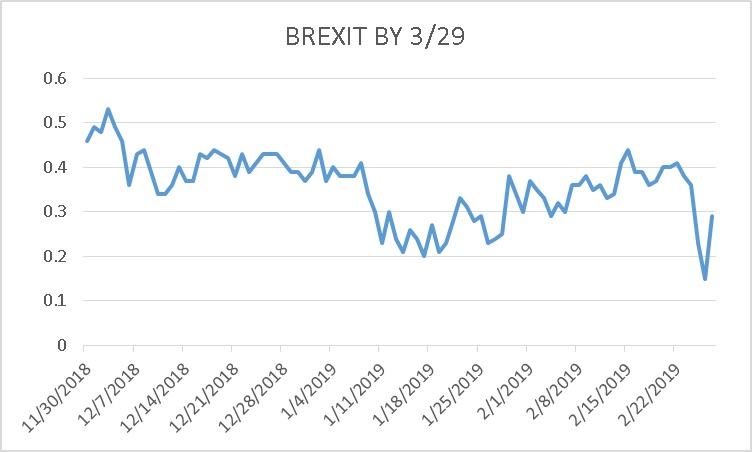
Here is the latest data from PredictIt on exit.

(Source: PredictIt)

The question is whether the U.K. will leave the EU on March 29.  Note that this decision market hasn’t been above 50 cents since late last year.  Essentially, the markets have been expecting a delay, which explains why the GBP hasn’t fallen.

European news: The ECB looks poised to move its stance toward easier policy as Eurozone growth slows.[6]  Spain’s former PM Rajoy testified against Catalan separatists yesterday, indicating the separatists bear responsibility for the violence and deaths that occurred in last year’s protests.[7]  Greece’s creditors, displeased with the pace of reforms in Greece, may not participate in the country’s first private post-crisis funding.[8]

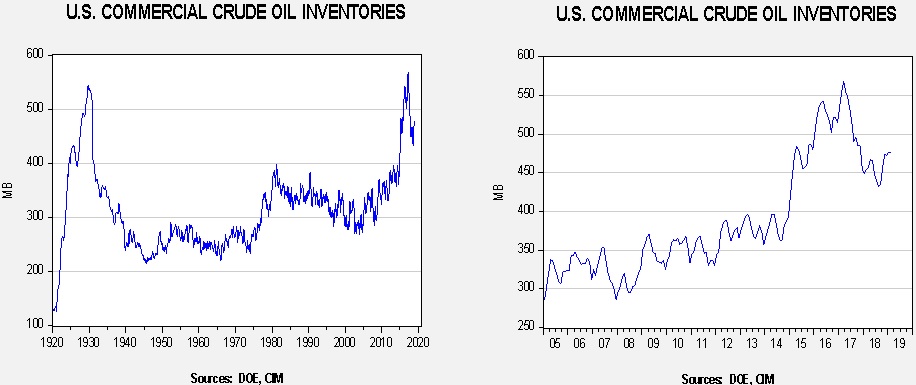
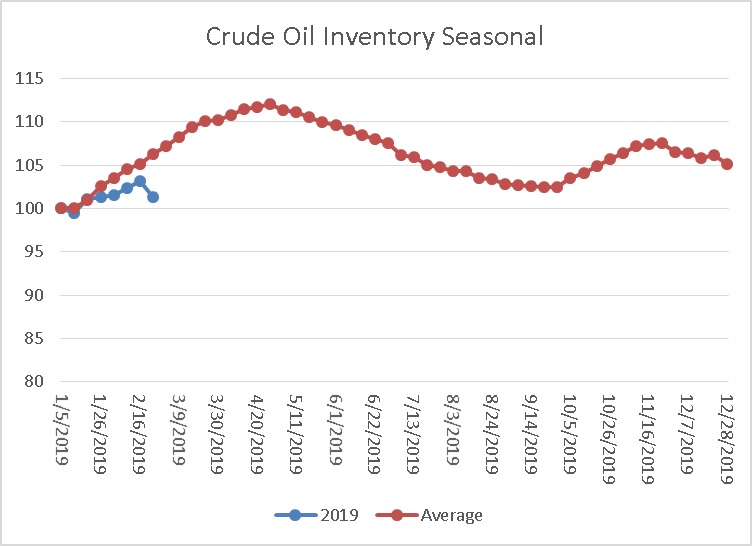
Energy update: Crude oil inventories fell 8.6 mb last week compared to the forecast rise of 3.0 mb.

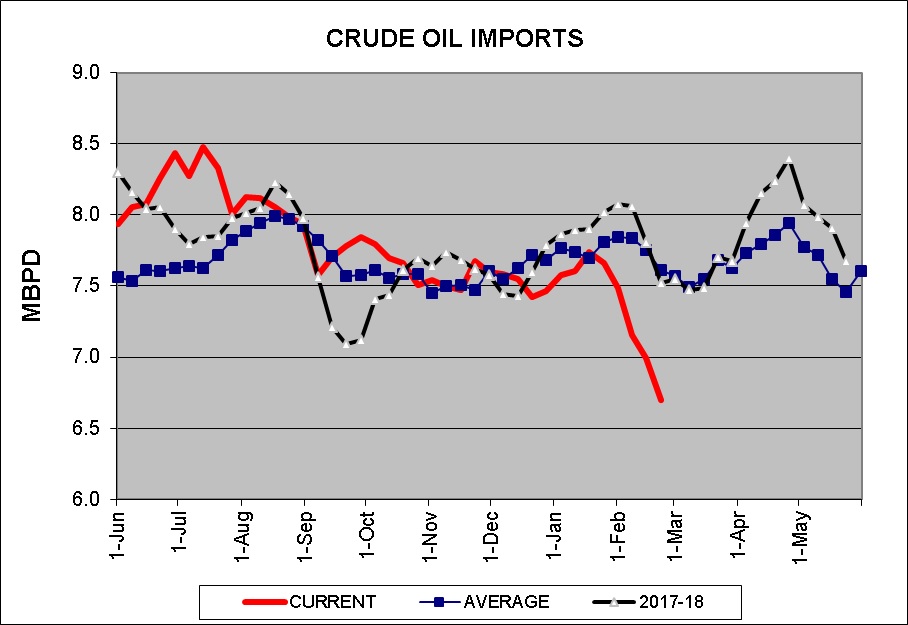
In the details, estimated U.S. production rose 0.1 mbpd, reaching a new record of 12.1 mbpd.  Crude oil imports plunged by 1.6 mbpd, while exports fell 0.2 mbpd.  Refinery runs rose 1.2% compared to the forecast of unchanged.

(Sources: DOE, CIM)

This is the seasonal pattern chart for commercial crude oil inventories.  We would expect to see a steady increase in inventories that will peak in early May; the pattern coincides with refinery maintenance.  Last week’s large decline is an anomaly and is very bullish for oil prices.  The unexpected drop in inventories was partially due to an early rise in refinery operations, although the increase isn’t far out of seasonal norms.  But, the slide in imports was a shocker.

(Sources: DOE, CIM)

The above chart is the four-week average of crude oil imports.  The data shows a sudden decline in crude oil imports even with the data being smoothed.

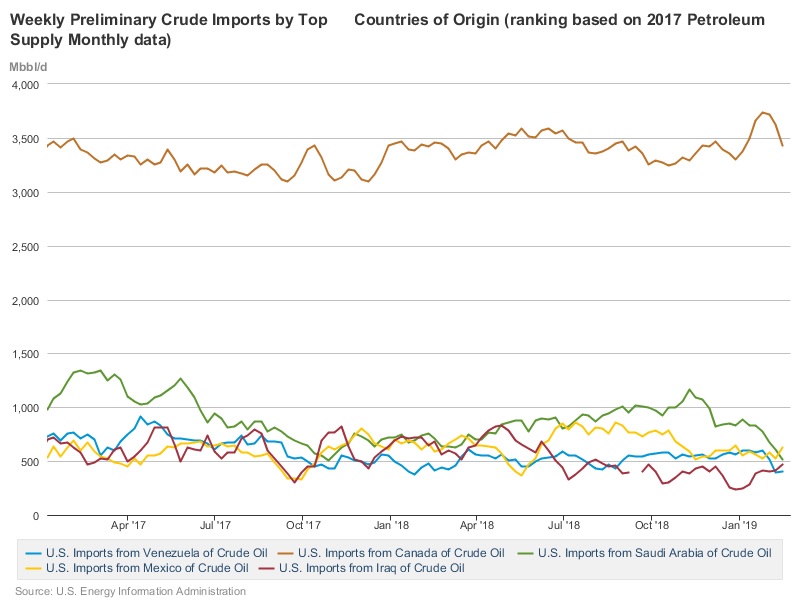
This chart shows the top five foreign suppliers of U.S. crude oil since early 2017.  The data is on a four-week average basis.  Note that we saw a sharp drop in Canadian crude oil imports, which will probably be reversed at some point.  However, there has also been a profound decline in imports from Saudi Arabia.  Since Q4, imports have declined by half.  That drop reflects Saudi oil policy and will not be reversed anytime soon.  We also point out that Venezuelan imports have also declined but the level isn’t all that large.  Overall, the drop in Saudi imports “moved the needle.”

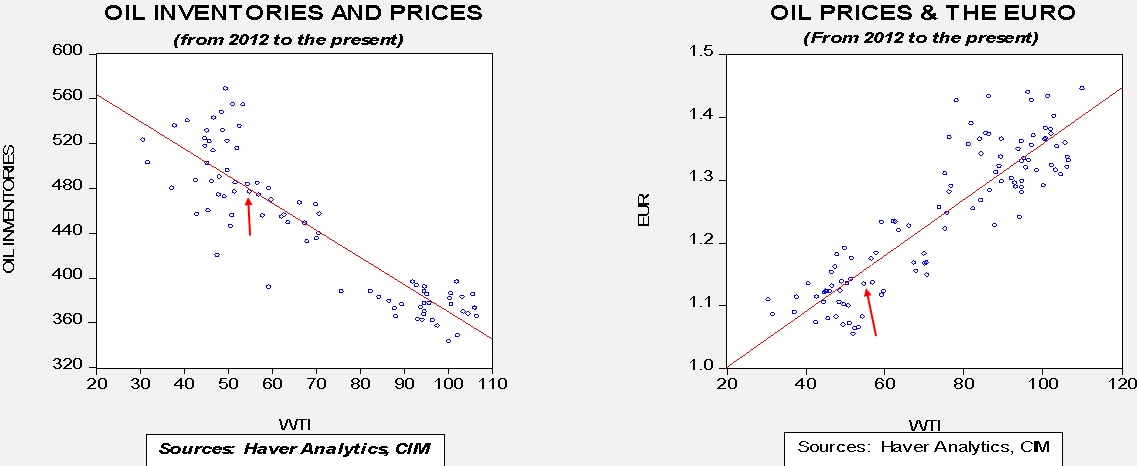
Based on oil inventories alone, fair value for crude oil is $58.71.  Based on the EUR, fair value is $54.03.  Using both independent variables, a more complete way of looking at the data, fair value is $54.90.  By all these measures, current oil prices are roughly in the area of fair value.  This week’s drop in crude oil inventories was a shocker and probably won’t be repeated, but it also likely means that we won’t see the usual seasonal build in crude oil stocks, either.  Thus, it improves the odds that prices hold their current levels into spring.

View the complete PDF


[1] https://www.washingtonpost.com/politics/trump-and-kim-downplay-expectations-as-key-summit-talks-begin/2019/02/28/d77d752c-3ac5-11e9-aaae-69364b2ed137_story.html?utm_term=.206117d9e980&wpisrc=nl_politics&wpmm=1 and https://www.ft.com/content/752d339c-3af4-11e9-b72b-2c7f526ca5d0

[2] https://www.ft.com/content/7c75cda0-3b15-11e9-b72b-2c7f526ca5d0

[3] https://www.politico.com/story/2019/02/27/china-trade-deal-lighthizer-1222220

[4] https://www.reuters.com/article/us-india-kashmir/trump-hints-at-de-escalation-between-india-and-pakistan-as-u-s-mediates-idUSKCN1QG0IR and https://www.scmp.com/news/asia/south-asia/article/2188087/kashmir-conflict-pakistan-willing-return-captured-indian-pilot

[5] https://www.ft.com/content/7d973c06-39c5-11e9-b72b-2c7f526ca5d0 and https://www.washingtonpost.com/business/economy/trump-trade-official-says-a-us-china-deal-wont-fix-all-of-beijings-anti-trade-policies/2019/02/27/aeb569b0-3a11-11e9-aaae-69364b2ed137_story.html?utm_term=.102b4b94f888

[6] https://www.ft.com/content/ca008578-35f8-11e9-bd3a-8b2a211d90d5

[7] https://www.nytimes.com/2019/02/27/world/europe/spain-rajoy-testimony-catalan-separatists.html?emc=edit_mbe_20190228&nl=morning-briefing-europe&nlid=567726720190228&te=1

[8] https://www.wsj.com/articles/greeces-creditors-threaten-to-withhold-first-post-bailout-funding-11551289224

Daily Comment (February 27, 2019)

by Bill O’Grady and Thomas Wash

[Posted: 9:30 AM EDT] There is an escalation between India and Pakistan, and a summit in Hanoi.  Futures markets suffered a technical glitch and stopped trading for several hours overnight.[1]  Here is what we are watching this morning:

India v. Pakistan: There has been an escalation of tensions between India and Pakistan.  During the past week, over 40 Indian paramilitary operatives were killed by militants in the disputed Kashmir region.  The militants are thought to be supported by Pakistan.  India responded with an aerial attack into Pakistani territory; it isn’t clear how effective the attack was, but it showed that the India Air Force could penetrate Pakistani air space without much trouble.  However, this morning, Pakistan claims it shot down two Indian fighters and apparently has one of the pilots in custody.[2]  Tensions between the two countries are nothing new.  Periodic clashes occur with great frequency.  There is always a concern about these clashes because both nations possess nuclear weapons and can likely deliver them.

We don’t think this current situation will escalate;[3] neither do the markets, otherwise we would be seeing flight to safety buying in gold, the dollar and Treasuries.  But, that doesn’t mean this situation isn’t instructive.  One interesting trend is that Islamabad isn’t getting support from anyone.  The U.S. has offered support to India[4] as has the EU.[5]  Even China, perhaps Pakistan’s closest ally, instructed both sides to restrain themselves.[6]  Simply put, the developed world is against the use of stateless proxies for policy goals; they can’t be completely controlled and offer the sponsoring nation a degree of deniability that makes them dangerous.

We wonder if these attacks were not tied to the upcoming Indian elections.  The brass in Pakistan likely prefer PM Modi as a foil.  He has been struggling against an insurgent Congress Party and the military in Islamabad could fear that a Modi loss would deescalate tensions between the two nations and undermine the support for defense spending.  By giving Modi a crisis, he gets to look like a leader and it may boost his reelection chances.

The summit meeting: President Trump and Dear Respected Comrade Kim are meeting in Hanoi today.  We do not expect any breakthroughs, although the outlines of a deal are emerging.  We suspect Trump would allow North Korea to keep its nuclear program in return for giving up its ICBMs.  This would make North Korea a nuclear threat to its near neighbors but not to the lower 48 (however, the range of North Korea’s intermediate-range missiles would include Alaska and Guam).[7]  Although one can see the logic in Trump’s position if this does become U.S. policy, it could trigger a regional nuclear arms race by prompting Japan, which is a threshold nuclear state, to develop its own deterrent.  At the same time, moving to normalize relations with North Korea will unsettle Beijing, which has used the Hermit Kingdom as a buffer state.  If the U.S. and North Korea develop better relations, China will be displeased.

Brexit: There isn’t a whole lot new to report, but there is some background on why PM May has reversed her position.  The government has ascertained that both the public and private sectors are woefully underprepared to sever relations with the EU and the economy would almost certainly suffer a nasty disruption if a break were to occur at the end of March.[8]  Votes on her plan or an extension will ensue next month and the odds that her plan gets more support are increasing as Brexiteers are beginning to realize that a hard Brexit isn’t going to be allowed to transpire.  Instead, the vote on March 12 is becoming a choice between May’s deal and indefinite delay.  Faced with that prospect, Brexit supporters may grudgingly decide that May’s plan is better than no exit.

Another interesting bit of information has emerged on the EU/U.K. post-agreement talks.  Apparently, EU bureaucrats sit in on the meetings and write confidential minutes to distribute to member nations.  As often happens, these summaries have leaked and confirm what we have long suspected—nothing happens in these meetings.[9]  The EU isn’t going to change anything and thus the U.K. will need to act if an adjustment is going to occur.

Powell to Capitol Hill: Chair Powell went to Capitol Hill.  There were no real surprises.  He gave ample reasons why policy will remain on pause, which was clearly telegraphed by other statements and speeches.[10]  He did warn of the fiscal deficit, but this has been a nearly constant theme of Fed chairs for decades.  After all, fiscal expansion can complicate monetary policy; if the former leads to an overheated economy then the Fed has to play the role of spoiler and tighten monetary policy.  Nevertheless, there is no inflationary evidence that current deficits are a problem.

Nigerian elections: Incumbent President Buhari has apparently won reelection in a poll that was marred with violence and a low turnout.[11]  We recently profiled these elections in a WGR.[12]  As we noted in our report, it is unlikely the opposition will accept the results peacefully, which may support oil prices.

Zarif resigns, Rouhani rejects: Iran’s foreign minister, Javad Zarif, offered to resign earlier this week.[13]  President Rouhani refused to accept the resignation.[14]  So, for now, Zarif will remain at his post.

League wins again: As we noted yesterday, the Five-Star Movement took a drubbing in local elections in Abruzzo over the weekend.  The votes are now in from local elections in Sardinia with the same result.  Right-wing populism is on the rise in Italy.  The leadership of the Five-Star Movement put on a brave face[15] regarding these losses, but if this trend continues the party will be doomed, at best, to junior partnership within the coalition.

A cyber counterattack: The U.S. military confirmed that it disrupted the internet access of a Russian troll farm[16] as a signal to Russia that the U.S. is not without the capacity to retaliate against cyberattacks.  We would not view this as a major disruption but more of a warning to Moscow.

A threat to tech: The Federal Trade Commission has created a task force to examine competition in the online platform industry.[17]  There has been growing concern about the acquisitive nature of some of these firms and this body could build a case for anti-trust action.[18]

Confirming our suspicions:A recent study[19] shows that only Germany and the Netherlands benefited significantly from joining the Eurozone.  Italy has fared the worst.  We have concluded that the Eurozone has essentially allowed Germany to treat the rest of the Eurozone as colonies, creating conditions that forced other nations to absorb its imports by expanding their debt burden.  This study mostly confirms that notion, although we were surprised that the Netherlands also prospered.  This is why we believe that, at some point, either the Eurozone will break up or Germany will have to play the role of benevolent hegemon and become a net importer (we think the first is the more likely outcome).

View the complete PDF


[1] https://www.ft.com/content/73279334-3a32-11e9-b72b-2c7f526ca5d0?segmentId=a7371401-027d-d8bf-8a7f-2a746e767d56

[2] https://www.ndtv.com/india-news/air-force-pilot-missing-pakistan-claims-hes-in-their-custody-we-are-ascertaining-claims-government-2000101

[3] https://www.nytimes.com/2019/02/26/world/asia/india-pakistan-kashmir-airstrikes.html?wpisrc=nl_todayworld&wpmm=1

[4] https://www.hindustantimes.com/world-news/we-support-india-s-right-to-self-defense-us-nsa-john-bolton-to-ajit-doval/story-uuvWwXJLRm51B4Px4xU0gK.html?wpisrc=nl_todayworld&wpmm=1 and https://www.ft.com/content/329e95fe-3a39-11e9-b72b-2c7f526ca5d0?segmentId=a7371401-027d-d8bf-8a7f-2a746e767d56

[5] https://twitter.com/tanvi_madan/status/1100431568441614337?wpisrc=nl_todayworld&wpmm=1

[6] https://theprint.in/opinion/the-factivist/india-has-called-pakistans-nuclear-bluff-again-but-modi-cannot-become-complacent/198346/amp/?__twitter_impression=true&wpisrc=nl_todayworld&wpmm=1

[7] https://thediplomat.com/2018/05/we-need-to-talk-about-north-koreas-intermediate-range-ballistic-missiles/

[8] https://www.ft.com/content/7d973c06-39c5-11e9-b72b-2c7f526ca5d0?emailId=5c76210b18880800041f4764&segmentId=22011ee7-896a-8c4c-22a0-7603348b7f22 and https://www.ft.com/content/fe7faba2-39e1-11e9-b856-5404d3811663?emailId=5c76210b18880800041f4764&segmentId=22011ee7-896a-8c4c-22a0-7603348b7f22

[9] https://www.nytimes.com/2019/02/26/world/europe/brexit-theresa-may-brussels.html?emc=edit_mbe_20190227&nl=morning-briefing-europe&nlid=567726720190227&te=1

[10] https://www.ft.com/content/9fb7ffc2-39d0-11e9-b856-5404d3811663?segmentId=a7371401-027d-d8bf-8a7f-2a746e767d56

[11] https://www.bbc.com/news/world-africa-47380663

[12] See WGR, The Nigerian Election (2/11/2019).

[13] https://www.nytimes.com/2019/02/25/world/middleeast/javid-zarif-resigns.html?emc=edit_mbe_20190226&nl=morning-briefing-europe&nlid=567726720190226&te=1 ; https://www.apnews.com/08cb7394544947f5aa0459a2fb99fcd7?utm_source=POLITICO.EU&utm_campaign=6c8db1e66d-EMAIL_CAMPAIGN_2019_02_26_05_51&utm_medium=email&utm_term=0_10959edeb5-6c8db1e66d-190334489 ; https://www.wsj.com/articles/irans-foreign-minister-resigns-in-an-instagram-post-11551128482

[14] https://www.aljazeera.com/news/2019/02/iran-rouhani-rejects-top-diplomat-zarif-resignation-190226152426950.html?utm_source=Eurasia+Group+Signal&utm_campaign=80438cd2d4-EMAIL_CAMPAIGN_2019_02_27_12_23&utm_medium=email&utm_term=0_e605619869-80438cd2d4-134308033

[15] https://www.ft.com/content/2dc730be-39d9-11e9-b856-5404d3811663?segmentId=a7371401-027d-d8bf-8a7f-2a746e767d56

[16] https://www.washingtonpost.com/world/national-security/us-cyber-command-operation-disrupted-internet-access-of-russian-troll-factory-on-day-of-2018-midterms/2019/02/26/1827fc9e-36d6-11e9-af5b-b51b7ff322e9_story.html?utm_term=.70944d2e0996&wpisrc=nl_todayworld&wpmm=1

[17] https://www.ft.com/content/2801ced2-39f7-11e9-b856-5404d3811663?emailId=5c76210b18880800041f4764&segmentId=22011ee7-896a-8c4c-22a0-7603348b7f22

[18] https://www.ftc.gov/tips-advice/competition-guidance/guide-antitrust-laws

[19] https://www.cep.eu/fileadmin/user_upload/cep.eu/Studien/20_Jahre_Euro_-_Gewinner_und_Verlierer/cepStudy_20_years_Euro_-_Winners_and_Losers.pdf

Daily Comment (February 26, 2019)

by Bill O’Grady and Thomas Wash

[Posted: 9:30 AM EDT] Equities are taking a breather this morning in a news heavy environment.  Here is what we are watching this morning:

Brexit: The drama continues.  PM May met with her cabinet this morning and will support a vote on delaying Brexit past the March 29 deadline[1] and another vote that would not allow a hard (no deal) Brexit.[2]  Meanwhile, opposition leader Corbyn has reversed his earlier positon and will back a second referendum.[3]  In fact, a number of Labour leaders have indicated they will support a Remain position (Labour, like the Tories, are divided on Brexit).  May opposes extending the deadline; we suspect her support for these measures is designed to push Brexit supporters into adopting her plan as the best alternative to no Brexit.  The votes are seen by the market as lessening the odds of a hard Brexit; the GBP rallied on the news.  We will likely have votes on these issues in the next day or so.

Powell to Capitol Hill: Chair Powell will visit the capitol for his semi-annual congressional testimony.[4]  We doubt new ground on monetary policy will be established; the FOMC is on pause and will likely remain so as the economy goes through a soft patch.  We would expect regulation to be a topic of interest, with left-wing political figures pressing the chair on macro prudential issues.  Expect lots of coverage but nothing market moving.

Here is an interesting chart that might help explain why the FOMC decided to pause:

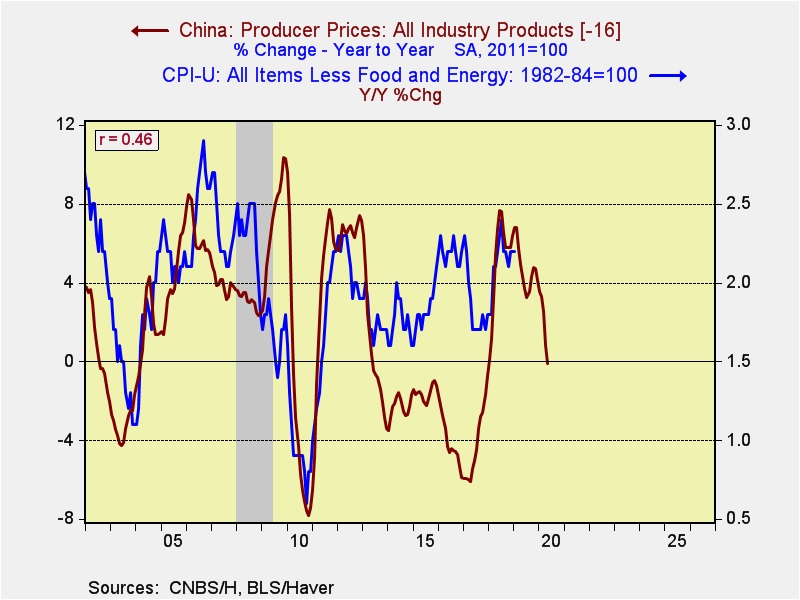
This chart shows U.S. core CPI along with China’s PPI, both on a yearly change basis, starting with China’s entrance into the WTO.  Although not a perfect correlation, it does suggest that, with a bit more than a five-quarter lead, China’s producer prices affect U.S. core CPI.  The recent drop in China’s PPI would signal that price pressure in the U.S. should dissipate in the coming months and give the FOMC room to keep policy steady.

The administration’s decision to delay additional tariffs on China may have also affected monetary policy.[5]  A paper by the San Francisco FRB suggests that the second round of tariffs could have boosted personal consumption prices by 0.4% and business investment costs by 1.4%.[6]  So, the delay gives Powell additional reasons to be patient.

Zarif turns in his resignation: Iran’s foreign minister, Javad Zarif, has offered to resign from his position.[7]  It isn’t clear why he resigned or if President Rouhani will accept the resignation.  Zarif was the lead negotiator of the Iran nuclear deal and has come under pressure from Iranian hardliners for negotiating the deal in the first place.  At the same time, he is schooled in Western diplomacy and if Iran’s plan is to hope President Trump is defeated in 2020 (and assuming a Democratic president would want to revive the nuclear agreement) then keeping Zarif in government would make more sense.  If Rouhani accepts the resignation it would be a signal that Iran has given up hope that the nuclear deal will return even with a change in government in Washington.  We expect Rouhani to turn down the offer; by resigning and having his offer refused, one would expect the pressure from hardliners to dissipate.  In other words, Zarif may be bluffing.

Trade: We have been expecting the administration to accept a lesser trade deal with China to avoid the economic dislocation that broader trade conflict might bring.  After all, the 2020 elections are not all that far away.  We have noted that hardliners in the administration, Navarro and Lighthizer, might balk at a lesser deal and could resign.  However, this isn’t the only area of political pressure.  Democrats are also pressing the administration to push back on China.  It isn’t clear if this is an ideological position or simply supporting the “right” policy that would also harm the president’s reelection chances.[8]

Venezuela: VP Pence met with South American leaders yesterday to shore up support to isolate the Maduro regime.[9]  Pence also announced additional sanctions on Venezuela and promised additional measures would be coming soon from the Treasury Department.[10]  So far, the military remains aligned with Maduro; we suspect U.S. sanctions will be designed to reduce cash flows to the military in hopes that fears of pauperism might lead the brass to change sides.

Trump on oil: Yesterday, we noted that the president called for OPEC to increase production and reduce oil prices; futures prices dropped on the news.  OPEC has responded by saying it will maintain and likely extend current production cuts.[11]

League wins:We are watching Italian politics closely because its current coalition is the rare mix of both left- and right-wing populists, a “Nader coalition.”  We have noted recently that the alliance is fraying as the Five-Star Movement, the left-wing of the coalition, has been losing favor.  Regional elections held yesterday are continuing that trend.  In the election in Abruzzo, the League doubled its share compared to the region’s vote in the last general election, while the Five-Star Movement saw its share drop in half.[12]  If current trends continue, we expect the League, the right-wing side of the current arrangement, to eventually end its pairing with the Five-Star Movement and join with the center-right to form a new coalition.  Although the Nader coalition remains theoretically possible, in nature it is difficult to manage given the wide divisions between left- and right-wing populists on social issues.  What remains to be seen is whether the center-right would control policy in a right-wing coalition or if the League would gain the upper hand.

View the complete PDF


[1] https://www.ft.com/content/3875b900-3901-11e9-b72b-2c7f526ca5d0

[2] https://www.reuters.com/article/us-britain-eu/theresa-may-buckles-british-pm-to-rule-out-no-deal-brexit-the-sun-idUSKCN1QF0LZ

[3] https://www.ft.com/content/028b90ca-3925-11e9-b856-5404d3811663 and https://www.nytimes.com/2019/02/25/world/europe/Jeremy-Corbyn-brexit-referendum.html

[4] https://finance.yahoo.com/news/fed-chair-powell-senate-testimony-184449926.html

[5] https://www.wsj.com/articles/trumps-retreat-on-tariffs-may-help-keep-inflation-pressure-at-bay-report-says-11551130832

[6] https://www.frbsf.org/economic-research/publications/economic-letter/2019/february/inflationary-effects-of-trade-disputes-with-china/?mod=article_inline

[7] https://www.nytimes.com/2019/02/25/world/middleeast/javid-zarif-resigns.html?emc=edit_mbe_20190226&nl=morning-briefing-europe&nlid=567726720190226&te=1 ; https://www.apnews.com/08cb7394544947f5aa0459a2fb99fcd7?utm_source=POLITICO.EU&utm_campaign=6c8db1e66d-EMAIL_CAMPAIGN_2019_02_26_05_51&utm_medium=email&utm_term=0_10959edeb5-6c8db1e66d-190334489 ; https://www.wsj.com/articles/irans-foreign-minister-resigns-in-an-instagram-post-11551128482

[8] https://www.nytimes.com/2019/02/25/us/politics/china-trump-trade-deal-democrats.html

[9] https://www.ft.com/content/3722d028-393e-11e9-b72b-2c7f526ca5d0?emailId=5c74b26254742a0004f1e257&segmentId=22011ee7-896a-8c4c-22a0-7603348b7f22

[10] https://www.nytimes.com/2019/02/25/world/americas/pence-guaido-venezuela-colombia.html?emc=edit_mbe_20190226&nl=morning-briefing-europe&nlid=567726720190226&te=1

[11] https://www.wsj.com/articles/saudis-likely-to-push-to-maintain-opec-output-cuts-despite-u-s-pressure-11551117577

[12] https://www.politico.eu/article/right-wing-parties-set-to-win-regional-italian-election-projections/?utm_source=POLITICO.EU&utm_campaign=6c8db1e66d-EMAIL_CAMPAIGN_2019_02_26_05_51&utm_medium=email&utm_term=0_10959edeb5-6c8db1e66d-190334489

Weekly Geopolitical Report – The Irish Question: Part I (February 25, 2019)

by Bill O’Grady

As the United Kingdom continues on its path to withdraw from the European Union, a key element that needs to be considered is the border issue in Ireland.  The Northern Ireland/Ireland frontier is the only border that would be directly affected by Brexit.  The rest of the U.K. is an island, although border checks would be required at the Chunnel and at U.K. ports.  However, the Irish border has broader geopolitical implications beyond just a border issue.

In Part I of this report, we will begin by introducing the importance of Ireland to Britain’s geopolitics and how this led to the effective British colonization of Ireland.  A short history of British/Irish relations will follow.  Next week, in Part II, we will examine the Good Friday Agreement and analyze the problems that Brexit brings.  As always, we will conclude with market ramifications.

View the full report