

Weekly Energy Update (August 26, 2021)

by Bill O’Grady, Thomas Wash, and Patrick Fearon-Hernandez, CFA | PDF

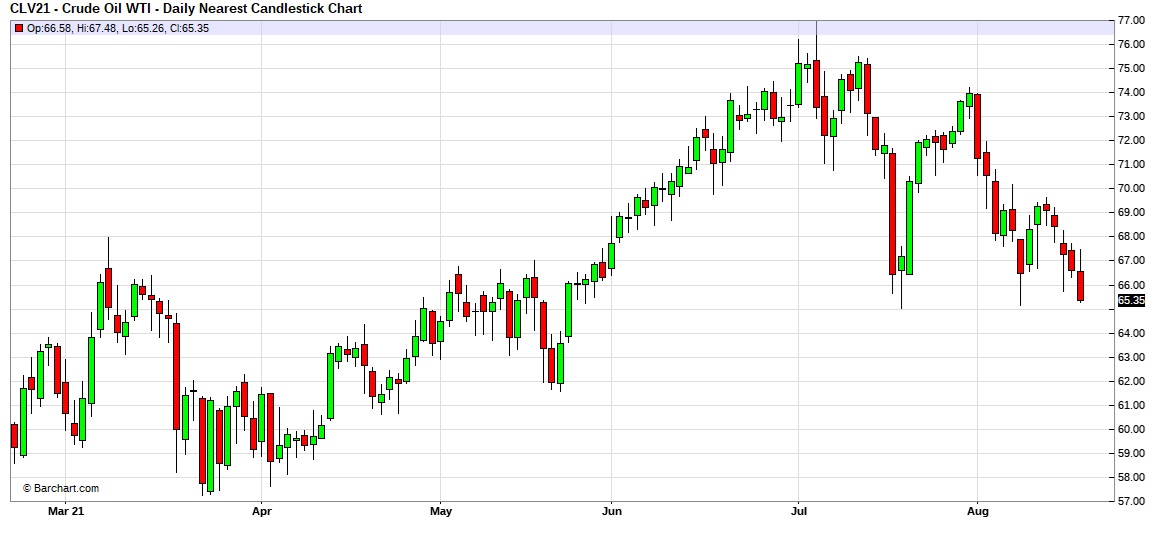
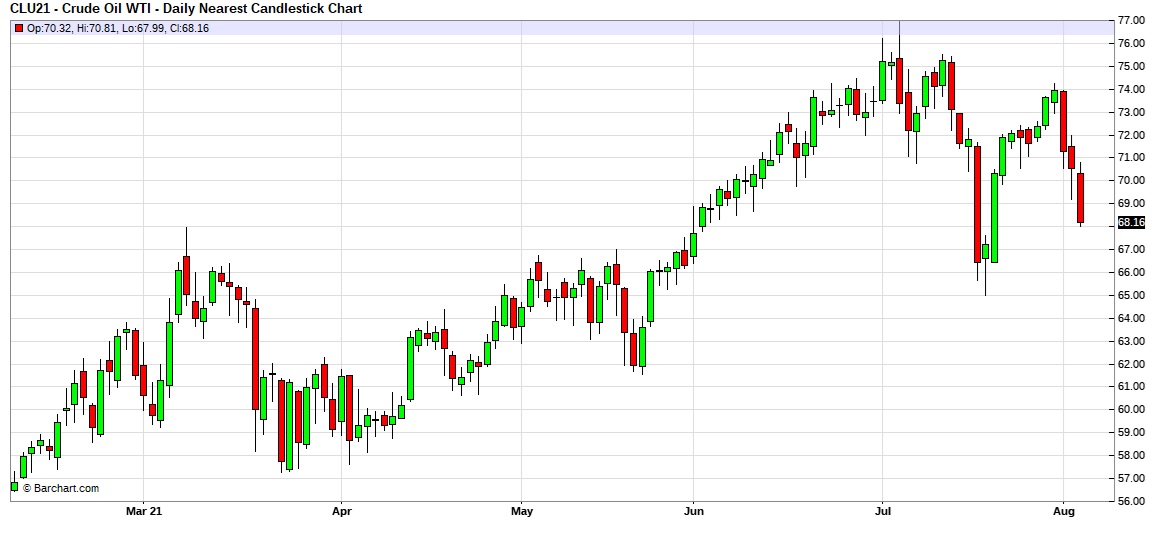
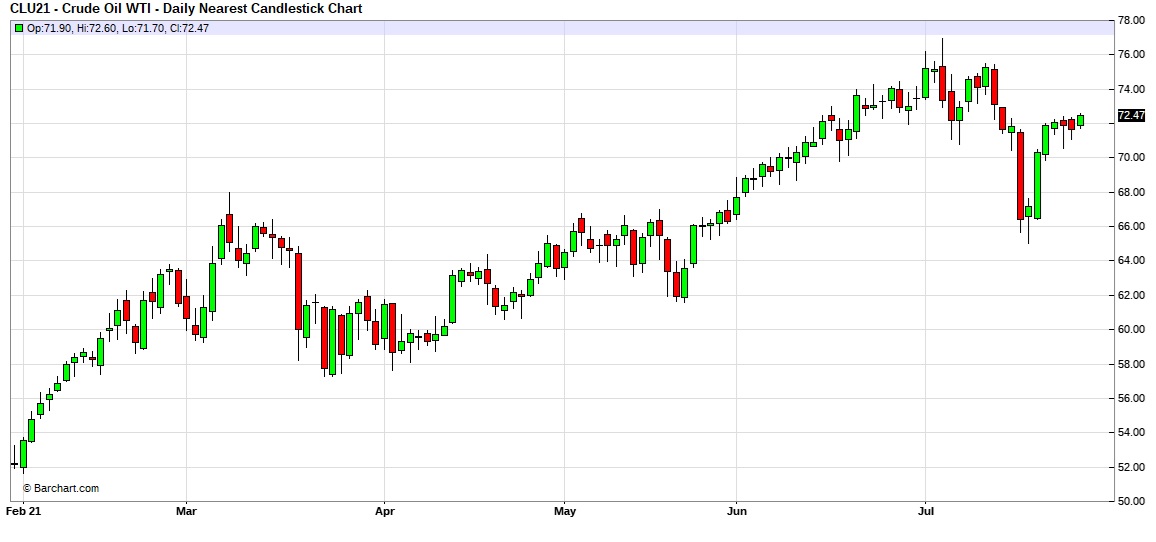
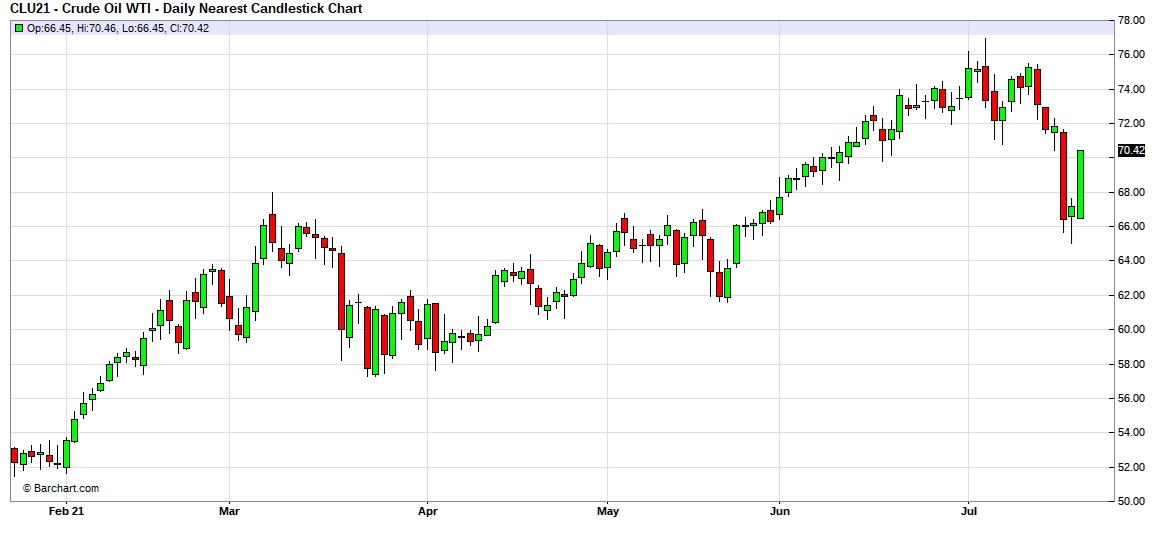
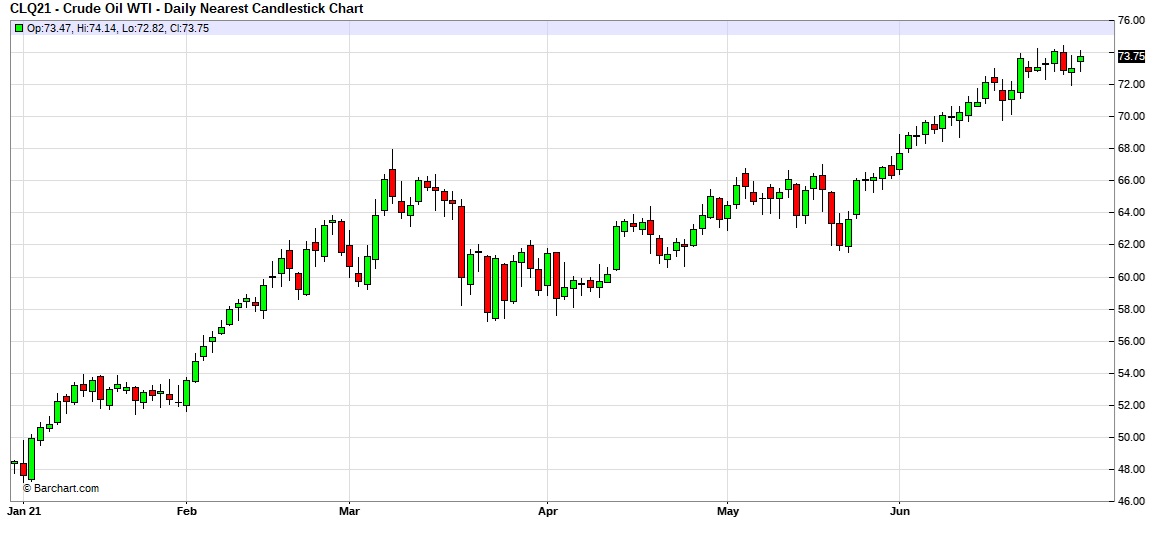
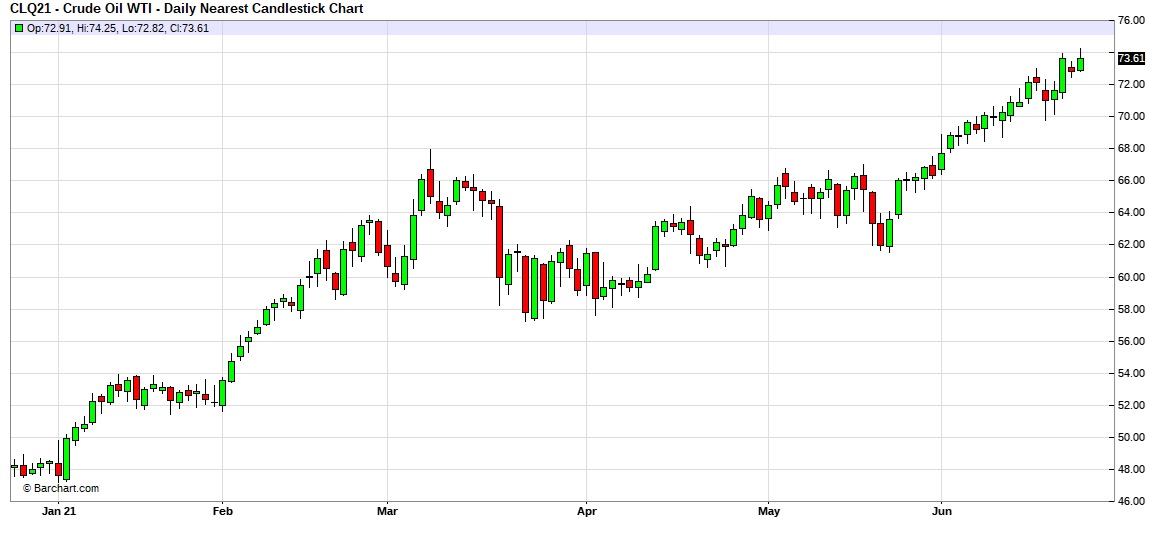
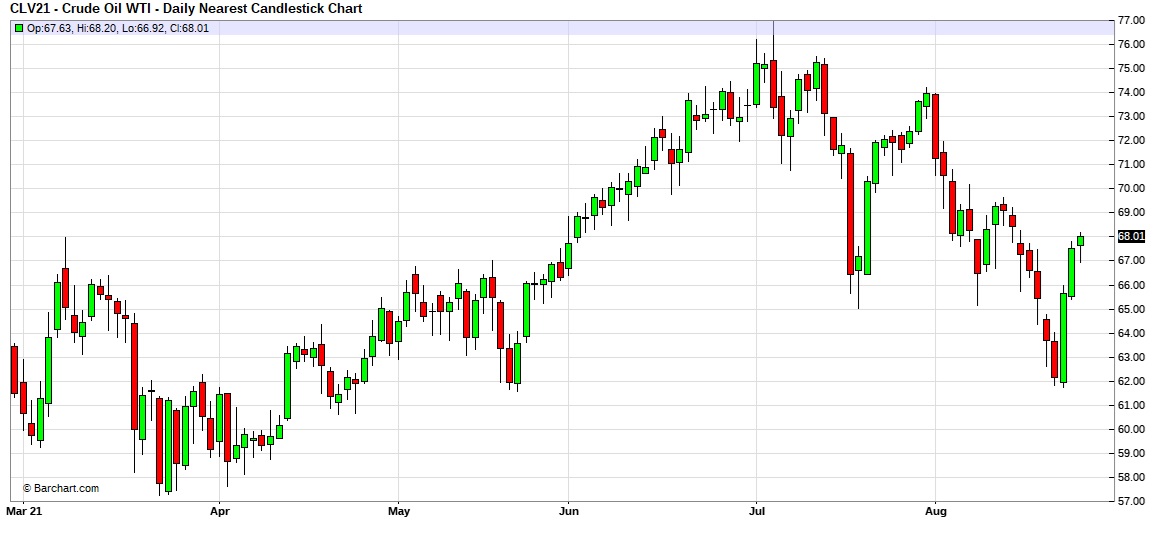
After reaching $62 per barrel support, prices have snapped back.
(Source: Barchart.com)

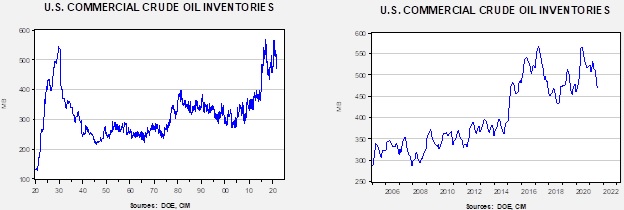
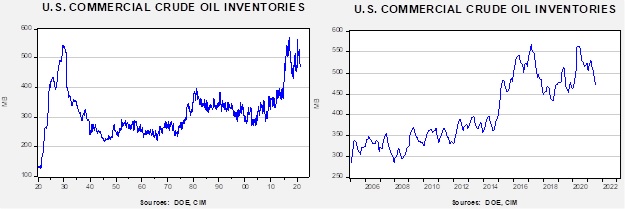
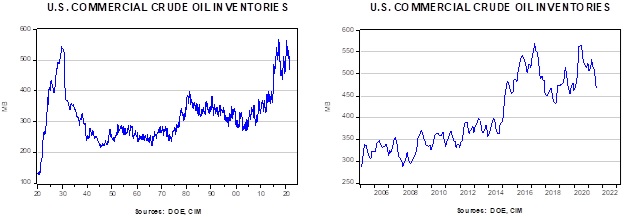
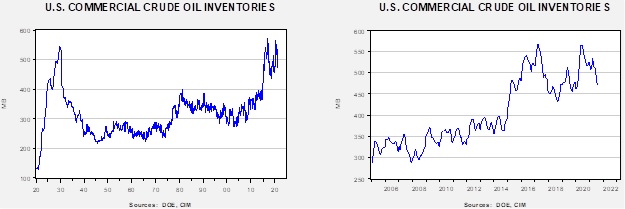
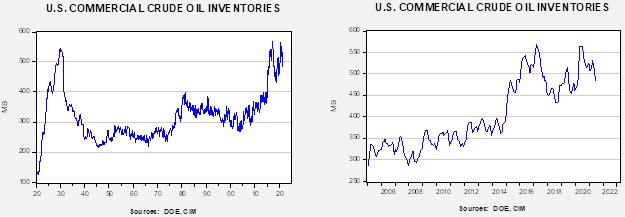
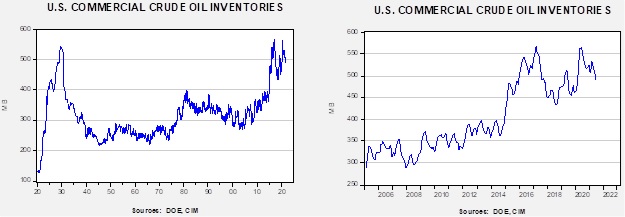
Crude oil inventories fell 3.0 mb compared to the 2.0 mb draw forecast.  The SPR was unchanged this week.
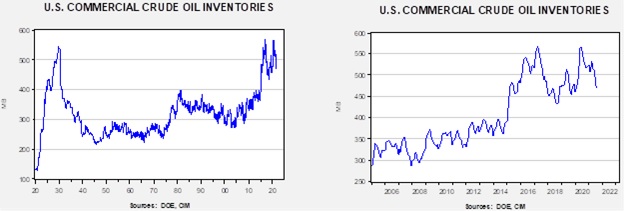
In the details, U.S. crude oil production was steady at 11.4 mbpd.  Exports fell 0.6 mbpd, while imports declined 0.2 mbpd.  Refining activity rose 0.2%.
(Sources: DOE, CIM)

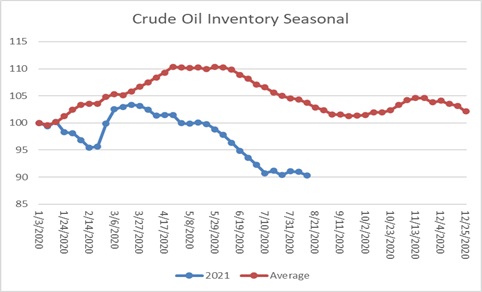
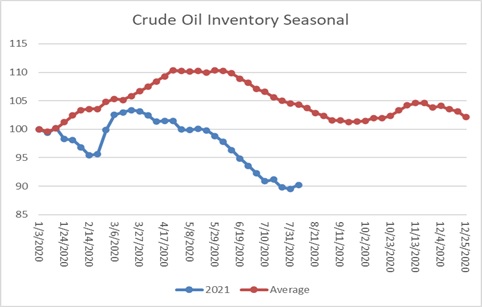
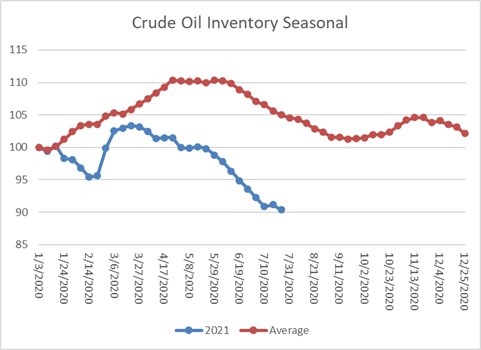
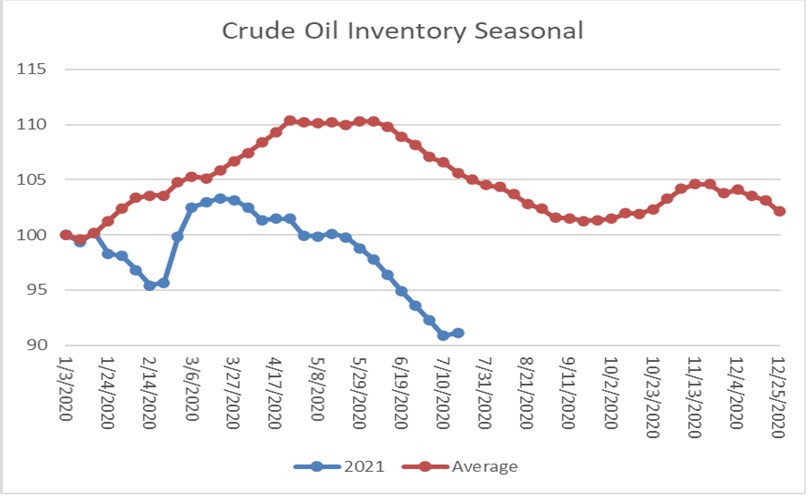
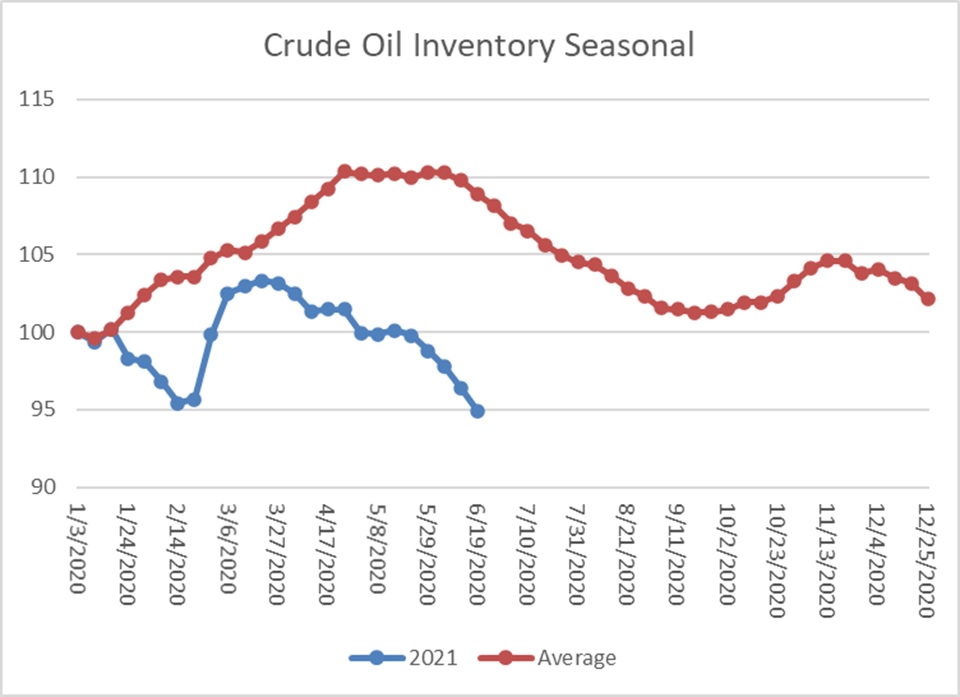
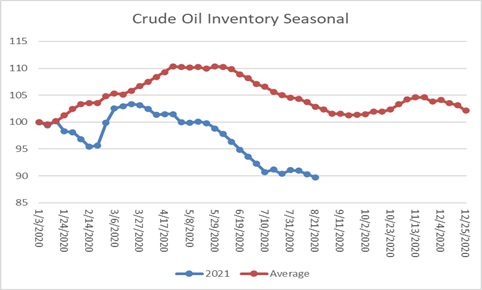
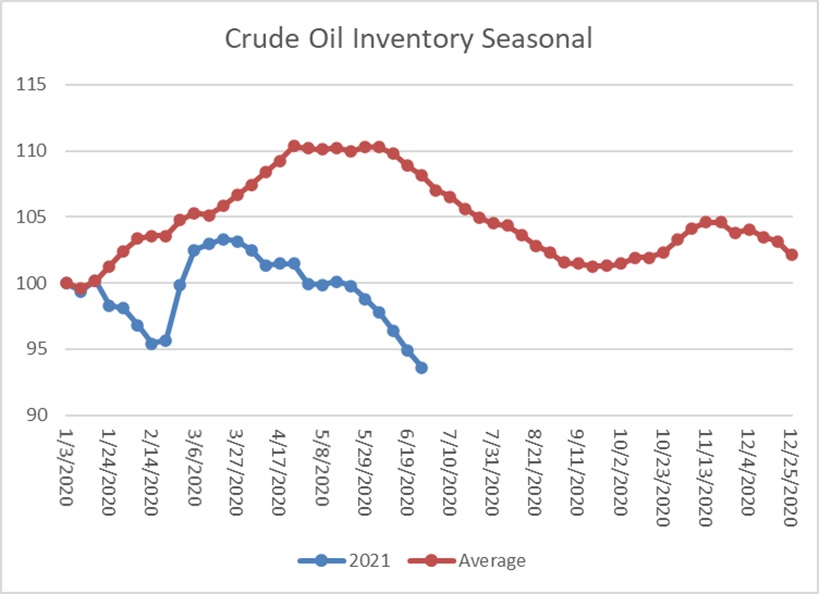
This chart shows the seasonal pattern for crude oil inventories.  We are well into the summer withdrawal season.  Note that stocks are significantly below the usual seasonal trough seen in early September.  A normal seasonal decline would result in inventories around 550 mb.  Our seasonal deficit is 67.7 mb.  Since early July, inventory levels have stabilized.  As the chart indicates, seasonal inventory stabilization usually occurs in September, and with stabilization, the seasonal deficit has narrowed compared to earlier in the summer.
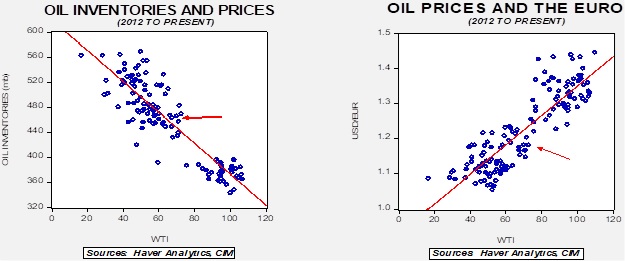
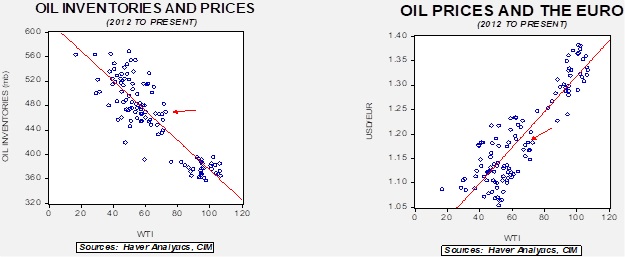
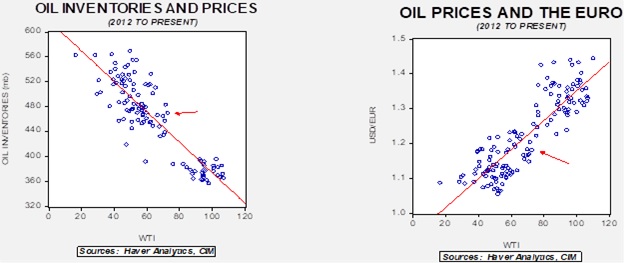
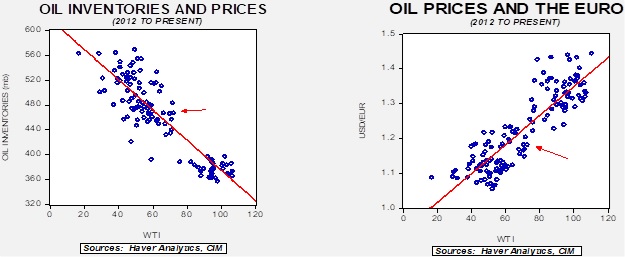
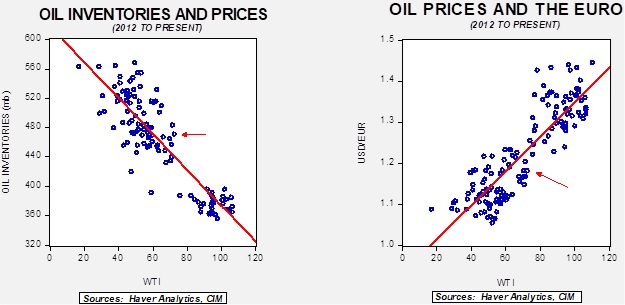
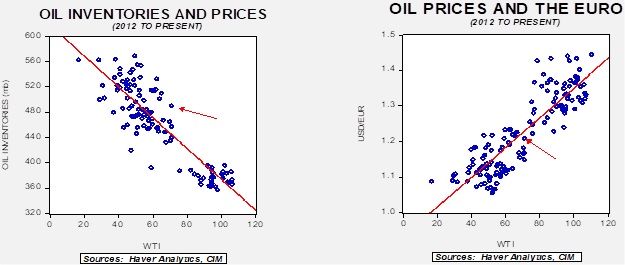
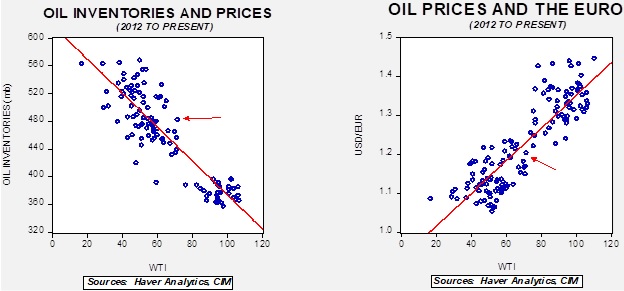
Based on our oil inventory/price model, fair value is $63.65; using the euro/price model, fair value is $61.75.  The combined model, a broader analysis of the oil price, generates a fair value of $62.43.  Continued dollar strength is weighing on oil prices.

 Market news:

Geopolitical news:

  • The world’s attention has been focused on the crisis in Afghanistan, but the U.S. is also planning to withdraw combat forces from Iraq.  The Kurds could be at risk, as both Iran and Turkey want to prevent moves toward a Kurdish state.  Turkey has been taking aggressive actions against Kurdish groups they deem as terrorist organizations.
  • As the Taliban gains control of Afghanistan, Iran is facing a series of potential problems.  The Taliban is a Sunni group, and Shiites in Afghanistan may be at risk; if they are, the logical place to flee would be Iran.  Iran has established refugee camps along its border with Afghanistan.  As the West freezes accounts and denies the Taliban government aid, it is likely the new government in Kabul will turn to opium, which raises the risk of trafficking and addiction in Iran.
  • EU carbon taxes may be worse for Russia than sanctions, according to Igor Sechin, the head of Rosneft (OJSCY, USD, 6.23).

 Alternative energy/policy news:

View PDF

Weekly Energy Update (August 19, 2021)

by Bill O’Grady, Thomas Wash, and Patrick Fearon-Hernandez, CFA | PDF

Oil prices remain under pressure as concerns over the Delta virus and seasonal factors press prices lower.

(Source: Barchart.com)

Crude oil inventories fell 3.2 mb compared to the 1.5 mb draw forecast.  The SPR was unchanged this week.

In the details, U.S. crude oil production rose 0.1 mbpd to 11.4 mbpd.  Exports rose 0.8 mbpd, while imports were unchanged.  Refining activity rose 0.4%.

(Sources: DOE, CIM)

This chart shows the seasonal pattern for crude oil inventories.  We are well into the summer withdrawal season.  Note that stocks are well below the usual seasonal trough seen in early September.  A normal seasonal decline would result in inventories around 550 mb.  Our seasonal deficit is 69.0 mb.  Since early July, inventory levels have stabilized.  As the chart indicates, seasonal inventory stabilization usually occurs in September, so if this pattern continues, the seasonal deficit should narrow.

Based on our oil inventory/price model, fair value is $62.67; using the euro/price model, fair value is $62.09.  The combined model, a broader analysis of the oil price, generates a fair value of $62.09.  Continued dollar strength is weighing on oil prices.

Market news:

  • Oil prices have come under pressure due to the impact of the Delta variant.  This variant is leading to limited lockdowns in parts of the world and raising fears of weakening oil demand.  Complicating matters are calls from the administration for OPEC+ to raise output.  The fear of weakening demand coupled with higher potential supply is bearish for crude oil.
  • Although environmentalists would like to reduce coal usage, strong natural gas prices are fostering more coal-burning for electricity production.
  • Although Alberta’s oil production hit a record, the future of tar sands looks bleak.

Geopolitical news:

 Alternative energy/policy news:

  • Although fracking and some onshore oil projects can be based on short-term outlooks for oil, deepwater projects take years to develop and need years of demand to justify.  We may be seeing the last Gulf of Mexico project, with nations projecting zero carbon emissions by 2050.
  • Economists of all stripes generally agree that a key part of addressing climate change is establishing a proper price for carbon.  Once the cost of burning fossil fuels includes the cost of environmental harm, market incentives will encourage conservation and help pay for mitigation efforts.  Carbon capture is one technology that might allow for the continued use of hydrocarbons if the carbon can be stored and not allowed into the atmosphere.  However, without a realistic price, it’s hard to justify the cost of such projects.  The EU has a carbon market, and prices are reaching a point where investing in carbon capture projects is starting to look feasible.
  • As we have noted, although electric vehicles remain the most likely replacement for cars and light trucks, large trucks and buses may use hydrogen instead.  Delivering hydrogen may be too difficult for retail use, but in concentrated depots, it might work well.  We are starting to see some cities experiment with hydrogen buses.
  • Poland, a heavy coal user, is strongly considering moving to nuclear power.

View PDF

Weekly Energy Update (August 5, 2021)

by Bill O’Grady, Thomas Wash, and Patrick Fearon-Hernandez, CFA | PDF

After last week’s recovery, selling has resumed; this week’s data and fears of weaker demand due to COVID-19 are pressuring prices.

(Source: Barchart.com)

Crude oil inventories unexpectedly rose 3.6 mb compared to the 3.2 mb draw forecast.  The SPR was unchanged this week.

In the details, U.S. crude oil production was steady at 11.2 mbpd.  Exports fell 0.6 mbpd while imports fell 0.1 mb.  Refining activity rose 0.2%.

(Sources: DOE, CIM)

This chart shows the seasonal pattern for crude oil inventories.  We are well into the summer withdrawal season.  Note that stocks are well below the usual seasonal trough seen in early September.  A normal seasonal decline would result in inventories around 550 mb.  Our seasonal deficit is 69.7 mb.  Since early July, inventory levels have stabilized; as the chart indicates, seasonal inventory stabilization usually occurs in September, so if this pattern continues, the seasonal deficit should narrow.

Based on our oil inventory/price model, fair value is $61.46; using the euro/price model, fair value is $62.98.  The combined model, a broader analysis of the oil price, generates a fair value of $61.92.  The weaker EUR has started to affect the model forecast, putting all the models’ fair value calculations well below the current price.

Market news:

Geopolitical news:

  • Over the weekend, an oil tanker, the MV Mercer Street, was attacked by drones, and two people were killed, a Briton and a Romanian.  Zodiac Maritime, an Israeli company, manages the vessel; it is owned by Taihei Kaiun (1968, JPY, 2723).  According to reports, the drones, which apparently carried explosive charges, crashed into the ship’s bridge, killing two crew members.  The U.S., U.K., and Israel have blamed Iran for the attack.  Tehran denies its involvement.  This attack has been part of a series of strikes between Iran and Israel.  We noted in June that Iran’s largest warship, the Kharg, caught fire and sank under suspicious circumstances.  Market reaction has been mostly nonexistent.  Oil prices are lower this morning on pandemic concerns.  However, an attack on oil shipping in the region around the Strait of Hormuz does raise the potential for a supply disruption.
  • Following this event, suspected Iranian gunmen seized a tanker in the Persian Gulf.  Reports say the situation has been resolved, and the gunmen have left the ship, although details are still scarce.  Iran denies involvement, but there is some evidence that a group linked to Iran may have been involved.  Nations in the region are pushing for retaliation.
  • These tensions coincide with President Raisi officially taking office today.  With the change in administration, there are growing doubts about a restoration of the 2015 nuclear deal.  The Biden administration has the goal of reinstituting the agreement, but Iran is less certain it wants to return to it.  Iran has been increasing its uranium processing and likely wants to maintain progress towards nuclear technology.  Another major issue is that the Iran nuclear deal was not a treaty.  Opposition in Congress meant that the measure could not pass through the legislature, so, and this occurred with the Trump administration, a new president could pull out of the agreement again.  Grand Ayatollah Khamenei wants guarantees that the U.S. won’t pull out again, but the structure of the agreement cannot provide that assurance.  It appears that Raisi’s plan is to focus on four areas—sanctions and other restrictions lifted, guarantees of irreversibility, normalization of trade, and the ability of Iran to verify sanctions are no longer in force.  We view these as non-starters; for instance, the U.S. is planning sanctions against Iran’s drones and guided missiles, meaning that some form of sanctions will always be in place.  Irreversibility can’t be offered either.  So, overall, we doubt the nuclear deal will return.
  • There is one factor to watch.  Iran engaged in what was called “strategic patience” during the Trump years, limiting retaliation to avoid a stronger response from the U.S.  With Trump out of office, Iran appears to be escalating its activities in the region, apparently because it assumes a more measured response from Washington.  With the U.S. wanting to reduce its involvement in the Middle East to focus on China, Iran may see it as an opportunity not just to retaliate against earlier provocations but to expand its area of influence.
  • Iran is facing a serious water problem caused by the lack of rainfall, mismanagement, and an attempt to become food independent.
  • Iran is also facing electricity instability, with blackouts raising social tensions.
  • As the world electrifies, the need for strategic metals is rising.  China has been making large investments in Africa.  It is now seeing pushback from African nations unhappy with Beijing’s behavior in the region.
  • China has made major investments in the U.K. nuclear power industry.  The Johnson government is having second thoughts about that decision.  Investor reluctance to join a project with Chinese involvement has played a role, so have concerns about security given China’s involvement.
  • Qatar is considering an investment in submarines.  It is negotiating with Italy to purchase the vessels.  If Qatar acquires submarines, it adds to concerns about an arms race in the region.

Alternative energy/policy news:

View PDF

Weekly Energy Update (July 29, 2021)

by Bill O’Grady, Thomas Wash, and Patrick Fearon-Hernandez, CFA | PDF

After last week’s selling, prices have recovered back above $70 per barrel.

(Source: Barchart.com)

Crude oil inventories fell 4.1 mb compared to the 2.1 mb draw forecast.  The SPR was unchanged this week.

In the details, U.S. crude oil production fell 0.2 mbpd at 11.2 mbpd.  Exports were unchanged while imports fell 0.6 mb.  Refining activity fell 0.3%.

(Sources: DOE, CIM)

This chart shows the seasonal pattern for crude oil inventories.  We are well into the summer withdrawal season.  Note that stocks are well below the usual seasonal trough seen in early September.  A normal seasonal decline would result in inventories around 550 mb.  Our seasonal deficit is 79.0 mb.  At present, inventories have started to stabilize after falling quickly since March.

Based on our oil inventory/price model, fair value is $62.91; using the euro/price model, fair value is $72.29.  The combined model, a broader analysis of the oil price, generates a fair value of $62.51.  Oil prices are now in line with oil inventories but undervalued compared to the dollar.

Market news:

 Geopolitical news:

 Alternative energy/policy news:

  • Electrification has created a pressing need for improved battery technology.  Lithium-ion batteries are commonly used because they hold a high level of energy relative to their weight.  The lead-acid batteries used in cars that have internal combustion engines, for example, are too heavy for standalone auto use.  However, for some uses, such as backup power for electric utilities, lithium-ion batteries are too expensive to be an economic alternative.  A number of firms are unveiling new battery technology that uses iron and air to hold power.  Iron is significantly cheaper than the metals used in lithium-ion batteries; although the weight precludes their use in transportation, for stationary backup power, iron is perfectly suitable.  If this technology lowers costs, it will make the combination of wind/solar and batteries a viable alternative to coal and natural gas-fired turbines.
  • Another emerging battery technology uses molten salt, although it is probably not evolving as quickly as the aforementioned iron-air batteries.
  • China is working on a commercially viable thorium nuclear reactor.  Such a reactor would not generate the nuclear waste that current reactors produce.
  • As the world warms, the need for air conditioning will rise.  The concern is that air conditioning requires electricity, and if the “juice” comes from fossil fuels, using air conditioning will compound the problem caused by greenhouse gases.  However, even if that hurdle is overcome by using renewables or nuclear, air conditioning refrigerants can also be potent greenhouse gases.  A new process would not only eliminate the current refrigerants but also be more efficient.

View PDF

Weekly Energy Update (July 22, 2021)

by Bill O’Grady, Thomas Wash, and Patrick Fearon-Hernandez, CFA | PDF

The OPEC+ agreement led to a deep selloff in oil prices, but the decline has attracted new buyers.

(Source: Barchart.com)

Crude oil inventories unexpectedly rose 2.1 mb compared to the 4.5 mb draw forecast.  The SPR was unchanged this week.

In the details, U.S. crude oil production was unchanged at 11.4 mbpd.  Exports declined 1.6 mbpd, while imports rose 0.9 mb.  Refining activity fell 0.4%.

(Sources: DOE, CIM)

This chart shows the seasonal pattern for crude oil inventories.  We are well into the summer withdrawal season.  Note that stocks are well below the usual seasonal trough seen in early September.  A normal seasonal decline would result in inventories around 550 mb.  Our seasonal deficit is 79.6 mb.  At present, inventories are falling faster than normal.

Based on our oil inventory/price model, fair value is $61.31; using the euro/price model, fair value is $63.07.  The combined model, a broader analysis of the oil price, generates a fair value of $61.89.  Even with this week’s pullback, oil prices are well above fair value for all the models.  The ability for oil to maintain current levels is dependent on sentiment towards OPEC and issues surrounding the pandemic.

Market news:

  • OPEC+ made it official this week; starting next month, it will increase production quotas by 0.4 mbpd each month into next year. Although this news already was signaled, as we note in the opening chart, oil prices slumped on the news.  The fear is that the cartel is adding supplies to the market while it is being adversely affected by the Delta variant of COVID-19.  Based on our modeling work, the market has been overvalued, so a pullback isn’t a complete surprise, and using the production news created a narrative for longs to take profits.  Supplies will remain relatively tight, and we don’t expect prices to fall too much from here.
  • Financial firms are increasing the financing for the oil and gas industry, but the firms are not using the loans for drilling. They are focusing on balance sheet repair.  This behavior isn’t surprising given the likely path of future demand.

Geopolitical news:

Alternative energy/policy news:

View PDF

Weekly Energy Update (July 15, 2021)

by Bill O’Grady, Thomas Wash, and Patrick Fearon-Hernandez, CFA | PDF

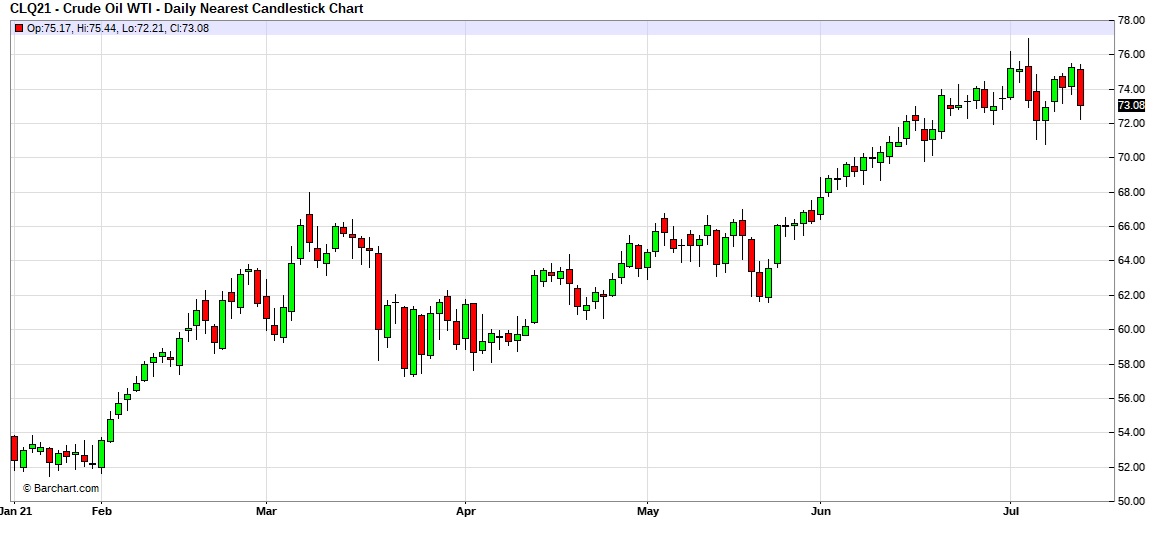
Prices appear to be consolidating between $72 to $76 per barrel.

(Source: Barchart.com)

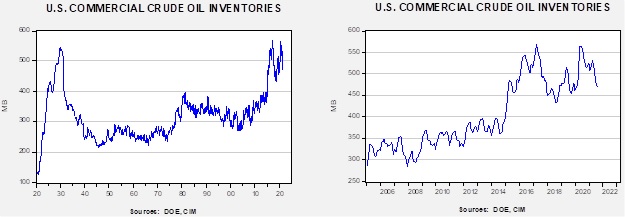
Crude oil inventories fell 7.9 mb compared to the 4.4 mb draw expected.  The SPR was unchanged this week.

In the details, U.S. crude oil production rose 0.1 mbpd to 11.4 mbpd.  Exports rose 1.4 mbpd, while imports rose 0.3 mb.  Refining activity fell 0.4%.

(Sources: DOE, CIM)

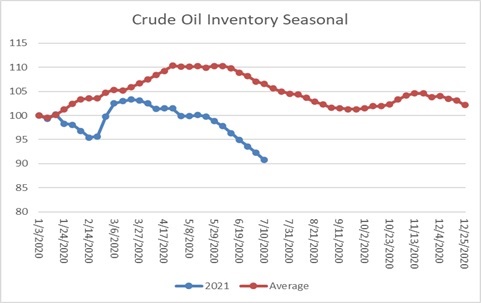
This chart shows the seasonal pattern for crude oil inventories.  We are well into the summer withdrawal season.  Note that stocks are well below the usual seasonal trough seen in early September.  A normal seasonal decline would result in inventories around 553 mb.  Our seasonal deficit is 81.7 mb.  At present, inventories are falling faster than normal.

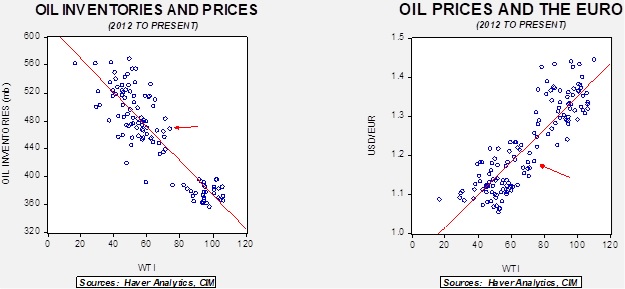
Based on our oil inventory/price model, fair value is $61.99; using the euro/price model, fair value is $63.36.  The combined model, a broader analysis of the oil price, generates a fair value of $62.42.  Oil prices are well above fair value for all the models.  The ability for oil to maintain current levels is dependent on sentiment towards OPEC, although the continued decline in oil stockpiles is improving the valuation gap.

Market news:

  • One reason capitalism has triumphed over communism is that, due to the profit motive and the ability to tolerate disruption, capitalist economies tend to use commodities with ever-increasing efficiency. In other words, capitalism tends to generate greater output with less input over time.  Communism, at least as it was practiced by the Soviets, tended toward high levels of commodity intensity.  In the 1970s, rising oil prices, coupled with tighter monetary policy to counteract inflation, led to two deep recessions, one in 1973-75 and another in the early 1980s.  In 1980, the U.S. needed 5,000 BTUs[1] of petroleum to make $1 of GDP; now that is down to around 1,700.[2]  Simply put, rising oil prices are not yet a threat to economic growth.
  • Although we are seeing a slow rise in U.S. oil production, we are still well below previous peaks. A change in oil company behavior is an important element of this slower production growth.  In the past, companies would tend to maximize production rather than profits.  That is no longer the case.
  • As oil prices rise, speculators are increasingly taking bullish positions on oil.
  • Qatar is poised to expand its LNG production by 63% over the next decade.

Geopolitical news:

Alternative energy/policy news:

View PDF


[1] Which is 0.4 gallons of crude oil, or four cups and 3 ounces.

[2] Roughly 13 ounces.

Weekly Energy Update (July 9, 2021)

by Bill O’Grady, Thomas Wash, and Patrick Fearon-Hernandez, CFA | PDF

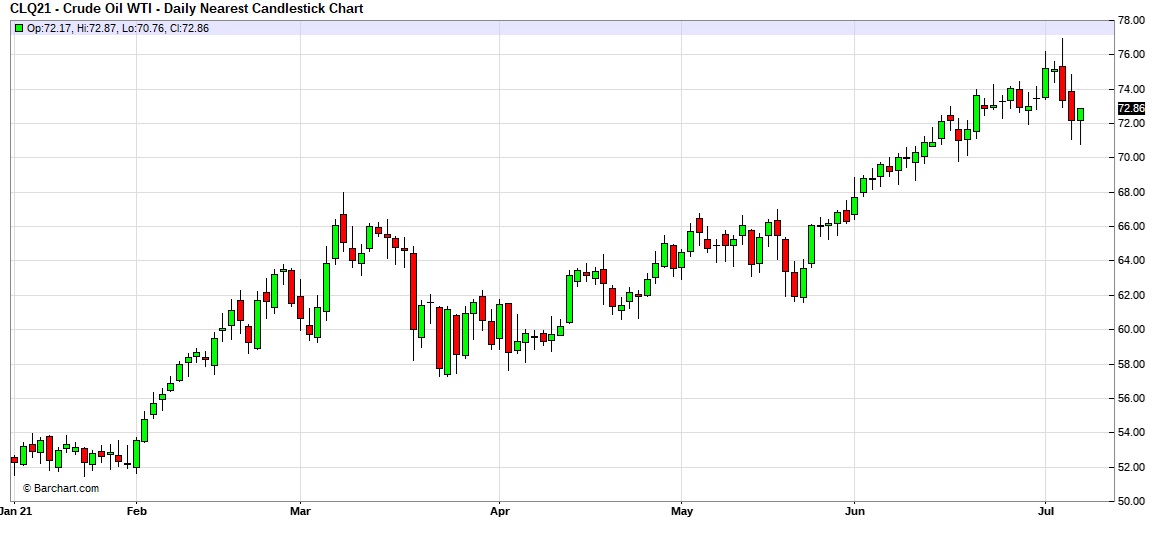
After rising above $76 per barrel on news of the OPEC+ impasse (see below) prices have corrected modestly.

(Source: Barchart.com)

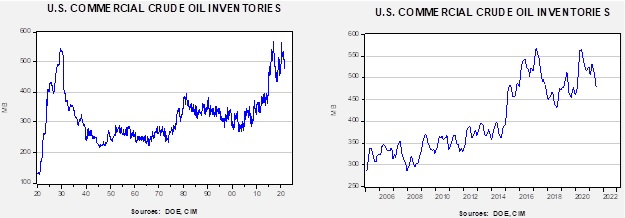
Crude oil inventories fell 6.9 mb compared to the 4.0 mb draw expected.  The SPR fell 1.2 mb, meaning without the addition from the reserve, commercial inventories would have declined 8.0 mb.  We note the SPR is at its lowest level since October 2003.

In the details, U.S. crude oil production was unchanged at 11.1 mbpd.  Exports rose 0.1 mbpd, while imports fell 0.5 mb.  Refining activity rose 0.4%.

(Sources: DOE, CIM)

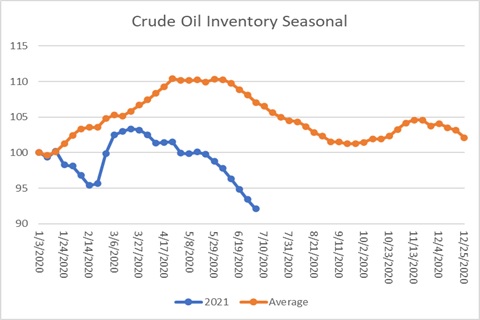
This chart shows the seasonal pattern for crude oil inventories.  We are well into the summer withdrawal season.  Note that stocks are already below the usual seasonal trough seen in early September.  A normal seasonal decline would result in inventories around 553 mb.  Our seasonal deficit is 77.1 mb.  At present, inventories are falling faster than normal.

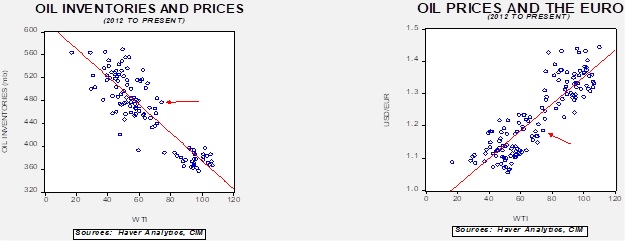
Based on our oil inventory/price model, fair value is $59.48; using the euro/price model, fair value is $63.41.  The combined model, a broader analysis of the oil price, generates a fair value of $61.09.  Oil prices are well above fair value for all the models.  The ability of oil to maintain current levels is dependent on sentiment towards OPEC.

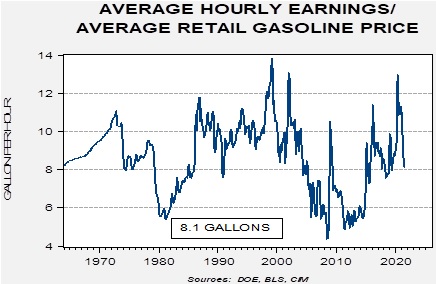
Rising gasoline prices can be a political problem for the White House.  However, the key isn’t just the rise in prices but the relationships to income.  Clearly, consumers prefer lower prices to higher prices, but the combination of high prices and low wage growth creates a much more serious problem.  One way we try to measure this relationship is to divide the current wage for non-supervisory workers into the national average gasoline prices.  This calculation measures how many gallons of gasoline an average worker can purchase from working one hour.

Currently, a worker can buy just over eight gallons at the average hourly wage.  The average since the mid-1960s is 8.6 gallons, so the current level is probably not enough to cause political turmoil.

Market news:

  • Alaskan crude oil production is steadily declining, which will support higher prices over time.
  • A Greenpeace activist was able to capture video comments from an Exxon (XOM, USD, 61.37) lobbyist that revealed some of the activities the company supported in Congress. The report put the company in a bad light and has triggered apologies.
  • Propane prices are soaring. It is unusual for this time of year, as demand is seasonally weak in the summer.  If supplies remain tight, it could boost crop drying costs (farmers often use propane to dry their crops before storing them in silos) and may become a crisis by winter, when rural households use the fuel for home heating.  What’s behind the rise?  Propane is a byproduct of oil refining and natural gas processing.  When production rose with the shale revolution, the propane market became oversupplied, leading the industry to build export capacity.  Now, nearly 70% of U.S. production is exported.  To reduce exports, domestic prices must exceed foreign prices.
  • As natural gas prices rise, coal demand is making a comeback.

Geopolitical news:

Alternative energy/policy news:

View PDF

Weekly Energy Update (July 1, 2021)

by Bill O’Grady, Thomas Wash, and Patrick Fearon-Hernandez, CFA | PDF

Oil prices are moving steadily higher although momentum is starting to slow.

(Source: Barchart.com)

Crude oil inventories fell 6.7 mb compared to the 4.0 mb draw expected.  The SPR fell 1.4 mb, meaning without the addition from the reserve, commercial inventories would have declined 8.1 mb.  We note the SPR is at its lowest level since October 2003.

In the details, U.S. crude oil production was unchanged at 11.1 mbpd.  Exports rose 0.1 mbpd, while imports fell 0.5 mb.  Refining activity rose 0.4%.

(Sources: DOE, CIM)

This chart shows the seasonal pattern for crude oil inventories.  We are well into the summer withdrawal season.  Note that stocks are already below the usual seasonal trough seen in early September.  A normal seasonal decline would result in inventories around 465 mb.  Our seasonal deficit is 75.1 mb.  At present, inventories are falling faster than normal.

Based on our oil inventory/price model, fair value is $57.17; using the euro/price model, fair value is $67.63.  The combined model, a broader analysis of the oil price, generates a fair value of $62.15.  Oil prices are still “rich” relative to inventory levels.  Recent dollar strength caused by uncertainty surrounding Fed policy has also reduced the dollar model’s fair value.

Market news:

  • The Dallas FRB produces quarterly surveys of oil and gas activity in its district. The report suggests that production and investment are recovering.  At the same time, the survey indicates costs are rising as well.  So far, we have only seen a modest rise in production.  Some of this is due to concerns about future regulation.  The shale industry, in particular, is trying to shed its reputation as a capital consumer.  Thus, the previous pattern of rapid output increases does not appear to be occurring this time around…so far.
  • The Supreme Court has backed refiners in their disputes over biofuel waivers. The renewable fuel standards mandated the required amounts of biofuels to be used, assuming steady growth in demand.  However, after the Great Financial Crisis, demand growth fell, and the only way to meet the standard was to move beyond the 10% “blend wall.”  The courts have pushed back against the mandated level of usage.
  • This report examines the idea that we may be at peak oil consumption.

Geopolitical news:

Alternative energy/policy news:

  1. We have often discussed how climate activists have targeted pipelines ultimately to reduce the availability of fossil fuels.  Such actions are controversial; pipelines move oil and products with less environmental impact compared to trains and trucks.  The goal of activists is to reduce consumption, so if a pipeline disruption is resolved by trucks or trains, it makes conditions worse.  After the initial support from the Biden administration in halting the Keystone XL pipeline, the White House has become less active, disappointing environmentalists.  There is a political risk from rising gasoline prices, and we suspect the administration is trying to avoid voter dissatisfaction from higher energy prices while maintaining some level of creditability with environmentalists.
  • Last week, we discussed ideas about placing sails on ocean-going vessels to reduce carbon consumption.  This report expands on that notion.
  • A groundbreaking nuclear power plant, which uses molten salt instead of water, is being constructed in Wyoming.  It is replacing a coal plant.  Such plants have interesting features, including the ability to create intermittent power, unlike traditional nuclear reactors, which provide baseload power.  These reactors have the promise of being cheaper and safer and may provide a way to provide reliable carbon-free electricity.
  • Renewable diesel, a plant-based product, has the potential to be a better replacement than biodiesel, which has suffered from poor performance in cold weather.  This new product is refined from the same feedstocks as biodiesel, but since it is refined much like crude oil, it has properties similar to fossil diesel.
  • Direct carbon capture from the atmosphere remains the great hope of reducing CO2.  This report is an update on progress.
  • The Senate has passed a measure (S.1251) that would give farmers and foresters the ability to sell carbon credits for the CO2 their activities capture.  The fact the bill passed overwhelmingly (92-8) shows that it is still good politics to be seen as farm friendly.  However, the actual execution of such policies is complicated.

The U.S. has moved to ban some solar products produced in Xinjiang.

View PDF

Weekly Energy Update (June 24, 2021)

by Bill O’Grady, Thomas Wash, and Patrick Fearon-Hernandez, CFA | PDF

Oil prices are moving steadily higher in an orderly fashion.

(Source: Barchart.com)

Crude oil inventories fell 7.6 mb compared to the 3.5 mb draw expected.  The SPR fell 1.7 mb, meaning without the addition from the reserve, commercial inventories would have declined 9.3 mb.  We note the SPR is at its lowest level since October 2003.

In the details, U.S. crude oil production fell 0.2 mbpd to 11.0 mbpd.  Exports fell 0.2 mbpd, while imports rose 0.2 mb.  Refining activity fell 0.4%.

(Sources: DOE, CIM)

This chart shows the seasonal pattern for crude oil inventories.  We are beginning the summer withdrawal season.  Note that stocks are already below the usual seasonal trough seen in early September.  A normal seasonal decline would result in inventories around 465 mb.  Our seasonal deficit is 72.2 mb.  At present, inventories are falling faster than normal.

Based on our oil inventory/price model, fair value is $55.05; using the euro/price model, fair value is $68.47.  The combined model, a broader analysis of the oil price, generates a fair value of $61.47.  Oil prices are still “rich” relative to inventory levels; recent dollar strength caused by uncertainty surrounding Fed policy has also reduced the dollar model’s fair value.

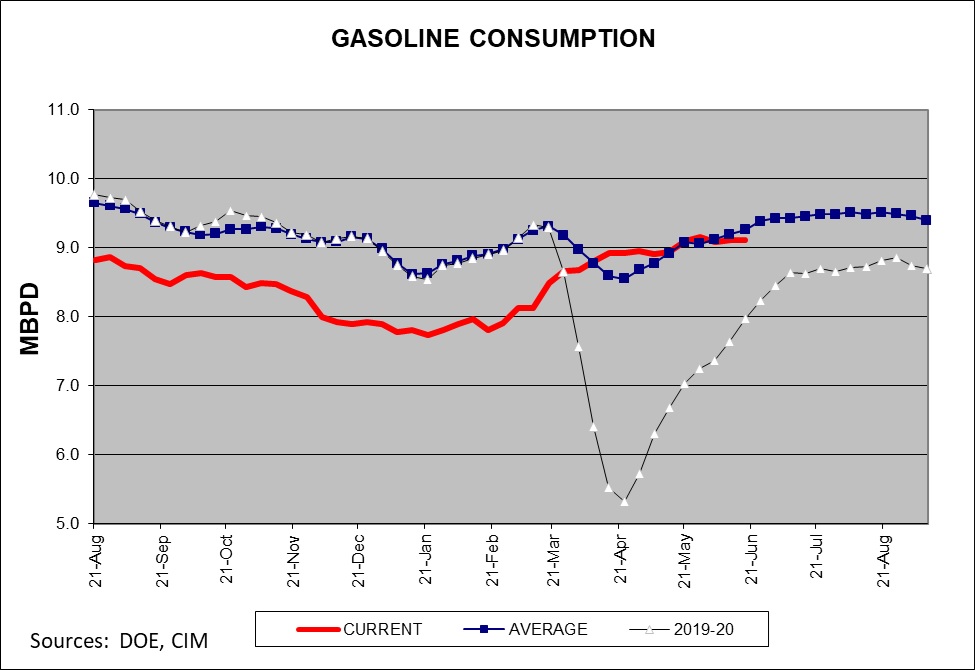
Although the economy is reopening, gasoline demand does not reflect any sort of “pent-up” demand.  Consumption is running in line with the five-year average.

Market news:

Geopolitical news:

Alternative energy/policy news:

View PDF