Daily Comment (August 5, 2019)

by Bill O’Grady, Thomas Wash, and Patrick Fearon-Hernandez, CFA

[Posted: 9:30 AM EDT]

It’s Monday, but far from a happy one.   Global equity markets are taking a beating while interest rates continue to decline.  Geopolitical tensions are rising in several theaters.  The U.S. is dealing with two mass shootings.  And, the Haj begins today.  Here are the details:

Trade wars:  Media reports indicate that nearly all the president’s advisors (Peter Navarro was the exception) did not want to see tariffs implemented on China.   As we have noted in the past, the president believes that the incidence of the tariffs falls on Chinese exporters and thus it is a “free tax” for the U.S.  Although this point is often disputed with great certainty by the media, in reality, it can work as the president suggests.  Without question, a tariff raises the price to a U.S. importer.  If the transaction were that simple, the president’s critics are correct.  However, the Chinese exporter, in order to maintain market share, may reduce his price to the level of the tariff.  In that case, the incidence falls on the exporter.  Or, the foreign nation may depreciate its currency by the amount of the tariff, offsetting the levy.  In that case, the incidence of the tax falls on U.S. exporters (the price of their goods increased due to a weaker currency) and on consumers in China (the cost of imports rises for those buyers).  In other words, it’s complicated.

However, China followed the textbook and this morning allowed the CNY to fall, as the currency broke seven CNY to the USD.  This was a level that markets assumed the PBOC would defend.  Instead, monetary officials simply allowed the currency to decline.  Although this action is consistent with international economic theory, Chinese officials tended to hold the line on this level due to worries about capital flight.  Although there have been conflicting reports, it appears China may be halting agricultural purchases.   In addition, China has disputed Trump’s claim over fentanyl exports.  Fears of a currency war are clearly undermining investor confidence.  At the same time, investors should be aware that the president could flip on this position at any time, as we saw with Mexico.  The hurdle for making a switch isn’t all that high.  All China would probably have to do is announce soybean purchases and make some show about seizing narcotics.  Although, doing so and not appearing to cave to the U.S. is tricky, especially in front of party meetings.  In addition, China is blaming the U.S. for not just the tariffs, but for unrest in Hong Kong; giving in to U.S. demands in this atmosphere looks unlikely.

India:  India appears to be moving to remove autonomy from Kashmir.   In the past few days, New Delhi has warned tourists to evacuate and has put the region on lockdown.   Communication links have been broken and local officials have been placed under house arrest.   The region has been a flashpoint in tensions between Pakistan and India, both who claim control over the districts.  The area, mostly Muslim, wants autonomy from both nations but neither are inclined to cede it to the other.  If India moves to absorb its area of control into greater India, local unrest will almost certainly escalate, and Pakistan could become involved.

Hong Kong:  There a no signs of cooling in Hong Kong.  A general strike, the first in 50 years, has been called for today and widespread protests occurred over the weekend.   Public transportation was disrupted over the weekend, and civil servants held protests against their government.

Iran:  Iran has seized another petroleum tanker although it appears it may be a smuggler’s vessel.  Iran subsidizes its petroleum products and there is an active business in buying product at lower prices in Iran and selling elsewhere in the region.   A broader problem for the U.S. is that China is actively defying U.S. sanctions on Iran by smuggling oil from Iran.  Smuggling adds complications not only with Iran but with China as well.  Iran is indicating it is reducing its commitment to JCOPA; the more Iran goes down this path, the greater the odds Europe will be forced to shift to the U.S. position on Iran.

Brexit:  Boris Johnson appears to be preparing for a snap election due to the narrow nature of this coalition.  Polls in Scotland show a rise in separatist sentiment due to Brexit.

International Monetary Fund:  Leaders from the European Union over the weekend settled on Bulgarian economist Kristalina Georgieva as their candidate to replace Christine Lagarde as head of the IMF.  The Europeans have traditionally been afforded the right to name the IMF chief, while U.S. government names the World Bank head.  Perhaps the more interesting element of the decision is that it marks the second time in the last few weeks that French President Macron got his way with a major EU personnel decision.  At least for the moment, the French president seems to be in the ascendency, even as German Chancellor Merkel sees her power on the wane.

Russia:  For a second straight weekend, demonstrations against unfair municipal elections led to more than 1,000 arrests in Moscow alone.  Perhaps more important, authorities have reportedly started to investigate whether the anti-corruption group run by opposition leader Alexei Navalny has been using illegal financing.  Such investigations are often used to muzzle government critics in Russia.  Now that President Putin’s approval rating has fallen to a six-year low of 64%, the government may be getting desperate to nip any further political protests at the bud.  Although we doubt Putin’s regime is in any danger, conditions are not good in Russia.  Consumer debt is becoming an issue, massive, uncontrolled wildfires are occurring in Siberia, and in the Ukraine, the new leader there is making life difficult for Putin.

Japan-South Korea:  The South Korean government’s free-trade commission has fined four Japanese companies for rigging bids to supply South Korean automakers.  Although this could be just a run-of-the-mill action, it could also be retaliation for Japan’s decision last week to tighten its control over exports to South Korea.  South Korea is taking steps to reduce its reliance on Japan’s technology.  That move was retaliation over Seoul’s continuing demands related to Japan’s colonization of the Korean peninsula before and during World War II.  There are deep tensions between China, Japan and the Koreas going back centuries.  One of the keys to post WWII peace has been America’s ability to freeze these hostilities and force cooperation on the parties.  However, as the U.S. retreats from the world stage, these ancient disputes are becoming a problem again.  The tensions threaten the U.S. security arc in the region.  Interestingly enough, China is meeting with both Japan and South Korea in December to hold a security summit.  China may be trying to fill the security gap by calming tensions between Japan and South Korea.

The U.S. and South Korea are set to start military exercises today.

The NY FRB:  The New York Fed is the most important of the regional Fed banks.  It is the only one whose president is a permanent voting member and it executes the Fed’s activities in financial markets.  The president of this bank has often come from the financial services industry, but its current president is more of a policy wonk out of the San Francisco FRB.  John Williams has apparently fired two long-time high-ranking officials in a dispute over management priorities.  Although this may be nothing more than a leader wanting his own people in place, firing officials with front line experience over the past two decades appears a bit rash.

Middle East:  Congressional officials are trying to convince President Trump to keep American soldiers in Afghanistan.  The U.S. is trying to stop Turkey from invading northeast Syria, the home of Kurdish fighters who have been allied with the U.S.


View the complete PDF

Asset Allocation Weekly (August 2, 2019)

by Asset Allocation Committee

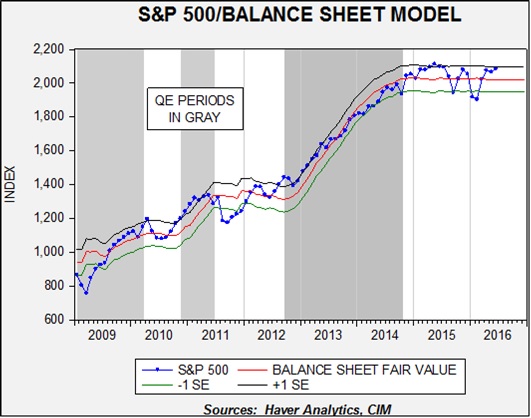
As wages and other costs rise and pricing power appears constrained, there are reasonable worries about the path of corporate earnings.  We use purely top-down analysis to forecast earnings.  Essentially, we forecast the percentage of total S&P company earnings relative to GDP.  We use the nominal GDP forecast from the Philadelphia FRB’s Survey of Economists along with our earnings as a percentage of GDP forecast to arrive at our estimate; we do note that this estimate is for total earnings for all members of the S&P 500 and not the per share estimate.

We are currently expecting S&P earnings to equal around 6% of GDP.

There are a large number of components in the model but the most statistically significant are net exports as a percentage of GDP, credit spreads, the dollar and oil prices.  The components suggest that margins will likely contract if the U.S. does move to reduce the trade deficit.  A weaker dollar will help lift margins, and higher oil prices will tend to lift margins as well.  Narrow credit spreads tend to support margins.

The process of getting to earnings per share is tied to the divisor of the index.  And, that has been steadily falling, which is lifting earnings per share.

The divisor adjusts the index by accounting for mergers, the exchange of new companies into the index, and share issuance and buybacks.  The persistence of share buybacks is clearly reducing the divisor which acts to boost earnings per share.

Adjusting for all these factors, our current forecast for earnings this year is $157.20, which is down from $160.93 at the beginning of the year.  We do use Standard and Poor’s earnings data, which tends to be less than the more widely reported data from Thomson-Reuters; we use the former because we have a much longer history of that data.  The current difference is significant.  Thomson-Reuters data is about 11% higher than what is reported by Standard and Poor’s.

Our conversion model suggests a Thomson-Reuters earnings number of $168.92, which is well above the current consensus of $165.21.  Given that we are working off a 3.8% nominal GDP growth rate (and so, 2% inflation would lead to a 1.8% GDP growth number), which seems achievable, the financial markets are probably too pessimistic on earnings for the rest of the year.  If we are wrong, it’s probably due to margin contraction.  Although there are worries about future policy causing margins to fall, the policy effect probably occurs next year, not in 2019.

View the PDF

Daily Comment (August 2, 2019)

by Bill O’Grady, Thomas Wash, and Patrick Fearon-Hernandez, CFA

[Posted: 9:30 AM EDT]

Happy Friday employment day!  We cover the data in detail below but the snapshot is generally in line with expectations.  Payrolls were 164k, nearly bang on forecasts of 165k, although revisions lowered payrolls by a net 32k.  The unemployment rate was unchanged at 3.7% when a 3.6% report was expected.   Wage growth was a bit stronger than expected (although the non-supervisory growth was steady) and the participation rate rose to 63.0%, a bit stronger than the 62.9% expected.  Here is what we are watching this morning:

Trade: So much for stability!  Midday yesterday, President Trump announced he would put a 10% tariff on $300 bn of additional goods.  The reason given was that China had not purchased grain as promised and was continuing to send Fentanyl into the U.S. In a press conference later in the day, the president suggested these tariffs might be temporary, which may mean if China buys grain and cuts narcotics exports, he may lift them.  Here is our take:

  1. We doubt China will react well to this action. The Xi government has already indicated that a deal has to include the removal of all tariffs, which is unlikely.  It’s important to note that Chairman Xi will be heading off to Beidaihe   This seaside resort has been a long-time favorite of Chinese leaders going back to the Qing dynasty.  CPC leaders, both current and former, mingle and discuss issues.  We would expect Xi to find plenty of support to push back against the U.S.  After all, no nation likes to be bullied.  In addition, any criticism of Xi for poorly managing the relationship with the U.S. will likely be silent as Trump’s latest actions tend to confirm he is erratic and probably unmanageable.
  2. As we have noted in the past, trade wars, like kinetic ones, usually occur because both sides miscalculate the actions of their opponent. We suspect President Trump is overestimating how damaging tariffs are to China and underestimating the impact on the U.S.  Chairman Xi is probably doing something similar.  In addition, we think President Trump continues to hold the position that the incidence of tariffs is falling solely on Chinese exporters.  Although it is occurring to some degree, a weaker CNY is offsetting some of the pain.  Additionally, some of the tax is falling on U.S. consumers and, as we note below, that effect will likely increase.  However, if the president believes the incidence isn’t affecting American buyers, he will tend to view tariffs as a “free tax” and have no compunction about continuing to apply them to China and others.  It should also be noted that S. trade negotiators knew the president was considering additional tariff measures before their most recent meetings with Chinese trade officials.
  3. “Blinking” will be difficult for both leaders. It is hard to see how either side backs down without losing face.  If President Trump backs down, it will be a campaign issue.  If Chairman Xi backs down, he will face criticism for caving into foreigners.
  4. China clearly can’t retaliate 1:1 simply because of the trade imbalance. So, look for other retaliation measures, e.g., harassing American foreign investment in China, perhaps the arrest of Americans in China or other penalties for American firms (regulatory raids, etc.).  We could also see European firms given preferential treatment to harm U.S. competitors.  Look for the “unreliable entities list” to reemerge to pressure U.S. firms to show allegiance to China instead of the U.S.  And, the most simple action is to weaken the CNY, which is already occurring.
  5. There is another angle to the president’s surprise. In Chair Powell’s press conference on Wednesday, he mentioned international economic weakness repeatedly.  The new tariffs will almost certainly increase pressure on the Fed to cut more aggressively.  In a sense, the tariff announcement may have more to do with affecting monetary policy than trade policy.
  6. Perhaps one of the unintended consequences of the additional tariffs is that the $300 bn of goods that will face the new tariffs are mostly consumer goods. Previous tariffs were mostly on intermediate goods and thus the price impact was not obvious to consumers or did it appear in the inflation data.  However, the new tariffs will directly affect consumersRetailer stocks fell hard on the announcement and merchants have been critical of the announcement.
  7. And finally, there is one other issue to consider. The president could be following the Mexican playbook and decide not to implement the tariffs on September 1st if China buys grain and cuts narcotics exports.  Since the tactic worked with Mexico, he may believe it will work with China as well.  Thus, there is a chance that nothing happens.

The market effects were swift.  The following are intraday charts of various U.S. markets.

(Source: Bloomberg)

The S&P 500 fell over 60 points.

(Source: Bloomberg)

The 10-year T-note yield fell over 15 bps to decline under 1.90%.

(Source: Bloomberg)

The dollar weakened on ideas that a trade conflict would likely force the Fed to cut rates more aggressively.

(Source: Bloomberg)

This chart shows the 2-year T-note yield.  Like it’s longer duration “cousin” that yield fell sharply, confirming the comment on the EUR above.  In fact, the yield curve modestly steepened.

(Source: Bloomberg)

On the other hand, oil prices plunged on fears that a trade war will harm global economic growth.  We are seeing some recovery in oil prices this morning.

We also note that tensions between the U.S. and China remain high; SoS Pompeo criticized China at the ASEAN meetings in Bangkok, a clear indication of deteriorating relations.

Tories lose: In a by-election in Wales, the Liberal-Democrats won the seat, reducing the Tory-DUP coalition to a single seat.   The loss increases the odds of snap elections.  Labour continues to struggle, as it didn’t perform all that well.  The Liberal-Democrats ran on a platform to Remain in a district that voted to leave.  Perhaps the signal for this election is that the most important issue is the “should I stay or should I go” decision and not the traditional issues of fiscal policy, foreign policy, etc.  The risk of new elections could be that there is a swift realignment of the parties, where Remainers in the Labour and Conservative Parties move to the Liberal-Democrats and the traditional parties fall to minority status.

North Korea: There were more missile launches by Pyongyang.  Clearly, the Young General is trying to get the world’s attention.

United States-Russia: Today is the day that the United States has officially withdrawn from the Intermediate-Range Nuclear Forces Treaty of 1987, in which Washington and Moscow agreed not to develop, test, or deploy certain ground-based nuclear missiles that were seen as particularly dangerous and destabilizing.  The move, announced in February, follows the Russian deployment of a ground-based cruise missile in violation of the accord.  That violation was real enough, but we note that the immediate U.S. response didn’t have to be a complete withdrawal from the pact.  The U.S. side is apparently gambling that in order to free its hands to develop its own new weapons to counter a rising China, it would be worthwhile to sacrifice stability in Europe.  As we’ve already seen in the U.S.-China trade dispute, the Western Europeans are the main losers, at least in the immediate term.  Separately, President Trump has belatedly imposed new financial sanctions against Russia for using the nerve agent novichok in its effort to assassinate former double agent Sergei Skripal in England during March 2018.  Under law, the administration was required to impose those sanctions last year, but resisted until Congress recently raised pressure on it with a number of new Russia sanctions bills.

Afghanistan withdrawal: Due to an agreement with the Taliban, the U.S. will reduce its troop strength in Afghanistan by 5k.

Russia-Japan:  In another provocative move, Russian Prime Minister Medvedev today visited an island in the Pacific Ocean that is claimed by both Russia and Japan, resulting in a strong diplomatic protest by Tokyo.

United States-European Union: As we mentioned yesterday, it’s important to remember that while the overall global trade picture continues to slide, there are smaller-scale improvements from time to time.  Today, for example, the United States and the European Union will sign an agreement giving U.S. beef producers more access to the EU market.  The deal is a direct result of the Rose Garden meeting last summer between President Trump and European Commission President Jean-Claude Juncker.

International Monetary Fund: The European Union’s finance ministers will vote today on their candidate to succeed Christine Lagarde as head of the IMF.  The Europeans traditionally name the IMF chief, while the United States names the head of the World Bank.  Frontrunners for the IMF job include former Dutch Finance Minister Dijsselbloem, Finnish Central Bank Governor Rehn, Spanish Finance Minister Calviño, and Bulgarian World Bank executive Georgieva.  The unusual need for a vote reflects disagreement between Europe’s more affluent northern countries and the less developed southern nations.


View the complete PDF

Daily Comment (August 1, 2019)

by Bill O’Grady, Thomas Wash, and Patrick Fearon-Hernandez, CFA

[Posted: 9:30 AM EDT]

Good morning!   Markets are dealing with the aftermath of the Fed meeting.  China is slow-walking trade. The BOE met today.  Osama bin Laden’s son is believed to have died.  The MLB trade deadline big winner was Houston, with Atlanta coming in a close second.  Here is what we are watching this morning:

The Fed: The FOMC generally did what was expected—the fed funds target was reduced by 25 bps and quantitative tightening has ended.  However, beyond that, the financial markets view the Fed’s action as relatively hawkish.  First, Chair Powell characterized the policy actions as “a mid-cycle adjustment.”  This comment, coupled with confirmation later in the press conference, suggests that this rate cut doesn’t signal a new rate cutting cycle.  Instead, to use a historical context, it is more like 1995.  Essentially, the Fed has admitted it moved rates too high and is adjusting rates to a level better suited to current conditions.  Powell did suggest that yesterday’s cut may not be enough for current conditions, but if the financial markets thought this was the beginning of 100 bps of easing into early next year, that probably isn’t the case.

Powell did note that the rate cut was also tied to the perceived decline in “neutral rate” which does indicate the Phillips Curve model still has some influence on members of the FOMC.  He mentioned global concerns and the trade conflict as well.  Although these issues do offer a potential path for future easing (e.g., weaker overseas growth could trigger additional rate cuts), these factors probably are less important than they appear.  The dissents tend to undermine these other issues as having an effect on future rate moves.

Specifically, there were two dissents.  KC FRB President George’s dissent was no surprise. She is a traditional hawk that would rely on the Phillips Curve for guidance.  Given that labor markets remain tight, it is consistent that she would oppose the action.  Boston FRB President Rosengren’s dissent is far more interesting.  He is what we would characterize a “financially sensitive” voter; his opposition to a rate cut is based on the idea that it would lead to excessive risk taking in the financial markets.  We examined this class of voter in an earlier AAW.  In general, what we found was that when the 12-week moving average of the VIX was below 20, this class of voter tended to support rate hikes.  And so, the recent drop in the VIX probably explains Rosengren’s dissent, which was telegraphed.   With two dissents, the odds of further rate cuts will be challenging.

Financial markets reacted by treating the action as hawkish.  Gold prices fell, the dollar jumped, the yield curve flattened and equities slid.  To some extent, the reaction was probably a bit excessive but it is clear the financial markets wanted more and are now bringing back the risk of recession.   President Trump was critical of the easing, suggesting it was inadequate.

Interestingly enough, the two-year deferred Eurodollar futures implied rate didn’t change.  Although the spread compared to fed funds narrowed because of the cut, the projection of fed funds two years from now is still on pace for the 1.65% level (or a ceiling rate of 1.75%), meaning that three more rate cuts remain imbedded in financial markets.

In the final analysis, if Chair Powell wanted to move more than what we saw yesterday, he hasn’t convinced enough members of the committee to follow him.  There were two significant clues for the Fed from the actions of the financial markets.  The first is the yield curve.  If the financial markets viewed the easing as stimulative, the yield curve would have steepened.  The fact that it flattened is a clear indication the financial markets believe the Fed move and the consequent signaling was inadequate.  The second is strengthening of the dollar.  Given the dollar’s current high valuation, a policy change to easing should have led to a weaker greenback.  The fact it rallied suggests the action was taken as non-stimulative.  We should also note that the Fed’s modest action is occurring in a backdrop where the ECB is considering more aggressive actions and the BOJ is looking at allowing the JGB’s to fall into deeper negative territory.

The White House has been increasing its focus on the exchange rate markets, in our opinion, because the president has figured out that currency depreciation blunts the impact of tariffs.  Although the Treasury has exchange rate policy in its mandate, it has limited tools to affect the rate.[1]  As we have been discussing, the White House appears, at least to us, to be moving toward undermining Fed independence in order to fix the dollar’s exchange rate lower.  Interestingly enough, now Congress is getting involved.  Senators Baldwin (D-WI) and Hawley (R-MO) have introduced a bill that calls for a weaker dollar.  It is starting to look a little like 1985 and the run-up to the Plaza Accord.

The BOE:  The Bank of England left policy rates unchanged but did reduce U.K. growth forecasts due to the uncertainty surrounding Brexit.   The GBP rose modestly on the news.

Iran:  The U.S. has applied personal sanctions to Javad Zarif, Iran’s foreign minister.  This action will make it more difficult to begin negotiations.  However, the U.S. has also granted waivers to foreign nations participating in Iran’s civilian nuclear projects.

Trade talks:  China’s negotiating tactics have shifted to stalling as it appears officials are considering the status quo to see if anything changes after the elections.  China isn’t pleased with this characterization.   The Trump administration is restraining comments on the situation in Hong Kong, fearing that siding with the protestors might set back trade talks.  China is apparently moving on grain purchases, preparing to import from the U.S.

In what may be a new front in the U.S.-China trade dispute – or at least a new sore point – U.S. authorities have indicted a Chinese aluminum magnate on charges that he sidestepped anti-dumping duties on millions of pallets of aluminum brought into the United States from 2011 to 2014.  The U.S. attorney for the central district of California said Liu Zhongtian’s “rampant criminality” not only posed a threat to U.S. industry, livelihoods, and investments, but also artificially inflated the value of his Hong Kong listed China Zhongwang Holdings (1333.HK, 3.44).  More broadly, the U.S.-China trade dispute continues to weigh on manufacturing throughout the Asia-Pacific region.  As shown below, the latest Markit purchasing managers’ indexes show factory activity continued to decline during July in Japan, South Korea and Taiwan.

Hong Kong:  The commander of the Chinese military garrison in Hong Kong has warned that the city’s increasingly violent political protests are “absolutely impermissible.”  In addition, the People’s Liberation Army released a video showing how the Hong Kong garrison is training to suppress mass protests.  The speech and video are being taken as a warning to Hong Kong’s anti-Chinese protestors that the military is itching to clamp down on them.  As a clamp down starts to look more and more likely, we would expect increasing economic disruption in Hong Kong and further headwinds for Chinese and Hong Kong assets.

Japan-South Korea:  The Japanese government is preparing to take South Korea off its list of export destinations enjoying eased trade rules as early as tomorrow.  The move is in retaliation to South Korea’s continued legal maneuvering to gain compensation for its treatment by Japan before and during World War II.  The move would require Japanese exporters to obtain licenses before they export a wide range of chemicals and electronic goods to South Korea, compared with the controls that have already been imposed on just three chemicals.  No licenses have been granted for exports of those three chemicals, seriously crimping South Korean computer chip manufacturers.

United States-Japan-Brazil:  In spite of the overall global trend toward protectionism and trade disputes, there are some small signs of cooperation, too.  For example, U.S. Trade Representative Lighthizer will meet today with Japanese Economic Revitalization Minister Toshimitsu Motegi to accelerate work on a U.S.-Japan free-trade deal.  Separately, Brazilian Economy Minister Paulo Guedes said yesterday that Brazil and the United States are now officially in negotiations for a deal.

Where’s Boris?  He was in Northern Ireland yesterday.  Just like what we saw in Wales and Scotland, his reception was rather cool.  Northern Ireland hasn’t had a local government because none of the parties can form a government so the area’s affairs are being run from Westminster.  Although Johnson’s coalition is dependent on the DUP for support, Johnson argued he would be an impartial arbitrator in establishing local government.  To a great extent, the Irish border is probably the most contentious issue with Brexit; if Ireland were unified, exiting the EU would be much easier.  The Republic of Ireland is considering plans to establish border controls on its soil to protect the EU’s trading area.

Germany says nein:  The U.S. has asked Germany to participate in protecting Persian Gulf shipping.  Germany has indicated it won’t act unless it is an EU wide effort.  The U.S. isn’t pleased.

Energy update:  Crude oil inventories fell 8.5 mb, well more than the 2.5 mb expected.

In the details, U.S. crude oil production rose 0.9 mbpd, recovering from the hurricane induced curtailment.  Exports fell 0.4 mbpd but import declined 0.7 mbpd.  Refinery operations fell 0.1 mbpd.

(Sources: DOE, CIM)

This chart shows the annual seasonal pattern for crude oil inventories.  The decline seen over the past few weeks now puts the level below the usual seasonal trough in September.  This decline in stockpiles is supportive for prices.

Based on our oil inventory/price model, fair value is $62.23; using the euro/price model, fair value is $51.84.  The combined model, a broader analysis of the oil price, generates a fair value of $54.73.   We are seeing a clear divergence between the impact of the dollar and oil inventories.  If President Trump is successful in bringing the dollar lower, it would be bullish for oil prices.

View the complete PDF


[1] In reality, the Treasury’s mandate on forex is something of a holdover from the days of fixed exchange rates.  In that period, the Treasury, working on behalf of the executive branch, would manage negotiations with other nations on the level of the exchange rate and instruct the Fed to take actions to maintain the peg (in an earlier period, against gold, later against other pegged rates).  Under floating rates, the Treasury has limited tools to intervene to adjust the currency and can “jawbone.” However, monetary policy has a much larger impact.

Daily Comment (July 31, 2019)

by Bill O’Grady, Thomas Wash, and Patrick Fearon-Hernandez, CFA

[Posted: 9:30 AM EDT]

Good morning!   The FOMC meeting ends today.  North Korea continues to fire off missiles.  The baseball trading deadline occurs at 4:00 EDT today.  Here is what we are watching this morning:

The Fed: Yesterday, we noted the scenarios for today’s monetary policy.  To repeat, there is almost no chance the Fed won’t cut by 25 bps today.  Instead, there are two factors that could offer insights into future actions.  First, Powell’s language, especially in the press conference, will be important.  The key word is “patient.”  If the statement includes the word “patience,” it will signal that this rate move is a recalibration, suggesting the policy rate overshot its equilibrium level and the move was an adjustment.  However, it won’t indicate that this cut is the start of a rate reduction cycle. If this is the outcome, markets will be disappointed and we could see equities decline.  Second, there could be action on the balance sheet.  The Fed might announce that it will end its balance sheet reduction six weeks earlier than planned.  Although modestly supportive, this action would be a dovish signal.

We are starting to see more of monetary policy discussion being framed by exchange rate concerns.   The ECB appears to be teeing up additional stimulus, including a deeper foray into negative interest rates and expanding QE.   Some pundits are suggesting the Fed is being forced to move on rates to prevent further dollar appreciation.  There is an element of truth to this charge.  Central bankers and finance ministers have been careful not to couch their policy actions in terms of affecting exchange rates.  In fact, in the unwritten rules of central banking, such discussions would be in bad form because they could open up a return to the 1930’s “beggar thy neighbor” devaluations that eventually led to a collapse in trade activity.   However, in reality, much of the monetary stimulus came from currency weakness.  After all, if you drive nominal rates below zero and you still can’t increase investment, what’s left?  Export growth!  Abenomics got most of this punch through a weaker yen, but because officials framed the actions as necessary for domestic growth, other central bankers essentially granted Japan a pass.  President Trump doesn’t buy this ideology; he wants the Fed to cut rates by more than 25 bps to weaken the dollar.

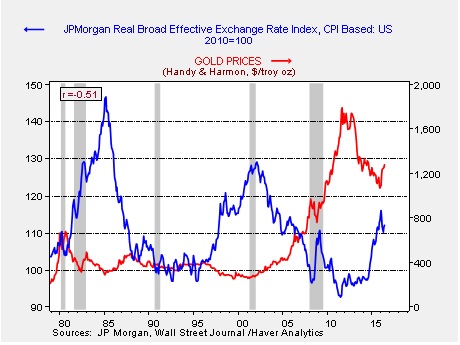
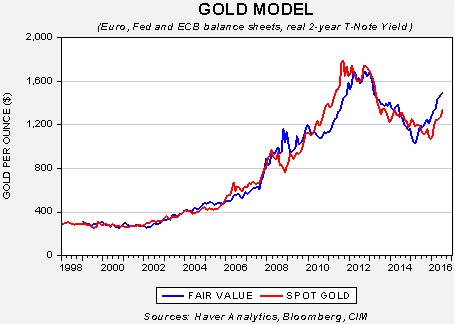
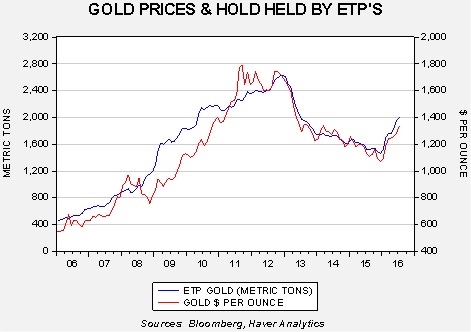
At some point, this race to the bottom will end; one possibility is that we return to some sort of fixed exchange rate system but that might require central banks to focus solely on the exchange rate to set policy.  But, before we get to some sort of resolution, continued attempts to weaken currencies is possible; the investor solutions are monetary assets, e.g. precious metals.

Trade:  The first post G-20 meeting between U.S. and Chinese trade negotiators has come to a close.  Not too much progress appears to have been made.  China has agreed to buy some grain, but only to the extent consistent with “internal demand.”  We also note that China is showing increasing interest in sourcing soybeans from South America.  The U.S. will probably offer some tech relief but it is starting to look like both sides are digging in and awaiting the end of the next U.S. election cycle.  This isn’t the worst outcome, which, specifically, would be a complete rupture of trade relations.  In fact, the “slow walking” gives both sides a chance to adjust.  The next round of face-to-face talks won’t take place until September.

North Korea:  Kim doesn’t want to be ignored.  As the U.S. and South Korea prepare for military exercises, for the second time in a week, Pyongyang has tested short-range missiles.  North Korea has always been concerned about military exercises, fearing that they could be a pretext to invasion.  Despite that fact that it hasn’t ever occurred, the worry is understandable.  So far, the tests have not crossed any “red lines” such as entering Japan’s territorial waters or a long-range test that would threaten the U.S.  We would not expect an overt threat to the U.S. from North Korea.

Brexit news:  PM Johnson visited Wales yesterday and, much like what he experienced in Scotland, the locals weren’t all that happy to see him.  Today, he visits Northern Ireland and will likely get a mixed reaction there as well.  In fact, the issue of the Irish border may be the most intractable of all the hurdles of Brexit.[1]  Johnson faces another challenge—there is a special election in Wales today that could go to a Liberal Democrat. If so, Johnson’s coalition margin in the House of Commons will fall to one seat and increase pressure for a snap election.

Hong Kong:  U.S. officials are watching the buildup of Chinese forces on the Hong Kong border with interest.  So far, Beijing has been content to allow local officials to handle the unrest but we doubt that the Xi regime has infinite patience on this issue.  Perhaps the most important reason why China has been reluctant to crack down on the protestors is it knows Taiwan is watching.  A harsh crackdown on Hong Kong will make it difficult for Beijing to convince Taiwan’s citizens that unification will preserve its democracy.  Reports that China is restricting tourist visits to Taiwan did catch our attention.  If Xi concludes he cannot tolerate continued unrest in Hong Kong and uses the military to restore order, it may mean that unification with Taiwan can only be accomplished by force.  And if that decision is made, it comes down to timing.

A softening on Iran?   The Trump administration is apparently going to reissue waivers that allow foreign nuclear projects in Iran to continue.  Iran hawks argued against the extensions, including NSD Bolton and SoS Pompeo.  At the same time, the U.S. has formally asked Germany to participate in maritime security operations in the Persian Gulf.  This request will be difficult for Germany to manage; on the one hand, it believes the U.S. has caused this crisis by leaving the JCPOA, so why should it work to fix a problem it didn’t cause.  On the other hand, if they don’t participate, it looks like Germany is continuing to “free ride” U.S. security.  After all, it is clearly benefiting from U.S. protection of Persian Gulf shipping.


View the complete PDF


[1] For details, see https://www.confluenceinvestment.com/wp-content/uploads/weekly_geopolitical_report_2_25_2019.pdf and https://www.confluenceinvestment.com/wp-content/uploads/weekly_geopolitical_report_3_4_2019.pdf

Daily Comment (July 30, 2019)

by Bill O’Grady, Thomas Wash, and Patrick Fearon-Hernandez, CFA

[Posted: 9:30 AM EDT]

Good morning!   The FOMC meeting begins today.  The GBP continues its slide.  Here are the details:

The Fed: Although there is almost no chance the Fed won’t cut by 25 bps tomorrow, we are watching for two items.  First, Powell’s language, especially in the press conference, will be important.  The key word is “patient.”  If the statement includes the word “patience,” it will signal that this rate move is a recalibration, suggesting the policy rate overshot its equilibrium level and the move was an adjustment.  However, it won’t indicate that this cut is the start of a rate reduction cycle. If this is the outcome, markets will be disappointed and we could see equities decline.  Second, there could be action on the balance sheet.  The Fed might announce that it will end its balance sheet reduction six weeks earlier than planned.  Although modestly supportive, the action would be a dovish signal.

Regardless of what happens tomorrow, we doubt the White House will be happy about it.  The president wants a weaker dollar and he wants the Fed to engineer that outcome.  If the reserve currency nation attempts to restrict trade, its currency will appreciate.  This is because there is always demand for the reserve currency and the most effective way to acquire it is to run a trade surplus with the reserve currency nation.  The best way to prevent the currency from appreciating is for the reserve currency nation’s central bank to peg an exchange rate and adjust its balance sheet to ensure the peg holds.  This is what Switzerland’s central bank, the Swiss National Bank (SNB), has been doing relative to the EUR for the past few years.  However, such a policy essentially ends central bank independence; the SNB’s policy is completely subsumed to exchange rate policy.

Trade:  Although talks are underway, there is little movement toward a grand resolution.  As we noted yesterday, China appears to be buying some U.S. grain.  The U.S. is offering unspecified relief on tech exports.  However, beyond these two actions, not much else is happening.  As the U.S./China trade spat continues, companies have been moving supply chains out of China.  They haven’t brought production back to the U.S. but are going to other low labor cost areas, e.g., Vietnam.  This development has caught the attention of USTR Lighthizer who is now calling out Vietnam for its trade surplus with the U.S.

For those wondering if a new president would lead to a change in trade policy, we doubt it.  In fact, it may become more protectionist.  Elizabeth Warren’s recent comments on foreign policy are classic Jeffersonian (which leans isolationist) and her trade policy would probably be more protectionist than Trump’s.  What this suggests is that the president’s foreign and trade policy may be less about him and more about the direction the country is headed.

Brexit:  PM Johnson visited Scotland yesterday and got a chilly reception.  He has told the EU that he won’t engage in talks unless the EU agrees to change the current agreement, which the EU has indicated isn’t going to happen.   As the odds of a no-deal Brexit increase, the GBP is continuing to spiral lower.

A peek inside China’s foreign reserves:  For the first time ever, China has released some details about its foreign exchange holdings.  The data isn’t up-to-date (the last data available is 2014).  But, it does show the State Administration of Foreign Exchange (SAFE) reduced its dollar holdings from 79% in 2005 to 58% by 2014.  It shifted to EUR and other currencies, along with gold.

Health care transparency:  Economists have debated the problem of health care costs for some time.  Although measures to open the industry to competition should reduce costs, there are specific structures in the industry that defy standard market remedies.  It is almost impossible to comparison shop for treatment because it is difficult for the average consumer to evaluate quality.  And, even if one wanted to shop around, getting accurate price information is devilishly hard.  The Trump administration has proposed measures to disclose price information; the fact the hospital industry is upset with the proposal suggests it probably would undermine its profit structure.

Japan:  The Bank of Japan today held its monetary policy unchanged, with its benchmark short-term interest rate at -0.1%, its ceiling for 10-year bond yields at 0% and its pace of government bond buying at 80 trillion yen.  However, in a sign that the BOJ is ready to join the other major central banks that have been loosening policy, the officials also vowed further monetary easing without hesitation “if the momentum towards our price stability objective is at risk.”

Hong Kong:  The deputy leader of Hong Kong reportedly apologized for the way the city’s police force responded to last week’s incident in which thugs from criminal gangs beat anti-Chinese demonstrators.  That sparked a protest by police officials, possibly pointing to cleavages within the municipal government regarding how to handle the ongoing political protests.

Venezuela:  Although President Nicolás Maduro still publicly embraces socialism and castigates capitalism, the government is quietly embracing free markets in an apparent last-ditch effort to help the economy and stay in power.  Private business owners say rules banning hard-currency transactions have not been enforced recently, importing has been freed, and many price controls have been dropped.  The reporting says the economy is rapidly dollarizing, while inflation has fallen from more than 100,000% last year to an expected level of several thousand percent this year.

View the complete PDF

Weekly Geopolitical Report – The Economic Triangle: Part II (July 29, 2019)

by Bill O’Grady

The Economic Triangle: Part II

 Last week, we referenced the basic philosophies of David Hume and Adam Smith and how their writings evolved into the economic theory of supply and demand.  From there, we examined the weakness of supply and demand at the macro level and discussed an alternative model, the Economic Triangle, as a different means of explaining how various economic participants operate and the way in which political factors affect the triangle.  This week, we will show how the Economic Triangle fits into the major economic systems, offer two contemporary examples and conclude with market ramifications.

The Theories
The history of economic thought and political economics has generated a plethora of theories and paradigms for balancing these interests.  Here are some of the important ones:

View the full report

Daily Comment (July 29, 2019)

by Bill O’Grady, Thomas Wash, and Patrick Fearon-Hernandez, CFA

[Posted: 9:30 AM EDT]

Happy Monday!  It’s Fed week.  The MLB trading deadline is Wednesday.  There was unrest around the globe.  Here are the details:

The Fed: It is all but certain the FOMC will cut rates on Wednesday.  Former Chair Janet Yellen came out in support.  However, once this action occurs, there is great uncertainty as to what follows.  There is growing doubt that this cut is the beginning of a cycle of reductions, even though it is obvious that this is what the market expects.  If this week’s reduction is isolated, it would suggest the Fed overshot its rate hikes and is adjusting to correct the action.  That would argue for a pause after this week’s reduction.  In addition, it appears to us the FOMC is divided on how to move forward.  We would not be surprised to see a dissent to the cut (KC FRB President George would be the most likely.)  If the Fed stands pat for a couple of meetings, dovish dissents are likely.  If we move into a period of “will they or won’t they” it is possible that equities will be rangebound for the next month or two.

Weak dollar?  President Trump reportedly rejected plans to purposely weaken the dollar through intervention or other measures.  The White House suggested that they didn’t think intervention would be all that effective.  Later, President Trump did indicate he hasn’t ruled out actions to depress the dollar.  We suspect he would rather see the dollar weaken due to aggressive easing from the Federal Reserve.

China trade:  Talks are set to resume, but neither side seems very excitedChina has indicated it is lifting agricultural imports from the U.S. and the U.S. will likely give China some limited export relief on technology.  President Trump suggested China may stall on talks, hoping to get a different figure in the White House after the elections.[1]  We expect talks to continue but we doubt much progress will be made.  The USTR has opened a plan to change how the WTO allows developing nations to use trade impediments during their development stages; China has been a major beneficiary of these “loopholes” and the U.S. wants to see these closed.

In related news, there are reports China is facing a glut of inventory.  This is evidence the U.S. trade action is having an effect.  Here is the basic macroeconomics:

0= (Investment-private saving) + (government-taxes) + (exports – imports)

China has used export promotion as a development model.  In that model, policies to generate saving are implemented.  China purposely has restrained household consumption with an undervalued exchange rate and low saving deposit rates.  If the private saving balance is negative (investment < private saving) and the fiscal account is balanced, by definition, a trade surplus will occur.  However, this is only if there is a ready buyer for the exports. The U.S. has played the role of “importer of last resort” for the world since the end of WWII but is pushing back against that policy.  As the U.S. restricts imports, the excess production will show up in the national income accounts as unintended investment, better known as “inventory”.  In other words, the private saving sector is forced into balance through unintended inventory accumulation.  If China wants to continue to export, it must further constrain consumption and drive down export prices.  Or, it can address the excess inventory by absorbing it with fiscal spending (which is a bit of what it is doing with infrastructure spending.)  Of course, another alternative would be to abandon export promotion altogether and absorb the excess with domestic consumption.  That doesn’t appear to be happening.  What the above article indicates is the U.S. policy is having an impact.

Brexit: The new government of Prime Minister Johnson has sent strong signals that a “hard Brexit” is now the most likely way the country will leave the European Union this fall.  Key advisor Michael Gove said over the weekend that the government is now “working on the assumption of no-deal,” while Foreign Secretary Dominc Raab said today that “the balance has shifted” to a no-deal exit. The GBP is coming under further pressure on this news.  The British auto industry is warning that a no-deal Brexit could be an “existential threat” to its survival.  The Congress of British Industry warns the EU isn’t ready for a hard Brexit either.

Hong Kong:  Protests continued over the weekend and are becoming increasingly violent.  Beijing, for the first time, has indicated it will respond to the unrest in a press conference.  The Communist Party newspaper, the People’s Daily, has today included an editorial calling on Hong Kong’s municipal government to act immediately and forcefully against the ongoing anti-Chinese protests in the city, saying the local officials “should not hesitate or have any unnecessary ‘psychological worries’ about taking all necessary steps.”  Chinese government said it still firmly supports Hong Kong Chief Executive Carrie Lam and the territory’s police force, in spite of the increasingly violent political demonstrations there. We continue to wonder how much longer Chairman Xi will tolerate this widespread dissent.  Separately, there are signs those political troubles and the ongoing economic slowdown in mainland China are weighing on the Hong Kong real estate market.

Protests in Moscow:  There were also major political protests in Moscow this weekend, as people demonstrated against the effort to keep opposition candidates off the ballot for the upcoming municipal elections (see our Weekly Geopolitical Report for July 15.)  The response from police was unexpectedly harsh, but even more ominous was what happened to opposition leader Alexei Navalny:  After being arrested last Wednesday for fomenting the demonstrations, he was rushed from the local jail to the hospital after he suffered an “allergic reaction.”  Given Moscow’s history, this sparked concerns that ruling officials may have poisoned Navalny in an effort to silence him.  While the U.S. government traditionally would have pushed back against such authoritarian transgressions, the reaction so far has been relatively muted.  It is possible the rather aggressive response suggests Putin is signaling to the factions within the Kremlin that he remains in power and that they shouldn’t consider siding with the protestors.  There have been sporadic protests around the country this year over a myriad of issues, including overflowing garbage dumps and poor economic growth.  The leaders of authoritarian governments are usually at greater risk to insiders abandoning the leader rather than to internal pressure.

Iran:  The Iranian government has thrown cold water on expectations that the United Kingdom and Iran could agree on an exchange of oil tankers, each has seized from the other, over the last couple of weeks.  Iran has decided to link the British seizure of an Iranian oil tanker to the nuclear deal, which will put that deal under further strain.  Britain has sent a second Royal Navy vessel to the Persian Gulf to protect U.K. shipping.  That should help keep alive some of the tensions in the Persia Gulf, buoying oil prices.

South Africa:  Although President Cyril Ramaphosa has been planning a constitutional amendment to allow land seizures and redistribution to the black majority without compensation, a government advisory panel has urged him to set strict limits on any such seizures.  The proposed law has soured investor sentiment on South Africa in recent months.

Japan:  The Cabinet Office has cut its forecast of economic growth to just 0.9% in the fiscal year ending March 2020, compared with 1.3% in its forecast six months ago.  The cut stemmed mostly from slowing export growth arising from weak demand in China and protectionist trade policies in the United States.

View the complete PDF


[1] Just a thought: We have noted rising concern about foreign interference in U.S. elections.  Although such attempts are nothing new, the ability to use social media has become a significant force multiplier for all sorts of actions to sway public opinion.  We could end up with a “free for all” in 2020, where Russia and Israel might prefer to keep Trump in office while China and Iran would rather see him ousted.  Since all four nations have sophisticated cyber capabilities, social media could be flooded with conflicting campaigns, all trying for different outcomes.

Asset Allocation Weekly (July 26, 2019)

by Asset Allocation Committee

How much attention is the FOMC paying to international factors?  It appears to be quite a lot.  We have documented that the financial markets are clamoring for a rate cut.  We have seen some of the more popular yield curves invert and the implied LIBOR rate from the Eurodollar futures market, two years deferred, has moved into easing territory.

The chart on the left shows the aforementioned implied LIBOR rate.  In Q3 last year, the implied rate was 3.30%; it has fallen to just above 1.60%, a decline of 170 bps.  The chart on the right compares the implied rate to the fed funds target.  When this implied rate falls below the target, it is a signal to policymakers that monetary policy is too tight.  The Bernanke Fed mostly ignored this indicator, unlike his predecessor, and Bernanke had to deal with the deep 2007-09 recession.  This indicator is giving clear evidence that the Fed should be cutting rates aggressively.

However, the signals from the domestic economy are not supporting a rate cut.  The ISM Manufacturing Index is well above 50; since the Federal Reserve began confirming the policy rate, it is rare to see rate cuts when the index is above 50.

We have indicated when the ISM index falls below the 50-expansion line with vertical lines.  The only time we saw significant rate cuts without the ISM index below 50 was in 2007, when financial markets were under clear stress.  In May 2007, the Chicago FRB National Financial Conditions Index, an index of financial stress, was reading -0.67.[1]  By August, it had risen to -0.13 and turned positive in November.

In this cycle, international pressures seem to be guiding policymakers to act.

This chart shows the fed funds target with the Global Economic Policy Index.  This index measures mentions of economic or policy uncertainty in 20 nations; the index is weighted by GDP, adjusted for purchase power parity.  A rising reading suggests increases in policy uncertainty.  This chart supports Chair Powell’s continued references to overseas issues when calling for easing.

To some extent, there is a worry among market participants that the Fed is simply creating a narrative to allow it to ease, reducing pressure from the White House while maintaining some element of independence.  The third chart suggests the Fed does have good reasons for acting to lower rates.  With trade wars, the immigration crisis in Europe and the U.S., the potential for conflict in the Middle East and worries about a currency war, the level of global policy uncertainty is historically elevated.  This factor, we believe, reflected in the financial markets, is what is prompting the desire to cut rates.  We do expect a significant level of dissent among FOMC voters but, in the end, we look for two rate cuts this year, unless global stress levels unexpectedly diminish.

View the PDF


[1] A reading under zero suggests low levels of stress.