

Daily Comment (August 22, 2019)

by Bill O’Grady, Thomas Wash, and Patrick Fearon-Hernandez, CFA

[Posted: 9:30 AM EDT]

We cover the Fed minutes below!  The G-7 summit is this weekend.  Tensions between Japan and South Korea are rising.  Quietly, overnight, the CNY fell to an 11-year low.  Here is what we are watching:

The Fed minutes: There were three points that emerged from the minutes:

  1. The members are divided. Although the two dissents made it clear that divisions exist, the issues appear to run deeper.  We know for sure that two members officially wanted to keep rates unchanged, but the minutes indicate that “several” wanted to maintain the target.  This means that either some of the regular voters (governors plus NY FRB president) reluctantly went along with the rate cut decision as long as it was framed as a “mid-course adjustment” or the hawks are centered among the regional bank presidents.  We suspect the former statement is probably more accurate.  At the same time, two participants wanted a 50 bps cut.  Given that Bullard came out favoring only 25 bps, we suspect Kashkari had a partner; if we had to guess, Daly probably wanted a larger cut.   Overall, if the majority are going along reluctantly, future rate cuts may be harder to generate than the market expects.
  2. The financial stability faction is getting visibility. In our taxonomy of FOMC members, we divide the group into traditional hawks, doves and moderates, with a fourth faction called financially sensitives.  The first three still maintain the Phillips Curve as their guide but shade policy toward either greater worry about inflation (the hawks) or unemployment (the doves), or they try to balance between the two (the moderates).  The financially sensitives are a new breed that worry about policy causing valuation issues in financial markets.  The committee is currently dominated by moderates; we estimate nine members are in that group.  There are four doves (including nominee Waller) and two hawks.  The financially sensitive group numbers three.  If our analysis is accurate, the financially sensitives are especially eloquent in their presentations because they received a rather high level of mention in the minutes.  Or, its membership is growing and we may be underestimating the size of this group.  If this group is getting larger, policy will tend to become hawkish as equities rally (or, to put a finer point on it, when the VIX falls below 15).
  3. Another surprise emerged in the discussion of the balance sheet. A “number” of participants suggested that QE worked so well it probably should have been deployed more aggressively.  It doesn’t appear this is a majority opinion, but it does look like this position was favored by a significant minority.  At the same time, the language seems to indicate that the FOMC has little interest in negative interest rates.

Overall, market reaction was somewhat mixed.  Equity markets took the news in stride.  The most hawkish reaction probably came from the dollar, which rallied after the report.  Bond yields also rose on the report.  Our take is that the minutes were a bit hawkish but the FOMC did try to leave itself room to adjust in the future.  The bottom line, though, is that Powell has his work cut out for him if he wants to take the committee to a more aggressive easing stance.

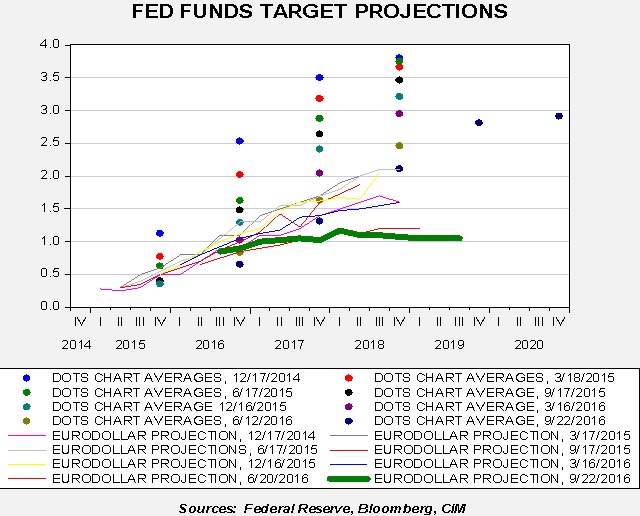
The financial markets have not changed their opinion in the wake of the report; the deferred Eurodollar futures are still signaling a serious inversion, and are projecting another 90 bps of easing over the next two years.

At the same time, the Mankiw Rule is suggesting that the last thing the Fed should be doing is cutting interest rates.  The Taylor Rule is designed to calculate the neutral policy rate given core inflation and the measure of slack in the economy.  John Taylor measured slack by using the difference between actual GDP and potential GDP.  The Taylor Rule assumes that the Fed should have an inflation target in its policy and should try to generate enough economic activity to maintain an economy near full utilization.  The rule will generate an estimate of the neutral policy rate; in theory, if the current fed funds target is below the calculated rate, then the central bank should raise rates.  Greg Mankiw, a former chair of the Council of Economic Advisors in the Bush White House and current Harvard professor, developed a similar measure that substitutes the unemployment rate for the difficult-to-observe potential GDP measure.

We have taken the original Mankiw rule and created three other variations.  Specifically, our model uses core CPI and either the unemployment rate, the employment/population ratio, involuntary part-time employment and yearly wage growth for non-supervisory workers.  All four variations compare inflation and some measure of slack.  Here is the most recent data:

This month, the estimated target rates all rose substantially.  Not only did inflation rise but the labor markets showed strength.  Three of the models, the ones using the unemployment rate, wages and involuntary part-time employment, all rose 20 bps to 40 bps and suggest the last thing the FOMC needs to do is ease.  Even the most dovish model, the variation using the employment/population ratio, rose by 20 bps and is flirting with neutral.  This analysis explains why so many members of the committee are reluctant to support an aggressive easing stance; the basic model that the Fed has used for years is calling for tightening.  Thus, the potential for disappointing the financial markets is elevated.

Jackson Hole: Now that the minutes are out of the way, the market’s focus will shift to the annual meeting in Wyoming.  Powell’s speech at Jackson Hole is scheduled for 10:00 EDT tomorrow, but the “festivities” begin today.  As our discussion of the minutes show, it will be very difficult to create a narrative for further easing that will sway the FOMC.  Greenspan would likely come up with some novel story to carry the day, but we can’t think of any other Fed chair who could pull this off.  Thus, the odds of disappointment are elevated.

South Korea v. Japan: The current spat between these allies centers around the issue of reparations surrounding the colonial period and WWII.  Japan argues that its previous actions have fully satisfied the responsibility for its past.  It’s unlikely that South Korea (or North Korea, for that matter) will ever fully absolve Japan for its past actions.  During the Cold War, the U.S. essentially forced these nations to work together as allies to contain communism.  However, with U.S. influence waning, old tensions are resurfacing.  South Korea has announced it will no longer share classified military information with Japan.

G-7 and Brexit: PM Johnson met with Chancellor Merkel yesterday.  Essentially, Merkel didn’t offer Johnson much, which suggests she would like to see the backstop issue resolved but that it is up to the U.K. to do that.  Johnson will meet with Macron next.  We are starting to see a realization among the pundits that the U.S. will be more than happy to make a free-trade deal with the U.K. after Brexit, but the outcome will likely make Britain a vassal state of Washington.  As noted yesterday, the G-7 won’t even try to issue a joint communiqué, an indication of the deep divisions within the world’s most significant democracies.

Looming tariffs: Although most of the tariffs on China were delayed, some will go into effect September 1.  China warns that new tariffs will raise tensions and vows to retaliate.  The earlier mentioned drop in the CNY is likely part of the response.  In other China news, companies are reporting that pulling supply chains from China is apparently harder than it looks.

Italy: Salvini’s attempts to force new elections may not work out.  For the next two weeks, parties will try to form a government to avoid fresh elections.  The center-left and populist-left parties are trying to form a coalition and elections will not be necessary if they are successful.

The establishment strikes back: The left-wing establishment has never been on board with President Trump, while the right-wing establishment has had a mixed relationship.  Until February 2018, the president talked like a populist but his policies were in line with establishment goals—taxes were cut, especially on the upper income brackets, and there was a massive pullback in regulation.  However, since February of last year, the administration and the right-wing establishment have diverged on trade and immigration policy.  We are now seeing establishmentmouthpieces” becoming increasingly critical of trade and immigration policy.

Trouble on the farm: My former colleague at A.G. Edwards, Bill Nelson, used to conduct a farm tour that moved through the Midwest corn belts and reported up close and personal on the condition of the crops.  It was an arduous task and fortunately for Bill he doesn’t have to do that anymore.  Pro Farmer is currently conducting a tour and is bringing some USDA officials along for the rideFarmers have been upset with the USDA, which has been rather optimistic about the prospects for this year’s crop despite damage caused by an unusually rainy spring and early summer.  These rosy estimates have depressed prices and apparently angered farmers to the point where government officials have been threatened.  Federal Protective Service agents have been dispatched to investigate the incidents.  Farmers are also upset with the administration’s decision to grant ethanol waivers to refiners which reduce demand for corn.

Energy update: Crude oil inventories fell 2.7 mb compared to an expected draw of 1.4 mb.

In the details, U.S. crude oil production was unchanged at 12.3 mbpd.  Exports rose 0.1 mbpd, while imports increased 0.5 mbpd.  Refinery operations rose 1.1%.

(Sources: DOE, CIM)

This chart shows the annual seasonal pattern for crude oil inventories.  Seasonal stockpiles are stabilizing a bit below the usual seasonal trough.  The summer driving season is rapidly coming to a close, but crude oil inventories usually don’t rise until late September when refinery maintenance begins.

Based on our oil inventory/price model, fair value is $61.72; using the euro/price model, fair value is $50.45.  The combined model, a broader analysis of the oil price, generates a fair value of $53.60.  We are seeing a clear divergence between the impact of the dollar and oil inventories.  Tensions in the Middle East have lessened and we are heading into a weaker demand period; thus, weaker oil prices in the short run are likely.  We do note that Alberta will continue to constrain oil production, although producers are being given a higher production ceiling.

In other oil-related news, Russian oil companies are moving to price oil in euros.  Over the years, there have been nations that have attempted to move away from dollar pricing.  Both Iran and Iraq tried when they were under sanction.  Russia’s decision does make some sense; not using dollars might allow it to skirt U.S. sanctions, which tend to depend on intersections with the U.S. banking system.  However, we doubt this will begin a wholesale shift away from dollar pricing for oil simply because the purchasing power of the dollar is so strong now that not taking in dollars is expensive for most nations.  After Brexit, the U.K. will dramatically reduce its strategic oil reserve.  OECD nations are required to hold oil in reserve as part of a global strategic reserve system designed, in part, to weaken OPEC’s ability to embargo oil and drive the price higher.  However, the EU has stricter rules than the OECD regarding the level of oil required to be held.  When (if?) the U.K. leaves, it will reduce its strategic reserve to the OECD level, which will put around 50 mb out for bid.  This action could lead to lower Brent prices post-Brexit.  The U.S. and Venezuela have been engaged in backchannel talks.  According to reports, Diasdado Cabello has been leading the talks on the Venezuelan side.  A deal would be bearish for oil prices at some point, although it might take years before Venezuela’s oil industry recovers.  Sanctions on Iran are having an effect; reports indicate it is in the deepest recession since the Iran-Iraq War.

View the complete PDF

Daily Comment (August 21, 2019)

by Bill O’Grady, Thomas Wash, and Patrick Fearon-Hernandez, CFA

[Posted: 9:30 AM EDT]

It’s Fed minutes day!  Equities are higher this morning, in what we are dubbing the “Seinfeld rally” because it seems to be driven by…nothing!  Although there was news overnight (which we discuss below), none of it reasonably explains the rally we are seeing so far.  The president won’t be visiting with Denmark’s PM Mette Frederiksen as was previously scheduled because she rebuffed his offer to buy Greenland.  Here is what we are watching:

The Fed minutes: The report comes out at midday; the minutes are a heavily sanitized version of the interactions between committee members, with words like “few” or “some” that get scrutinized like scriptural text for meaning.  The reality, which is better seen in 2024 when the transcripts come out, often reveals sniping and side comments that show what the members really think.  Still, we will work with what we have and the important question we hope to answer from the report is whether Powell can pull the committee along to cut rates faster.  We are seeing continued comments from members, the most recent from the San Francisco Fed, that the last rate move was precautionary and not necessarily the start of a more profound cutting cycle.  In our view, the breakdown of the committee suggests that Powell will struggle to get more than one more rate cut this year out of the FOMC.  Too many members are still working within some form of the Phillips Curve framework and will push back against rate cuts with low unemployment in place.  However, there is a growing contingent that wants to conduct policy with an eye on the financial markets, and this group worries that additional stimulus will simply show up in the financial markets as “froth” and create financial instability.  At the same time, as we note below, Powell is facing relentless pressure from the White House to cut rates aggressively.  The chance of disappointment from the minutes is rather high.

Italy: We thought that, in the end, Salvini would make a deal to keep the government in place.  Turns out, we were wrong.  Conte, the PM, resigned before the no-confidence vote and now the president is working to figure out if a replacement government can be formed.  There are four likely outcomes from this:

  1. New elections. The timing is bad because the government is in the middle of budget negotiations. Polling suggests the League and associated parties would probably prevail in a new government, sending shockwaves throughout Europe.  This would be the equivalent of the AfD taking control of Germany or Le Pen’s National Rally governing France.
  2. The current coalition could decide to hold together a while longer to get through the budget process.  To some extent, this may simply be delaying the inevitable.
  3. A broad anti-League coalition. A grand coalition of sorts could form a government; however, this would require some elements of the non-League right and the center and populist-left. It might stave off elections, but the coalition would be unstable.
  4. A narrow anti-League coalition. It would exclude the right-wing but would still require a center-left and populist-left government to form.  More stable than option three, but not by a lot.

It appears to us that the most likely outcome is new elections.  That’s risky for Salvini because surprises can occur, but the surge of right-wing populism in Europe seems to be strengthening.  What we find interesting is that the financial markets have taken the news in stride.  In fact, the spread between Italian and German sovereigns actually narrowed with the resignation.  Perhaps markets are more comfortable with the League without the Five-Star Movement, or, more likely, it’s hard to get overly concerned about Italian governments simply because they fail with such regularity.

White House recession worries: The White House is clearly concerned about the chances of a recession in the upcoming year.  Officials were on various Sunday news shows talking up the economy.  As noted above, Fed criticism is continuing.  In addition, the administration is considering additional fiscal measures to lift growth.  These ideas include a payroll tax cut, indexing capital gains taxes to inflation and perhaps even delaying or removing some tariff measures.  As we noted yesterday, measures to boost the economy are common in this year of the election cycle, which is part of the reason why the year before the election tends to be good for equities.  However, that trend has been somewhat stunted by trade concerns this year.

Boris goes to Europe: PM Johnson is on his way to Europe to meet with Chancellor Merkel and President Macron.  Johnson’s message to the EU will be clear—the U.K. is leaving on Halloween unless the EU gives ground on the Irish backstop.  Johnson is under the impression that opposition to a hard Brexit in Parliament is signaling to the EU that the exit on Halloween is a hollow[1] threat.  Johnson seems to think that the EU will break if there is an unmistakable signal that a hard Brexit is imminent.  We think he is wrong.  When faced with the economic disruption the EU will experience from a hard Brexit, Johnson believes the EU will react; in other words, Britain will be willing to suffer more from a hard break compared to the EU.  That calculation might be true; however, we think Johnson might not appreciate how hard it is to get a unanimous position from the EU on any topic.  As a result, once established, it takes extraordinary circumstances to reopen negotiations within the EU, which are nearly always tortuous.  To some extent, playing “chicken” with the EU is a bit like competing with an opponent whose steering wheel is locked.  There may be good reason for the EU to “veer,” but it just can’t.

ISIS on the rise?  As the U.S. gets closer to securing an agreement with the Taliban, it appears that elements of ISIS are making themselves more known.  Today, top U.S. negotiator Zalmay Khalizad is expected to arrive in Qatar to discuss the remaining parts of a withdrawal agreement. In said agreement, the Taliban would sever its ties with al-Qaeda and assist in counter-terrorism measures.  Following the bombing of a wedding that took place on Saturday in Kabul, the effort to secure a deal has been complicated by growing doubts that the Taliban will be able to follow through in countering terrorist threats from ISIS.  As a result, this could mean the U.S. withdrawal, which was originally slated to be 5,000 troops, might be lower.

Russia-U.S.: Following the U.S. withdrawal from the Intermediate-Range Nuclear Forces (INF) Treaty, the relationship between the U.S. and Russia has become more tense.  Yesterday, Russia showed displeasure that the U.S. has begun testing cruise missiles by stating it believes the U.S. had likely been working on the missile prior to its withdrawal from the INF Treaty.  Later that day, President Trump attempted to de-escalate tensions by calling for Russia to be reinstated into the G-7.  It appears that despite the president’s attempt to normalize relations between the two countries, the relationship between the U.S. and Russia appears to be in its worst shape since the Cold War.  Although we do not expect conflict to arise soon, we do anticipate that both sides will reinforce their military capabilities.  Russia will attempt to show the world that it is still a major factor, and the U.S. will likely do so in an attempt to deter perceived threats to its interests in the Pacific.

View the complete PDF


[1] See what we did there!

Daily Comment (August 20, 2019)

by Bill O’Grady, Thomas Wash, and Patrick Fearon-Hernandez, CFA

[Posted: 9:30 AM EDT]

Markets are mostly quiet this morning, more typical of late August.  Here is what we are watching:

G-7 Summit: Japanese government sources say the Group of Seven (G-7) summit this weekend in France will probably not adopt a joint communiqué because of the deep disagreements between the various countries regarding free trade and climate change.

Italian no-confidence vote: Italy’s legislature will vote today as to whether it will continue with its current government or force new elections.  Although we think the odds that the government falls are not that high (members seem cool to the idea), anytime a vote is held unexpected outcomes can emerge.  If Deputy PM Salvini had his way, he would bring down the government and become the new prime minister.  While this outcome is likely at some point in the future, it probably won’t happen today.  A Salvini-led government would be a problem for the EU; he has been pressing to violate EU fiscal rules and would likely foster a governance crisis for the union.

Brexit letters: PM Johnson is trying to prod the EU into reopening negotiations; he sent a note to Donald Tusk, the president of the European Council,[1] indicating that the Irish backstop should be removed and in its place, well…that part’s not clear.  Mr. Tusk rejected the proposal.  The Irish backstop is a real problem for Brexit; the EU won’t allow a free trade border to exist with a nation that isn’t in the EU, which is what Johnson seems to want.  That’s why Theresa May accepted the backstop which effectively keeps Britain in the trading union without the ability to influence it.  Essentially, if Britain wants to leave, a hard border on the Northern Ireland/Ireland frontier will return.  Additionally, that will seriously complicate Britain’s ability to negotiate a free trade deal with the U.S.  It looks to us like the odds of a hard Brexit are rising.  A looming constitutional crisis could emerge as Johnson tries to overcome opposition in Parliament to a hard Brexit.  In addition, dissention in Parliament could trigger new elections.

United Kingdom-China: The British consulate in Hong Kong has announced that one of its employees has been detained in mainland China since making a business trip there in early August.  The detention could be Chinese retaliation for a telephone call that British Foreign Secretary Raab made to Hong Kong Chief Executive Carrie Lam earlier this month.  In the call, Raab lobbied for an investigation into the issues surrounding the anti-Chinese political protests that have been plaguing Hong Kong, which Beijing sees as its own internal affair.

Social media firms accused China of spreading disinformation about Hong Kong protestors, and the firms have removed accounts with suspected ties to Beijing that have been involved in disseminating such disinformation.  These firms will likely face retaliation from Beijing.

More stimulus: The year before the election year tends to be a good year for equities.

To create the data for this chart, we index the Friday close for the S&P 500 going back to the first week of January 1928 for a four-year period.  We repeat the process for every four-year period to the present; this gives us a consistent presidential cycle.  Note that in the second year, after the November midterms, equities tend to rally strongly until around mid-year of the last year before the election.  Part of that rally is the removal of uncertainty surrounding the midterm elections, but often presidents act to stimulate the economy to either improve the odds of reelection or support the party in power.  This year generally fits that pattern.

And, right on cue, the White House is pressing for economic support.  First, the president has subjected the Federal Reserve to strong criticism, pressing for aggressive rate cuts.  Second, the White House is apparently considering a payroll tax cut.  A payroll tax cut would be a significant move for the economy.  It would affect almost all workers and, unlike the earlier tax cuts, the benefit would mostly go to the bottom 80% of households in terms of income share.  We have seen such reductions in the past; the Obama administration cut the rate by 200 bps in 2011 and 2012, but the rate returned to its earlier level after the two-year break.  The administration has denied the report, but we doubt that a measure such as this isn’t at least being considered.

Syria-Russia-Turkey: Syrian forces and their Russian allies have bombed a Turkish military convoy making its way toward an observation post set up to help diffuse tensions in northwestern Syria.  Ankara claims the convoy was merely trying to resupply the post, but the Syrians and Russians say it was bringing supplies to anti-government rebels in the area.

Russia-Ukraine: French President Macron and Russian President Putin agreed at a summit yesterday that there may be a new chance to resolve the military conflict in eastern Ukraine, based on the election of the new Ukrainian president, Volodymyr Zelensky.  Earlier this month, Zelensky called for fresh peace talks between his government and Russian-backed separatists in the region.

Russia: Two more radiation-monitoring stations in Russia have gone dark, adding to evidence that the government is trying to hide what happened in the apparent test failure of a new nuclear-powered cruise missile last week.  A total of four monitoring stations connected with the Comprehensive Nuclear Test Ban Treaty have now gone silent.

Iran: State-run media are casting the release of the Iranian oil tanker seized in Gibraltar last month as a sign that Iran can stand up to the economic sanctions imposed on it by the United States.  Iranian politicians reportedly believe the tanker was released only because the country’s Revolutionary Guards retaliated by seizing a British tanker.  That could encourage further such actions by Iran, which will keep tensions high in the Persian Gulf and maintain some measure of a risk bid for oil.  Meanwhile, as the released tanker steams toward Greece, the U.S. government has issued a warning that any entity that provides support to the ship or her crew would be subject to U.S. “immigration and potential criminal consequences.”

Mexico: In another worrying sign for the viability of contracts under leftist President Andrés Manuel López Obrador, the Mexican government has demanded $900 million from the builders of a major natural gas pipeline that is supposed to deliver natural gas from Texas to Mexico.  The government is demanding the money as compensation for construction delays, and it has already forced the builders to enter into arbitration.  Separately, the government is trying to reduce the capacity and usage charges it faces under the contract for the project.

Colombia: Agricultural officials in Bogotá have confirmed that a soil fungus that has devastated banana plantations throughout Southeast Asia has been detected in Colombia, the top global exporter of the fruit.  While the fungus isn’t dangerous to humans, it prevents trees from producing and is considered so dangerous that it could eventually eliminate all Cavendish bananas, which make up 95% of world exports.

Odds and ends: Yesterday, we reported that the Business Roundtable moved to change the focus of business from promoting shareholder value to a broader goal of stakeholder value.  Shareholders have responded unfavorably.  The Reserve Bank of Australia discussed unconventional policy at its August meeting.  Japan allowed more exports of high-tech materials to South Korea, easing recent tensions.  Another reason for the recent U.S. attraction to Greenland—rare earths.  And, ISIS isn’t completely eliminated yet.

View the complete PDF


[1] The European Council is a body whose members comprise the heads of state of the EU governments, along with the presidents of the European Council and the European Commission.  Although it has little formal power, it’s informal power is significant as it is the “talking shop” for the leadership of the EU.

Weekly Geopolitical Report – Weaponizing the Dollar: Part II (August 19, 2019)

by Bill O’Grady

Weaponizing the Dollar: Part I

In Part I, we began our analysis with a discussion of Mundell’s Impossible Trinity.  We also covered the gold standard model and Bretton Woods model.  This week, we will examine the Treasury/dollar standard and introduce what could be called Bretton Woods II.  Finally, we will conclude with market ramifications.

View the full report

Daily Comment (August 19, 2019)

by Bill O’Grady, Thomas Wash, and Patrick Fearon-Hernandez, CFA

[Posted: 9:30 AM EDT]

Happy Monday!  Equity futures are pushing higher again this morning after the U.S. gives Huawei (002502, CNY 2.95) a 90-day extension.  It’s a big week—Fed minutes, the Jackson Hole meeting and the G-7 next weekend.  Treasury yields are higher and gold is retreating.  Here is what we are watching:

The Fed: We will get the Fed minutes at mid-week.  Although these reports are heavily sanitized (comparing the minutes to the transcripts that come out in five years is an interesting exercise), given the degree of dissent at the last meeting the minutes might offer some insight into how fast Powell can push the committee to further easing.  The other big event is the annual central bankers meeting in Jackson Hole, WY, sponsored by the KC FRB.  Chair Powell will speak on Friday under heavy pressure from the White House and financial markets.  To some extent, Powell probably needs a new narrative to use for more aggressive easing.  In the past, Fed chairs have deployed new frameworks to make major adjustments to policy.  For example, Volcker shifted from rate setting to money supply targeting in order to aggressively raise rates without it looking like the Fed was merely implementing austerity (it was).  Greenspan argued that rising productivity allowed policymakers to avoid the straitjacket of the Phillips Curve in the late 1990s, keeping policy rates lower than they otherwise would be.  Sadly, Powell may not have the intellectual “chops” to create a new regime; perhaps Jim Bullard (St. Louis FRB) could offer him one.  If Powell wants to use the current paradigm to cut rates, he will likely face continued resistance from traditional hawks and Phillips Curve adherents.

U.S.-China Trade: President Trump tweeted over the weekend that trade talks with China are going well, and that U.S. and Chinese negotiators might soon meet in Washington again.  Chief Economic Advisor Larry Kudlow said the negotiators would have at least one more telephone call in the next week or two to lay the groundwork for the next round of face-to-face meetings. This suggests those meetings wouldn’t happen until at least September.  Separately, Trump provided a positive readout on his Friday dinner with Tim Cook, the CEO of Apple (AAPL, 206.50).  According to Trump, Cook made a compelling argument that the new U.S. tariffs against China are disproportionately affecting Apple, while giving an advantage to South Korea’s Samsung Electronics (005930.KS, 43,600).  Since that probably raises the chance of some tariff relief for the company, Apple is rallying so far today and helping to pull the rest of the market along with it.  On the other hand, we note that although over the weekend Kudlow announced a three-month extension of licenses for U.S. firms to sell to Chinese telecom firm Huawei (002502.SZ, 2.95), the president last night said U.S. companies ultimately shouldn’t be doing business at all with the Chinese firm.

Although the president’s postponement of tariffs has led to a lift in equities, it should be noted that not all tariffs were delayed and the ones that will be implemented early next month matter.  We also note that the president is making reference to Hong Kong in comments, signaling to China that a harsh crackdown will adversely affect trade talks.

We also want to mention an editorial by Robert Samuelson, quoting one of our favorite books[1] and authors, Charles Kindleberger.  In this book, Kindleberger introduced the idea of “hegemonic stability theory” and argued that the Great Depression was caused by a global power vacuum; essentially, the U.S. was unwilling to accept the superpower role and the U.K. was unable to maintain it.  This situation led to a collapse in global trade and supported the rise of fascism.  Samuelson correctly notes that we are seeing somewhat similar conditions today.

PBOC: The PBOC unveiled a new policy rate, called the “loan prime rate,” which will replace the benchmark lending rate.  The rate is derived from quotes on prime loans from 10 major banks and has been published since 2013, but it is basically unused in setting policy.  After tomorrow, commercial banks will be required to price loans off the loan prime rate.  Since the loan prime rate does trade a bit below the benchmark lending rate, at least for now, this move is something of a modest easing.

Recession talk: This weekend, talk shows were dotted with administration officials downplaying the odds of recession.  Despite the attempt to lift spirits, worries about recession are mounting.  The chart below shows relative interest in the word “recession” in searches.  It has reached its highest point in a year and in the past five years (not shown).

The yield curve has prompted this surge in interest.  Additionally, as worries mount, analysts are looking at other variables that might either confirm the recession signal from the financial markets or offer some insight into timing.  As a general rule, the earliest warning signs tend to have the highest false positives, or the most variability in terms of timing.  One industry that has a generally good track record in signaling downturns is the recreational vehicle industry.  RVs are purely discretionary products; thus, their sales tend to signal how optimistic consumers are in the business cycle.  Here at Confluence, we have a long history in analyzing this part of the economy.  Recent evidence from this industry is clearly worrisome, suggesting a downturn is likely.

Hong Kong: Hundreds of thousands of protestors demonstrated against China’s growing influence in Hong Kong yet again over the weekend, with police water cannons on standby, but reports indicate the organizers were successful in keeping the protests peaceful.  That suggests the protestors are able to adjust their behavior in order to maintain or even build further support among Hong Kong’s population.  This could help stave off any crackdown by Beijing – a move that would probably be negative for the financial markets – but it also risks sapping the momentum from the protests and allowing Beijing to wait it out.

There are reports that capital flight issues are starting to emerge from Hong Kong.  In the short run, this may undermine the Hong Kong dollar’s peg to the U.S. dollar.  However, in the long run, it creates the issue discussed by Albert Hirschman[2] as to whether one exits under deteriorating conditions or agitates for change.  This issue will become increasingly important with Hong Kong as those who can may simply leave, increasing the odds that Beijing will be able to bring the territory under a single government.

United Kingdom: A leak of Prime Minister Boris Johnson’s contingency plan for a no-deal Brexit – dubbed Operation Yellowhammer – shows that the government thinks “EU Exit fatigue” has discouraged many companies from properly planning for an abrupt, chaotic exit from the European Union on October 31.  The plan envisions three months of chaos at British ports, shortages of food and fuel, nation-wide political unrest and the imposition of a hard border between Northern Ireland and the Republic of Ireland.  Separately, the outgoing president of the European Commission, Jean-Claude Junker, will miss the G-7 meeting on Friday due to an emergency gallbladder operation over the weekend.  That will deprive Johnson of one of his last opportunities to pressure the EU for a new withdrawal deal to replace the deal negotiated by the former prime minister, Theresa May.

Russia: Although former Soviet dissidents aren’t being allowed to mark the event, today is the 28th anniversary of the attempted coup against Soviet President Mikhail Gorbachev, which led to the breakup of the USSR, the demise of Soviet communism and the eventual rebirth of Russia as a kleptocratic, corporatist state under President Putin.  Last week’s apparent explosion of an experimental nuclear-powered cruise missile illustrates the extent to which Russia is also trying to rebuild its military strength and reestablish its military technology effort.  New reports say two nearby radiation monitoring stations connected with the Comprehensive Nuclear Test Ban Treaty have gone silent since the missile mishap, illustrating how Russia is also trying to cloak its new military buildup, just as the Soviet Union would have done.  Old habits die hard.

Greece: Finance Minister Christos Staikouras said in an interview that Greece’s new center-right government will implement a comprehensive tax reform plan that would cut corporate and personal income taxes, reduce the value-added tax, streamline tax incentives and eliminate the emergency levies imposed during the Greek debt crisis over the last decade.  Staikouras vowed that the plan would be implemented without violating Greece’s bailout promise to maintain a primary budget surplus of 3.5% of GDP.

Saudi Arabia: Iran-backed Houthi rebels in Yemen attacked a Saudi oil and gas facility with 10 drones over the weekend, but Saudi officials said the attack only resulted in a fire that has already been controlled.

United States: In the midst of last week’s market turmoil, President Trump held a previously undisclosed conference call with the chief executives of three of the largest U.S. banks.  It’s not clear who initiated the call or what exactly was discussed, but it wouldn’t be a surprise if the bankers gave Trump an assessment of the current economic situation and the risks arising from the administration’s trade policies.

Times they are a-changing: The U.S. Business Roundtable has issued a statement suggesting that the sole focus on shareholder value is no longer viable.  This notion, which was famously supported by Milton Friedman, is an element of the equality/efficiency cycle.  When one is in an efficiency cycle, the focus on shareholder value alone is usually championed.  However, when equality becomes more important, other factors emerge.  We examined this issue in a recent WGR series (here and here).  Such concerns will almost certainly lead to lower margins as CEOs begin to balance the needs for profits along with consumer concerns and improving the lot of its employees.

Odds and ends: If you buy a house in Denmark, the bank will pay you for your trouble in an era of negative interest rates.  Germany is considering a modest fiscal expansion but only if conditions worsen.

View the complete PDF


[1] Kindleberger, Charles. (1973). The World in Depression, 1929-1939. Berkeley, CA: University of California Press.  Ed. Note: we have a review of this book on our website; see link at the top of this report.

[2] Hirschman, Albert. (1970). Exit, Voice, and Loyalty: Responses to Decline in Firms, Organizations and States. Boston, MA: Harvard Press.

Asset Allocation Weekly (August 16, 2019)

by Asset Allocation Committee

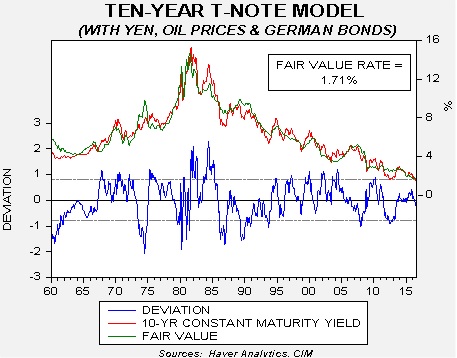
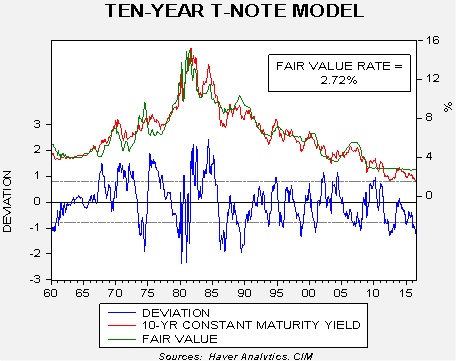
As the 10-year T-note yield tumbles, we are reaching a point where the market looks overvalued based on current fundamentals.

Our yield model uses fed funds and the 15-year average of the yearly change in CPI[1] along with the JPY/USD exchange rate, oil prices, the yield on 10-year German bunds and the fiscal deficit as a percentage of GDP.  The current yield on the 10-year T-note, dipping below 1.70%, puts the deviation from fair value at nearly a standard error below fair value.  Not every deviation from fair value is resolved through higher interest rates; sometimes the fair value yield declines.  The last time we saw this sort of event occur was in 2012 during the Euro crisis and the U.S. Treasury downgrade.  That proved to be an unsustainable low in yields.  We also saw a dip in early 2008; that issue was resolved by falling T-note yields due to the financial crisis.

Isolating fed funds and assuming the rest of the variables remain steady shows that the bond market has factored in a fed funds of 10 bps, or essentially a return to ZIRP.  To be fair, it is also possible that the financial markets are lowering estimates of inflation.  The 5-year/5-year TIPS calculation[2] puts the forward inflation rate at 1.80%; our long-term average calculation is around 2.08%.  Applying that inflation rate expectation into the model means the current T-bond yield has discounted a 50 bps fed funds rate.

In any case the bond market is essentially making the case that a recession is likely.  If a recession is avoided, we would expect to see a significant rise in long-duration yields.  For now, the uncertainty surrounding trade and weakening global growth will probably continue to support a long-duration position.  But, given the mercurial nature of the trade discussions, a rapid reversal is not out of the question and thus requires close monitoring. 

View the PDF


[1] This variable acts as a proxy for inflation expectations.

[2] This series is a measure of expected inflation (on average) over the five-year period that begins five years from today.

Daily Comment (August 16, 2019)

by Bill O’Grady, Thomas Wash, and Patrick Fearon-Hernandez, CFA

[Posted: 9:30 AM EDT]

Happy Friday!  Equity futures are higher this morning on hopes that the president is further retreating on tariffs.  Treasury yields are higher and gold is retreating.  Central banks around the world are moving to ease.  Here is what we are watching:

Backing away?  There are signs that President Trump may be looking for an off-ramp for his recent tariff threats.  The presidents of China and the U.S. are reportedly in contact and some movement on fentanyl is possible which, if met, would give the U.S. a reason for pulling back or delaying the tariff threat.  There are reports that the president is getting concerned about the economy.  Although the general response from the administration on economic fears are centered around overly tight monetary policy, history shows that incumbent presidents who face recessions for whatever reason tend to be blamed for the downturn.  Thus, even if it is true that monetary policy is too tight, voters don’t care; the president in office suffers the loss.

Although yesterday’s retail sales data suggests that consumption remains strong, it is clear the trade conflict is weighing on other parts of the economy.  A long list of nations, mostly export-dependent, are seeing serious economic pressure.  The fear is that these nations may drag the U.S. into a downturn as well.  Backing away from the trade conflict would remove a worry from the economy and would clearly lift market sentiment.

Monetary policy: Although yesterday’s retail sales data was impressive, it probably won’t cause the FOMC to hold steady on policy next month.  We note that Fed officials are signaling cuts, although there is no evidence that aggressive action is being considered.  It should also be noted that the Fed isn’t alone in easing; more than 30 other central banks are also cutting rates.  More importantly, the ECB appears ready to not just cut rates but to become more aggressive in QE.

Fiscal policy: There are reports that both China and Germany are considering fiscal stimulus.  The former has already conducted some actions, while the latter is usually reluctant to spend.  This action would be important; the saving identity shows why:

0 = (private investment – private saving) + (taxes – spending) + (exports-imports)

Persistent trade surplus nations usually have excess private saving over investment.  If they run a balanced fiscal account, to balance this identity, exports>imports by the exact level of the excess private saving.  So, a trade deficit has nothing to do with how much your consumers prefer foreign goods and everything to do with macroeconomic policy.  If China and Germany (especially Germany) were to lift fiscal spending, their trade accounts would be closer to balanced as the government deficit would be used to absorb the excess saving rather than the trade account.

A lift to growth: The Atlanta Fed’s GDPNow estimate for Q3 GDP rose 40 bps on yesterday’s data.

The contribution data suggests the economy is mostly being supported by the consumer.

Outside the consumer, the rest of the components of GDP are a wash.  Of course, strong consumption will tend to boost imports, so some offset is expected from net exports in the wake of rising consumer activity.  However, some of that consumption is also resulting in inventory reductions, which are also a drag on growth.  An interesting side note comes from reports that auto dealers are holding excess inventory, which may mean they will be forced to aggressively price product to rebalance their market.

China and Hong Kong: Widespread protests are expected for the 11th consecutive weekend.   We reported yesterday that Chinese security officials are making a clear show of force in what is likely a bid to intimidate the protest movement.  So far, it isn’t working.  If China were to use the military against the protestors, we don’t see how the U.S. would not react with some sort of economic sanctions at a minimum.

The chief executive of a major Hong Kong airline has submitted his resignation “to take responsibility” for airline staff who have supported or participated in the city’s anti-Chinese political protests.  The resignation of Rupert Hogg, CEO of Cathay Pacific Airways (CPCAY, 6.68), shows how Beijing is trying to rein in private businesses for its own political purposes.  As such, the incident is another negative dimension to the ongoing protests.  The disruptive protests have helped drive down Hong Kong stocks over the last month, but reporting today says the declines have been muted by strong inflows from Chinese investors.  Those purchases could simply reflect mainland investors trying to take advantage of the drop in Hong Kong valuations.  However, there is some chance that the purchases also come from state-owned entities under the direction of the central government, which wants to maintain Hong Kong’s attractiveness as a global financial center.

India: The Hindu nationalist government of Prime Minister Narendra Modi announced that it would relax some of the communications and social restrictions it imposed on Jammu and Kashmir on August 5, when it said it would withdraw the Muslim-majority region’s autonomy.  To date, the clampdown seems to have been successful in limiting protests against the loss of autonomy.  However, while the government’s justification for the move was largely economic, the clampdown has reportedly brought the region’s economy to a standstill.

Mexico: Banco de México yesterday cut its benchmark short-term interest rate to 8.00%, marking its first rate cut in five years.  The policymakers said the 4-to-1 vote to cut the rate was based largely on the fact that Mexico’s inflation rate has recently moderated, leaving the “real” benchmark rate too restrictive.

North Korea: The North Korean military launched two more short-range ballistic missiles today, marking the fifth test firing in the last month.  The missile tests are largely an effort to protest the current U.S.-South Korea military exercises, but it’s important to remember that the tests also give the North Koreans a chance to refine and improve their missile technology. 

Venezuela: China announced it will stop buying oil from Venezuela in response to U.S. sanctions.  There are reports that Maduro is cracking down hard on the military with suspected coup plotters facing torture or worse.  This strategy is risky because if Maduro decides to pick on the wrong military figure then the brass might turn on him, and that would almost certainly end his time in office.

Iranian oil tanker released: Gibraltar has released a Iranian oil tanker that was being held by the Royal Navy.   If this action signals a de-escalation of tensions, it would put downward pressure on oil prices.

United States-Greenland: A report yesterday afternoon said President Trump has expressed an interest in having the United States buy Greenland.  The general response so far seems to be incredulity and irritation on the part of Denmark (which owns Greenland) and pushback even from right-wing Danish politicians.  However, to gauge how far this could go, it’s important to remember some historical precedents.  President Jefferson’s purchase of the Louisiana Territory and Seward’s purchase of Alaska will be on everyone’s mind, but there are much more direct precedents, too.  In 1916, the U.S. bought the Danish West Indies, which we now know as the U.S. Virgin Islands, to make sure they didn’t fall into German hands as a result of World War I.  Then, in 1946, President Truman offered to buy Greenland for $100 million, but Denmark rejected the idea.  A key reason for Truman’s interest in the purchase was national security.  The U.S. ultimately gained an air base at Thule, north of the Arctic Circle, and to this day it maintains multiple radar and other military assets on the island that are vital to the developing competition with China and Russia in the far north.  In fact, the U.S. last year took steps to thwart a Chinese effort to build three airports in Greenland.  Finally, the island also has valuable natural resources that may have caught Trump’s eye.  We’ll see if this develops into anything more.

View the complete PDF

Daily Comment (August 15, 2019)

by Bill O’Grady, Thomas Wash, and Patrick Fearon-Hernandez, CFA

[Posted: 9:30 AM EDT] Equity futures have rebounded in the past hour, likely on news that President Trump and Chairman Xi are exchanging letters and talking on the phone.  Economic worries continue to dominate.  And, how will we remember the Hickenlooper campaign?  Here is what we are watching:

Economy and markets: Equity markets took a beating yesterday, while interest rate markets enjoyed a strong rally and the 30-year T-bond dipped under 2% for the first time in history.  Global equities continued to weaken overnight as China vowed to retaliate against U.S. tariff measures.  Adding to worries were vague comments from President Trump, who, for the first time, appeared to link the tensions in Hong Kong to trade talks.  Some of the president’s advisors have been pressing for a hardline reaction to China’s handling of the situation, but so far the president has resisted commenting strongly on this issue.  However, as we noted above, we have seen a rebound develop after it was revealed that the two leaders have been in contact.

Equities have been slumping on worries about global growth.  There are reports noting that the growing trend of economic nationalism is playing havoc on global trading patterns.  Even the reliable WSJ editorial page is becoming critical of White House trade policy.

However, the yield curve is front and center in market and media commentary as the two-year/10-year spread inverted yesterday.  As we have noted, several other permutations of the yield curve have inverted already, including the fed funds/10-year, which is used by the Conference Board in calculating the leading economic indicators.

Journalists, seeking clarity, correctly indicate that each recession has been preceded by an inversion of some sort.  This is true, as far as it goes.  However, it is rare for the media to delve into the notion of the “false positive,” a signal that isn’t followed by an event.  The yield curve is a powerful indicator, one that should not be ignored.  However, it isn’t perfect and has been subject to false positives in the past.

Let’s use the 10-year/fed funds measure as an example.  This indicator failed to invert for the 1957 and 1961 recessions, but, since then, it has inverted prior to each downturn.  However, it also signaled two false positives, one in the mid-1960s and one in 1998.  In both those cases, a recession was avoided due to aggressive actions by the FOMC to cut interest rates.  So, if the Fed were to act aggressively, a recession might be avoided; simply put, it isn’t inevitable.  But, the odds of a downturn are elevated, and that fear has weighed on financial markets.

We would not be surprised by an equity market recovery in the wake of yesterday’s drop.  As we see in this morning’s activity, glimmers of hope on trade are enough to trigger rebounds.  After all, as the above chart indicates, the inversion tends to predate the recession by a rather long period.  Nevertheless, it does make sense to be aware that the odds of recession are elevated.

Japan-South Korea: In a speech today, South Korean President Moon Jae-in struck a conciliatory tone toward Japan, vowing to “join hands” with Japanese leaders if they choose dialogue to overcome the continuing dispute concerning Japanese-Korean relations before and during World War II.  This adds to evidence that the countries may be ready to step back from the dispute in which both sides have weaponized trade rules.  Reports yesterday said senior Japanese and South Korean officials will meet on the dispute in Guam on Friday and Saturday.  Separately, Japanese Emperor Naruhito today repeated his father’s groundbreaking expression of “deep remorse” for Japan’s behavior in the 1930s and 1940s.

Hong Kong: There are more reports of Chinese security personnel amassing near Hong Kong, with one article discussing how tens of thousands of Chinese military police are conducting drills in a large sports stadium in Shenzhen.  Satellite imagery shows over a hundred armored personnel carriers and other vehicles parked inside the facility.  Officials claimed that previous drills were merely in preparation for the anniversary of the People’s Republic of China on October 1, but the apparent continuation of security deployments raises the prospect that Beijing is about to clamp down on anti-Chinese protestors in Hong Kong – a move that would probably have painful political and economic costs for China and further undermine global investor sentiment.  One especially important implication of a violent crackdown is that it would signal to the Taiwanese that they could be subject to the same treatment.  Taiwan is also becoming increasingly leery of China’s intentions under the nationalist policies of President Xi Jinping.  Today, Taiwan’s government released a plan to boost its defense spending by 8.3% in 2020.  That would be the island’s biggest defense budget boost since 2008.

United Kingdom: Labour Party leader Jeremy Corbyn has released a plan to thwart Prime Minister Johnson’s apparent intention for a no-deal Brexit.  Under Corbyn’s plan, a coalition of opposition parties led by Labour would try to bring down the Johnson government via a no-confidence vote in early September.  Labour would then try to form a temporary government whose mandate would be limited to asking the European Union to extend the current Brexit deadline of October 31 and call new elections.  In any such elections, Corbyn vowed that Labour would run on a platform of holding a new referendum on Brexit.  At least some opposition parties have already expressed reservations about the plan, especially due to its slant toward Labour, in general, and Corbyn, in particular.

Canada: The government’s independent ethics watchdog said Prime Minister Trudeau violated conflict-of-interest laws when he pressured his former attorney general to settle a corruption case against the Canadian engineering company SNC-Lavalin (SNCAF, 12.99).  The controversy is old news, but the formal decision by the ethics board is likely to further undermine Trudeau’s position in the country’s October elections.

United States-Iran: Just when the United Kingdom and Iran seemed ready to resolve their dispute over the Iranian oil tanker Grace 1, which Britain detained in Gibraltar last month, the U.S. Department of Justice today filed a motion in Gibraltar to seize the ship.  The British originally seized the ship for violating sanctions against Syria, but the legal basis for the U.S. motion isn’t clear.

Argentina: President Macri has announced several emergency economic measures aimed at stopping the plunge in the Argentine currency and shoring up the economy.  The peso and the economy are in a tailspin after Macri’s poor performance in last weekend’s primary elections sparked concern that the populist, unorthodox Peronists will return to power.  However, the emergency measures, such as a hike in the minimum wage and a freeze on gasoline prices, may not be sufficient enough to make a difference.

Cybersecurity: As we continue to see signs of a political shift toward increased economic sovereignty and higher regulation in at least some areas, it appears that cybersecurity may be one reason for a clampdown on the technology industry.  Reports today say the hacker who stole huge amounts of cloud-based data from Capital One (COF, 83.45) also broke into more than 30 other firms’ cloud systems.  Democratic Senator Ron Wyden of Oregon is demanding that cloud service providers take further action to protect data.

Energy update: Crude oil inventories unexpectedly rose 1.6 mb compared to an expected draw of 2.3 mb.

In the details, U.S. crude oil production was unchanged at 12.3 mbpd.  Exports rose 0.7 mbpd, while imports increased 0.6 mbpd.  Refinery operations fell 1.6%.

(Sources: DOE, CIM)

The above chart shows the annual seasonal pattern for crude oil inventories.  We are seeing a modest recovery in inventories after nearly two months of declines that put the level of inventories below the usual seasonal trough.  The summer driving season is rapidly coming to a close, but crude oil inventories usually don’t rise until late September.

Based on our oil inventory/price model, fair value is $60.84; using the euro/price model, fair value is $50.96.  The combined model, a broader analysis of the oil price, generates a fair value of $53.62.  We are seeing a clear divergence between the impact of the dollar and oil inventories.  If President Trump is successful in bringing the dollar lower, it would be bullish for oil prices.  Recession fears are acting as a bearish factor for oil prices as well, overcoming worries about geopolitical disruptions.

View the complete PDF

Daily Comment (August 14, 2019)

by Bill O’Grady, Thomas Wash, and Patrick Fearon-Hernandez, CFA

[Posted: 9:30 AM EDT] It’s mid-week in what has been a busy week.  President Trump blinks (sort of) on trade.  Equity markets don’t follow through, mostly due to lingering trade uncertainty and mounting evidence of global economic weakness.  Hong Kong remains a flashpoint.  Here is what we are watching:

Trade: In a surprise move, President Trump announced delays in the majority of announced tariffs until December 15.  Looking at the goods affected, there was a clear decision to avoid tariffs on consumer goods before ChristmasRisk assets were emboldened by the announcement.  All in all, more than $150 billion of goods were affected by the delay.  Both sides agreed to resume negotiations.

This action appears tactical in nature.  Delaying the implementation doesn’t mean they have gone away.  It is interesting that the president framed the action as a way to avoid issues for the holidays, perhaps a tacit acknowledgement that consumers may pay at least some of the tariffs.  If that is true, then delaying the tariffs into the year before elections is a risky ploy.  It also signals to China that the White House may be less tolerant of inflicting pain on the U.S. economy and therefore may make Beijing less open to concessions.

If the goal was to lift confidence and financial markets, the effect was short-lived.  Risk markets did rally strongly but are giving back everything today.  Equities, from a technical perspective, are starting to look soft; fading rallies is not a good sign.

What happens as we approach December 15?  We suspect it will all depend on how the economy looks.  If the economy is struggling, the tariffs may remain in place.  At the same time, there will be a political calculus at work as well.  If the president believes the tariffs improve his chances of reelection, they will probably go forward.  But, overall, we think the economy will be the key variable and we would envision further delays if deceleration continues.

Weakening global growth: A key factor for today’s equity weakness is a batch of soft economic data abroad.  German GDP fell into negative territory.

Although the data was near expectations, a negative reading isn’t welcome and the odds of two consecutive negative quarters, the “working” definition of recession, is highly likely.  This data highlights the fact that the major European nations are likely in a downturnGerman economic sentiment fell to its lowest level since 2011.

China released a series of weak numbers as well.  Industrial production came in weaker than forecast, at 4.8% (Y/Y%), well below the 6.0% expected.  As the chart below shows, this is the weakest showing since 2008.

Retail sales also slumped.

This data raises questions about the effectiveness of Chinese stimulus measures.  Given China’s history (and the continued problems in Hong Kong), we would expect the Xi administration to return to more aggressive stimulus measures if the economic slowdown continues.

Slumping global growth will almost certainly bring easier policy from the FOMC.  As various permutations of the yield curve either invert further or approach inversion, the signal from the financial markets is clear that the Fed needs to cut rates.  Unfortunately, given the fact that we had two dissents last meeting, it may be hard not only to lower rates but to move more than 25 bps.  The other worry, of course, is that a rate cut might not matter all that much.

Finally, it’s worth noting that the Eurozone and China are both export-dependent.  Germany has essentially turned the Eurozone into a broader version of itself, making it heavily dependent on foreign sales, and China’s development model was based on exports.  Thus, the trade conflict is affecting China and Europe much more than the U.S., which is less dependent on exports for growth.

Yield curve inversion: Today, U.K. and U.S. bonds inverted after a stream of bad economic data from Germany and China triggered a flight to safety into 10-year bonds.  Because yield curve inversions have a strong track record of predicting recessions, they are often followed closely by investors.  That being said, the yield curve inversion in the U.K. is probably the bigger concern as its economy had contracted in Q2 and there are still growing concerns about the impact Brexit will have on the economy.  Meanwhile, the U.S. yield inversion has grown; the yield on the 10-year Treasury was already lower than the three-month Treasury bill.  At this time, we do not expect a recession to take place in the U.S. in the immediate future as consumption still appears strong, but we are becoming more vigilant as financial markets appear to be sending a strong signal that the economy may be more vulnerable than we realize.

Hong Kong: The scene at the Hong Kong airport was tense yesterday as violence erupted.   Apparently, protestors attacked two men thought to be undercover agents for Beijing.  Police attacked protestors in response; there was a moment when it appeared police were about to open fire on the demonstrators.  There were social media pictures suggesting the PLA is mobilizing, although this wasn’t confirmed by the Pentagon.  There is now a court order barring the protestors from the airport and officials are taking steps to prevent anyone other than passengers to enter the airport terminal.  Hong Kong police have brought a hardline former deputy commissioner out of retirement and actions by police have become more hostile since his return.  Chinese media is actively spreading disinformation about the protests, trying to frame the protestors as “terrorists,” perhaps to give them an excuse to use heavy force.  A British MP has indicated he thinks the U.K. should issue passports to Hong Kong citizens, an action that would infuriate Chinese leaders who often refer to the colonial period of British domination to stir nationalist sentiment.  Finally, companies operating in Hong Kong have been activating contingency plans as unrest continues.

Italy—populist coalition collapse?  On Tuesday, Matteo Salvini failed in his plans to call early elections, which will be needed for him to shore up support for his reforms.  Last month, Salvini’s party, the Northern League, was unable to get reforms that included tax cuts through parliament after members of its coalition in the Five-Star party failed to support the reforms.  Following the defeat, Salvini has been angling to call snap elections, a move that might see him become the new prime minister of Italy.  Salvini’s popularity appears to be on the rise, while support for the Five-Star movement has fallen in recent months.

Despite his failed attempt to call a vote on Tuesday, a no-confidence vote is expected to take place on August 20.  If the vote succeeds, Prime Minister Giuseppe Conte will have to submit his letter of resignation and new elections will be held.  In the event of new elections, the Northern League would be expected to win a plurality of the seats, but there are rumors that the Five-Star Movement could align with the Democratic Party to block Salvini from becoming prime minister.  Nevertheless, if Salvini does become prime minister it will likely raise the possibility of Italy’s exit from the Eurozone, which should weigh on the euro and possibly European equities.

(Source: PredictIt)

The chart above shows how the prediction markets view the likelihood of the dissolution of the Italian government before the end of the year, with each cent representing a percentage point.  As of yesterday, the prediction markets value the possibility at about $0.76, which suggests there is about a 76% chance of the Italian parliament dissolving.  At the same time, even though there will be a no-confidence vote on August 20, it isn’t likely that snap elections will follow anytime soon.  Instead, the coalition leaders have decided to keep the government in place until a government restructuring law is passed.  This action could take up to a year.

View the complete PDF