


Author: Rebekah Stovall
Weekly Geopolitical Report – The Geopolitics of the 2020 Election: Part V (June 22, 2020)
by Bill O’Grady | PDF
This is the final report in our five-part series on the geopolitics of the 2020 election, which was divided into nine sections. This week, we conclude the report by covering the eighth and ninth sections, the base cases for a Trump or Biden win and market ramifications.
Asset Allocation Weekly (June 19, 2020)
by Asset Allocation Committee
By now, investors have rightly come around to the idea that the equity market’s strong rebound since late March can be largely ascribed to the aggressive monetary and fiscal policies put in place to counter the coronavirus crisis. The economic downturn from the pandemic lockdown has been severe, pushing unemployment to its highest level since the Great Depression and freezing demand for most products. All the same, the Federal Reserve’s massive bond-buying and the federal government’s gigantic spending programs have convinced many people that the public sector is doing what’s necessary to support a quick recovery and minimize the long-term damage. Investors have bid up stocks in response. The technology-heavy NASDAQ has even reached a new record high.
What’s gotten less attention is that the policy moves have also helped limit the damage in the debt markets. That’s especially clear in the market for riskier debt that the credit rating firms consider to be below-investment grade, i.e., “high yield” or “junk” bonds. One way to measure the demand for that kind of debt is to compare the yield investors are requiring for that kind of bond versus the yield on a risk-free bond of similar maturity, such as the five-year Treasury note. As shown in the chart below, the effective yield on the BofA Merrill Lynch High-Yield Master II Index spiked to as much as 8.57% at the peak of the coronavirus crisis in March and April. At the same time, safe-haven buying drove down the yield on the five-year Treasury note to just 0.39%. That boosted the high-yield spread over the five-year Treasury all the way to 8.18% compared with an average spread of 5.61% over the last several decades.
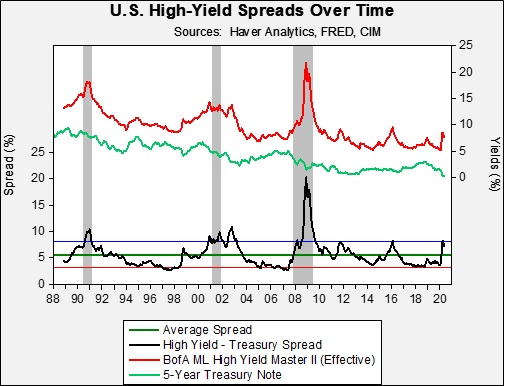
As shown in the chart, the April spread of 8.18% was one full standard deviation above the average spread since 1988. But instead of rising even further above the one-standard deviation mark as typically happens during a recession, the spread has fallen modestly in May and June. We think that’s a clear indication that investor nerves have been calmed by the aggressive monetary and fiscal policy already put into place. One particularly helpful move was the Fed’s decision to purchase corporate debt, ultimately including debt that had been downgraded to junk status after March 22 and corporate bond ETFs that might hold high-yield obligations.
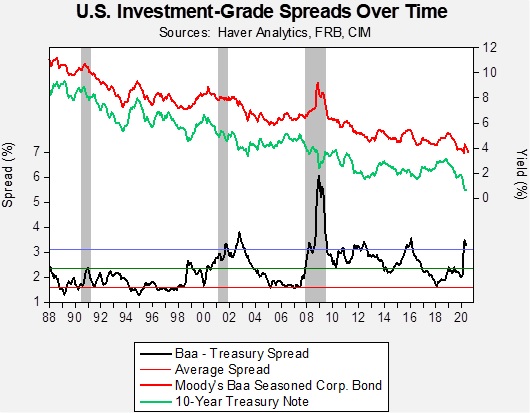
By pumping liquidity into the economy and helping many firms avoid bankruptcy, the U.S. policy moves have helped bolster not only junk bonds, but also investment-grade bonds and equities. For example, the chart below shows how the spread of corporate investment-grade yields over the 10-year Treasury also initially spiked and then narrowed after the policy moves were implemented. The pattern looks very similar to the narrowing of high-yield spreads. Although the financial markets remain volatile and credit spreads could widen again, we think the early signs of credit spread narrowing support increasing exposure to corporate credit in portfolios.
Weekly Energy Update (June 18, 2020)
by Bill O’Grady, Thomas Wash, and Patrick Fearon-Hernandez, CFA
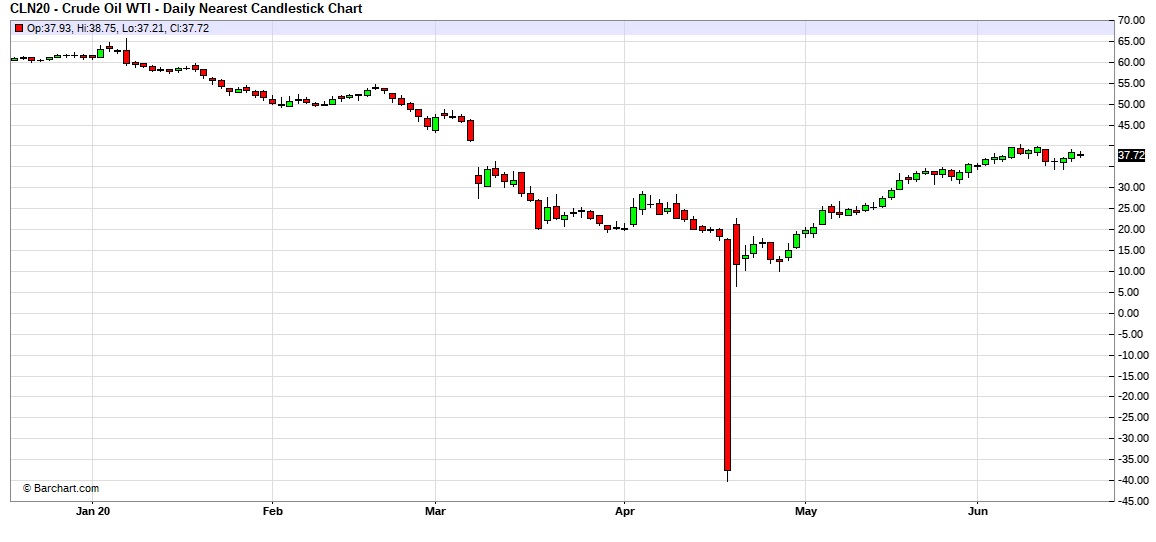
Here is an updated crude oil price chart. The oil market has stabilized at higher levels after April’s historic collapse.
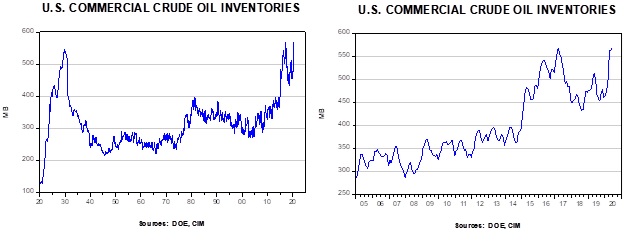
Crude oil inventories were mostly in line with market expectations, with stockpiles rising 1.2 mb compared to forecasts of a 0.8 mb draw. The SPR added 1.7 mb this week.
In the details, U.S. crude oil production fell 0.6 mbpd to 10.5 mbpd. Exports were unchanged, while imports fell 0.2 mbpd. Refining activity rose 0.7%, in line with expectations. As we have seen in recent weeks, the level of unaccounted-for crude oil remains elevated but did decline this week.
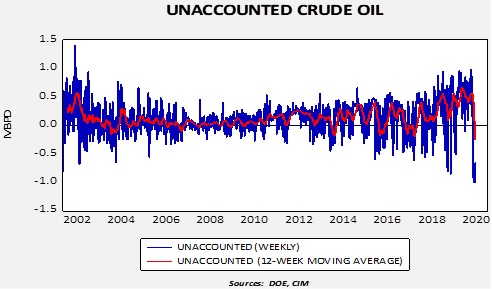
Unaccounted-for crude oil is a balancing item in the weekly energy balance sheet. To make the data balance, this line item is a plug figure, but that doesn’t mean it doesn’t matter. This week’s number is -0.7 mbpd. The fact that the decline fell from 1.0 mbpd to 0.7 mbpd and coincided with a sharp drop in oil production suggests that this number is reflecting falling output. Simply put, oil production is falling faster than the official data suggest.
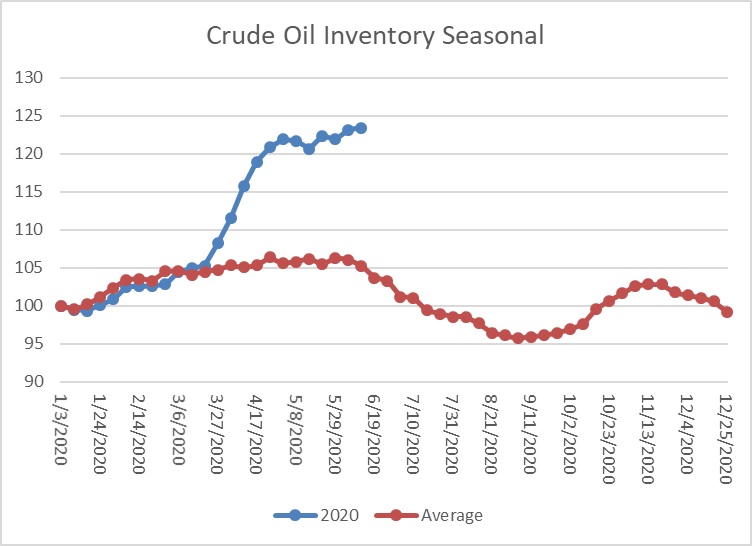
The above chart shows the annual seasonal pattern for crude oil inventories. This week’s data showed a modest rise in crude oil stockpiles. We are on the cusp of the beginning of the seasonal draw for crude oil. If inventories don’t decline in the coming weeks, oil prices would be vulnerable to a correction.
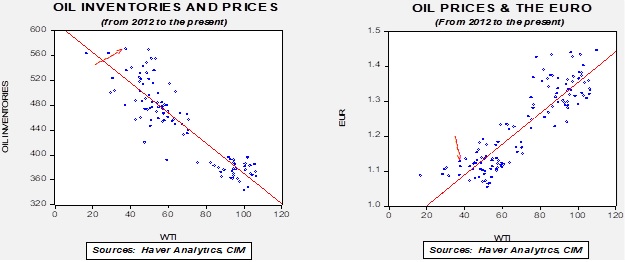
Based on our oil inventory/price model, fair value is $27.27; using the euro/price model, fair value is $52.74. The combined model, a broader analysis of the oil price, generates a fair value of $40.24. We are starting to see a wide divergence between the EUR and oil inventory models. The weakness we are seeing in the dollar, which we believe may have “legs,” is bullish for crude oil and may overcome the bearish oil inventory overhang.
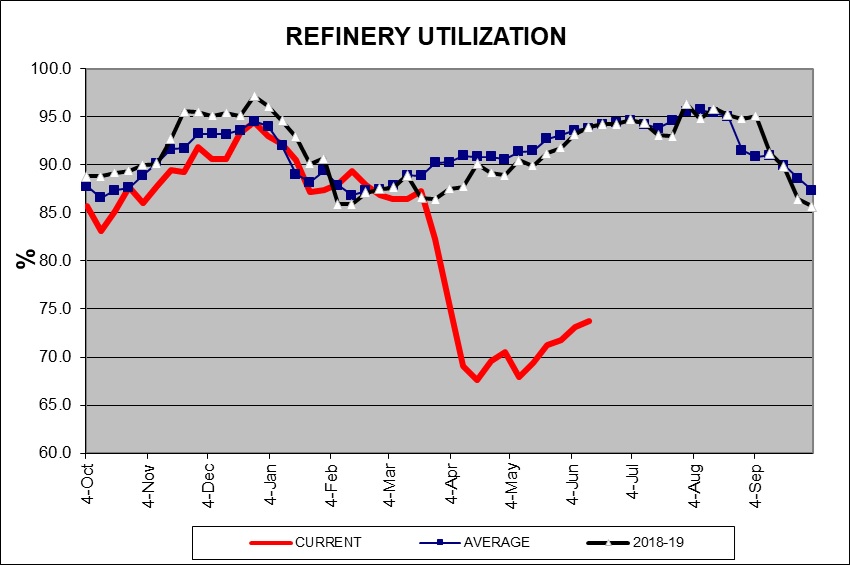
Although conditions in energy are improving, the recovery is slow. Refining operations are 20 points below average.
The IEA forecast a sharp recovery in oil demand in 2021, which we would expect. This year’s crude demand is expected to fall 8.1 mbpd but rise 5.7 mbpd next year.
Weekly Geopolitical Report – The Geopolitics of the 2020 Election: Part IV (June 15, 2020)
by Bill O’Grady | PDF
In this five-part series on the geopolitics of the 2020 election, we have divided the reports into nine sections. Last week, in Part III, we covered the incidence of establishment policy and the role of social media. This week, we reveal the sixth and seventh sections; we handicap the race as it stands and discuss how foreign nations are likely to intervene in the election.
Who is Going to Win?
Before we discuss our expectations of the outcome, we want to note that we analyze elections with an eye toward answering two questions. First, who is going to win? Second, what will they do once elected? In our primary role of managing money, we cannot afford to allow any political preference to distort our process as that bias could affect investment performance. And, being well ensconced in the flyover zone of the U.S., our political biases don’t matter anyway. It’s not as if our analysis affects the actual outcomes of elections. Our position is that, as a money manager, we want to know what the future looks like, not necessarily root for a certain outcome. So, here goes.
To forecast the outcome of elections, we have various factors we examine that have signaled the outcomes of previous elections. These factors are:
- Incumbency
- The Economy
- Polling
- Prediction Markets
- Base of Support
- Money
- Social Media Presence
We are also sensitive to the fact that we don’t directly elect presidents; we elect electors to the Electoral College who, in most states, vote for the president based on the majority of votes in that state.[1] So, our focus is on determining our best estimate of the Electoral College based on polls and available decision markets, along with economic activity at the state level.
Asset Allocation Weekly (June 12, 2020)
by Asset Allocation Committee
Although gold is the primary precious metal for investors, platinum, palladium and silver also can fulfill that role. Complicating matters is that these three metals are dual-use products. Unlike gold, which has few uses outside of monetary (store of value) purposes and jewelry, these other three have industrial uses as well. About 55% of silver consumption is in electronics, while 39% is used for jewelry, silverware and monetary reasons. The remaining 6% of silver consumption is in associated industrial use, including solar panels. Industry and automotive demand accounts for about 60% of platinum demand, with jewelry absorbing about 30% and investment demand the remainder. Palladium, which has been in the news lately due to strong price behavior, is mostly used in automobile exhaust systems; nearly 84% of the metal goes into cars, with other industrial uses taking up nearly all the remaining demand.
Thus, unlike gold, the other three precious metals are much more sensitive to industrial activity. Supply factors are different as well. Silver is mostly a byproduct of base metal and precious metal mining; only about 28% of silver comes from primary silver mines. The rest comes from the mining activities of lead, zinc, copper and gold. Thus, the supply of new silver is affected by the demand for these other metals. In contrast, platinum and palladium both have limited sources; nearly 75% of new supply of platinum comes from South Africa, whereas 40% of the world’s palladium comes from Russia.
Both gold and silver prices began to rally in the early part of the 2000s after being in the doldrums from the mid-1980s through the 1990s. High real interest rates depressed demand as policy was designed to contain inflation. But, around 2003, gold began to rally, and by 2005, silver did as well. This rally continued into 2011 when silver prices began to fall, and gold followed in 2012. A stronger dollar weighed on precious metals prices during this period.
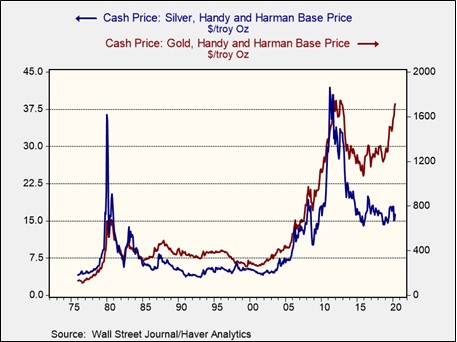
Since 2017, gold prices have clearly outpaced silver, but since August 2018, gold’s outperformance has been substantial.
The gold/silver ratio has been a longstanding way of measuring the relative value of the two metals.
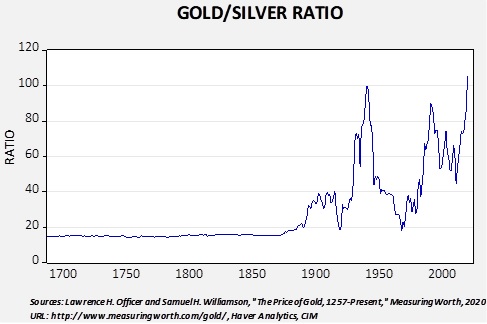
During the gold standard years, many nations conducted a bimetallic system, where gold and silver could be used for money. The common exchange was 15:1. The relative scarcity of gold relative to silver led to a widening ratio after the Civil War into WWI. During WWI, silver prices rose due to expanding industrial activity for the war effort. The change in the official price of gold by the Roosevelt administration led the ratio to widen out during the 1930s into WWII. Steadily rising silver prices reduced the ratio to 20:1 by late 1960; in response, the Coinage Act of 1965 dramatically reduced the use of silver in U.S. coins, easing the demand for silver and causing the ratio to rise.
The end of Bretton Woods ended the last remnants of the gold standard, leading to much higher prices for both metals. Since the mid-1970s, the gold/silver ratio has generally tracked the path of industrial production. This relationship reflects the industrial demand for silver that doesn’t exist to the same extent for gold.
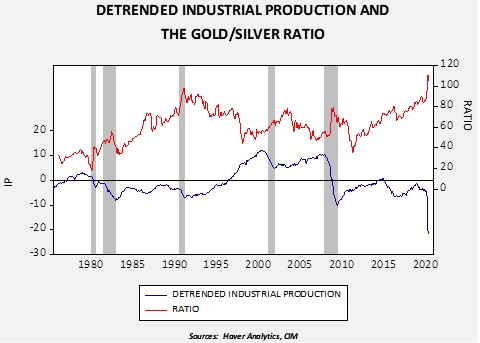
The upper line on the chart shows the monthly gold/silver ratio; the lower line shows detrended U.S. industrial production. Although the relationship isn’t perfect, in general, stronger industrial production has tended to coincide with a lower ratio, whereas falling and below-trend industrial production benefits gold in the ratio. The current ratio is near its all-time highs, reflecting (a) generally weak industrial production in the latest business cycle, and (b) the recent collapse in production due to the pandemic shutdowns.
Although there remains a great deal of uncertainty surrounding the path of the recovery, as we detailed recently, the most likely path of this business cycle will be a deep but short recession followed by a lengthy recovery. If this assessment is correct, industrial activity should rebound in the coming months. Given the historic level of the gold/silver ratio, coupled with our overall positive position on gold, we believe silver is also attractively valued at current prices if our expectations about the economy are correct. Therefore, for risk-tolerant investors, silver may be an attractive allocation at this time.
Weekly Energy Update (June 11, 2020)
by Bill O’Grady, Thomas Wash, and Patrick Fearon-Hernandez, CFA
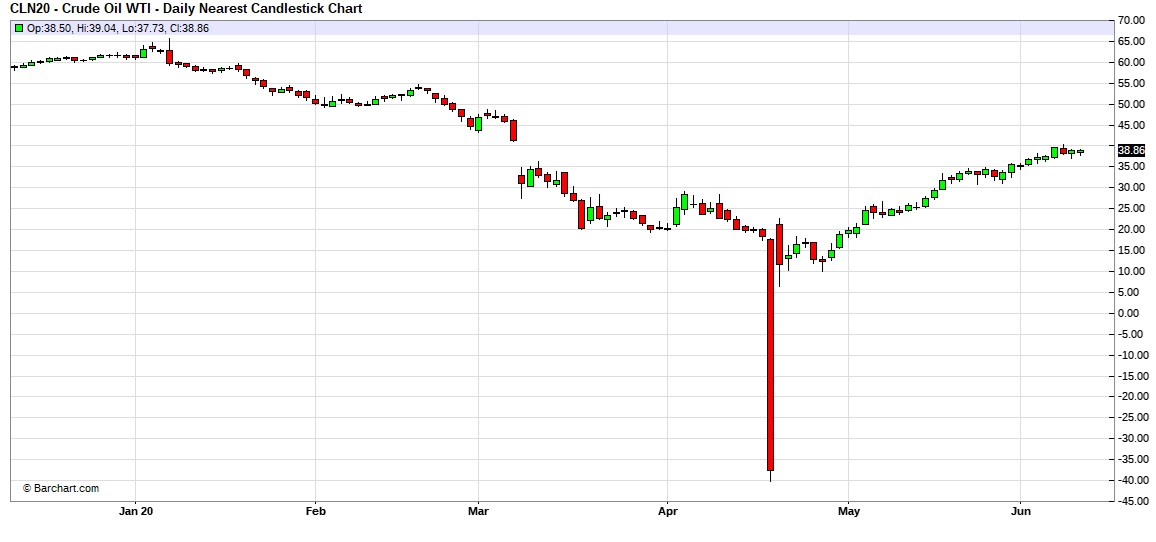
Here is an updated crude oil price chart. The oil market continues to recover after April’s historic collapse.
Crude oil inventories surprised the markets again, with stockpiles rising 5.7 mb compared to forecasts of a 3.0 mb draw. The SPR added 2.2 mb this week.
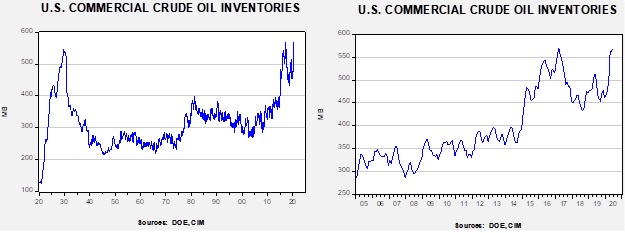
In the details, U.S. crude oil production fell 0.1 mbpd to 11.1 mbpd. Exports fell 0.4 mbpd, while imports rose 0.7 mbpd. Refining activity rose 1.3%, above the 0.6% rise forecast. As we have seen in recent weeks, the level of unaccounted-for crude oil remains elevated.
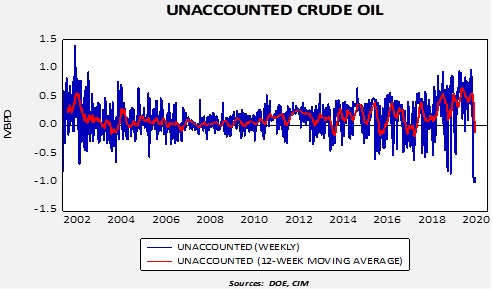
Unaccounted-for crude oil is a balancing item in the weekly energy balance sheet. To make the data balance, this line item is a plug figure, but that doesn’t mean it doesn’t matter. This week’s number is -0.9 mbpd. For the fifth week in a row, this number is running nearly 1.0 mbpd. The 12-week average has now gone negative for the first time since October 2017. It may mean that in the scramble for finding storage, some oil is being inventoried outside the survey system. This week, some 7.0 mb of crude oil went into storage somewhere, just not where it can be recorded. Or, production is falling much faster than the DOE estimates are capturing so there aren’t any missing barrels; simply put, production is cratering. The DOE did indicate it had made modest downward revisions to production, but we are increasingly leaning toward the idea that production is falling rapidly, much faster than the DOE is able to record.
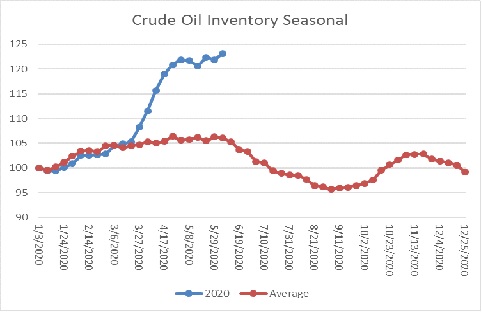
The above chart shows the annual seasonal pattern for crude oil inventories. This week’s data showed a rise in crude oil stockpiles. We are getting close to the beginning of the seasonal draw for crude oil. If inventories don’t decline in the coming weeks, oil prices would be vulnerable to a correction.
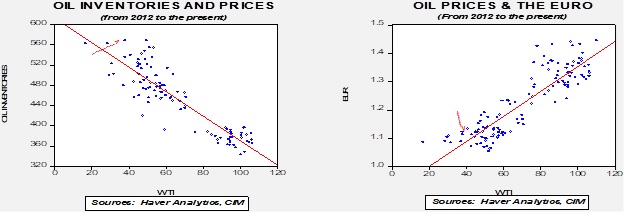
Based on our oil inventory/price model, fair value is $27.65; using the euro/price model, fair value is $51.76. The combined model, a broader analysis of the oil price, generates a fair value of $39.87. We are starting to see a wide divergence between the EUR and oil inventory models. The weakness we are seeing in the dollar, which we believe may have “legs,” is bullish for crude oil and may overcome the bearish oil inventory overhang.
Although gasoline consumption is improving, the distillate market is becoming a worry.
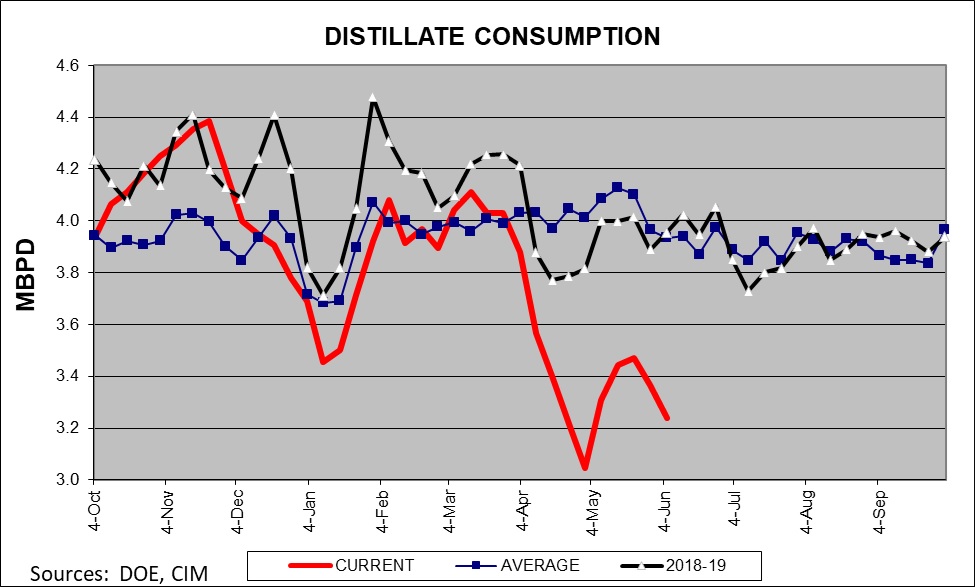
Distillates are the fuels of commerce; trucks, trains, planes and ships run on this fuel. The weakness in consumption suggests that wholesale activity is probably slumping. Perhaps the restocking of inventory that occurred after the initial decline is waning and the subsequent pickup is soft. But the weakness here will tend to keep refinery activity slow and may cap the recent recovery in oil prices.
Although there are anecdotal reports that shale production may be restarting, history shows that there is about a five-month lag between prices and drilling activity. That would suggest production overall will likely remain depressed well into Q4.
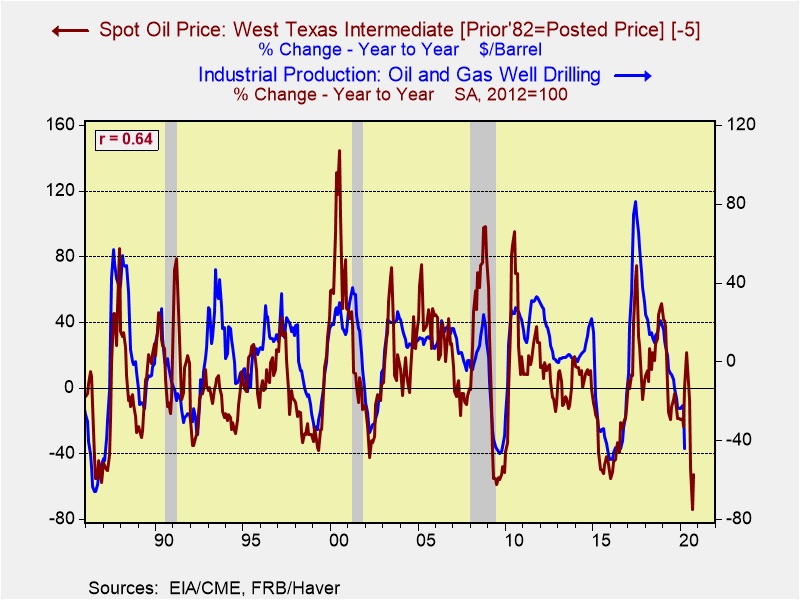
This chart shows oil and gas drilling activity from the industrial production data; in general, oil prices lead this measure by about five months. If this pattern is maintained (and there is little reason to see why it won’t), we probably won’t see a recovery in drilling until much later this year, which is bullish for crude oil prices.
In politics and geopolitics this week, Iran has built a likeness of an aircraft carrier to allow its naval forces to train against. Iran did something similar in 2015. As U.S. forces leave Iraq, Islamic State activities are returning. Although they are not in oil-producing areas, a return of IS would be bad news for Iraq. We continue to monitor developments in Libya; currently, Khalifa Hifter’s forces have been reeling in the face of Islamic-leaning groups in western Libya who have been supported by Turkey. We are seeing intermittent oil output disruptions. China has been showing interest in increasing its influence in the Middle East. Given China’s oil dependence, increasing its activity in the region makes sense, especially as the U.S. reduces its regional footprint. However, we are surprised at Beijing’s increasing interest in Syria, which is a very small oil producer. It will be interesting to see how Putin reacts to such behavior. Although elements within the Democratic Party have pushed to severely restrict oil and gas drilling for environmental reasons, minority groups within the party are pushing for jobs in the sector.
Weekly Geopolitical Report – The Geopolitics of the 2020 Election: Part III (June 8, 2020)
by Bill O’Grady | PDF
In this five-part series on the geopolitics of the 2020 election, we have divided the reports into nine sections. Last week, in Part II, we discussed the second and third sections, understanding the electorate and party coalitions. In this report, we continue our coverage with the fourth and fifth sections, the incidence of the establishment coalition and the impact of social media.
Asset Allocation Weekly (June 5, 2020)
by Asset Allocation Committee
Last week, we discussed how equity markets, because of their anticipatory nature, tend to bottom in advance of the end of recessions. Assuming that condition continues, if our expectations for a short recession (but probably a long recovery) are correct, it would make sense that the equity market would have already bottomed. That historical pattern, coupled with extraordinarily supportive monetary policy, is supporting equity values.
The view of the economy for most Americans is the job market. In general, the common belief is that a good economy is one with a good job market. Economists tend to take a broader view and assume that the economy is more than just jobs. And so, when overall economic activity recovers, recessions are declared over. However, there are numerous cases where the economy and equity markets are doing fine, while the labor markets are still sluggish.
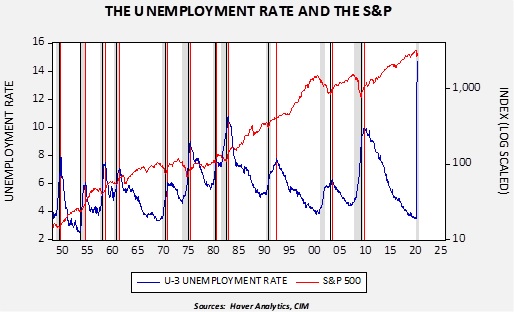
This chart shows the S&P 500 with the unemployment rate. We have placed black vertical lines at the trough of the equity index (using S&P 500 monthly averages) and a red line at the peak of unemployment. Here is a table of the results.
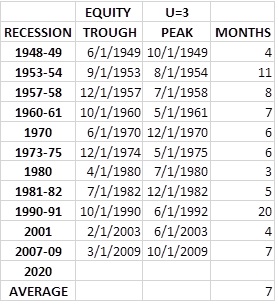
This table shows that equities trough about seven months before the peak of the unemployment rate. Thus, if the unemployment rate has peaked the turn in equity markets seen in recent weeks would be consistent with that pattern. The full recovery in the labor markets will take much longer, but we do expect labor market conditions will steadily improve.