

Daily Comment (August 10, 2017)

by Bill O’Grady and Thomas Wash

[Posted: 9:30 AM EDT] Global equity markets are lower this morning as tensions surrounding North Korea rise.  There is a growing chorus of commentators warning about a repeat of 1987 (maybe because we are approaching the 30-year anniversary?), which would be momentous because that crash was the last major one that was not associated with a recession.  We have our doubts that a major correction is in the offing but, if it is, it should probably be treated as a buying opportunity.  The softer than expected PPI data (see below) has put some downward pressure on the dollar and boosted Treasuries.  It didn’t have much of an effect on equities. We get the CPI data tomorrow.

North Korea: The Kim regime has indicated it is drawing up plans to fire up to four missiles at Guam, which is a U.S. territory and the home of the Anderson AFB, a major base in the region.  The symbolism of such a threat is high; Guam, although not a state, is close to being one.  Persons born in Guam are American citizens.  The territory has a non-voting delegate to the U.S. House.  It has no electoral votes but it does participate in the primary process, so it has a modest effect on the presidential race.  Thus, attacking Guam isn’t exactly like attacking an American state, but it’s close.  We suspect the Kim government intends to land the missiles in the waters around Guam.  This would represent the closest attack on what should be described as American soil so far by North Korea.  It’s not clear how the U.S. will respond to such a launch if it transpires.  NBC is reporting[1] that the U.S. is drawing up plans to attack North Korean missile sites pre-launch (so-called “left of launch”) that would likely be executed by B-1 bombers[2] currently located in Guam.  Another alternative would be to use anti-missile defense systems to hit North Korea’s medium-range missiles after launch.  Attacking North Korea left of launch risks escalating the situation; not attacking assumes the North Korean missiles will fall harmlessly into the sea and not actually hit Guam.  We are treading into difficult territory here and the steady flight to safety in assets is warranted.

Mixed messages: The “fire and fury”[3] comments from President Trump, which were apparently his own, have been downplayed by his secretary of state and secretary of defense.  We do know that Chief of Staff Kelly has actively worked to limit the reading material of the president to create a consistent message.  Still, with the president’s use of social media and his personality, it will be nearly impossible to prevent such statements.  The worry is how they are interpreted by the rest of the world.  Already, Japan and South Korea are looking to boost their own defenses, in part on concerns that they can’t accurately predict how the U.S. will react to events.  Although we believe this rearming is a natural consequence of the U.S. reducing its superpower role, this process may be accelerating as the world observes how the U.S. behaves in light of foreign policy crises.

Trump v. McConnell: A war of words has erupted between the president and the Senate majority leader.  The latter, citing the lack of experience in the White House, has chastised the president for creating impossible deadlines that lead to the impression of failure on the part of Congress.  The White House has pushed back, suggesting that McConnell is ineffective and should be working more diligently to get legislation passed.  This spat is counterproductive.  All presidents want things to happen fast; political capital is perishable and thus patience isn’t a virtue.  On the other hand, senators only face a vote every six years and not all at once, so a more deliberate pace is part of the legislative structure.  In our observation, the key to speed in the Senate is sequencing.  Presidents should offer the easiest and most bipartisan legislation first to get bills passed quickly even if this legislation isn’t a high priority.  Instead, administrations tend to pursue the most aspired legislative goals that are often partisan in nature and consume lots of political capital and take a lot of time to pass.  If we are correct, President Trump should have started with infrastructure, which would have built his bipartisan credentials and would have passed easily.  Bill Clinton often remarked that he should have started with welfare reform instead of his ill-fated health care changes.  The president will need McConnell to create tax reform (or cuts) and so this argument isn’t helpful toward that goal.

Energy Recap: U.S. crude oil inventories fell 6.5 mb compared to market expectations of a 2.1 mb draw.
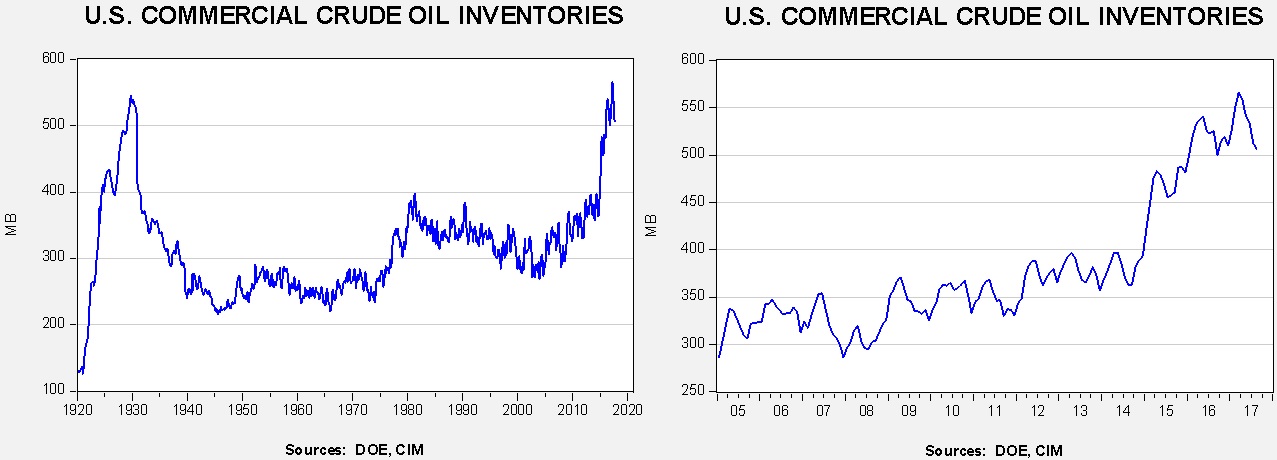
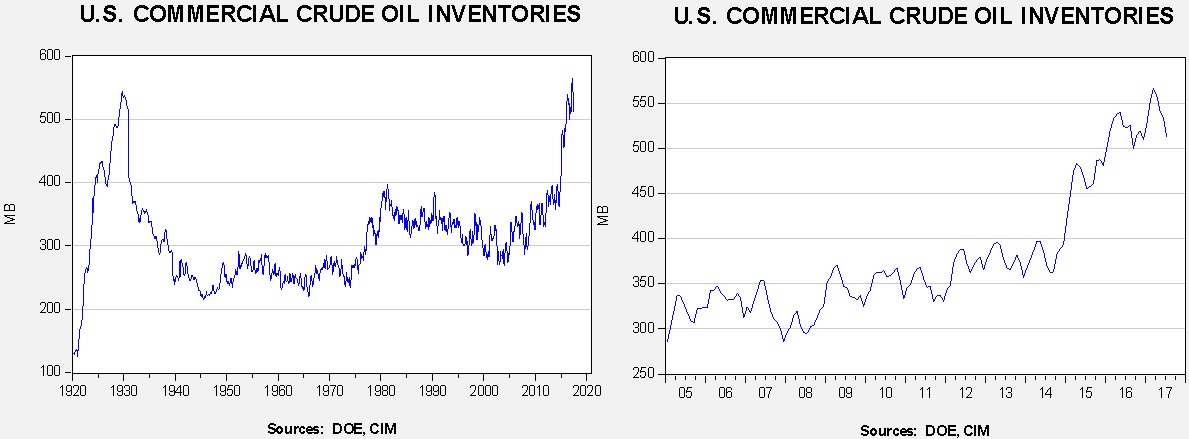
This chart shows current crude oil inventories, both over the long term and the last decade.  We have added the estimated level of lease stocks to maintain the consistency of the data.  As the chart shows, inventories remain historically high but they are declining.  Again, there was no oil sold out of the Strategic Petroleum Reserve this week.  The authorized sale is nearly complete as 16.2 mb have been released out of an authorized 17.0 mb.

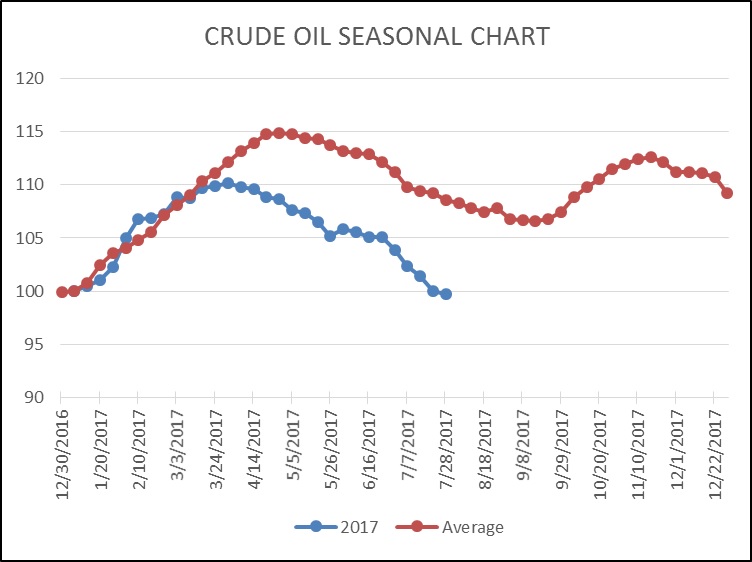
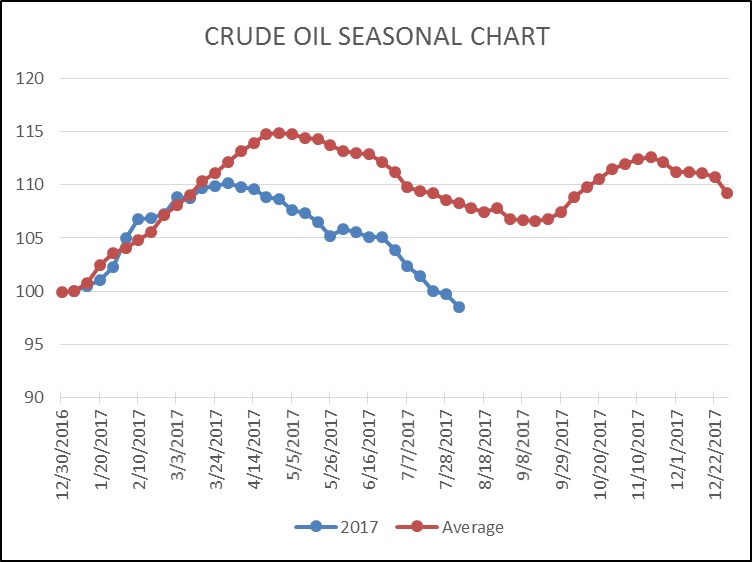
As the seasonal chart below shows, inventories are usually well into the seasonal withdrawal period.  Even with the SPR sales, we have already seen a larger than normal seasonal decline; in fact, the drop is rather remarkable.  It should be noted that the seasonal trough isn’t usually hit until mid-September.  Thus, we should see further stock withdrawals over the next five weeks.
(Source: DOE, CIM)

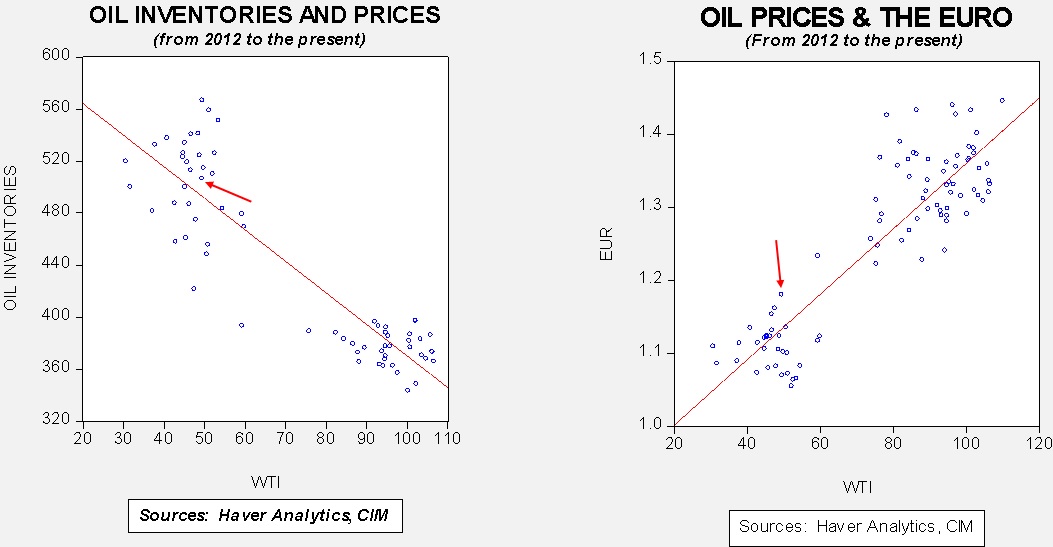
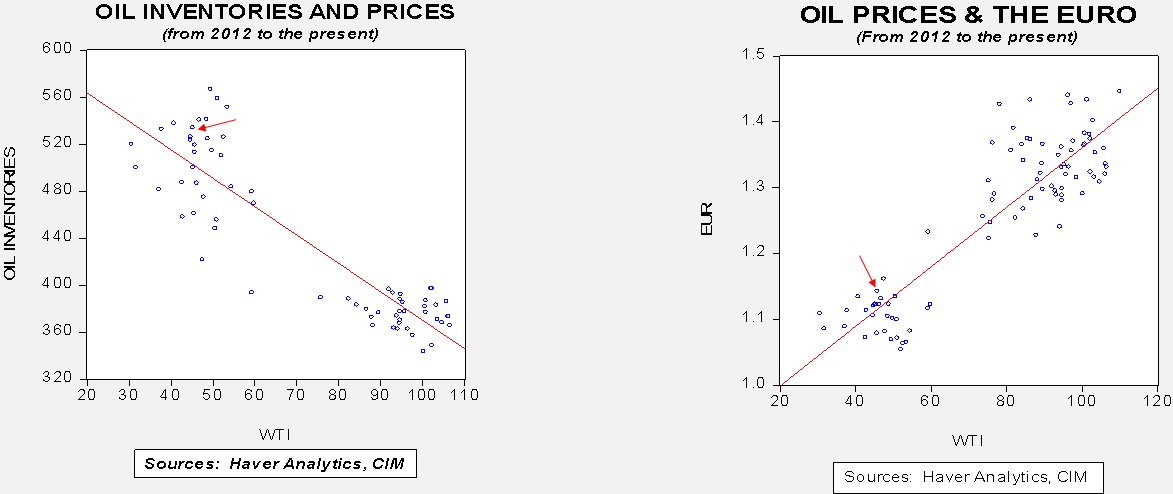
Based on inventories alone, oil prices are overvalued with the fair value price of $49.36.  Meanwhile, the EUR/WTI model generates a fair value of $64.36.  Together (which is a more sound methodology), fair value is $59.54, meaning that current prices are well below fair value.  The most bullish factor for oil currently is dollar weakness, although the rapid decline in inventories is also supportive.  Prices are essentially at fair value based on inventory levels but, thus far, oil prices have completely ignored the weaker dollar.  We do expect that the dollar will begin to have a bullish impact on oil prices in the coming weeks.

View the complete PDF


[1] http://www.nbcnews.com/news/north-korea/b-1-bombers-key-u-s-plan-strike-north-korean-n791221

[2] One of the reasons for using B-1s is that they are no longer fitted to carry nuclear weapons.  Thus, there would be no confusion from North Korea misconstruing this as a nuclear attack.

[3] https://www.nytimes.com/2017/08/08/world/asia/north-korea-un-sanctions-nuclear-missile-united-nations.html
Daily Comment (August 9, 2017)

by Bill O’Grady and Thomas Wash

[Posted: 9:30 AM EDT] It’s not quiet today.  There is a lot of news, almost all geopolitical.  We are seeing modest “flight to safety” in financial markets this morning, with equities in retreat while Treasuries, gold, the Swiss franc and Japanese yen move higher.  We don’t expect any equity pullbacks to be all that meaningful, beyond a normal correction.  The U.S. economy is far from a recession and there is ample liquidity, so, barring a geopolitical event, a correction probably remains a buying opportunity.  Although this is a reasonable base case, the potential for a tail event is also elevated.

North Korea: Yesterday, a number of media outlets reported that North Korea has successfully miniaturized a nuclear device into a warhead, meaning it is probably now a member of the nuclear club in that it has a deliverable nuclear weapon.[1]  The Defense Intelligence Agency has concluded that not only has North Korea overcome the hurdle of building a warhead, but it probably has 60 nuclear weapons.  Although this estimate may be at the high end of the confidence band, it still suggests that the threat of a nuclear North Korea is no longer a future theoretical problem.  President Trump responded with unusually harsh language,[2] threatening “fire and fury” from the U.S.  The U.S. possesses overwhelming force; North Korea’s 60 warheads are up against 6,800 American warheads.  In addition, the U.S. has three delivery options and far more experience in nuclear war.  So, American presidents are usually more understated in their comments because they can be.  The problem with these comments is that they may be misinterpreted by Kim Jong-Un as a precursor for war.  We note that SOS Tillerson tried to walk back some of the rhetoric today by suggesting there are no imminent threats.  North Korea has responded by suggesting it is targeting Guam.  Anderson AFB has a significant number of strategic air assets, including B-52, B-1 and B-2 bombers along with support aircraft; taking out that airbase would reduce the direct threat to North Korea.  On the other hand, it would likely trigger a massive U.S. response, especially if a nuclear weapon is deployed.  We still put the probabilities of war at a low level but they are rising.  If North Korea with nukes is intolerable, as American presidents have indicated, some sort of response would seem to be necessary.  What that response will be in reality remains to be seen.  We do note that the latest reports on U.S. carrier groups indicate that none are in theater.  Thus, we are at least two to three weeks away from mobilizing forces for military operations against North Korea.

Maduro’s growing problem: There are increasing reports of dissention within the Venezuelan military.  So far, the government has been able to control the military but it does appear that an increasing number of units are engaging in mutinous actions.  The Chavez government armed civilian groups in the cities, which could act as a counterforce to a coup.  On the other hand, these civilian groups are probably no match for regular soldiers.  Sadly, the existence of these armed civilian groups could mean that a coup evolves into broad civil conflict.  The history of Latin America is littered with military coup solutions to chaotic civilian governments, so such an outcome in Venezuela would not be a shock.  So far, we haven’t seen any noticeable disruption to oil flows.

Zuma survives: Yesterday, we reported that President Zuma of South Africa was facing his sixth no-confidence vote.  And, because this one was a secret ballot, the odds were higher that he might be ousted.  In fact, it appears that 24 ANC members did vote against their president, but it wasn’t enough to lead to a failure of his government.  It will be interesting to see how Zuma handles these defections but, for now, it looks like he will survive.

View the complete PDF


[1] https://www.washingtonpost.com/world/national-security/north-korea-now-making-missile-ready-nuclear-weapons-us-analysts-say/2017/08/08/e14b882a-7b6b-11e7-9d08-b79f191668ed_story.html?utm_campaign=New%20Campaign&utm_medium=email&utm_source=Sailthru&utm_term=.bf8beede2be1

[2] https://www.nytimes.com/2017/08/08/us/politics/trumps-harsh-language-on-north-korea-has-little-precedent-experts-say.html?emc=edit_mbe_20170809&nl=morning-briefing-europe&nlid=5677267&te=1

Daily Comment (August 8, 2017)

by Bill O’Grady and Thomas Wash

[Posted: 9:30 AM EDT] Financial markets remain quiet.  Here are some of the headlines we are following:

Zuma out?  South Africa’s president, Jacob Zuma, faces a parliamentary vote of no-confidence today (around 9:45 EDT).  That isn’t exactly news as this is the sixth such vote Zuma has faced.  There is ample evidence of corruption which accounts for the earlier no-confidence measures.  Zuma heads the African National Congress (ANC), which holds 249 out of 400 seats in parliament.  Under normal circumstances, we would expect most ANC members to maintain party discipline and keep Zuma in office.  However, parliamentary leaders have decided to make this a secret ballot, which increases the odds that Zuma may be ousted.

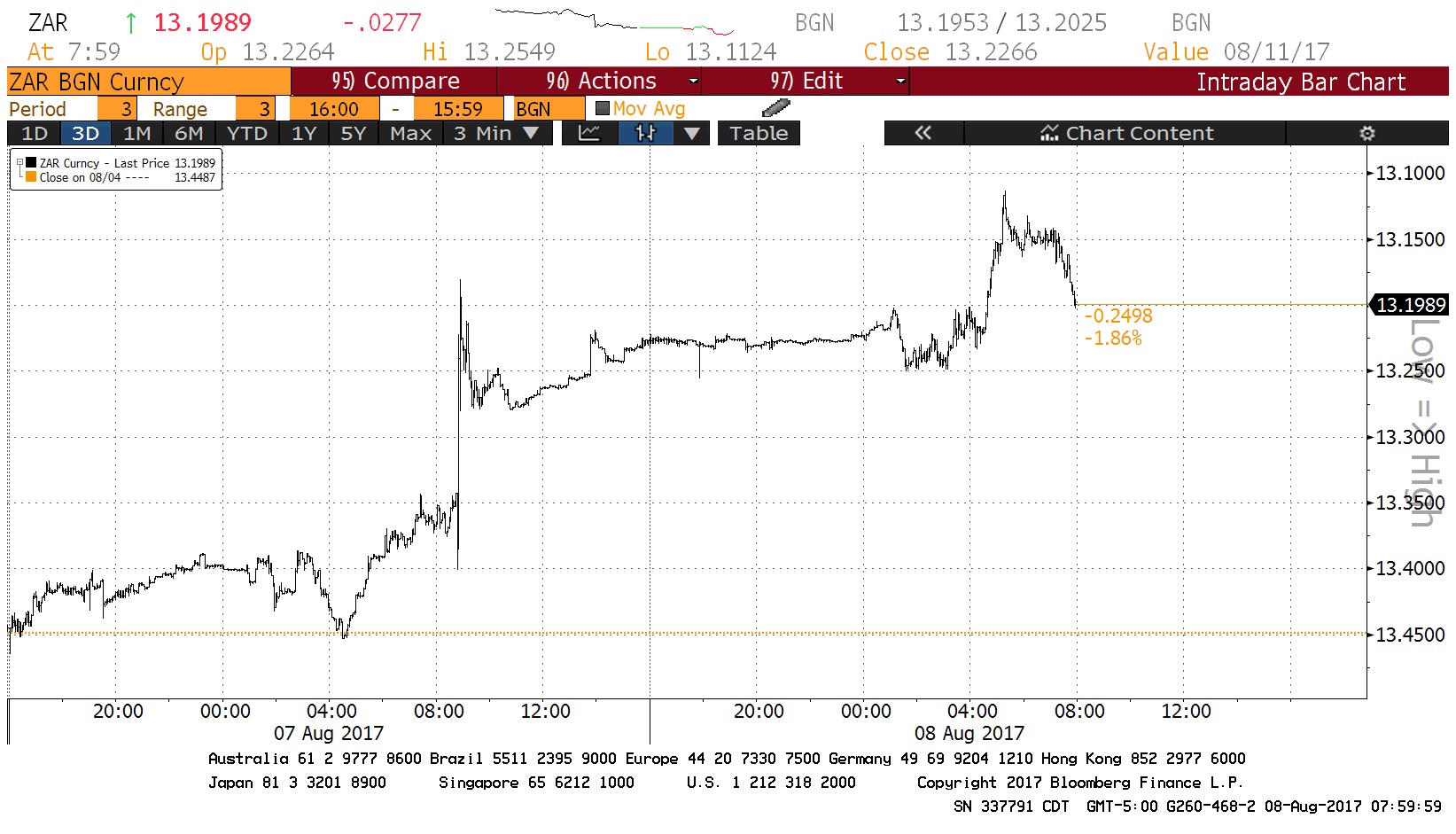
What is interesting about this vote is that hopes of his ouster have actually lifted the exchange rate.

(Source: Bloomberg)

This chart shows the ZAR/USD exchange rate in ZAR per USD; we have inverted the scale.  When the vote was announced late yesterday, the ZAR jumped.  We are seeing some profit taking in front of the vote.

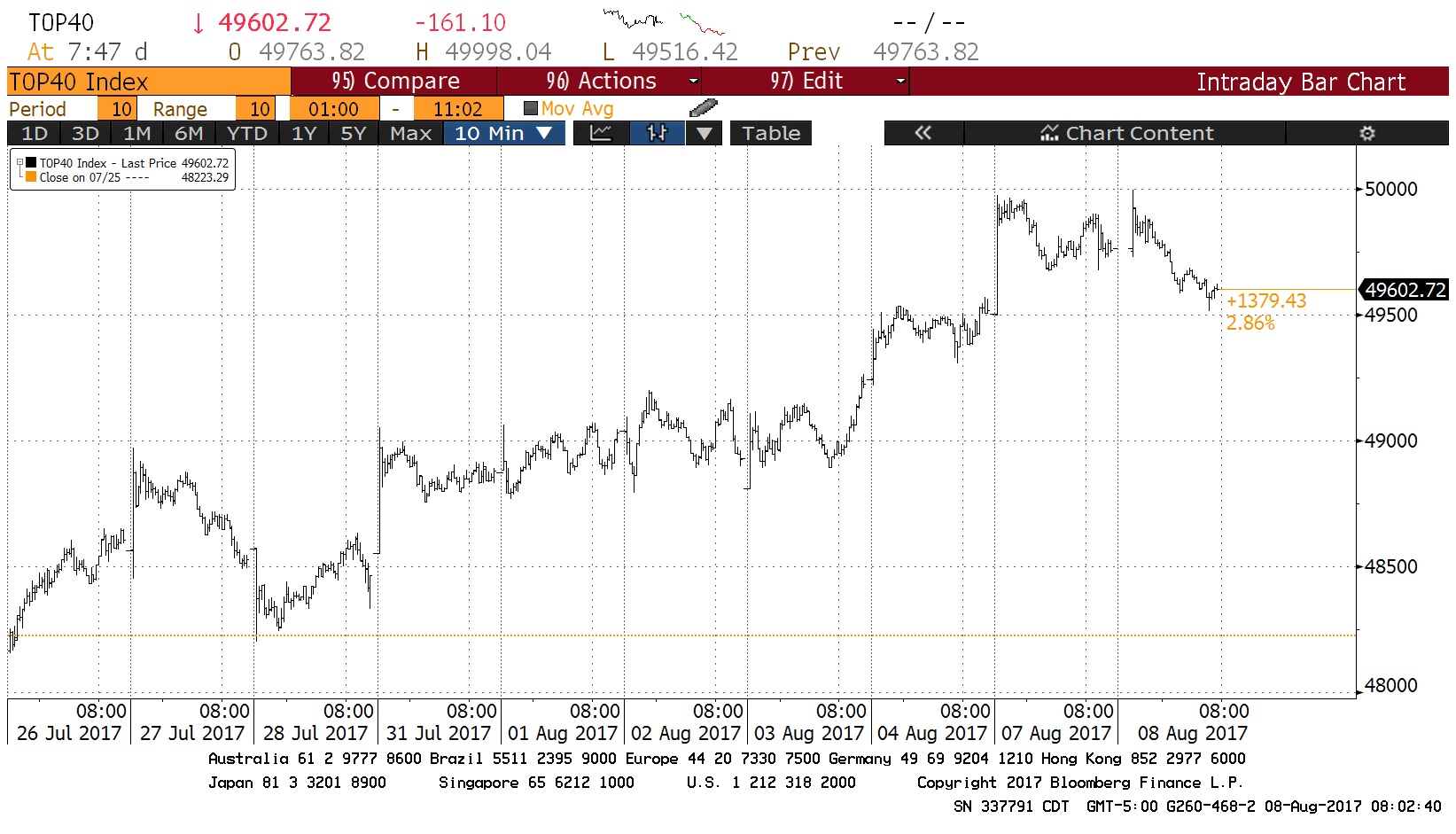
Equities behaved in a similar fashion.

(Source: Bloomberg)

This chart looks at trading of the South African Top-40 equity index over the past 10 days.  The market has been trending higher recently but, just like what we saw with the ZAR, equities jumped when the vote was announced yesterday.  We are seeing some modest position squaring in front of the vote.

Normally, political turmoil weakens financial markets but it is clear that investors have concluded they would be better off without Zuma.  We will be watching the no-confidence outcome later this morning.  Although a secret ballot may doom Zuma, it will still take 50 ANC members to vote against their leader to oust the president.  If Zuma does lose, his government will resign en masse and the country will have a caretaker government for 30 days until new elections are held.   Investors are obviously expecting a better manager to be elected.

Saudi cut to Asia: Saudi Arabia announced today it will cut some exports to Asia in September in a bid to boost prices.  This is a risky move as it will likely encourage Russia and Iran to take market share from the kingdom.  Obviously, the Saudis hope that this won’t happen and oil prices will lift.  The news has stabilized oil prices this morning in front of the weekly data.

Trump delays trade action against China: The administration plans to delay a trade investigation regarding China’s intellectual property in the wake of China’s vote to sanction North Korea at the UNSC.  The administration has been using trade “carrots and sticks” with China in hopes that it will force the Kim regime to the bargaining table.  Comments from Pyongyang do not indicate any softening of positions; in fact, if anything, the new sanctions have hardened positions.  Still, for economic nationalists who want the president to impede imports, it’s becoming clear that Trump isn’t an ideologue on this issue.  He views the trade situation instrumentally, meaning that it is something to bargain around.  Therefore, if he can use the threat of trade impediments to encourage China to press North Korea, he will “trade away” import restrictions for North Korea.

View the complete PDF

Weekly Geopolitical Report – The Qatar Situation: Part I (August 7, 2017)

by Bill O’Grady

On June 6th, several members of the Gulf Cooperation Council (GCC)[1] announced a sweeping blockade of Qatar, also a member of the GCC.  The GCC members enforcing the blockade, led by Saudi Arabia, issued a list of 13 demands which Qatar rejected.

Since the blockade was implemented, Qatar has managed to replenish basic foodstuffs that were initially stripped from store shelves as households rushed to hoard necessities.  The emirate state has managed to fly in dairy cows from abroad which are now contentedly supplying milk from air conditioned barns in Qatar.

In the first part of this report, we will offer a short history of Qatar and examine its geopolitical imperatives.  Next week, in Part II, we will analyze the events precipitating the blockade, the blockade itself, the GCC’s demands and the impact thus far on Qatar.  We will examine how the situation has reached a stalemate and, as always, we will conclude with market ramifications.

View the full report


[1] Member states include Saudi Arabia, Kuwait, United Arab Emirates, Qatar, Oman and Bahrain.

Daily Comment (August 7, 2017)

by Bill O’Grady and Thomas Wash

[Posted: 9:30 AM EDT] It’s a quiet Monday morning in August.  Washington is mostly on recess and families are squeezing out the last few days of summer before school begins.  Here are the notable news items.

Sanctions on North Korea: The UNSC voted unanimously to apply further sanctions on North Korea.  If fully implemented, they would cut the Hermit Kingdom’s trade by about a third.  The real surprises were the “yes” votes from China and Russia.  We note that China’s foreign minister, Wang Yi, had intensive talks with his North Korean counterpart at the ASEAN meetings in Manila over the weekend, calling on North Korea and the U.S. to ratchet down tensions.  The Chinese media pressed the U.S. to ease off North Korea as well.  Despite these comments from Chinese sources, getting UNSC sanctions approved on North Korea is a major diplomatic win for the Trump administration.  We suspect part of China’s compliance involved hopes to delay trade tensions with the U.S.  Vetoing sanctions would have certainly triggered a U.S. reaction on trade.  We also suspect Russia went along because China voted in favor of sanctions.  Still, it’s a win for the administration; now we will be watching to see if the sanctions are implemented.

Iran’s widening reach: The NYT carried a report over the weekend that Iran is expanding its influence in Afghanistan by working with the Taliban.[1]  Iran has already widened its influence in Iraq as well.  Essentially, in areas where the U.S. has fought two wars since 2003 America has failed to build replacement governments for the Hussein regime and the Taliban.  Iran is rapidly filling this void.  On the surface, Taliban and Iranian cooperation appears odd.  The former, a hardline Sunni group, would generally view Shiites as an anathema.  However, the key point that is often missed is that Iranians should probably be thought of as Persians first and Shiites second.  As Persians, the Iranians are working to expand their influence and are less concerned with religious issues.  There is no easy solution to this issue in the Middle East.  The Obama administration appeared to have concluded that Iran was going to run the region and thus was willing to cooperate with them; the Trump administration is not comfortable with that position but doesn’t really have an alternative to containing Iranian influence.

A coup in Venezuela?  Turmoil in Venezuela remains extremely elevated.  The newly “elected” body to rewrite the constitution appears to be taking power and opposition leaders are being arrested again.  Over the weekend, there were reports of a military uprising.  This looks rather suspicious to us; if there was an uprising, it was in the lower officer ranks and this is little evidence of success.  Instead, we suspect this was a “false flag” operation of sorts.  If the Maduro regime can convince its internal opposition that it faces a potential coup it will tend to solidify support.  Thus, it wouldn’t surprise us if this was staged.  So far, there is no evidence that oil supplies have been affected by the problems in Venezuela.

OPEC meets: The oil cartel is meeting with selected non-OPEC members to monitor quota compliance.  As summer comes to a close, we are about five weeks away from the usual seasonal trough in inventories.  Although we have seen a drop in U.S. commercial crude oil stockpiles, current levels are not low enough to support prices much higher than current levels.  Thus, there are hopes that OPEC can engineer some sort of cuts in output at this meeting.  We doubt we will see much other than promises to improve compliance.

View the complete PDF


[1] https://www.nytimes.com/2017/08/05/world/asia/iran-afghanistan-taliban.html

Asset Allocation Weekly (August 4, 2017)

by Asset Allocation Committee

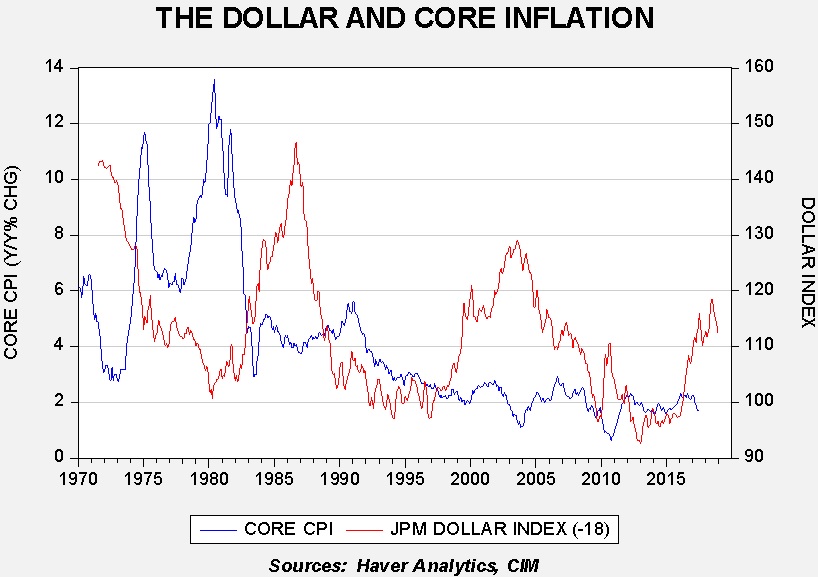
Two weeks ago, we detailed our expectations for a weaker dollar.  If we are correct, one of the potential effects could be inflation.  A weaker dollar has two price effects.  First, it directly raises import prices.  Second, it gives pricing power to domestic firms competing with imports as price pressures should dissipate as import prices rise.  The Federal Reserve has struggled with continued low inflation rates as the Phillips Curve models have consistently overestimated inflation.  Perhaps dollar weakness will come to the FOMC’s rescue and lift price levels, allowing the Fed to raise its policy rate.

This chart shows the yearly change in core CPI with the JP Morgan dollar index, which is advanced 18 months.  A cursory view of the chart does suggest that a rising dollar seems to depress inflation, while a falling dollar seems to have the opposite effect.  And, the idea that the dollar’s impact takes place over time is consistent with theory.  This is because foreign firms will initially try to maintain market share by holding prices steady and face margin compression in a weak dollar period and will only move prices higher over time.  The opposite tends to occur during periods of dollar strength as domestic firms attempt to maintain their market share.

However, as much as our eyes see the above pattern, the statistical impact is actually rather weak.  The correlation is only a mere 5%.  There are clearly other factors that are keeping core inflation low; we believe the long-term effects of deregulation and globalization play a much more important role.  Thus, as we discussed two weeks ago, the dollar should have an important impact on foreign equity performance but probably only a modest effect on core inflation.

View the PDF

Daily Comment (August 4, 2017)

by Bill O’Grady and Thomas Wash

[Posted: 9:30 AM EDT] Happy employment day!  We cover the data in detail below but the headline numbers are reflecting a strong economy.  Payrolls came in at 209k, with revisions adding a modest 2k.  Expectations called for a 180k rise.  The unemployment rate was on forecast at 4.3%, down from the prior month at 4.4%.  The mystery of wages remains; average hourly earnings rose by 2.4%, below the 2.5% forecast.  Equity markets are up on the news, interest rates have ticked higher and the dollar is rising.  See our comments below for charts and other details.

Overall, news flow was quiet overnight.  Here are the news items we are following:

Mueller issuing subpoenas: Special Counsel Mueller has started issuing subpoenas through the Washington Grand Jury.  We won’t comment on the content or the direction of the investigation but we did note market action yesterday.  After the announcement, the S&P dipped but the decline was met with buying and the index closed nearly unchanged.  This is a consistent pattern we have seen recently; because there is so much sideline liquidity, modest market drops seem to attract new buying in short order.  This was the topic of last week’s AAW.[1]  As long as cash levels remain high, we doubt that market declines can be sustained.  However, we do note that the dollar weakened.  The forex markets seem to be the place where political fears are being expressed.  The JPY was especially strong and this currency is often one of the flight to safety currencies.  Thus, if we get news out of this investigation that raises concerns about political stability, equity losses might be shallow and short lived but dollar weakness could accelerate.

Mulvaney supports clean debt ceiling bill: Mick Mulvaney, the White House budget director, came out yesterday in support of a clean debt ceiling bill.  Mulvaney is sympathetic to the Freedom Caucus agenda and was pushing for spending cuts in return for raising the debt ceiling.  His decision to support a clear raise will provide political cover for the Freedom Caucus to also support a clean rise.  If the U.S. can avoid a debt ceiling crisis it will remove a key near-term risk to the financial markets.


[1] See Asset Allocation Weekly, 7/28/17.

Daily Comment (August 3, 2017)

by Bill O’Grady and Thomas Wash

[Posted: 9:30 AM EDT] Washington is shutting down for August, earnings remain solid and news flow is rather quiet.  Here’s what we are watching today.

BOE holds steady: The BOE held everything steady.  Its QE remains in place and rates were left unchanged.  The Monetary Policy Committee (MPC) voted 8-0 to keep buying Gilts but had two dissenters on rates, with two wanting hikes.  BOE Governor Carney warned that inflation is rising but also noted that wages are not keeping pace, meaning real wages in the U.K. are contracting.  This situation puts the BOE in a difficult spot; if it raises rates to ease inflation it will further harm households seeing weak wage growth, but if it allows inflation to keep rising it will further cut real wages unless wage growth improves.  We do expect rates to rise in the U.K. in the coming year but, like here, the pace of hikes will be slower than in the past.  The GBP fell sharply on the news and Gilt yields declined.

A “clean” debt ceiling hike?  Politico is reporting[1] that Senate Majority Leader McConnell and House Speaker Ryan are quietly trying to build a coalition of centrists from both parties to pass a straight increase in the debt ceiling.  This would avoid spending cuts from the Freedom Caucus and spending amendments from Democrats.  It isn’t clear if such a coalition is possible.  On the one hand, the debt ceiling is obscure enough that progressive opposition probably won’t be strong.  On the other hand, creating this coalition will isolate the Freedom Caucus and highlight internal GOP divisions.  Another complication is that the Democrat Party leadership will be sorely tempted to pay back the GOP for the series of debt ceiling crises President Obama endured.  And, that same leadership doesn’t want to pass a clean bill only to see the GOP push tax cuts on them soon after.  So far, financial markets expect smooth sailing on this issue; we remain concerned.

Energy recap: U.S. crude oil inventories fell 1.5 mb compared to market expectations of a 3.3 mb draw.

This chart shows current crude oil inventories, both over the long term and the last decade.  We have added the estimated level of lease stocks to maintain the consistency of the data.  As the chart shows, inventories remain historically high but they are declining.  Again this week there was no oil sold out of the Strategic Petroleum Reserve.  The authorized sale is nearly complete, as 16.2 mb have been released out of an authorized 17.0 mb.

As the seasonal chart below shows, inventories are usually well into the seasonal withdrawal period.  Even with the SPR sales, we have already seen a larger than normal seasonal decline; the seasonal trough isn’t usually hit until mid-September.  Thus, we should see further stock withdrawals over the next six weeks.

(Source: DOE, CIM)

Based on inventories alone, oil prices are overvalued with the fair value price of $47.18.  Meanwhile, the EUR/WTI model generates a fair value of $56.55.  Together (which is a more sound methodology), fair value is $53.38, meaning that current prices are well below fair value.  The most bullish factor for oil currently is dollar weakness, although the rapid decline in inventories is also supportive.

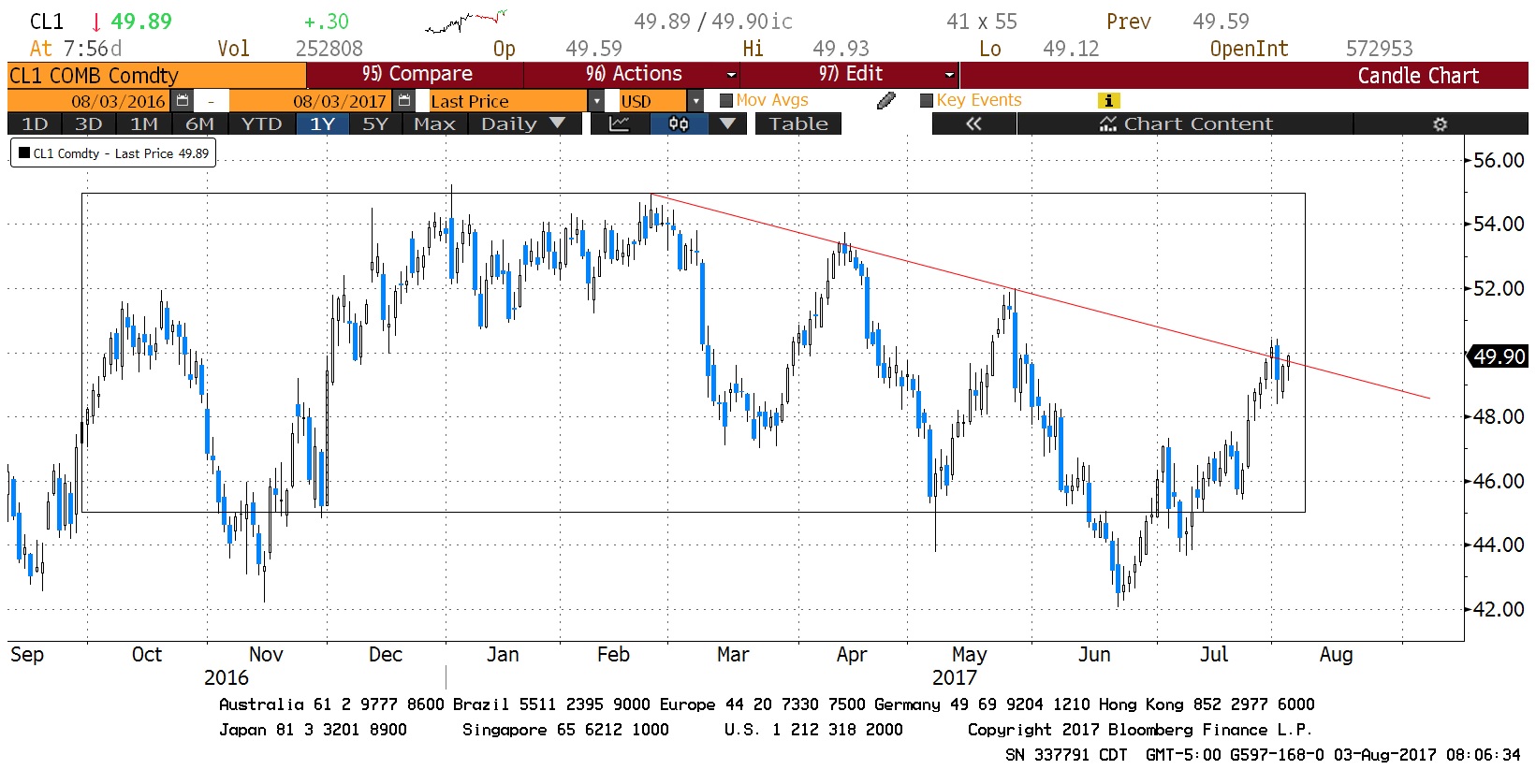
Oil prices have recovered from earlier weakness and are stalling at about the midpoint of the recent range.

(Source: Bloomberg)

This chart shows the nearest oil futures price; we have placed a box that highlights the price range of $45 to $55 per barrel.  We have also set a downtrend line from the past three price peaks.  Prices are struggling to break that downtrend line, but if they do manage to move higher then resistance rests at $52 and $54 per barrel.  We would not expect prices to break out above $55.

View the complete PDF


[1] http://www.politico.com/story/2017/08/03/debt-ceiling-republicans-clash-congress-241263

Daily Comment (August 2, 2017)

by Bill O’Grady and Thomas Wash

[Posted: 9:30 AM EDT] It was a quiet overnight trade.  The Reserve Bank of India did cut rates as expected.  Here are the trending news items we are watching:

Trade war with China: Several media outlets are reporting that the administration is opening a broad investigation into China’s trade practices with regard to intellectual property.[1]  China has pressed U.S. companies to reduce licensing fees, demanded joint ventures and is now requiring tech firms to set up China-based data centers if they want to do business in the country.  Complaints from U.S. companies over China’s behavior have been rising for some time.  Previous administrations and the companies themselves have tolerated these behaviors; the former to maintain relations and the latter to maintain access to Chinese markets.  However, U.S. companies have become increasingly jaded about prospects for growth in China.  We suspect that in the coming years China will be forced to see its growth fall by at least 50% to constrain debt growth.  At lower growth rates, the indignities that China enforces become a bigger issue.  Of course, the president ran on a protectionist platform, promising to boost jobs by reducing the trade deficit.  Up until now, the administration was offering China continued supportive trade relations if the Xi government constrained North Korea.  Now that it is apparent China is either unable or unwilling to act on North Korea, the president is moving on trade against China.  It’s difficult to measure the impact from a trade war with China.  Bilateral trade conflicts are complicated—we could see trade flows simply move to other nations and China won’t be all that affected.  On the other hand, given the complexity of global trade we may see unexpected outcomes, both positive and negative.  One thing to remember about trade is that the outcomes are full of tradeoffs.  Improving the standing of one party almost always comes at a cost to another.  The uncertainty factor alone could dampen both business and consumer sentiment.

Growing divisions within the White House: In one sense, this isn’t news.  After all, we have seen a number of firings from this administration.  However, one trend we are starting to notice is that cabinet members and others are directly contradicting the president.  President Trump clearly wants better relations with Russia, while VP Pence visits the borderlands in Russia’s near abroad and supports expanding NATO, a red line for Putin.  The president supports Saudi Arabia and the GCC against Qatar, while again SOS Tillerson visits to broker a peace deal and suggests that the GCC’s demands on Qatar are excessive.  President Trump engages in harsh rhetoric against North Korea; SOS Tillerson says today the U.S. does not seek regime change in the Hermit Kingdom and tells Kim Jong-Un that “we are not your enemy.”[2]  President Trump strongly suggests that he would like to decertify Iran[3] and scuttle the nuclear deal President Obama negotiated with Tehran; both Tillerson and DOD Mattis indicate Iran is meeting its treaty obligations.[4]  The AP is reporting that Mattis and CoS Kelly agreed early on in the Trump presidency that one of them should always be in the U.S. “to keep tabs on the orders rapidly emerging from the White House.”  Increasingly, we are seeing members of the cabinet moving to constrain the president.  So far, Trump is submitting to these actions.  It remains to be seen how long he will tolerate these differences.

The debt ceiling: Treasury Secretary Mnuchin suggested yesterday that the Democrats should support efforts to raise the debt ceiling.  The party leadership declined the offer.  There are rumblings from the Freedom Caucus that they will demand spending cuts to raise the ceiling.  This wing of the GOP is starting to look like it intends to hold its own party and the White House hostage.

View the complete PDF


[1] https://www.wsj.com/articles/u-s-plans-trade-measures-against-china-1501635127 (paywall)  https://www.nytimes.com/2017/08/01/business/trump-china-trade-intellectual-property-section-301.html?hp&action=click&pgtype=Homepage&clickSource=story-heading&module=first-column-region&region=top-news&WT.nav=top-news&_r=0

[2] https://www.ft.com/content/485dffe8-76fd-11e7-90c0-90a9d1bc9691?emailId=5981537c1d69e900049eab93&segmentId=22011ee7-896a-8c4c-22a0-7603348b7f22 (paywall)

[3] https://www.nytimes.com/2017/08/02/opinion/trump-killing-iran-nuclear-deal.html

[4] https://www.reuters.com/article/us-usa-tillerson-iran-idUSKBN1AH5E7  http://www.cnn.com/2017/04/19/politics/tillerson-iran-deal/index.html