

Daily Comment (March 16, 2018)

by Bill O’Grady and Thomas Wash

[Posted: 9:30 AM EDT] Happy Friday!  Here is what we are watching this morning:

The shakeup continues:  Numerous media sources indicate that Gen. McMasters is on his way out as National Security Director.  The most rumored replacement is John Bolton, a well-known hawk.  If Bolton does get the job, the odds increase significantly that the Iran nuclear deal gets overturned.  Bolton and Pompeo are harsh critics of the Iran deal and would support the president’s instincts to break it.  Iran’s reaction will be interesting to watch.  The pragmatists, led by President Rouhani, would be under tremendous pressure from the hardliners, who are also critical of the pact.  It all comes down to the Supreme Leader, Ayatollah Khamenei, who approved the original treaty.  We suspect he has never trusted the U.S. and would view a treaty break as just another example of American duplicity.  It is possible the Trump administration thinks it can negotiate a new deal with Iran.  Maybe he can, but it is more likely that Iran will dump the deal and rush to build a nuclear weapon.  This leads to two possible outcomes, both bad.  First, we note that the Saudi crown prince indicated that if Iran gets a nuke, the kingdom will acquire one too.[1]  Nuclear proliferation in an unsettled part of the world is not a good outcome.  Second, if Iran does “go for nuclear,” Israel would likely view this as an existential threat.  Although its first choice would be for the U.S. to fight Iran, if Netanyahu determines that isn’t going to happen he may decide to attack Iran directly.  The most likely response would be a nuclear first strike; Iran’s nuclear program is too large and dispersed to be successfully attacked with Israel’s conventional forces.  Although we are still a ways from this worst case scenario, the trends are not looking favorable.  From our standpoint, all this points to the potential for a supply disruption in the energy markets.

Cyberattacks: The Trump administration is accusing Russia of a series of cyberattacks on the U.S. and Europe that targeted key infrastructure of electric and water systems.  Apparently, this gave Russian hackers control of these systems and, if triggered, the attacks could have caused a power shutdown.[2]  The NYT[3] is also reporting that a cyberattack on a Saudi petrochemical facility appears to have been designed to cause an explosion at the plant and the only reason it didn’t work was because the undisclosed attackers made errors in their computer code.  Their errors inadvertently shut down the plant before the more deadly aim of sabotage could take place.  The West does appear to be mobilizing against Russia.  New sanctions have been announced but we will be watching for Western cyberattacks on Russia.  In the current environment, nations are engaging in belligerent acts that essentially come just short of triggering a war response.  For example, China’s militarizing shoals in the South China Sea, Russia’s annexation of Crimea, Abkhazia, South Ossetia and parts of Ukraine, undermining the democratic process in the West and cyberattacks are all elements of this “hybrid war.”  At some point, the West will need to respond.  How it responds will be important.  If a Cold War model is adopted, look for the West to try to isolate China and Russia.

More trouble for Abe: Polls show that PM Abe’s support is down to 39%, a nearly 9.5% point drop, as the land scandal will simply not go away.  Although Abe continues to indicate he won’t resign, if it becomes apparent his position is untenable the end of Abe means the end of Abenomics.  That outcome will likely bring a stronger JPY.

A couple of economy concerns: Although we don’t see signs of recession, there are some signs of slower growth.
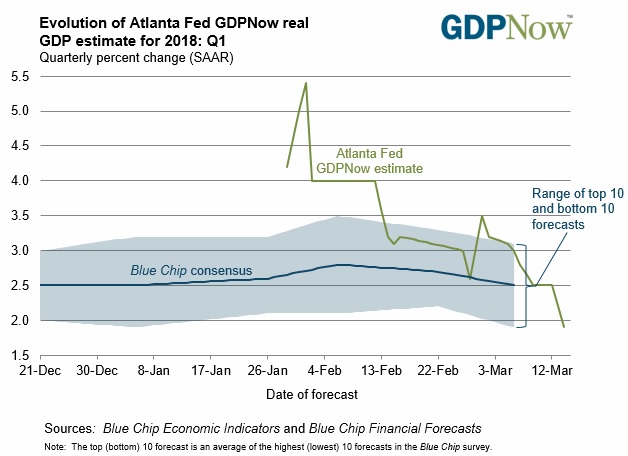
The Atlanta FRB’s GDPNow forecast for Q1 has fallen rather precipitously.  They haven’t updated their contributions to their model so we can’t yet pinpoint where the weakness is coming from, but it appears weakening consumption is weighing on growth.  Q1 GDP has had a seasonal adjustment problem; over the past four years, Q1 has been weaker than trend in three of those years.  In addition, we should see a boost in consumption as the effects of the new tax law on withholding are implemented.  Still, this drop in growth with the Fed raising rates is a worry.

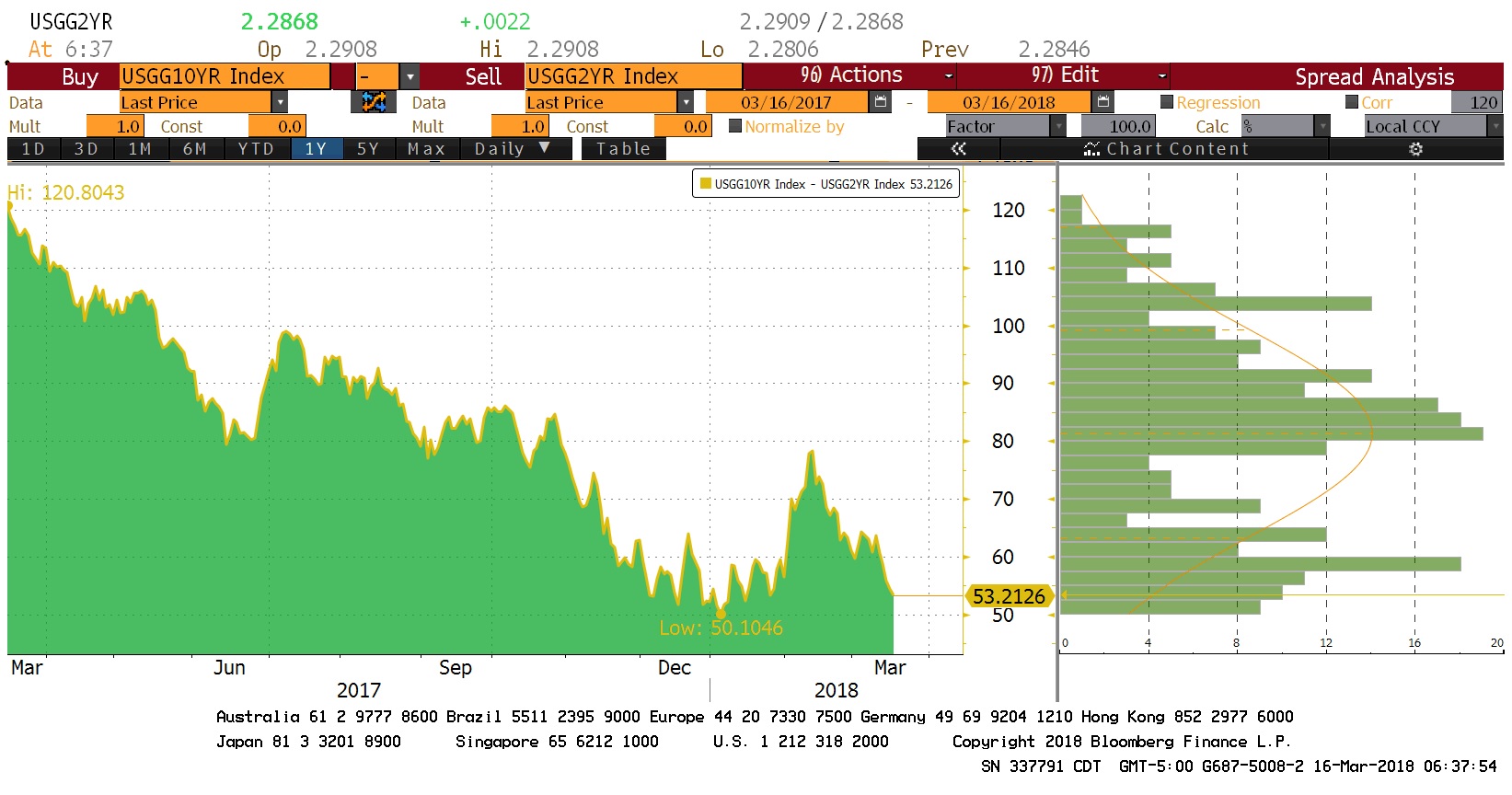
In addition, the yield curve has been flattening again.
(Source: Bloomberg)

After steepening last month, the curve has rapidly flattened to nearly the lows seen in early January.  Some of this is because German Bund yields have declined.  Nevertheless, the flattening should be a signal to policymakers to exercise caution.

View the complete PDF


[1] https://www.nytimes.com/2018/03/15/world/middleeast/mohammed-bin-salman-iran-hitler.html?emc=edit_mbe_20180316&nl=morning-briefing-europe&nlid=5677267&te=1

[2] https://www.nytimes.com/2018/03/15/world/middleeast/mohammed-bin-salman-iran-hitler.html?emc=edit_mbe_20180316&nl=morning-briefing-europe&nlid=5677267&te=1

[3] https://www.nytimes.com/2018/03/15/technology/saudi-arabia-hacks-cyberattacks.html?emc=edit_mbe_20180316&nl=morning-briefing-europe&nlid=5677267&te=1
Daily Comment (March 15, 2018)

by Bill O’Grady and Thomas Wash

[Posted: 9:30 AM EDT] It’s the Ides of March!  Be careful out there.  Markets were very quiet overnight.  Here is what we are watching:

Trump 2.0: As expected, Larry Kudlow is replacing Gary Cohn as NEC director.  This should be a somewhat market supportive appointment.  Kudlow isn’t an economic heavyweight; he doesn’t have a degree in the subject and his claim to fame is mostly as a supply side pundit.  On the plus side, he is a skilled media spokesman and will improve the profile of the administration, whereas Cohn could be a bit stiff in front of the cameras.  Kudlow will be in his element.  We doubt he will push back too hard against the president’s policies but we do expect him to frame the policies as pro-growth and pro-market.  Contorting trade impediments into being pro-growth and pro-market will be a feat but, if anyone can do it, Larry is the best candidate.  He has already come out in favor of a “strong dollar” in a public statement; the forex markets ignored his comments.  Kudlow likely assumes the strong dollar of the early 1980s was due to supply side economic policies.  We doubt they played a major role; a more important part was played by Paul Volcker’s tight money policies.  But, returning to allowing the markets to set exchange rates is a better policy stance than Treasury Secretary Mnuchin’s comments at Davos.

There are reports[1] that the president is preparing to replace more of his cabinet and aides, including Chief of Staff Kelly, National Security Director McMaster and AG Sessions.  Financial markets have not reacted well to previous departures, although we expect the impact will decline over time.  As we noted yesterday, this is a normal pattern that presidents follow.  They usually attract strong characters in the first year but by the time their first four years end presidents tend to surrounded themselves with people who can execute the president’s plans, not comment on the plans themselves.

Russia and Britain: We are still awaiting Russia’s official response but the commentary has been denial and contempt.  Russia is trying to portray itself as a great power and actions like executing old double agents are part of that narrative.  The U.S., Germany and France have joined the chorus demanding that Russia accept responsibility for the attack, although we note it hasn’t been a universal position.  In France, a spokesman suggested Britain’s proof of Russian involvement is “fantasy politics.”  However, the Macron government did later indicate that it believes the British claims of Russian involvement.  In the U.K., Labour leader Corbyn refused to endorse May’s claim of Russian responsibility, reminding British voters what a “PM Corbyn” would look like.  We don’t think diplomatic expulsions will make much difference and we don’t expect major sanctions to follow.  Sadly, the lack of an effective response will only embolden Putin to take more aggressive steps.

Abe’s woes continue: The land scandal that has ensnared Finance Minister Aso is expanding.  If Aso and perhaps Abe either ordered or knew documents were altered, it could bring down his government.  The end of Abe would likely end Abenomics as well.  We would expect a “knee-jerk” rally in the JPY and a weaker Nikkei.

Energy recap: U.S. crude oil inventories rose 5.0 mb compared to market expectations of a 1.9 mb build.

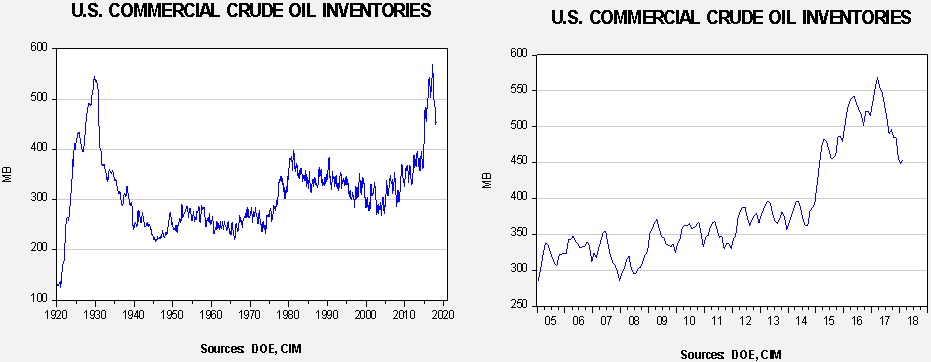
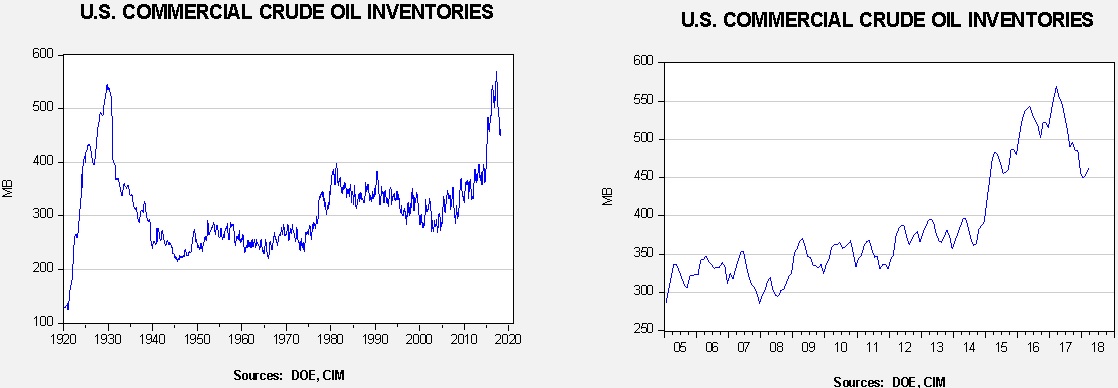
This chart shows current crude oil inventories, both over the long term and the last decade.  We have added the estimated level of lease stocks to maintain the consistency of the data.  As the chart shows, inventories remain historically high but have declined significantly since last March.  We would consider the overhang closed if stocks fall under 400 mb.

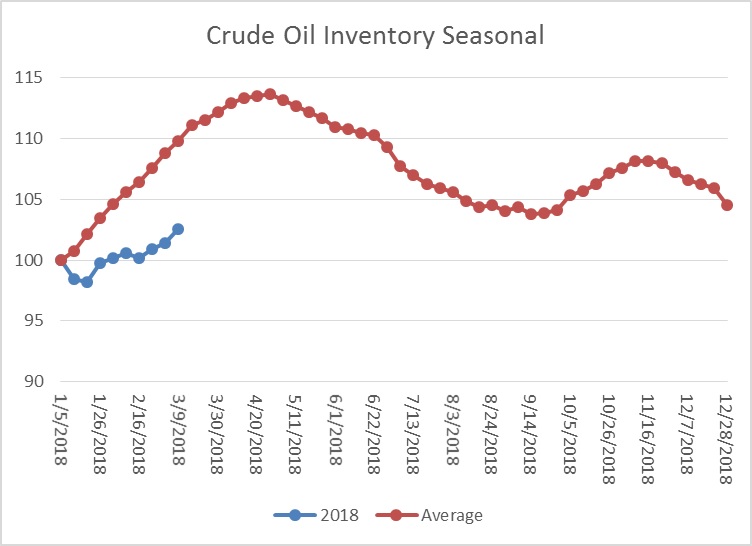
As the seasonal chart below shows, inventories are usually rising this time of year.  This week’s rise was more in line with a normal increase in oil inventories during late winter into spring.  If this pattern continues, oil prices may come under further pressure in the short run, although it still appears to us that prices are undervalued.

(Source: DOE, CIM)

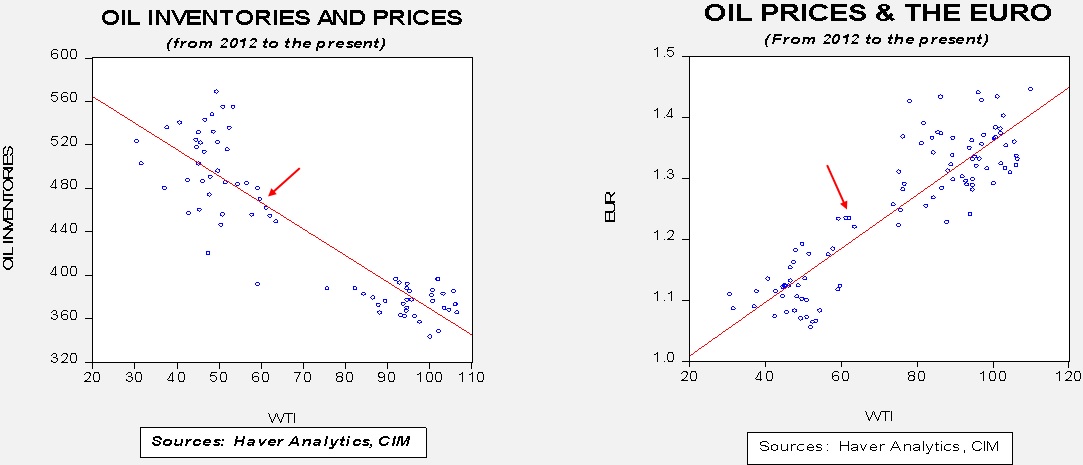
Based on inventories alone, oil prices are undervalued with the fair value price of $63.90.  Meanwhile, the EUR/WTI model generates a fair value of $75.13.  Together (which is a more sound methodology), fair value is $71.45, meaning that current prices are below fair value.  Oil prices have been struggling on fears that U.S. production is going to overwhelm OPEC supply cuts.  Earlier this week, we published our Quarterly Energy Comment[2] looking at the rapid rise in production without a commensurate increase in rig counts.  We wonder if that production level can be maintained without an increase in resources.  If not, oil prices should move higher once seasonal pressures dissipate. 

View the complete PDF


[1] https://www.vanityfair.com/news/2018/03/trump-swinging-the-axe-at-tillerson-mcmaster-sessions-jared-and-ivanka

[2] See Quarterly Energy Comment, 3/13/18

Daily Comment (March 14, 2018)

by Bill O’Grady and Thomas Wash

[Posted: 9:30 AM EDT] Here is what we are watching this morning:

May responds: The Russians ignored Britain’s deadline so PM May is expelling 23 Russian diplomats, the biggest expulsion since the Cold War.  Expect a similar response from Russia.  This is an issue that bears watching.  We expect that Chairman Xi is closely observing the West’s response to Russia’s rather blatant attacks on its expats in the U.K.  China also has an interest in controlling the actions of its nationals living abroad.  If troublesome characters can be killed with impunity in the West, it would not be a shock to see China engage in similar behavior.  This reaction is probably the best May can muster; without a broader response, we can expect more of these killings carried out by more nations in the democratic West.

Trade talk: One of the evolving features we continue to watch closely is what we call “Trump 2.0.”  In the president’s first year, especially after the appointment of John Kelly as Chief of Staff, the White House became much more orderly.  Populist voices, such as Stephen Bannon, were banished.  The flow of information and persons to the Oval Office was monitored and restricted.  Gary Cohn and the establishment steadily gained control and the key issue the GOP establishment wanted, the tax act, was passed.  That order is now being unwound.  SOS Tillerson’s firing was announced yesterday and Mike Pompeo was nominated as his replacement (conditional on Senate approval).  Cohn has moved on.  As the president becomes more comfortable with the office, he is taking control of the job and the “controllers” are steadily losing power.

For our purposes, what does this mean for financial and commodity markets?

  • We would expect more turnover until the president shapes his staff to his liking. The president is making it clear he wants voices around him that are not contradictory.  In reality, most presidents make this shift, although perhaps not as quickly as this one.  Early in the first term of a new president, especially when the party has been out of power, there are a group of political operatives ready and willing to accept appointments.  These are usually “stars” of the party with strong personalities and their own agendas.  As presidents become more familiar with the job, they tire of all the “advice” and replace the stars with people who will execute the vision of the president.  Mike Pompeo will more likely be willing to execute the vision of the president, whereas Rex Tillerson often clashed with the White House.
  • This turnover will raise uncertainty but markets will adapt. A similar pattern emerges with geopolitical issues; the first terrorist attack is a big deal.  Over time, markets become inured and they have less effect.
  • Our read on President Trump is that he is an economic and geopolitical nationalist. The U.S. is going to become increasingly stingy with providing global public goods, including acting as importer of last resort.  Although Trump will get criticized for doing so, in fact, this is just the most recent attempt to develop a post-Cold War policy.  None of them, since Clinton, have managed to create a lasting policy response to the fall of the Berlin Wall.  It does appear that Trump’s policy of reducing global exposure is popular; although the establishment is horrified (mostly because it has benefited greatly from globalization), the majority of Americans feel that all they get from the superpower role is cheap foreign goods that reduce their employment opportunities.  This doesn’t necessarily mean the U.S. becomes autarkic, but open trade and providing the reserve currency to the world will now come with strings attached.  The big issue to watch is if the world decides that it will reduce using the dollar as a reserve currency.  For now, we don’t really see an alternative; neither Europe nor China is willing to run persistent trade deficits, the requirement to be the primary reserve currency.  But, if foreigners stop using the dollar for reserve purposes, then fiscal deficits suddenly matter…a lot.
  • The key market issue is whether trade impediments become serious enough to change inflation and, even more critically, inflation expectations. So far, the rhetoric on trade has far outpaced the actual impact.  But, we know the president has China in his sights and is threatening more serious measures against China’s trade with the U.S.[1]  If these come to fruition, we would expect inflation fears to become an increasingly negative factor for financial markets.
  • Iran will likely become a more serious issue.  President Obama wanted to pivot to Asia and, to do so, he needed to reduce America’s interests in the Middle East.  He decided he was willing to allow Iran to become the regional hegemon and provide order as the U.S. shifted its focus to Asia.  The nuclear deal was a step toward normalization; we suspect Obama assumed Clinton would win in 2016 and finish the normalization process with Iran.  Needless to say, this was a very controversial decision.  Although some regional experts had suggested this outcome as the most rational policy,[2] Iran is a long-time adversary for the U.S. and it is politically unpopular to support any sort of normalization with the Mullahs.  This president wants to “rip up the script” of the Iranian nuclear deal by May of this year.  If the Iranians disagree, we expect the latter to move quickly to acquire a nuclear weapon.  Rising regional tensions increase the odds of an oil supply disruption.  Keep in mind that the Iran issue will be occurring at nearly the same time as when the president is expected to meet with Kim Jong-un, so the White House will be busy.

View the complete PDF


[1] https://www.politico.com/story/2018/03/13/trump-demands-aides-strengthen-china-tariffs-460416

[2] See Baer, R. (2008). The Devil We Know: Dealing with the New Iranian Superpower. New York, NY: Crown Publishing Group. and Friedman, G. (2011). The Next Decade. New York, NY: Doubleday (especially chapter 7).

Quarterly Energy Comment (March 13, 2018)

by Bill O’Grady

The Market
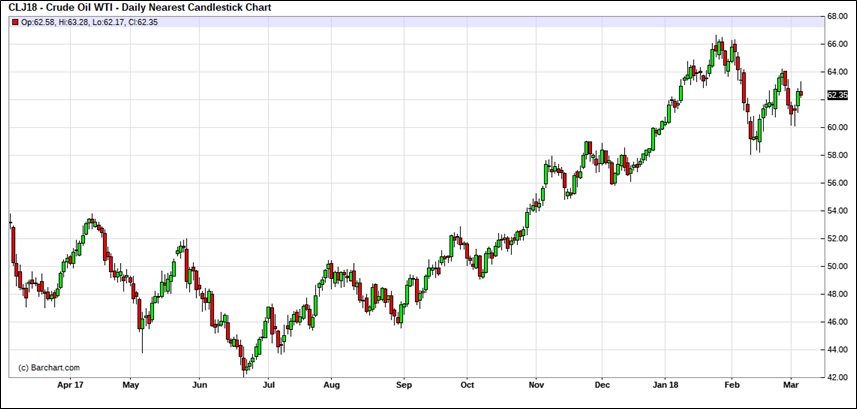
Over the past quarter, oil prices have ranged from a low of around $56 to a high of $66 per barrel.

(Source: Barchart.com)

Prices remain elevated, supported by OPEC production discipline and solid global oil demand.

Prices and Inventories
Inventory levels remain elevated but have clearly declined from last year’s peak.

View the complete PDF

Daily Comment (March 13, 2018)

by Bill O’Grady and Thomas Wash

[Posted: 9:30 AM EDT] CPI came in on forecast.  Financial markets were fearing faster inflation and so we are seeing the dollar ease and equities rally on the news.  Here is what we are watching this morning:

NEC Chair: Shahira Knight has signaled she doesn’t want the job, and Chris Liddell didn’t move the president.  Instead, Larry Kudlow has emerged as the front-runner.  Kudlow has become a well-known television personality, positioned as a defender of free markets and low taxes.  He has an undergrad degree in history from the University of Rochester and did begin a master’s program at the Princeton Woodrow Wilson School of Public and International Affairs but left before completing his degree.  According to reports, the president is impressed with how he handles himself on television.  Kudlow, if appointed (and until he is announced and seated nothing is certain), will be a relief to the financial markets.  Although we still expect the president to lean toward trade protection, Kudlow will act as a counterpoint to that sentiment.

Tillerson out: Rex Tillerson, the former Exxon (XOM, 75.24) CEO, is out as Secretary of State and will be replaced by CIA Director Pompeo.  This isn’t a huge shock; Tillerson has never really gotten along with the president and was expected to leave sometime this year.  We will be watching to see who gets the CIA position.  Tom Cotton, the GOP senator from Arkansas, is a likely candidate.  Pompeo will require Senate approval but that shouldn’t be a major issue.

48 hours: PM May has accused the Russian government of involvement in the recent assassination attempt of a former Russian spy in the U.K.  Although the Putin regime has denied the report, it should be noted that the nerve agent used was Novichok, a Soviet-era nerve agent said to be 10x more powerful than VX.  The use of such a weapon makes it almost certain that the Russian government, in some fashion, was involved.  It is possible that this was a rogue operation, but we doubt that is the case.  First, this is another brazen act by Russia to intimidate its critics that live in the U.K.  Britain has become a haven of sorts for Russian capital flight and discontented Russians.  This isn’t the first attack; a former Russian security member was killed with Polonium in 2006, and other Russians and fellow travelers, either critical of Putin or thought to be involved in money laundering, have also died under suspicious circumstances.[1]  The use of a military-class nerve agent that was only formulated in Russia suggests that whoever was involved was not concerned about plausible deniability.  Second, PM May is clearly angry, giving Russia 48 hours to explain itself.  The Russians have denied involvement, as one would expect.  Britain has been trying to generate international support but, so far, the Trump administration has been mostly quiet outside of Tillerson’s indication of likely Russian involvement (see above).  At the same time, most other NATO states have also remained mostly quiet.  We expect some diplomatic expulsions and U.K. sanctions on Russia, but major sanctions won’t be possible without international support.

Broadcom (AVGO, 262.84) and Qualcomm (QCOM, 62.81): The White House has stepped into this proposed merger and quashed it on national security grounds.  At first glance, this reasoning looks tortured; Broadcom is based in Singapore, a nation that is no national security threat to the U.S.  However, Qualcomm has made a major R&D investment in 5G technology and it was feared that the merger would undermine that investment and give the lead in the next generation of wireless to China’s Huawei (CNY, 7.71).  It appears the administration may be taking the position that high tech is a key military industry and the U.S. intends to prevent foreign firms from owning these key assets.  In other words, globalization is starting to be curtailed as industries are going to become off limits to foreign buyers.

Slovakia in turmoil: Slovakia’s government is teetering on collapse after a journalist working on tax evasion and corruption was assassinated in a gangland fashion.  For good measure, the killers also shot and killed the journalist’s fiancée.  The attack was so blatant that it has triggered mass protests in the country and it appears new elections may be coming.

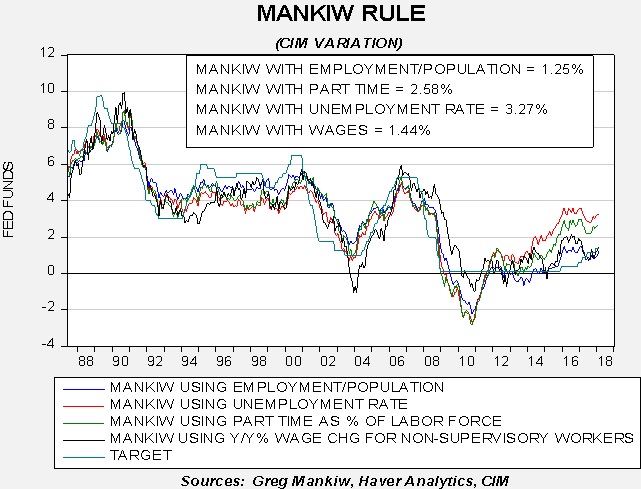
Fed policy: With the release of the CPI data we can update the Mankiw models.  The Mankiw rule models attempt to determine the neutral rate for fed funds, which is a rate that is neither accommodative nor stimulative.  Mankiw’s model is a variation of the Taylor Rule.  The latter measures the neutral rate using core CPI and the difference between GDP and potential GDP, which is an estimate of slack in the economy.  Potential GDP cannot be directly observed, only estimated.  To overcome this problem, Mankiw used the unemployment rate as a proxy for economic slack.  We have created four versions of the rule, one that follows the original construction by using the unemployment rate as a measure of slack, a second that uses the employment/population ratio, a third using involuntary part-time workers as a percentage of the total labor force and a fourth using yearly wage growth for non-supervisory workers.

Using the unemployment rate, the neutral rate is now 3.27%.  Using the employment/population ratio, the neutral rate is 1.25%, a 28 bps rise over last month.  Using involuntary part-time employment, the neutral rate is 2.58%.  Using wage growth for non-supervisory workers, the neutral rate is 1.44%, a 19 bps rise over last month.  Although inflation remains steady, the sharp improvement in the employment/population ratio and the modest rise in wages suggest that some of the slack is leaving the labor market.  However, the differences are still very wide between the wage growth and employment/population ratio variations compared to involuntary part-time employment and the unemployment rate.  If the FOMC is using the former two variations, policy is essentially neutral.  Overall, the CPI data does not suggest anything unusual in price levels and thus, monetary policy will likely continue to tighten on its current cautious path.

View the complete PDF


[1] https://www.buzzfeed.com/heidiblake/from-russia-with-blood-14-suspected-hits-on-british-soil?utm_term=.pkzDdmmwZr#.ygJqyRRv8a

Weekly Geopolitical Report – Emperor Xi: Part II (March 12, 2018)

by Bill O’Grady

Last week, we discussed China’s power structure and how the suspension of term limits changes recent precedents.  We examined President Xi’s actions in his first term to consolidate power and prepare for the next phase in China’s adjustment.  We concluded with the reasons for moving now and what it potentially signals about Xi’s view of his power and political capital.

This week, we will continue this topic by analyzing China’s challenges while shifting from the world’s high growth/low cost producer to a slower growth, “normal” economy.  We will show how these challenges fit into China’s overall geopolitics and Xi’s response to these constraints.  From there, we will offer an analysis of America’s policy toward China in the postwar era with specific discussion on the critical assumptions regarding democracy and markets that have clouded policymakers’ expectations toward China.  Finally, we will conclude with market ramifications.

China’s Challenges
China is in the process of making the adjustment from being the world’s high growth/low cost producer to a slower growth economy.  Since the industrial revolution, the world has seen a number of nations make this transition.  The British carried the high growth/low cost producer role from the onset of the industrial revolution in the early 1800s until around 1870.  After 1870, the U.S. and Germany both played this role.  Following WWII, Germany and Japan were high growth/low cost producers, with a parade of nations succeeding them in this position, including South Korea, Taiwan and, now, China.

In general, the high growth/low cost producer engages in a set of policies designed to boost the industrial capacity of the economy.  This usually requires policies designed to increase saving.  Saving can be domestic and/or foreign.  The U.S. did attract a good deal of foreign saving from Britain after the Civil War but still exported saving (which is running a trade surplus).  Most other nations followed a policy mix to generate most of the saving domestically.  That required a specific policy mix that boosted domestic household saving.  This was usually accomplished by an undervalued exchange rate, a weak or non-existent social safety net and low interest rates on retail bank deposits.  All of these policies combine to curtail consumption. This saving funded domestic investment by allowing for low interest rate loans.

In the postwar period, with the U.S. providing the reserve currency and acting as importer of last resort, all of the high growth/low cost economies have been export promoters.  They all built excess capacity to not only meet (admittedly constrained) domestic consumption but global consumption as well.  In most cases, these nations have large rural populations that could migrate to cities and provide low-cost labor.

No nation that has accepted this role has maintained it indefinitely.  Usually, three factors develop that undermine a country’s ability to continue as the high growth/low cost producer.  First, costs rise over time as the “Lewis tipping point” is reached.  Named after the Nobel Laureate economist Arthur Lewis, this occurs when all the excess labor from the countryside is exhausted and wages begin to rise.  This increases costs for the high growth/low cost producer and opens up the global economy to another competitor.  Second, the country reaches sufficient size that the rest of the world finds it burdensome to continue to absorb the high growth/low cost producer’s exports.  Trade barriers are implemented which leaves the high growth/low cost producer with excessive productive capacity.  Third, the accumulated debt that fostered industrialization becomes unsustainable and increases the odds of a debt crisis.

View the full report

Daily Comment (March 12, 2018)

by Bill O’Grady and Thomas Wash

[Posted: 9:30 AM EDT] Happy Monday!  We switched to daylight savings time on Sunday (a rather barbaric practice).  Here is what we are watching this morning:

Scrambling on Korea talks: Weekend reporting made it clear that the president agreed to talks on his own without consulting staff.  The normal protocol is for advisors to the president to meet with officials of the other nation, hammer out a deal or at least topics for leader discussion and then the leaders meet.  That way, the odds of a successful meeting are high.  This meeting is in reverse; the president agreed to a meeting but it is unclear exactly what will be discussed.  Yes, both the U.S. and North Korea have long-standing goals—North Korea wants a peace treaty and security guarantees, while the U.S. wants denuclearization—but there hasn’t been any real discussion about how to achieve these measures.  For example, North Korea probably wants a peace treaty that will include the removal of U.S. troops from the peninsula.  Denuclearization without inspections isn’t realistic.  Thus, we currently have talks promised without an agenda.  More to come, obviously…

NEC Chair: Shahira Knight has signaled she doesn’t want the job.  Chris Liddell has emerged as the front-runner.  He is a former Microsoft (MSFT, 96.54) and General Motors (GM, 37.84) executive who has close ties to Jared Kushner.  Kevin Warsh, the former Fed governor, has also been mentioned and Peter Navarro is also offering his services.  It should be noted the WSJ editorial board is critical of Liddell, suggesting he isn’t high profile enough or strong on free trade.[1]  Expect more drama on this appointment; however, financial markets probably won’t care all that much unless Navarro is selected—that decision would be taken as bearish.

Iran nuclear deal in trouble?  Axios[2] is reporting that the president indicated to Israeli PM Netanyahu that the U.S. will pull out of the Iranian nuclear deal if major changes are not made.  According to this report, the U.S. has told European negotiators they have until May 12 to fix the deal or face U.S. withdrawal.  If the deal falls apart, look for Iran to make a dash for a bomb.  At worst, this leads to a U.S. or Israeli air campaign against Iranian nuclear sites.  At best, it sets off a nuclear arms race in the Middle East.  The Iran nuclear deal is far from perfect but it does appear to have frozen Iran’s nuclear program.  Given that Iran hasn’t really seen any improvement in its economy since the agreement, Tehran may conclude it is better off without a deal.  If the deal fails, we view it as bullish for oil prices.

Saudi IPO postponed: According to the FT,[3] the Saudi Aramco IPO won’t come to market this year but in 2019 at the earliest.  Apparently, the delay is due to the fact that CP Salman wants a $2.0 trillion valuation and company executives are struggling to achieve this number.  In a related report, the WSJ[4] is reporting there is a pricing policy difference between Saudi Arabia and Iran.  The former wants oil prices in excess of $70 per barrel (Brent), while Iran wants a price closer to $60.  This is an interesting role reversal; historically, Iran has been a price hawk, wanting to maximize revenue, while Saudi Arabia has been a moderating force, worried that high prices induce demand destruction.  We believe Saudi Arabia needs that higher price to (a) balance its fiscal budget, and (b) improve the valuation for the Saudi Aramco IPO.  We remain bullish oil until the Saudi IPO prices; after that, we will need to see if Saudi Arabia’s market share policy changes.

Trade talk: The president continues to make trade threats, this time targeting German luxury automakers.[5]  Interestingly enough, both BMW (EUR 85.46) and Mercedes-Benz (EUR 68.33) have extensive U.S. production and thus may not be all that affected by the tariff.  So far, financial markets are taking the stance that the talk is more aggressive than the reality.  Still, we view trade impediments as a serious threat to the financial markets because they would raise structural inflation, which would tend to depress P/Es and raise interest rates by boosting inflation fears.

Abe scandal: In February 2017, Moritomo Gakuen, an ultra-nationalist school developer, acquired land in Osaka for ¥134 mm, about 10% of its appraised value.  Gakuen’s schools reportedly use texts from the Imperial era as part of the curriculum, a practice outlawed by the U.S. during occupation.  Although the administration has denied the reports, the principal of the school has indicated that the PM’s wife gave him a gift of ¥1.0 mm.  By itself, the donation isn’t illegal but Abe could be in trouble if he is found to have misled parliament.  Further investigations have revealed that 14 alterations were made to documents by the finance ministry surrounding the aforementioned land sales and are threatening to engulf Taro Aso, the finance minister.  The LDP is holding leadership meetings this autumn and Abe may not be able to hold his position if the scandal continues.  If Abe is ousted, Abenomics goes with him and we would expect the JPY to appreciate.

View the complete PDF


[1] https://www.wsj.com/articles/a-not-so-liddell-problem-1520802951

[2] https://www.axios.com/trump-said-us-will-leave-iran-deal-netanyahu-d9672407-6d18-4978-a08b-3051484b1486.html

[3] https://www.ft.com/content/62fa88b0-21f4-11e8-9a70-08f715791301

[4] https://www.wsj.com/articles/opec-divided-on-the-right-price-for-oil-1520769600?utm_source=newsletter&utm_medium=email&utm_campaign=newsletter_axiosgenerate&stream=top-stories

[5] https://www.ft.com/content/6bbd9e74-2546-11e8-b27e-cc62a39d57a0?segmentId=a7371401-027d-d8bf-8a7f-2a746e767d56

Asset Allocation Weekly (March 9, 2018)

by Asset Allocation Committee

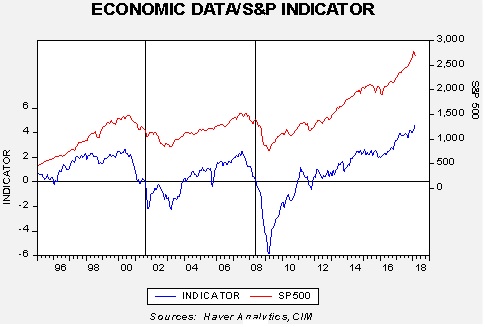
Last year, we introduced an indicator of the basic health of the economy and added it to the many charts we monitor in gauging market conditions.  The indicator is constructed with commodity prices, initial claims and consumer confidence.  The thesis behind this indicator is that these three components should offer a simple and clear picture of the economy; in other words, rising initial claims coupled with falling commodity prices and consumer confidence is a warning that a downturn may be imminent.  The opposite condition should support further economic recovery.

This chart shows the results of the indicator and the S&P 500 since 1995.  We have placed vertical lines at certain points when the indicator falls below zero.  Although it works fairly well as a signal that equities are turning lower, there is a lag.  In other words, by the time this indicator suggests the economy is in trouble, the recession is likely near or underway and the equity markets have already begun their decline.

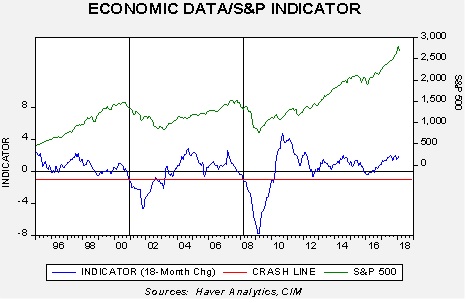
To make the indicator more sensitive, we took the 18-month change and put the signal threshold at -1.0.  This provided an earlier bearish signal and also eliminated the false positives that the zero threshold generated.  Notwithstanding, we will pay close attention when the 18-month change approaches zero.

What does the indicator say now?  The economy is healthy and currently supportive for equity markets.  Future market performance is likely to be more affected by the P/E multiple rather than earnings, which are dependent on economic growth.  The P/E is mostly a function of interest rates and inflation, although there is also an element of sentiment to the ratio.  For now, we expect the multiple to remain elevated but the risk of contraction will grow over time, especially if inflation worries increase.  We will have more to say on this issue in the coming weeks.

View the PDF

Daily Comment (March 9, 2018)

by Bill O’Grady and Thomas Wash

[Posted: 9:30 AM EST] It’s employment data Friday!  We detail the data below but the quick summary is “shocking.”  Wage growth moderated and payrolls came in stronger than expected.  In the household survey, the unemployment rate remained at 4.1% but that masked massive increases in employment and the labor force.  Employment in the household survey jumped 785k, but the unemployment rate remained steady due to an even more impressive rise in the labor force of 806k.  Thus, both the participation rate and the employment/population ratio rose sharply.  The data does indicate that there is still ample slack in the labor market and thus should cool worries about inflation.  Here are the other items we are watching:

Trump to Pyongyang: Just a few months ago, we were worried about war on the Korean Peninsula.  Now, the president is going to meet with Kim Jong-un.  This will be the first time in history that a sitting U.S. president will meet directly with the leader of North Korea.  All of us are trying to sort out what this means but it is a clear high-wire act for both leaders.  There is the potential for a game-changing agreement.  One could imagine bringing peace to the Korean peninsula and pulling North Korea out of China’s orbit.  Or, Kim could snooker Trump and get aid and sanctions relief while keeping his nukes.  We can’t cover all the bases in a Daily Comment; the basis for negotiations is enough for a full Geopolitical Report.  But, while there is great risk of failure, there is also probably a better chance of success than the pundit class recognizes.  Kim Jong-un could be looking for something different than his father and grandfather.  Although the Kim dynasty is all about staying in power, the current leader may be more interested in boosting growth.  Anecdotal evidence suggests he is more tolerant of market activity compared to his predecessors, and the young leader may have concluded he has more to worry about from Beijing than Washington.  On the other side, President Trump seems to love the dramatic and he approaches negotiations with virtually a blank slate.  We will have more to say on this in the coming weeks, but a peace deal with North Korea would be historic and a boost to sentiment.

Tariffs and trade: As expected, the president announced his steel and aluminum tariffs.  Although there were serious concerns about the direction, in reality, the president preserved flexibility and we expect a surge of negotiations to establish carve-outs and exemptions.  That doesn’t mean this president isn’t leaning toward protectionism; he is, but his core principle is flexibility.  Thus, he wants to create conditions for lots of negotiations, which, he believes, play to his strengths of extracting concessions from negotiating partners.  If our assessment is correct, we will see more trade-related measures but it is uncertain whether there is a specific goal (a trade deficit target, for example).  As we noted earlier, if the president wanted a clean trade restriction, he could have accepted the border adjustment tax.  That doesn’t appear to be his aim.

Who’s next at the NEC?  The betting sites are leaning toward Shahira Knight, a former lobbyist, as the leading candidate for Cohn’s former job.   She is currently the NEC’s tax expert.  Others in the mix are Larry Kudlow, Peter Navarro and Kevin Warsh.  All three have issues.  Kudlow has been very critical of the recent tariffs, Navarro is seen as too controversial and it isn’t clear that Warsh wants the job.  Our worry about Knight is that she may not have enough gravitas to stand up to the president.  But, according to reports, it’s her job if she wants it.

View the complete PDF