Daily Comment (May 23, 2023)

by Patrick Fearon-Hernandez, CFA, and Thomas Wash

[Posted: 9:30 AM EDT] | PDF

Our Comment today opens with some key data showing how reduced demand for goods is slowing the global economy, even as post-pandemic demand for services continues to grow.  We next review a wide range of other international and U.S. developments with the potential to affect the financial markets today, including more signs of tension and decoupling between the West and China.

Global Economy:  Maritime research consultant Drewry has released data showing the world’s production of shipping containers has slumped dramatically in response to the falling demand for goods now that countries have eased their pandemic restrictions.  With consumers shifting their spending back to services instead of goods, shipping activity has declined, leaving a glut of containers around the globe.  Transportation dynamics often reflect the strength of economic activity, so the drop in container production helps confirm that the global economy is slowing.

Eurozone:  S&P Global said its May “flash” purchasing managers’ index for manufacturing fell to a 36-month low of 44.6, compared with 45.8 in April.  Like all major PMIs, this one is designed so that readings below 50.0 point to declining activity.

  • The recent readings, therefore, indicate that the Eurozone’s factory output remains in a deep slump.
  • On a more positive note, however, the May flash PMI for the service sector merely pulled back to 55.9 from 56.2 in the previous month. That illustrates how service activity in the bloc continues to grow smartly.
  • The increased activity in the service sector is keeping the overall Eurozone economy growing despite the post-pandemic pullback in manufacturing. Illustrating that, the May flash composite PMI stood at 53.3, down only modestly from 54.1 in April.

United Kingdom:  The International Monetary Fund reported in an updated forecast that it no longer expects British economic activity to slip into recession this year.  The institution now expects gross domestic product to expand 0.4% in 2023 and 1.0% in 2024, reflecting stronger wage growth, more supportive fiscal policy, and an easing of global energy prices and supply chain blockages.  All the same, the IMF forecasters warned that consumer price inflation is likely to be elevated for some time to come.

Greece:  As we flagged in our Comment yesterday, conservative Prime Minister Mitsotakis called new parliamentary elections for June 25, rather than trying to form a coalition government after winning a plurality, but not a majority, in Sunday’s elections.  Because of how the seats in parliament will be allocated in the second election, Mitsotakis and his New Democracy Party will have a good shot at forming a government by themselves.

Bulgaria:  After having five elections since 2021 that have ended inconclusively or resulted in short-lived governments, the country’s two main political parties have agreed to a power-sharing deal aimed at finally producing an effective government.  Under the deal, the two rival parties will form a coalition government with rotating prime ministers.  The agreement could help the country finally make progress on important issues like cutting inflation, clamping down on corruption, reducing economic dependency on Russia, and joining the Eurozone.

Japan-China:  Semiconductor manufacturers in China say they are worried that Japan’s new rules on selling advanced semiconductor-manufacturing equipment to the country could be tougher than the U.S. and Dutch restrictions.  If so, the executives said the restrictions could crimp China’s output of basic, relatively unsophisticated chips like those used in automobiles or kitchen appliances.  As we’ve warned many times before, investors remain at risk as the West and China try to decouple from each other economically and technologically.

United Kingdom-China:  In a member survey last month, the British Chamber of Commerce in China said only 8% of its members were pessimistic about their prospects in the country, down from 42% at the beginning of China’s post-pandemic opening last December.  However, fully 70% of the members said they were still taking a wait-and-see approach to new investments in the country because of continued regulatory uncertainty.  The survey shows how President Xi’s drive to bring the economy under stricter state control and clamp down on security risks is also playing into the decoupling phenomenon.

United States-China:  Several Chinese residents and a real estate firm filed a federal lawsuit to block a new Florida law restricting the sale of real estate to citizens of China, Russia, Iran, and other “countries of concern.”  The suit seeks to invalidate the law on grounds that it violates the Constitution’s equal protection clause and intrudes on the federal government’s right to manage national security, international affairs, and international commerce.

  • The new Florida legislation was championed and recently signed into law by Governor Ron DeSantis, a prospective Republican presidential candidate.
  • We think passage of the law illustrates how both Republicans and Democrats will likely compete to look toughest on China in the run-up to next year’s elections. If so, there could be a spiral of aggressive measures and proposals against China, which would likely make U.S.-China tensions even worse than they are at present.

U.S. Fiscal Policy:  In their latest face-to-face negotiation over raising the federal debt limit yesterday, President Biden and House Speaker McCarthy failed to reach an agreement, but McCarthy indicated the discussion was productive and that he expects to keep talking with Biden daily until they reach a deal.  The key sticking points now appear to be how much to raise the debt ceiling and at what level to cap federal spending in the upcoming fiscal year.  We continue to believe a deal will be reached and passed into law before the government loses its ability to pay its bills, but brinksmanship over the next couple of weeks could lead to heightened volatility in the financial markets.

U.S. Consumer Sentiment:  In the Federal Reserve’s annual survey of financial well-being, conducted last October, some 73% of U.S. adults said they were doing OK or living comfortably, down from 78% in 2021.  Importantly, a record 35% of the respondents said they were worse off financially than one year before, with more than half citing price inflation as a major challenge.  The survey underscores how the pain of rising prices was more than enough to offset the impact of low unemployment and rising wages last year.  It also reveals a likely reason why polls show that President Biden’s job approval ratings are so low despite high levels of employment.

View PDF

Daily Comment (May 22, 2023)

by Patrick Fearon-Hernandez, CFA, and Thomas Wash

[Posted: 9:30 AM EDT] | PDF

Our Comment today opens with a short recap of the Group of Seven (G7) summit in Japan, which finished over the weekend.  We next review a wide range of other international and U.S. developments with the potential to affect the financial markets today, including more Chinese retaliation against the U.S.’s clampdown on advanced technology flows and the latest on the negotiations over the U.S. federal debt limit.

G7 Summit:  Wrapping up their annual summit over the weekend, the G7 countries (the U.S., Japan, Germany, France, the U.K., Italy, and Canada) said they will work to insulate themselves from Chinese economic coercion and block the transfer of sensitive technology to China.  The statement reflects a growing realization of the way Beijing weaponizes other countries’ dependency on trade or capital flows with China, as we have described extensively in our various publications.

  • Despite the tough communiques, however, President Biden said in a post-summit news conference that he wants more open lines of communication with China.
  • Biden also predicted that U.S.-China relations would soon thaw, suggesting that there has been some sort of quiet diplomacy going on between the countries.

China-United States:  Although President Biden hinted at the G7 summit about an imminent thaw in U.S.-China relations, the Cyberspace Administration of China said yesterday that products made by U.S. memory chip maker Micron Technology (MU, $68.17) failed its network security review and that it would bar Chinese operators of key infrastructure from buying Micron’s chips.  The Chinese officials provided no details, and they didn’t say exactly which of the firm’s products would be affected.  In any case, Seoul said it didn’t plan to stop South Korea’s big memory chip makers from filling the gap left by Micron, in spite of U.S. entreaties.

  • The Chinese move against Micron is widely believed to be retaliation for the U.S.’s draconian restrictions on the sale of advanced semiconductors and related goods and services, which were announced last October.
  • Other suspected retaliatory measures include China’s recent clampdown on foreign consulting firms operating in China and the arrests of foreign business executives in the country.
  • China’s belated retaliation for the U.S. technology clampdown illustrates the U.S.-China decoupling that is gathering force, at least in the realm of technology. As the U.S. begins to focus more on China’s increasing military threat, such decoupling is likely to expand, creating significant risks for U.S. investors.

European Union-United States:  Regulators in the EU imposed a record fine of $1.3 billion on Facebook parent Meta Platforms, Inc. (META, $245.64) for storing European user data in the U.S. in violation of the bloc’s privacy rules.  At issue is the regulators’ belief that European user data stored in the U.S. could be accessed by U.S. spy agencies with insufficient protections.  Meta said it would appeal the ruling, and the regulators said they would allow such data transfers if the EU and U.S. reach an accord on the protection of personal data.

United Kingdom:  Prime Minister Sunak is facing another headache after news was reported over the weekend that last summer Home Secretary Suella Braverman tried to use her then-position as attorney general to avoid standard penalties for a speeding ticket.  Sunak today will consult his independent adviser on ministerial ethics after being urged to investigate the matter.  The scandal comes as Sunak continues to battle high inflation, public-sector strikes, a controversial immigration proposal, and his Conservative Party’s poor results in recent local elections.

Greece:  In elections yesterday, the conservative New Democracy party of Prime Minister Mitsotakis won the most votes but not enough for a majority in parliament.  Since Mitsotakis then derided the possibility of negotiating a coalition deal to form a government, it appears Greece will face a new election sometime in the coming weeks.

  • Given the way that parliamentary seats would be allocated in a second vote, Mitsotakis and New Democracy stand a better chance of winning a majority in parliament in that election.
  • In anticipation that the business-friendly conservatives will win a new mandate, Greek assets are trading higher so far this morning.

India:  The Reserve Bank of India announced that it will take all of its largest denomination bills out of circulation by the end of September.  The move, which is reminiscent of a 2016 currency reform that eliminated smaller bills overnight, has sparked fear among consumers even though the central bank offered assurances that the bills would remain legal tender until September.  In fact, the large bills that are now subject to elimination were introduced amid the chaos touched off by the 2016 reform, which in turn was ostensibly aimed at undermining illicit activity.  The move appears to be weighing very slightly on the value of the rupee (INR) in foreign exchange trading so far today.

U.S. Fiscal Policy:  President Biden and House Speaker McCarthy have agreed to meet on Monday afternoon to try to overcome their impasse over raising the federal debt limit.  However, Treasury Secretary Yellen reiterated her view that the government would be unable to pay its bills by June 1 if there is no deal to raise the limit, saying the date is a “firm deadline.”  That underscores the risk that the government could default on its debt and leave many of its bills unpaid, potentially sparking economic havoc and calling into question the U.S.’s role as the foundation of the global financial system.

  • All the same, we still suspect that the administration and Congress will reach a deal at the last moment and avert such an outcome.
  • One key reason for optimism is that both Biden and McCarthy have already made some concessions to each other—a fact that’s easy to miss amid the political rhetoric.
    • Press reports say Biden, for example, has expressed his willingness to claw back unused pandemic relief funding, tighten work requirements for some social safety-net programs, reform permitting for energy infrastructure, and freeze spending in this year’s budget.
    • Meanwhile, McCarthy and his team haven’t pushed their earlier calls to undo provisions of last year’s Inflation Reduction Act and student debt relief. They also insist on increasing the budget for the armed forces, veterans, and border security.

U.S. Monetary Policy:  In a Friday interview with the Wall Street Journal, Minneapolis FRB President Kashkari said he would be open to holding the Fed’s benchmark fed funds interest rate steady in June to give officials more time to assess the effects of past rate increases and the inflation outlook.  Considering that other Fed officials have recently indicated they’re leaning toward at least one more rate hike in June, the statement by Kashkari illustrates how the June decision is basically too close to call at this time.

U.S. Oil Market:  In a new effort to refill the nation’s Strategic Petroleum Reserve after massive sales from it last year because of the Russia-Ukraine war, the Energy Department has revamped how it will accept bids from oil companies.  In contrast with its tender for fixed-price bids earlier this year, which failed because of the price risk it imposed on oil producers during the two weeks needed to evaluate the bids, the department will now request bids based on a less volatile measure of price spreads.

  • If completed, the tender will result in the government purchasing about 3 million barrels of domestically produced sour crude, with more to be purchased later.
  • Amid weakening demand and softer crude pricing as the economy slides toward recession, the purchases could provide some support for crude values.

U.S. Labor Market:  In its annual report on foreign-born workers, the Labor Department said immigrants made up 18.1% of the labor force in 2022, the highest level ever in records dating back to 1996.  Of the 164 million in the U.S. labor force (people working or looking for work), 29.8 million were born abroad, for an increase of 1.8 million from the previous year.  That means immigrants accounted for more than half the increase in the labor force last year.

  • The analysis suggests the increased weight of foreign-born workers in the work force reflects both the pull of strong labor demand by companies and the high level of retirements and other withdrawals from work by native-born workers.
  • Amid strong labor demand and company complaints about worker shortages, the influx of foreign-born workers probably helped hold down average wage rates, potentially helping to limit inflation pressures.  Nevertheless, many will likely see the rise in immigrant labor as competition for native-born workers, so the report could feed into the current backlash against immigration.

View PDF

Asset Allocation Bi-Weekly – The Case for New Home Sales (May 22, 2023)

by the Asset Allocation Committee | PDF

A common topic among the financial markets is the impact of rapid monetary policy tightening.  After years of accommodative monetary policy, the spike in inflation caused by the pandemic has continued to persist.  To address the inflation issue, the FOMC has lifted the policy target rate at the fastest pace in over 40 years.  Rapid increases in the policy rate can often cause problems in the financial system which then filter into the real economy, and although unfortunate, such disruptions are often necessary in order to weaken demand and reduce inflation.

However, not all disruptions are created equal.  In general, policymakers want to achieve lower inflation with the least disruption possible.  This goal often means that policymakers want to avoid disturbing key asset markets, which, if adversely affected, could trigger widespread financial stress.  The events surrounding the mortgage crisis in 2008 are a clear example of what not to do.

When we wrote our 2023 Outlook, one of the risks we cited was falling nominal home prices.  The two worst financial crises in the past 90 years were both preceded by falling nominal home prices.  We are currently seeing a modest decline in home prices.

During the pandemic, working from home coupled with low mortgage rates led to strong home sales and swiftly rising home values.  Rapid policy tightening has led to a jump in mortgage rates, which normally places downward pressure on home prices.

However, the impact from housing on the economy and financial system, so far, has been rather modest.  On its face, this seems odd.  The rise in interest rates should reduce the value of homes; after all, if it costs more to finance a home, then the value of that home should decline at some point.

The chart above shows the number of weeks that a worker earning the average weekly wage for a non-supervisory position must allocate to service a mortgage at the going mortgage rate and the median existing home price.  This series is a way of capturing affordability.  The chart shows that during the Volcker Shock, a non-supervisory worker had to contribute almost a month’s worth of work to service a mortgage.  After the shock, though, the market settled into a range of 2.0 to 2.5 weeks.  Homes became remarkably affordable after the Great Financial Crisis, but the recent spike in interest rates has caused the number of weeks needed to afford a home to increase to the top of the range seen from 1985 through 2007.

So, why haven’t home prices fallen to reflect the higher interest rates?  Essentially, it appears that homeowners are reluctant to sell and give up their current low mortgage rates.  Goldman Sachs reports that 99% of homeowners have a mortgage rate of 6% or less, whereas the current mortgage rate is 6.48%.  This means that almost any homeowner that is selling a house to buy another one would need to be willing to accept a higher mortgage rate.  The same research shows that 72% of homeowners have a rate of 4% or less, and 28% are at 3% or less.  With labor markets remaining strong, there is little forced selling, and therefore we have seen a drop in listings.

The data in the above chart, which originates from Realtor.com, shows that since mid-2022, new listing numbers have plunged.  However, there is still strong demand for homes, especially since the millennial generation is hitting its home-buying years and is a large cohort.  So, with current homeowners staying put, an opportunity for homebuilders has emerged as new homes may be the best alternative.  We note that new home sales as a percentage of total sales have been rising.

New home sales relative to total sales dropped after the 2007-09 recession but steadily recovered, although the amount remained below the 16% level that was roughly the average from 1990 to 2005.  New home sales spiked during the pandemic, and then declined, but have started to recover again.

What does all this tell us?  New home sales relative to total sales have improved but remain below historical averages.  Since the vast majority of existing homeowners with mortgages have interest rates below current mortgage rates, there is a clear disincentive to list one’s home for sale.  To meet demand, homebuilders have an opportunity to build homes for new buyers.  This situation has boosted the shares of homebuilders.  Although this recent rally may extend, the risk to the position is a rise in unemployment that would be significant enough to trigger forced liquidations.  Since we expect a recession over the next six to nine months, there is a risk that new homes could be facing competition from existing homes later this year.

View PDF

Daily Comment (May 19, 2023)

by Patrick Fearon-Hernandez, CFA, and Thomas Wash

[Posted: 9:30 AM EDT] | PDF

Good morning! Today’s Comment will start with our thoughts on the recent performance of European stocks. Next, we will give a broad overview of the limitations and controversy surrounding generative artificial intelligence. Lastly, we explain why emerging markets may not be keen to choose sides between the U.S.-led and China-led blocs.

The Renaissance: European equities have garnered attention from international investors as they continue to defy expectations of an economic slowdown.

  • The market has been taken by surprise due to Europe’s resilience over the year since Russia invaded Ukraine. Initially, the conflict raised concerns about the Continent potentially slipping into a severe recession, mainly due to the potential blockade of Russian energy. However, as time passed, it became evident that Europe had not only managed to avoid a downturn, but gas prices have now dipped to their lowest level since 2021. Another positive factor was China’s reopening, which resulted in a surge in demand for European goods. This improved outlook has led investors to seek refuge in European assets. Buoyed by the prospect of Fed policy moderation, dollar-based investors have looked to Europe for portfolio diversification.
  • This year, several European stock price indexes have risen to record highs, showcasing the strength of the market. Germany’s DAX stock index surpassed 16,272 points on Friday, marking a new record. At the same time, France’s CAC 40 index and Italy’s FTSE MIB index have also reached unprecedented levels in 2023. These exceptional gains in European equities have outpaced their U.S. counterparts. The chart below highlights Europe’s superior performance in recent months. The relative performance of MSCI United States compared to its European counterpart, declined from a multiple of 3.2 in August 2022 to slightly above 2.5 last month.

  • The strong performance of European stocks is expected to continue in the coming months, but there are potential threats looming in the long term. The ongoing trade tensions between the U.S. and China may eventually compel countries within the EU to choose between the two superpowers. While it is likely that EU members will lean towards the U.S.-led bloc, countries like France and Germany might resist relinquishing their access to the world’s fastest-growing consumer market. Additionally, there is a possibility of Europe experiencing another energy crisis as supply constraints drive up commodity prices. Consequently, while performance is expected to remain positive in the foreseeable future, investors should remain vigilant and mindful of risks that may impact the market.

AI in Focus: Generative artificial intelligence (AI) has become the new buzzword as investors are optimistic about the technology’s earnings potential.

  • Lawmakers and tech leaders convened on Capitol Hill to address growing concerns surrounding the rapid advancement of generative AI technology. During the hearing, OpenAI’s CEO Sam Altman emphasized the need for some form of regulation on this technology. Generative AI technology has faced criticism due to its potential for misuse, including the spread of misinformation, the creation of scams, and the exposure of company trade secrets. Furthermore, there have been talks about the potential revisions to Section 230 of the Communications Decency Act, which shields social media companies from liability for user-generated content. Altman’s testimony serves as an initial step by tech leaders to prevent lawmakers from imposing excessive regulations on AI. As aptly stated by IBM’s Christina Montgomery, “This cannot be the era of move fast and break things.”
  • The release of OpenAI’s ChatGPT in partnership with Microsoft (MSFT, $318.52) has sparked a technological gold rush. Major tech companies such as Amazon (AMZN, $118.50), Alphabet (Googl, $123.55), and Meta (META, $246.85) have made major investments in this revolutionary technology as generative AI is seen as the future of business. These machine-learning algorithms are popular due to their ability to generate content. Although the tech is in its infancy stage, investors believe that over time companies will use the technology to improve their efficiency and boost productivity. Fear of the potential of generative AI has already sparked outrage among labor advocates who worry that the technology may be used to displace workers. The screenwriters’ union has been one of the most notable trade groups to speak out about the AI threat.
  • While this new technology holds immense potential to reshape the world, its full impact is likely to take considerable time to materialize. To explore its capabilities, we tasked OpenAI with providing suggestions for recently released books about generative AI (see image below). The chatbot’s response revealed a significant flaw. Despite the authors being real individuals, a quick search on Google and Amazon shows that the book titles and reviews are not. Hence when it is faced with a difficult question, chatbots will generate responses that sound accurate but are ultimately incorrect. Such limitations are expected to diminish over time as AI models process larger volumes of data. Nevertheless, the flaw underscores the fact that the current state of the technology is not as advanced as sensational headlines may imply. Therefore, investors should exercise caution and not feel compelled to rush into this space prematurely.

Battle of Soft Power: As the West looks to improve ties within its own group, emerging market countries have decided to keep their options open for as long as possible. 

  • Meanwhile, leaders from African and Middle Eastern countries are actively asserting their neutral stance in the Ukraine conflict. Recent developments include Russian President Vladimir Putin and his Ukrainian counterpart agreeing to hold separate meetings with six African countries to explore potential peace plans. Additionally, Zelensky is visiting Saudi Arabia to participate in the Arab League Summit, where discussions will revolve around enhancing bilateral trade relationships and seeking a possible resolution to the ongoing war. Our analysis indicates that commodity-producing countries in the Middle East and Africa often align themselves with China and Russia based on bloc tendencies. These diplomatic efforts highlight the regional engagement and strategic considerations when addressing the Ukraine conflict.

  • Currently, emerging market countries exhibit a greater reluctance compared to wealthier nations when it comes to aligning themselves with major blocs. Many countries within the bloc led by China and Russia rely significantly on the West for security and humanitarian aid, preventing them from fully severing ties with America. On the other hand, developed countries face fewer challenges in this regard. While countries like Germany and France have expressed their desire to maintain strategic autonomy, they have been hesitant to directly challenge U.S. foreign policy. Consequently, we anticipate that most emerging market countries will not rock the boat with the U.S.-led bloc. This pragmatic approach reflects the complex dynamics and considerations involved in balancing geopolitical relationships and economic interests among diverse nations.

View PDF

Daily Comment (May 18, 2023)

by Patrick Fearon-Hernandez, CFA, and Thomas Wash

[Posted: 9:30 AM EDT] | PDF

Good morning! Today’s Comment starts with an update on the U.S. debt-ceiling discussion and an explanation as to why it may not be as bullish as some investors would expect. Next, we explain why calls for a Fed interest rate cut in September may be a bit premature. Finally, we end with our thoughts about how global fracturing may improve relations between governments and corporations.

The Debt Ceiling: Market sentiment was lifted on Thursday after President Biden reassured investors that the government would not default on its debts.

  • President Joe Biden and House Speaker Kevin McCarthy announced that the two would meet to discuss the debt ceiling. Negotiations are expected to occur and include the potential for a deal on Sunday after President Biden returns from his trip to Japan. Talks between the two leaders will focus on possible budget cuts as the Republican party aims to reduce the deficit through spending decreases and Democrats look to increase government revenue. The two sides remain far apart on a potential agreement, but after weeks of posturing, there is now progress.
  • Markets welcomed the announcement; however, there are still concerns about whether the two sides can reach an agreement by the June 1 deadline. On Wednesday, the S&P 500 closed 1.2% higher than the previous day, while the tech-heavy NASDAQ finished the day up 1.3%. The improvement in stocks is related to investors’ confidence that the U.S. government will avoid breaching the debt limit and triggering an unprecedented default. That said, government data released Monday showed that the Treasury’s cash balance fell below $100 billion, suggesting lawmakers are less than a month away from hitting the government’s spending cap.

  (Source: Haver Analytics, CIM)

  • A lift in the cap will potentially lead to a knee-jerk reaction in the market, but we would not expect it to last. Over the last few weeks, policymakers have used the cash pile in the Treasury Government Account to keep the government afloat during the debt-ceiling showdown. Research from Strategas shows that the TGA spending has offset much of the impact of quantitative tightening, leading to an overall increase in net liquidity within the financial system. If the two sides agree by Monday, it may lead to a temporary bounce; however, the lack of cash injection would make it difficult for the market to sustain any rally.

Fed Speak: Policymakers have left the door open for an additional hike despite signs that the economy may be slowing.

  • Despite investor expectations, it is unclear whether the Fed will cut rates during a recession. JP Morgan Asset Management stated that it supports the market view that the Fed will cut as soon as September. The remarks reflect previous Fed reactions to recessions where it cut aggressively to protect the labor market. However, this time may be different. As the chart above shows, aggressive interest rate increases have done little to reduce demand-driven price pressures. As a result, we suspect that the Fed may decide to keep rates higher for longer before it chooses to pivot. This scenario raises the likelihood of a prolonged recession.

Global Repositioning: State involvement in industry is becoming more prevalent as countries prepare to move into blocs.

   (Source: Reuters)

  • The fragmentation into global blocs will likely bring government and state interests closer. This dynamic will lead to greater cooperation between lawmakers and businesses that look to prioritize national strategic aims over wealth accumulation. A similar situation occurred during WWI when households loaded up on government bonds to show patriotism. Additionally, firms had friendlier relations with their workers during those times of war in order to maintain positive national sentiment. As a result, we suspect that firms that have close ties with the U.S. strategic aims like defense and aerospace should make suitable long-term investments.

View PDF

Weekly Energy Update (May 18, 2023)

by Bill O’Grady, Thomas Wash, and Patrick Fearon-Hernandez, CFA | PDF

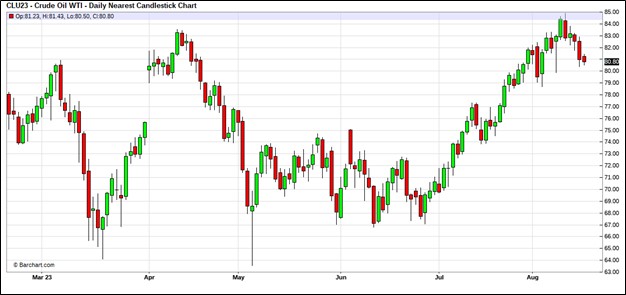
Oil prices were mostly steady over the past week.  Recession fears continue to stifle price movements.

(Source: Barchart.com)

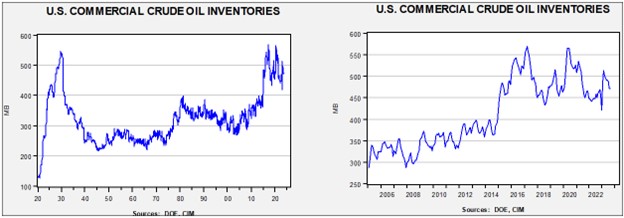
Commercial crude oil inventories rose 5.0 mb compared to the forecast draw of 2.0 mb.  The SPR fell 2.4 mb, putting the total build at 2.6 mb.

In the details, U.S. crude oil production fell 0.1 mbpd to 12.2 mbpd.  Exports rose 1.4 mbpd, while imports increased 1.3 mbpd.  Refining activity rose 1.0% to 92.0% of capacity.

(Sources: DOE, CIM)

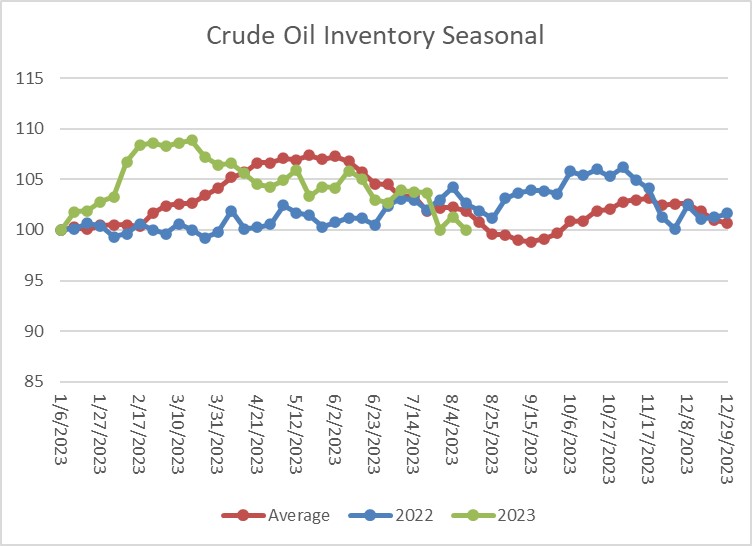
The above chart shows the seasonal pattern for crude oil inventories.  After accumulating oil inventory at a rapid pace into mid-February, injections first slowed and then declined.  For the past two weeks, stock have increased, putting the current level near average.

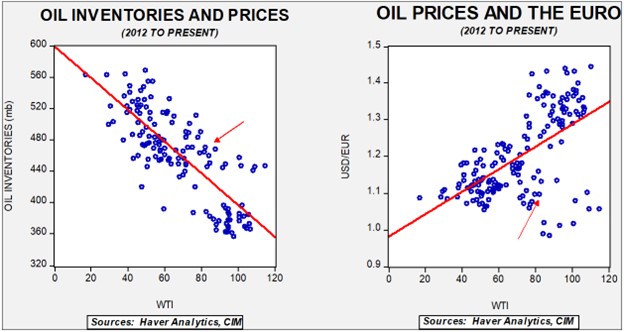
Fair value, using commercial inventories and the EUR for independent variables, yields a price of $56.42.  Although OPEC+ is trying to stabilize the market, recession worries are clearly pressuring crude oil prices.

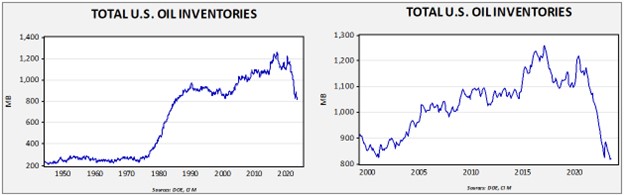
Since the SPR is being used, to some extent, as a buffer stock, we have constructed oil inventory charts incorporating both the SPR and commercial inventories.  With another round of SPR sales set to happen, the combined storage data will again be important.

Total stockpiles peaked in 2017 and are now at levels last seen in 2002.  Using total stocks since 2015, fair value is $93.20.

Gasoline markets are tight.

The previous chart shows the number of days the current level of inventory could cover based on current demand.  The latest reading is 24 days, a level we usually see in late October, well after the summer driving season has ended.  As the five-year average shows, we usually have about six more days of inventory available as we swing toward Memorial Day.  Barring a sharp decline in demand, we are going into the summer with unusually tight gasoline supplies, which may boost prices.

Market News:

 Geopolitical News:

 Alternative Energy/Policy News:

  View PDF

Daily Comment (May 17, 2023)

by Patrick Fearon-Hernandez, CFA, and Thomas Wash

[Posted: 9:30 AM EDT] | PDF

Our Comment today opens with a hawkish statement by Bank of England Governor Bailey that suggests British interest rates are likely to go higher.  We next review a wide range of other international and U.S. developments with the potential to affect the financial markets today, including a new technology-theft scandal that will probably further worsen U.S.-China relations and news that commercial office buildings are starting to be sold at fire-sale prices.

United Kingdom:  Bank of England Governor Bailey warned that he is prepared to keep raising interest rates as much as necessary to fight what he called a wage-price spiral and bring consumer price inflation down to the institution’s target of 2%.  Despite optimism that the Federal Reserve will now pause U.S. interest rates, Bailey’s comments serve as a reminder that “second-round” inflation pressures are probably in place around the world and could still require the major central banks to hike rates higher and keep them there for longer than currently anticipated.

China-United States-South Korea:  Yesterday, the U.S. Department of Justice’s new task force focused on protecting critical technologies from being stolen by foreign governments charged a Chinese citizen, Weibao Wang, with stealing trade secrets from Apple (AAPL, $172.07).  While Wang worked for Apple in California on a project related to driverless-car technology, he simultaneously took a job at the U.S. subsidiary of a Chinese company developing driverless cars.  Prior to informing Apple that he was quitting, he allegedly stole thousands of documents and other information before fleeing to China.  Other recent reports show Chinese firms and spy services are ramping up their effort to steal technology secrets from South Korea and other advanced countries in the West.

  • While many Western business elites continue to resist decoupling with China for fear of losing financial and economic opportunities, we think Beijing’s continued program of getting Western technology “by hook or by crook” will ultimately undermine their position. China’s aggressive military build-up will probably also justify decoupling.
  • Indeed, Western leaders in recent months have noticeably shifted their rhetoric to emphasize protecting national security over trade and investment with China.

Taiwan:  The island’s largest opposition party has picked Hou Yu-ih, the popular mayor of New Taipei City, as its candidate in January’s presidential election.  To contrast himself with the independence-minded ruling party, the Kuomintang party’s Hou opposes a formal breakaway from China but also doesn’t support operating under Beijing’s “One China, Two Systems” arrangement as it is applied in Hong Kong.  That stance may make him more palatable than other Kuomintang politicians who want the island to be closer to China, but it remains to be seen whether it will be enough to win the election.

Indonesia:  The chief executive of the country’s sovereign wealth fund said the fund will deploy some $3 billion into Indonesian infrastructure, digital assets, and other domestic opportunities in 2023, including funds from international co-investors.  The announcement is being seen as a sign of Indonesia’s attractiveness as an investment destination as investors sour on China, and Indonesia positions itself as a key supplier for materials related to green technologies.

Turkey:  The united opposition group that unexpectedly lost the first round of Sunday’s election to President Erdoğan accused the electoral authorities of large-scale irregularities but admitted that it would have lost the first round anyway.  Since Erdoğan very nearly snagged the 50% of the vote needed to win outright, he appears to be in the driver’s seat to win the second and final round of voting on May 28.  The likelihood that Erdoğan’s unorthodox economic policies will remain in place continue to weigh on Turkish assets so far this week.

Brazil:  State-owned oil giant Petrobras (PBR, $11.78) said it will end its longstanding practice of pegging the domestic price of its fuels to global prices.  The move appears to clear the way for leftist President Luiz Inácio Lula da Silva to keep domestic prices artificially low for his own political purposes.  If that comes to pass, it could portend expensive new subsidies to be paid from the government budget.  The loss of fiscal discipline would likely be negative for Brazil’s stocks, bonds, and currency.

U.S. Monetary Policy:  Consistent with our earlier comments on the Bank of England’s policy, Cleveland FRB President Mester yesterday warned that she hasn’t seen enough evidence that U.S. inflation pressures have eased to the point where the Fed should stop hiking interest rates.  However, Chicago FRB President Goolsbee and Atlanta FRB President Bostic both signaled they want to hold rates steady now to avoid over-tightening and potentially sparking a financial crisis.  We continue to believe the Fed is at least close to the end of its tightening cycle, if it’s not there already, but continued inflation pressures mean rates in the U.S. and in other developed countries could still go higher.

U.S. Energy Industry:  Data from Baker Hughes (BKR, $27.44) confirms that U.S. oil and gas exploration has suddenly cooled since the beginning of the year.  The figures show the number of oil and gas drilling rigs in operation has fallen some 6% so far in 2023 to just 731.  The drop in exploration likely reflects multiple factors, including lower energy prices, investors demands that energy companies exercise capital discipline, and concerns about regulation and the green-energy transition.  As we noted in our Comment yesterday, the fall-off in global output comes at a time of rising energy demand in China and other developing countries, which could spark a rebound in prices later in the year.

U.S. Commercial Real Estate Market:  Several sizable office buildings around the country have recently been sold at fire-sale prices, suggesting the work-from-home movement and high interest rates are causing increasing stress in the commercial real estate market.  Importantly, building owners now appear to have capitulated to the idea that weak prices are here to stay.  Distressed sales are expected to keep increasing in the coming months.

View PDF

Daily Comment (May 16, 2023)

by Patrick Fearon-Hernandez, CFA, and Thomas Wash

[Posted: 9:30 AM EDT] | PDF

Our Comment today opens with new forecasts showing global crude oil demand in 2023 will likely rise more than expected, potentially boosting prices later in the year.  We next review a wide range of other international and U.S. developments with the potential to affect the financial markets today, including a range of disappointing economic indicators out of China and signs of weakening small-business hiring in the U.S.

Global Oil Market:  In its monthly report, the International Energy Agency boosted its forecast for global crude oil demand in 2023 to 102.0 million barrels per day (mbpd), up from 101.9 mbpd in last month’s forecast.  The new forecast, driven by stronger-than-expected demand in China and other developing countries, represents an increase of 2.2 mbpd when compared with demand in 2022.

  • In contrast, the IEA expects global supply to grow only weakly because of recent cuts by the Organization of the Petroleum Exporting Countries and its allies, capital discipline among drillers, and regulatory and energy-transition headwinds.
  • Even though oil prices have recently pulled back because of concerns about weakening demand in the advanced countries, the IEA’s forecast indicates some risk that higher demand in the developing countries could boost prices later in the year.

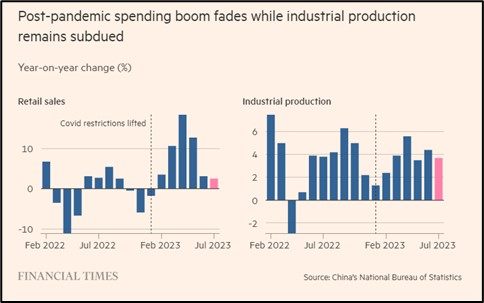
China:  Despite China’s stronger-than-expected oil demand in the IEA oil market report, several data releases today provided more evidence that the country’s post-pandemic economic rebound is running out of steam.  For example, April retail sales were up 18.4% year-over-year, but that was largely because of the big pandemic lockdown in Shanghai in April 2022.  The annual rise was weaker than expected, and sales last month were only slightly higher than in March.  The April unemployment rate fell to 5.2%, but that masked a record jobless rate of 20.4% for people aged 16 to 24.  Fixed-asset investment and factory production also disappointed.

China-South Korea:  Chinese police on Friday arrested Son Jun-ho, a 31-year-old who plays in China’s top-tier soccer league and has appeared for the South Korean national team, on suspicion of accepting bribes.  The arrest marks another in a series of detentions of high-profile foreigners from countries that have been working more closely with the U.S. to build their national defense capabilities and crack down on technology flows to China.

  • Along with Beijing’s recent clamp down on foreign consulting and information businesses in China, the arrests are probably retaliation for the U.S.’s dramatic and internationally coordinated restrictions on selling advanced semiconductors and related equipment and services to China. Those restrictions were first announced October 7, 2022.
  • The arrests and harassment of Western firms in China have already added to the disincentives for foreign companies to operate in China. That may seem counterproductive for Beijing.  However, it’s important to remember that the Chinese Communist Party ultimately wants to end the country’s reliance on foreign providers for any high-value goods or services.  The new arrests and harassments may signal that the party sees China as strong enough to push those foreign providers out now.

China-United States:  Yesterday, the U.S. Department of Justice announced that it has arrested Litang Liang, 63, of Brighton, Massachusetts, on charges of acting as an unregistered foreign agent for China.  Liang, a U.S. citizen, allegedly provided officials at the Chinese consulate in New York City with information about Boston-area individuals and organizations that oppose Chinese policies.  He also organized counter-protests against anti-Beijing activists in the area and suggested the names of ethnic Chinese people that Beijing’s spy services should try to recruit.

  • Naturally, the arrest of Liang will further spoil U.S.-China relations.
  • The arrest also provides more evidence that China is running a large, aggressive program of spying, influence operations, and extraterritorial policing on U.S. soil.

Japan:  As global investors plow into Tokyo’s stock markets, the country’s key indexes today have reached their highest levels in 33 years.  We agree that Japanese equities look attractive on several counts, including valuations, corporate performance, geopolitical trends, and the prospect for a decline in the value of the dollar, which typically boosts returns for foreign stocks.

Brazil:  Arthur Lira, the speaker of the Brazilian Congress’s lower house, vowed in an interview with the Financial Times that he will block any effort by leftist President Luiz Inácio Lula da Silva to roll back the business-friendly laws of the previous conservative President Bolsonaro.  The statement is being seen as a shot across the bow of the Lula administration, since it does not command a majority in congress and must rely on Lira’s center-right bloc in order to pass bills.

U.S. Monetary Policy:  Richmond FRB President Barkin yesterday said the Fed shouldn’t be afraid to keep raising interest rates to bring down inflation even if doing so raises the risk of financial instability.  Barkin effectively argued that bringing down inflation was a higher priority, and that “steady” rate hikes would help lower the risk of a financial crisis.


U.S. Fiscal Policy:  President Biden, House Speaker McCarthy, and other congressional leaders will meet face-to-face again today in an effort to reach a deal on raising the federal debt limit.  Biden expressed optimism yesterday that Democrats and Republicans can reach an agreement that would avoid a federal debt default.  Press reporting suggests the evolving deal might be built on fixed caps on federal spending for some period of time, clawing back unused pandemic relief funds, and tightening work requirements to receive certain federal benefits.

U.S. Labor Market:  A survey by the Wall Street Journal showed that the share of small-business owners who expect to expand their workforce over the next year was below 50% for the second month in a row in May, hitting the lowest level since June 2020.  The fall in hiring intentions is another hint that the economy is slipping toward recession, even if the main economic indicators don’t show it yet.

  • At the same time, the country continues to face longer-term imbalances in the labor market, in part because of the prospect for “re-industrialization” as geopolitical tensions and new government industrial policies encourage firms to invest more in domestic manufacturing.
  • Many of the new factories being built are in technology-intensive sectors like semiconductors, defense, and clean energy. Because of a shortage of U.S. workers with top-notch skills in science, technology, engineering, and mathematics, a number of tech and clean-energy executives have called for the government to urgently loosen immigration rules to let in more highly-skilled workers from abroad.
  • At the same time, the Biden administration has begun to stress that its signature laws which boost infrastructure investment and subsidize factory development will create many new jobs that don’t require a college degree. Once the economy has moved past the expected recession, the new re-industrialization could produce a long-lasting shortage of workers in areas like construction and construction trades, welding and metalworking, and machine-tool operating.

U.S. Stock Market:  Berkshire Hathaway (BRK-B, $323.53) revealed in a regulatory filing yesterday that it has opened a new position in credit-card issuer Capital One (COF, $89.12).  Because of CEO Warren Buffett’s reputation as a star investor, the news looks set to give a boost to Capital One when the market opens today.  The filing also revealed that Berkshire has recently increased its holdings in Apple (AAPL, $172.07) and Bank of America (BAC, $27,65), which could help buttress near-term buying in those names as well.

  • The company eliminated its position in at least two regional banks, consistent with the recent crisis in U.S. medium-sized and smaller lenders.
  • It also eliminated its position in Taiwan Semiconductor Manufacturing (TSM, $85.66), which perhaps should be no surprise given Buffett’s recent concerns about growing geopolitical tensions between China and the West.

View PDF

Bi-Weekly Geopolitical Report – Opportunities and Risks in a Tripolar Nuclear World (May 15, 2023)

Patrick Fearon-Hernandez, CFA | PDF

Some 30 years into China’s development boom, it’s no longer controversial to say that tomorrow’s global investment environment will be shaped by Beijing’s effort to displace the United States as the world’s dominant country.  China remains focused on building its various sources of power, whether they be political, economic, technological, or military.  We have examined those sources of power and their implications for investors in various publications.  This report dives deeper into one aspect of China’s growing military power: its new effort to expand its arsenal of strategic nuclear weapons and the means to deliver them against the U.S.

China’s nuclear buildup will result in a scarier, less stable world.  Many investors and investment managers will be tempted to close their eyes to this uncomfortable risk.  Here at Confluence, we think it’s better to understand this important trend and incorporate the resulting opportunities and risks into our investment strategies.  It may seem strange to mention opportunities in relation to a potential nuclear arms race, but history shows that riches are often made during times of war or international tension.  Although nuclear war is unthinkable and unwinnable, preparation for a conflict will require investment and economic allocation.  Portfolios should take this spending into account.  In discussing the investment implications of China’s nuclear buildup, we therefore identify both the opportunities and the risks that may arise.

Read the full report

Don’t miss the accompanying Geopolitical Podcast, available on our website and most podcast platforms: Apple | Spotify | Google