

Weekly Energy Update (March 9, 2023)

by Bill O’Grady, Thomas Wash, and Patrick Fearon-Hernandez, CFA | PDF

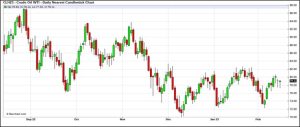
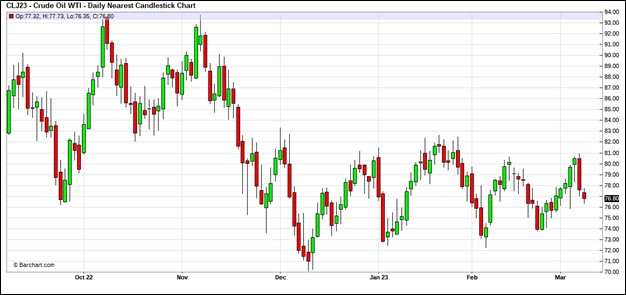
Crude oil remains in a trading range between $72-$82 per barrel.
(Source: Barchart.com)

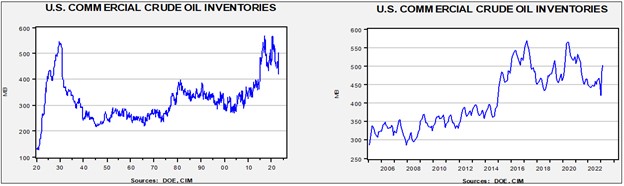
Crude oil inventories fell 1.7 mb compared to a 1.9 mb build forecast.  The SPR was unchanged.
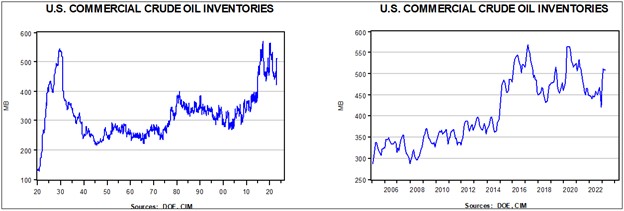
In the details, U.S. crude oil production declined 0.1 mbpd to 12.2 mbpd.  Exports fell 2.3 mbpd, while imports rose 0.1 mbpd.  Refining activity rose 0.2% to 86.0% of capacity.
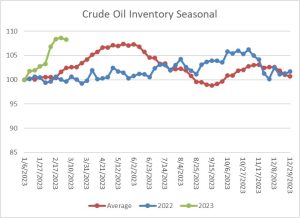
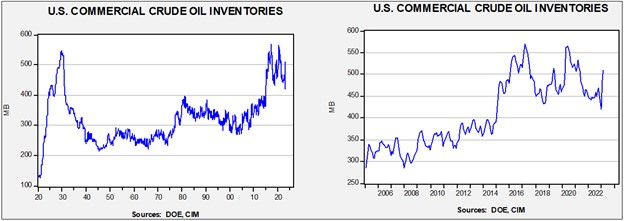
(Sources: DOE, CIM)

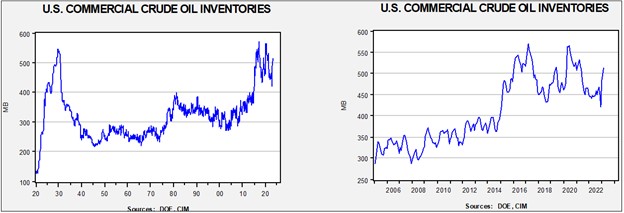
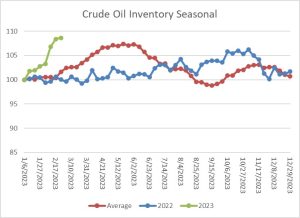
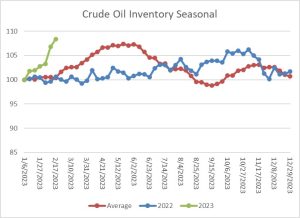
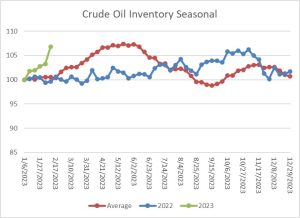
The above chart shows the seasonal pattern for crude oil inventories.  We have been accumulating oil inventory at a rapid pace, even without SPR sales.  This week, while there was a modest drop in inventory, we remain well above normal seasonal levels.
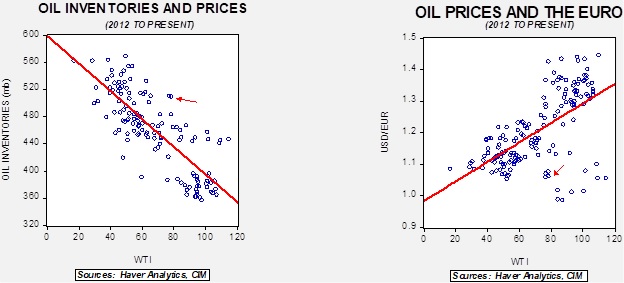
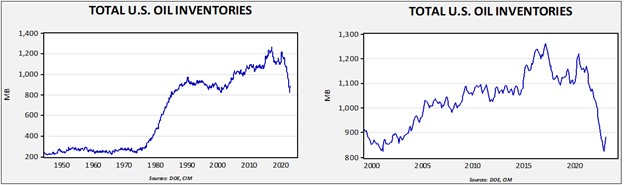
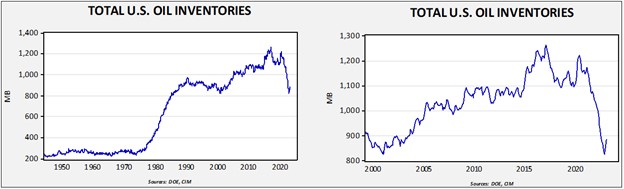
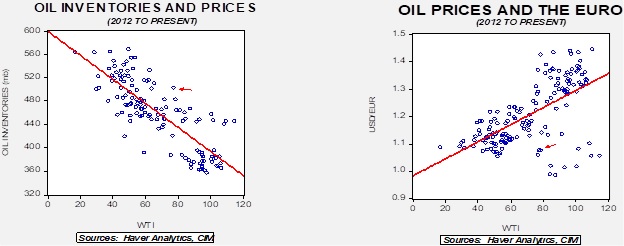
Since the SPR is being used, to some extent, as a buffer stock, we have constructed oil inventory charts incorporating both the SPR and commercial inventories.  With another round of SPR sales set to happen, the combined storage data will again be important.
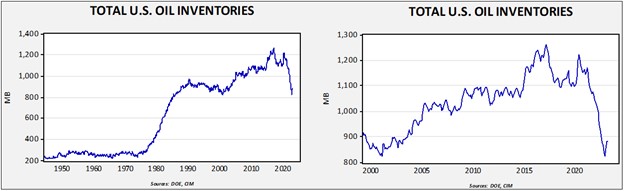
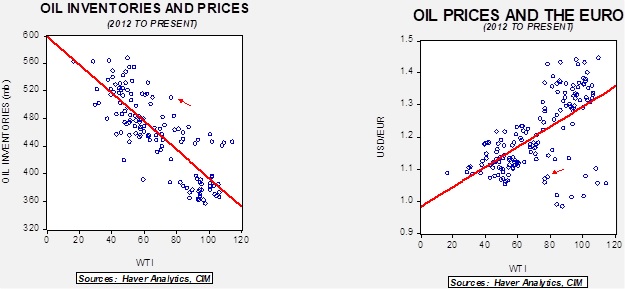
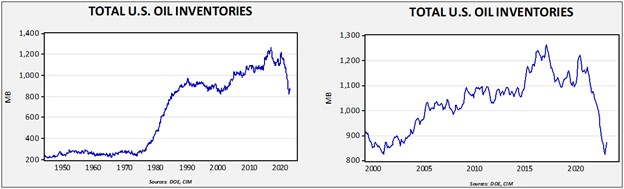
Total stockpiles peaked in 2017 and are now at levels last seen in 2001.  Using total stocks since 2015, fair value is $93.31.

The Unaccounted Problem

The DOE’s weekly report is a combination of survey data and estimates.  Although traders focus on the weekly reports, the government views the monthly reports as the most accurate.  Unfortunately, the monthly reports are issued with a two-month lag. For practical purposes then, the weekly data, though imperfect, is what moves markets.

Line 13 of the petroleum supply section of the petroleum balance sheet is a plug number called “adjustment.”  It was previously called “unaccounted for crude oil” as it balances the known sources of crude oil (production, net imports, stock change) with the level of crude oil consumed by the domestic refining industry.  Lately, this number has been rising.
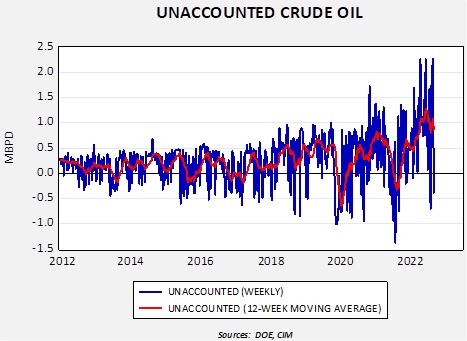
When the reading is above zero, it indicates that more crude oil was refined that week than was identified in the surveys or estimates.  What we know is that there is more crude oil (and/or associated products) available, but what is being missed is quite important.  The DOE argues that blending components used by refiners are possibly being included in the count of crude oil.  However, it is also possible that (a) production is higher than estimated since production in the lower 48 is an estimate, (b) imports are higher, (c) exports are lower, or (d) there is more oil being moved from inventory.  Obviously, how this unaccounted crude oil is accounted for matters a great deal.  Our guess is that it’s likely a combination of blending stocks being counted as crude oil and, perhaps, lower exports.  In any case, the monthly numbers should provide some clarity…in May.

Market News:

 Geopolitical News:

 Alternative Energy/Policy News:

  • The IEA released its CO2 emissions report for 2022. Although emissions reached a new record high, the pace of emissions growth is actually declining.
    • Carbon capture projects are continuing to develop, but the pipelines that carry CO2 to storage are unregulated at this point.
  • Agroforestry is the practice of planting trees around farm fields. The idea is that the trees will help prevent soil erosion and can provide shelter for livestock.  Government funding for increasing agroforestry is being considered.
  • The anti-ESG movement has begun to target insurance companies that may be denying coverage due to climate change concerns. The industry is pushing back, but it may be impossible for the government to force firms to cover areas adversely affected by climate issues.
  • In the early days of the auto industry, firms often attempted to vertically integrate operations. As the industry matured, it decentralized, which led to multiple firms supplying all sorts of inputs.  Due to insecurity of supply, EV makers are attempting to follow the early founders of car manufacturers by vertically integrating.
  • Volkswagen (VWAGY, $18.99) will build a battery plant in North America to take advantage of the subsidies offered by the Inflation Reduction Act. This news will likely trouble EU policymakers, who have been critical of the “buy American” elements of the act.
  • One of the problems with the transition to clean energy is that China dominates the production of the needed components. As the world devolves into blocs, the U.S.-led bloc may, in the short run, either continue to use fossil fuels or import clean energy components from China.
  • China is reportedly building “breeder” nuclear reactors. Although such reactors can be used to generate power, they also create plutonium which can be used for nuclear weapons.
  • Geothermal power is attracting attention from industry and government.
  • Environmentalist groups have been trying to curb oil and gas production by restricting pipeline expansion. Data from the DOE suggests that they were remarkably successful.  Meanwhile, oil companies are preparing the groundwork needed to acquire subsidies for investments in carbon capture.
  View PDF

Bi-Weekly Geopolitical Report – Enter the Petroyuan (March 6, 2023)

Bill O’Grady | PDF

In December, General Secretary Xi made a state visit to the Kingdom of Saudi Arabia (KSA) where he discussed the potential for trading oil in CNY.  Although nothing formal was signed on this issue, Xi suggested that the KSA should trade oil and gas using the CNY for settlement.  Talks between China and the KSA have been underway for some time, and there is a certain logic to making this change as China is the world’s largest oil importer and the KSA is its largest supplier.  For China, being able to buy oil with its own currency would reduce its need to acquire dollars to secure oil supplies.  For the KSA, accepting payment in non-dollar currencies would improve ties between the two nations.

Accepting payment for oil in currencies other than the dollar would be a major change in practice and has raised concerns about the dollar’s reserve status.  This discussion has triggered sharp divisions between some of the brightest minds in finance.  The potential for the emergence of a new payment system could bring notable changes to geopolitics and financial markets.

The dispersion of opinion on this issue is due, in part, to the “siloing” effect in academia and research.  Few foreign exchange or international finance analysts have a deep understanding of the energy markets, while most oil and gas analysts are not experts in foreign exchange or international finance.  This situation is unfortunate, because the experts on international finance tend to underestimate the critical nature of oil, while oil analysts miss the complexity of foreign exchange.  We will attempt to, at least partially, bridge that gap in this report.

In this (rather lengthy) report, we will begin with a short history of the geopolitics of oil and its intersections with finance.  This section will include a discussion of the sanction regimes implemented against Iran and Russia, which have raised concerns among other nations.  Included is an examination of the basics of reserve currency economics.  The next section will examine the emerging structure of the petroyuan system.  Following that will be a framing of the debate on the threat of the emerging petroyuan: Is it a replacement of the dollar system, or not?  We will close with the potential market ramifications of a parallel reserve currency regime.

Read the full report

Don’t miss the accompanying Geopolitical Podcast, available on our website and most podcast platforms: Apple | Spotify | Google

Business Cycle Report (March 2, 2023)

by Thomas Wash | PDF

The business cycle has a major impact on financial markets; recessions usually accompany bear markets in equities.  The intention of this report is to keep our readers apprised of the potential for recession, updated on a monthly basis.  Although it isn’t the final word on our views about recession, it is part of our process in signaling the potential for a downturn.

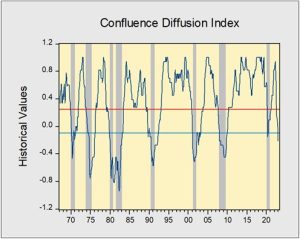
The Confluence Diffusion Index fell further into contraction territory in January. The latest report showed that eight out of 11 benchmarks are in contraction territory. The diffusion index declined from -0.03 to -0.21, below the recession signal of +0.2500.

  • Fed tightening hurt bond and equity measures
  • All the manufacturing indicators have dipped into contraction territory
  • The employment gauges are the only indicators in expansion territory

The chart above shows the Confluence Diffusion Index. It uses a three-month moving average of 11 leading indicators to track the state of the business cycle. The red line signals when the business cycle is headed toward a contraction, while the blue line signals when the business cycle is in recovery. The diffusion index currently provides about six months of lead time for a contraction and five months of lead time for recovery. Continue reading for an in-depth understanding of how the indicators are performing. At the end of the report, the Glossary of Charts describes each chart and its measures. In addition, a chart title listed in red indicates that the index is signaling recession.

Read the full report

Weekly Energy Update (March 2, 2023)

by Bill O’Grady, Thomas Wash, and Patrick Fearon-Hernandez, CFA | PDF

Crude oil remains in a trading range between $72-$82 per barrel.

(Source: Barchart.com)

Crude oil inventories rose 1.2 mb compared to a 1.8 mb build forecast.  The SPR was unchanged.

In the details, U.S. crude oil production was unchanged at 12.3 mbpd.  Exports rose 1.0 mbpd, while imports fell 0.1 mbpd.  Refining activity fell 0.1% to 85.8% of capacity.

(Sources: DOE, CIM)

The above chart shows the seasonal pattern for crude oil inventories.  We have been accumulating oil inventory at a rapid pace, even without SPR sales.  The primary culprit is low refining activity, which should pick up later this year.  The rapid rise in stockpiles is a bearish factor for oil, and current stockpiles have already exceeded the five-year average peak normally seen in early summer.

Since the SPR is being used, to some extent, as a buffer stock, we have constructed oil inventory charts incorporating both the SPR and commercial inventories.  With another round of SPR sales set to happen, the combined storage data will again be important.

Total stockpiles peaked in 2017 and are now at levels last seen in 2001.  Using total stocks since 2015, fair value is $94.18.

Natural Gas Update:

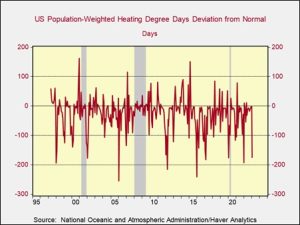
Natural gas prices have been under pressure this winter, mostly due to mild temperatures.

This chart shows the deviation of population-weighted heating degree days[1] for the U.S. compared to the average from 1981 through 2010.  A negative reading suggests warmer-than-normal temperatures, meaning fewer heating degree days.  Although this January was not the mildest on record, heating degree days were clearly below normal.

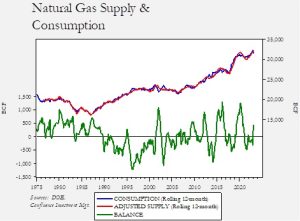
In looking at the trend of supply and consumption, currently the market is oversupplied (indicated by the balance variable being greater than zero).  Interestingly enough, consumption remains robust but so does supply growth.

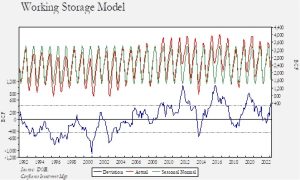
Because of the warm winter, current inventories are above normal.

The previous chart shows seasonally adjusted working natural gas storage.  As the deviation line shows, stockpiles are above normal.  We have one more month of storage withdrawals.  In April, the inventory injection season begins.

Market News:

(Source: NOAA)

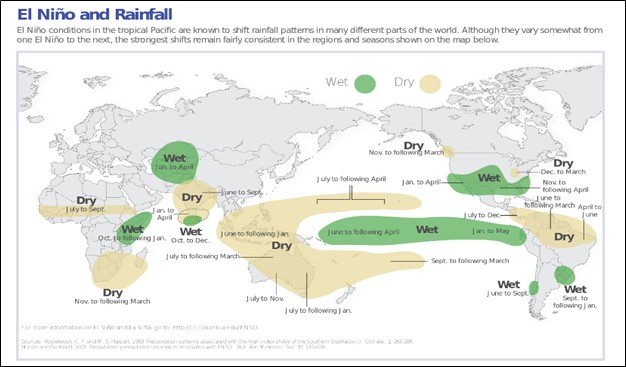
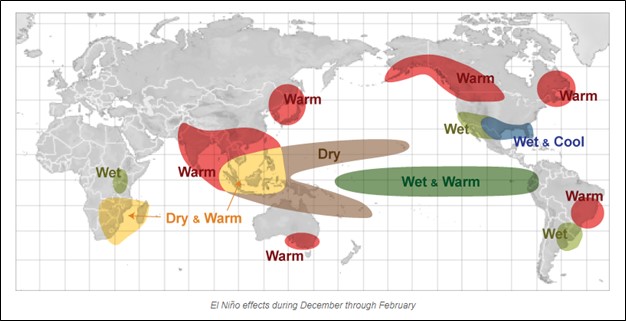
The below map shows likely winter temperature effects from El Niño.

(Source: weather.gov)

  • Although strong pricing of oil should support increased drilling activity, shale producers have been raising output slowly. Rising production costs and less attractive fields are capping production growth.
  • After more than 70 years, BP (BP, $39.87) announced that it will cease publishing its Statistical Review of World Energy. The report will now be compiled by the Energy Institute.

 Geopolitical News:

  Alternative Energy/Policy News:


[1] Heating degree days (HDD) are a measure of how cold the temperature was on a given day or during a period of days compared to 65oF. For example, a day with a mean temperature of 40°F has 25 HDD. Two such cold days in a row have a total of 50 HDD for the two-day period.

  View PDF

Asset Allocation Bi-Weekly – Federal Reserve Policymakers in 2023: Hawks or Doves? (February 27, 2023)

by the Asset Allocation Committee | PDF

The Federal Reserve surprised markets when it raised its benchmark fed funds interest rate by a total of 450 bps in 2022, the most rapid increase in over 40 years. Weighed down by technology stocks, equities had their first annual decline in over a decade. The weak stock performance was mainly due to investors’ beliefs that the Fed was not fully committed to its fight against inflation. Recent trends in the fed funds futures market suggest that investors are just now acquiescing to the idea that the Fed is determined to bring down price pressures. However, our analysis shows that the new committee in 2023 may be more dovish than the market currently realizes.

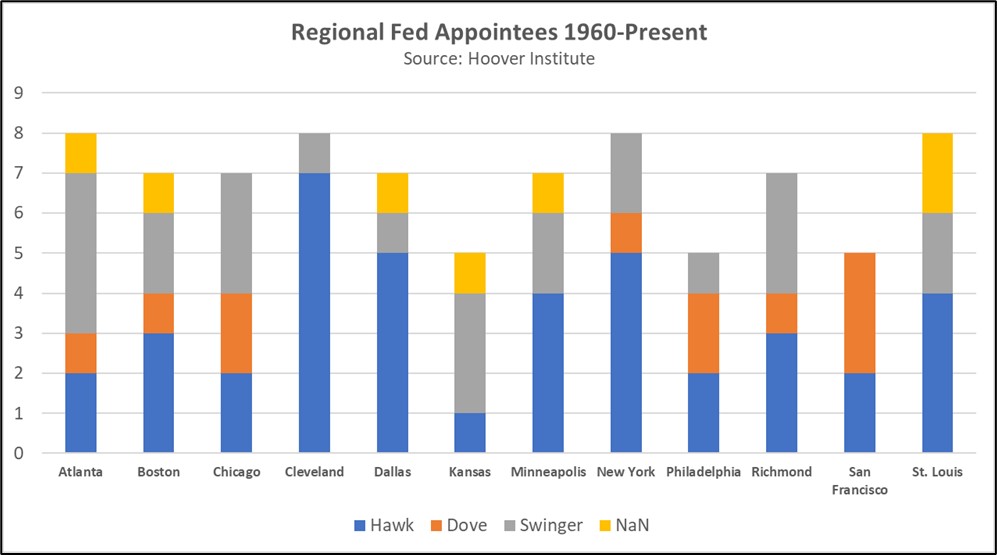
Based on data collected by InTouch Capital Markets, we have given a score to each of the permanent and rotating members of the Federal Open Market Committee based on their level of perceived policy assertiveness. The scores range from 1 to 5, with 1 being a complete dove and 5 being a complete hawk.

The FOMC has 12 seats total with four of those reserved for presidents of the regional Federal Reserve banks. Those four seats are rotated every year, and in 2023 they will be filled by new members from the Federal Reserve banks of Chicago, Dallas, Minneapolis, and Philadelphia. The new group will lean dovish, with an average score of 2.0 for policy assertiveness. In fact, three of the four new members in 2023 rank in the bottom quartile of assertiveness for all permanent and rotating FOMC members. These new members are significantly more dovish than their predecessors, whose average score is 2.6. Indeed, half of the members rotating out in 2023 ranked in the top quartile for policy assertiveness.

In addition to the rotating seats, President Biden’s selection of Lael Brainard as his top economic advisor has left one of the FOMC’s permanent voting seats vacant. There are 10 potential candidates for the position: Mary Daly, Austan Goolsbee, Susan Collins, Lisa Cook, Betsey Stevenson, Karen Dynan, Christina Romer, Janice Eberly, Brian Sack, and Seth Carpenter. Most of the candidates have ties to the Obama administration or are considered reliable doves, so it is unlikely that Brainard’s replacement will add to the current group’s policy assertiveness score. Currently, Chicago Fed President Austan Goolsbee is considered the front-runner. His selection would leave a vacant regional seat, and the Chicago Fed traditionally chooses doves or dove-hawk “swingers” as its president.

Although our analysis suggests that the Fed will favor accommodative monetary policy, the state of the economy and the level of inflation will also guide rate decisions. With unemployment well below its natural rate and inflation significantly above the Fed’s 2% inflation target, the policymakers are still inclined to tighten policy. Hawkish comments from Fed officials following January’s higher-than-expected CPI report illustrate the committee’s sensitivity to backsliding inflation data. Hence, just because the FOMC members may lean dovish doesn’t mean that they will vote that way.

Historically, Fed officials have not been comfortable with raising rates during a recession. The last time the Fed tightened in a downturn was in 1982. Therefore, if unemployment rises significantly, this current group of FOMC voters will likely stop hiking. However, January’s blockbuster payroll numbers and a near-record-low unemployment rate suggest that a pause is unlikely to happen in the short term. Nevertheless, as the economy heads into recession, which we expect to take place in the second half of the year, we will likely begin to see more Fed officials pushing back against further tightening.

We currently forecast that the approaching downturn will probably be a garden-variety recession, which will downplay the need for aggressive rate cuts. Given the Fed’s dovish tilt we suspect that the committee may pause or make a slight pivot by the end of the year. If we are correct, then this outcome will likely lead to a sharp recovery in equities. However, if inflation increases and the economy continues to expand, the Fed could raise rates again which could weigh on stocks.

View PDF

Weekly Energy Update (February 23, 2023)

by Bill O’Grady, Thomas Wash, and Patrick Fearon-Hernandez, CFA | PDF

Crude oil remains in a trading range between $72-$82 per barrel.

(Source: Barchart.com)

Crude oil inventories rose 7.6 mb compared to a 2.0 mb build forecast.  The SPR was unchanged.

In the details, U.S. crude oil production was unchanged at 12.3 mbpd.  Exports rose 1.5 mbpd, while imports rose 0.1 mbpd.  Refining activity fell 0.6% to 85.9% of capacity.

 (Sources: DOE, CIM)

The above chart shows the seasonal pattern for crude oil inventories.  We are accumulating oil inventory at a rapid pace, even without SPR sales.  The primary culprit is low refining activity, which should pick up later this year.  The rapid rise in stockpiles, though, is a bearish factor for oil, and current stockpiles have already exceeded the five-year average peak normally seen in early summer.

Since the SPR is being used, to some extent, as a buffer stock, we have constructed oil inventory charts incorporating both the SPR and commercial inventories.  With another round of SPR sales set to happen, the combined storage data will again be important.

Total stockpiles peaked in 2017 and are now at levels last seen in 2001.  Using total stocks since 2015, fair value is $94.35.

Market News:

 Geopolitical News:

 Alternative Energy/Policy News:


[1] Most natural gas storage is housed in depleted wells.  To maintain well integrity, gas must be injected and withdrawn at a steady pace.  During mild winters, current production and required storage withdrawals tend to cause significant price weakness.

  View PDF

Bi-Weekly Geopolitical Report – Chip War: Book Review (February 21, 2023)

Thomas Wash | PDF

It was simple in the beginning. American firms developed all the designs for semiconductor chips, and Asian manufacturers turned them into reality. It was a match made in capitalist heaven. This all changed after the pandemic exposed supply chain vulnerabilities in the business model, and the situation only worsened after Russia’s invasion of Ukraine. This has led to a rethink regarding the U.S.’s reliance on Taiwan-produced semiconductors. Thus, an industry model which previously had been based solely on working with the lowest-cost producer must now consider supply-chain security.

In his book Chip War: The Fight for the World’s Most Critical Technology, Chris Miller discusses how semiconductors have become essential for economic and military ambitions. The author not only details how semiconductors originated but also how they became a linchpin in the global economy. In this report, we summarize the findings in Miller’s book, including how chip manufacturers paved the way for globalization and a subsequent clash between global powers. Additionally, we provide our thoughts on the book and conclude with potential market ramifications.

Read the full report

Don’t miss the accompanying Geopolitical Podcast, available on our website and most podcast platforms: Apple | Spotify | Google

Weekly Energy Update (February 16, 2023)

by Bill O’Grady, Thomas Wash, and Patrick Fearon-Hernandez, CFA | PDF

Crude oil prices appear to have based but so far have failed to break above resistance at around $80-$82 per barrel.

(Source: Barchart.com)

Crude oil inventories rose a whopping 16.3 mb compared to a 2.0 mb build forecast.  The SPR was unchanged.

In the details, U.S. crude oil production was unchanged at 12.3 mbpd.  Exports rose 0.2 mbpd, while imports declined 0.8 mbpd.  Refining activity fell 1.4% to 86.5% of capacity.

 (Sources: DOE, CIM)

The above chart shows the seasonal pattern for crude oil inventories.  We are accumulating oil inventory at a rapid pace, even without SPR sales (see below).  The primary culprit is low refining activity, which should pick up later this year.  The rapid rise in stockpiles, though, is a bearish factor for oil.

Since the SPR is being used, to some extent, as a buffer stock, we have constructed oil inventory charts incorporating both the SPR and commercial inventories.  With another round of SPR sales, the combined storage data will again be important.

Total stockpiles peaked in 2017 and are now at levels last seen in 2001.  Using total stocks since 2015, fair value is $95.37.

The Nord Stream Issue:  Seymour Hersh, a long-time investigative reporter, released a blockbuster allegation a few days ago, suggesting that the U.S., along with Norway, attacked the Nord Stream pipelines.  According to his report, U.S. Navy divers from the Diving and Salvage Center based in Panama placed explosives on the pipeline and were responsible for the damage.  If these allegations are true, it would create a crisis.  Arguably, this action is a casus belli and could put the U.S. and NATO into a direct conflict with Russia.  Although, before we take the report at face value, caution should be exercised.

Hersh is an 85-year-old investigative reporter who won a Pulitzer Prize in 1970 for uncovering the Mỹ Lai massacre.  However, over the years, a good bit of his reporting has been increasingly discredited.  He wrote a large piece for the London Review of Books that suggested the Obama administration’s account of the assassination of Osama bin Laden was essentially a lie.  He faced strong criticism for that report, which relied heavily on unnamed sources.  Later, he seemed to side with the Assad regime over chemical weapons, but the allegations he made were not entirely refuted either.  Our take is that Hersh, at least at one time, was an important journalist.  Over the years, though, his reporting seems to have become increasingly erratic.

As we noted, Hersh isn’t a crackpot, but likely due to his experiences in dealing with the U.S. military and intelligence agencies, he seems to have taken a position more recently that the benefit of the doubt should go to foreign interests.  Thus, there is a potential bias to his reporting.  At the same time, even though there is a notable lack of sourcing in the report, there are solid geopolitical reasons for the U.S. to want to end Nord Stream.

The age of oil has been difficult for Europe, mainly because the continent doesn’t have much oil of its own.  Although Europe is blessed with ample coal resources, the superiority of oil as an energy source meant that without secure sources of oil, European dominance of the world was in trouble.  There is a bit of production available in Romania, and of course, after oil prices spiked in the 1970s, oil was extracted from the North Sea, but Europe was never going to achieve oil and gas independence.  The European powers attempted to expand their colonial reach into the Middle East and Asia to acquire oil, but those areas proved difficult to secure.  The Dutch lost the oil in Southeast Asia to Japan during WWII.  After WWII, when the U.S. fostered independence for European colonies, Europe lost controlled access to oil in North Africa and the Middle East.  Until the early 1970s, Europe was mostly dependent on the U.S. for oil.  Not wanting to be fully dependent on Washington for energy, Europe, and especially Germany, turned to Russia.  Naturally, this reliance on Russia wasn’t popular with the U.S.  Consistently, American administrations criticized Europe for its increasing reliance on Russia oil and gas.  The Nord Stream projects were especially galling because they directly linked Russia to Germany.

Thus, the destruction of the pipelines is arguably in American interests.  That’s why this narrative will likely be hard to quash, even if the Hersh reporting is false.  It is natural to assume that if a party benefits from an event it might have had a role in causing it.  However, that is about as far as this goes.  It is quite possible that Hersh received this information from someone that would also benefit from increased tensions between the U.S. and Russia.  And since no sources are named, it may be impossible to really prove anything.

We will continue to monitor developments and reporting around this issue.  We doubt that we will see anything definitive on this in the near term, so the most likely outcome is that it won’t cause an escalation directly involving the U.S. and NATO against Russia.  But we could see “tit-for-tat” actions, such as sabotage of LNG facilities, cutting of fiber optic cables, etc.

Market News:

  • The big news this week, although maybe it shouldn’t be, is that the U.S. will sell an additional 26 mb out of the SPR. This sale was previously mandated by Congress.  Over the past couple of decades, Congress has, on occasion, used the SPR as sort of a “slush fund” to address budget issues that couldn’t be met with taxes or by borrowing.  This is a rather small sale given the scale of recent withdrawals, but the market didn’t take the news well by selling on fears of further sales from the reserve.  In fact, the administration considered canceling the sale, but doing so would have required an act of Congress, probably difficult to do in the current environment.  We don’t think this sale matters all that much, but our Twitter feed lit up with all sorts of commentary about how irresponsible the SPR sales were, and “look, they are at it again.”   We don’t disagree about the risks from earlier sales, but this one isn’t all that big of a deal.
  • The IEA is forecasting oil demand will reach a new high this year due to China’s reopening.
  • In response to the G-7 price cap, Russia announced a 0.5 mbpd oil production cut. There are two concerns beyond the obvious one that this action will lift prices. The first is that Russia may not be making this cut voluntarily but is finding that demand for its oil is falling.  Announcing a cut may be a measure to save face.  Second, cutting production is always a risky idea because once a well is shut in, in a short amount of time that production is lost without having to redrill.  Complicating matters further is that Russia was dependent on Western expertise to drill and maintain technically difficult oil fields.  Sanctions and disinvestment may lead to further output losses.  Oil prices initially rose on the report but failed to hold gains.  Oil markets are most likely worried about global recession weakening demand rather than the loss of supply.
  • China is working on an LNG deal with Qatar. As Qatar develops its North Field, it is apparently looking for long-term contracts to finance the development.
  • Although Freeport began exporting LNG this week, regulators report that the plant has systemic safety concerns.
  • The U.S. natural gas market is dealing with increased demand, especially from LNG, and rising production. However, inventory capacity is mostly fixed, meaning that price volatility is rising.  Complicating matters is that most U.S. inventory facilities are depleted gas wells where, to maintain integrity, gas is injected and withdrawn at a mostly steady pace.  This factor leads to a seasonal pattern of storage where gas is injected from April to October and withdrawn from November to March.  Storage seasonality is why price lows usually occur in January; however, if temperatures are moderate, stored gas must still come to market.  Exports come with their own set of difficulties.  Although European gas prices have declined due to mild temperatures, once the European refill season begins, export demand will likely increase.  Volatile natural gas prices will make planning difficult and could increase volatility for fertilizer and chemical prices as well.
  • We are hearing of increasing concern over the future production from the Permian Basin. In some respects, this is nothing new.  A few years ago, some analysts were sounding the alarm that drilling practices were damaging reservoirs.  Now, firms operating in the region are considering consolidation which is rational if production has peaked.
  • A growing number of long-term forecasts suggest that U.S. oil demand may be close to peaking. If true, the case for investing in future production would be hard to make. At the same time, the lack of refining investment could lead to strong margins for the foreseeable future.
  • A warming trend over the Arctic may bring much colder temperatures to Europe and North America. If it persists, it could lead to a cold spring which could delay crop planting.

 Geopolitical News:

 Alternative Energy/Policy News:

  View PDF

Asset Allocation Bi-Weekly – Reflections on Inflation (February 13, 2023)

by the Asset Allocation Committee | PDF

[Note: There will be no accompanying podcast with this report.]

Several advisors and their clients have been asking questions about inflation, which suggests there is a degree of uncertainty surrounding the issue.  This uncertainty is understandable as inflation is a very complicated subject and, unfortunately, economic theory has oversimplified inflation to the point where it can seem mechanical.  For example, an increase in the money supply and/or strong economic growth doesn’t always lead to inflation, but theory would suggest it should.  On the other hand, sometimes these factors do lead to inflation.  In the absence of a definitive working theory of inflation, confusion shouldn’t be a surprise.

We won’t offer a definitive theory of inflation in this short report, but we will make some observations that will hopefully shed some light on the situation.  First, it’s important to have working definitions of topics.  The Consumer Price Index (CPI) measures the cost of living, while inflation measures the rate of change in the cost of living.

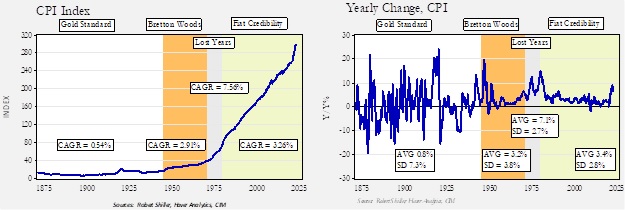
The chart on the left shows the CPI beginning in 1871, and the chart on the right depicts the yearly rate of change (inflation).  On both charts, we have labeled four different monetary regimes.  On the far left is the Gold Standard.  It yielded cost of living stability, and over time, the level of the index barely budged.  However, the chart on the right shows the rate of change in the index (inflation or deflation), indicating that price volatility was the main feature of the Gold Standard years.  Because the money supply was mostly fixed, industrial expansion often led to deflation.  During wars, or when new gold mines were discovered, the influx of new money or the increase in velocity (wars boost spending) led to spikes in inflation.  Note the standard deviation in this period was a whopping 7.3%.

The second regime was Bretton Woods, which was a quasi-gold standard.  The dollar was convertible to gold, and other currencies were fixed against the dollar.  In theory, this system created an anchor, with the idea that the U.S. couldn’t abuse its reserve currency position because foreigners could demand gold for their dollars.  In practice, the U.S. was only partially constrained by the restriction of gold convertibility.  Capital controls were a key feature of this era.[1]  But the advent of the Eurodollar market created a way to circumvent capital controls and accelerated the end of Bretton Woods.  Still, in terms of price and inflation control, the system led to higher, but much less volatile, inflation.

The third regime, known as the Lost Years, emerged when President Nixon ended gold convertibility.  Although the Eurodollar market was undermining the system, Nixon didn’t want to curtail fiscal spending or the Fed to trigger a recession going into the 1972 election.  The decision unmoored the dollar and convinced foreigners that the U.S. would not inflict austerity in order to protect the value of the dollar.  In other words, American policymakers would protect the domestic economy to the detriment of foreigners.[2]  The greenback entered a deep bear market, and inflation roared.  Interestingly enough, the standard deviation actually fell, suggesting that prices were rising at a steady clip.

The fourth era, which we call Fiat Credibility, is the current regime.  Paul Volcker was a key figure in this regime.  Although he is credited with bringing down inflation by forcing two recessions on the economy, perhaps his greatest contribution was that his policies signaled that the U.S. would implement austerity (at least monetary austerity) and would be willing to put the country into a deep downturn to curtail inflation.  In other words, Volcker signaled that, to bring inflation under control, the U.S. would offer some degree of protection to foreign investors.  The dollar soared, and combined with deregulation and globalization, inflation remained at bay.[3]  Monetary policy had two pillars: a defined inflation target (usually 2%) and central bank independence, both seen as necessary to implement austerity.

This history shows that low inflation isn’t the same as cost-of-living stability.  During the Gold Standard, the broad index of prices didn’t change much over time, although year-to-year the swings could be large.  The Fiat Credibility era showed that steady price increases can be tolerated.  But make no mistake about it—prices generally rise.  When Chair Greenspan was asked to define price stability, he stated that it is an inflation level low enough to where the general price level isn’t taken into consideration when making investment or purchasing decisions.  However, this isn’t cost-of-living stability; instead, it’s a pace of price increases deemed to be tolerable.

Ultimately, inflation becomes a problem when businesses and households think it’s a problem.  When inflation begins to affect purchasing and investment decisions, the very act of protecting oneself from higher future inflation creates an adverse feedback loop of ever-increasing inflation.  For example, a business estimating a project will build in an inflation estimate for materials, thereby increasing the cost to the buyer.  Consumers, seeing higher prices, begin to protect themselves by hoarding goods. Accordingly, businesses may react similarly, causing rising inventories.  Consumers will also tend to buy sooner rather than later, which can feed into demand and exacerbate inflationary pressures.

Central bankers believe that 2% inflation is tolerable, and thus, have established public targets for that rate.  However, there isn’t anything to prove that 2% inflation has this unique characteristic.  It’s just as possible that 3% might lead to the same outcome, or it’s also possible that any target rate might lead to the perception of price stability.

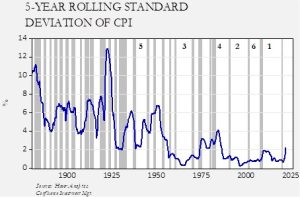
This chart shows the rolling five-year standard deviation of the yearly change in CPI.  We have numbered business cycles by their length in rank order.  In general, there is a tendency to see long expansions when price volatility is below 2%.  This chart suggests that the pace of price increases may matter less than the dispersion.  Note that in the Gold Standard years, recessions were common, but ultimately, what households and businesses want is the absence of recessions.  It is quite possible that the 2% target isn’t “magic”; instead, inflation stability may be the more important goal.

Sadly, in a world that is resetting supply chains, inflation volatility is much more likely.  This is because the end of the 1990-2020 period of hyper-globalization will likely lead to a steeper aggregate supply curve which means greater inflation volatility.  If so, maintaining the 2% target may be excessively costly to the economy and, in fact, may lead to more frequent recessions and higher inflation variation.


[1] This feature also allowed governments to implement high marginal tax rates on high earning households.  It was difficult to avoid taxes by shifting money abroad.

[2] Hence the famous quote, “The dollar is our currency, but it’s your problem.”

[3] That is, until recently.


View PDF