


Asset Allocation Bi-Weekly – The Power of Gold (May 11, 2026)

by Patrick Fearon-Hernandez, CFA | PDF

Since the Iran war began on February 28, several corners of the financial market have behaved in unusual and unexpected ways, with gold prices being perhaps the most surprising. Gold has been a safe-haven asset for centuries, and investors have come to expect its value to rise in times of crisis or conflict. Indeed, many investors hold gold specifically to hedge against political instability or other disasters, just as they tend to hold it to hedge against currency debasement or price inflation. In this case, however, gold prices fell sharply in the days after the war commenced and have only modestly rebounded in recent weeks. What’s behind this extraordinary behavior?
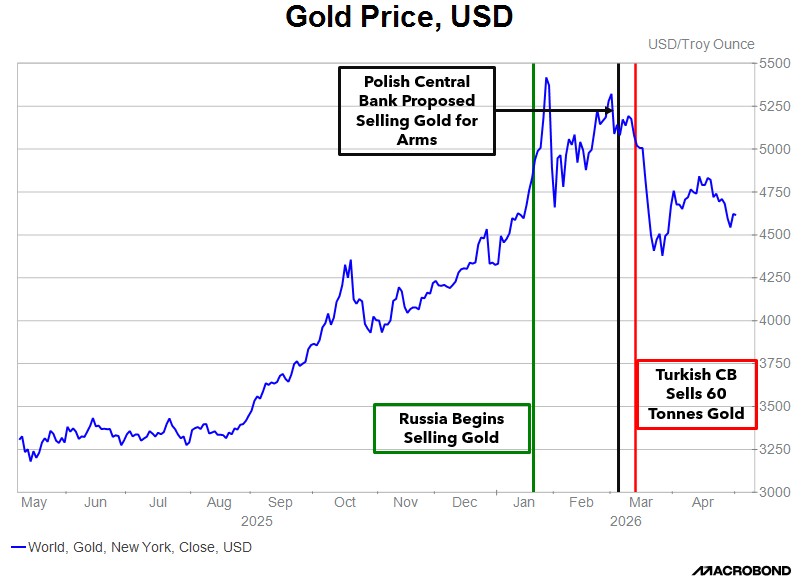
In our view, gold prices fell mostly because central banks and other major investors have been trying to raise liquidity ahead of an anticipated spike in costs. For example, since most oil is traded in dollars, central banks in oil-importing countries must raise greenbacks to prepare for a surge in oil import costs. The chart of gold prices above illustrates the phenomenon. In the chart, the vertical red line shows when Turkey’s central bank announced it would sell 60 tonnes of gold to raise dollars. Other central banks also reportedly started selling gold at about the same time, taking profits after gold prices skyrocketed in the months ahead of the war. This also marks the date when gold prices began to soften in response to all this selling. Gold prices dropped from about $5,200 per ounce in early March to about $4,700 per ounce at the end of April, for a decline of almost 10%. In contrast, other traditional safe-haven assets have held their value much better. Medium-term Treasury notes had a negative total return of 1.5%, while three-month bills returned about 0.6%.

One new factor is that many foreign reserve managers now see gold as a replacement for US Treasurys. It therefore makes sense, in a crisis, for them to sell the yellow metal to raise liquidity. Before the US levied sanctions on Iran and Russia in recent years, reserve managers tended to view Treasurys and gold as complementary: Gold was held as a long-term asset, while Treasurys were prized for liquidity management. Thus, gold sales were rare, and when they were executed, it was usually due to a structural decision as to the allocation of gold and Treasurys. Following the US imposition of sanctions on foreign-held Treasurys, gold is now being seen as a substitute. One change this appears to be causing is that reserve managers will now sell gold to raise liquidity. Due to this change in reserve management practice, we think gold prices are likely to become more volatile going forward.
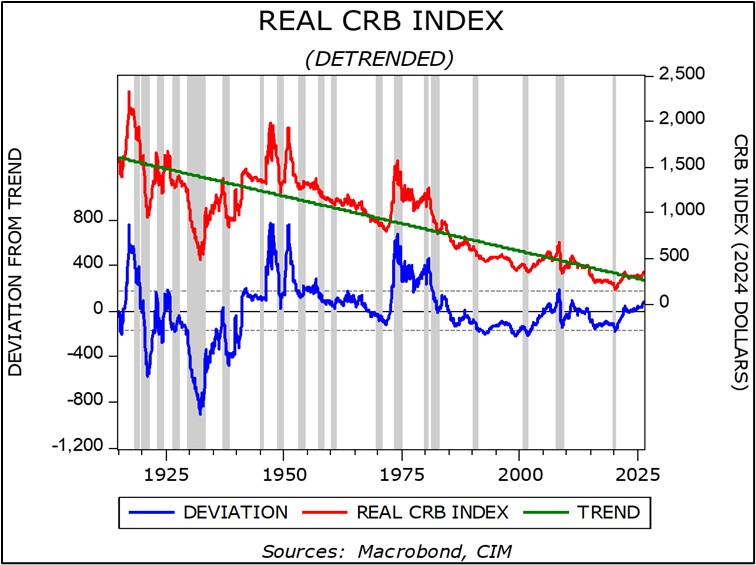
An important question is whether gold will rebound and regain its reputation as a safe-haven asset. On that score, we’re optimistic given the historical behavior of commodity prices generally, and gold prices in particular, during periods of conflict and geopolitical upheaval. In the chart above, the red line shows how the inflation-adjusted CRB commodity-price index has changed over time. The green, downward-sloping trend line shows that real commodity prices tend to fall over time. This is what would be expected in a capitalist economy that incentivizes commodity producers to boost output and users to use less. However, in periods of geopolitical conflict or major supply disruptions, such as the periods around World War II and in the mid-1970s, commodity prices may spike well above the trend and stay high for some time. We think we’re heading into an era like that now. In fact, we can see that the red index line is now moving above the trendline.

For centuries, gold has been prized as a safe, secure store of value based on characteristics such as its density, malleability, and resistance to corrosion. We therefore believe that its recent liquidity-driven selling is likely to peter out soon, if it hasn’t already done so, even if gold prices remain more volatile than in the past. We also think global central banks could replenish their gold holdings once the war in Iran cools down. After all, we think many central banks want to continue diversifying their reserves away from the US dollar and the risk that dollar holdings pose for US sanctions. The recent modest rebound in gold prices gives us some confidence in that stance. In fact, we have recently increased our exposure to gold in some of the Confluence Asset Allocation strategies, while keeping our allocations to the yellow metal unchanged in the others.
View PDF

Note: The accompanying podcast for this report will be delayed until later this week.

Asset Allocation Bi-Weekly – Wars, Price Shocks, and Inventories (April 13, 2026)

by Patrick Fearon-Hernandez, CFA | PDF

Since the launch of the US-Israeli war against Iran on February 28, if there’s been one dramatic feature, it’s that the conflict and official statements about it have shifted dramatically almost on a daily basis. By the time this report is published, the war could be going in a wholly different direction from when we started writing it. Nevertheless, we do think we can make some predictions about how the conflict will affect the global economy over the long term. One such prediction touches on how corporate behavior may change in the future. Specifically, we think the war will spur companies to once again embrace high inventories to shield themselves against supply disruptions and associated price jumps. A broad return to higher inventories will likely have important implications for corporate profitability, facility-site decisions, and stock valuations.

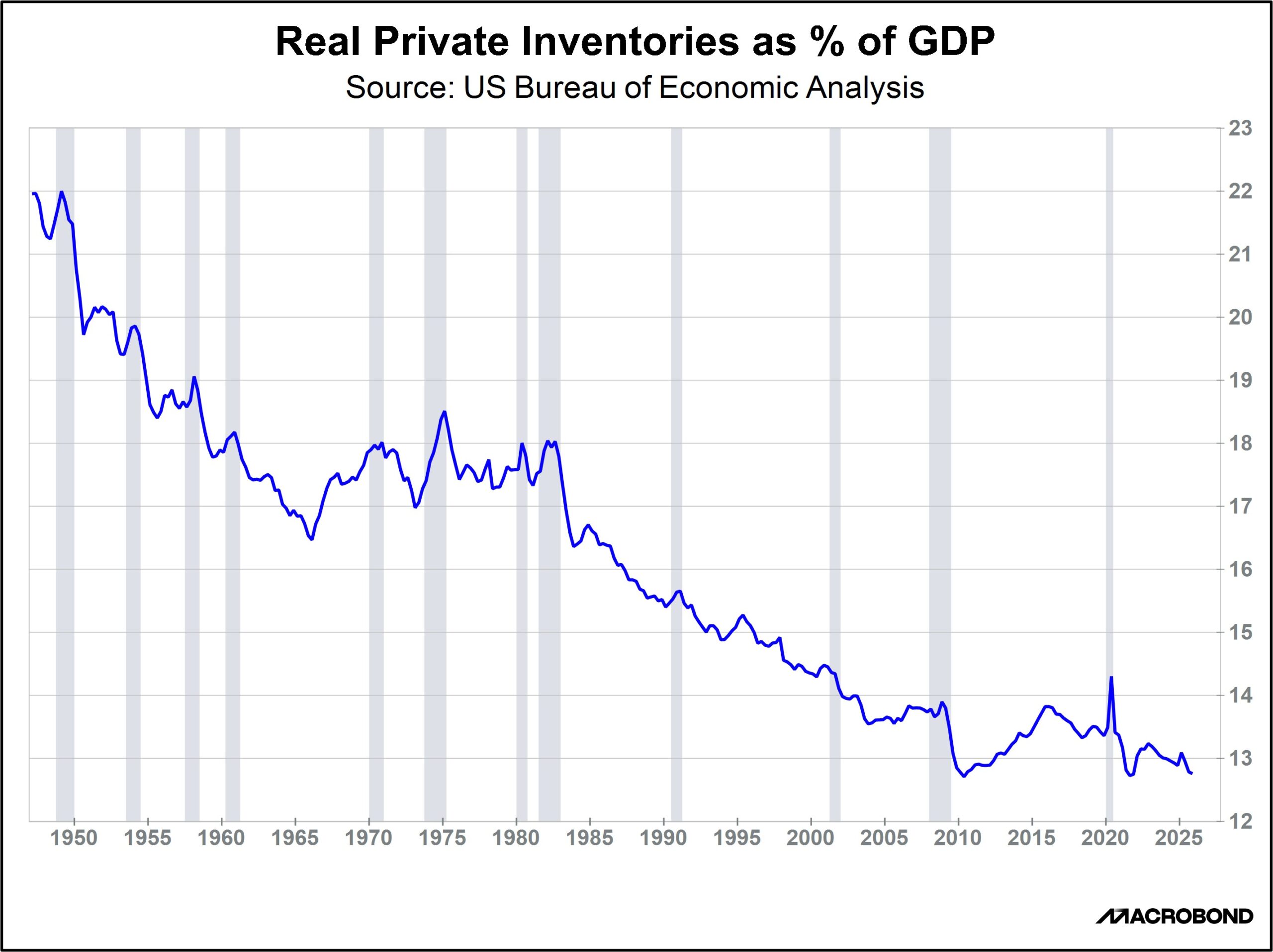
The chart above shows the inflation-adjusted value of US private sector inventories as a share of gross domestic product (GDP) since the end of World War II. Clearly, the overall trend has been for companies to hold less inventory compared with their sales. What explains this? We believe many factors are responsible. For example, the extremely high inventories around World War II and the Korean War probably reflected hoarding at a time of limited consumer sales. Inventory holdings would have naturally fallen as the end of those conflicts allowed for normalized supply dynamics and rebounding consumer spending. At the same time, innovations in transportation quickened delivery times and reduced freight costs, while the information technology revolution improved the ability of firms to optimize inventory holdings. And, as we’ve argued many times before, the end of the Cold War convinced many business managers that global peace was at hand and that competing in the era of globalization required using just-in-time inventory management.

Equally noteworthy, the decline in price inflation since the early 1980s has made inventories less needed. Indeed, the chart above shows a long, steep decline in inventory ratios starting in the early 1980s when the Federal Reserve under Chair Paul Volker hiked interest rates and Congress passed a series of deregulation bills, both of which slashed price pressures on the economy. Just as important, the chart clearly shows how rising inflation in the 1960s and the energy crises of the 1970s prompted a big jump in inventory holdings equal to about 1% of GDP. The chart also shows that after commodity prices surged around 2005, firms boosted their inventory holdings. That inventory investment was short-circuited by the US housing crisis, but once the recovery started, inventories climbed back to almost 14% of GDP.

This review of history suggests that as company management internalizes the commodity supply shocks and rising prices associated with the war in Iran, there will likely be a rebuilding of inventories. More broadly, as it becomes increasingly clear that the war reflects a wider geopolitical change marked by a US retreat from hegemony, global fracturing, and increased international tensions, we think the rebound in inventories could be bigger and longer lasting than the one in the early 2000s. We also believe this trend will extend beyond the US, with companies around the world incentivized to boost their inventory holdings again.

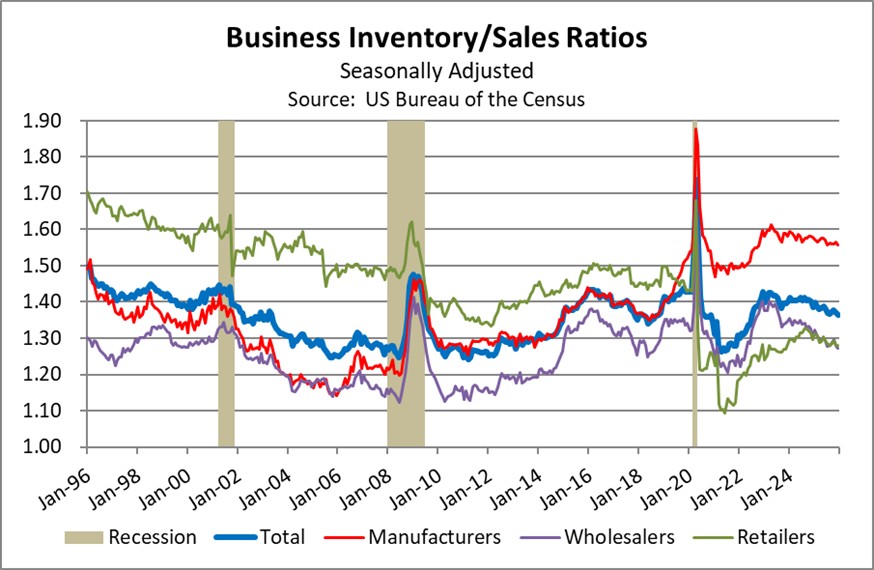
What firms will be most affected? In the chart above, we focus on the US Census Bureau’s current series of monthly business sales and inventory data, in nominal terms, which allows us to trace corporate inventory/sales ratios by sector. The chart clearly shows that the rise in the overall inventory/sales ratio since the early 2000s has come from higher manufacturing stockpiles. This makes sense to us, as supply disruptions and higher costs for inputs and components are probably more important for manufacturers than for wholesalers or retailers. Going forward, we suspect that the Iran war will especially boost inventory holdings at the factory level.

In our view, any broad, sharp rise in manufacturers’ inventories from here on out will have significant investment implications. For example, holding more inventories will tie up more of manufacturers’ capital and increase costs. Investors are therefore likely to put higher valuations on the stocks of manufacturing firms that can better control their inventory levels, all else being equal. Given that the US is now a net energy exporter and has significantly greater levels of secure supplies of oil, gas, and other key commodities, we expect many foreign manufacturers to move production to the US, helping to reindustrialize the US economy and stimulating business for US suppliers. The need to store more inventory could also lead to increased demand and stronger rents for firms that own commercial warehouses. All the same, higher inventories will generally result in a less efficient economy than in the just-in-time world of globalization, so price inflation is still likely to be higher and more volatile than in years past, and the same will likely be true for interest rates.

View PDF

Don’t miss our accompanying podcasts, available on our website and most podcast platforms: Apple | Spotify 

Bi-Weekly Geopolitical Report – Implications of North Korean Soldiers in the Ukraine War (November 18, 2024)

by Daniel Ortwerth, CFA  | PDF

In late October, the world learned that North Korean soldiers had deployed to Russia to assist their allies in the Ukraine war. This dramatically changed the geopolitical profile of the conflict. Allies and partners of both Ukraine and Russia have been providing material and financial support to both countries since virtually the beginning of the war. North Korea itself (formal name Democratic People’s Republic of Korea, or DPRK) has been contributing large quantities of arms and ammunition to Russia; however, this is the first known instance of another country sending combat troops to join the fight on either side. This precedent-setting action marks a clear escalation and raises the question of how this development might further accelerate the conflict.

This report addresses that question. We begin with a review of the known facts concerning troop numbers, types, locations, etc. We continue with an assessment of the likely impact of DPRK forces on the course and outcome of the Ukraine war and culminate with considerations of how this development might affect the broader geopolitical landscape beyond the conflict. As always, we conclude with investment implications. Since this report addresses a newly emerging and rapidly evolving development, its status may materially change post-publication. We encourage readers to monitor our Daily Comment for emerging updates.

Read the full report

Don’t miss our accompanying podcasts, available on our website and most podcast platforms: Apple | Spotify