


Author: Rebekah Stovall
Asset Allocation Bi-Weekly – #104 “Where’s the Recession? Examining Employment” (Posted 8/14/23)
Bi-Weekly Geopolitical Podcast – #33 “China’s Collapsing Population” (Posted 7/24/23)
Keller Quarterly (July 2023)
Letter to Investors | PDF
At least once a decade, the stock market vibrates with excitement over a new technology and, in this revelry, the stocks of any company close to that technology separate themselves from the rest of the market as a rocket separates itself from the ground. That remarkable upward surge in stock prices provides validation to speculators that they’re doing the right thing in paying exorbitant prices for these stocks. No analysis of business models, profit margins, capital structures, dividends, or (least of all) valuations are required. All that’s needed to justify the investment is to cite the name of the technology: “It’s artificial intelligence!” No other explanation is needed. Other speculators nod knowingly. “It’s a sure thing!”
Prior speculations were provided with similarly simple justifications. “It’s crypto-currency!” “It’s electric vehicles!” “It’s the internet!” “It’s mobile phones!” “It’s personal computers!” “It’s semiconductors!” “It’s plastics!” “It’s television!” “It’s radio!” “It’s the airplane!” “It’s the automobile!”
The ironic thing is that most, if not all, of these new speculation-sparking technologies really are transformational. They change the economy and society. What’s rarely remembered years later is how much capital was incinerated along the way as investors chased one “sure thing” after another. In 1908, there were 253 automobile manufacturers in the United States; by 1929, there were 44. Even among those 44 companies, General Motors, Ford, and Chrysler were making 80% of all cars in that year. Fifty years later, they were the only three left. Yes, some of the 250 other manufacturers were acquired, but the majority simply went out of business, leaving investors with nothing to show for their optimism.
Stock market analysts as old as I am can name dozens of defunct companies in all these transformational industries. You can probably think of a few crypto and EV companies that have already “bit the dust.” It’s hard enough to forecast which technologies are going to succeed financially; it’s much harder to figure out which companies in these lanes are going to both survive and prosper.
All too many people today believe that this is investing. To us, it is simply speculation: a level of risk that we deem unwise. I’ve often likened this manner of investing to wildcat drilling, that is, drilling lots of speculative holes in the ground, hoping that at least one proves to be a gusher and delivers enough of a return to more than compensate for all the dry holes. While that makes sense to some, we’ve never gone that route. If that gusher never comes in, you’re left with lots of lost money.
What makes much more sense to us is to invest in companies that are successful today, whose prospects for staying successful seem bright based on current developments, and whose management teams have proven to be effective in adapting to changing conditions. In other words, we want to invest in what is, not what if.
T.S. Eliot voiced similar thoughts (with infinitely greater eloquence):
What might have been and what has been
Point to one end, which is always present.
(Burnt Norton, I, 9-10)
With investing, as with life, we can get lost if we live in the past or in the future. We live in neither; we live in the present, and thus we can only invest in the present. But isn’t investing about the future? Future returns, future cash flows, etc.? Yes, but we can’t go to the future and see what’s there. We must invest in the present, using the best available information and judgment we can bring to the decision. When the present changes, we can adjust our decisions. The problem with the future is that you can’t know if or when it will change.
Loeb Strauss emigrated from Bavaria to the U.S. in 1848 and joined his older brothers’ wholesale dry goods business in New York. A year later, gold was discovered in California. Unlike other 20- year-olds, Loeb wasn’t interested in chasing the prospect of maybe finding gold; he went to San Francisco to sell wholesale dry goods. He imported clothing, umbrellas, bolts of fabric, and other such stuff from his brothers in New York and sold them to local retailers. When one of his customers asked him to help patent a method for making pants out of Strauss’ denim by putting rivets at the points of stress, Loeb (now known by his nickname Levi) quickly agreed. The blue jean was born. Not many of the 300,000 people who went to California to find gold made a serious amount of money. Not only was Levi much more successful than the dream-followers, but his business also survives to this day.
We like the example of Levi Strauss, who invested in the present rather than speculating on the future.
We appreciate your confidence in us.
Gratefully,
Mark A. Keller, CFA
CEO and Chief Investment Officer
Asset Allocation Bi-Weekly – #102 “Are Higher Interest Rates Bearish for Risk Assets?” (Posted 7/17/23)
Confluence of Ideas – #31 “The 2023 Mid-Year Geopolitical Outlook” (Posted 7/10/23)
Bi-Weekly Geopolitical Report – The 2023 Mid-Year Geopolitical Outlook: The Polycrisis (July 10, 2023)
Bill O’Grady, Thomas Wash, and Patrick Fearon-Hernandez, CFA | PDF
As is our custom, we update our geopolitical outlook for the remainder of the year as the first half comes to a close. This report is less a series of predictions as it is a list of potential geopolitical issues that we believe will dominate the international landscape for the rest of the year.
We have subtitled this report “The Polycrisis” to reflect the complicated and multifaceted geopolitical world that is rapidly evolving. The number of issues we cover here is much greater than our usual mid-year update, but we felt that all these matters were important enough to mention. They are listed in order of importance.
Issue #1: Russian Political Instability
Issue #2: Ukraine’s Military Prospects
Issue #3: China Navigating Great Power Relations
Issue #4: China’s Youth Unemployment
Issue #5: China’s Debt Problem
Issue #6: U.S. Superpower Status and Fracturing Domestic Consensus
Issue #7: Re-Industrialization
Issue #8: Climate Change and Great Power Competition
Issue #9: The Problem with Mexico
Issue #10: Artificial Intelligence
Issue #11: EU vs. Poland and Hungary
Issue #12: Middle East Realignment
Issue #13: Iranian Nuclear Breakout
Issue #14: Emerging Market Debt
Don’t miss our accompanying podcasts, available on our website and most podcast platforms: Apple | Spotify | Google
The podcast episode for this particular edition is posted under the Confluence of Ideas series.
Weekly Energy Update (July 6, 2023)
by Bill O’Grady, Thomas Wash, and Patrick Fearon-Hernandez, CFA | PDF
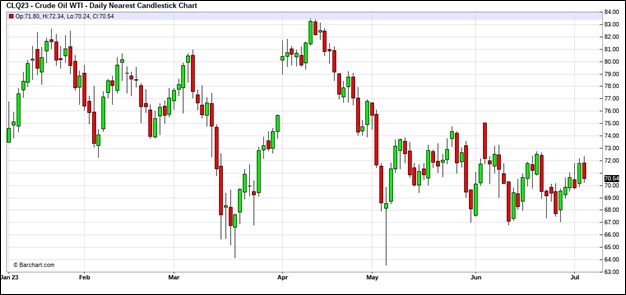
Despite OPEC+ promises to cut production, oil remains in a $67 to $74 per barrel trading range.
Commercial crude oil inventories fell 1.5 mb, which was on forecast. The SPR fell 1.5 mb, putting the total draw at 3.0 mb.
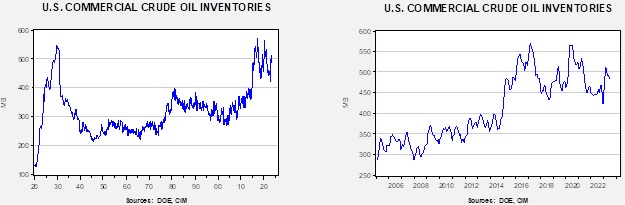
In the details, U.S. crude oil production rose 0.2 mbpd to 12.4 mbpd. Exports fell 1.4 mbpd, while imports rose 0.5 mbpd. Refining activity declined 1.1% to 91.1% of capacity.
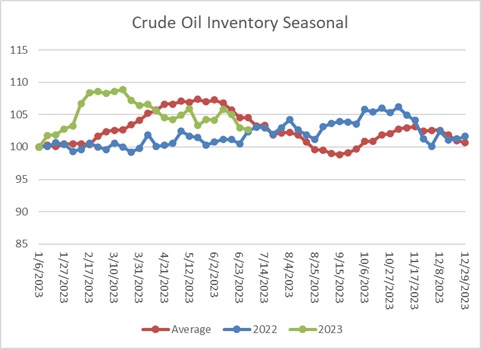
The above chart shows the seasonal pattern for crude oil inventories. After accumulating oil inventory at a rapid pace into mid-February, injections first slowed and then declined. This week’s draw is consistent with seasonal norms. The seasonal pattern would suggest that stocks should fall in the coming weeks, but this pattern has become less reliable due to export flows.
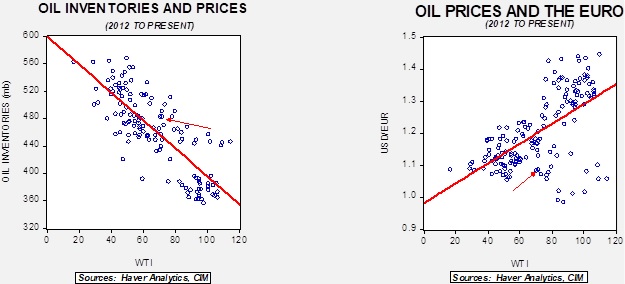
Fair value, using commercial inventories and the EUR for independent variables, yields a price of $61.81. Commercial inventory levels are a bearish factor for oil prices, but with the unprecedented withdrawal of SPR oil, we think that the total-stocks number is more relevant.
Since the SPR is being used, to some extent, as a buffer stock, we have constructed oil inventory charts incorporating both the SPR and commercial inventories. With another round of SPR sales set to happen, the combined storage data will again be important.
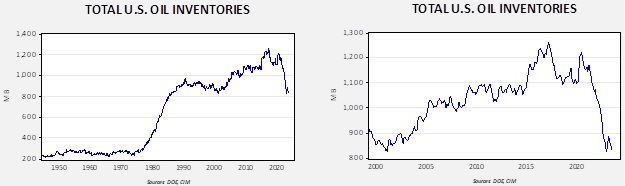
Total stockpiles peaked in 2017 and are now at levels last seen in 2002. Using total stocks since 2015, fair value is $94.69.
Market News:
- This week’s big news was the decision by OPEC+ to extend voluntary production cuts. The Kingdom of Saudi Arabia (KSA) agreed to extend its 1.0 mbpd cut another month and Russia promised to cut its production by 0.5 mbpd. The action by the cartel’s two largest oil producers did lift prices, but the rise has been rather modest given the size of the reduction. Why has the market mostly shrugged off the cuts? There are a few reasons to account for the lackluster response.
- It’s a simple fact that production cuts are usually seen as temporary. Production cuts mean that OPEC+ excess capacity rises. Bullish market positions are based on confidence that the cuts will be maintained. History shows there is always a risk that the cuts will either be violated or eventually reversed. Given that the dollar now tends to rise when oil prices rise, the temptation to cheat on announced cuts is even higher.
- World economic growth is cutting into oil demand. The forward curve for crude oil suggests traders don’t see a near-term supply issue.
- Other producers within OPEC+ are still producing and could take market share. This is especially true of Iran; the sanctions regime is coming under pressure and thus more Iranian oil will likely be on the market.
- As interest rates around the world rise, the cost of storing oil also rises. If the oil market is in contango, the higher price for deferred barrels can offset the increases in interest rate costs. But the spread doesn’t currently compensate for higher borrowing costs. Overall, higher interest rates will tend to depress oil inventories, which could lead to higher prices if there is a disruption in flows.
- Argentina’s oil production is rising due to investment in shale fields at the Vaca Muerta project.
- Climate change policies are likely to lead to falling oil demand. This factor makes long-term production forecasting problematic for oil companies.
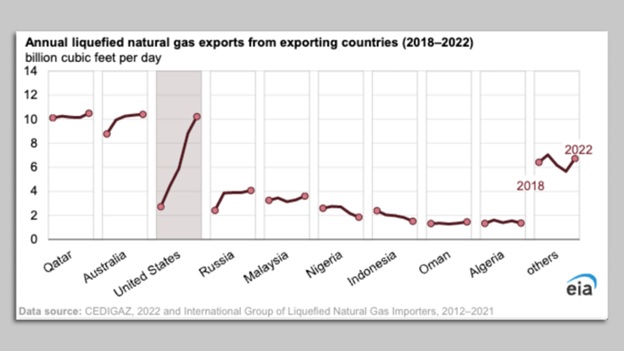
- The U.S. is rapidly building out its LNG export capacity, which has led to a sharp rise in exports. As this chart shows, this expansion has been rapid compared to the rest of the world. And, the U.S. number was adversely affected by the outage at Freeport. Despite the rapid increase, Europe and China are scrambling to secure U.S. LNG, which is adversely affecting smaller buyers in Asia.
Geopolitical News:
- The whole “decoupling/derisking” discussion with China is ongoing. The issue affects numerous industries, with technology and clean energy getting most of the attention. However, it should be noted that China imports significant levels of LNG from the U.S. So far, those flows have not been affected by the debate.
- The U.S. has released frozen funds to Iran in a bid to improve relations enough to make a modest nuclear deal and garner the release of Americans held by the regime. This thaw happened at the same time the U.S. Navy prevented Iran from seizing oil tankers near the Strait of Hormuz.
- Russia’s continued problems are prompting Central Asian oil producers to build new logistical channels to avoid the country. Increasingly, the war in Ukraine is causing Russia to lose its grip on its former near-abroad.
- Due to constraints within the Indian refinery system, we may be at the peak of Russian oil sales to New Delhi.
Alternative Energy/Policy News:
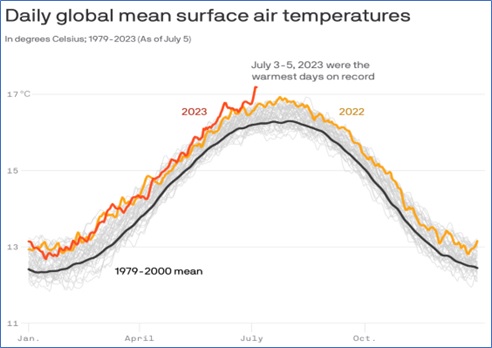
- Hot weather continues across the South and Midwest. According to researchers at the University of Maine, global temps may have set a record recently.
- In Texas, electricity demand hit a new record on June 27 due to high temperatures. It turns out that solar power in Texas has been a reliable source of power, helping Texas avoid service interruptions.
- These hot temperatures are not unique to the U.S. The world is seeing record temperatures.
- Solar panel production is creating tight supplies for silver.
- Electric vehicle (EV) news:
- As cobalt prices decline, China is stockpiling the metal. High prices last year led to higher production; as supply rose, prices fell. Cobalt is used in EV batteries. China is also the world’s primary source for finished nickel, which is also part of EV batteries. Meanwhile, Indonesia may be poised to further increase nickel output but perhaps at high environmental cost.
- Car companies around the world are taking an interest in acquiring key battery minerals. BYD (BYDDY, $67.21) announced a lithium processing project in Chile. As foreign interest rises, nations with the deposits are driving harder bargains to access these key resources. On a related note, the recent phosphate deposits discovered in Norway appear to be very large.
- China’s announcement of export licenses for rare earth metals is triggering a global scramble to secure these resources.
- In China, firms are creating subsidiaries to capture EV government funding.
- As we have been noting recently, China is targeting Europe for EV exports. China also announced groundbreaking on a new EV battery factory in Thailand and a lithium processing plant in Zimbabwe.
- Nations around the world have been subsidizing elements of their domestic EV industries. India announced subsidies for batteries this week.
- Toyota (TM, $161.99) announced a solid-state battery that would cut the weight of current batteries by 50% and reduce charging times to 10 minutes. The company hopes to commercialize the product by 2027. Solid-state batteries would likely tip the balance toward EVs because they would provide longer-range vehicles with recharging speeds near gasoline refills. However, it has been the promise for a long time.
- Recent surveys show that the public is open to EVs but only about 40% are in favor of totally eliminating ICE vehicles. Generally speaking, Republicans are less open to alternative energy than Democrats, although there is still some support for the transition even among the former.
- China is rapidly expanding its solar and wind energy capacity. In fact, it has hit its existing targets five years earlier than expected. However, progress has been slower than expected in rural regions.
- The Inflation Reduction Act is prompting European nations to build hydrogen production in the U.S.
- Siemens Energy (SMNEY, $16.46) wind turbines are developing cracks that are expected to cost at least €1.0 billion to address.
- Ocean shippers are experimenting with large kites to aid in propulsion. Using kites could reduce fuel consumption by up to 30%.