


Author: Rebekah Stovall
Asset Allocation Weekly (May 7, 2021)
by the Asset Allocation Committee | PDF
Yogi Berra is famous for various quotes. He famously said, “Always go to other people’s funerals, otherwise, they won’t come to yours.” He also noted that, “A nickel isn’t worth a dime anymore.” The one we deal with most in asset allocation is the saying, “It’s tough to make predictions, especially about the future.” But, as Hyman Roth remarked, “This is the business we have chosen.”
So, how do we make predictions? Our asset allocation process uses a committee approach and gives each member the freedom to create their own methodologies to arrive at their forecasts. This system has worked out reasonably well, in part because there is enough diversity of methods and opinions to cover a wide range of possibilities. From there, the committee comes to a consensus about the return, risk, and yield of 12 different asset classes.
One way to examine this issue is to adapt a tool from psychology called the “Johari Window.”

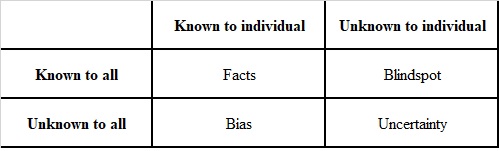
This scheme was used by Secretary of Defense Rumsfeld in his famous “known-unknowns” press conference. For our purposes, the “Facts” quadrant, quadrant one, is essentially history. This quadrant contains factual information—what we know is true. The second quadrant, “Blindspot,” is the area of known-unknowns. This is where we know a factor is important, but we don’t know what the outcome will be quite yet. This is the area of risk, where some degree of probability can be assigned. The other two quadrants are “Bias” and “Uncertainty.” Quadrant four, the uncertainty zone, is where we are not even aware of the outstanding risks. The third quadrant, the zone of bias, is where we think we know something but, in fact, we don’t.
To a great extent, quadrants three and four are where the problems lie. Of the two, bias is probably the most dangerous. This is the region of belief. John Maynard Keyes summed up this issue with the following quote:
Practical men, who believe themselves to be quite exempt from any intellectual influence, are usually the slaves of some defunct economist. Madmen in authority, who hear voices in the air, are distilling their frenzy from some academic scribbler of a few years back.[1]
This is where narratives can dominate thinking and blind us to other possible outcomes. It is probably impossible to be a bias-free human. All of us carry self-evident truths that help us manage our lives. The key point is to be aware of them. One of the benefits of a committee structure, at least one with enough diversity, is that the bias risk can be offset by having “competing biases.” An even more effective committee can help each member become more aware of their individual biases as well.
Quadrant four, the area of the unknown, can only be divined by intuition. For the most part, this is the area where events haven’t happened before or occur so infrequently that there isn’t much history to work with. It isn’t impossible to predict these outcomes, but it isn’t easy. And, it is nearly impossible to get it right consistently. The history of markets is littered with analysts who were “one-hit wonders,” having made a great call once without repetition. A process in which multiple participants intuit the unknown at least offers the chance of a correct assessment.
Here is an example using the Johari Window with a current market issue. There is currently great concern about inflation. Here is what we know:
- Money supply growth is at record levels, up 25% on a yearly basis;
- The FOMC has changed its policy to end its primary focus on inflation control;
- Fiscal policy is expanding rapidly.
All these factors would support rising inflation risks. Offsetting these risks are:
- The bulk of cash remains on the balance sheets of the affluent;
- The U.S. economy remains mostly open, meaning that imports can help contain inflation;
- Household debt levels remain elevated and “scarring” from the pandemic will probably keep households cautious about spending.
So, what did the Asset Allocation Committee do, in light of these factors?
- We acknowledged the growing inflation risk well before the current situation. We have had an allocation to precious metals for nearly three years and have utilized bond ladders in portfolios with fixed income. We have also included an allocation to commodities for a year now.
- At the same time, given the distribution of cash, there is a chance that asset inflation could occur, at least in the near term. Price inflation will need less inequality. Thus, we are overweight equities.
- We also expect that policy will lead to a weaker dollar, and so we hold a sizeable allocation to international equities.
Essentially, Confluence’s asset allocation process attempts to take what we know and assess the quantifiable risks, based on history, consider what might happen that is uncertain, and make sure we don’t assume outcomes that may not be consistent with what we know.
[1] Keynes, John M. (1936). The General Theory of Employment, Interest, and Money. New York, NY: Harcourt, Brace, Jovanovich. (p. 383)
Weekly Geopolitical Report – The Geopolitics of Taiwan: Part I (May 3, 2021)
by Bill O’Grady | PDF
Tensions over Taiwan have been steadily escalating in recent years. When President Trump was elected in 2016, one of the first official contacts he made was with President Tsai Ing-wen, the leader of Taiwan. Accepting this call infuriated Beijing, which views Taiwan as a province of the People’s Republic of China (PRC). Recently, there have been alerts from American military officials warning that China has hostile designs on Taiwan. Chinese warplanes regularly enter Taiwan’s airspace, normalizing this hostility.
There are numerous subcurrents in Asia; the predominant one is that China no longer accepts U.S. hegemony in the region and seeks to become the dominant power of that continent.[1] However, having the goal of hegemony and becoming a hegemon are two different issues. The size of China’s economy clearly makes it a world power. The country has been rapidly building its military to compete with the U.S. At the same time, it has serious vulnerabilities that prevent it from ousting America from the Pacific region.
Taiwan encapsulates many of the issues surrounding China’s goal of hegemony. In this report, we will examine them in depth. In a subsequent report, my colleague, Patrick Fearon-Hernandez, will build off this research to examine the global semiconductor industry which has much of its critical infrastructure in Taiwan. To some extent, the geopolitics of Taiwan, in general, and the semiconductor industry, specifically, detail the current situation surrounding globalization. As globalization comes under strain, the stresses are being exhibited clearly in Taiwan and in semiconductors.[2]
In Part I of this report, we will begin with a history of Taiwan. Next, we will address current relations between the PRC and the Republic of China (ROC) and the end of strategic ambiguity. In Part II, we will analyze the geopolitical importance of Taiwan and China’s military options. In Part III, we will examine how Xi Jinping may react, in light of his ascendency to power. Finally, we will conclude with market ramifications.
[1] Allison, Graham. (2017). Destined for War: Can America and China Escape Thucydides’s Trap? New York, NY: Houghton, Mifflin, Harcourt. Our review of the book and concept can be found here and here.
[2] Because these reports touch on not just macroeconomic and geopolitical issues, but will also discuss industries and companies, we want to acknowledge the support and counsel provided by our colleagues at Confluence Investment Management on the Value Equities and International Equities Investment Committees. Dan Winter, Matt Sinkovitz, Mark Keller, Joe Hanzlik, and Greg Tropf provided insight and information in our research. While acknowledging their contributions, any errors and omissions in this report are mine alone and the research reflects my sole conclusions.
Confluence of Ideas – #21 “The U.S.-China Balance of Power: Part II” (Posted 4/30/21)
Asset Allocation Weekly (April 30, 2021)
by Asset Allocation Committee | PDF
(Due to staff vacations, there will not be an accompanying podcast and chart book this week. The multimedia offerings associated with this report will resume next week, May 7.)
In our asset allocation strategies, we continue to have a separate provision to homebuilders. The reason for this particular position is due to our belief that homebuilding and associated industries are poised for a multiple-quarter expansion. One reason for this expectation is that housing and homebuilding are still recovering from the housing bubble that peaked in 2005. The aftermath of that bubble caused a decline in homebuilding.
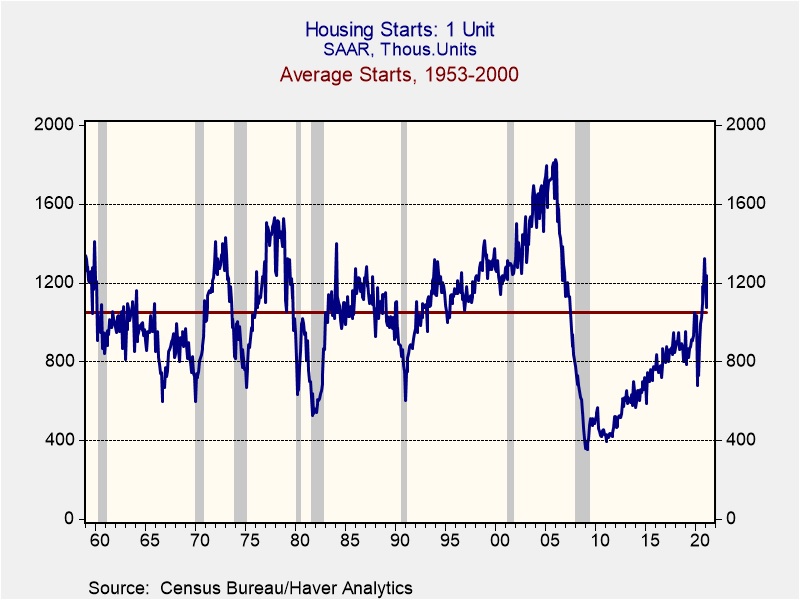
This chart shows housing starts from 1953 to the present. From 1953 to 2000, the average was 1.048MM single-family starts per month on a seasonally adjusted annualized basis. Note that starts rose well above average during the housing bubble and then plunged during the Great Financial Crisis. They only returned to their earlier average last August. Given that the population was smaller in the past, existing sales per capita would be even lower now.
The shortage of single-family homes relative to starts is even more stark when compared to the single-family home vacancy rate.
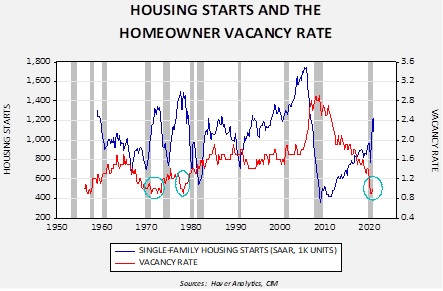
This chart shows single-family housing starts compared to the vacancy rate. We have marked low vacancy levels with teal circles. In the 1970s, vacancies at the current level led to starts between 1.3MM and 1.4MM starts. We are currently around 1.1MM, which suggests a boom in homebuilding is not only likely, but probably necessary to meet the demand for housing. Thus, our outlook for the homebuilding sector remains especially positive.
Business Cycle Report (April 29, 2021)
by Thomas Wash | PDF
The business cycle has a major impact on financial markets; recessions usually accompany bear markets in equities. The intention of this report is to keep our readers apprised of the potential for recession, updated on a monthly basis. Although it isn’t the final word on our views about recession, it is part of our process in signaling the potential for a downturn.
In March, the diffusion index rose further above the recession indicator, signaling that the recovery is continuing. In the financial markets, heightened inflation fears led to a sell-off in equities and 10-year Treasuries. Meanwhile, a slowdown in COVID-19 cases and easing restrictions made it easier to hire workers; thus, last month saw an improvement in labor market conditions. However, poor weather conditions and supply constraints, particularly the lack of semiconductors and lumber, led to a pullback in manufacturing activity. As a result, four out of the 11 indicators are in contraction territory. The reading for March was unchanged from the previous month at +0.2727, above the recession signal of +0.2500.
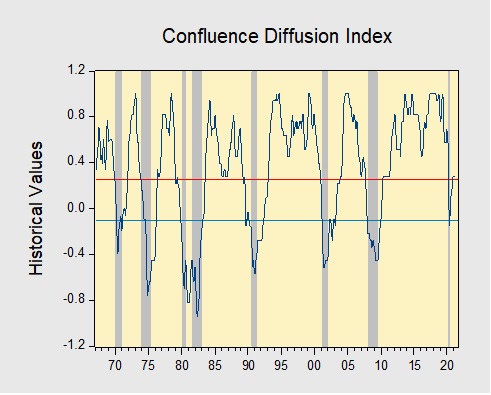
The chart above shows the Confluence Diffusion Index. It uses a three-month moving average of 11 leading indicators to track the state of the business cycle. The red line signals when the business cycle is headed toward a contraction, while the blue line signals when the business cycle is headed toward a recovery. On average, the diffusion index is currently providing about six months of lead time for a contraction and five months of lead time for a recovery. Continue reading for a more in-depth understanding of how the indicators are performing and refer to our Glossary of Charts at the back of this report for a description of each chart and what it measures. A chart title listed in red indicates that indicator is signaling recession.
Weekly Geopolitical Report – Irish Border Revisited (April 26, 2021)
by Thomas Wash | PDF
It has been more than a year since the U.K. and European Union (EU) came to terms with the Withdrawal Agreement, yet questions remain on how it will impact Northern Ireland, which was granted an exception to remain in the EU. Having decisively voted 56% to 44% to remain a part of the EU during the Brexit referendum, it is unclear whether Northern Ireland allegiance lies with the U.K. or the EU.
The exception, which went into effect earlier this year, keeps the Northern Ireland economy in the EU to prevent a hard border between Northern Ireland and the Republic of Ireland. This has angered pro-British Unionists who believe that the exception ostracizes Northern Ireland from the U.K. and draws it closer to Ireland. As a result, the Unionists have protested the decision and violence has erupted between competing factions in Northern Ireland. However, demographic trends have shown that the pro-British faction seems to be slowly dwindling, likely heightening concerns.
In this report, we will focus on the current relationship between Northern Ireland, the U.K., and the EU, and summarize the Good Friday Agreement. Next, we will discuss the impact of demographic changes on reunification efforts and what we expect to happen going forward. As usual, we will conclude with potential market ramifications.
Asset Allocation Weekly – #36 (Posted 4/23/21)
Asset Allocation Weekly (April 23, 2021)
by Asset Allocation Committee | PDF
A decade ago, the Rent Is Too Damn High Party became a viral sensation after a candidate for the New York governorship, Jimmy McMillan, announced lowering New York rent as his central platform. Now, over a decade later, rent prices in New York have finally started to fall. The pandemic-driven moratorium on evictions has likely played a role in declining prices in New York, but more of this change can likely be attributed to the phenomenon of people leaving cities in favor of suburban and rural areas. In fact, this migration out of major cities into the suburban and rural areas has been so pronounced that national rent prices have risen. Additionally, this increase in rental rates has led some economists to speculate that the uptick in rent prices is a sign that inflation is on the horizon. In this report, we will discuss how the rise in rental rates, and home prices for that matter, may not have as big of an impact on the Consumer Price Index (CPI) as many would claim.
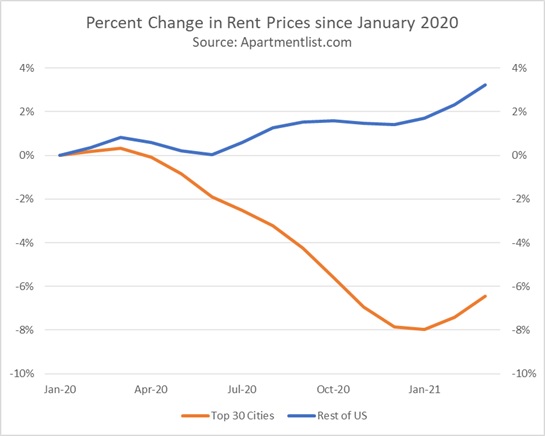
The real estate market has changed dramatically since the start of the pandemic. Rent prices have dropped in the most populated cities, while suburban and rural areas have seen an increase. Since last year, the top 30 cities by population have seen a decline of roughly 6% in rent prices, while the rest of the country has seen a 4% rise. Purchase prices for homes have also risen sharply during the pandemic, with the S&P CoreLogic Case-Shiller index showing an 11% rise since January 2020. Because shelter is heavily weighted in the CPI, there have been concerns that increasing rental and home prices could push the overall CPI higher.
The CPI estimates the total cost of shelter for the urban areas in the country. Shelter prices account for approximately one-third of headline CPI and about 40% of core CPI. Its heavy weighting is due to the fact that it is the one service most consumers cannot avoid. Because of its weight, a significant movement in shelter prices can lead to huge swings in the index. This is one of the reasons people have been paying close attention to rental and home prices. Shelter has two major components: rent for primary residence and owners’ equivalent rent. Owners’ equivalent rent accounts for approximately 73% of the shelter price, while rent for primary residence accounts for 24%.[1]
Since homes are a capital investment, they are excluded from CPI. As a substitute, the index uses owners’ equivalent rent, which is the implicit rent that homeowners believe they would have to pay if they were to rent their own home. In order to gauge what the prospective rent went would be, the BLS asks consumers who own their primary residence the question, “If someone were to rent your home today, how much do you think it would rent for monthly, unfurnished and without utilities?” This approach reduces the impact home prices could have on CPI because the consumers have to take into account actual economic conditions when responding. Thus, consumers cannot simply answer the question by stating their mortgage payment.
In addition, the way shelter is calculated may also contribute to why CPI doesn’t seem to reflect the upturn in rental and home prices. Because 88% of the population lives in urban areas, CPI primarily tracks prices in cities. In fact, the top five heavily weighted cities ― New York, Los Angeles, Dallas, Philadelphia, and Chicago ― account for about one-fifth of the sample size. Therefore, any increase in rent prices and owners’ equivalent rent in areas outside these cities will not likely swing the index significantly. This helps explain why shelter prices in the CPI have waned in recent months, despite the rise in real estate purchase prices. Put another way, the BLS, which calculates CPI, has to create a weighted average for the entire economy. The problem of averaging is that there is a dispersion around an average that may be wide, but the average masks that issue.[2] It also makes sense to weight the average by population; after all, the central bank would probably not want to react to rising rent prices in Salina, KS, when rents are not rising in New York, NY.
In short, due to the way the CPI is constructed and sampled, increases in rental and home prices may not have a strong impact on the index, depending on the dispersion of pricing changes. Furthermore, the slowdown in the rise in shelter prices, as determined by CPI, is due to people moving out of major cities in favor of suburban and rural areas. Thus, we suspect inflation fears about the rise in rental prices are likely overblown, at least in terms of the CPI. On the other hand, because each person purchases their own unique basket of goods and services, some people may be experiencing rising prices in a way that is different from the average experience across the economy.
[1] The other two components are lodging away from home and tenants’ and household insurance.
[2] Often this situation is highlighted in statistics classes by the example of a person with their head in a 350o oven and foot in an ice bucket; on average, the person’s temperature is normal.