

Daily Comment (June 21, 2023)

by Patrick Fearon-Hernandez, CFA, and Thomas Wash

[Posted: 9:30 AM EDT] | PDF

Good morning! Today’s Comment begins with our thoughts on investor concerns regarding Federal Reserve Chair Jerome Powell’s testimony to Congress later today. Next, we discuss how China may jump start its economy without relying solely on policy stimulus. Lastly, we explain why India’s growing prominence makes it an attractive investment target.

Powell Speaks: Investors’ fears of a more hawkish Federal Reserve have weighed on equity performance.

  • Fed Chair Jerome Powell is slated to testify before Congress this week about the state of the economy and monetary policy. He is expected to provide clarity on the future path of interest rate hikes after markets were previously left confused following his comments at the Federal Open Market Committee’s meeting on June 13-14. Powell will also update lawmakers on the state of the banking system following the turmoil that took place in March.
  • The S&P 500 closed down 0.4% on Tuesday as strong economic data reinforced fears that Powell will deliver a hawkish message during his testimony to Congress. Despite concerns that the U.S. economy could fall into recession sometime this year, new government data showed that the economy remains resilient. Housing starts, a leading economic indicator, rose to their highest level in 14 months. The Atlanta Fed’s GDPNow model also estimates that real GDP growth rose 1.9% in the second quarter, slightly higher than the previous quarter’s reading of 1.3%.
    • The current CME FedWatch Tool shows that there is now only a 5% chance that the FOMC will hold rates below 5% before the end of the year, much lower than the 90% chance it predicted a month ago.

(Source: CME)

  • It is unclear whether the Federal Reserve will ease off its inflation-fighting efforts as the economy heads into recession. Recent speeches from Fed officials suggest that they are more likely to hold interest rates stable in order to contain inflation, even if it means causing economic pain. This outcome would help accelerate the decline of inflation, but it would come at a cost. Therefore, any comments from Powell about the economy being resilient should be interpreted as evidence that the Fed is still committed to its hawkish monetary policy.

Emerging Markets: While the lack of stimulus in China may be a cause for concern, investors should not completely turn their backs on other emerging market countries.

  • While China is a significant emerging market, investors should not overlook the opportunities offered by other individual countries. For example, Argentine stocks have risen 6.0% over the last seven days, highlighting the upside of looking abroad. The recent surge in stock prices in developing countries is likely due to a number of factors, including investors’ desire to hedge against currency depreciation. However, it is important to remember that financial assets in developing countries are more volatile than those in developed countries. This means there is a greater risk of losing money on these types of investments. Therefore, investors should always do their due diligence before making investment decisions.

Is India a New Power?  Rising geopolitical tensions have led countries to become more assertive as they look to have more global influence.

  • On Wednesday, U.S. President Joe Biden and Indian Prime Minister Narendra Modi are set to meet in Washington to discuss ways to deepen their countries’ strategic partnership. The meeting comes as the growing friction between the U.S. and rivals China and Russia is rising. Prior to his first official visit to the White House in nine years, Prime Minister Modi stressed that the relationship between the United States and India was “tighter than ever.” Meanwhile, Washington views India as a crucial partner in its attempt to prevent China from expanding its influence throughout the Indo-Pacific region.
  • Despite not having the best performance so far this year, India has a lot of potential. India’s blue-chip stock index, the Nifty 50, is up 3.62% on the year, and even though this is not a bad performance, it does lag many of its Asian counterparts (as the chart below shows). That said, the country is a major target for foreign direct investment as firms look for supply chain diversification. Companies such as Apple (AAPL,$185.01), Tesla (TSLA, $274.45 ), and Google (GOOGL, $123.10) have announced a desire to set up factories in India.

(Source: Reuters)

  • India has been a major beneficiary of the conflict between the United States and China, particularly following Russia’s invasion of Ukraine. New Delhi has been able to leverage the conflict to its advantage by playing the two sides against each other. On the one hand, India has received weapons and oil from Russia, while on the other hand, it has maintained trade ties with the United States. India’s ability to remain neutral in the conflict has also boosted its global clout, as the country has ambitions to become a significant player on the world stage. As a result, India is well-positioned for long-term growth.

View PDF

Daily Comment (June 20, 2023)

by Patrick Fearon-Hernandez, CFA, and Thomas Wash

[Posted: 9:30 AM EDT] | PDF

Our Comment today opens with many China-related reports, including a recap of U.S. Secretary of State Blinken’s weekend meetings in Beijing with top Chinese officials and a new report that Beijing and Havana are negotiating to establish a joint military training base in Cuba.  We next review a wide range of other international and U.S. developments with the potential to affect the financial markets today, including a new conservative government in Finland and welcome signs that the U.S. financial markets are comfortably digesting the massive issuance of Treasury bills now that the federal debt limit has been lifted.

United States-China:  In a bid to ease U.S.-China tensions, U.S. Secretary of State Blinken visited Beijing over the holiday weekend and held meetings with Foreign Minister Qin Gang, top diplomat Wang Yi, and President Xi Jinping.  Afterward, both sides described the marathon talks as “candid” and “constructive.”  The meetings do look like they could cool tensions, but we doubt that they will appreciably shift the overall trajectory in bilateral relations, in which U.S. leaders feel like they have to respond to China’s growing military and economic power and increasingly aggressive geopolitical stance.  As we’ve written before, increased tensions are likely to further disrupt trade, investment, and technology flows, putting investors at risk.

  • One key goal for the U.S. was to get bilateral communications back on track to reduce the risk of miscalculation and accident as Washington and Beijing compete ever more sharply in the military, diplomatic, economic, and technological spaces. The Chinese officials emphasized their commitment to taking back control of Taiwan and demanded that the U.S. not interfere with their development strategy.
  • In something of a win for the U.S., the Chinese side agreed to send Qin to Washington for a reciprocal visit at an undetermined time in the future. However, they repeatedly rebuffed U.S. requests to re-establish military-to-military communications.
  • The results of the meeting also look set to be overshadowed by a new example of Chinese aggressiveness reported this morning. According to the Wall Street Journal, Beijing and Havana are negotiating the establishment of a joint military training base on Cuba’s northern coast.  Such a base would imply that Chinese troops would be stationed less than 100 miles from Florida.
    • This and other recent developments suggest Chinese officials believe that taking ever more aggressive military steps against the U.S., even at the U.S. doorstep, will scare Washington into backing off China in the Indo-Pacific region.
    • Given that Republicans and Democrats in Washington share a strong and growing bipartisan sentiment that China is a threat, Beijing’s approach is ripe for miscalculation. Faced with an aggressive move such as rotating Chinese combat troops through Cuba, domestic U.S. political pressure could conceivably force the administration to act.  We therefore cannot discount the risk of an outright U.S.-China military crisis at some point, along with further disruptions in bilateral economic and financial ties.
  • Finally, it’s useful to remember that the risks for Western businesses in China don’t all come from government action. New reporting shows Chinese consumers have also begun to shift their buying toward domestic brands, at least in part because those brands have improved their quality, service, and marketing techniques.

European Union-China:  The European Commission today released a new economic security strategy that included a call for EU member states to consider restricting outbound investment into countries that could be a security risk.  Although the document didn’t specifically name China as a target, it was widely interpreted as being another example of how Brussels has swung around to embrace U.S. concerns about China, even if many of the EU’s national governments are still resisting any substantial efforts to restrict trade or investment ties with Beijing.

China:  Separately, Chinese officials continue to signal they plan to roll out a big economic stimulus package as the post-“Zero COVID” recovery peters out.  For example, the State Council said its Friday meeting considered several new policies aimed at boosting “effective demand” in a “more powerful way.”  Such policies would buttress the central bank’s interest-rate cuts last week and today’s cut in bank prime loan rates.  The question is whether President Xi will be willing to unleash enough new lending and spending to really rev up the economy, since doing so would worsen the structural challenges, like high debt, that Xi wants to bring under control.  Reflecting the limited policy space for stimulus, several Western financial institutions have cut their forecast for Chinese economic growth in 2023, sparking a risk-off stance in markets today.

Finland:  A coalition of right-wing parties has agreed to form a government with Petteri Orpo, the leader of the conservative National Coalition Party, as prime minister.  Besides the NCP, the government will include the right-wing populist Finns Party, the Swedish People’s Party, and the Christian Democratic Party.  Altogether, the four parties hold 108 of the 200 seats in parliament.

U.S. Financial Markets:  The Federal Reserve reported that utilization of its facility for reverse repurchase agreements, which allows money market funds to park cash with the Fed, last week fell below $2 trillion for the first time since June 2022.  The drop in usage of the facility suggests money market funds have instead been buying up the large amounts of fresh U.S. Treasury bills that the government has been selling following the recent lifting of the federal debt limit.

  • Money market fund managers have likely been enticed by the yields of approximately 5.15% available on Treasury bills maturing in one or two months, since that beats the current repo rate of 5.05%. The bill buying by money market funds could help ease fears that high Treasury issuance to replenish government coffers might disrupt the markets.
  • Nevertheless, risks remain, especially as the bulk of the new Treasury issuance is still to come. If money market funds and other investors can’t digest all the new issuance, interest rates could jump to the point where they cause instability.  In addition, if the Fed hikes its benchmark fed funds interest-rate target further, the reverse repo rate would also rise and might draw funds again from the money market funds and the banking system.

U.S. Defense Industry:  According to data from PitchBook, venture capitalists in the U.S. have closed more than 200 defense and aerospace deals worth about $17 billion just in the first five months of 2023.  That’s more than all the deals in the sector in full-year 2019, illustrating how the war in Ukraine and the prospect of higher global defense spending has heightened investor interest in military-focused startups.  We continue to believe that the trends will benefit both new and mature defense industry firms going forward, especially those focused on cutting-edge technologies.

  • Notably, the wave of VC funding into defense startups is reportedly rivaling the activity in artificial intelligence.
  • We find the VC surge into defense and artificial intelligence especially notable because high interest rates have sapped dealmaking in a wide range of other sectors.

View PDF

Asset Allocation Bi-Weekly – The Great Divergence (June 20, 2023)

by the Asset Allocation Committee | PDF

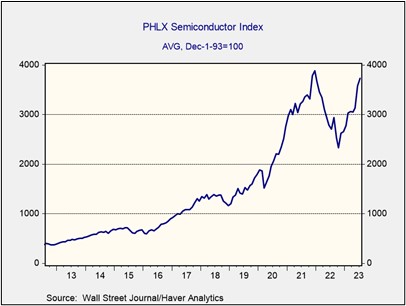
The S&P 500 is up 10% year-to-date and briefly reached the 4,200 level in late May. The recent rally in equity markets has been driven by the rise of generative artificial intelligence (AI), which has bolstered tech stocks. In fact, much of this strong performance has come from the five largest tech companies, which now account for 24.7% of the index’s value, a record high. This concentration has led some investors to fear that a bear market similar to the dot-com bubble burst of 2000 may be on the horizon. The pessimistic outlook is related to concerns that the underperformance of the broader index has generally followed previous periods of high market concentration.

The chart above shows the relative performance of the S&P 500 Market Capitalization and Equal Weight indexes over the past 30 years. During times of uncertainty, investors tend to pile into established companies with large market capitalizations. These firms are typically better positioned to weather a downturn as they have more resources and access to capital. In this environment, the Market Cap index generally outpaces its Equal Weight counterpart. However, this outperformance does not usually last long. When the market recovers, investors often go bargain hunting as the lesser names are likely to offer more value. Thus, the Equal Weight index can outperform the Market Cap index over an extended period. That said, the recent unevenness is different than in previous market rallies.

The 2020 tech rally was driven by monetary and fiscal stimulus. The Federal Reserve injected billions of dollars into the financial system, which lowered interest rates and encouraged investors to take on more risk. Additionally, many households had excess savings due to the COVID-19 pandemic stimulus, which increased the number of retail investors. Overall, tech stocks benefited as investors looked for better returns. However, the rally was not sustainable.

As the Federal Reserve began to tighten monetary policy in 2022, interest rates rose and investors became more risk-averse. This led to a sharp decline in tech stocks, which continued until early 2023, when people began to focus on the investments that Microsoft (MSFT, $346.10) had made in machine-learning company OpenAI. The investments signaled the company’s commitment to artificial intelligence and its potential to usher in a new technology wave.

The craze for AI reached new heights in May after chipmaker Nvidia (NVDA, $431.33) forecasted that strong demand for AI chips could help the company generate $110 billion in revenue in 2024. The news led to one of the biggest tech rallies in two decades as the tech-heavy Nasdaq Composite Index rose by more than 7% in May.

Analysts have compared the release of AI-related products such as ChatGPT to the advent of the internet browser, calling it a game-changer. Although still under development, the product has a wide range of potential uses, from content creation to task automation. The technology’s diverse applications have encouraged investors to purchase AI-related stocks at a premium as they are willing to pay for AI-related companies based on their future cash streams as opposed to current earnings.

Unlike the dot-com boom of the early 2000s, many of the companies developing AI technology are not startups. The major movers in AI are established tech giants, such as Microsoft, Amazon (AMZN, $126.50), Alphabet (GOOG, $124.77), Meta (META, $280.34), Baidu (BIDU, $148.19), Tencent (TCEHY, $45.55), and Alibaba (BABA, $92.13). These companies have proven track records of success, and they are unlikely to fail if the AI bubble goes bust. As a result, the recent rally in tech stocks poses significantly less risk than the internet mania of the early 2000s because the firms driving the rally are more stable and have better track records of profitability.

While the Market Cap index has outperformed recently, this outperformance is unlikely to last. Economic growth is expected to slow in the second half of the year, which could lead to a new down-leg in the market. As demand decreases, earnings will likely be negatively impacted, leading to a decline in stock prices. However, we do not expect the repricing of major tech companies to lead to a market crash. Instead, we believe other stocks within the S&P 500 will be less affected. Consequently, the Equal Weight index may recover against the Market Cap index toward the end of the year. Additionally, these companies could be very attractive once economic growth begins to pick up.

View PDF

Daily Comment (June 16, 2023)

by Patrick Fearon-Hernandez, CFA, and Thomas Wash

[Posted: 9:30 AM EDT] | PDF

Good morning! Today’s Comment begins with a discussion on how the expiration of options contracts may place downward pressure on equities. Next, we explain why equity investors are still not convinced that central banks will not cut rates this year. Lastly, we give our thoughts on the latest Bank of Japan policy decision.

Triple Witching: Markets are expected to be down today, but there is evidence that investor optimism could still lift equities higher.

  • After six consecutive days of gains in the S&P 500, the simultaneous expiration of stock options, index futures, and index futures derivative contracts, also known as triple witching, threatens to end the streak. Today, $4.2 billion of U.S. and European futures are set to expire, along with the quarterly expiration of index futures and the rebalancing of benchmark indexes. Although the combination of these events does not necessarily lead to a bad day for equities, it does suggest that the day will likely be faced with increased trading volume as well as heightened volatility, particularly in the final hours as investors decide whether to chase recent gains or hedge against potential losses.
  • An imminent recession combined with continued optimism regarding generative artificial intelligence (AI) technology may impact investor behavior today. The craze over the machine-learning algorithms has pushed the P/E ratio for the S&P 500 Communication Services and Information Technology sectors to their highest level since the start of 2022. In contrast, the P/E ratio for the Equal-Weight Index has remained relatively stable within that same period. The divergence in performance reflects investors’ expectations that the technology will allow firms to add different sources of revenue. On the flip side, economic fears are elevated as forecasters are still predicting a recession for the second half of the year.

  • The decision to hedge or pursue gains may come down to each investor’s recession call. If they believe that a major downturn is imminent, they may be tempted to play it safe and protect gains made for the year. If true, this could sap momentum from the current market rally. On the other hand, if market participants assume that a recession will likely be mild or averted altogether, they may be persuaded to take on additional risk in order to maximize profits. As of right now, we believe that as long as the economic conditions remain positive, equities may offer attractive opportunities for risk-tolerant investors.

Peak Rates: Investors are already looking for the exit to the tightening cycle, even as central banks signal that their job is not done.

  • On Thursday, the S&P 500 index rose above 4,400 for the first time since April 2022, a surprise move given that the Federal Reserve is still expected to raise interest rates by another 50 basis points and the economy may be headed for a recession. Although some of the rally can be attributed to the recent surge in generative AI technology, all sectors of the index managed to close higher. The broad performance was likely due to investor optimism that the Fed is nearing the end of its rate-hiking cycle, as it is assumed that recent data showing that consumption is slowing and jobless claims are rising may force policymakers to rethink their current strategy.
  • The STOXX Europe 600 Index is hovering near a monthly high, despite falling to an intraday low following hawkish comments from ECB President Christine Lagarde. Media and retail related stocks helped fuel a recovery toward the end of the trading period resulting in the index closing slightly below the previous day’s close. The rally was related to doubts that the central bank will be able to raise interest rates significantly while the economy is in recession. Last month, consumer prices rose 6.1% from the prior year, well above the central bank’s inflation target of 2%.

  • The strong performance of both indexes shows that investors are not confident that policymakers will be able to maintain their inflation fight during a downturn. This bias is the most prevalent in the United States where traders appear to be looking past the Fed commenting that they are serious about continuing to increase interest rates. The CME FedWatch Tool shows that some traders expect a rate cut this year. At the same time, eurozone overnight index swaps suggest that the European Central Bank will cut rates in December. This confidence could lead to sorrow if the US economy remains resilient and the eurozone economy rebounds in subsequent quarters since inflation would then be unlikely to fall to 2% before the end of the year, which could possibly lead to additional hikes.

Bank of Japan: The Bank of Japan (BOJ) continues to be the only central bank in the G10 not to tighten policy in response to elevated inflation.

  • The Bank of Japan has decided to keep its negative interest rates and yield-curve-control policy in place following its two-day meeting on June 14-15, 2023. Governor Kazuo Ueda remained relatively ambiguous as to when the BOJ may alter its policy, but he maintained that officials believe inflationary pressures will moderate as cost-push factors dissipate. He also noted that the group noticed a change in corporate price-setting behavior. In April 2023, Japanese headline inflation rose 4.6% from the previous year, while core inflation rose 4.1%. These figures are well above the BOJ’s target of 2%. However, Ueda said that the central bank is confident that inflation will eventually fall back to its target as the economy adjusts to higher energy prices and other cost-push factors.
  • The suspense over when the Bank of Japan will finally decide to remove policy stimulus has started to weigh on the Japanese yen (JPY). The currency sank to a 15-year low against the euro after the central bank announced its policy decision on Thursday. Meanwhile, the JPY traded further above 140 against the dollar, adding to concerns that the BOJ may need to intervene to protect the currency. Going into 2023, investors had speculated that the BOJ would signal an end to the ultra-accommodative monetary policy that has kept interest rates at near zero for years. However, the BOJ has so far resisted calls to tighten policy, even as other central banks have begun to raise rates in an effort to combat inflation.

  • Despite elevated inflation, Japanese equities have performed remarkably well to begin the year. The Nikkei 225 is up 31% for the year, drastically outpacing the S&P 500, which is only up 15%. Much has been made about the country’s corporate reforms restoring the confidence of foreign investors. However, we believe some of this performance is related to expectations that the BOJ will end its yield-curve-control policy. In our view, the BOJ will be unlikely to quickly remove this policy, but it could take small steps, such as tweaking the band on its cap on ten-year yields. As a result, we believe that a hawkish BOJ could offer support for dollar-based investors looking for foreign exposure.

View PDF

Daily Comment (June 15, 2023)

by Patrick Fearon-Hernandez, CFA, and Thomas Wash

[Posted: 9:30 AM EDT] | PDF

Good morning! Today’s Comment begins with a discussion on the Federal Reserve’s latest interest rate decision. Next, we review the latest central bank policies in the eurozone and China. Lastly, we end with why recent developments in the Middle East and Europe have caught our attention.

Skip or Pause? Fed Chair Jerome Powell is uncertain whether the central bank will pause or hike, but he is adamant that a cut is not being considered.

  • The Federal Reserve left rates unchanged for the first time since February 2022. On Wednesday, policymakers announced that they would hold rates at their current levels to give the group time to observe the state of the economy. In its dot plots, Fed officials signaled that they still plan to lift rates an additional 50 bps before the end of the year. Meanwhile, the summary of economic projections showed that members had revised their expectations for real GDP growth and inflation upwards but decreased their estimates of the unemployment rate. In short, the Fed officials have become more hawkish since the February meeting despite their decision to pause.
  • During the press conference, Fed Chair Jerome Powell downplayed the importance of the dot plots, which show the individual projections of the Federal Open Market Committee (FOMC) members for the future path of interest rates. Powell insisted that there were no discussions held about rate hikes for the July FOMC meeting. His comments led to a strong recovery in risk assets, which had dipped following the release of the hawkish dot plots. The Nasdaq 100 fell 0.8% within 20 minutes of the Fed announcement but closed the day higher by 0.7% from the previous day. The extreme swings in equities reflect investor confidence that the central bank is finished with its hiking cycle. Fixed-income securities also rallied as bondholders believed that the Fed would trigger a recession in its attempt to fight inflation.

  • The opposing reactions from the bond and equity markets suggest that there is still much uncertainty regarding the Fed’s future policy path. Bondholders are confident that policymakers will continue to hike rates until inflation is under control, while equity traders believe that the Fed is leaning toward holding rates at their current levels. The diverging viewpoints suggest that one of the markets may be headed for a correction. It is too early to say which market is wrong, but we are confident that recession will likely be the arbiter.

Other Central Bank News: As the European Central Bank prepares to end its hiking cycle, the People’s Bank of China eases its monetary policy.

  • The ECB decided to raise its deposit rate by 25 bps to 3.50%, its highest level in 22 years. During the press conference, ECB president Christine Lagarde insisted that it has no plan to end its hiking cycle anytime soon. The decision to push rates higher comes amidst concerns that inflation is still stubbornly high. The Euro Stoxx 50 index sank following the ECB’s rate decisions as investors worried that the policy would weigh on the regional bloc’s economy, which fell into recession last quarter. However, the hawkish stance did provide a bump in the euro.
  • In a contrasting tactic, the People’s Bank of China cut its medium-term lending facility (MLF) rate to 2.65% from 2.75%. The decrease in rates will lower borrowing costs on 237 billion CNY ($33 billion) worth of one-year loans. This move is designed to stimulate the economy as the central bank looks to encourage growth. Earlier this week, the central bank cut interest rates on the standing lending rates by 10 bps, thus pushing down overnight rates to 2.75%, the seven-day reverse repurchase rate to 1.9%, and the one-month rate to 3.75%. The announcement will likely encourage banks to reduce their lending rates over the coming weeks, which may lead to an increase in consumption.

  • Despite hawkish comments from the ECB, European assets may be able to benefit from a revitalized Chinese economy. As the chart above shows, European countries are becoming increasingly integrated with the Chinese economy. Germany, in particular, may be uniquely positioned to benefit from a Chinese economic recovery since China is a significant market for Germany, accounting for nearly 10% of its GDP. The majority of these sales come from German subsidiaries in China, such as Volkswagen (VWAPY, $14.14) and BASF (BASFY, $12.63). As a result, the PBOC stimulus for the Chinese economy may provide support to European equities.

Rising Uncertainty: Geopolitical risks are increasing as tensions escalate over Iran’s nuclear program, and Europe’s access to LNG is more vulnerable than originally thought.

  • The U.S. has been holding talks with Iran over an agreement to limit Tehran’s nuclear program. An agreement has not been reached, but it appears Washington is prepared to release billions of dollars of frozen Iranian funds and conduct a prisoner exchange. The discussions come amidst rumors that Iran has been able to enrich uranium to 60% purity, a level at which experts say has no civilian use. Israel, also considered to have nuclear capabilities, has vowed to prevent Iran from becoming a nuclear power. If the United States and Iran are unable to reach an agreement, it is possible that Israel will take military action against Iran. This would be a major escalation of tensions in the region and could lead to a broader conflict.
  • Meanwhile, benchmark futures for European natural gas prices spiked as high as 24% on Thursday. The price surge was in response to an announcement that the Dutch government plans to permanently shut down Europe’s biggest gas field later this year. Gas price volatility was already elevated following forecasts of hotter weather coupled with a possible pickup in Asian demand which threaten to strain global stockpiles. Uncertainty over supply and demand for natural gas raises concerns over energy availability for the winter. Consequently, this may make it harder for countries to reduce their dependency on Russian supplies due to the conflict in Ukraine.

  • Geopolitical risks remain one of the biggest threats to the global economy. As the chart above shows, the Economic Policy Uncertainty (EPU) index remains well above its long-term average of 100. The EPU index tracks the relative frequency at which local newspapers use words associated with economic policy uncertainty. The index has been elevated since Russia began its invasion of Ukraine and has remained high. Although the EPU index does not suggest that the financial markets will suffer, it does signal that the chances of a fat-tail event are elevated meaning investors should continue to pay close attention to ongoing geopolitical conflict.

View PDF

Weekly Energy Update (June 15, 2023)

by Bill O’Grady, Thomas Wash, and Patrick Fearon-Hernandez, CFA | PDF

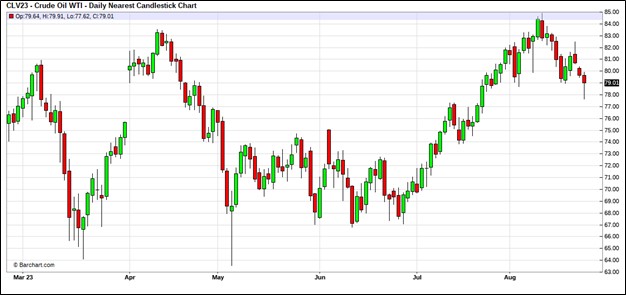
Oil prices may be establishing a new trading range between $67 and $75 per barrel.

(Source: Barchart.com)

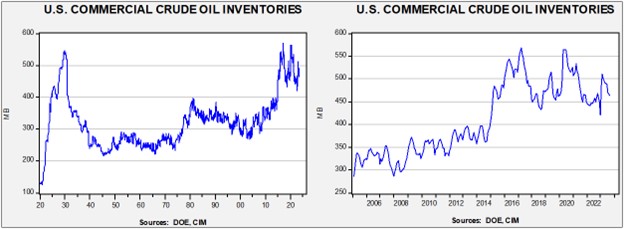
Commercial crude oil inventories rose 7.9 mb when compared to the forecast draw of 1.5 mb.  The SPR fell 1.9 mb, putting the total build at 6.0 mb.

In the details, U.S. crude oil production was steady at 12.4 mbpd.  Exports rose 0.8 mbpd, while imports were flat.  Refining activity declined 2.1% to 93.7% of capacity.

(Sources: DOE, CIM)

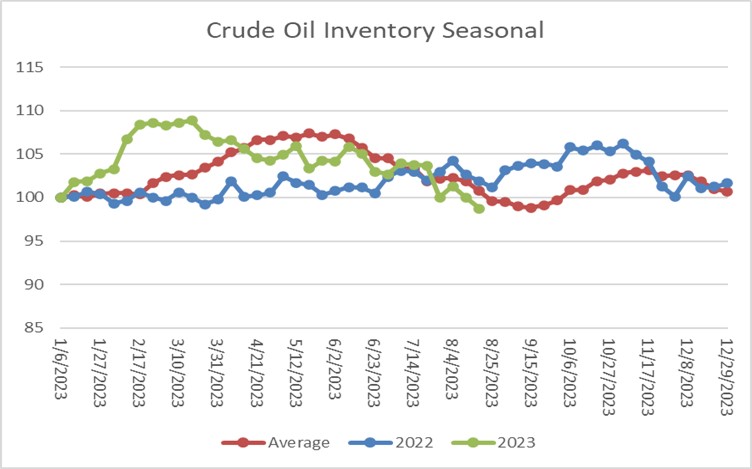
The above chart shows the seasonal pattern for crude oil inventories.  After accumulating oil inventory at a rapid pace into mid-February, injections first slowed and then declined.  This week’s outsized build puts inventories back at seasonal norms.  The seasonal pattern would suggest that stocks should fall in the coming weeks, but the seasonal pattern has become less reliable due to export flows.

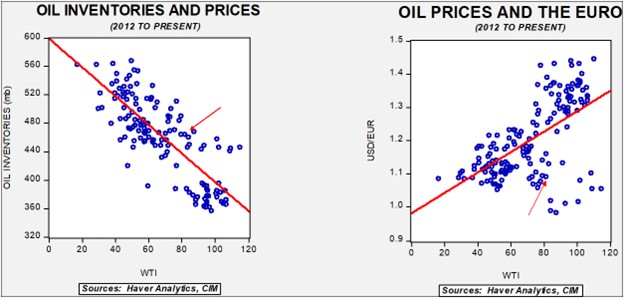
Fair value, using commercial inventories and the EUR for independent variables, yields a price of $57.11.  Commercial inventory levels are a bearish factor for oil prices, but with the unprecedented withdrawal of SPR oil, we think that the total-stocks number is more relevant.

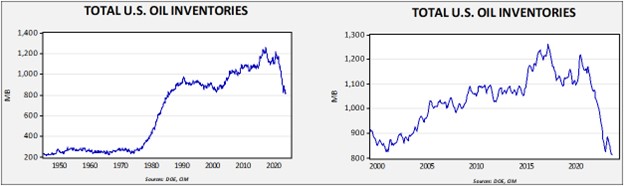
Since the SPR is being used, to some extent, as a buffer stock, we have constructed oil inventory charts incorporating both the SPR and commercial inventories.  With another round of SPR sales set to happen, the combined storage data will again be important.

Total stockpiles peaked in 2017 and are now at levels last seen in 2002.  Using total stocks since 2015, fair value is $92.53.

Market News:

  • The IEA released its forecast for oil demand over the next five years. The group estimates that expanding EV usage will dampen gasoline demand and thus lead to a peak in global oil demand after an almost continuous rise for 80 years.

  • As the above chart shows, oil demand is forecast to fall dramatically mostly due to negative growth for road transportation.  We have serious doubts that this will actually occur, but oil producers, especially those beholden to shareholders, have to be aware of this forecast since it suggests that investment in new production is at risk of being stranded.  Therefore, shareholders are likely to demand a shareholder return instead of investment into new production, and it appears this trend is already beginning to happen.  This forecast is likely to add to bullish pressure for prices, especially if demand exceeds expectations.
  • Oil prices continue to mark time in the wake of the OPEC+ announcement. Our take is that the U.S. wants prices around $60 per barrel and the Saudis have a target of at least $80 per barrel.  Because of this, we are sitting in a netherworld between these two price points.  Worries about Chinese demand are acting as a bearish factor on prices and offsetting the supply cuts coming from OPEC+.
  • U.S. crude oil exports have been increasing, but we are starting to get close to capacity at some export facilities.
  • Natural gas production in the Permian Basin has hit a new record high.
  • There is always tension between commodity project development and environmental concerns. Oil drilling in the Amazon Delta is pitting oil drillers against environmentalists.
  • Much to our surprise, it looks like the U.S. will add 3.0 mb to the SPR. Of course, this injection pales in comparison to the sales over the past year.  We note the Biden administration wants to purchase another 12.0 mb over this coming year.
  • Venezuela has suffered falling oil production for years. However, we are starting to see a slow recovery in this area.  As Russian sanctions change global oil flows, the U.S. has begun easing sanctions on Caracas.

 Geopolitical News:

 Alternative Energy/Policy News:

  View PDF

The Case for Hard Assets: An Update (June 2023)

by Bill O’Grady & Mark Keller | PDF

Background and Summary

Secular markets are defined as long-term trends in an asset. There are both secular bear and bull markets. In most markets, there are also cyclical bull and bear markets, often tied to the business cycle, and in some markets, there are seasonal bull and bear markets that are usually tied to annual production or consumption cycles. For example, a secular bull market in bonds is characterized by falling inflation expectations that trigger steady declines in interest rates. A secular bear market in bonds is caused by the opposite condition―rising inflation expectations which lead to consistently rising interest rates. In comparison, a cyclical bull market in bonds is often related to the business cycle and monetary policy.

In general, secular cycles tend to last a long time. Using bonds as an example, we are likely concluding a four-decade secular bull market which encompassed several cyclical cycles. The length tends to be tied to specific characteristics of each market.

Commodity markets have secular cycles as well. Commodity demand is mostly a function of economic and population growth, whereas commodity supply comes from agriculture, ranching, mining, and drilling. As this chart shows, commodity producers face a serious secular headwind—capitalist economies tend to persistently improve their efficiency in producing finished goods from raw commodities. Commodity production is also subject to steady improvement in productivity.

Read the full report

Daily Comment (June 14, 2023)

by Patrick Fearon-Hernandez, CFA, and Thomas Wash

[Posted: 9:30 AM EDT] | PDF

Our Comment today opens with updated oil demand and supply forecasts from the International Energy Agency.  We next review a wide range of other international and U.S. developments with the potential to affect the financial markets today, including more signs of faltering Western investment in China and a preview of today’s Federal Reserve decision on interest rates.

Global Oil Market:  In its monthly report, the International Energy Agency raised its 2023 forecast for global crude oil demand to 102.2 million barrels per day, an increase of 2.4 mbpd from 2022.  The organization also raised its 2023 supply forecast to 101.3 mbpd, suggesting a tight market that could mitigate some of the downward pressure on oil prices as the U.S. and other major economies post weaker economic growth or look set to enter recession.  So far this morning, Brent crude is trading up approximately 0.7% to $74.80, but that remains far below the level of almost $120 per barrel one year ago.

China – Inbound Portfolio Investment:  In the latest sign that Western investors are losing their appetite for Chinese assets, U.S. investment banks such as Goldman Sachs (GS, $342.50) have reportedly been pulling out of initial public offering deals involving companies based in China.  Even when the investment banks take part in a Chinese IPO, reports indicate they are sometimes having trouble selling the deals.  As we have often argued, geopolitical tensions between China and the West, along with slowing Chinese economic growth, have raised the risks involved with investing in China.  It is now becoming increasingly clear that investors are responding to those risks.

China – Monetary Policy:  The People’s Bank of China cut another set of policy interest rates yesterday, following its earlier cut in its seven-day reverse repo operations.  This time, the central bank cut the rate on its overnight Standing Lending Facility to 2.75% from the previous 2.85%.  The institution also cut its SLF rate for other maturities.  The rate cuts have spurred expectations of more monetary easing in the coming weeks.

  • Separately, top officials are also reportedly considering a broad economic stimulus program that would help areas such as personal consumption and real estate.
  • Nevertheless, it is not clear if President Xi would be willing to abandon his plans to rein in debt and other economic imbalances engendered by the government’s past stimulus programs.

European Union:  The European Commission today issued fresh antitrust charges against Google (GOOG, $124.43), alleging that the company illegally distorts competition in the bloc’s advertising technology sector.  The document includes a call for Google to divest some of its online advertising business.  The charges illustrate how major U.S. technology firms continue to face heightened regulatory risks, both in the U.S. and in Europe.

North Atlantic Treaty Organization:  Members of the NATO military alliance are struggling to agree on a successor to Secretary General Jens Stoltenberg when his term ends in October.  As a result, the members are leaning toward extending the former Norwegian prime minister’s mandate for a fourth time.  That would not only allow more time for the NATO members to agree on a new leader, but it would also allow for some continuity in the midst of Russia’s invasion of Ukraine.

Russia-Ukraine War:  Speaking of the war, yesterday Russian President Putin publicly backed Defense Minister Shoigu’s demand that the Wagner Group of mercenaries be brought under central control.  Wagner chief Yevgeniy Prigozhin has so far refused to do so, but Putin said formalizing Wagner’s relationship to the Defense Ministry would be necessary to ensure veterans’ benefits for the mercenaries—an argument that likely aims to undermine Prigozhin’s popularity with his troops and short-circuit his political ambitions.

United States-Iran:  Reports today say the Biden administration has quietly restarted indirect talks with the Iranian government in a bid to ease tensions.  After giving up last November on its effort to reinstate the international agreement limiting Tehran’s nuclear program, the administration now appears to be seeking better behavior from Iran through talks and the easing of some international financial flows that had been frozen by U.S. sanctions.

U.S. Monetary Policy:  Officials at the Fed today wrap up their latest policy meeting, with their decision due to be released promptly at 2:00 PM EDT.  Market indicators suggest investors now expect the policymakers to pause their interest-rate hikes and keep the benchmark fed funds rate steady within a range of 5.00% to 5.25%.  The officials are also expected to signal an option to resume their rate hikes in the future if consumer price inflation doesn’t moderate as expected.

U.S. Military Leadership:  In a surprise move, Defense Secretary Austin has recommended U.S. Pacific Fleet Commander Samuel Paparo to be the new Chief of Naval Operations.  The move was a surprise because Austin had been widely expected to name the current Vice CNO, Admiral Lisa Franchetti, to be the Navy’s top officer.  President Biden will have final word on the matter, but Austin’s support for Paparo suggests that growing U.S.-China tensions have put a premium on top-level experience in the Pacific theater, even if that means missing a chance to name the first female leader of the Navy and the first female member of the Joint Chiefs of Staff.

U.S. Defense Industry:  Defense giant Lockheed Martin (LMT, $452.37) and semiconductor maker GlobalFoundries (GFS, $62.89) announced a deal that will secure the supply of computer chips used in Lockheed’s weapons in return for investments in new GlobalFoundries production capacity.  The agreement will also help make GlobalFoundries eligible for capacity funding from last year’s CHIPS and Science Act.  The deal serves as a reminder that the legislation aims to spur domestic production of not only advanced computer chips, but also the less-advanced chips used in military equipment.

U.S. Labor Market:  Officials in the Biden administration have started trying to ease tensions between the West Coast dockworkers’ union and port employers, who have been struggling to agree on a new labor contract for the last year.  With patience wearing thin on both sides, the dockworkers have reportedly begun to stage informal work slowdowns, raising the risk of broader disruptions or even an outright strike that would snarl supply chains and potentially boost inflation again.

View PDF

Daily Comment (June 13, 2023)

by Patrick Fearon-Hernandez, CFA, and Thomas Wash

[Posted: 9:30 AM EDT] | PDF

Our Comment today opens with plenty of China news, including signs of an investor exodus from the country and efforts by the central bank to boost economic growth.  We next review a wide range of other international and U.S. developments with the potential to affect the financial markets today, including signs of re-industrialization in the European Union and an overview of the latest Federal Reserve policymaking meeting, which begins today.

China – Inbound Portfolio Investment:  Major asset managers around the world report they are being deluged by client requests for “Asia Ex-China” products, as global investors react to China’s slowing economic growth and increasing geopolitical tensions with the West.  As a corollary, the fund managers say they’ve seen an uptick in requests for “Asian ally” products that would invest in Asian countries that are friendly toward the U.S., such as Japan and South Korea.  Some clients are also requesting funds that would invest in Asia excluding both China and Japan.

  • As we have been arguing for some time now, worsening geopolitical tensions are likely to prompt both the U.S. and China to clamp down on investment flows between the two countries. Tightened rules could come from out of the blue at any time, leading to losses for investors.
  • We continue to believe that a safer approach may be for U.S. investors to focus their exposure on the evolving U.S. geopolitical bloc, which will likely consist mainly of today’s rich, highly advanced industrialized countries that are liberal democracies and provide good protections for property rights. The U.S. bloc will also include a number of tightly related emerging markets, such as Taiwan, South Korea, and Mexico.

China – Monetary Policy:  Today, in a sign that officials now feel they must address the economy’s slowing growth, the People’s Bank of China unexpectedly cut the interest rate it charges on seven-day reverse repo operations to 1.9%, versus 2.0% previously.  The central bank also injected 2 billion CNY ($280 million) into the banking system at the new, lower rate.  Analysts expect that China’s other key lending rates will also be cut soon.  Nevertheless, faltering confidence by businesses and consumers and weak loan demand mean the policy easing may have little positive effect on growth.

China – Military Policy:  According to a recently declassified Intelligence Community report, China’s actual military spending is now equivalent to about $700 billion per year, even more than the $516.1 billion that we estimated in our recent report on Chinese military power and almost three times that of China’s official defense budget.  As the Soviets did during the Cold War, the Chinese use a range of budgetary shenanigans to under-report their actual defense spending.

  • The Chinese spending of $700 billion still doesn’t match the U.S. defense budget of $824.4 billion in 2022, but China’s spending is concentrated on only about one-quarter of the earth’s surface, whereas the U.S., as the global hegemon, must spread its budget over virtually the entire world.
    • With total actual military expenditure of $700 billion per year, China would be spending about $14,200 for every square mile of its core defense sphere (basically, the eastern half of the Northern Hemisphere).
    • In contrast, the U.S. defense budget equates to just $4,302 for every square mile of the Earth’s surface excluding Antarctica (which is supposedly neutral).
  • Along with China’s aggressive military operations and intensive investment in its weapons arsenal, the lack of transparency in its defense spending should be a major concern for Western defense officials and will likely be an argument against the cooling of tensions being advocated by Western business elites seeking to protect their commercial interests.

European Union:  On top of the recent construction data indicating a massive jump in U.S. factory construction, new data suggests re-industrialization is also happening in Europe.  The data shows global businesses acquired or leased 9.6 million square feet of industrial space in the region in 2022, marking a 29% increase over the previous year.  The uptake of factory buildings comes even as weak consumer growth in the region pushes down contracts for retail and warehousing space.

  • Re-industrialization in Europe is probably being driven by many of the same forces as in the U.S. Faced with slower growth in China and the risk that geopolitical tensions will sever their critical global supply chains, firms are cutting their risks by “near shoring” production.
  • Nevertheless, the Europeans are probably still not seeing the level of re-industrialization that they could have if they adopted U.S.-style subsidies for green technology, advanced semiconductors, and other key industries. As in the U.S., the EU also probably hasn’t yet seen the full impact of defense spending increases, which will require a build-out of the region’s defense industrial base.

United Kingdom:  The unemployment rate in February through April fell to a seasonally adjusted average of 3.8%, rather than rising to 4.0% as anticipated.  That means joblessness declined further from the 3.9% rate in January through March.  Even more alarming for the Bank of England, average weekly earnings in April were up 7.2% year-over-year, surpassing the expected increase of 7.0% and accelerating from the rise of 6.7% in the previous month.

  • The strong labor market data suggests the central bank will be even more inclined to keep hiking interest rates.
  • In response, U.K. bonds are slumping so far this morning, driving yields higher. The yield on two-year Gilts has now reached its highest level since 2008.

Global Oil Market:  In its monthly market report, the Organization of the Petroleum Exporting Countries said their producers as a whole cut oil production by 464,000 barrels per day in May, down to a total level of 28.07 million bpd.  Although the cuts were largely concentrated among a few of OPEC’s biggest producers, the figures suggest the organization is following through with its “voluntary” effort to boost prices by restricting supply.  Nevertheless, output increases by some OPEC members will likely mute the impact on global supplies, especially as demand falters in the face of slowing economic growth.

  • So far this morning, Brent crude is trading up 2.5% at about $73.60 per barrel.
  • All the same, that is sharply lower than the price of $120 per barrel one year ago.

Nigeria:  In a sign that he will continue to shift economic policy in a more orthodox direction, newly elected President Bola Tinubu has suspended central bank chief Godwin Emefiele, who had spent billions of dollars of the country’s foreign reserves to prop up the currency.  Tinubu has also ended a program of fuel subsidies that cost Nigeria some $10 billion per year.  The moves have given a significant boost to Nigerian bonds.

U.S. Monetary Policy:  Officials at the Fed begin their latest two-day policy meeting today, with their decision to be released tomorrow at 2:00 PM EDT.  Market indicators suggest investors now expect the policymakers to pause their interest-rate hikes and keep the benchmark fed funds rate steady within a range of 5.00% to 5.25%.  The officials are also expected to signal an option to resume their rate hikes in the future if consumer price inflation doesn’t moderate as expected.

U.S. Apartment Market:  New figures from rental-listing and property-data companies show that asking rents for new leases have hit a plateau and in some cases are declining.  That marks a big slowdown from the double-digit increases one year ago.  Of course, the slowdown in asking rents is a positive for apartment dwellers and could soon start pushing down overall consumer price inflation.  Nevertheless, weaker-than-expected rent rates could also cause problems for building owners, potentially making the apartment sector another source of concern in the commercial real estate market.

View PDF