

Weekly Energy Update (January 20, 2023)

by Bill O’Grady, Thomas Wash, and Patrick Fearon-Hernandez, CFA | PDF

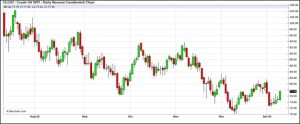
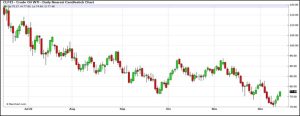
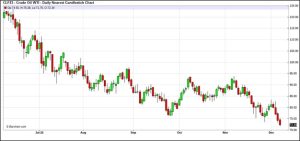
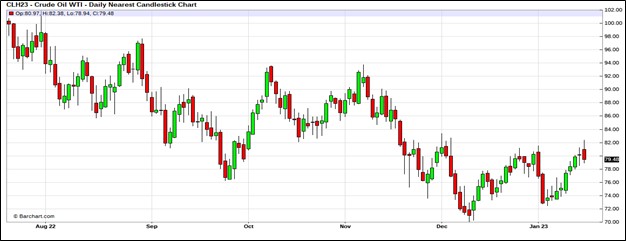
Crude oil prices are trying to base but so far have failed to break above resistance at around $80 per barrel.
(Source: Barchart.com)

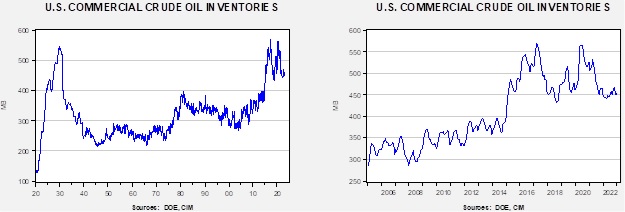
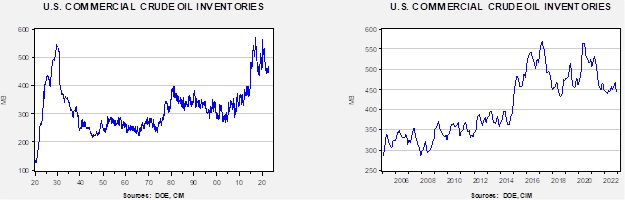
Crude oil inventories rose 8.4 mb compared to a 2.0 mb draw forecast.  The SPR was unchanged, the first time since the reporting week of May 20, 2022.  The unusually large build was caused by slower than expected recovery in refinery operations.
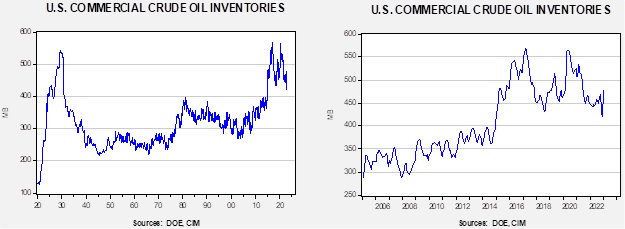
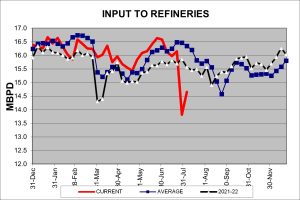
In the details, U.S. crude oil production was unchanged at 12.2 mbpd.  Exports rose 1.7 mbpd, while imports rose 0.5 mbpd.  Refining activity rose 1.2% to 85.3% of capacity.  The Christmas cold snap closed in a significant level of refining activity, and the industry is slowly recovering.
(Sources: DOE, CIM)

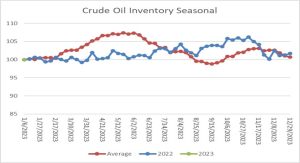
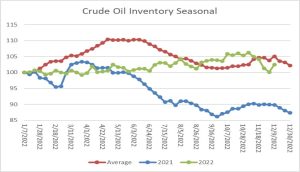
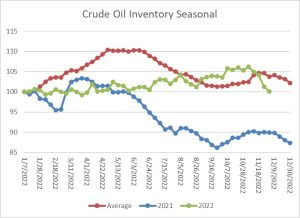
The above chart shows the seasonal pattern for crude oil inventories.  Last week’s jump in inventory means we are starting the year off with well above average inventory injections.  The chart does show that the usual seasonal pattern was not followed last year.  This is because the average still reflects the restrictions on U.S. oil exports whereas there isn’t much of a discernable pattern to this data now that exports are allowed.

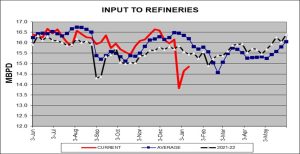
Th chart below shows the sharp drop and partial recovery in refining operations.  Usually, we do see some refinery maintenance this time of year, which will end in early February.  Thus, we may not see a full recovery in refinery operations until later in the quarter.
(Sources:  DOE, CIM)
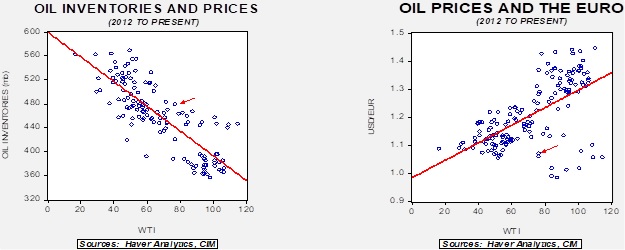
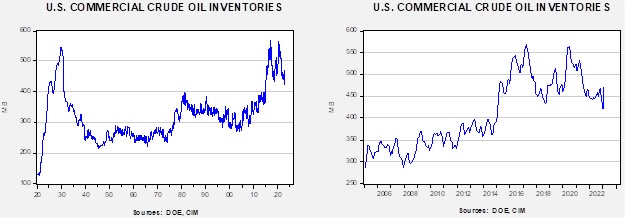
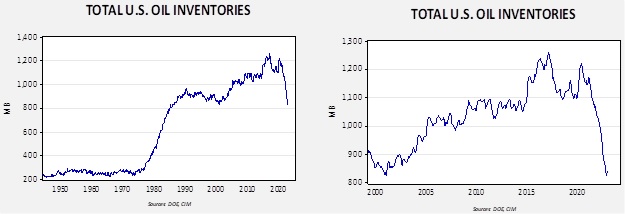
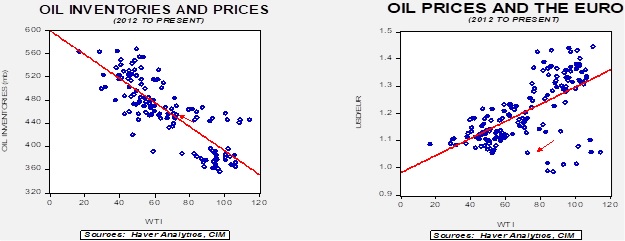
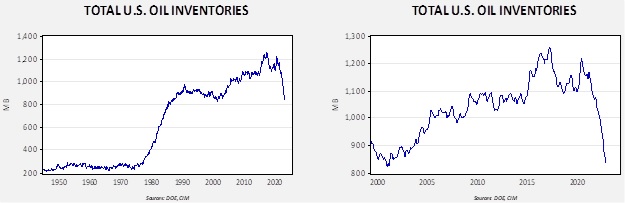
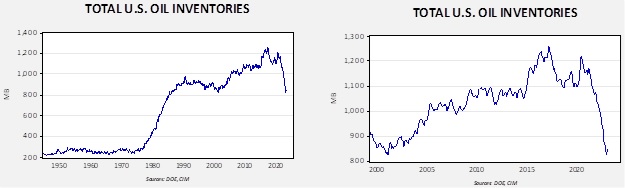
Since the SPR is being used, to some extent, as a buffer stock, we have constructed oil inventory charts incorporating both the SPR and commercial inventories.  For the next few months, we expect the SPR level to remain steady, so changes in total stockpiles will be driven solely by commercial adjustments.

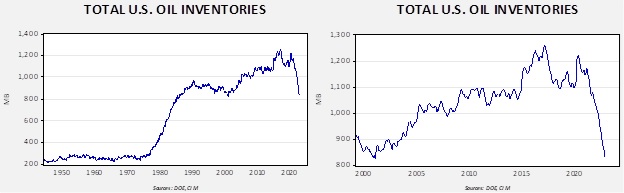
Total stockpiles peaked in 2017 and are now at levels last seen in 2001.  Using total stocks since 2015, fair value is $107.07.

Market News:

  • As the government’s SPR sales begin to wind down, the potential for higher prices has increased. We do expect a resumption of sales if oil prices threaten $100 per barrel, but it is unlikely that we will see another large sale just because prices are high.  We believe that the SPR sale was an underappreciated bearish factor last year, and if we are correct, an end to selling will likely be more bullish than expected.
    • It is our position that the SPR will never be refilled to its +600 mb level last seen before the recent sales. The structure that the Biden administration has put in place to buy oil makes it very unlikely that purchases will occur.
  • The IEA is warning that the reopening of China will lift global oil demand to a new record.
  • The Kingdom of Saudi Arabia (KSA) is kicking off investment into the mining sector, likely to diversify its economy away from oil and gas just in case demand for these products fall as green energy expands. The $15 billion starter fund should boost mining investment and will likely support the sector.
    • Saudi Arabia, due to cost structure and low emissions from production, believes it will be the last oil producer standing, even as the world moves away from fossil fuels.
    • In another effort to diversify its energy sources, one that will be most controversial, the KSA has indicated that it will use its domestic uranium to complete the nuclear fuel cycle. In theory, doing so could give the country the wherewithal to develop nuclear weapons.  Given the advanced status of Iran’s program coupled with uncertainty surrounding the U.S. security guarantee, this claim could further raise risks in the region.
  • The history of oil is littered with “we are running out” narratives. Daniel Yergin’s The Prize is perhaps the best history of the industry, and at several junctures, the accepted wisdom was that the age of oil was ending because all the fields had been tapped.  What history shows is that supply shortages lift prices, increasing not just exploration activity but also new technologies.  Since oil was discovered in 1859, this cycle has been in place.  Thus, when the Financial Times runs a story about the end of shale, we take it with a bit of skepticism.  In some respects, the story might be right if current conditions remain in place, but, those conditions probably won’t last.  The FT story and the EIA’s short-term forecast for production are predicated on prices staying about where they are.  However, as we have noted, if we assume around a 200 mb decline in commercial stockpiles, which would have occurred had it not been for the SPR draw, we would be looking at $135 per barrel for crude oil.  Prices at that level will probably change behaviors.  Supply issues, such as the lack of workers, capital constraints, regulatory constraints, etc., remain, but all these can be overcome with higher prices.
  • There is an old adage in markets that “nothing cures high prices like high prices.” In market theory, price is a signal, and high prices tell consumers to conserve, but more importantly, they reward suppliers who bring product to market.  As prices rise, especially in Europe, we are seeing a notable increase in exploration and development activity in the eastern MediterraneanLarge natural gas fields are being discovered in a difficult geopolitical environment.  Offshore fields south of Cyprus have brought the involvement of Turkey, Greece, Israel, Lebanon, and even indirectly, Hamas.  Although there has been some degree of cooperation, deep divisions remain; for example, Turkish and Greek vessels routinely threaten each other.  Government instability can also upend agreements, but high prices will make it more likely that these obstacles will be overcome and will improve the supply situation in Europe and the Middle East.

 Geopolitical News:

 Alternative Energy/Policy News:

  • The IEA has issued its annual report on the state of energy technology, which skews toward green energy production. There are a number of takeaways but the one that caught our attention is China’s dominance in the production of components for these products.  If the West is going to develop these energy sources, a massive level of investment will be required.
  • Sweden announced it has discovered a large deposit of rare earths. Rare earths are not really all that rare, although finding concentrated deposits can be a challenge.  The mining of such products, however, is environmentally difficult and the processing even more so.  Thus, the challenge of overcoming China in this area is, to some degree, tied to either making the process cleaner (and likely more expensive) or accepting the environmental degradation.
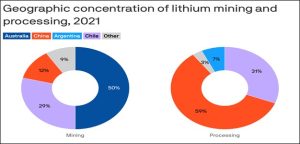
  • China’s dominance in lithium is seen in the chart below.
(Source:  IEA)

  View PDF

Keller Quarterly (January 2023)

Letter to Investors | PDF

A new year is underway, and we wish you and yours all the best in 2023! The stock market certainly seems to be optimistic about the new year: the S&P 500 is up 4.1% through its first full two weeks of 2023 and it’s up 14.5% from the 52-week low on October 13. Without repeating too much of my October letter, you know that we believe a recession is likely in the current year. In fact, that seems to be the consensus among Wall Street economists. So, why the positive market behavior?

Financial markets are not independent entities, but rather represent the collective behaviors of thousands of participants, each of whom is making their best guess about the future. When most of those participants expect the same thing to occur, guess what? It’s “in the market,” as we say; that is, the event is almost certainly reflected in market prices. In my opinion, the stock market spent the middle six months of last year discounting the probability of a 2023 recession.

It remains to be seen whether this recession will be shallow, normal, or deep. Our expectation is that it will be shallow-to-normal, which seems to concur with the consensus view, judging by the market’s behavior. Why is that? The U.S. consumer appears to be in better shape than usual at this point in the cycle. Relatively low unemployment rates mean that most people who want a job have one, consumer debt relative to household cash and income is relatively low, and the banking system appears to be in very good shape relative to past cycles. One reason for this good condition is that the last recession was just three years ago (2020), meaning there hasn’t been a lot of time for businesses and consumers to over-extend themselves. In addition, the extraordinary fiscal and monetary stimulus the economy received in the wake of the pandemic-induced recession allowed many to reduce their debts and “get their houses in order.”

On the other hand, could the recession be deeper? Yes, it is possible that the Fed will raise the fed funds rate beyond what the market presently expects (that is, more than 5.0% to 5.5%), which might cause a worse recession. Geopolitical factors, especially those involving Russia or China, could intervene and deepen a recession. But, at this point, we believe those are lower probability events. The stock market tends to look six to 12 months into the future and, in our opinion, the market is presently looking past the recession to what late 2023 and even 2024 might look like. Our crystal ball gets cloudy that far out, but, as we noted last quarter, we see other trends in place today that will likely continue for many years.

Notably, we expect the average rate of inflation over the next 10 years to be meaningfully higher than the last 10 years. Inflation is “too much money chasing too few goods.” Politicians and economists talk incessantly about the “too much money” part of that definition. Thus, they obsess over money supply and monetary stimulus. What they forget is that the “too few goods” side of the definition is usually the key determinant of inflation. When ever-increasing globalization was dramatically increasing the supply of goods and lowering their cost (from approximately 1980 to 2015), inflation trended lower and stayed there. Once globalization peaked, however, the trend began to change. Throw in the disruptions due to a pandemic and a war and you have a real supply problem, otherwise known as inflation. While the pandemic is winding down and the war will eventually end, deglobalization is here to stay.

As a result, we expect inflation to average 4% or more for the long-term, about double the prior long-term rate. That’s what we’re factoring into our thinking. It is a headwind for investment returns, to be sure, but, as we’ve communicated in prior letters, this is not an environment unknown to us. Our investment strategies and security selection processes were all developed with higher inflation in mind because we are old enough to have experienced it before.

We appreciate your confidence in us.


Gratefully,

Mark A. Keller, CFA
CEO and Chief Investment Officer

View PDF

Asset Allocation Bi-Weekly – The Master of Surprise (January 17, 2023)

by the Asset Allocation Committee | PDF

[Note: The podcast that accompanies this report will be delayed until Friday, January 20.]

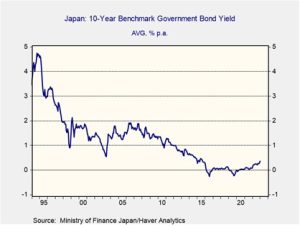
They don’t call Haruhiko Kuroda the “Master of Surprise” for nothing. The Bank of Japan (BOJ) Governor lifted the yield cap on 10-year Japanese government bonds (JGB) by 25 bps last month. The bank will now allow the 10-year yield to fluctuate between -0.50% and +0.50% before intervening in the market. The move jolted markets as it paved the way for possible future monetary tightening. Because Japan is the world’s largest creditor, an increase in Japanese yields could attract capital from abroad back to the mainland. As a result, the policy change could lead to an overall increase in borrowing costs for other countries, including the U.S., and could also affect exchange rates.

The JPY surged as much as 5% against the dollar on the day following the BOJ’s surprising decision. This was the JPY’s largest gain since the New York Fed and BOJ joined forces to prop up the currency in 1998. The rise in the currency reflects investor sentiment that the BOJ is getting ready to tighten its monetary policy. The central bank has intervened in bond markets to keep its bond-yield rates around 0%. Attempts by speculators to push the BOJ to adjust its policy prematurely have typically ended in tears as the bank defended its caps aggressively and burnished the short JGB trade as “the widow-maker in the process.

Although the BOJ maintains that the move was not designed to alter future monetary policy, it is difficult to discern another motive. The latest meeting summary showed that BOJ officials raised their cap to address issues within their bond market. Days before the decision, a BOJ survey revealed that investors’ perceptions of bond market functionality fell to a record low. Additionally, the 10-year JGB failed to trade for four straight days at one point between the October and December meetings, signaling a decline in liquidity. However, the lack of telegraphing, especially given the bank’s sizable bond holding, suggests that the decision may have been more nuanced.

BOJ Governor Kuroda’s term ends on April 8. The two front-runners to succeed him are former BOJ Deputy Governor Hiroshi Nakaso and current Deputy Governor Masayoshi Amamiya. The latter is seen as more of a dove, but both are expected to tighten policy. By raising the yield cap, Kuroda gave his successor more wiggle room to navigate a way forward without rattling markets. The policy adjustment allows the future head of the BOJ to chart their own path forward without the cloud of their predecessor.

The biggest obstacle preventing further tightening is the country’s substantial debt burden. Japan has the largest government debt-to-GDP ratio among advanced economies at 206%. It has been able to manage this burden through its yield-curve control. Japan’s effective interest was 0.6% in 2021, much lower than many of its peers. In contrast, the effective interest rate on Italian debt was 2.3% in 2021, while the U.S. paid 1.6% during that period. Given the size of the debt, a small increase in interest rates could still lead to a sizable jump in debt payments. Although manageable in the long term, a 100-bps rise in interest rates would add 3% to the government debt-to-GDP ratio by 2025, according to Fitch Ratings Agency.

Higher interest rates in Japan could also lift borrowing costs for other countries. An increase in the yield on Japanese sovereigns incentivizes Japanese investors to bring capital home, leading to higher interest rates for the rest of the world. The U.S. is particularly vulnerable. Higher yields on JGB will attract interest from Japanese investors, who are the largest holders of U.S. Treasuries outside of America itself. As a result, the increase in Japanese interest rates could also lead to an increase in U.S. rates.

Although the markets anticipate that the BOJ will tighten policy more in 2023, they are not completely certain. We suspect that Japan’s decision to raise its yield cap by 25 bps had more to do with giving Kuroda’s successor more flexibility to conduct policy. That said, it appears that either candidate expected to take over, Hiroshi Nakaso or Masayoshi Amamiya, is likely to tighten. If correct, this should help boost financial sector equities internationally as it makes it easier for banks to profit from lending.

View PDF

Weekly Energy Update (January 12, 2023)

by Bill O’Grady, Thomas Wash, and Patrick Fearon-Hernandez, CFA | PDF

Crude oil prices continue to come under pressure on worries over economic growth, although there is some evidence that prices may be basing between $72 and $82 per barrel.

(Source: Barchart.com)

Crude oil inventories jumped 19.0 mb compared to a 3.0 mb draw forecast.  The SPR delined 0.8 mb, meaning the net build was 18.2 mb.  The unusually large build was caused by a large drop in exports, a rise in imports, and continued depressed refinery operations due to the deep cold snap late last year.

In the details, U.S. crude oil production rose 0.1 mbpd to 12.2 mbpd.  Exports fell 2.1 mbpd, while imports rose 0.6 mbpd.  Refining activity rose 4.3% to 84.1% of capacity.  The Christmas cold snap closed in a significant level of refining activity, and the industry is slowly recovering.

(Sources: DOE, CIM)

The above chart shows the seasonal pattern for crude oil inventories.  Because we are starting the new year, we only have one datapoint for 2023.  The chart does show that the usual seasonal pattern was not followed last year.  This is because the average still reflects the restrictions on U.S. oil exports whereas there isn’t much of a discernable pattern to this data now that exports are allowed.

This chart shows the sharp drop and partial recovery in refining operations.

(Sources:  DOE, CIM)

Since the SPR is being used, to some extent, as a buffer stock, we have constructed oil inventory charts incorporating both the SPR and commercial inventories.

Total stockpiles peaked in 2017 and are now at levels last seen in 2001.  Using total stocks since 2015, fair value is $107.08.

Market News:

  • As China reopens from its COVID-19 lockdowns, it is increasing its oil import quotas. This decision is likely bullish for crude oil prices.  China is expected to buy a significant amount of Russian crude for this reopening, which should be available as the EU price cap has reduced Russian exports.
  • OPEC+ production rose modestly in December.
  • The DOE is forecasting lower oil prices in 2023 and 2024. For 2023, it is expecting Brent to average $83 per barrel, with $78 per barrel in 2024.  Expectations of rising output are behind the lower price forecast.
  • We discussed proposed rules for U.S. refiners last year. Further analysis suggests that the costs of the new rules could lead to about a 700 kbpd loss of gasoline production as older refineries become unprofitable.  Although we could see some “grandfathering,” refining issues remain a concern.
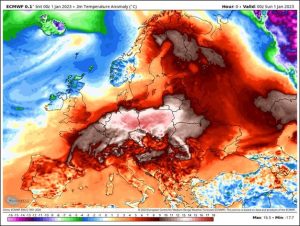
  • As we went into winter, the worry for the EU was that a cold winter would lead to a shortage of natural gas and therefore higher prices. Instead, Europe is being blessed with a historically mild winter.  Although these mild temperatures have helped Europe avoid a price crisis this winter, it could portend a hot, dry summer, which could lift natural gas prices later this year.  Last year’s dry summer caused havoc in Europe, affecting river travel and reducing nuclear power production, which was adversely affected by the water being too warm and too scarce to cool reactors.  Although summer remains a secondary demand season for natural gas, rising temperatures will lift natural gas-fired-electricity demand and may disrupt the inventory cycle, increasing the price risk when the eventual cold winter does occur.

(Source)

 Geopolitical News:

 Alternative Energy/Policy News:

  View PDF

Bi-Weekly Geopolitical Report – How China Will Manage Its Evolving Geopolitical Bloc (January 9, 2023)

Patrick Fearon-Hernandez, CFA | PDF

In mid-2022, we published a report showing that as the United States begins to step back from its traditional role as the global hegemon, the world is fracturing into relatively separate geopolitical and economic blocs.  Our study looked at almost 200 countries around the world and aimed to objectively predict which bloc each of those countries would end up in, i.e., the evolving U.S.-led bloc, the China-led bloc, the blocs that lean one way or the other, and a neutral bloc.  The study predicted that this global fracturing would have major effects on the world’s economy and financial markets, for example, by boosting commodity prices, inflation, and interest rates.

In this report, we deepen the analysis to examine how the U.S. and China will lead their respective blocs, and what that might mean for the global economy and financial markets.  We pay especially close attention to the implications for the U.S. dollar and the Chinese yuan as well as the broader implications for investors.

Read the full report

The associated podcast episode for this report will be available next week.

2023 Outlook: A Recession Year (December 21, 2022)

by Mark Keller, CFA, Bill O’Grady, and Patrick Fearon-Hernandez, CFA | PDF

Summary of Expectations:

  • A recession is highly probable in 2023. Our base case is a garden-variety recession.
  • Three factors could trigger a deep recession: a. Falling nominal home prices; b. A financial crisis; c. A geopolitical event
  • One factor that could mitigate the downturn is investment spending, especially on manufacturing plants and equipment. Manufacturing has been depressed for over three decades and the prospect for reshoring and building redundancies could support the economy. We suspect this factor will tend to be longer term in nature, but it could begin next year.
  • We expect inflation to ease in 2023, but the Federal Reserve’s preferred narrative on inflation control and how inflation was quelled in the 1970s could increase the odds of a policy mistake.
  • Long-duration Treasuries are signaling faith that the FOMC will curtail inflation even at the cost of a deep recession. This faith has led to a deep inversion of the yield curve. Credit spreads are expected to remain well behaved. This good behavior is mostly a function of the short business cycle, which has not been long enough to support the usual deterioration of credit standards.
  • Increasing concerns about market liquidity are a risk to the Treasury market. The liquidity issues may signal that the size of the deficit is too large for the current auction distribution system. Either the system needs to be reformed or the deficit reduced.
  • Strictly based on our modeling, our S&P 500 operating earnings forecast for 2023 is $179.61 with a year-end multiple of 17.1x. However, remaining excessive liquidity and the usual rise in the multiple during recessions increase the odds that the multiple will offset the expected decline in earnings. Depending on the depth of the recession, a decline in the market to 3520-3071 is possible, and as we note below, from there, a recovery to the 4100-4300 range is likely. Obviously, the key to equity market behavior is the timing of the recession and Fed behavior. We expect small caps to outperform, although this outperformance will likely be tempered by the recession. Value is expected to outperform Growth. Although U.S. markets may outperform in the first half of 2023, the relative outperformance of U.S. stocks will occur in the very late innings. We look for dollar weakness to develop over 2023, which will tend to be supportive for foreign stocks.
  • Although we are bullish long-term on commodities, it is common, even in secular bull markets, for prices to decline during recessions. We expect to maintain modest positions in commodities, but as the dollar weakens next year, commodities should benefit. An economic recovery will support commodities as well. Again, the timing of the downturn is important.

Read the full report

Weekly Energy Update (December 15, 2022)

by Bill O’Grady, Thomas Wash, and Patrick Fearon-Hernandez, CFA | PDF

(This will be the last report of 2022; we will resume publication on January 12, 2023.)

Crude oil prices continue to come under pressure on worries over economic growth.  There was likely some bullish positioning in front of the Russian price cap which is probably being liquidated.

(Source: Barchart.com)

Crude oil inventories jumped 10.2 mb compared to a 3.8 mb draw forecast.  The SPR declined 4.7 mb, meaning the net build was 5.5 mb.

In the details, U.S. crude oil production fell 0.1 mbpd to 12.1 mbpd.  Exports and imports rose 0.9 mbpd.  Refining activity fell 3.3% to 92.2% of capacity.  Pipeline issues caused the drop in refinery activity.

(Sources: DOE, CIM)

The above chart shows the seasonal pattern for crude oil inventories.  This week’s data reversed the recent contra-seasonal pattern of the past few weeks, most likely due to the drop in refinery activity caused by pipeline issues.

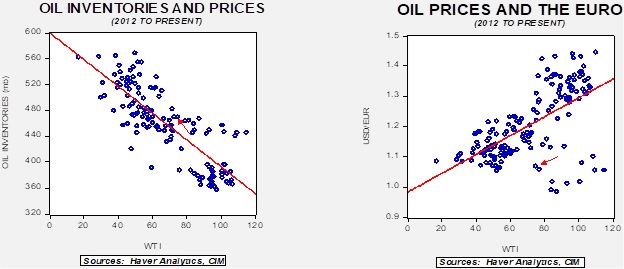
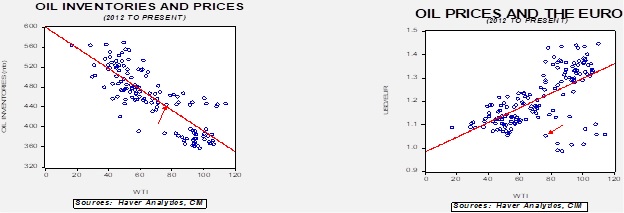
Shortly after the war started, we stopped reporting on our basic oil model that uses commercial inventory and the EUR for independent variables.  We have now updated that model, which puts fair value at $73.60 per barrel.  We are currently trading near fair value for the first time since the war began.

Since the SPR is being used, to some extent, as a buffer stock, we have constructed oil inventory charts incorporating both the SPR and commercial inventories.

Total stockpiles peaked in 2017 and are now at levels last seen in 2001.  Using total stocks since 2015, fair value is $104.10.

Market News:

  • We are continuing to watch how the Russian price cap is working. As we noted last week, the first reaction was that shipping was disrupted around the Black Sea.  Russia’s fiscal situation could suffer as well, and although Russia’s breakeven is thought to be around $20 per barrel, fiscally it needs $70 per barrel to balance its budget.  We still don’t know if the price cap is low enough to curtail Russian output, but the disruptions have cut exports.
  • The Keystone pipeline has suffered a rupture in Kansas, leaking 14,000 barrels worth of oil. The leak will disrupt oil flows to at least two refining centers.  We may see a drop in production in the coming weeks if the outage persists.
  • Up until now, Europe has been helped by mild weather. That string of good fortune appears to be fading, which will likely lift oil and gas demand, and therefore, prices as well.
  • Amos Hochstein, the White House international energy envoy, described the U.S. shale industry as “un-American.” He wants the industry to expand production, even though the government has sent rather clear signals that the future of oil demand is in doubt, in part due to policies of the same government.  If the goal is to encourage the industry to lift output, name-calling probably won’t have the desired effect.  At the same time, to be fair to Mr. Hochstein, his “beef’ is mainly with Wall Street, who is demanding a focus on shareholder returns rather than output.  Even with that emphasis, we note that production is rising in the shale patch, although the pace isn’t exactly rapid.
  • Germany is making remarkable progress in building out its LNG infrastructure.
  • With South Korean ship builders at capacity, orders for new LNG tankers are being sent to China.
  • Europe has tentatively passed a carbon tariff. When a nation implements environmental rules of any type, it usually increases the costs of production.  This change puts domestic producers at a disadvantage relative to foreign producers who are likely not under similar restrictions.  In some sense, it is a form of protectionism, but for social goals.  The ability of the tax to level the playing field for European industry is still uncertain.  The levy is designed to be placed on the carbon content emitted during the production of the product, which may not be all that precise.  If the levy is too low, it will still be cheaper to buy it from the “dirty” foreign producer.  If it’s high enough to prevent the import, it will increase costs.
  • The IEA is warning that oil markets will likely tighten next year.
  • Infrastructure matters—we note that natural gas prices in the Permian Basin have fallen to $0.05 per MMBTU due to the lack of pipeline infrastructure.

 Geopolitical News:

  • President Xi made a state visit to the Kingdom of Saudi Arabia (KSA) last week. The two nations inked a “strategic partnership” but, in reality, if the KSA is threatened by its neighbors, we doubt its first call will be to Beijing.  Still, the visit does highlight a drift in the KSA’s relations with the U.S.
    • Fin-Twitter was ablaze with commentary concerning reports that the KSA and China were about to begin settling oil sales in CNY. The fear is that pricing oil in a currency other than USD would undermine the reserve role of the greenback and lead to all sorts of potential ramifications.  However, the change might not be as groundbreaking as it is portrayed.  First, the KSA runs a modest trade surplus with China.  If the KSA is okay with accepting CNY instead of USD, we suspect Riyadh will find investments in China that will be acceptable.  Chinese financial markets are not as deep as U.S. ones, and as the real estate situation shows, in a workout agreement, Chinese investors are given preference.  At the same time, the treatment of USD reserves held by Russia and Iran have to give any nation pause as clearly getting “offside” with the U.S. can have a potentially bad outcome.  So, diversifying away from the dollar would make sense for the KSA, whose relations with the U.S. have become rather strained.
    • The “big deal” would be if the KSA demanded CNY for all oil sales. That would drive up demand to run trade surpluses with China in order to acquire CNY.  Given China’s reluctance to run large trade deficits (and incur the negative impact on employment), we doubt this action will spread beyond the bilateral relationship.
    • China is a newcomer to the region’s geopolitics, and it is getting a feel for just how fraught the region can be. During President Xi’s visit to the UAE, he agreed to a statement supporting the Emirates’ claims that the islands of Greater Tunb, Lesser Tunb, and Abu Musa should be submitted to some sort of international adjudication.  These three islands were part of the UAE when it was formed following the British withdrawal in 1971.  Iran decided to take advantage of the British leaving and seized the islands.  The UAE has wanted them back ever since, but Tehran has no interest in acquiescing.  Either the Chinese diplomats are siding with the UAE in this dispute, or they more likely walked into a conflict.  Iran was quite upset with the communiqué following the China/UAE meeting and is demanding an explanation.
    • Iran and China have had a longstanding relationship as the latter has helped Iran evade Western sanctions. It is worth noting, however, that the relationship may be more transactional than anything else.  As China is acquiring more oil from Russia, its overall trade with Iran is declining.
  • Iran’s economy continues to suffer, but that sluggish economy has not led the state to ease its repression. At the same time, Russia and Iran are deepening their military relationship, a situation that will complicate the security of nations aligned against Tehran.
  • A hack of Islamic Revolutionary Guard Corps documents details some of the discussions tied to the renewal of the 2015 nuclear deal. Although the veracity of the reports isn’t confirmed, the information provided does suggest that the two sides were always far apart.
  • We note that gold purchases by central banks have been rising rapidly, with most of the purchases coming from emerging market central banks. It is quite possible that these banks are worried that the U.S. could reduce the value of their foreign exchange reserves as Washington did to Russia and Iran.  It should be noted that gold has other uses for central banks.  Iran has been trading fuel to Venezuela in return for gold.  Both nations have been under sanctions and have used gold to evade those sanctions.
  • The KSA warns that if Iran develops/acquires a nuclear weapon, then “all bets are off,” which suggests a nuclear arms race in the region is likely.
  • The U.S. made an outreach to Africa this week as part of a broader program to secure rare earths and other minerals critical to the energy transition. It is not obvious if the African nations will find the American effort useful, however.  Ultimately, Africa needs infrastructure investment (in which China tends to excel) and market access (which the U.S. is reducing from all nations), so this may turn out to be more rhetoric than reality.  Still, the U.S. is promising funding as part of the meeting, which will likely be welcomed.

 Alternative Energy/Policy News:

  View PDF

Bi-Weekly Geopolitical Report – The 2023 Geopolitical Outlook (December 12, 2022)

by Bill O’Grady & Patrick Fearon-Hernandez, CFA | PDF

(This is the last BWGR of 2022; the next report will be published on January 9, 2023.)

As is our custom, in mid-December, we publish our geopolitical outlook for the upcoming year.  This report is less a series of predictions as it is a list of potential geopolitical issues that we believe will dominate the international landscape for 2023.  It is not designed to be an exhaustive list; instead, it focuses on the big-picture conditions that we believe will affect policy and markets going forward.  They are listed in order of importance.

Issue #1: The Big Picture

Issue #2: The Expanding, Strengthening State and Populism

Issue #3: China Learns to Lead a Bloc

Issue #4: The Race for Space

Issue #5: The Brittleness of Authoritarianism

Read the full report

The associated podcast episode for this report will be available next week.

Weekly Energy Update (December 8, 2022)

by Bill O’Grady, Thomas Wash, and Patrick Fearon-Hernandez, CFA | PDF

Crude oil prices continue to come under pressure on worries over economic growth.

(Source: Barchart.com)

Crude oil inventories fell 5.2 mb compared to a 3.9 mb draw forecast.  The SPR declined 2.1 mb, meaning the net draw was 7.3 mb.

In the details, U.S. crude oil production rose 0.1 mbpd to 12.2 mbpd.  Exports fell 1.5 mbpd, while imports were unchanged.  Refining activity rose 0.3% to 95.5% of capacity.

(Sources: DOE, CIM)

The above chart shows the seasonal pattern for crude oil inventories.  As the chart shows, we are past the seasonal trough in inventories and heading toward the secondary peak which occurs in early Q4.  SPR sales have distorted the usual seasonal pattern in this data.  This week’s draw takes inventories further below the seasonal average, though perhaps the most important takeaway is that the usual seasonal pattern in inventory is breaking down.

Shortly after the war started, we stopped reporting on our basic oil model that uses commercial inventory and the EUR for independent variables.  We have updated that model, which puts fair value at $73.60 per barrel.  We are currently trading near fair value for the first time since the war began.

Since the SPR is being used, to some extent, as a buffer stock, we have constructed oil inventory charts incorporating both the SPR and commercial inventories.

Total stockpiles peaked in 2017 and are now at levels last seen in 2001.  Using total stocks since 2015, fair value is $106.07.

The CapAt long last, the EU has finally agreed on a price cap plan for Russian oil, pending Poland’s approval tomorrow.  The cap price is $60 per barrel, and since the current Urals price is around that level, it’s possible that not much will change.  The price was below what the Eastern Europeans were pushing for—Poland wanted a $30 price.  The U.S., however, was afraid that a price that low, which would effectively ban Russian oil exports, would trigger a major price rally and harm the world (and U.S.) economy.  The current price won’t really stop Russian exports if Russia wants to sell the oil.  Russia’s initial reaction is to refuse to sell oil to nations using the price cap.  We also note that, effective last Monday, the EU and U.K. will stop seaborne oil imports from Russia, which will have a more material impact on the oil markets.  The most likely market reaction is volatility.  The initial reaction to the cap and the OPEC+ decision was a sharp rise in oil prices, but that reaction faded earlier this week.

Market News:

  • The White House is seeking to halt SPR sales in the coming years. Congress has tended to use the SPR as a sort of budget “piggy bank” to allow for funding of various projects.  Thus, various sales have already been authorized for future years.  However, with the SPR being drained by the sales completed due to the war in Ukraine, the administration now wants to halt those future sales.  So far, we are not seeing any programs put in place to refill the reserve, but this action does suggest growing concern about the sales.
  • Recent data suggests that U.S. drilling activity remains lackluster. Due to regulatory and investment constraints, the U.S. oil and gas industry thus far has not reacted strongly to high oil prices.  We expect that to continue.
  • The fertilizer market has been a major concern since the Russian invasion of Ukraine. Both nations are major producers of fertilizers and feedstock for the product.  The UN says that it is near a deal that would allow Russia to export ammonia via a Ukrainian pipeline.  Ammonia is a key element for the economy and resuming this supply is important.  We note that fertilizer prices have been falling recently as markets adjusted to high prices, and the UN news will likely support further price declines.
  • One of our firm’s positions is that the unwinding of U.S. hegemony will lead to supply disruptions and trigger hoarding. Confirming this assertion is an announcement that Japan is building a strategic reserve for natural gas.  Japan gets nearly all of its natural gas from LNG and has faced higher prices as European demand for LNG has soared due to the war.
  • High prices and weak economic activity have reduced EU natural gas demand.
  • If China continues to ease COVID restrictions, oil prices should benefit.
  • Saudi Arabia announced it has discovered two new natural gas fields.
  • A 2019 study by the NBER showed that lower heating costs prevent winter deaths. The study suggested that the shale gas revolution likely saved 11k lives in the U.S.  If the study is correct, high heating prices may lead to higher mortality rates in Europe this winter.
  • Ethanol blending has hit new records.
  • Mild temps are bearish for natural gas prices. Meanwhile, U.S. LNG projects are being funded rapidly, although there are concerns that the industry won’t be able to find enough gas to match these projects.
  • Glencore (GLNCY, $13.31) is planning to accelerate coal mine closures. The closures have little to do with profitability but are instead being done to meet emissions targets.  The IEA is forecasting that renewables will overtake coal by 2025.
  • Russia and China have completed a pipeline to Shanghai.
  • New England authorities are warning that if the weather is unusually cold, rolling blackouts might occur. Some of the problem is tied to the Jones Act.

 Geopolitical News:

 Alternative Energy/Policy News:

  View PDF