

Daily Comment (November 15, 2022)

by Patrick Fearon-Hernandez, CFA, and Thomas Wash

[Posted: 9:30 AM EDT] | PDF

Good morning to all those eight billion out there (that are growing older, btw)!  Equities are trending higher this morning, interest rates are falling, and the dollar is lower.  The driving factor behind the rally is primarily the meeting between President Biden and President Xi (although the better-than-expected PPI data gave another leg up to the rally), which will head up our Comment this morning.  Up next is broader China news.  Ukraine comes next, followed by our take on economics and policy.  An update on the crypto situation is the next item, and we close with international news.

Biden-Xi:  The leaders of China and the U.S. met yesterday for the first time since Biden has been in office.  Although unusually late for the leaders of the two largest economies on earth to delay a meeting, President Xi has mostly stayed home during China’s Zero-COVID policy.  Expectations about the meeting were low, and for the most part, these expectations were met.  The first clue that no new ground was broken was that there was no joint statement as both sides issued their own statements.

So, if the outcome was so pedestrian, why are markets surging?  Mainly because relations have become so difficult, even this outcome looks quite positive.  China’s official media was downright gushing.  Here are the key takeaways from our perspective:

  • The meeting does appear to stabilize relations, which seemed to be on a downward spiral. Xi and Biden have a positive history as they met several times when both were second in command in previous administrations.  The meeting does suggest that at least the two sides can begin talking.
  • Our take is that China needed stabilization more than the U.S. did. China is attempting to deal with a property bubble (see next section), and its Zero-COVID policy is hurting its economy.  We suspect that Beijing thought that after Trump’s loss, U.S. policy to China would ease, but that didn’t happen.  In fact, it may have become harsher.  Beijing was avoiding contact with Washington for a host of reasons, but a big one may have been to wait until after Xi was given his third term as general secretary.  China’s economy is still dependent on exports, and it needs to trade with the U.S.  Thus, cooling tensions makes sense.
  • It appears that contact will continue. Secretary of State Blinken is scheduled to visit his counterparts as a follow up.  Even Australia is trying to mend relations.
  • At the G-20, China also signaled it wasn’t happy with the war in Ukraine. China’s English language readout didn’t include the quote below, but it was in the Chinese readout (translation courtesy of Bill Bishop of Sinocism).

The two heads of state also exchanged views on issues such as the Ukraine crisis. Xi Jinping pointed out that China is highly concerned about the current situation in Ukraine. After the crisis broke out, I put forward the “four should,” and not long ago I put forward the “four commons.” In the face of a global and complex crisis such as the Ukraine crisis, there are several points that deserve serious consideration: first, there are no winners in conflicts and wars; second, there is no simple solution to complex problems; third, major power confrontation must be avoided. China has always stood on the side of peace and will continue to promote peace talks. It supports and looks forward to the resumption of peace talks between Russia and Ukraine. At the same time, China hopes that the United States, NATO, and the European Union will conduct comprehensive dialogues with Russia.

  • At the same time, very large differences remain. The U.S. is more than happy to maintain the status quo in Taiwan as Washington supports a quasi-independent state without full independence.  For China, this is unacceptable, but it doesn’t really have a path to unify the island without setting off a war.  Biden is not fully in control of policy towards China and Taiwan, as Congress is becoming increasingly hawkish toward Beijing and toward supporting Taipei.  The actions taken on semiconductors have been viewed as a major step in a costly “cold war” with China, and it would be hard to pull back politically.  Much like U.S. administrations found in the Cold War, appearing “soft on communism” was a loser in elections.  Thus, we would not expect a major change in policy from the U.S. side.

Overall, it’s good news that the two sides are talking, but it’s important not to view this meeting as some sort of turning point.  The differences between the U.S. and China are great.  China is envisioning a world where it is a regional hegemon and expects the U.S. to acquiesce to its role and allow that to occur.  We don’t see Washington ceding that outcome without a fight.  The meeting does stabilize conditions, but we would not expect the U.S. to adjust its policy on trade or semiconductors.  But at least with both sides talking, the risk of miscommunication is lessened.

China News:  China moves to bolster its economy by easing COVID-19 restrictions and helping the real estate sector.

  • Although the Zero-COVID policy remains officially in place, in practice restrictions are easing despite a steady rise in infections. Quarantine rules are being relaxedTracking and investigation of reported cases are being eased.  Testing rules are becoming less stringent.  We would not expect a major announcement from the government in rolling back rules, but at the provincial level, Beijing is allowing local governments to ease up.  Although it may take a while for citizens to return to pre-pandemic behavior, this easing should boost economic activity.
  • Banks are being instructed to extend deadlines, and regulations on how real estate firms handle escrow accounts are being eased. These measures are helpful, but there is increasing evidence that the sentiment towards real estate has fundamentally changed.  Before, real estate was seen as a safe investment.  In a country that restricted capital flows, real estate was one area where households could have a chance at a positive real return on savings.  That idea is now widely seen as outdated, and real estate is seen as risky, as household saving shows signs of building.
  • Global investors are shunning China bonds.

War in Ukraine:  Discussions of peace talks are rising, but Russia and Ukraine appear to be in no hurry to begin serious discussions.

  • One of the truisms of nuclear weapons is that a nation possessing them can never be forced into unconditional surrender. That doesn’t mean nuclear powers can’t lose wars, but that loss is a choice.  Essentially, a nuclear power loses a war when it concludes that the costs of continuing the conflict exceed the benefits.  For example, the U.S. and U.S.S.R. both lost wars in Afghanistan.  They both left not because they couldn’t win, but because they decided winning wasn’t worth the trouble.
    • Ukraine can’t force a surrender on Russia, since, as Moscow has warned, it can use nuclear weapons to avoid defeat. Thus, this conflict will end with some sort of negotiated settlement.  At this juncture, Ukraine sees little reason to talk as it is enjoying battlefield success.  And Russia expects Ukraine’s allies to tire of the conflict and thus sees every reason to continue to war, regardless of losses, hoping that the deprivations caused by the war will lead NATO to reduce its support of Ukraine.
    • And so, allies of the combatants are making comments about talks. General Milley recently suggested that a “window” for talks could emerge this winter.  The administration has “clarified” these remarks by saying it’s up to the Ukrainians to decide to talk, but the reality is that if the U.S. reduces its support, Ukraine will be forced to make a deal.
    • As noted above, China’s displeasure with Russia over the war could lead Beijing to pressure the Kremlin to sue for peace.
    • At this point, we don’t expect a rapid resolution to the conflict, but the war won’t go on indefinitely. Outside pressure on both Russia and Ukraine can likely force some sort of ceasefire.  We are not there yet as the U.S. sees value in degrading Russia’s military.  But the loss of Russian energy is a major problem for the EU, and China is clearly displeased with the course of the war.  So, by next summer, we could see some moves toward talks.
  • The U.S. is warning Russia against the use of nuclear weapons. The U.S. has also added additional sanctions on Russia.

Markets, Economics and Policy:  Vice-Chair Brainard bolsters the case for slowing rate hikes, and student debt relief is in limbo.

Crypto:  The FTX debacle continues.

A deal in Europe:  The U.K. and France have a new arrangement to deal with migrants attempting to move to the U.K.  Westminster will pay Paris $75 million to manage the migrant flows, an increase of $10 million from earlier agreements.

View PDF

Daily Comment (November 14, 2022)

by Patrick Fearon-Hernandez, CFA, and Thomas Wash

[Posted: 9:30 AM EDT] | PDF

Our Comment today opens with an update on the Russia-Ukraine war, including a discussion of what comes next following Ukraine’s dramatic recapture of the southern city of Kherson late last week.  We next review a wide range of other international and U.S. developments with the potential to affect the financial markets today, much of which is focused on developments in China and in U.S.-China relations.

Russia-Ukraine:  Now that Russian forces have abandoned the southern Ukrainian region around Kherson, they appear to be redeploying their forces northward to launch new offensives in the province of Donetsk.  That will likely force the Ukrainians to reinforce their units in that area, but they are also expected to send some troops from Kherson northward to bolster their offensive in the northeastern Luhansk region.  In any event, it appears that Ukraine’s recapture of Kherson has set the stage for intensified fighting, rather than less fighting, in the coming months.

Turkey:  An apparent terrorist bombing in central Istanbul killed six people yesterday, prompting the government to vow vengeance on the Kurdish militants that it suspects planted the device.  Because of U.S. support for Kurdish rebels in Syria, the attack and any Turkish retaliation is likely to worsen U.S.-Turkish relations.  Potentially, that could mean that Turkey will become even less cooperative in supporting Ukraine as it tries to defend itself against Russia’s invasion.  It could also prompt Turkey to dig in its heels against Sweden and Finland joining NATO.

United Kingdom-France:  Today, negotiators from the U.K. and France struck a deal in which the U.K. will provide additional resources to France so it can halt additional migrants from illegally crossing the English Channel to the U.K.  The agreement is an early sign that Prime Minister Sunak’s government may be able to work more constructively with France and the rest of the EU than other recent Conservative governments.

China COVID Policy:  The Communist Party has ordered that the country’s Zero-COVID policy be “optimized and adjusted” to minimize its impact on economic growth, people’s lives, and foreigners’ ability to visit China.  Along with the news of easing inflation in the U.S., the announcement helped give a big boost to stocks in China and Hong Kong on Friday.

  • However, it’s important to note that the order didn’t change the overarching policy goal of completely stamping out COVID-19. Many Western observers assessed the move to be merely fine-tuning, rather than easing, the Zero-COVID policy.
  • That’s especially the case given that new infections in China have now surged to more than 10,000 per day, marking their highest level since Shanghai was forced to shut down its economy in March. Since so many Chinese citizens remain unvaccinated or vaccinated only with China’s relatively less effective indigenous vaccines, especially among the elderly, a large breakout of new infections could spark a big increase in deaths.  In turn, that would probably prompt the government to tighten restrictions again, with negative implications for the Chinese economy and financial markets.

China Real Estate Policy:  In the country’s second major move to accelerate economic growth, the People’s Bank of China and the China Banking and Insurance Regulatory Commission released a broad support program for the real estate industry on Friday.  One of the biggest policy changes in the notice is to allow a “temporary” easing of restrictions on bank lending to real estate developers.  In addition, developers’ outstanding bank loans and trust borrowings due within the next six months could be extended for a year, while repayment on their bonds may also be extended or swapped through negotiations.  To reduce the risk of popular unrest over developers’ failure to deliver finished homes after buyers made down payments, the new policy also calls on banks to negotiate with homebuyers on extending mortgage repayment and emphasized that buyers’ credit scores should be protected.

  • The regulatory adjustments for the real estate market come on top of other, more limited measures issued in recent months, including cutting interest rates, urging major banks to extend 1 trillion yuan ($140 billion) of financing in the final months of the year, and offering special loans through policy banks to ensure property projects are delivered.
  • The eased property restrictions probably also fed into the surge in Chinese stocks on Friday. However, it is important to remember that the regulatory easing flies in the face of President Xi’s desire to rein in real estate developers’ debt, so it’s not entirely clear how far the measures will be taken.  It therefore remains to be seen whether Chinese stocks will continue to rebound.

United States-China:  President Biden and Chinese President Xi held their first in-person meeting as national leaders today on the sidelines of the Group of 20 summit in Indonesia.  According to U.S. National Security Advisor Sullivan, Biden used the occasion to warn China about U.S. red lines as the two countries’ rivalry intensifies.  He also suggested that Xi should help rein in North Korea’s belligerent nuclear missile program.

U.S. Mid-Term Elections:  Based on updated vote tallies released over the weekend, Nevada Senator Catherine Cortez Masto now appears to have won re-election, ensuring the Democratic Party will retain control of the upper house of Congress with Vice President Harris’s tie-breaking vote.  If the Democrats win Georgia’s senatorial run-off vote on December 6, they will improve their position in the Senate to an outright majority of 51-49.

  • Nevertheless, for investors, the key story is simply that the Republicans have probably taken control of the House of Representatives.
  • If confirmed by final vote tallies in the coming days, Republican control of the House means that the federal government will again be split between the parties. Historically, that has been a positive environment for U.S. stocks.

U.S. Monetary Policy:   At an event in Australia today, Federal Reserve board member Christopher Waller warned that investors shouldn’t be lulled by last week’s report showing cooler inflation.  According to Waller, the monetary policymakers “have a ways to go yet” to boost interest rates high enough to get inflation truly under control.  The statement should be a reminder that the Fed is still desperately keen to rebuild its inflation-fighting credentials, so it is likely to keep raising interest rates in the near term even if doing so pushes the economy into recession, as we expect.

U.S. Economy:  The freight unit of FedEx (FDX, $175.61) said it is furloughing some workers in select U.S. markets in response to slowing demand.  Since transportation services can often be a bellwether for the overall economy, the action provides concrete evidence that U.S. economic activity is slowing sharply, consistent with our view that it will slip into recession sometime in the first half of 2023.

  • Because of slowing demand and purchasing mistakes amid the pandemic’s disruptions, many retailers have already started offering big “Black Friday” discounts to clear out excess inventories. The drop in prices could help bring down inflation but will probably also weigh on retailers’ profits and stock prices.
  • In other potential good news for inflation, wetter weather in Brazil and Indonesia is promising to bolster coffee supplies which will prompt a big decline in prices. Futures prices for the Arabica variety have fallen approximately 22% in just the last month.

View PDF

Asset Allocation Bi-Weekly – The Impossible Trinity (November 14, 2022)

by the Asset Allocation Committee | PDF

The U.S. Dollar Index hit a 20-year high in September as the greenback gained against other global currencies. The climb in the U.S. dollar (USD) began in the post-pandemic recovery. Investors flocked to the greenback for safety as the U.S. economy outgrew its peers in the OECD. Aggressive policy tightening by the Federal Reserve accelerated the appreciation as U.S. dollar-denominated assets have become even more attractive for foreign investors. The strong pick-up in demand for the USD intensified inflationary pressures globally and could push other countries into recession.

With limited options, central banks and governments were forced to take extreme actions to prevent their currencies from depreciating. Throughout 2022, investors have penalized countries that failed to prioritize fiscal and monetary austerity to contain inflation. Examples include a controversial tax plan in the U.K., the European Central Bank’s stealth quantitative easing to maintain sovereign spreads within the eurozone, and Japan’s insistence on yield-curve control, which led to nosedives in those countries’ respective currencies. The resulting depreciation has made dollar-denominated imports more expensive, adding to price pressures. As a result, inflation rose to an all-time high in the eurozone and to multi-decade highs in Japan and the U.K.

The exchange rate volatility reflects the limitations of central banks and governments when conducting monetary and fiscal policy. Typically, policymakers have three options with macroeconomic policy: fixed exchange rates, sovereign central bank policy, or open capital markets. It is impossible to do all three simultaneously as it creates a phenomenon known as the impossible trinity, or the policy trilemma. In other words, policymakers can opt for a fixed exchange rate only by either giving up monetary sovereignty or restricting capital flows.[1]  Post-Bretton Woods, most developed economies chose to solve the predicament by opting for floating exchange rates. This choice allowed policymakers to have open capital markets and monetary sovereignty.

The problem with the post-Bretton Woods arrangement is that exchange rate levels affect macroeconomic policy goals. For example, a weak exchange rate can be inflationary, while a strong exchange rate can act as unwelcome policy tightening. Thus, extreme moves in exchange rate levels may become counterproductive to policy goals and may require a response to change the trend in an exchange rate. Unfortunately for policymakers, this is where the impossible trinity becomes a problem. During currency crises, emerging nations are notorious for implementing capital controls. However, developed economy policymakers have generally shied away from such controls, and this reluctance leaves them with only one policy option: they must cede sovereignty. For instance, the Bank of England, the Bank of Canada, and the European Central Bank have all accelerated their respective paces of rate hikes to keep up with the Federal Reserve. As a result, the decision to raise rates in line with the Federal Reserve has calmed the nerves of investors while simultaneously hurting economic growth.

Although the impossible trinity does describe the problem facing policymakers in a single country, there are multinational solutions to resolve the issue. The 1985 Plaza Accord, the 1987 Louvre Accord, and the 1995 Halifax Accord are all examples of international cooperation to address exchange rate divergences. The Plaza Accord was an agreement to address dollar strength. European and Japanese policymakers were reluctant to follow Federal Reserve policy rates as the Fed was addressing a serious inflation problem, while the other central banks were not facing the same issue.[2] However, the Fed’s monetary policy led to capital inflows and the rapid appreciation of the dollar. By the mid-1980s, the dollar’s strength was making U.S. manufacturing uncompetitive and was lifting foreign inflation. And so, in September 1985, the G-5 nations agreed to a coordinated policy response to weaken the dollar. In addition to direct intervention to weaken the dollar, the Fed cut policy rates as the other countries’ central banks raised policy rates. The dollar then reversed its trend.

One could argue that the trilemma was not really resolved but simply managed during these accords. In the Louvre Accord, for example, the policy actions of the Plaza Accord were reversed to halt the dollar’s depreciation. In a sense, policymakers agreed to a certain policy direction and worked in concert to achieve a particular goal, which was a change in the trend in exchange rates. Strictly speaking, all the central banks sacrificed sovereignty to resolve an exchange rate issue.

Policymakers, therefore, resolved the trilemma by allowing exchange rates to float within unspecified boundaries. When those boundaries are hit, central bankers are forced to give up monetary sovereignty until the exchange rates adjust to acceptable levels. The question facing markets now is if there is consensus among developed-market policymakers that the USD is too strong. So far, that consensus hasn’t emerged, but it is clear that Japanese authorities are not happy with the yen’s exchange rate but are continuing to maintain monetary sovereignty through selective intervention. History suggests such unilateral actions slow the “direction of travel” but don’t reverse the trend. If the Europeans are unhappy with the euro rate, they haven’t yet made it public. And, with U.S. policymakers mostly concerned with inflation reduction, there is little incentive to pressure the FOMC to cut rates.

That doesn’t mean there isn’t collateral damage coming from the exchange rate markets. The USD’s rise slashed an estimated $10 billion from corporate earnings for Q3 2022. Much of this pain was concentrated on U.S. firms with foreign revenue exposure, specifically in the tech sector. But so far, weakness in the tech sector has not been enough of an issue to support a policy change. Until U.S. policymakers think they have inflation under control, foreign policymakers  have to choose whether to allow their exchange rates to weaken further or adopt the monetary policy of the Federal Reserve. Given the persistence of U.S. inflation, dollar strength is likely to continue.


[1] Bretton Woods, which was a system of fixed exchange rates, solved the problem through restricting capital flows.

[2] In the early 1980s, German CPI was around 5%, while U.S. CPI was 14.5%.

View PDF

Daily Comment (November 11, 2022)

by Patrick Fearon-Hernandez, CFA, and Thomas Wash

[Posted: 9:30 AM EDT] | PDF

Happy Veterans Day! Today’s Comment begins with our view on the market’s reaction to the positive CPI report. Next, we discuss how a moderation in Fed policy could impact the dollar. The report ends with a review of recent developments that may impact commodity markets.

 CPI Day: A deceleration in inflation has bolstered investor confidence that the Fed will end its tightening cycle.

  • Markets rejoiced Thursday after the latest consumer price index report showed that inflation slowed more than expected in October. Last month, headline CPI rose 7.7% from the previous year, well below the September rise of 8.2%. Meanwhile, core CPI, which excludes food and energy prices, rose 6.3% from October 2021, down from 6.6% in the previous month’s report. The sharp decline in inflation was driven by a deceleration in energy and used car prices. The reaction from investors is likely the result of speculation that the Fed may pivot soon.
  • The upbeat report helped boost equities and bond prices but weighed heavily on the dollar. On Thursday, the S&P 500 had its best performance in over two years as the index rose 5.5% from the previous day. Meanwhile, the yield on the 10-year Treasury, which is inversely correlated to bond prices, fell 28 bps to 3.86%. Hence, the robust market response from the inflation data suggests that there is still much optimism that the Fed will not raise rates much higher than their current levels. The latest CME Fedwatch tool shows that the market has priced in an 85.4% chance the Fed will raise rates by 25 bps in its next meeting.
  • We have our doubts about a possible Fed pivot. The chart below shows the implied three-month LIBOR rate using two-year Eurodollar futures and compares it to the Fed Funds target rate. The blue line shows the spread between the two rates, and the black line shows where the Federal Reserve ended its tightening cycle. Assuming this trend holds, the latest spread numbers suggest that the Fed may stop hiking in early 2023. That said, this time may be different. The Fed has habitually disciplined markets whenever investors doubted the central bank’s commitment to fighting inflation.

Dollar’s Descent: As the Fed starts to ease off the accelerator, other central banks are looking to press on.

  • Fed officials welcomed the positive inflation news but insisted that the central bank is not finished tightening. Philadelphia Fed President Patrick Harker signaled that in light of the CPI data, the Fed could raise rates by 50 bps. His colleagues Dallas Fed President Lorie Logan and San Francisco Fed President Mary Daly, mirrored his sentiment. The insistence by Fed officials that they will continue to raise rates is another example of the Fed’s relentless effort to reinforce its inflation fighting credential. As a result, the rally in equities may be short-lived as investors realize that financial conditions will likely get tighter going into 2023.
  • Moderation in the Fed tightening cycle could allow other central banks to catch up. On Thursday, several European Central Bank officials stressed that interest rates must rise much further to control inflation. Meanwhile, the Bank of England announced that it was prepared to offload some of the bonds it purchased during its emergency action. Even the Bank of Japan has discussed the possibility of normalization! The move to tighten monetary policy in other parts of the world will put downward pressure on the dollar but also threatens global growth. As a result, the U.S. may be an attractive target for investment going into 2023.
  • The strong CPI report may not be enough to sway the Fed to stop tightening, but it could threaten the greenback. There are two reasons that support a possible peak in the U.S dollar. 1) Inflation in Europe and the U.K. has yet to hit its peak, suggesting more tightening is needed. 2) Advanced economies have typically maintained a relatively tight place when the Fed has started cutting. That said, a global recession or a geopolitical conflict, such as a nuclear attack on Ukraine or an invasion of Taiwan by China, could trigger a flight-to-safety response from investors, pushing the dollar up even further. As a result, the currency’s continued decline is far from certain.

  • Several European economies are showing signs of an impending recession. On Friday, economic reports showed that Spain, Germany, and the U.K. are in dangerous territory.

Commodity Challenges: Despite the warmer-than-expected winter so far, there is still a risk that commodity prices could begin to surge.

  • The reopening of the Chinese economy could bolster demand for commodities. On Friday, Beijing eased some pandemic restrictions. Temporary bans on routes from countries with COVID outbreaks have been lifted, while regulators narrowed quarantine and mass testing requirements. Although China has not formally ended its controversial Zero-COVID policy, the recent measures suggest it is heading in that direction. As a result, crude oil prices jumped 3.3% so far today, as there are now expectations that demand will rise. We estimate that the price of Brent Crude could easily surpass $100 a barrel once China fully opens its economy.
  • Meanwhile, Germans are reluctant to supply non-allied countries with their natural gas. On Friday, Germany sent diplomats to India to resolve a dispute over a cut in supplies. Their decision to reduce exports to India may be related to New Delhi’s continuing trade ties with Russia. Although India has not formally taken a side in the Russia-Ukraine war, its indifference on the matter could lead it to be shunned by western countries. That said, Germany’s hesitancy to sell its LNG to India will likely reduce its chance of facing an energy crunch later in the winter.
  • Despite the Russian retreat in Kherson, the war in Ukraine is far from over. On Friday, the Kremlin announced that its soldiers had left the city. Although this may sound like good news, residents have stated that Russians remain in the country dressed in civilian clothing. The ongoing war in Ukraine remains the biggest threat to commodities. There is hope that Russia and Ukraine will come to terms on a new peace agreement; however, it does not appear that either side is ready to make steep concessions to get a deal done. The U.S. is rumored to be working on a way to get the two sides together, and if they are successful, we could see a drop in commodity prices.

View PDF

Daily Comment (November 10, 2022)

by Patrick Fearon-Hernandez, CFA, and Thomas Wash

[Posted: 9:30 AM EDT] | PDF

Good morning! Today’s Comment begins with a quick observation on the market action following the CPI data. Next is our take on the midterm election results. Then, we point out the recent slowdown in the movement toward deglobalization. Lastly, we give an update on the downfall of FTX.

What the CPI Data Tells Us: CPI data for October came in less than expected (see the data section in the pdf) triggering some sharp moves in the financial and commodity markets. The most violent moves occurred in equities, with S&P futures jumping 3.5%. Treasuries also rallied strongly, with the 2-year yield dropping over 20 bps. But perhaps the key market indicator is the dollar as the DXY plunged nearly 200 pips after the release. Gold, often thought to be an inflation hedge, revealed its true nature as prices popped nearly $30 per ounce on weaker than expected inflation. Gold, like bitcoin (which also rallied) is a debasement, not an inflation hedge.

As we note below, yearly CPI is still 7.7% higher than last year. The fact that we can see such violent moves in markets on a rather modest improvement in inflation suggests that (a) there is still ample liquidity available to move markets on “good” news and (b) the data is raising hopes that the FOMC will be done soon, as shown by the rally in the 2-year T-notes.

We have doubts about this market move because we are less optimistic this data will change the Fed’s policy trajectory all that much. Today, as we note in the data section, we have a full slate of Fed speakers so we should have some insight soon on how at least some of the members of the FOMC view the report. We would look for some “fade” after this early move, but today does suggest there is a lot of liquidity and more investors seem worried about missing out on the rally rather than protecting themselves from further weakness.

 The Red Ripple: Congress will likely narrowly split between the Democrats and Republicans, which should be favorable for equities.

  • More results came in from Tuesday’s election. Currently, only three senate races have yet to be called. Georgia will head to a run-off; meanwhile, results for Arizona and Nevada are expected to be released later this week. In the House of Representatives, there are 33 races that have not been called, including 21 of the 53 most competitive races. Betting odds on Predictit.org show that the Democrats, as of the time of this writing, have an over 90% chance of winning the Senate, while Republicans are eight seats away from taking back the House. A split Congress came as a surprise to investors who were expecting a “red wave,” but in time this change should be viewed favorably by the market.
  • The market reaction was slightly lower as investors awaited more results to be announced. The S&P 500 stocks closed down 2.1% on Wednesday. Meanwhile, the election uncertainty contributed to the choppy trading of U.S. bonds. The yield of the 10-year Treasury, which moves inversely to its price, rose 2.5 bps to 4.151% the day after polls closed. However, Wednesday’s trading showed investors are still a bit wary about the outcome, but we do not expect that feeling to last long.
  • A divided legislative branch is a net positive for equities as it reduces the likelihood of policy changes. It will be more difficult for the Democrats to push through another round of fiscal stimulus as the Republicans will look to block it. It will also strengthen the hand of Democrats that favor Ukraine-Russia peace talks. Last month, House Minority Whip Kevin McCarthy warned that Ukraine would not be given a blank check to fight its war. The lack of stimulus and a possible end to the war in Ukraine should remove some inflationary pressure and make it easier for the Fed to ease up on policy tightening.
    • However, there is some downside risk. The lack of a solid Republican majority will allow fringe groups to potentially play party spoiler. As a result, the likelihood of a debt ceiling showdown is now elevated.

On Second Thought: There are signs that major countries are looking to slow the trend toward deglobalization.

  • Moscow ordered its forces to leave the city of Kherson, an embarrassing setback for Vladimir Putin. Meanwhile, the U.S. is working behind the scenes to secure peace talks with Russia. The developments suggest that there is wavering support for the war in Ukraine; thus, there may be room for negotiations. Although we may point to Russian losses as the reason for the Kremlin wanting to start talks, Western support for restrictions, particularly on Russian energy, is far from solid. As a result, both groups have room to make concessions.
    • A possible solution to the war in Ukraine would be favorable for equities as it should lead to fewer supply chain disruptions and stable pricing for commodities.
  • In the United Kingdom, Brexiteers are starting to loosen their opposition to immigration. On Thursday, Next plc (NXT.L, £5,528) boss Simon Wolfson urged the government to allow more foreign workers to enter the country. As a backer of the leave camp during the Brexit vote, Wolfson’s comments are noticeable given the group’s strong anti-immigration stance. Therefore, his reversal may reflect a growing sense of regret that the U.K. left the European Union. Although it is unlikely that the U.K. will apply to rejoin the EU within the next decade, it does suggest that populist policies are starting to lose some appeal as the country struggles to find labor and cope with higher levels of inflation.
  • The shift toward deglobalization is going to take a lot of work. In a free trade world, countries had access to cheap labor and relatively stable commodity prices. That said, the cost of maintaining these benefits came at the expense of higher inequalities within countries. Although it would be foolhardy to believe that the latest developments could lead to a reversal in the trend toward deglobalization, the recent push by governments to prevent further decline of international ties suggests that the world is still a long time away from a complete fracture. Assuming we are correct, it would indicate that a more regionalized world is still far away.

 A Crypto Moment: FTX may be the digital currency version of Lehman Brothers.

  • Major trading platform FTX is going bust. On Wednesday, Binance announced that it was pulling out of its deal to buy FTX. The breakdown in talks was related to the discovery of a big hole it found in FTX’s financial data. The platform has an $8 billion shortfall and needs $4 billion to remain solvent. The problem began when Coindesk reported that Almada Research, a trading desk for FTX, had more liabilities than assets and escalated when traders began offloading FTTs, the platform’s signature crypto tokens. The sell-off threatens to hurt other platforms that hold FTTs in their portfolio of crypto currencies.
  • The rapid decline in FTX has spilled over into other digital currencies and crypto institutions. For example, Bitcoin has fallen below $17,000, and shares in Silvergate Capital (SI, $34.69), a financial bank for digital currencies, declined more than 7% on Wednesday. Meanwhile, investors pulled $700 million out of Tether after the stablecoin fell below parity with the dollar for the first time since July. The fragility of crypto markets is related to the lack of users for digital assets. As a result, the market is susceptible to runs as investors look to liquidate at the first sign of trouble.
  • The biggest unknown from this development is how the regulators will interpret the turmoil. Unlike money market funds, crypto is not deeply integrated into the financial system. That said, the recent market crash could lead policymakers to pass legislation restricting these assets’ use as leverage in financial transactions. At this time, the likelihood of a possible financial crisis related to the downturn is minimal. However, the shift away from digital assets reflects investor preference for shorter-duration assets since they can provide quick returns.
    • The crypto crisis is another example of how tightening financial conditions have negatively impacted risk assets. We expect these episodes to persist as long as the Federal Reserve continues to raise interest rates.

View PDF

Weekly Energy Update (November 10, 2022)

by Bill O’Grady, Thomas Wash, and Patrick Fearon-Hernandez, CFA | PDF

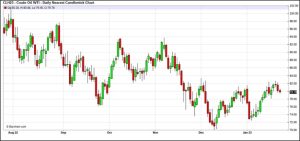
Crude oil prices appear to be building in a base in the mid-$80s.

(Source: Barchart.com)

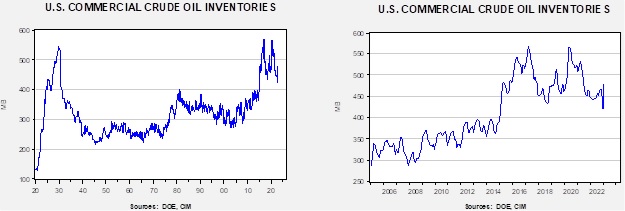
Crude oil inventories rose 3.9 mb compared to a 0.3 mb build forecast.  The SPR declined 3.6 mb, meaning the net build was 0.3 mb.

In the details, U.S. crude oil production rose 0.2 mbpd to 12.1 mbpd.  Exports declined 0.41 mbpd, while imports rose 0.3 mbpd.  Refining activity rose 1.5% to 92.1% of capacity.

(Sources: DOE, CIM)

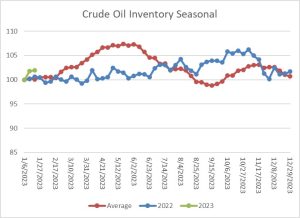
The above chart shows the seasonal pattern for crude oil inventories.  As the chart shows, we are past the seasonal trough in inventories and heading toward the secondary peak which occurs later this month.  SPR sales have distorted the usual seasonal pattern in this data.

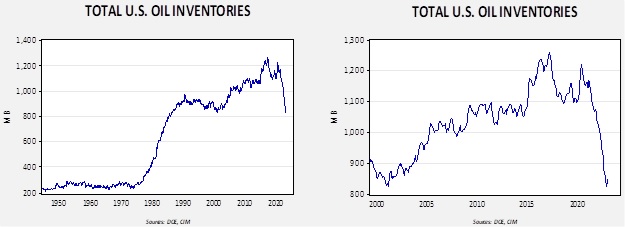
Since the SPR is being used, to some extent, as a buffer stock, we have constructed oil inventory charts incorporating both the SPR and commercial inventories.

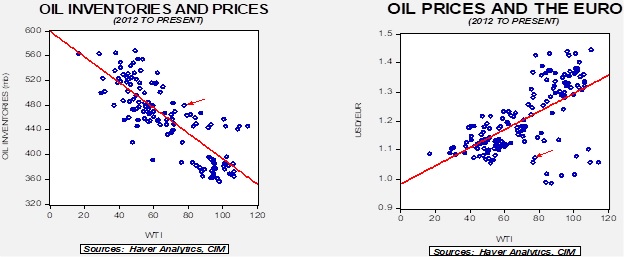
Total stockpiles peaked in 2017 and are now at levels last seen in 2002.  Using total stocks since 2015, fair value is $105.36.


 Market News:

 Geopolitical News:

 Alternative Energy/Policy News:

  • Cop-27 is underway this week. We won’t have much to say because we doubt anything binding will emerge.  We do note that the U.S. is proposing a system of carbon credits that can be purchased by firms.  Although the idea makes some sense, it should be noted that no accreditation process has been created, which means it could be merely a form of greenwashing.
  • Canada has ordered three Chinese firms to exit the lithium mining sector, citing national security concerns.
  • U.S. spending for wind and solar power has been weak this year.
  • Geoengineering is the process of directly acting to offset various climate issues. For example, one way to cool the planet is to inject aerosols into the upper atmosphere to reflect sunlight back into space.  Geoengineering is controversial because the potential side effects are hard to predict, and those side effects might be “levied” against those who don’t benefit from the action.  Despite the controversy, DARPA is quietly funding various projects probably because the government wants to know how they would work if we were to reach a situation where such measures became necessary.
  • There are a number of new nuclear technologies being developed. Here is a primer on molten salt reactors.
  • Researchers claim a breakthrough related to creating renewable jet fuel.
  • Similarly, researchers in Singapore note that they have made the process of pulling hydrogen out of water more efficient by using a procedure involving light. Meanwhile, researchers at Rice University have devised a way to pull hydrogen from hydrogen sulfide (rotten egg gas), which is an unwanted byproduct of desulfurization in refining and natural gas processing.
  • One of the problems with expanding solar and wind power is that it takes up lots of space and the least costly place to acquire that space is rural areas. However, residents are cooling to these facilities, worried about the impact on farming, ranching, and property values.
  • U.S. automakers are lobbying for the Treasury to widen the nations for which EV components can be imported and thus be eligible for subsidies. We suspect this is to leave room for China to participate.
  • The EU is growing increasingly upset with the Inflation Reduction Act’s EV subsidy rules that restrict payments to consumers only if they buy vehicles mostly constructed in the U.S. European automakers wanted carve outs so they could participate, but the U.S. countered with “make your own subsidies.”  We could see an EU trade retaliation, but we doubt this will change U.S. policy.
  • Last week, we noted that the EU voted to end the sale of internal combustion engines in Europe by 2035. As regulators tally up the potential job losses, there are new calls to delay that transition.

  View PDF

Daily Comment (November 9, 2022)

by Patrick Fearon-Hernandez, CFA, and Thomas Wash

[Posted: 9:30 AM EDT] | PDF

Our Comment today opens with an update on the Russia-Ukraine war, including a discussion of some of the key air defense and cyberwarfare assistance that the U.S. has provided to Ukraine.  We next review a wide range of other international and U.S. developments with the potential to affect the financial markets today, including an initial take on the U.S. mid-term elections, although it’s important to note that the votes are still being counted and the outcomes of many races are still up in the air.

Russia-Ukraine:  Ukrainian forces continue to make marginal gains in their counteroffensives in the northeastern Donbas region and in the southern region around Kherson.  Reports today indicate that the Ukrainians have entered a key city just north of Kherson.  Meanwhile, the Russians continue to strike back with air, missile, and kamikaze drone attacks.  Additional reporting shows that the Russians continue to struggle with depleted weapons inventories and difficulties with manufacturing replenishment weapons, in part due to Western sanctions.  They are therefore turning to other countries to buy weapons.  The most recent reports suggest Russian National Security Council Secretary Patrushev arrived in Tehran yesterday, probably to discuss the potential sale of Iranian ballistic missiles to Russia.

  • Yesterday, the Ukrainian military announced it had received its first two U.S.-supplied National Advanced Surface-to-Air Missile Systems (NASAMS), which should improve the country’s air defense capabilities and reduce the damage to its civilian infrastructure from Russian air, missile, and drone attacks. The U.S. has pledged to provide six more NASAMS over the next year and a half.
    • One benefit of the NASAMS is their use of adapted air-to-air missiles known as Surface-Launched AMRAAMs. Newer NASAMS can also launch other air-to-air missiles, such as the AIM-9 Sidewinder.
    • That’s important because the U.S. and its allies have significant stocks of those types of missiles.
  • U.S. Army Gen. Paul Nakasone, head of the National Security Agency, recently explained why Russia has launched only small, ineffective cyberattacks against Ukraine and its allies so far in the war. According to Nakasone, Russia’s cyber capabilities were seriously blunted by U.S. “hunt-forward” teams sent to Ukraine in late 2021.
    • The hunt-forward teams, consisting of U.S. cyber soldiers, conduct defensive and cooperative measures overseas at the invitation of a foreign government. The teams are a part of the U.S. military’s “persistent engagement strategy,” which centers on maintaining constant contact with cyber adversaries and ensuring that proactive, not reactive, moves are made.
    • According to Nakasone, U.S. hunt-forward teams have conducted dozens of operations abroad in recent years, including in Croatia, Estonia, Lithuania, Montenegro, and North Macedonia.

China:  As shown in the data section, the October producer price index was down 1.3% year-over-year, marking China’s first annual drop in wholesale prices since December 2020.  Along with the weak international trade data released earlier this week, the fall in the PPI provides clear evidence that China’s economy is losing momentum, which is likely to be a headwind for the global economy and global risk assets in the coming months.

European Union:  The European Commission proposed a loosening of the bloc’s debt rules today that would give highly indebted governments more room to spend money. Until now, the bloc has required governments to keep the budget deficit below 3% of GDP and debt below 60% of GDP, with tight timelines for cutting above-target deficits and debt.  Those rules have been suspended for several years now, but the EU is proposing to replace them with country-specific action plans to cut deficits and debt over longer, more realistic time periods.

  • We suspect some version of the proposed rules will be put into place, simply because the prior rules and timelines are unrealistic given that many EU countries have boosted their spending and debt so much in recent years.
  • The new rules would likely trade austerity for higher debt, leaving many EU countries at economic risk. High debt among countries in the Eurozone could also lead to widening currency spreads that would complicate ECB policymaking and threaten the euro.

United Kingdom:  To help cut the U.K.’s yawning budget deficit, Chancellor Hunt is reportedly considering a proposal to reduce the income level at which the country’s top personal income tax rate of 45% kicks in.  The move would allow the government to avoid breaching the Conservative Party’s 2019 pledge not to increase tax rates.

U.S. Mid-Term Elections:  Based on the results available so far this morning, the key takeaway from the elections yesterday is that the “red wave” of massive Republican Party gains failed to materialize.  The Republicans are expected to regain control of the House of Representatives, but with a smaller majority than they had hoped and anticipated going into the polls.  The Senate remains up in the air, with votes in several key races still being counted.  At least one important Senate race, in Georgia, could result in a run-off election.

  • In any case, the U.S. will now have a divided government again, with Democrats retaining the Executive Branch and Republicans controlling at least one chamber of the Legislative Branch.
  • Historically, such divided government has actually been positive for investors. In addition, the U.S. stock market has historically tended to rally over the year following the mid-term elections.  U.S. stock futures are trading lower so far this morning, perhaps on investor disappointment that pro-business Republicans didn’t do better, but the election may have actually helped lay the groundwork for stronger stock markets once the U.S. economy gets through its impending recession.

U.S. Military Power:  Because of the military’s recent shortfalls in recruiting, the U.S. Navy said late last week that it is raising its maximum age for new sailors from 39 to 41.  The policy change means that the Navy is now accepting the oldest enlisted recruits of the four services.  The Air Force’s maximum enlistment age is now 40, and the Army’s maximum is 35, while the Marine Corps’ enlisted age limit is 28.

U.S. Semiconductor Industry:  Taiwanese computer chip giant Taiwan Semiconductor Manufacturing Company (TSM, $65.02) is reportedly preparing to build a second cutting-edge fabrication facility north of Phoenix, Arizona.  The scale of the investment is expected to be similar to the $12 billion or so the firm will spend on its first cutting-edge Arizona fab, announced in 2020.

  • The development marks a welcome diversification of TSMC’s production capacity, which currently is heavily focused on Taiwan itself, making the firm’s critical output subject to disruption as China pushes Taiwan toward reunification with the mainland.
  • The new plant also reflects the kind of shortened supply chains and “friend shoring” we expect to see as the world fractures into relatively separate geopolitical and economic blocs. Our studies indicate that Taiwan would end up as a key member of the evolving U.S. bloc.

U.S. Cryptocurrency Market:  After suffering a sudden liquidity crunch, major cryptocurrency exchange FTX agreed to be taken over by rival Binance.  The crypto world had already been shaken this year by rising interest rates, investors’ falling risk appetite, and a series of bankruptcies in which FTX founder Sam Bankman-Fried often rode to the financial rescue.  The takeover of FTX, therefore, marks a major power shift from FTX to Binance and a humbling comedown for Bankman-Fried.

  • The news has also sparked a new round of weakness in crypto assets. So far this morning, Bitcoin has fallen approximately 4.6% to $17,859.99, while Ether is down 7.6% to $1,229.85.
  • FTX’s own token, FTT, has lost some three-fourths of its value so far today.

View PDF

Daily Comment (November 8, 2022)

by Patrick Fearon-Hernandez, CFA, and Thomas Wash

[Posted: 9:30 AM EDT] | PDF

Our Comment today opens with an update on the Russia-Ukraine war, including a new statement by Ukrainian President Zelensky that he is open to peace talks with Russia, subject to tough conditions.  We next review a wide range of other international and U.S. developments with the potential to affect the financial markets today, including a series of speeches by policymakers at the European Central Bank that indicate they will continue to hike interest rates aggressively.

Russia-Ukraine:  The Ukrainians continue to slowly and methodically press their counteroffensives in the northeastern Donbas region and in the southern region around Kherson.  Meanwhile, the Russians increasingly look like they are preparing to defend Kherson, although perhaps with only a blocking force of minimally trained, recently mobilized troops.  The Russians also continue to attack civilian infrastructure targets throughout Ukraine using air, missile, and kamikaze drones.  However, Ukrainian intelligence officials say that Russia has now run through some 80% of their modern, high-precision missiles, which could mean their campaign against the Ukrainian infrastructure will soon slow enough for the Ukrainians to get much of their energy grid back into operation.

Eurozone Monetary Policy:  Pushing back against politicians and investors hoping for a “dovish pivot” toward stabilizing or even falling interest rates soon, several senior policymakers at the ECB today insisted that the fight against price inflation will require them to keep hiking interest rates, even beyond the point at which they constrain demand and weaken growth.  The well-coordinated statements signal that the ECB will continue to hike rates aggressively, even as it tries to keep a lid on longer-term bond yields in the bloc’s weaker economies.

Pakistan:  Supporters of Former Prime Minister Imran Khan have blockaded roads around the capital of Islamabad in an effort to topple the government following an attempted assassination of Khan last week.  The protestors are angry at what they see as the government’s reluctance to investigate allegations that current Prime Minister Sharif and senior civilian and military officials conspired to kill Khan.

China:  The latest figures show that new COVID-19 infections nationwide have topped 5,400 cases per day for the first time since May.  Although there are now multiple conflicting reports about whether the government will end its disruptive Zero-COVID policies in the coming months, the current surge suggests that the government could impose new lockdowns in the coming days.  As we have discussed before, such lockdowns have been challenging for the Chinese economy, the broader global economy, and global financial markets.

United States-China:  In another example of how the world’s technology industry is finding work-arounds to the strict new U.S. restrictions on selling semiconductor technology, equipment, and services to China, Nvidia (NVDA, $143.01) announced it has developed a new graphics chip for advanced Chinese companies that can be exported to China without restriction.

  • According to Nvidia, the new chip has the same computational performance but a narrower interconnect bandwidth, i.e., the capacity of the chip to send and receive data from other chips, which is crucial for training large-scale AI models or building supercomputers.
  • Nvidia hopes the new chip will allow it to retain hundreds of millions of dollars of revenue from China that otherwise would be lost.
  • Nevertheless, it appears that the new, restricted chip will help meet the U.S. goal of further suppressing the overall computational capacity of China and the Chinese military.

U.S. Labor Market-Impact of COVID-19:  Even though new COVID-19 infections have fallen sharply, pandemic restrictions are practically gone, and life in many respects is approaching normal, new research indicates that the disease continues to impede labor force participation and productivity growth.  In turn, the resulting labor shortages are contributing to upward pressure on wages and inflation.

  • According to the new studies, the number of workers who missed at least one week of work because of illness in any given month is now up 630,000 from the average levels before the pandemic.
  • At least 500,000 more workers have dropped out of the labor force because of the lingering effects of a previous COVID-19 infection.
  • In a Census Bureau survey in October, 1.1 million people said they hadn’t worked the week before because they were concerned about contracting or spreading the virus.
  • The pandemic’s lingering suppression of the labor force has forced many firms to keep payrolls higher than they otherwise would in order to ensure adequate personnel for operations. That means those firms are now operating less efficiently than they would have before the pandemic.  The resulting drop in productivity per worker hour has raised labor costs and fed into inflation.

U.S. Labor Market-Impact of Recession:   Recent layoff announcements by major employers suggest that middle managers may be particularly at risk as the economy slips into recession.  Skilled production workers and other non-supervisors are typically the first to be let go as firms trim their labor costs going into a downturn, but today’s massive shortage of such workers means firms will probably be loathe to let them go.  Rather, the economy may be slipping into a “white collar recession.”

U.S. Real Estate Market:  New data shows developers are slowing their major office projects already under way and shelving new projects as they face soaring interest rates and high office vacancy rates after the COVID-19 pandemic.

  • Reduced office construction will help slow the economy and push it into recession, but it could eventually help bring the supply of office space down to the lower, post-pandemic level of demand. In time, that could help stabilize office rents.
  • The boom-and-bust cycles in property development can be difficult for investors, but they also hold out the promise that excess space and low rents today can eventually reverse.

U.S. Elections:  Voters across the U.S. go to the polls today for mid-term elections in which all seats in the House of Representatives and one-third of the seats in the Senate will be contested.  The latest polls suggest that the summer swing of voting intentions toward the Democrats has now largely dissipated, raising the chance that the Republicans could take control of both chambers.

View PDF