
Weekly Geopolitical Report – The Tragedy of Venezuela (June 6, 2016)

by Bill O’Grady

The decline in oil prices has been a major problem for oil-exporting nations.  In general, the degree of disruption is mostly based on how well the country was run before oil prices plunged.

Venezuela has arguably been the worst run of the major oil producers.  The late President Hugo Chavez built an economy that was distorted by subsidies, price freezes and an arcane tiered exchange rate system.  His economic program only worked because of revenue generated by high oil prices.  Once oil prices declined, the Chavez economic system began to unravel.

Conditions have deteriorated to a critical point where it seems unlikely that the country can continue on its current path.  Barring an unexpected rally in oil prices, the economy appears to be on the brink of collapse.

In this report, we will explain how the distortions in the economy have led to the current crisis, discuss the future of President Madero and explore the possibility that Venezuela will become the first major oil producer to collapse and lead to an unexpected supply shock.  As always, we will conclude with market ramifications.

View the full report

Asset Allocation Weekly (June 3, 2016)

by Asset Allocation Committee

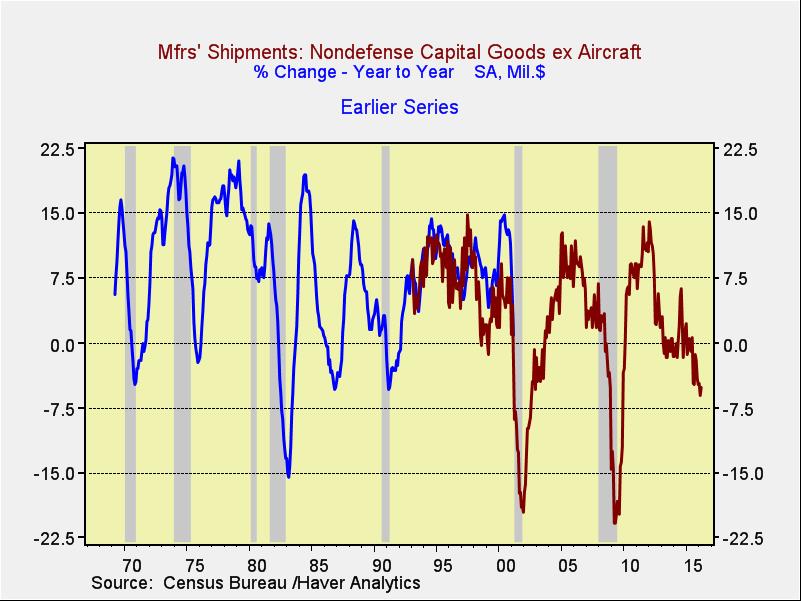
The prolonged weakness seen in capital spending is a concern for the economy and equity markets.

This chart shows the yearly change in the three-month smoothed non-defense capital goods orders excluding aircraft.  The Census Bureau changed how it calculates this series in 1992; we have overlapped the yearly change in the earlier series.  In general, a negative reading is a concern.  It isn’t a certain signal of recession, and in some downturns it becomes weak late in the cycle, but, in any case, a persistent negative reading does suggest economic weakness.  The only other time the yearly change in this number was this negative without being associated with a recession was in 1987.

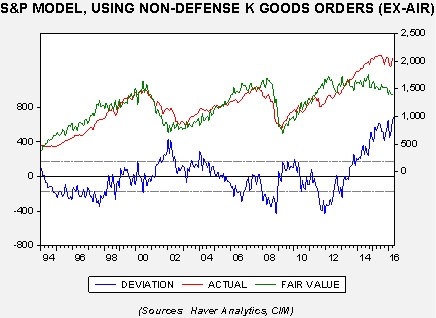
Taking this data from 1992 and regressing it against the S&P 500 suggests an overvalued equity market.

This chart shows the results of regressing non-defense capital goods orders, excluding aircraft, against the S&P 500.  The orders data closely fit this equity index until around 2012.  Based on this study, fair value is around 1383.

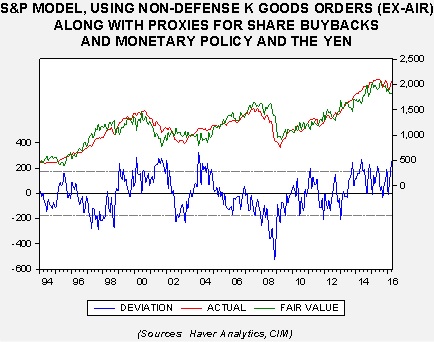
So, what is causing this divergence?  We suspect monetary policy, the dollar and corporate behavior are affecting the equity market.  Adding a proxy for buybacks and monetary policy, along with the yen’s exchange rate, reduces the degree of overvaluation.

Adding these proxies increases fair value to 1811, significantly reducing the degree of overvaluation.  This is still well below the current market, but it does show how equity markets have become dependent on accommodative monetary policy, dollar strength and share buybacks.  Without stronger corporate economic growth—which will boost the demand for investment goods—monetary policy tightening, regulation to reduce buybacks or a stronger yen could put pressure on equity markets.  We remain supportive of equity markets, although we are only looking for single-digit gains, at best, due to current valuation levels.

View the PDF

Asset Allocation Weekly (May 27, 2016)

by Asset Allocation Committee

As promised, this week we will discuss how President Clinton’s policies would likely affect the financial markets.  It should be noted that, unlike Mr. Trump, Sen. Clinton has published most of her policy positions.  However, there have been apparent shifts in her policy positions as Clinton adjusts her campaign to react to changes in the election environment.

Sen. Clinton’s campaign is similar to that of a succeeding vice president: In 2008, when Clinton ran against Barack Obama, she framed him as an ephemeral dreamer who lacked the necessary experience to accomplish much.  Early in her 2016 campaign, she appeared to be distancing herself from the president.  For example, President Obama has characterized his foreign policy as “don’t do stupid s*@t.”  Clinton suggested that this sentiment wasn’t a working foreign policy stance for the world’s superpower.  Her comment raised expectations that she would triangulate a position different from Obama and her GOP opponent.

However, as it became apparent that she faced a legitimate primary threat from Sen. Sanders, Clinton, in an effort to secure the African American voter block, has completely embraced President Obama and has framed Sanders’s calls for new policies as a repudiation of Obama’s legacy.  This position has been very effective in securing African American votes and has also given her an edge in closed primaries, taking advantage of Obama’s popularity with most Democrats.  However, in open primaries, which allow independents to vote, and in areas with white voters, Sen. Clinton has underperformed Sen. Sanders.  While tying her fate to President Obama’s legacy has been mostly effective in winning the nomination,[1] Clinton’s positioning as essentially the third term of the Obama administration is a risky general election strategy as she will face the debate line, “if you liked the last eight years, you should vote for Hillary.”[2]

What can we expect from a Clinton administration?

Foreign Policy: This is one of the few areas where we would expect a Clinton government to differ significantly from the outgoing administration.  Clinton is much more hawkish than Obama and her positions are in direct opposition to the apparent populist mood of the nation.  During her time as secretary of state, she often favored a more hawkish foreign policy than the president, pushing for greater military involvement in the world.  Although she isn’t a neoconservative, she is about as close to one as this group can hope for among the remaining candidates.  In terms of Meade’s archetypes, she is Wilsonian.  Thus, we would not be surprised to see neoconservatives, who usually vote Republican, drift toward Sen. Clinton.

Domestic Policy: As noted above, she is proposing nothing more than maintaining and defending the Obama policy legacy.  That  policy means preserving Obamacare, holding tax rates at current levels or perhaps raising them modestly on the very wealthy, and expanding on the regulatory legacy started by President Obama.

Trade Policy: On trade, Clinton has generally supported free trade agreements.  She was originally in favor of the Trans-Pacific Partnership (TPP) before she turned against it.  We seriously doubt she actually opposes either this agreement or the Transatlantic Trade and Investment Partnership (TTIP), but given the rising unpopularity of such agreements and the fact that both Sen. Sanders and Mr. Trump have made opposition to trade a major plank of their platforms, Clinton has been forced to tack left on this issue.  We think there is a chance that President Obama will try to get the TPP passed before he leaves office; in fact, he may accomplish this during the “lame duck” session after the November elections.  Although a President-elect Clinton would officially oppose this tactic, in reality, we suspect she would privately support it.

Immigration: The Democratic Party and, by extension, Sen. Clinton have generally supported easing restrictions on immigration and want to create a “path to citizenship” for illegal aliens living in the U.S.  This position will alienate her with white, working-class voters, perhaps putting swing states like Ohio and Pennsylvania in play, but could help Clinton wrest Arizona and Georgia from GOP hands.

Defense: We would expect Clinton to have a better relationship with the military than President Obama.  In fact, it would not be a surprise if she asked Ash Carter, the current secretary of defense, to stay on in her administration.  Given her foreign policy stance, the military would likely be utilized more often in her government.

Fiscal Policy: Clinton would likely run an orthodox fiscal policy with a modest tilt toward raising taxes.

Environmental Policy: Her policies will likely follow in the trends established by President Obama.  We would not expect anything as radical as Sen. Sanders’s bid to end fracking.  At the same time, her policies won’t revive coal and we would expect a steadily tightening regulatory environment for oil and gas producers.

The market impact from a Clinton presidency would be negligible.  Not only is she a solid member of the political establishment, but because she is running a campaign similar to a succeeding vice president, she will have virtually no political capital to bring “change” after gaining office.  Thus, the slow growth, low inflation economic environment would likely continue.  If markets fear a Trump presidency is likely and financial markets weaken into the election due to these fears, then a strong relief rally may ensue from a Clinton presidency, which is about the most notable market impact that would occur.

In our asset allocation views, we have consistently held that inflation would remain low; we have tended to favor longer duration in fixed income and generally supported equities.  A Clinton presidency would maintain the status quo.  We would continue to closely monitor the evolution of populism in the U.S., which threatens the current low inflation environment, but we would not expect Clinton to support a populist agenda.  Bottom line: a Clinton presidency is a status quo outcome.

View the PDF

_______________________

[1] Although one could argue that she has barely been able to beat an elderly socialist.

[2] It should be noted that Gov. Reagan used a similar line against President Carter in a debate; some historians have argued that this phrase turned the election for Reagan.

Weekly Geopolitical Report – Sykes-Picot: 100 Years Later (May 23, 2016)

by Kaisa Stucke, CFA

Last week marked the 100th anniversary of the Sykes-Picot Agreement, which divided the disintegrating Ottoman Empire territories in the Middle East into British-controlled and French-controlled areas following WWI.  One hundred years after the agreement, the effects of the borders established by these European powers continue to reverberate as the region remains unstable.  The Middle East has a rich and complex history that could fill several volumes of books.  Although we will give a condensed overview of the long history in the region, we will focus on the WWI time period, specifically the circumstances that led to the Sykes-Picot Agreement.

View the full report

Asset Allocation Weekly (May 20, 2016)

by Asset Allocation Committee

As promised, this week we will discuss how President Trump’s policies would likely affect the financial markets.  It should be noted that Mr. Trump has not published any clear policy papers, so our descriptions are based on his public comments.  Next week, we will discuss the expected policies and financial market effects from President Clinton.

Trump is a right-wing populist.  This means we would expect him to support the following list of policies:

Immigration: Immigration is perhaps the most ancestrally common experience of most Americans.  The acceptance of people from other places makes the U.S. unique.  In the U.S., if you pass the citizenship exam and take the oath, you are an American.  However, in most European nations, becoming a citizen does not make one “French” or “Italian.”  Despite this commonality of experience, immigrants have not always been welcomed.  The “Know-Nothings” in the 1850s opposed the influx of Irish and German Catholics to America, fearing they would undermine American values.  Often, lower skilled workers face competition from immigrants which drives down wages in certain parts of the job market.  Compounding the problem is that approximately 10 to 12 million foreigners are in the U.S. illegally, signaling a lack of border control.  The political establishment tends to turn a “blind eye” to illegal immigration; for the right-wing establishment, this form of immigration provides a steady supply of low wage workers.  For the left-wing establishment, a “path to citizenship” would be expected to create new left-wing voters.  Trump has appealed to right-wing populists who likely face, or perceive that they face, wage competition from illegal immigration.  Thus, Mr. Trump’s “build the wall” message raises the hopes of lower income workers that wages could rise.

Defense: Although Mr. Trump has campaigned on making a strong military, his positions are actually more nuanced than they first appear.  Specifically, he has adopted positions similar to Sen. McCain (R-AZ) on many spending programs, which is to hold a skeptical eye toward spending programs.  For example, Trump appears to oppose the F-35 and suggests that spending more on existing platforms makes better sense because of the inadequacies of the newer aircraft.  This will infuriate the establishment on both wings who tend to support newer systems that bring money to their states and districts.  Trump has promised to let the military choose what weapons it wants and threatens the infamous “military-industrial complex.”

Foreign Policy: As noted last week, Trump is a classic Jacksonian based on the Meade archetypes.  This characterization means he will run an isolationist foreign policy, although he will tend to overreact to perceived slights.  In other words, he may allow Iraq to crumble and not oppose Japanese remilitarization.  He has made it abundantly clear that he won’t act as the “world’s policeman.”  On the other hand, we would expect him to react strongly to Russian “buzzing” of U.S. Navy vessels or hostage-taking by terrorist groups.  Postwar treaty organizations, like NATO, or other bodies like the U.N., will probably be ignored or allowed to deteriorate.

Trade Policy: Trump sees himself as a deal maker.  He wants to renegotiate existing agreements and get better deals on pending ones.  He has strongly opposed outsourcing and has threatened trade retaliation against China.

Fiscal Policy: Trump promises to maintain middle class entitlements, namely, Social Security and Medicare.  He has promised to replace Obamacare but the details on its replacement are not clear.  His tax policy would lead to significantly higher deficits, even when using “dynamic scoring,” which accounts for the revenue impact of higher economic growth.  His comments on Treasury debt have been interesting—he has suggested that Treasury debt could be restructured, but reversed himself when he apparently discovered that restructuring would not be necessary since the U.S. prints the money required to service the debt.  Although it is difficult to determine with certainty, Trump could prove to be more amenable to heterodox economic policies, e.g., “helicopter money,” if a recession were to develop.  In any case, there is nothing to suggest that Trump is a deficit hawk.

The market impact of a Trump presidency could be significant; at the same time, it is always important to remember that the structure of the American government tends to restrain aggressive policy changes.  Rahm Emanuel’s famous quote of “you never let a serious crisis go to waste” reflects the structure of American government in that major changes usually only occur when conditions are bad enough to force the change.  Newly elected, first-term presidents are at the peak of their political capital early in their terms; we expect President Trump’s first priority will be immigration.  Beyond that, he may find some support for his anti-trade policies and Congress can’t force the president to intervene abroad.

There are two key changes that we see from a Trump presidency.  Domestically, Trump’s policies are essentially reflationist.  His opposition to globalization by interfering with trade and immigration will likely make the economy less efficient and lift price levels.  For Trump’s constituents, it’s a mixed bag.  Although higher prices will undermine their buying power, the likelihood of them getting jobs, at least at first, will rise.  Eventually, those jobs may face automation pressures, but that will take some time.  For the establishment, the outcome is unequivocally negative; rising inflation will raise interest rates, narrow profit margins and compress price/earnings multiples.

The second major change from a Trump presidency is the end of Pax Americana.  As noted above, Trump has made it clear that he wants to end the U.S. role of world policeman.  Without American leadership, the world will devolve into regional power centers with competing hegemonic powers; in other words, China will square off against Japan and India, Russia and Germany could be at odds again and Saudi Arabia and Turkey could line up against Iran.  These policies will certainly lead to deglobalization and cut global supply chains, leading to less efficiency and exacerbating the already inflationist tendencies of Trump’s immigration and trade policies.

In our asset allocation views, we have consistently held that inflation would remain low; we have tended to favor longer duration in fixed income and generally supported equities.  A Trump presidency would likely be a harbinger of inflation which would lead us to adjust these positions.  Rising inflation coupled with deregulated financial markets will almost certainly lead to higher long-term interest rates.  Equity markets will face pressures as well.  On the other hand, commodity prices will tend to rally if real interest rates turn negative.  The impact on the dollar is more mixed.  We really have no historical instance where the primary reserve currency is running protectionist trade policies.  Because there is built-in demand for the reserve currency and protectionism blocks the traditional path for other countries to acquire the reserve currency, the dollar would become scarce.  Paradoxically, Trump’s policies could lead to a significantly stronger dollar as other nations take steps to reduce costs and the prices of their exports to offset tariffs and other trade barriers.  Although it would seem that Trump’s policies would spell the end of the dollar’s reign as the primary reserve currency, there is no obvious replacement to the dollar.  In addition, we would expect the Federal Reserve, assuming it remains independent, to raise rates to contain rising price levels, giving a further boost to the dollar.  Although Congress will act as a restraint on Trump, as the current president has shown, some of these constraints can be evaded through regulatory policy and executive orders.  Bottom line: a Trump presidency will likely bring higher inflation, reversing 36 years of disinflationary policies.

View the PDF

Six Pack Chartbook – May 2016

Lorem Ipsum is simply dummy text of the printing and typesetting industry. Lorem Ipsum has been the industry’s standard dummy text ever since the 1500s, when an unknown printer took a galley of type and scrambled it to make a type specimen book. It has survived not only five centuries, but also the leap into electronic typesetting, remaining essentially unchanged. It was popularised in the 1960s with the release of Letraset sheets containing Lorem Ipsum passages, and more recently with desktop publishing software like Aldus PageMaker including versions of Lorem Ipsum.

Business Cycle Monitor – May 2016

Lorem Ipsum is simply dummy text of the printing and typesetting industry. Lorem Ipsum has been the industry’s standard dummy text ever since the 1500s, when an unknown printer took a galley of type and scrambled it to make a type specimen book. It has survived not only five centuries, but also the leap into electronic typesetting, remaining essentially unchanged. It was popularised in the 1960s with the release of Letraset sheets containing Lorem Ipsum passages, and more recently with desktop publishing software like Aldus PageMaker including versions of Lorem Ipsum.

Weekly Geopolitical Report – The Geopolitics of Helicopter Money: Part 3 (May 16, 2016)

by Bill O’Grady

Two weeks ago, we described the process of “monetary funded fiscal spending” (MFFS), including a discussion of why it might be implemented, how it would work and the potential problems that could come with using it.  Last week, we examined two historical examples where forms of MFFS were implemented, Japan in the 1930s and the U.S. during WWII.  In the final segment of this series, we will make some observations based on the two historical examples discussed last week.  We will then discuss the likelihood of MFFS being deployed in today’s world, focusing on which nation is most inclined to use it.  As always, we will conclude with market ramifications.

View the full report

Asset Allocation Weekly (May 13, 2016)

by Asset Allocation Committee

With Donald Trump and Hillary Clinton becoming the presumptive nominees for the Republican and Democratic Parties, respectively, this week’s Asset Allocation Weekly will offer some of our initial thoughts on this election cycle.  We will offer more in-depth analysis in the coming months but these highlights express our starting points about the candidates and the election.

This election is shaping up to be establishment versus populist: As we discussed in our three-part series on the election in the spring of 2014,[1] we noted a rising trend of populism in the U.S. that could lead to a populist candidate and president.  Donald Trump is running as a classic “traitor to his class” by supporting populist positions such as anti-globalization (anti-immigration, anti-trade) and support for middle-class entitlements (Social Security, Medicare, Disability).  These positions are in direct opposition to the establishment’s positions on free trade, open immigration and entitlement reform.  Sen. Clinton finds herself as the establishment candidate, which has been well exposed in her primary campaign against Sen. Sanders.  In Europe, both the right- and left-wing establishments tend to coalesce around one establishment figure to fend off a populist challenge.  If we see a similar pattern in the U.S. (which we would expect), look for talk about a third-party “real conservative” challenger to dissipate soon.  Otherwise, if a third-party establishment figure runs, it will simply split the vote and allow Trump to win easily.  Instead, we look for the right-wing establishment to either stay home or vote for Sen. Clinton.  In any case, unlike in most elections, there will be major differences between the candidates which will probably lead to historic voter turnout.

Domestic Policy: If you liked the last eight years, you should vote for Sen. Clinton.  She is running a campaign similar to what a vice president runs when he is trying to succeed a sitting two-term president.  Although this didn’t appear to be her initial plan, the surprising performance of Sen. Sanders has forced her to defend President Obama’s policies to frame her opponent as being too radical and she has used Sanders’s criticism of President Obama to suggest that he is denigrating the current Democratic Party president.  This means she really can’t run on a domestic policy platform that aims to fix all that has gone wrong and allows Mr. Trump to claim that current conditions are bad and that a new policy stance, which he would provide, would make things better.  Since many Americans claim things are bad,[2] it makes Sen. Clinton’s position difficult to defend.

This election will likely be determined by Sen. Sander’s supporters: In 2014, Ralph Nader published a book titled Unstoppable.[3]  In the book, he argues that populists on both the left and right have a common cause around which to unify and overthrow the political establishment.  As we noted in our aforementioned WGRs, the establishment supports deregulation, globalization and the unfettered introduction of new technology.  Although these policies are very successful in bringing down inflation through supply side efficiency, they have the effect of holding down wage growth that harms most populist households.[4]  Nader acknowledges that there are major disagreements between left- and right-wing populists on social issues.  However, on economic issues, the differences are significantly less and the two sides could find common ground.  If Sanders’s voters decide that Donald Trump can improve their economic situation and swing toward him, he has a solid chance for victory.  If Trump can, at a minimum, discourage Sanders’s supporters from voting for Sen. Clinton, he will improve his odds of winning.  Although we doubt Ralph Nader had Donald Trump in mind when he penned his book, Trump may be best positioned to bring Nader’s coalition of populists together.  This may be even more evident in foreign policy (see below).

Foreign policy is about be flipped: Sen. Clinton is hawkish; she supported the invasion of Iraq, a much heavier military presence in Syria and the overthrow of Muammar Gaddafi.  Using Walter Russell Mead’s archetypes,[5] Sen. Clinton is a Wilsonian.  She believes that the U.S. is a source of good in the world and that using military force is legitimate in order to protect the weak or support goals like democracy in the world.  Trump is a Jacksonian; this archetype can be belligerent but only if the national honor is besmirched.  Trump has indicated that we will give up our superpower duties[6] by forcing European and Asian allies to pay for their own defense.  At the same time, he is promising a major boost in military spending to ensure that “nobody messes with us,” a classic Jacksonian position.  On the one hand, Trump promises that we won’t be drawn into wars to protect others; on the other, he would likely order the U.S. Navy to shoot on sight any Russian warplanes buzzing around U.S. vessels.  The differences between Trump and Clinton offer an unusual shift for voters; neoconservatives who currently are part of the GOP will be inclined to vote for Clinton, while those who oppose U.S. hegemony will tend to find Trump’s “America First” message appealing.  In terms of foreign policy, Sanders’s supporters have much more in common with Trump than Clinton.

The debates could be historic: Trump has proven to be an effective debater, a brawler that tends to force opponents to operate at a base level.  For example, Sen. Rubio ended up in a verbal sparring match more suitable for a middle school; however, Trump operates well in such situations while most politicians don’t.  Rubio didn’t…and neither did Governor Bush.  Sen. Clinton has a wonkish grasp of policy that will far exceed Trump’s knowledge.  But, if he forces her into his “alley,” the results could be devastating.  The debates could be the most watched television outside the Super Bowl and may swing the campaign.

Next week, we will discuss the market impact of a Trump presidency and the asset allocation measures we would likely consider.  The following week, we will examine a Clinton presidency and perform the same drill.

View the PDF

______________________

[1] See WGRs: 2016, Part 1 (3/31/2014); 2016, Part 2 (4/14/2014); and 2016, Part 3 (4/21/2014).

[2] On average, 66% of those polled think the country is going in the “wrong direction,” see: http://www.realclearpolitics.com/epolls/other/direction_of_country-902.html.

[3] Nader, R. (2014). Unstoppable: The Emerging Left-Right Alliance to Dismantle the Corporate State. New York, NY: Nation Books.

[4] We define the differences between populists and establishment in the aforementioned WGRs.

[5] See WGR, 4/4/2016, The Archetypes of American Foreign Policy: A Reprise.

[6] See WGR, 4/11/16, Intergenerational Forgetfulness.