

Daily Comment (April 6, 2021)

by Bill O’Grady, Thomas Wash, and Patrick Fearon-Hernandez, CFA

[Posted: 9:30 AM EDT] | PDF

In today’s Comment, we open with new developments that suggest Democrats in Congress could have more options to push through their economic and tax agendas than previously thought.  Increased fiscal stimulus, rapidly expanding vaccinations, and economic reopening continue to buoy risk markets, as we saw with yesterday’s record highs, even with the risk of higher taxes and coronavirus mutations that could slow progress against the disease.  We also discuss key news from overseas and the latest on the pandemic itself, including the International Monetary Fund’s latest projection of how fast the global economy will recover from the crisis.

U.S. Fiscal Policy:  The Senate’s nonpartisan parliamentarian ruled in favor of a Democratic effort to pass additional legislation through the process of reconciliation, which only requires 50 votes to pass a bill, rather than the 60 needed to overcome a filibuster.  The ruling turns on the idea that any time a fiscal year budget resolution is amended, it can be passed via reconciliation.  That opens the door for Democrats to approve more fiscal measures along party lines in the Senate this year.

U.S. Antitrust and Technology Law:  Trade groups representing small hardware stores, office suppliers, booksellers, grocers, and others, along with business groups from 12 cities, are forming a coalition to lobby Congress for stricter antitrust laws, including measures that could force Amazon (AMZN, USD, 3,226.73) to spin off some of its business lines.  The move highlights the growing regulatory risks facing high-flying technology companies.

United States-China-Japan:  In a sign that the Japanese government is willing to help the U.S. pressure China over its human rights record and other transgressions, Japanese Foreign Minister Motegi used a 90-minute phone call with Chinese Foreign Minister Wang to press for improved treatment of ethnic Uyghurs in Xinjiang.  In a statement after the call, the Chinese government warned Japan not to interfere in its internal affairs or be influenced by countries that are “prejudiced against China.”

India-Pakistan:  In back-channel negotiations launched in January and facilitated by the United Arab Emirates, Indian and Pakistani military leaders are preparing the ground for peace talks between the two countries’ prime ministers.  Although peace deals have been discussed between the two nuclear powers in the past, they have faltered.  If the new negotiations lead to a lasting deal, it could have major implications for the geopolitics of South Asia.  For example, not only would a peace deal promote trade ties between India and Pakistan, but it could reduce India’s incentives to work with the U.S. in its competition with China.  Indeed, China may well have played a key role in nudging its ally Pakistan toward better ties with India.

United States-Iran:  Diplomats from Iran, France, Germany, the U.K., Russia, and China will meet in Vienna today to discuss reviving the 2015 deal limiting Iranian nuclear weapons, with the U.S. taking part indirectly from a separate location.

Russia:  Jailed opposition leader Alexei Navalny, who said several other inmates in his quarters have come down with tuberculosis, has himself been moved to a medical ward after complaining of a cough and fever.  Navalny had complained that he was not being afforded medical care by prison authorities, despite growing health issues.  Now, the question arises as to whether the Putin government purposefully exposed him to tuberculosis, hoping he would contract it.

Jordan:  The court of King Abdullah II announced that former crown prince Hamzah, accused of plotting with foreign countries against the government, met with senior members of the royal family and pledged his loyalty.  It’s not yet clear whether the kingdom has really nipped Hamzah’s opposition in the bud or whether it will have continuing issues with Hamzah’s accusations of corruption and incompetence.

Central Bank Digital Currencies:  Today’s Wall Street Journal carries an informative review of China’s effort to create an official digital currency.  For more on the geopolitics of this trend around the world, see our ongoing Weekly Geopolitical Report series here.

COVID-19:  Official data show confirmed cases have risen to 131,907,441 worldwide, with 2,862,885 deaths.  In the United States, confirmed cases rose to 30,786,016, with 555,619 deaths.  Vaccine doses delivered in the U.S. now total 207,891,395, while the number of people who have received at least their first shot totals 107,515,428.  Finally, here is the interactive chart from the Financial Times that allows you to compare cases and deaths among countries, scaled by population.

Virology

  • Newly confirmed U.S infections rose to more than 78,000 yesterday, although some of the increase apparently reflected several states catching up after not reporting cases over the Easter weekend.  More encouraging, the seven-day moving average of new infections, at 63,283, is now only slightly above the 14-day moving average of 63,260.  New deaths related to the virus, 603 yesterday, remain much lower than at the beginning of the year.  More than 32% of people in the country have received at least one dose of a vaccine, while almost 20% are fully vaccinated.
  • President Biden today will announce that all U.S. adults should be eligible for a coronavirus vaccine by April 19, speeding up a timeline he set last month.  Biden had previously called for states and territories to make all adults eligible for a shot by May 1. The president will also say that the U.S. has surpassed 150 million shots since he took office.
  • Moderna (MRNA, USD, 129.91) has struck a deal for 80 million additional doses of its vaccine to be produced by contract drug manufacturer Catalent (CTLT, USD, 105.75).  The expansion will help Moderna reach its goal of supplying an additional 100 million doses to the U.S. by the end of May and another 100 million doses by the end of July, all of which would help ensure that the U.S. has ample vaccine supplies in the coming months.
  • Even the U.S. Army is getting into the vaccine game, as it begins small-scale testing of a compound it developed at the Walter Reed Army Institute of Research in Maryland.  Initial results of the study could become available by midsummer. If the data are positive, the Army likely will try to join with a drug company to further test and develop the vaccine.
  • British Prime Minister Johnson said the U.K. will begin to relax more public-health restrictions starting next week and remains on course to fully reopen its economy by the summer, in contrast with the worsening picture elsewhere in Europe.
  • Ground zero of the pandemic shifted to India on Monday, as it recorded more than 100,000 fresh cases for the first time, topping the daily totals everywhere else in the world.  New infections in India are now even greater than in Brazil.  The Indian government is therefore locking down neighborhoods and restricting travel again, even as it tries to ratchet up its vaccination program.
  • North Korea said it would not participate in the Tokyo Olympic Games this summer, citing concerns about the pandemic.

 Economic and Financial Market Impacts

  • In its flagship World Economic Outlook publication, the IMF boosted its forecast for global economic growth to 6.0% in 2021, up from 5.5% previously, as the overall recovery from the pandemic proceeds faster than expected.  The organization also boosted its forecast for 2022 to 4.4% from 4.2% previously.
    • U.S. gross domestic product is projected to expand 6.4% this year and regain its pre-pandemic size after an estimated contraction of 3.5% last year. The IMF earlier projected 5.1% growth in 2021.
    • China’s economy is projected to expand 8.4% this year, up from an earlier forecast of 8.1%.
  • In China, the government’s effort to get its people spending again got a boost over the three-day traditional tomb-sweeping holiday, with official and private data showing travel back up to pre-coronavirus levels by some metrics.
 View PDF

Daily Comment (April 5, 2021)

by Bill O’Grady, Thomas Wash, and Patrick Fearon-Hernandez, CFA

[Posted: 9:30 AM EDT] | PDF

Good morning and happy Monday!  The S&P 500 moved above 4,000 last week, and equity futures are moving further higher this morning.  Some of the upward pressure is coming from Friday’s employment data, which we recap in today’s comment.  BTW, the IMF meeting is on the docket this week.  Our coverage begins with Jordan; it appears there was a coup plot underway that was apparently thwarted.  Economics and policy follow, with an update of the pandemic next.  We close an international news roundup.

Jordan:  At least 20 people have been arrested in what appears to be a conspiracy to overthrow the government of King Abdullah II, king of Jordan.  The half-brother of the king and former crown prince, Prince Hamzah bin Hussein, was included in those arrested.  He is reportedly under house arrest.  Their father, the late King Hussein, had four wives and 11 children, meaning that there are numerous family members with royal linage but no path to power.  Prince Hamzah bin Hussein has emerged as a prominent critic of the king, accusing the government of corruption and incompetence.  He has developed a strong online following for his comments.  He has also fostered strong ties to tribal leaders in Jordan who have considerable informal power.  The king has accused the prince of involvement in the coup; the prince is arguing that his arrest is an attempt to silence his criticism.  In addition to the prince, there were several high-ranking, and former high-ranking, officials and members of the royal family arrested.  The government has suggested “foreign involvement” in the plot, although it is unclear who that foreign power is exactly.  Interestingly enough, most of the nations in the region responded with supporting King Abdullah, suggesting the foreign power may be outside the region.

Jordan is a small country with a small economy, but it is a source of stability for the region.  The country has an accord with Israel and has mostly been a neutral party in the region’s numerous conflicts.  It has housed refugees from the Syrian civil war.  Instability in Jordan would unsettle the region, and thus, we would expect a rush of economic support for the king.

Economics and policy:  Housing and the infrastructure bill lead the news.

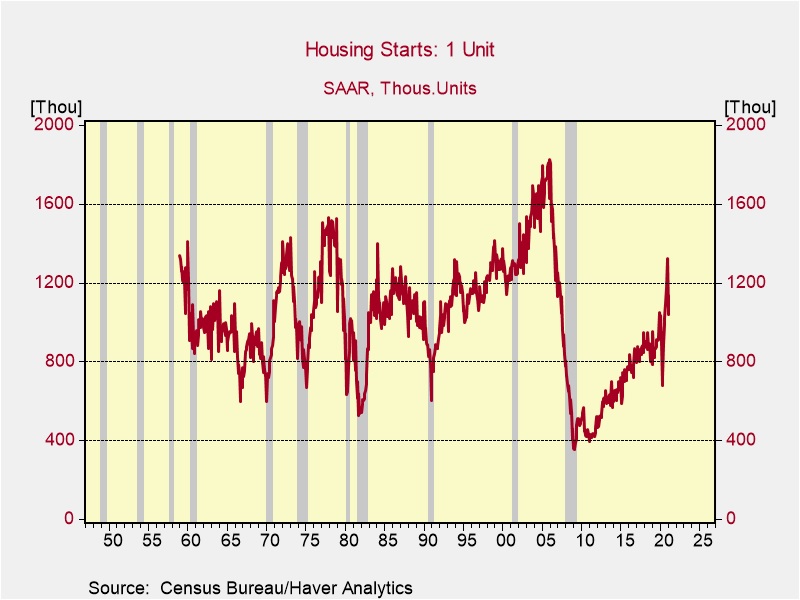
  • Strong demand and low supply are rapidly lifting home prices, creating the strongest conditions since the housing bubble. The demand part is being driven, to some extent, by the Millennial generation moving into their home-buying years.  The supply problem is caused mostly by two issues.  First, boomers are hanging on to their homes longer.  The pandemic has stalled the usual generational shift to downsizing.  Second, homebuilding is just now reaching normal levels in the wake of the housing collapse in 2006.

The drop in building from 2009 until recently means there is a dearth of supply.

COVID-19:  The number of reported cases is 131,401,449 with 2,854,727 fatalities.  In the U.S., there are 30,706,531 confirmed cases with 555,001 deaths.  Both cases and fatalities in the U.S. are declining.  For illustration purposes, the FT has created an interactive chart that allows one to compare cases across nations using similar scaling metrics.  The FT has also issued an economic tracker that looks across countries with high-frequency data on various factors.  The CDC reports that 207,891,295 doses of the vaccine have been distributed with 165,053,746 doses injected.  The number receiving at least one dose is 106,214,924, while the number of second doses, which would grant the highest level of immunity, is 61,416,536.  Around 3 million Americans are being vaccinated daily.  The FT has a page on global vaccine distribution.

Virology

  • The COVID passport issue isn’t just an American one. PM Johnson is also facing criticism on this issue, but it isn’t stopping a pilot project.  Israel has created a “Green Pass,” a document designed to carry on a smartphone.  It has become the document that allows its holder to participate in mass events, e.g., concerts, sporting events, religious gatherers, etc.  Although political resistance to such passports remains strong, meaning it is unlikely that governments will force their adoption, we think it is highly likely that the private sector will insist, meaning that for practical purposes, the vaccination card in the U.S. will become the de facto
  • Meanwhile, in Europe, a third wave of infections is underway. New variants and the lack of vaccination progress are leading to lockdowns and another downturn in economic activity.
  • In vaccine news:
    • There are additional reports of blood clotting being tied to the AstraZeneca (AZN, USD, 49.53) vaccine; these reports are coming from the U.K.
    • A study of the Pfizer (PFE, USD, 36.30) vaccine shows it to be effective against the South African variant.
  • The pandemic has fueled a teacher shortage. The pandemic led to early retirements and a decline in the population of substitute teachers.  There are rising concerns about the future impact of those students affected by the past year.

China and international news:  A roundup.

  • For the past decade, we have seen China move through a cycle of credit restrictions, a consequent drop in growth, and a resurgence in borrowing to offset the slower growth. We are moving into another credit crunch cycle.  China has a serious debt problem, but it can’t really address the debt issue without accepting slower growth.  Since it hasn’t been able to accept slower growth, the debt issue continues.
  • Western multinationals are facing a dilemma; to maintain their business in China, they must adhere to Beijing’s protocols. However, by doing so, they run afoul of Western mores and restrictions.  Companies will likely try to avoid the limelight so as to continue current operations, but eventually, they will be forced to choose.
  • The U.S. is scheduled to pull its remaining troops from Afghanistan on May 1. American negotiators are trying to create conditions that will allow that withdrawal to occur.
  • The U.S. and other signatories to the Iran nuclear deal are set to meet next week to discuss two goals. First, the Europeans want the U.S. to remove Trump-era sanctions, and second, Iran must roll back its nuclear activities to bring it back into compliance.  American negotiators won’t be in the formal talks but will be in the background.  We doubt much will come of this.  Iran has little reason to trust that the U.S. will continue to maintain the arrangement, and the political cost of easing sanctions for the White House will be high.
  • Cuba has been seeing a rise in political dissent. The latest is a hunger strike where dissidents have been using this method to protest the government’s actions.

 View PDF

Daily Comment (April 1, 2021)

by Bill O’Grady, Thomas Wash, and Patrick Fearon-Hernandez, CFA

[Posted: 9:30 AM EDT] | PDF

We have published our latest Weekly Geopolitical Report, which constitutes Part III of our series on the Geopolitics of Central Bank Digital Currencies (CBDC).  We also have several other recent multimedia offerings.  There is a new chart book recapping the recent changes we made to our Asset Allocation portfolios.  Here is our latest Confluence of Ideas podcast.  Our most recent Asset Allocation Weekly, chart book, and podcast are also available.  Note: Due to the upcoming Good Friday and Easter holidays, we will not publish an AAW this week; it will resume on April 9.  Being Thursday, there is a new Weekly Energy Update.  You can find all this research and more on our website.  As a reminder, due to the Good Friday market closures, there will be no Daily Comment tomorrow; we will be back on Monday and recap the employment report on that day.

Good morning.  It’s Opening Day!  Major League Baseball kicks off its season to mostly restricted crowds.  On the first day of Q2, U.S. equity futures are ticking higher.  Our coverage begins with economics and policy the day after the infrastructure package was revealed.  An update on the Archegos event comes next.  China and international news follow.  Technology is next, and we close with a pandemic update.

Economics and policy:  The infrastructure package dominates this sector’s news.

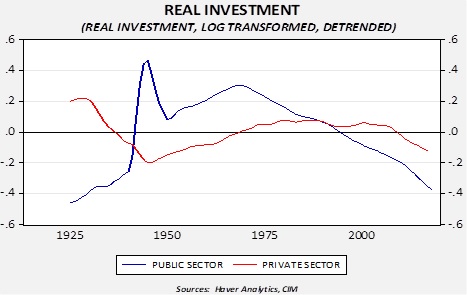
This chart shows real public and private investment against the trend.  There was clear displacement during the Great Depression and the war years, although the cause of the drop in private investment probably had more to do with weak demand and excessive investment as the industrial revolution came to a close.  But, in the 1950s, both rose against trend.  What we have been experiencing this century is unusual; public sector investment has been falling against trend since the early 1970s, but since the Great Financial Crisis, both are below trend.  Thus, we are probably in a position where (a) we probably have too little public investment, and (b) there is probably room for both rising public and private investment.  In fact, one could argue that in the 1950- the 60s, we were able to increase both.

  • There is another item of note. We have been accumulating research on the semiconductor industry.  It is a highly efficient industry that is becoming a notable geopolitical risk.  Not only are parts of the industry strung out around the world, but Taiwan is absolutely essential, and China has a large segment as well.  The package attempts to reduce this geopolitical risk by proposing to spend $50 billion on building capacity in the U.S.
  • All that being said, it is critically important to remember two points. First, although the need for investment is reasonably clear, getting it right is really hard.  Investment is one of the hardest things society does because it requires some projection into the future.  If one gets it right, he or she is blessed with stronger growth and lower inflation.  Getting it wrong means resources are squandered.[1]  So, if the investment allocation is done well, this investment will effectively pay for itself.  If it isn’t, we will expand debt for little purpose.  In reality, what has been proposed will probably fall somewhere in between. It should also be remembered that private sector investment carries the same risks.  What tends to make private sector investment preferred is that the threat of ruin makes investors careful.  Public sector investment lacks a profit motive, and thus, it is even more difficult to get right.  Second, this package, paradoxically, could end up acting as a drag on growth.  It should be noted the spending is spread over eight years, but the tax increases hit immediately.  It will take years for the benefits of the spending to be felt, but paying for it will occur new.  We can debate if this makes sense (actually, it doesn’t), but this is the structure of the current bill.
  • So, will it pass? We have our doubts.  The GOP would probably be on board for parts of the package and might even go along with a smaller increase in the corporate tax rate.  We don’t see any member of the opposition voting for the package as currently constructed.  However, within the majority, there are deep divisions.  The populist left has figured out the second point above and wants even more spendingCentrist Democrats are already balking at the tax hikes.

Archegos:  So far, the good news is that the collapse of Archegos Capital has not been systemic.  Although a number of investment banks have suffered losses (some more than others), it doesn’t appear that anyone is in enough trouble to require a bailout.  Still, the event highlighted the problems within the non-bank financial system (“shadow banking”), namely, leverage is widespread.  Servicing banks don’t seem to have a good idea about the security of their collateral.  It also showed how the financial services industry is extremely adept at creating products that (a) allow for high levels of leverage to occur and (b) seem structured to avoid regulatory scrutiny.  The event also shows that regulators always seem to be chasing situations and making new rules that would have protected the markets from what just happened but do little to affect future events.  The SEC is examining what occurred with Archegos; reports suggest that the family office space may be riskier than generally perceived.

 China:  China’s lending practices and messaging control dominate the headlines.

  • A new report that investigates the terms and conditions of Chinese loans to emerging and frontier markets suggests that Beijing lends similar to a 19th century imperialist. Terms include confidentiality clauses and measures that exclude China’s loans from global resolution bodies, such as the Paris Club.  Our position is that the belt and road project is a modern version of 19th century imperialism, a natural progression given China’s excess capacity.  Essentially, China can no longer rely on the wider world to buy its exports, and thus, is creating colonies through debt and investment to force smaller, less-developed nations to be a conduit for its excess production.
  • China is increasing pressure on foreign correspondents who publish reports that Beijing doesn’t like. A British and an Irish journalist have left the country, citing excessive pressure.  Increasingly, Beijing is controlling the message and is intolerant to positions that stray from the CPC’s line.
  • The U.S. and Taiwan have announced a cooperative agreement among their respective coast guards. Beijing isn’t pleased.  Adding to the pressure, Taiwan is purchasing Patriot missile systems.
  • Huawei (002502, CNY, 2.94) reported falling revenue in Q4, as U.S. sanctions weigh on the company. In a surprising development, Ericsson (ERIC, USD, 13.19), who generally benefits from sanctions on Huawei, has been lobbying against sanctions on the Chinese company.  As sanctions hit Huawei, China has been threatening Ericsson’s business in China and has also expanded to other Swedish businesses that operate in China.  This situation highlights the difficulty of sanctioning China; unlike the Soviet Union, China is a major international economic force and has multiple ways to not only evade sanctions, but retaliate.
  • We are noting a steady number of articles quoting U.S. officials expressing concern that China is considering an invasion of Taiwan. This is a topic will we be investigating in the coming weeks.

International news:  The Taliban is winning; the U.S. restricts trade with Myanmar and the EU takes aim at Poland.

Technology:  We don’t trust or particularly like tech firms.

COVID-19:  The number of reported cases is 129,032,284 with 2,818,245 fatalities.  In the U.S., there are 30,461,312 confirmed cases with 552,073 deaths.  For illustration purposes, the FT has created an interactive chart that allows one to compare cases across nations using similar scaling metrics.  The FT has also issued an economic tracker that looks across countries with high-frequency data on various factors.  The CDC reports that 195,581,725 doses of the vaccine have been distributed with 150,273,725 doses injected.  The number receiving at least one dose is 97,593,290, while the number of second doses, which would grant the highest level of immunity, is 54,607,041.  The FT has a page on global vaccine distribution.  The Axios map shows that infections are starting to increase again despite accelerating vaccinations.

Virology

 View PDF


[1] Although a whole different story, this is why China’s economy is such a “high wire act.”  China relies on investment to grow, and, as Michael Pettis has pointed out, it has probably reached the point where the true value of its investment is close to zero if not negative.  In other words, high-speed rail to nowhere increases GDP at the time of the investment but should be written to zero upon completion to account for the waste.

[2] Canada has 10 people per mi2 compared to the U.S. at 87 per mi2.


Daily Comment (March 31, 2021)

by Bill O’Grady, Thomas Wash, and Patrick Fearon-Hernandez, CFA

[Posted: 9:30 AM EDT] | PDF

In today’s Comment, we open with an overview of the new economic plan that President Biden will propose in a speech today in Pittsburgh.  We next review other key U.S. and international news, including today’s latest U.S.-China tensions.  We end with recent developments related to the coronavirus pandemic.

U.S. Fiscal Policy:  President Biden today will release a $2 trillion infrastructure plan centered on fixing roads and bridges, expanding broadband internet access, and boosting funding for research and development.  Under the plan, that spending would be paid for over 15 years by raising the corporate tax rate to 28% from 21% and increasing taxes on companies’ foreign earnings.

  • The proposal includes $621 billion to modernize transportation infrastructure like roads and bridges, $400 billion to help care for the aging and disabled, $300 billion to boost the manufacturing industry, $213 billion on retrofitting and building affordable housing, and $100 billion to expand broadband access, among other investments.
    • The plan calls for modernizing 20,000 miles of roadway; building 500,000 electric vehicle charging stations, replacing the country’s existing lead pipes and service lines, repairing aging schools, and investing billions of dollars in domestic semiconductor manufacturing.
    • The plan would also establish a standard mandating that increasing portions of the country’s electricity be generated from low-carbon sources, with a goal of eliminating carbon emissions from the power grid by 2035.
  • A second plan focused on childcare, healthcare, and education will be released in April.
  • As justification for the plan, Biden is expected to argue that the investments are necessary to help the U.S. compete with China and tackle climate change.
  • Obviously, the huge amount of additional spending and tax hikes will generate pushback from Republicans and moderate Democrats.  Nevertheless, Biden has promised to be flexible where necessary and firm where it’s essential.  His success in pushing through his $1.9 trillion pandemic relief package suggests all things are possible.  In any case, the prospect of massive new fiscal stimulus on top of today’s loose monetary policy could buoy equities and further undermine bonds, pushing yields higher. Although, those factors will be battling it out with concerns about higher taxes.  The result could potentially be increased volatility and only muted gains for risk assets over the course of the year.

U.S. Bond Market:  While domestic expectations for faster economic growth and rising inflation have clearly been a factor in the recent run-up in bond yields, new reporting suggests another important factor.  Many Japanese institutional investors sold down their holdings of U.S. Treasuries in order to lock in their investment returns ahead of their fiscal year end on March 31.

United States-China:  In its annual human rights report, the U.S. Department of State accused China of being an “authoritarian state” and committing “genocide and crimes against humanity” against its Uyghur minority.  According to the report, China is detaining more than one million Uyghurs and other Muslims in its western Xinjiang region and is engaging in abuses including rape, forced sterilization, coerced abortions, torture, and forced labor.  The report provides further evidence that the Biden administration is continuing much of the hardline approach to China adopted by former President Trump.  It is even going further than Trump in expanding its focus toward human rights and reinvigorating U.S. alliances.  Today’s report will further hike tensions with China, which, as we have often argued, raises the risk that investors could be caught in the crossfire.

Australia:  The government announced today that it is fast-tracking plans to manufacture advanced missiles and other guided weapons in response to growing tensions in the Indo-Pacific region and concerns over its reliance on imports.  According to Prime Minister Morrison, the government will spend $1 billion to develop an indigenous manufacturing capability along with a major western defense contractor.  The move highlights the possibility that military tensions between China and the major liberal democracies could eventually present investors with new opportunities in the defense sector, despite concerns that growing government debt will lead to tighter public budgets.

Slovakia:  Prime Minister Matovic has stepped down to end a crisis in the year-old ruling coalition that was sparked by his decision to buy Russia’s Sputnik V coronavirus vaccine.  Matovic will be replaced by his ally Eduard Heger, a member of the same Ordinary People party who currently serves as finance minister.  Matovic, in turn, is set to replace Heger at the finance ministry.  All four parties in the right-wing coalition have approved the changes.

Brazil:  Following up on President Bolsonaro’s cabinet shuffle on Monday, described in yesterday’s Comment, the chiefs of Brazil’s army, navy, and air force all stepped down in apparent solidarity with the ousted defense minister.  The resignations point to growing dissatisfaction with Bolsonaro’s attempts to politicize the military, especially as his government comes under fire for failing to prioritize or take control over the coronavirus pandemic.

COVID-19:  Official data show confirmed cases have risen to 128,301,662 worldwide, with 2,805,972 deaths.  In the United States, confirmed cases rose to 30,394,189, with 550,998 deaths.  Vaccine doses delivered in the U.S. now total 189,451,285, while the number of people who have received at least their first shot totals 96,044,046.  Finally, here is the interactive chart from the Financial Times that allows you to compare cases and deaths among countries, scaled by population.

Virology

  • Newly confirmed U.S infections fell to approximately 60,000 yesterday, coming in below the seven-day moving average of 65,789 but slightly above the 14-day moving average of 59,741.  The figures remain well below the levels reached at the beginning of the year; nevertheless, they reflect a recent plateau and then rebound as factors such as new, more transmissible mutations and quick restriction loosening offset the gains from mass vaccinations.  Meanwhile, yesterday’s deaths related to the virus rose to 804.  On the vaccination front, 28.9% of U.S. residents have now received at least one dose of a coronavirus vaccine, and 16.1% are fully vaccinated.
  • In a study involving 2,200 children, the vaccine developed by Pfizer (PFE, $36.11) and BioNTech (BNTX, $104.44) was found to be 100% effective in protecting against symptomatic disease in those over 12 years old, with no safety concerns.
    • Given the results, Pfizer said it would ask U.S. health regulators in the coming weeks to expand the use of the shots to those 12 to 15 years of age.
    • The timetable for authorization in the U.S. could mean kids will be able to be vaccinated before the next school year begins in the fall.
  • In contrast with the improved conditions in the U.S. and the U.K. since early 2021, the pandemic continues to rebound in Europe.  In France today, President Macron is expected to announce strict new lockdown measures aimed at controlling a third wave that is overwhelming the country’s hospitals.  He may even be forced to close schools after pleas from teachers, doctors, and local officials.
    • Macron’s determination to keep schools open after the first coronavirus lockdown a year ago — in contrast to the closures ordered in many other countries — has been popular in France.
    • However, Macron has come under intense criticism in recent weeks for ignoring the warnings of scientists and doctors about the need for tighter measures against the third wave.
  • What appears to be a fourth wave of the pandemic is materializing in Japan mere weeks after the country began easing virus countermeasures.
  • Following a similar move by Canada, yesterday the German government said the vaccine from AstraZeneca (AZN, $49.97) would be restricted for people younger than 60 years of age due to new blood-clotting incidents found among recipients.  Despite a recent ruling by the European Medicines Agency that the vaccine is “safe and effective,” Germans under 60 will only be able to receive it if they specifically demand it, and if their request is granted by a physician.  Besides marking another body blow to the vaccine’s reputation, the decision is likely to further slow Germany’s plodding vaccination program.
  • The WHO team that visited China early this year to investigate the origins of the pandemic issued its report arguing that the coronavirus most likely jumped to humans from an animal,.  However, the real story was the international response to the document.  The U.S. and more than a dozen other countries issued a joint statement complaining the investigation came too late, and the team wasn’t afforded full or timely access to pertinent data by the Chinese government.
    • Rather, the statement called for “transparent and independent analysis and evaluation, free from interference and undue influence.”
    • On top of that, WHO Director, General Ghebreyesus, called for a more extensive probe into whether the coronavirus had escaped from a lab, the strongest terms he has used in public on the matter.
    • As might be expected, the Chinese government responded by warning against politicizing the issue and calling for similar probes in other countries.

 Economic and Financial Market Impacts

Foreign Policy Response

  • In China, the government’s effort to withdraw the pandemic stimulus it implemented last year has started to undermine the country’s currency.  In the tightly regulated onshore market, the renminbi has fallen 1.4% against the greenback so far in March, marking its worst one-month drop since August 2019 and erasing the currency’s gains against the dollar since the new year.

 View PDF

Daily Comment (March 30, 2021)

by Bill O’Grady, Thomas Wash, and Patrick Fearon-Hernandez, CFA

[Posted: 9:30 AM EDT] | PDF

Today’s Comment opens with an Archegos trading update and the extent to which it might be portending broader risks in the markets.  We next review the latest developments in the U.S. tax policy, where Democrats in the Senate have floated a proposal to tax unrealized capital gains at death, subject to an exemption.  Finally, we review key international news and the latest trends in the coronavirus pandemic.

Archegos:  It now appears that the forced margin calls on hedge fund Archegos, which led to elevated market volatility in the midst of massive block sales in certain stocks over the last few days, related as much to competition among the fund’s prime brokers as to fears about the stocks themselves.  A report by the Financial Times indicated that prior to the fund’s troubles becoming public knowledge, representatives from its trading partners Goldman Sachs (GS, $325.73), Morgan Stanley (MS, $77.88), Credit Suisse (CS, $11.39), UBS (UBS, $15.59), and Nomura (NMR, $5.68) held a meeting with Archegos to discuss an orderly wind-down of troubled trades.  The goal was to implement orderly, coordinated sales that would minimize market impacts and any hit to the banks’ own balance sheets as they worked to sell down stakes in companies that Archegos had amassed through derivatives instruments.  Although it’s unclear whether an understanding was actually reached among the banks, several sources said it was quickly clear that some banks began selling to stem their own losses, triggering a rush to the exits.

  • Those firms that moved quickly, including Morgan Stanley, evidently were able to minimize their losses.  The banks that moved slowly, including Credit Suisse and Nomura, incurred the heaviest losses.
  • Of course, many other issues related to Archegos remain.  These include the extent to which the fund’s risky positions were driven by today’s loose monetary policy and massive amounts of liquidity, whether regulators will now try to close the loophole that allowed the fund to use swaps to amass huge stakes in companies, and whether there was a systematic breakdown in the banks’ risk control processes.

U.S. Tax Policy:  Several progressive Democrats in the Senate have released a draft proposal to tax unrealized capital gains at death, subject to a $1 million exemption.  The tax would aim to raise money from high-income households to help pay for President Biden’s proposed spending on infrastructure and social programs.

  • Under current law, someone who dies with appreciated assets—including homes, businesses, and stocks in taxable accounts—doesn’t have to pay capital-gains taxes on that increase. Instead, the heirs have to pay capital-gains taxes only after they sell and only on gains after the original owner’s death.
  • That “stepped-up basis” is a longstanding feature of the tax code, but it has come under increasing attacks from Democrats who see wealthy people’s profits escaping the income tax.

United States-Taiwan-China:  The Biden administration is reportedly preparing to issue guidelines, making it easier for U.S. diplomats to meet Taiwanese officials.  The new rules, including some adopted by President Trump, would contravene decades-old restrictions meant to avoid provoking China.  The new rules will almost certainly anger Beijing and further worsen tensions between the U.S. and China.

Turkey:  Just ten days after sacking the head of the Turkish central bank for his effort to hike interest rates, President Erdogan has also fired the institution’s deputy governor and replaced him with a lesser-known commercial banker.  With Erdogan once again showing his penchant for taking control of monetary policy, the lira is down approximately 1.8% against the dollar so far today.

Russia:  Amid reports that jailed opposition leader Alexei Navalny is suffering medical issues and not being offered sufficient treatment, some 500 physicians and medical experts in Russia have signed an online petition saying that at a bare minimum, an independent physician whom Navalny trusts should have the opportunity to examine him.  In addition, the petition suggests Navalny be examined by experts from the Charite clinic in Berlin, Germany, where he was treated after he was poisoned in Siberia last year; the current deterioration of his condition may be related to the attack.  The situation illustrates the Kremlin’s balancing act in trying to muzzle Navalny without causing political pushback among Russians.

Brazil:  President Bolsonaro has announced a sweeping reshuffle of his cabinet, including new foreign and defense ministers, as political pressure mounts on him to get a grip on the country’s coronavirus crisis.  Not only did Bolsonaro replace his chief of staff, justice minister, and attorney general, but he also replaced his ministers of defense and foreign affairs.

  • In particular, Foreign Minister Araújo had been under pressure from lawmakers unhappy with Brazil’s efforts to acquire coronavirus vaccines.
  • Critics have blamed Araújo for Brazil’s increasing international isolation.  Just as important, they have complained that his belligerent stance toward China has led to delays in the delivery from China of important pharmaceutical ingredients.

Global Supply Chains:   The skyscraper-sized container ship stuck in the Suez Canal for almost a week was finally freed yesterday, clearing the way for hundreds of backlogged ships to traverse the waterway over the coming days.  The effects of the blockage are likely to linger for weeks or even months.  While the clearing of the canal will ultimately be a positive for the world’s tight and disrupted supply chains, a separate report said the recent fire at a major Japanese facility producing computer chips for the auto industry caused more damage than earlier known, and fully restarting production could take up to four months.

COVID-19:  Official data show confirmed cases have risen to 127,775,460 worldwide, with 2,794,246 deaths.  In the United States, confirmed cases rose to 30,332,358, with 550,073 deaths.  Vaccine doses delivered in the U.S. now total 180,646,565, while the number of people who have received at least their first shot totals 95,015,762.  Finally, here is the interactive chart from the Financial Times that allows you to compare cases and deaths among countries, scaled by population.

Virology

  • Newly confirmed U.S infections rose to approximately 68,000 yesterday, surpassing both the seven-day moving average of 63,239 and the 14-day moving average of 58,829.  Infections are now clearly on the upswing again, as factors such as new, more transmissible mutations and the removal of social distancing rules combine to offset much of the advantage of expanding vaccinations.  On the other hand, deaths related to the virus totaled a relatively low 668 yesterday, and they continue to trend modestly downward.
  • In a CDC study of almost 4,000 vaccinated healthcare workers, first responders, and other essential workers, the COVID-19 shots developed by Moderna (MRNA, $123.42) and Pfizer (PFE, $36.62) were confirmed to be 90% effective at reducing the risk of both symptomatic and asymptomatic infection two weeks after a second dose.  The study confirms that the vaccines are highly effective in real-world conditions, which can be more complex and challenging than the conditions in clinical trials.
  • In contrast, the vaccine from AstraZeneca (AZN, $50.81) continues to face ups and downs.  Canadian authorities yesterday recommended a halt on administering the vaccine to people under age 55 in light of evidence from Europe because of potentially serious side effects targeting younger women.
    • The change in guidance marked a sharp shift from Canadian health officials, who until now have said the AstraZeneca vaccine was safe for people of all ages.
    • The Canadian officials had issued their previous positive opinion of the shot as recently as early March, when governments in Europe paused the vaccine’s use due to worries over blood clotting.
  • President Biden said his administration is more than doubling the number of pharmacies in the federal vaccination program and opening additional mass vaccination sites. He said 90% of adults would be eligible for vaccination by April 19, and 90% will have a vaccination site within 5 miles of their residence.
  • New York state will make COVID-19 vaccine shots available to residents 30 years old and up starting today, while New Jersey yesterday expanded eligibility to include more public-facing workers.
  • As more and more people get vaccinated, polling shows vaccine hesitancy is declining quickly.  In a survey of 80,000 adults in the U.S. earlier this month, about 17% said they would either definitely or probably not get vaccinated, down from 22% in January.
    • The decline was almost entirely due to fewer respondents saying they probably would not get the shot.
    • The share that stated they definitely would not has remained essentially unchanged in the past two months.
  • As Japan struggles to procure COVID-19 vaccines from foreign manufactures in a timely manner, the government has backpedaled on its plan to let people choose which vaccine to get.  Its vaccinations chief said nothing has been decided yet.
  • A WHO-led team investigating the origins of the pandemic reported that data provided by China and examined during a recent mission to the country was insufficient to answer the critical questions of when, where, and how the virus began spreading.  The report calls for a closer examination of Chinese hospital records and blood samples from before the first known cases in December 2019.  More extensive testing of farms that supplied wild animals to a market that is linked to many early cases is also recommended.
  • Government leaders from more than 24 countries have joined the head of the WHO, in calling for a new international treaty on pandemic preparedness and response.  It is aimed at improving alert systems, data sharing, and transparency, as well as widening access to vaccines.

 Economic and Financial Market Impacts

U.S. Policy Response

 View PDF

Daily Comment (March 29, 2021)

by Bill O’Grady, Thomas Wash, and Patrick Fearon-Hernandez, CFA

[Posted: 9:30 AM EDT] | PDF

Good morning and happy Monday!  We are down to the elite eight in NCAA men’s basketball, and opening day is just around the corner!  U.S. equity futures are a bit lower this morning but off their worst levels of the overnight session.  Coverage starts today with reports that a large family office is facing massive margin calls, which have led to aggressive selling of select equities.  We look at who is behind the situation and its potential impact.  Up next is the latest on the Suez situation.  International news follows, with Myanmar and Germany’s supreme court featured.  China news is next; economics and policy follow, and we close with the latest on COVID-19.

Who is Bill Hwang?  He comes out of Tiger Management, a hedge fund of yesteryear run by Julian Robertson.  He was one of Robertson’s “tiger cubs,” fund managers who spun out of Tiger Management to start their own hedge funds.  Hwang took an initial stake of $23 million at the turn of the century and turned it into $8.0 billion by the end of 2007.  His firm is called Archegros Capital Management, and it is a “long/short” hedge fund.  Since 2007, his fortunes have been mixed.  He was caught in the massive short squeeze of Volkswagen (VWAGY, USD 32.53), which rose 82% in one day after Porsche (POAHY, USD, 10.29) announced it had purchased shares.  He also paid the SEC $44 million in fines over insider trading of Chinese bank stocks.  Hong Kong exchanges banned him from trading for four years in 2014.  In response to these legal challenges, as well as market issues, Hwang converted his hedge fund into a family office.

On Friday, Goldman Sachs (GS, USD, 327.39), Credit Suisse (CS, USD 12.87), and Morgan Stanley (MS, USD, 79.98),[1] who acted as prime brokers for Archegros, issued margin calls on the family office.  Nomura (NMR, USD, 6.61) and Credit Suisse have warned they may “incur substantial losses.”  Reports indicate that banks liquidated at least $30 billion (yes, with a “B”) of positions.  Hwang tends to run a concentrated portfolio with leverage, which accentuates both gains and losses.  His holdings appear to be weighted toward U.S. media companies and Chinese tech stocks.  It appears the brokers initiated the stock sales, meaning this was a forced margin liquidation.

Here is the “known/known”—the sales are massive and were done in blocks, suggesting the bankers were worried about losses and wanted to move quickly to get as much out of the collateral as they could.  This sort of action with a trader of this size isn’t common.  Here are the “known/unknowns”—first, hedge fund managers often participate in the same ideas, and thus the sharp declines in selected stocks may also have ramifications for other managers.  Second, the leverage may have been larger than one would expect.  Margin loans are fixed at 50%, but traders can increase their leverage through derivatives, e.g., options, swaps, single stock futures, etc.  We suspect Hwang’s positions were highly leveraged, which triggered the unified response.  Third, and perhaps most important, we don’t know yet if the selling is nearly complete or if there is more to come.  The initial weakness in stock index futures suggests worries were elevated; so far, it looks like we may be close to completion, and this event is just another tale of hubris and leverage.  It is also possible that we aren’t finished yet, and wider selling may still be possible.

Suez:  There is some good news on this front.  The combined efforts of tugboats and excavators, along with the moon (from high tide), have partially refloated the stuck container vessel.

(Source:  FleetMon)

The ship’s bow has been freed from the eastern bank, and the stern has been shifted into the channel.  However, even if the boat is freed, it will take weeks for traffic to normalize completely.  This is leading shippers to consider alternative routes.  Security of supply concerns are leading consumers to reconsider just-in-time inventory methodsInsurance firms are also facing a raft of claims.

International news:  Myanmar increasingly looks like a civil conflict, and the German Supreme Court throws a potential spanner into the Eurobond.

China:  The EU and China are engaging in dueling sanctions, and China and Iran formalize ties.

Economics and policy:  Infrastructure, taxes, and inflation lead the headlines.

COVID-19:  The number of reported cases is 127,285,692 with 2,785,365 fatalities.  In the U.S., there are 30,262,717 confirmed cases with 549,335 deaths.  For illustration purposes, the FT has created an interactive chart that allows one to compare cases across nations using similar scaling metrics.  The FT has also issued an economic tracker that looks across countries with high-frequency data on various factors.  The CDC reports that 180,646,465 doses of the vaccine have been distributed with 143,462,691 doses injected.  The number receiving at least one dose is 93,631,163, while the number of second doses, which would grant the highest level of immunity, is 51,593,564.  The FT has a page on global vaccine distribution.

 Virology

 View PDF


[1] UBS (UBS, USD, 16.04) and Deutsche Bank (DB, USD, 12.35) also are listed as prime brokers, but we haven’t seen a direct mention that they were involved in margin sales.

Daily Comment (March 26, 2021)

by Bill O’Grady, Thomas Wash, and Patrick Fearon-Hernandez, CFA

[Posted: 9:30 AM EDT] | PDF

We have published our latest Weekly Geopolitical Report, which constitutes Part II of our series on the geopolitics of Central Bank Digital Currencies (CBDC).  We also have several other recent multimedia offerings.  There is a new chart book recapping the recent changes we made to our Asset Allocation portfolios.  Here is our latest Confluence of Ideas podcast. It’s Friday, and our most recent Asset Allocation Weekly, chart book, and podcast are also available.  (Note: Due to the upcoming Good Friday and Easter holidays, we will not publish an AAW next week; it will resume on April 9.)  Finally, here is our latest Weekly Energy Update.  You can find all this research and more on our website.

Good morning, all! U.S. equity futures are higher this morning as investors are growing more optimistic for a stronger recovery.  We begin with President Biden’s first press conference.  Next, we provide an update on the Suez Canal blockage and give our views on the tech hearing on Capitol Hill.  Our news roundup includes economic and domestic stories, international news, and a virus update.

Biden’s Press Conference: On Thursday, President Biden held his first press conference since taking office. He started with a summary of the administration’s accomplishments and then took questions from reporters. Here are the highlights:

  • The 100 million vaccination goal has already been met, and now the president is aiming for 200 million vaccinations within 100 days of taking office.
  • There is no timeline for the Afghanistan withdrawal. President Biden has stated that he doesn’t expect the troops to withdraw in May but doesn’t think they will be stationed in Afghanistan beyond this year.
  • Biden intends to run for office in 2024 but was unclear when he would formally launch a campaign.
  • Filibuster reform could be taken up if conservatives use it to block voting rights legislation. However, the president was reluctant to commit to supporting its complete removal.
  • Biden also pushed back against criticism that he is the reason immigration has spiked in recent weeks. Several reports implied that immigrants may have been motivated by his nice-guy persona to come to America.  In response, the president attributed the rise in numbers as typical for all presidents, and he erroneously stated that the majority of families attempting to cross the border were immediately sent back.

Out of the items mentioned above, we believe President Biden’s potential run in 2024 is probably the most notable, although not for the reason many would expect.  Despite headlines implying that he has committed to running again, we felt like he was a bit more ambivalent toward the issue.  When asked why he hadn’t formally announced his intention to run again, as his predecessor did, he deflected the question by telling a joke at his predecessor’s expense, stating 2024 isn’t his current focus.  The president’s reluctance to commit to running again could have implications on his agenda going forward.  If conservatives consider him a lame duck, they could ramp up efforts to slow his agenda as they gear up to launch their own challenge in 2024. If we are right, this could mean Biden’s window of getting things done is a lot narrower than we originally thought and could add to the urgency in reforming the filibuster.

Suez Canal Update:  The ship in the Suez Canal remains stuck while specialist dredgers attempt to dig it out.  So far, all efforts to remove the ship have failed, and it is not expected to be removed for at least a week.  Shipping rates have since spiked as vessels have been forced to take a longer route to transport goods.  Additionally, the number of vessels queued up in canals has risen from 186 to 238.  Although this hasn’t led to a rise in oil prices yet, it is expected to happen in the coming weeks.

Tech Congressional Hearing: CEOs from Facebook (FB, $278.74), Twitter (TWTR, $61.20), and Google (Googl, $2,032.46) attended another hearing on Capitol Hill.  The five-hour hearing focused primarily on the January 6 Capitol riots and the role social media had in inciting the riot. As one could have expected, the hearing was quite tense.  Politicians forced CEOs to answer a series of “yes” or “no” questions, at times interrupting when answers went beyond that.  The interruptions were so frequent that Twitter CEO Jack Dorsey sarcastically posted a “yes” or “no” poll on Twitter.  Although it wasn’t clear that any legislation could be made based off the testimony, it does appear there is growing bipartisan support to regulate these social media companies.

U.S. Economic and Domestic Policy:

  • In a bipartisan letter sent Thursday, 41 senators urged President Biden to take action to deter Iran’s nuclear program.  The letter asserted that Iran had accelerated its nuclear activity in “alarming ways,” and urged the Biden administration to use “economic and diplomatic tools” to deter further efforts.
  • A severe tornado outbreak led the National Weather Service to issue a category five warning to southern states Alabama, Mississippi, and Tennessee.  Violent tornadoes are expected to hit major cities such as Jackson, Mississippi, Memphis, Tennessee, and Huntsville, Alabama.  At least three people have already been killed by the tornadoes in Alabama.
  • The Federal Reserve announced on Thursday that buybacks and dividend limits will end for most firms on June 30 after the completion of the most recent round of stress tests. The pandemic-era restrictions were designed to ensure that banks remained healthy enough to continue lending during the pandemic.  That being said, banks will need to maintain capital requirements if they want to resume buybacks and dividend payouts.
  • On Thursday, Congress extended the Paycheck Protection Program for two months.  Both lenders and small business owners were given an additional 30 days to adjust to program changes implemented by the Biden administration.  The changes were designed to help more self-employed people and small business owners take advantage of additional aid provided by the program.
  • The U.S.-U.K. trade deal is expected to miss a deadline needed for it to fast-track through Congress.  The delay is due to the Biden administration’s insistence on a resolution to the Boeing (BA, $247.19)-Airbus (EADSY, $28.55) dispute.  The deal needed to be completed by the end of the month for it to be covered by legislation called the Trade Promotion Authority (TPA).  Missing the deadline could drastically slow down passage as lawmakers will likely attempt to bog down the deal with additional amendments to protect special interest groups such as agriculture.

International Economic News:

  • The election in Israel on Thursday likely extended the parliamentary deadlock as it was unable to produce a clear winner.  The two main blocs, the Likud party and the Yesh Atid party, now need to form a coalition with smaller parties in order to reach the 61 seats needed to form government.  This is the fourth election in two years, and there are doubts regarding whether either side can gain enough support; it seems likely that another election will have to take place.
  • The U.S. and Britain imposed sanctions on two conglomerates in Myanmar following the February 1 coup and crackdown.  The two conglomerates, Myanma Economic Holdings Public Company Ltd. (MEHL) and Myanmar Economic Corporation Ltd. (MEC,), control large sections of the Myanmar economy.  The European Union is also facing pressure to follow suit in issuing sanctions.
  • The Biden administration announced that it would restore humanitarian aid to the Palestinians, along with an additional $15 million to help with the pandemic.  However, the administration made clear that the additional aid will be given to NGOs and not directly to the Palestinian Authority.  The Trump administration had withdrawn aid from Palestine following the decision to boycott the peace meeting in 2018.
  • Canadian Prime Minister Justin Trudeau notched a win in the Supreme Court on Thursday.  The court ruled that because global warming is a national concern, the federal government can set national carbon prices.

 China:

  • Western apparel companies have expressed concern over the alleged use of forced labor in Xinjiang.  These companies are now facing boycotts in China as well as a possible ban because of their decision to address the issue publicly.  Following H&M’s (HMRZF, $23.92) decision to no longer source its cotton from Xinjiang, China has effectively erased the clothing store from its online platform.  Nike (NKE, $128.64) and Adidas (ADDF, $310.50) have also faced criticism for their stance against forced labor used to produce cotton.

COVID-19:  Official data show confirmed cases have risen to 124,985,317 worldwide, with 2,746,720 deaths.  In the United States, confirmed cases rose to 30,021,447, with 545,422 deaths.  Vaccine doses delivered in the U.S. now total 169,223,125, while the number of people who have received at least their first shot totals 85,472,166.  Finally, here is the interactive chart from the Financial Times that allows you to compare cases and deaths among countries, scaled by population.

Virology

 View PDF

Daily Comment (March 25, 2021)

by Bill O’Grady, Thomas Wash, and Patrick Fearon-Hernandez, CFA

[Posted: 9:30 AM EDT] | PDF

Good morning!  U.S. equity markets have turned lower this morning.  Our coverage begins with the pandemic, with a focus on the mess that Chancellor Merkel finds herself in with elections coming in autumn.  China coverage follows; the diplomatic spat between the EU and China has intensified and Beijing and Moscow continue to tighten relations.  International coverage is next, followed by economics and policy, and we close with technology news.

COVID-19:  The number of reported cases is 124,894,108 with 2,745,702 fatalities.  In the U.S., there are 30,011,551 confirmed cases with 545,746 deaths.  For illustration purposes, the FT has created an interactive chart that allows one to compare cases across nations using similar scaling metrics.  The FT has also issued an economic tracker that looks across countries with high frequency data on various factors.  The CDC reports that 169,223,125 of the vaccine has been distributed with 130,473,853 of doses injected.  The number receiving at least one dose is 85,472,166, while the number of second doses, which would grant the highest level of immunity, is 46,365,515.  The FT has a page on global vaccine distribution.  The weekly Axios map shows a mixed bag; some states are reporting falling cases, but there is a disturbing rise in others.  Due to reporting issues, we have seen a jump in U.S. infections to 86K.

Virology

  • Germany is facing a jump in infections that is leading to a political crisis. In light of a slow vaccine rollout and after a meeting with regional leaders, Chancellor Merkel decided to issue not only a lockdown order but to extend the Easter holiday by two days.  The backlash was strong; protests broke out and the political opposition was critical of the move.  The suddenness of the action and the lack of planning for how businesses and households would handle the changes to the holiday raised hackles.  And so, in the face of strong opposition, Merkel reversed her order and publicly took sole responsibility, asking Germans to forgive.
    • There is growing political fallout from the current government’s handling of the pandemic. Although Germany’s actions, at first, were considered strong, the inability to distribute vaccines, the persistent waves of infections followed by ineffective lockdown measures, and the fact that there appears to be “no light at the end of the tunnel” have weighed on the government.  Political standouts of the CDU, possible successors to Merkel, have seen their stars fall, raising the possibility that the CDU/CSU/SPD will fall from power in September.
    • Belgium has announced a lockdown over Easter; however, the measures don’t appear to be all that strict and there hasn’t been a notable public response.
  • The EU’s vaccine program has been something of a mess. The leadership focused on price rather than securing supply.  In a globalized world, this has led to a situation where vaccines produced in the EU are being shipped to other parts of the world, where nations paid higher prices.  Europe is considering restricting vaccine exports in response, which will not make its trading partners happy.  But supply isn’t the only problem.  Logistics and clear lines of authority have been a problem, too.
  • The U.K. is signaling that it will restrict travel between France and the U.K. due to the surge in COVID-19 cases in the EU.
  • AstraZeneca has revised down its efficacy rate to 76% from its original report of 79% due to data integrity problems.
  • The UAE has been aggressive in acquiring vaccines, allowing China and Russia to conduct clinical trials in return for vaccine supply. The Sinopharm (SHTDY, USD, 12.04) vaccine has been distributed; we note that health authorities are notifying some of the recipients who received two injections that they should receive a third, suggesting the prior inoculations were ineffective.  China claims a 79% efficacy rate, but never released any supporting data.  This vaccine has also been distributed in Egypt, Cambodia, Senegal, and Peru.  If it turns out the vaccine is ineffective, it would require these countries to source vaccines from other nations and would be a blow to China’s prestige.
  • Studies published in the New England Journal of Medicine suggest that out of 8,121 fully vaccinated employees at the University of Texas Southwestern Medical Facility, only four contracted COVID-19 after inoculation. A similar study in Los Angeles hospitals shows seven out of 14,990.  Although we doubt the current vaccines will give us sterilizing immunity, these studies suggest it will be close.  In addition, those who did contract the disease reported mild symptoms, suggesting that getting the shot will keep a recipient from a serious case of the disease.

China:  China’s foreign relations with the EU and U.S. are getting increasingly difficult.  In response, Beijing is getting close to Russia.

International news:  Israel is trying to form a government, North Korea launched missiles, and the Indian farmers’ strike continues.

Economics and policy:  The Suez Canal remains blocked, rental arrears continue to be an issue, we are watching what households do with the “stimmy,” and inflation worries are rising.

  • The Suez Canal remains blocked, roiling global shipping. Over 100 ships are stuck, waiting for authorities to move the vessel.
  • One of the concerns about the aftermath of the pandemic is squaring up rents in arrears. Landlords need to be paid to remain current on their mortgages; without rental payments, defaults at that level may start.  At the same time, if evictions begin, it may be difficult for landlords to find renters at current rental levels and could create a homelessness problem.  So far, the government’s response has been to delay evictions and hope for a resolution.  The current extension expires in a week; the government is considering an extension into July.
    • Part of the recently passed rescue package has $47 billion of relief to households. The expectation is that some (or all) of this money may be used for back rent and utility bills.  There is a concern about delays in receiving these checks, which is why the extension is being considered.
  • Surveys of college-age Americans who received stimulus checks suggest the majority will be used for savings and debt reduction. If so, the forecast growth that is expected may not immediately materialize.  At the same time, these actions would improve household balance sheets and improve the chances of better future growth.
  • Surveys of businesses conducted by the Atlanta FRB suggest supply worries are becoming the most significant concern among businesses. This fear is reflected in ISM surveys as well.  Supply bottlenecks are exacerbating inflation issues; the Suez situation is just one of these concerns.
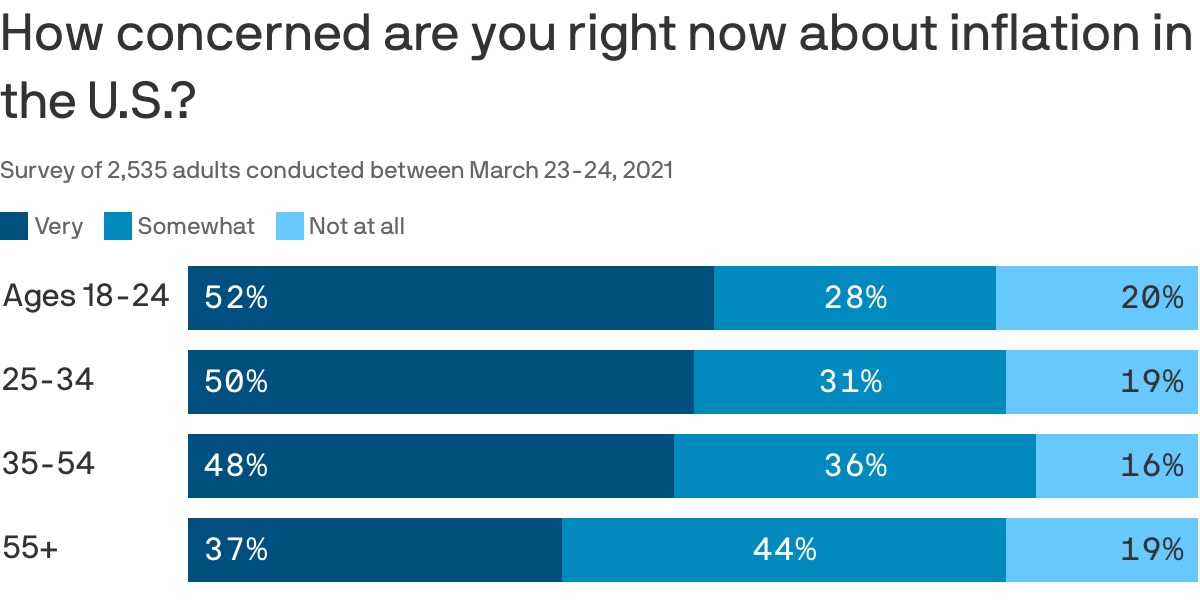
    • Perhaps even more unsettling are surveys suggesting the youngest Americans are the most concerned about inflation. This is odd because they haven’t experienced it to any great degree.  Their worries may not express themselves as they did for baby boomers; the millennials may buy bitcoin instead.
(Source: Axios)

Technology:  Tech leaders testify before Congress and Amazon (AMZN, USD, 3087.07) faces a union vote.

 View PDF

Daily Comment (March 24, 2021)

by Bill O’Grady, Thomas Wash, and Patrick Fearon-Hernandez, CFA

[Posted: 9:30 AM EDT] | PDF

Today’s Comment opens with the ongoing testimony before Congress from Federal Reserve Chair Powell and Treasury Secretary Yellen.  Both officials will wrap up their testimony before the Senate today.  We next turn to various overseas developments, including elections in Israel, new missile tests in North Korea, and a container ship causing a traffic jam in the Suez Canal.  Finally, we recap the latest news on the coronavirus pandemic.

U.S. Monetary Policy:  Testifying before the House Financial Services Committee yesterday, Fed Chair Powell repeated his view that the post-pandemic economic recovery is far from complete, and the Fed should keep monetary policy extraordinarily loose for some time to come.  Powell did note that the recovery and the latest fiscal package could push inflation higher, but he said such price hikes wouldn’t be very large or sustained, and even if they were, the policymakers have the tools necessary to get inflation under control again.

  • Despite Powell’s sanguinity, many investors continue to fret that the Fed could end up behind the curve as inflation accelerates and might have to react by tightening policy sooner than planned.  Bond yields have recently risen in response, prompting volatility in stocks.
  • At the same time, however, concerns about deadlier and more transmissible coronavirus mutations have started to make some investors question the thesis about a fast economic recovery, especially in Europe.  That contributed to the fall in stocks yesterday.
  • All the same, it’s notable that if the European economy remains locked down, it would be a drag on global economic growth and could help hold down inflation.  In other words, inflation fears and bond yields could begin to moderate in the near term.  They may have already started to do so.  Eventually, a more balanced view of economic prospects and stable bond yields could prompt another up leg in equities.

U.S. Fiscal Policy:  In her testimony before the House Financial Services Committee yesterday, Treasury Secretary Yellen said tax increases would be required to fund President Biden’s evolving $3 trillion infrastructure and economic development package.  Facing strong opposition from Republicans, she pledged that the administration wouldn’t do anything to adversely impact small businesses or middle-income citizens.

  • Just as the Biden spending plan would be broken into two parts, one for infrastructure and one for other economic initiatives, the developing tax plan would also include two parts.  Taxes on businesses would be included with the infrastructure spending plan, while taxes on higher-income households would be matched with the other spending proposals.
  • Aides are expected to present the plan to Mr. Biden and his top advisers this week, meaning its details and configuration could change before the White House brings it to leaders on Capitol Hill.

Israel:  In yesterday’s parliamentary elections, Prime Minister Netanyahu’s alliance looks like it would come up just short of a majority in parliament, even if he manages to entice a former ally, Naftali Bennett, to join his camp.  The ultimate size of Netanyahu’s shortfall will depend on whether a small Islamist party clears the vote threshold to be represented in the Knesset.  If it does, the seat allocation would be shifted enough to make Netanyahu’s shortfall substantial.  Final results, and the formation of a government, are likely to be up in the air for days.

Turkey:  President Erdogan’s decision to replace the Turkish central bank chief continues to reverberate in the country’s financial markets.  The lira and Turkish assets have depreciated severely.  Meanwhile, the offshore overnight swap rate, the cost to investors of exchanging foreign currency for lira over a set period, soared to an annualized 1,400% on Tuesday before easing to a still-elevated 500% late in the day.  Those rates indicate it is becoming more difficult for foreign investors to hedge their exposure to lira assets, unwind their bullish positions, or bet against the currency.

China:  Satellite imagery shows China has reclaimed land to extend a reef in an area of the Spratly Islands that is also claimed by Vietnam and the Philippines.  Moreover, the imagery suggests the Chinese may be preparing the site to construct a military radar system.  The aggressive moves to increase control and militarize the island will likely feed into concerns about Chinese territorial ambitions and further exacerbate tensions between China and other countries.

North Korea:  Officials in South Korea and at the U.S. Defense Department confirmed that the North Korean government tested two cruise missiles over the weekend.  However, the officials downplayed the development on grounds that it was not unusual for the regime and therefore didn’t require a response.

Global Shipping:  Adding to the port congestion, container shortages, and other woes that have been holding back global shipping and boosting prices in recent months, one of the world’s largest container ships has run aground in the Suez Canal, creating a massive traffic jam that might not be cleared for days.

COVID-19:  Official data show confirmed cases have risen to 124,330,400 worldwide, with 2,736,621 deaths.  In the United States, confirmed cases rose to 29,923,371, with 543,849 deaths.  Vaccine doses delivered in the U.S. now total 164,300,795, while the number of people who have received at least their first shot totals 83,930,495.  Finally, here is the interactive chart from the Financial Times that allows you to compare cases and deaths among countries, scaled by population.

Virology

  • Newly confirmed U.S infections rose slightly to approximately 51,000 yesterday, but that was still within the recent range.  New infections have fallen dramatically since the beginning of the year, but they’ve hit a plateau as new, more transmissible mutations offset the impact of accelerating vaccinations.  Meanwhile, new deaths related to the virus came in at 844.
  • Texas and Georgia announced plans to expand vaccine eligibility to all adults, joining a handful of states that will have fully opened appointments to residents by the end of the month.  Ohio began allowing unfilled appointments to be given to residents aged 16 and older as of Monday and will open up vaccinations to all adults on March 29.
  • While the U.K. has given at least one vaccine dose to 41% of its population, and the U.S. has done so for about 25% of its people, countries in Asia that were initially far more successful in controlling the pandemic are now far behind in their vaccination efforts.  Although China and Hong Kong have given at least initial doses to about 5% of their citizens, most Asian countries have only hit about 3%.
  • In an effort to encourage hesitant Russians to get vaccinated, the Kremlin said President Putin has finally been vaccinated.  However, officials deliberately decided not to reveal the name of the Russian-made vaccine Putin chose to take.
  • AstraZeneca (AZN, $49.40) said it would publish more data on its U.S. clinical trial “within 48 hours,” after the independent monitoring board that oversaw the study warned that efficacy results released by the company on Monday were misleading.
  • In an escalation of its dispute with the U.K. and AstraZeneca over access to vaccine production, the European Commission is drafting a new law broadening the basis for stopping vaccine shipments to countries that import from the EU but refuse to export their own vaccines or vaccine raw materials.
  • Moderna (MRNA, $136.52) is developing a vaccine targeting the seasonal flu and COVID-19.  If successful, the combination would protect recipients from both illnesses. The shot could be ready for use in a couple of years, a timeline dictated by the company’s progress and the regulatory process.
  • Pfizer (PFE, $35.36) said it has begun testing an oral COVID-19 drug on humans, and if proven to work safely could provide doctors yet another tool to fight the pandemic.  Researchers are enrolling 60 healthy subjects to evaluate the safety of different doses of the treatment.  If results are positive, Pfizer would determine whether the treatment works safely in people infected with COVID-19.

 Economic and Financial Market Impacts

  • As broader vaccinations and economic reopening points toward increased driving this summer, and as fuel stockpiles remain contained, gasoline prices are marching higher.  According to the AAA, national gasoline prices averaged $2.88 this week, up 30% from one year ago.  Rising fuel prices could eventually help dampen the expected economic recovery later in the year, although they would naturally heighten concerns about broader inflation pressures.

 View PDF