

Daily Comment (May 18, 2021)

by Bill O’Grady, Thomas Wash, and Patrick Fearon-Hernandez, CFA

[Posted: 9:30 AM EDT] | PDF

In today’s Comment, we open with a range of global news developments, touching primarily on the energy industry and the Middle East.  The Israeli-Hamas conflict remains a major story, although there has been little to no direct impact on the financial markets so far.  There is also a potential new migration crisis brewing in Spain.  We end our report with the latest news on the coronavirus pandemic, including reports that many major U.S. retailers are lifting mask mandates in their stores–a move that could further boost Americans’ optimism and encourage more spending.

Global Energy Industry:  The International Energy Agency issued a report saying that reaching a global goal of net-zero carbon emissions by 2050 would require stopping all new oil and gas exploration and development projects from this year forward, drastically cutting fossil fuel consumption, and dramatically boosting investment in renewable energy projects.  Given perceptions that the IEA is allied with the global oil and gas industry, the report is taken as a surprising concession supporting green policies.  However, it hasn’t had a noticeable negative impact on the energy markets so far this morning, as the price for Brent Crude has once again surpassed $70 per barrel.

United States-Israel-Hamas:  Following a call on Monday with Prime Minister Netanyahu regarding the Israeli-Hamas conflict, the White House stated that President Biden “expressed his support for a cease-fire and discussed U.S. engagement with Egypt and other partners toward that end.”  The statement said that Biden supported Israel’s right to self-defense, nevertheless urged Israel to try to minimize civilian casualties.  In a word, it amounted to only minimal pushback against what Israel describes as an effort to degrade Hamas’s rocket factories, underground tunnels, and other military infrastructure that has allowed it to attack Israel.  The latest reports indicate Israel continues to attack Hamas targets today, with a new focus on trying to kill Hamas leaders.

United States-China:  Chinese mobile telephone giant China Mobile (0941.HK, 50.10) said it plans to sell approximately $6.1 billion worth of shares in Shanghai, days after learning it would definitely be ejected from U.S. markets under a Trump-era investment blacklist.  The move illustrates how U.S. policies restricting investors from holding Chinese assets for reasons like national security or inadequate auditing standards will tend to bifurcate the U.S. and Chinese equity markets.

Spain-Morocco:  Raising the specter of a new migrant crisis in Europe, a record number of migrants have entered Spain’s north African enclave of Ceuta after Morocco scaled back the policing of its border, following a diplomatic rift between the two countries.  Reports indicate Spanish Prime Minister Sánchez has mobilized army troops in Ceuta to help the police and civil guard patrol the border.

  • Spanish-Moroccan relations have worsened since December, when President Trump said the U.S. would recognize Morocco’s sovereignty over Western Sahara, a former Spanish colonial territory, in return for Morocco’s recognition of Israel.  Morocco is now frustrated that Spain hasn’t followed the U.S. lead.
  • The Moroccan government is also angry that Spain is providing medical care to Brahim Ghali, the head of the Polisario Front, which has been fighting for the independence of the Western Sahara region for years.  We described the situation in Western Sahara in our Weekly Geopolitical Reports of March 1 and March 8.

Chile:  The country’s election agency announced that leftist and leftist-leaning groups have won approximately 70% of the seats in the special assembly that will draft Chile’s new constitution.  President Piñera’s conservative coalition fell short of the 33 1/3% needed to block changes to the current constitution, virtually assuring that the final document will pave the way for a significant increase in social spending and the state’s role in the economy while weakening the country’s free-market model.  The results drove Chilean equities and the Chilean peso lower yesterday, and they will likely continue to weigh on Chilean assets at least in the near term.

COVID-19:  Official data show confirmed cases have risen to 163,714,589 worldwide, with 3,392,575 deaths.  In the United States, confirmed cases rose to 32,994,769, with 586,470 deaths.  Vaccine doses delivered in the U.S. now total 344,503,595, while the number of people who have received at least their first shot totals 157,827,208.  Finally, here is the interactive chart from the Financial Times that allows you to compare cases and deaths among countries, scaled by population.

Virology

  • Newly confirmed U.S infections jumped to 53,497 yesterday, well above both the seven-day moving average of just 33,213 and the 14-day moving average of 37,086.  Similarly, the number of new deaths related to the virus jumped to 401.  It wasn’t clear why new cases and deaths rose so much, but the numbers can be volatile.  Since the recent trends have been strongly downward, the jumps yesterday may not continue.  That’s especially the case as mass vaccinations continue.  The CDC reports that approximately 47% of U.S. residents have now received at least one dose of a vaccine, and 37% are fully vaccinated.
  • As most of the ardent vaccine seekers have probably now gotten their shots, local health officials are coming up with innovative ways to reach those who are open to the vaccines but want them to be convenient.  Many vaccine programs are now giving shots in places like public transportation facilities, restaurants, factories, and other places of employment.
  • Following the CDC’s new guidance last Thursday that fully vaccinated people may stop wearing face coverings in most indoor and outdoor settings, U.S. companies including Walmart (WMT, $138.89), Target (TGT, $210.02), CVS (CVS, $84.56), and Starbucks (SBUX, $110.98) have begun lifting requirements that staff and customers wear masks and practice social distancing in their stores.  Some firms, such as Macy’s (M, $19.16), will reportedly keep their mandates in place for now, but the broader lifting of restrictions could further encourage consumers to start spending again.
    • One question, however, is whether lifting the restrictions will make it harder to attract workers concerned about their health.
    • On the other hand, easing mask requirements for staff could make it easier to attract new employees who don’t want to deal with the hassle of wearing a mask for an entire work shift.
  • As more and more Americans get vaccinated, especially in older age groups, the number of people hospitalized with COVID-19 is skewing more toward younger people.
  • In Denmark, the leading political parties have agreed on an almost complete reopening of the nation’s economy starting this Friday.  Amid favorable progress on mass vaccinations and testing capabilities, the plan calls for public-sector workplaces, universities, sports and music clubs, zoos, theme parks, and saunas to open up again at the end of the week.  Only nightclubs will remain closed.
  • Despite the move toward normalization in some areas, virus mutations remain a concern.  In the U.K., the number of local areas where the Indian variant makes up more than half of sequenced cases has almost doubled in just the last week.
  • In Japan, the government is only now deciding it should consider allowing pharmacists to administer coronavirus vaccines, as the country’s mass vaccination program continues to proceed slowly.
  • President Biden announced that the U.S. will increase the number of vaccine doses it will share with other countries to 80 million, including 20 million doses of the vaccines from Pfizer (PFE, $40.11), Moderna (MRNA, $160.43), and Johnson & Johnson (JNJ, $170.39).

 Economic and Financial Market Impacts

 View PDF

Daily Comment (May 17, 2021)

by Bill O’Grady, Thomas Wash, and Patrick Fearon-Hernandez, CFA

[Posted: 9:30 AM EDT] | PDF

Good morning and happy Monday!  It’s a down day for equities this morning.  Our coverage begins with a recap of the situation in Israel, a second look at the retail sales data, and the Atlanta FRB’s GDPNow forecast.  Our update on economics and policy is up next, followed by China news.  The international roundup is next in line, and we close with the pandemic update.

Israel:  Despite international calls for a ceasefire, violence continued unabated over the weekend.  For now, Israel says it will continue operations against Hamas in Gaza.  The IDF is conducting airstrikes against Hamas infrastructure, targeting its office facilities and tunnels that allow Hamas fighters to find shelter and conduct operations.  Hamas has been steadily launching missiles into Israel.  An office building used by the Associated Press was hit by airstrikes over the weekend; Israel claims it was also used by Hamas.  The usual pattern is for international pressure to increase to the point where Israel calls off the offensive.  It is likely that, expecting such pressure, Israel is moving quickly to attack as much of Hamas’s infrastructure as it can before operations endThe U.N.S.C. met over the weekend to discuss this issue, but no action was taken.

So far, this tragedy has not affected financial markets to any significant degree.  Geopolitically, we note that outside nations are reluctant to get involved.  The Arab states have been mostly quiet.  These nations have been normalizing relations with Israel and are not all that fond of Hamas.  Its ties to the Muslim Brotherhood make Arab state leaders disinclined to help.  Iran has become perhaps the most notable foreign ally, but its ability to assist has limits.  Turkey has made negative comments towards Israel, but we doubt Ankara’s actions will go beyond jawboning.  The difference this time is that foreign nations are bringing less pressure to bear on Israel, meaning that the current conflict may drag on longer than normal.

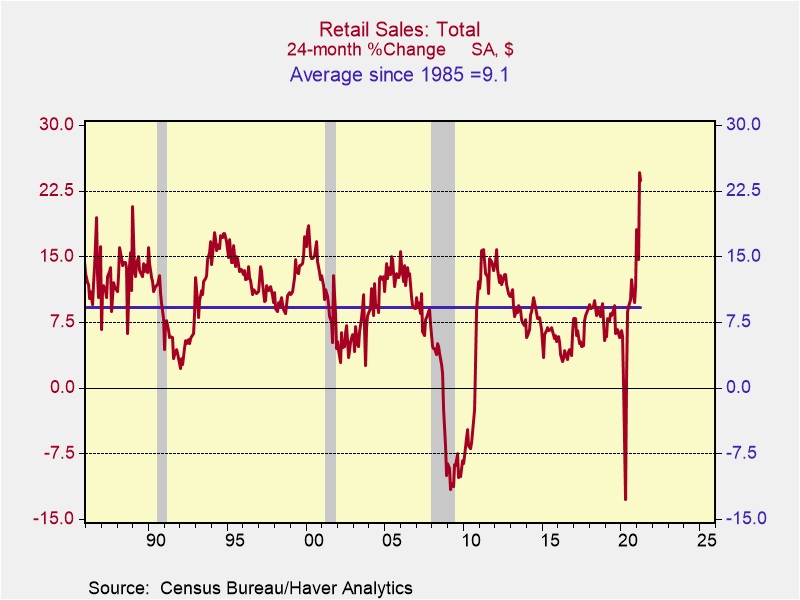
About that retail sales data:   For the inflation data, we used a two-year change to avoid the base effect impact on CPI.  We did the same thing with regard to the retail sales data, which was flat relative to March.  The longer-term look shows that retail activity is robust.

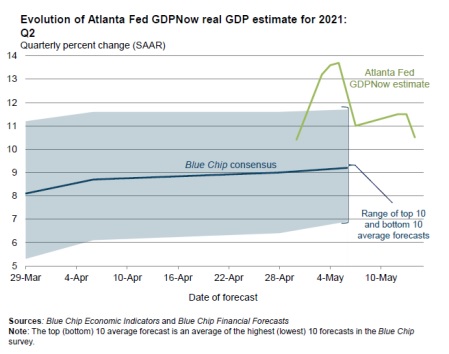
The latest data has the Atlanta FRB’s GDPNow forecast running at 10.5%.

(Source:  Atlanta FRB)

Individual data releases have shown wide dispersion recently, but the GDPNow calculation reveals that the economy is doing quite well.  Reading too much into individual data releases is probably ill-advised.

 Economics and policy:  Semiconductor issues will persist, and the fog of data may reduce the likelihood that the president’s tax and spending policies will be enacted.

China:   The administration is taking a longer look at Chinese disinvestment policy.

  • The Pentagon has delayed a report to Congress detailing Chinese companies with ties to the People’s Liberation Army. The report, mandated by an executive order from the Trump administration, banned Americans from investing in Chinese companies with military ties.    The deadline for implementing the rule is May 27, but the U.S. military says it won’t have the report ready until fall.   It appears the Biden administration is inclined to keep the rule but will likely adjust it.
  • A Chinese agricultural consultancy mysteriously suspended operations on April 29, and the company’s offices were sealed by security forces. The company, Cofeed, provided price data and analysis of grain and oilseed prices.  There is speculation that the CPC wants to keep the information secret, and thus, closed the firm and may have arrested the principals.
  • One of the inconsistencies of administration policy is that it wants to reshore investment and jobs to the U.S. while building a coalition to contain China. During the Cold War, an element of coalition-building allowed potential partners access to U.S. consumers.  In other words, the U.S. tolerated trade deficits and the loss of jobs to trade for foreign policy purposes.  That policy has come under fire in recent years.  The Obama administration was unable to move the Trans-Pacific Partnership (TPP) through Congress, and in the 2016 presidential election, both major party candidates vowed to pull the U.S. from the trade pact.  The remaining partners in the TPP went ahead without Washington and created the Comprehensive and Progressive Agreement for the Trans-Pacific Partnership (CPATPP).  Interestingly enough, the Senate Finance Committee is pressing the USTR Tai to engage in talks to potentially join the CPATPP.  The support is based on the idea that the U.S. needs trade to build support for allies in Asia.
  • China’s credit rating agencies have been rapidly downgrading Chinese corporate debt. Foreign rating agencies have been critical of the domestic agencies, which have tended to give favorable grades to Chinese corporations.  However, as Beijing cracks down on corporate defaults, the rating agencies are also moving in that direction.
  • Although China’s industrial sector continues to recover, retail sales have been disappointing. This divergence could lead to higher Chinese exports.

International roundup:  Armenia and Azerbaijan are seeing tension rise, and Venezuela moves against the last independent newspaper.

COVID-19:  The number of reported cases is 163,112,783 with 3,380,404 fatalities.  In the U.S., there are 32,941,053 confirmed cases with 585,970 deaths.  For illustration purposes, the FT has created an interactive chart that allows one to compare cases across nations using similar scaling metrics.  The FT has also issued an economic tracker that looks across countries with high-frequency data on various factors.  The CDC reports that 344,503,495 doses of the vaccine have been distributed with 273,545,207 doses injected.   The number receiving at least one dose is 157,485,596, while the number of second doses, which would grant the highest level of immunity, is 123,282,685.  The FT has a page on global vaccine distribution.

 View PDF


[1] The company is Chinese and has issued a coin that is $603.60.

Daily Comment (May 14, 2021)

by Bill O’Grady, Thomas Wash, and Patrick Fearon-Hernandez, CFA

[Posted: 9:30 AM EDT] | PDF

Good morning, all! U.S. equities are expected to open higher this morning following reports that the Fed will likely not be withdrawing monetary support anytime soon despite the Consumer Price Index rising faster than expected in April. Today’s report starts off with a brief update on the Colonial Pipeline cyberattack. International news follows, with details about elections in Northern Ireland and Venezuela, a new conflict between Armenia and Azerbaijan, and escalation in the Israel-Palestine conflict. Economics and policy news are up next, including the debt ceiling talks, a possible end to the gasoline shortage, and the impact the semiconductor shortage will have on the auto industry. China news follows, and we close with our pandemic coverage.

Colonial Pipeline update: It was revealed on Thursday that Colonial Pipeline Company paid nearly $5 million to hackers last week to regain access to its computer network. The ransom was paid in “difficult-to-trace cryptocurrency” in exchange for a decrypting tool to help the company restore access to its computer system. So far, it isn’t clear who is responsible for the attack but President Biden has stated there is a “strong reason” to believe the attack was based in Russia, although he does not suspect that the Russian government was involved. The cyberattack on the pipeline exposes the vulnerabilities in U.S. infrastructure to attacks by opportunistic hackers and U.S. enemies. In addition, the ransom payment highlights the growing importance of semi-anonymous cryptocurrencies in facilitating criminal activity.

International news: Northern Ireland chooses a new leader, Olympic athletes are finding it difficult to find accommodations in Japan, and violence in the Gaza Strip.

 Economics and policy: Colonial Pipeline is fully operational, Senate Democrats are considering alternatives to raising corporate and wealth taxes, and the semiconductor shortage is expected to have a more severe impact on the auto industry in the second quarter.

China:  Defaults for Chinese companies are rising, and China will start taxing dirty fuel.

COVID-19:  The number of reported cases is 161,206,768 with 3,345,317 fatalities.  In the U.S., there are 32,852,998 confirmed cases with 584,487 deaths.  For illustration purposes, the FT has created an interactive chart that allows one to compare cases across nations using similar scaling metrics.  The FT has also issued an economic tracker that looks across countries with high-frequency data on various factors.  The CDC reports that 337,089,765 doses of the vaccine have been distributed with 264,680,844 doses injected.  The number receiving at least one dose is 153,986,312, while the number of second doses, which would grant the highest level of immunity, is 117,647,439.  The FT has a page on global vaccine distribution.  The weekly Axios map shows rising cases in about half the country.

Extending the time between Pfizer vaccines from three to 12 weeks may boost the antibody response, according to a study released by Birmingham University. The study suggests that a longer interval between shots could reduce the need for a subsequent booster for the elderly.

 View PDF

Daily Comment (May 13, 2021)

by Bill O’Grady, Thomas Wash, and Patrick Fearon-Hernandez, CFA

[Posted: 9:30 AM EDT] | PDF

Good morning.  Our coverage begins with a few comments about yesterday’s CPI report.  We take a quick look at the deteriorating situation in Israel.  The Colonial pipeline has reopened.  Economic and policy news follows, with China news next.  The international roundup comes after that, and we close with the pandemic update.

About that inflation data:  Yesterday’s CPI data was clearly a surprise.  Although we expect prices to accelerate into late summer, the surprise effect will diminish over time.  Usually, economists overcompensate when they miss widely, so even with rising CPI in the coming months, the market reaction should be lessened.  As we have warned before, base effects from last year would tend to boost inflation this year.  April data showed that and then some.  However, some of the price spikes won’t last.  Rising prices will eventually lift supply and will probably curtail demand.

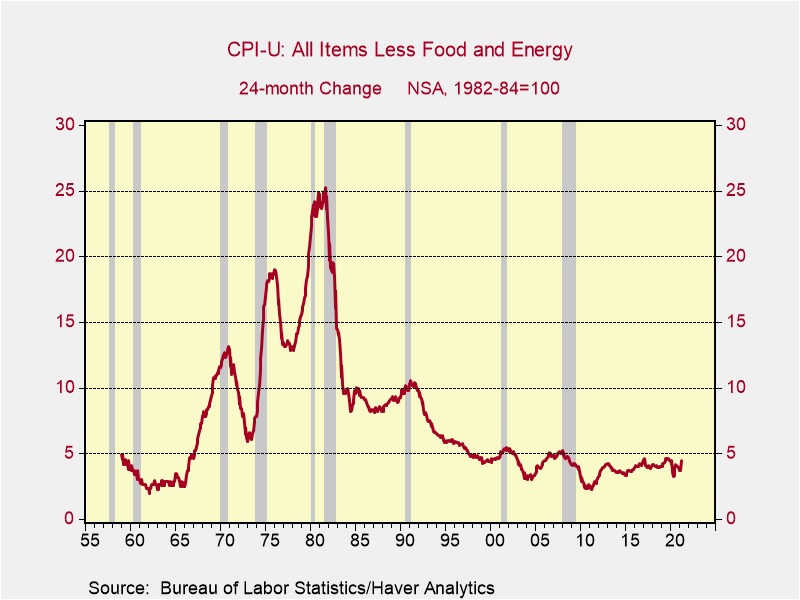
Here’s another way of looking at the data.  Since an event last year affected the yearly comparisons, it might make sense to look at the price changes from two years ago.  That data suggests an increase, but nothing that indicates an outlier.

The Fed’s position is that the increase we are seeing in inflation is transitory.  We tend to agree with this position.  Rising prices will trigger a supply response and bring down prices at some point.  However, there is a risk to this position, which is that inflation expectations change.  If households begin to buy now for fear of higher future prices and firms begin to treat inventory as an asset, inflation could become a much more serious problem.  We don’t think that is happening yet, but we are watching closely.

Clearly markets were not happy.  Outside of shorting, there really was no area of the market that hasn’t suffered over the past few days.  Rising yields boosted the dollar and depressed commodities, stocks, and bond prices.  In equities, the market has become richly valued, so a period of pullback isn’t the worst thing.

The FOMC is getting the first real test of its shift to a focus on labor markets and less emphasis on inflation control.  There will be increasing worries about the Fed allowing inflation expectations to get out of hand.  We think it is more likely that we see a few months of elevated inflation followed by a moderation.  Current Fed policy will, over time, raise inflation, but there are several long-term factors that will continue to weigh on keeping inflation under wraps.  These include aging demographics, the preponderance of intangible investment and capital, inequality, and the openness to trade.  We do expect the latter two factors to eventually reverse, but for now, they remain factors that will dampen inflation.

The Israel problem:  There is a persistent level of tension between Israel and the Palestinians.  When violence flares, it can be tricky to determine whether the situation is a short-term event or something more serious.  The current one is starting to worry us.  The tensions are ostensibly about the eviction of a group of Palestinians from East Jerusalem to allow Israeli settlers to move in.  The broader situation appears to be tied to a conflict between Hamas and Palestinian Authority.  The Palestinians were expected to hold elections this year, and Hamas was projected to gain power, mostly due to divisions within Fatah.  To prevent this from occurring and to remain in power, the leader of the Palestinian Authority, Mahmoud Abbas, postponed the vote.  This decision has led Hamas to try to find a way to retaliate against Abbas.  It appears Hamas has decided to attack Israel using the evictions as a reason.  Unfortunately, the fighting is escalating rather quicklyCasualties are occurring on both sides as Hamas fires volleys of rockets into Israel from Gaza, and the IDF retaliates with airstrikesCivil unrest in Jerusalem is leading to additional casualties.  There is also increasing unrest in Arab parts of Israel and Israeli cities.

As the violence increases, outside parties are being drawn in.  The U.S. is reluctantly becoming involved, with President Biden offering support for IsraelTurkey and Russia are calling for peacekeepers, something Israel will oppose.  Complicating matters is the uncertainty surrounding the Israeli government.  Successive U.S. presidents have been trying to reduce American involvement in the region, in part, to focus on the great power competition with China.  This tragedy could undermine the Biden administration’s domestic agenda.  There is one other interesting factor; the silence from the Arab states that has been improving relations with Israel is notable.  The Abraham Accords have changed the diplomatic situation in the Middle East, meaning that the Palestinians can no longer rely on support from these nations during uprisings.  That factor may reduce the duration of the current tensions.

Colonial pipeline:  The pipeline managers announced that operations have restarted.  That’s good news.  The bad news is the flow in the line is between three to five miles per hour, meaning it will be several days before product begins to flow at adequate levels.  Meanwhile, gas lines, reminiscent of the 1970s, have emerged.  The southeast appears to be seeing the fastest price increases.  We should see supply issues improve by the end of next week.

An observation:  The Colonial pipeline, the inflation spike, and the tensions in Israel all have one common effect—they will tend to become a distraction for the administration’s policy progress.  All new presidents enter office with plans.  But, as Clausewitz noted, “No campaign plan survives the first contact with the enemy.”  Although these events are not all related, they do show that governments operate under conditions that can distract and delay policy progress.  Given that political capital is perishable, such events make it difficult to meet policy goals.

 Economics and policy:  Comments on crypto assets and credit cards.

China:  China is expanding its use of social media, and the population issue continues to dominate the news.

International roundup:  Russia is seeing a worker shortage and is looking at gun control.  Austria’s chancellor is being investigated.

COVID-19:  The number of reported cases is 160,513,476 with 3,333,245 fatalities.  In the U.S., there are 32,815,408 confirmed cases with 583,690 deaths.  For illustration purposes, the FT has created an interactive chart that allows one to compare cases across nations using similar scaling metrics.  The FT has also issued an economic tracker that looks across countries with high-frequency data on various factors.  The CDC reports that 337,089,765 doses of the vaccine have been distributed with 264,680,844 doses injected.  The number receiving at least one dose is 153,986,312, while the number of second doses, which would grant the highest level of immunity, is 117,647,439.  The FT has a page on global vaccine distribution.  The Axios map shows a clear improvement in the U.S.

 View PDF

Weekly Energy Update (May 13, 2021)

by Bill O’Grady, Thomas Wash, and Patrick Fearon-Hernandez, CFA | PDF

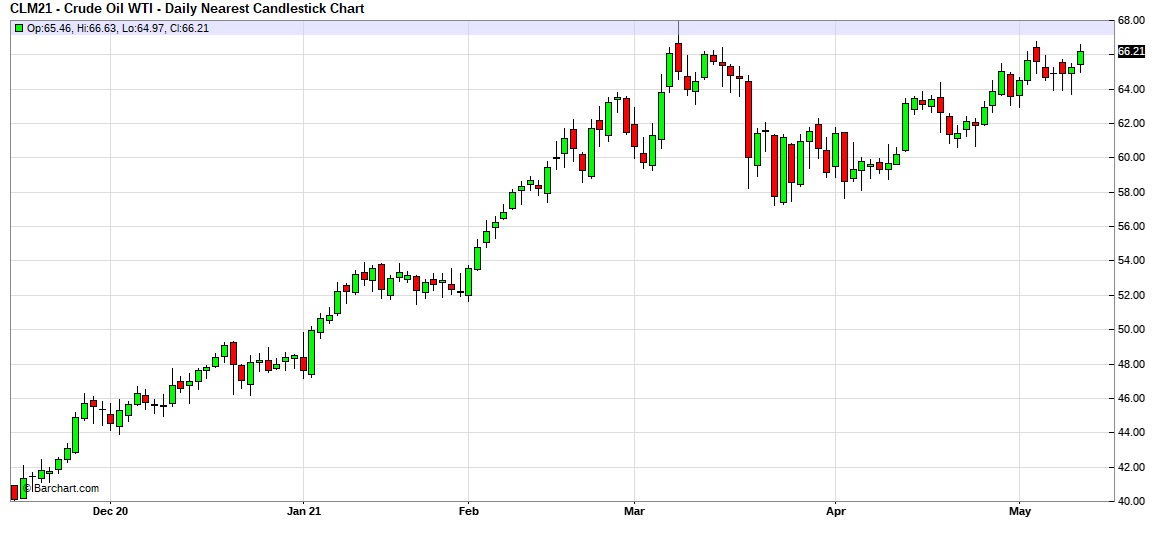
Tightening supplies have lifted crude oil prices toward the top of the recent trading range.

(Source: Barchart.com)

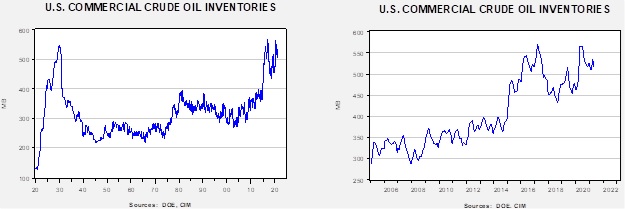
Crude oil inventories declined 0.4 mb compared to the 1.8 mb build expected.  The SPR fell 1.4 mb, meaning without the addition from the reserve, commercial inventories would have declined 1.8 mb.

In the details, U.S. crude oil production rose 0.1 mbpd to 11.0 mbpd.  Exports fell 2.3 mbpd while imports were unchanged.  Refining activity declined 0.4 mbpd.

(Sources: DOE, CIM)

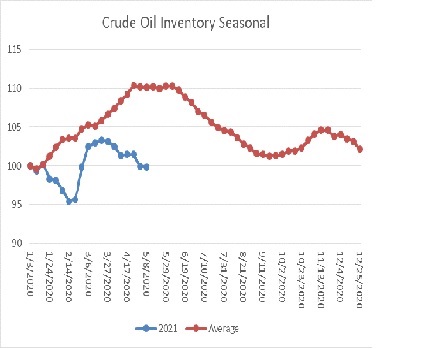
This chart shows the seasonal pattern for crude oil inventories.  We are through the peak of the winter/early spring build season.  In the second half of June, stockpiles usually decline.  Note that stocks are already below the usual seasonal trough seen in early September.  Our seasonal deficit is 52.6 mb.

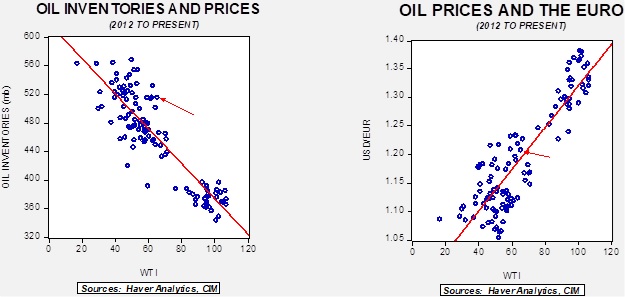
Based on our oil inventory/price model, fair value is $46.65; using the euro/price model, fair value is $68.54.  The combined model, a broader analysis of the oil price, generates a fair value of $56.86.  Although the slow decline in stockpiles is price supportive, the weakening dollar is much more important in lifting the model’s fair value.

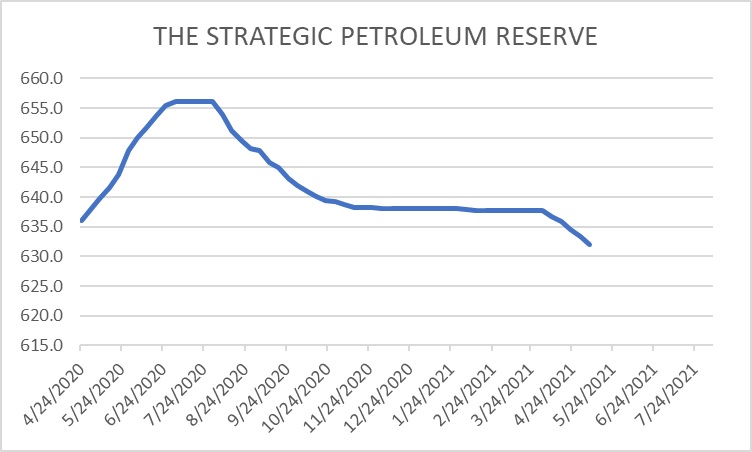
The DOE is continuing to reduce the SPR.

(Source:  DOE, CIM)

This action is a bearish factor for prices, but the gradual nature of the sale has not had much of an effect thus far.  We expect another 7.0 mb of sales to occur this year.

Market news:

(Source:  AP)

Local gasoline prices are rising rapidly.  Meanwhile, government officials are trying other forms of transportation to move the product to markets facing shortages.  This situation will affect the energy data for the rest of May.

  • Michigan is threatening to close a pipeline that runs from Canada to the U.S.  A portion of the pipeline passes across the Great Lakes, and there are fears a rupture could be catastrophic.  At the same time, the lines have run for over 70 years without incident.  The threat is raising tensions between the U.S. and Canada.  Trade is conducted through the USMCA, and thus, Ottawa may have legal remedies to halt the closure.  Meanwhile, Michigan Gov. Whitmer is threatening to seize profits from Enbridge (ENB, USD, 40.12), the pipeline operator, for continuing to operate the pipeline.  If this situation leads to a disruption, the timing could not be worse, given the turmoil caused by the Colonial pipeline situation.
  • We continue to see news on the Texas freeze-out.  During the crisis, state regulators implemented a program that pays industrial users to reduce their natural gas consumption.  Paradoxically, this led to the curtailment of natural gas as firms involved in the natural gas infrastructure were taken offline.

Geopolitical news:

Alternative energy/policy news:

View PDF

Daily Comment (May 12, 2021)

by Bill O’Grady, Thomas Wash, and Patrick Fearon-Hernandez, CFA

[Posted: 9:30 AM EDT] | PDF

In today’s Comment, we open with an update on the Colonial Pipeline ransomware hack and the panic buying of gasoline that it has sparked in the Southeast.  We next cover various news related to U.S. fiscal policy, the energy industry, inflation, and Chinese trade issues (there is more detail on the latest U.S. inflation data in the “U.S. Economic Releases” section below).  We wrap up with the latest developments related to the coronavirus pandemic.

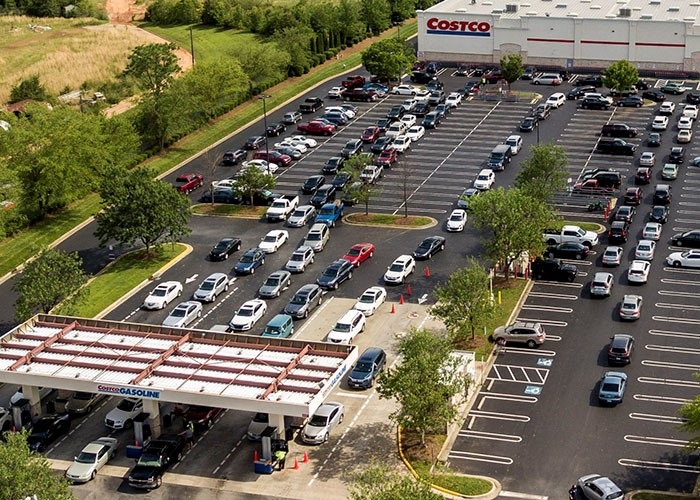
Colonial Pipeline Hack:  As we warned in our Comment yesterday, motorists worried about gasoline shortages arising from the Colonial Pipeline ransomware attack began panic buying on the East Coast yesterday, resulting in long lines and shortages.  Colonial continues to express confidence that it can restart normal operations by the end of the week, but the crisis is already wreaking havoc in the Southeast, where there are fewer alternative pipelines or refineries to serve as backup sources of supply.

  • According to the AAA, the average price for regular gas in Georgia yesterday was up $0.11 per gallon from the previous day.  In North Carolina, the average price was up $0.05 per gallon.
  • Georgia Governor Brian Kemp signed an executive order temporarily suspending the state’s gas tax and Virginia Governor Ralph Northam declared a state of emergency. North Carolina Governor Roy Cooper also declared a state of emergency Monday because of the outage.

U.S. Fiscal Policy:  For the first time since his inauguration, President Biden today will meet at the White House with all four of the top Democrats and Republicans in Congress.  The purpose of the meeting is to begin hammering out an agreement on the president’s spending plans, including his $2.3 trillion package of spending on infrastructure and other economic programs and his $1.8 trillion proposal to strengthen the country’s social safety net.

  • Although Biden quickly gave up on a bipartisan approach to his pandemic relief program earlier this year when he assessed the Republican counteroffer as insufficient, aides say he is likely to be more flexible this time around.
  • Even if that’s the case, it’s not entirely clear that the Republicans have been chastised by being shut out of the pandemic program’s process so quickly.  There is still a significant chance that they will offer far too little for the administration’s taste, although we would still expect the Democrats to push through some level of new spending addressing Biden’s priorities.  Any additional fiscal stimulus would help accelerate the budding economic recovery, although it would also feed into the market’s growing fear about a prolonged new era of high inflation.

U.S. Energy Industry:  The Interior Department yesterday gave final federal approval for the nation’s first major offshore wind farm.  The Vineyard Wind project, to be built off the coast of Massachusetts, will consist of up to 84 turbines and produce enough electricity to power 400,000 homes and businesses when it becomes operational in about 2023.  According to its developers, the project will be the first of many in a broad, new regional energy industry.

Global Inflation Scare:  In the latest news feeding into fears of a prolonged new era of high inflation, tin prices have surged to record highs for the first time in a decade.  The price jump reflects increased demand for consumer electronics and difficulties shipping the metal out of Asia, resulting in a shortage of tin.

China-Hong Kong:  In the latest poll by the American Chamber of Commerce in China, the number of people saying they are considering leaving Hong Kong has risen sharply, with a significant number citing last year’s new national security law as the primary driver.  About 40% of respondents said they were considering leaving, which was a bit lower than the share in a poll last August.  However, a much larger number of people responded, so the actual number who said they were thinking of abandoning the city increased.  The increased response rate also suggests a greater concern and desire to express their views.

China-Sweden:  A newspaper affiliated with the Communist Party of China warned that Ericsson (ERIC, USD, 13.29), the Swedish telecom equipment giant, will not be invited to participate further in constructing China’s 5G network unless Sweden reverses its ban on equipment from Chinese telecom giant Huawei (002502, CNY, 3.21).  The warning is another instance of China using the heft of its domestic market to pressure foreign countries and companies to respect its interests, just as it imposed import restrictions against Australian products to punish Canberra for proposing an investigation into China’s role in the coronavirus pandemic.  As a rising China continues to chafe against the international system crafted by the U.S. and its allies, such punishments could impose heavy costs on the global economy and weigh on investors.

Chinese Financial Industry:  The China Banking and Insurance Regulatory Commission today granted final approval for U.S. financial services behemoth BlackRock (BLK, USD, 844.10) to begin operating its 50.1%-owned wealth management joint venture on the mainland.  Despite China’s heavy-handed trade and investment policies targeting foes abroad, the government has continued to selectively open parts of its economy to foreign investors.  However, that opening is probably aimed, at least in part, at creating a pool of foreign firms that will pressure their home governments to take a soft stance toward Beijing.

  • Despite the Chinese government’s lobbying to keep advantageous trade rules in place, the tariffs imposed by the Trump administration and continued under the Biden administration continue to impede U.S. purchases of Chinese goods.
  • New data show the tariffs have led to a sharp decline in Chinese imports, with purchases of telecommunications gear, furniture, apparel, and other goods shifting to other countries.

Israel-Hamas:  Israel and the militant Palestinian militia Hamas kept up their deadly barrage of rocket launches and airstrikes on Tuesday night, escalating a conflict that a UN envoy warned could spiral into an all-out war.  In the worst violence seen since the 2014 war, Israeli airstrikes toppled two high-rise buildings in Gaza City that it said were used by Hamas, prompting retaliatory launches of hundreds of rockets at large Israeli cities.

COVID-19:  Official data show confirmed cases have risen to 159,732,343 worldwide, with 3,319,169 deaths.  In the United States, confirmed cases rose to 32,779,414, with 582,848 deaths.  Vaccine doses delivered in the U.S. now total 334,081,065, while the number of people who have received at least their first shot totals 153,448,316.  Finally, here is the interactive chart from the Financial Times that allows you to compare cases and deaths among countries, scaled by population.

Virology

  • Newly confirmed U.S infections fell to approximately 33,000 yesterday, well below both the seven-day moving average of 38,826 and the 14-day moving average of 44,222.  New deaths related to the virus came in at a moderate 684.  Meanwhile, the nation’s mass vaccination program continues to make progress.  According to the CDC, 44.7% of all adults in the U.S. are now fully vaccinated against COVID-19.
  • Testifying before a Senate committee yesterday, administration officials said there should be enough evidence by late fall to potentially extend the use of COVID-19 vaccines to many children under age 12.  Administration medical adviser Anthony Fauci told the panel that such steps to vaccinate younger children would probably occur in stages, progressing younger and younger, as study evidence accumulates.
  • A late-stage human trial of China’s first vaccine candidate using mRNA technology will soon be launched in Mexico, according to Mexican Foreign Minister Ebrard.  The mRNA technology is the same one used in the highly effective, two-dose vaccines produced by Pfizer (PFE, USD, 39.35) and Moderna (MRNA, USD, 158.99).
  • Even though investors are fixated on the huge new waves of infection in places like India and Brazil, a recent resurgence in Taiwan is suddenly getting attention as well.  The island has had very few infections over the course of the pandemic, but because of 16 newly discovered cases of domestically transmitted infections, Health Minister Chen Shih-chung warned that Taiwan was very likely to raise its epidemic alert level to its highest level since the onset of the pandemic.  The news has sparked fears over the island’s key semiconductor industry and pushed the stock market down sharply over the last few days.  The country’s main stock index is now nearly 10% below its record closing high reached on April 27.
  • A review panel convened by the World Health Organization issued a scathing report criticizing both the Chinese authorities and the WHO for being too slow to recognize that the novel virus was spreading between people in Wuhan and then warning the world about human-to-human transmission.  The report contends that a swift international response could have stopped the 2019 COVID-19 outbreak in China from becoming a global catastrophe in 2020.

 Economic and Financial Market Impacts

  • Today, the European Commission sharply raised its economic forecasts for the coming two years, as an accelerating vaccination campaign helps the Eurozone recover from the historic blow delivered by the pandemic.  The EC now forecasts that the Eurozone’s gross domestic product (GDP) will expand by 4.3% in 2021 and 4.4% in 2022, compared with previous forecasts for 3.8% growth in both years. As a result, all member states are now expected to regain their pre-crisis output levels by the end of next year, following a historic 6.6% slump in 2020.
  • In a positive sign for equities moving forward, a data tally by Goldman Sachs shows U.S. companies announced $484 billion in share buybacks in the first four months of this year, the highest such total in at least two decades.
    • Not only did firms rush to raise precautionary cash at the outset of the crisis last year, but now they’ve come through a blockbuster earnings season and have much more clarity on the future trajectory of the economy.  That’s encouraging firms to put their cash to work through new investments, dividend hikes, or share buybacks.
    • While we’ve often mentioned that stocks are likely to be buoyed by continued loose monetary policy, new fiscal stimulus, economic reopening, and rebounding consumer demand, share buybacks could offer further noticeable support for equities this year.

 View PDF

Daily Comment (May 11, 2021)

by Bill O’Grady, Thomas Wash, and Patrick Fearon-Hernandez, CFA

[Posted: 9:30 AM EDT] | PDF

In today’s Comment, we open with the latest on the Colonial Pipeline ransomware hack.  We then turn to a variety of news items relating to the global energy industry, international relations, eurozone monetary policy, Chinese population data, and the Israeli-Palestinian conflict.  We end with the latest developments on the coronavirus pandemic.

Colonial Pipeline Hack:  U.S. cybersecurity officials said they have been investigating the DarkSide ransomware used in the Colonial Pipeline hack since last October and that it constitutes a commercial-style “software as a service” model.  In other words, DarkSide sells the right to use the ransomware to other criminal groups, who then share any proceeds from its use with the DarkSide developers.

  • It remains unclear whether Colonial has paid or is planning to pay the hackers to release the company’s data.  Biden administration officials have opened a debate on how companies should handle such ransom attacks in the future.  Of course, the Colonial hack will also invigorate other industry-led efforts to harden companies’ cyber defenses, as outlined here.
  • Meanwhile, Colonial said it is working on a plan to phase operations back in by the end of the week.  If the pipeline remains substantially shut beyond that, there would be an increased chance on the East Coast and elsewhere of panic buying or significant price hikes for gasoline and other refined products.

Global Energy Industry:  The International Energy Agency today issued a report showing renewable power capacity grew at its fastest pace this century in 2020, with a rise of more than 45% from the prior year.  The increase of 280 gigawatts was driven partly by a rush to complete projects before government subsidies elapsed in China, the U.S., and Vietnam.  All the same, the data illustrate the extent to which the build-out of renewable power capacity is now well entrenched and has become a phenomenon that investors probably can’t ignore.

  • According to the IEA, renewables were the only energy source for which demand increased in 2020, with COVID-19 lockdowns hitting consumption of all other fuels as government restrictions shut factories, grounded planes, and kept people at home.
  • The agency also raised its 2021 and 2022 capacity growth forecasts by around 25%, with an addition of 270 gigawatts in capacity expected this year and 280 gigawatts next year.

United States-Japan:  Sources say President Biden has chosen Rahm Emanuel to be the next U.S. ambassador to Japan.  A close confidante of the president, Emmanuel is a former Illinois congressman, mayor of Chicago, and chief of staff to President Obama.  His nomination, therefore, would resurrect a U.S. tradition of sending influential former lawmakers to Tokyo, which Japanese leaders have appreciated because of their perceived gravitas and direct access to the White House.

United States-Iran:  In the third such incident in the last five weeks, a U.S. ship was forced to fire warning shots against a swarm of Iranian fast-attack boats that were harassing it in the Persian Gulf yesterday.  The Iranian moves are likely an effort to pressure the Biden administration for concessions amid talks in Vienna over restarting the 2015 deal limiting Iran’s nuclear program.  Even though none of the incidents so far has resulted in damage, the aggressive moves are risky and could lead to bloodshed that seriously escalates into a crisis, in which case global oil prices would likely spike.

Eurozone:  Ollie Rehn, the chief of the Finnish Central Bank and a board member of the ECB, said in an interview with the Financial Times that the ECB should follow the lead of the U.S. Federal Reserve by accepting an overshoot of its inflation target to make up for years of sluggish price growth.  In the interview, Rehn argued that changes in the eurozone labor market and the world economy had weakened wage inflation pressures, meaning lower levels of unemployment wouldn’t necessarily spark rapid inflation.  Although it’s not clear whether the ECB would take such an explicit stance as the Fed, the argument by Rehn offers additional evidence that monetary policymakers around the globe may tolerate higher inflation and hold interest rates lower for longer than investors envision.  Indeed, Isabel Schnabel, an executive director at the ECB, separately sought to soothe concerns about an expected increase in German inflation above 3%, saying such a rise was unlikely to cause a tightening of monetary policy.

China:  After an unusual delay, the government finally released the results of its 2020 census and said the country’s population grew to 1.41 billion last year.  However, the annual increase was marginal, and the data show that the country’s population growth rate averaged just 0.6% per year over the last decade (essentially matching the U.S. growth rate).  As in major economies, the culprit to the population slowdown has been a steep drop in births.  Falling birth rates are also pushing up average ages around the world, which will tend to retard economic growth and inflation over the longer term.

Israel:  Apparently reacting to an Israeli-Palestinian housing dispute, Palestinian demonstrators have been rioting in central Jerusalem, and Hamas forces have fired rockets into Israel.  In response, Israeli security forces are clamping down on the rioters, and Israeli warplanes are attacking Palestinian sites in the Gaza Strip.

COVID-19:  Official data show confirmed cases have risen to 159,031,885 worldwide, with 3,306,038 deaths.  In the United States, confirmed cases rose to 32,744,471, with 582,162 deaths.  Vaccine doses delivered in the U.S. now total 329,843,825, while the number of people who have received at least their first shot totals 152,819,904.  Finally, here is the interactive chart from the Financial Times that allows you to compare cases and deaths among countries, scaled by population.

Virology

 Economic and Financial Market Impacts

  • As further evidence that the post-pandemic inflation surge is gathering force, China’s April producer price index (PPI) was up 6.8% year-over-year, beating expectations and accelerating from a rise of 4.4% in the year through March.  In fact, the increase was the strongest in more than three years.  So far, however, wholesale inflation in China hasn’t yet had a large impact on consumer inflation.  The April Consumer Price Index (CPI) was up just 0.9% year-over-year, for its strongest gain in seven months.
  • Soaring commodity prices and supply shortages have driven up shipping costs as well.  The Baltic Dry Index, which tracks rates for the three largest classes of ships, has risen to its highest level in more than a decade, soaring over 700% in the last year.

 View PDF

Daily Comment (May 10, 2021)

by Bill O’Grady, Thomas Wash, and Patrick Fearon-Hernandez, CFA

[Posted: 9:30 AM EDT] | PDF

Good morning, and happy Monday!  What an active weekend!  After spending time watching the skies, worried about falling Chinese space debris, U.S. equity futures are mostly higher this morning. We begin with the Colonial Pipeline cyberattack.  Up next are some thoughts about last Friday’s employment report.  We then have some information about the U.K. elections.  On Wednesday, we get the CPI report, so a few comments about inflation are in order.  General economics and policy news are up next.  China news follows, and international news comes after.  We close with pandemic coverage.

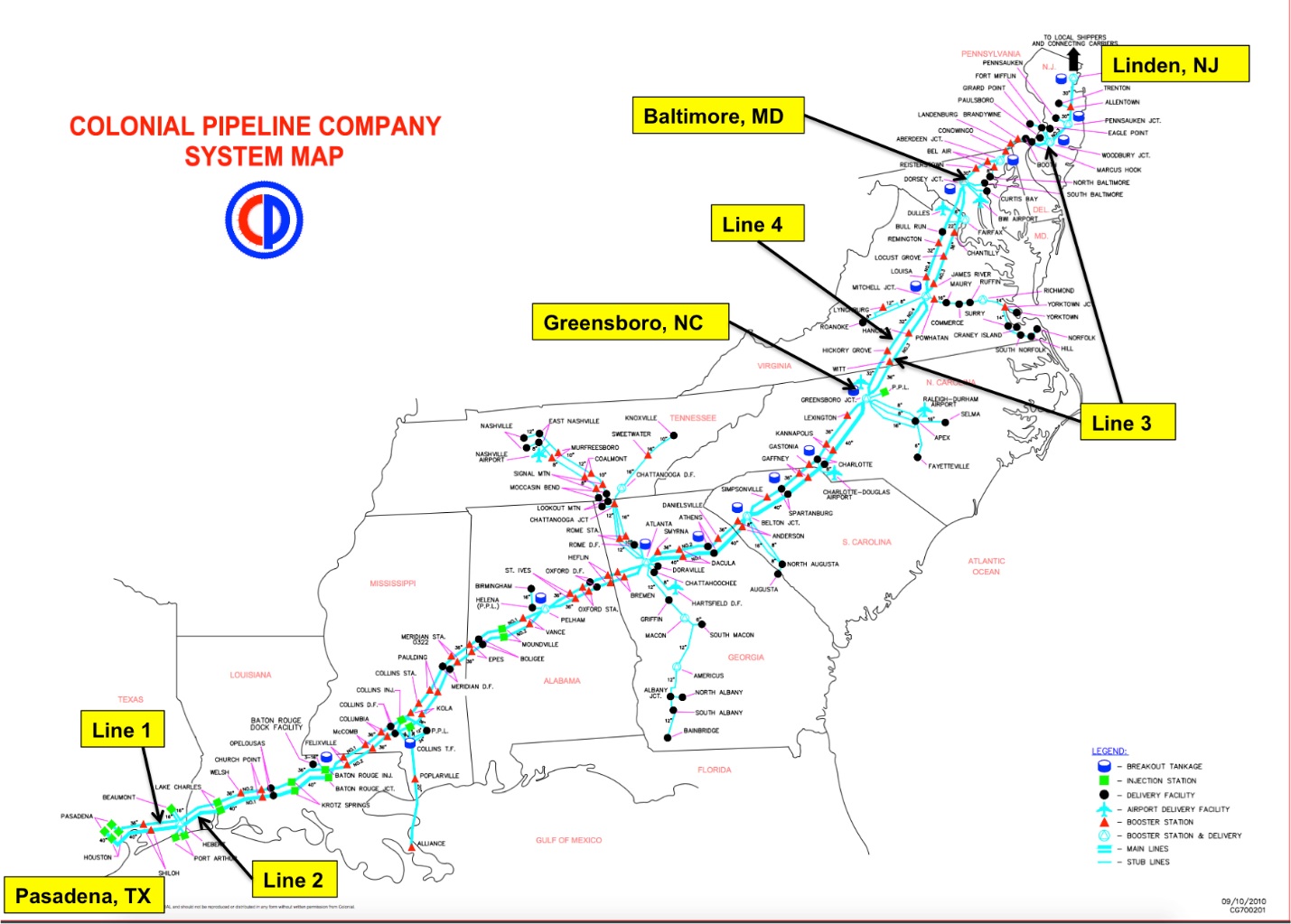
 The Colonial pipeline:  The Colonial pipeline is a key piece of U.S. energy infrastructure; about 45% of all product flow from Houston to the Eastern Seaboard moves on this 5,500-mile pipeline.  The pipeline transports about 2.5 mbpd of products from refineries in Texas and Louisiana to the states shown below.

(Source:  RBN Energy)

On Friday, the system was hit by a cyberattack that involved ransomware.  Reports suggest that hackers took data on Thursday before deploying the ransomware.  In a sense, this was a two-part attack.  The stolen data was used to threaten the company with a data dump while hackers encrypted parts of the network, demanding payment to decrypt.  The last official statement indicates that the four main lines are still closed.  However, as the map shows, there are numerous lateral lines, and some of them have resumed operations.  Although the culprit hasn’t been officially determined, the Darkside ransomware group is thought to be involved.  It is an eastern European criminal organization that has struck infrastructure before.  The fact that it is a criminal group doesn’t necessarily mean a state sponsor isn’t involved.  This is by far the most extreme attack on U.S. infrastructure and raises concerns that this and other critical infrastructure may be vulnerable to similar actions.

As of this morning, the pipeline remains closed, and there is no clear restart time.  The government has declared a state of emergency that will ease regulations on shipping fuel, and officials are working with the company to restart operations.  If the shutdown persists, gasoline, diesel, and jet fuel prices in the affected states will likely rise.  Over time, the U.S. can ship fuel by railcar and tanker, but these solutions will be costly, and the logistics will take time to manage.  The market reaction thus far has been modest.  Although we did see a spike in product futures prices yesterday evening, prices have been drifting lower since.  If the outage is contained this week, markets should remain calm.  However, if we are not back online by Friday, we will expect higher retail product prices.

The employment report:  Friday’s employment report caught the market off guard.  Pundits, economists, and strategists are all creating narratives to account for the surprise.  Friday’s report may be the largest true forecast miss we have ever seen.  Although the March 2020 miss was epic, it also occurred while lockdowns were being implemented.  Most of the forecasts were in place pre-lockdown.  Here are a few thoughts:

  • The employment data is a volatile report. It is not uncommon for misses to occur, and the “misses” then absolved in later revisions.  You don’t get much out of one month’s report.  It would probably be a mistake to read too much into this surprise.
  • Of course, that didn’t stop the narrative machines from churning out reasons for the disappointing data. It is important to remember that there are several cross-currents at work in the labor markets.
    • In Friday’s Daily Comment, for example, we showed the sharp drop in over 65 labor participation from the pre-pandemic level. The loss of older workers, which had been a rapidly growing part of the labor market, could be contributing to worker shortages.
    • We suspect underlying changes are occurring in the labor markets from the pandemic. Jobs in foodservice and retailing can be grueling.  The work is hard; the hours are uncertain, and facing the public can be challenging.  Many of these workers lost their jobs in the pandemic and found other ones.  They may have decided they aren’t going back.  That means retailers and restaurants may be forced to improve working conditions and pay to find workers.  Anecdotal reports are appearing that suggest this may be the case.  We are always careful with such information, but it can signal emerging changes.
    • Some states are ending Federal government COVID-19 benefits. This will act as a natural experiment to see if it was high transfer payments that were keeping workers away from jobs.
  • There is some evidence to suggest the Bureau of Labor Statistics may have a seasonal adjustment problem. The non-seasonally adjusted non-farm payroll report was up 1.089 million compared to the seasonally adjusted data of 266 thousand.  The pandemic has clearly played havoc with the payroll data, and we suspect that the BLS is struggling to separate the seasonal effects that may be skewed due to the pandemic recovery.

U.K. elections:  It was good news and bad news for PM Johnson.  The good news was that the Tories continue to dominate Labor.  The bad news was that the SNP in Scotland narrowly missed an outright majority (it captured 64 seats with 65 being a majority), but since it is widely expected to make a government with the separatist Green Party, it will control 74 seats in the 129 seat legislature.[1]  It is also expected that Nicola Sturgeon, the head of the SNP, will use this election as a springboard for an independence referendumPM Johnson has called for crisis talks on this issue.

So, what happens now?  Expect a long, drawn-out process for a referendum.  PM Johnson opposes granting a separation vote and will use every option to delay it.  Expect Johnson to argue that since the SNP didn’t win an outright majority, it really doesn’t have a mandate.  It will be difficult for Johnson to postpone a vote indefinitely, but the SNP’s lack of an outright win will likely give him fodder to slow the process.

The primary issue driving Scottish independence is the EU.  Scotland wanted to remain; England wanted to leave.  Of course, in any issue like this, personalities matter, and Johnson’s divisive persona makes Sturgeon’s position easier to sell.  However, don’t underestimate the difficulties of independence.  Scotland may want out, but the EU might be reluctant to let it in.  Leaving will require Scotland to accept some of the U.K. debt.  The amount will be negotiated, but its debt level could be high enough to give the EU pause.  In addition, Spain has been reluctant to accept Scotland, fearing its Catalan independence movement would be bolstered by such an event.  The vote to accept a member requires unanimous consent, so Spanish opposition could doom the effort.  Scotland would not have a currency before it joins the EU.  Sturgeon says the country would continue to use the GBP, but that would give the BOE control of its monetary policy without any input.  And, joining the EU doesn’t make entering the Eurozone automatic.  Current polls suggest a narrow plurality would rather stay in the U.K.  However, undecided voters are around 8%, so there is room for the vote to go in either direction.  Although this issue will be on the minds of investors going forward, the GBP is higher this morning on the fact that the SNP didn’t win an outright majority.

Inflation:  We will get our first inflation reading that will matter on Wednesday; this will be the first one that takes into account the base effects of last year’s drop in prices.  Much of the price pressure we see is coming from supply constraints.  Bottlenecks and production disruptions are clearly leading to higher prices.  The unknown is whether households, flush with cash, will spend the money to buy things that cost more or balk at the increases and reduce spending.  Obviously, some items are staples and hard to economize.  Nevertheless, we could see changes in spending patterns as prices increase.

There is no doubt we are seeing reflation and debasement.  The Fed has made it abundantly clear that the focus on inflation control, the policy emphasis since Volcker, has been reversed.  This 1970s-style inflation requires a change in attitude, a fear that prices will be higher in the future, and thus the only option is to buy now, which will solidify price increases.  As we noted last week, it also requires a change in the thinking about inventories.  Stockpiles need to be seen as an asset instead of a cost to be managed.  Our take is that this current inflation event, to paraphrase Obi-Wan Kenobi, “is not the inflation you are looking for.”  We suspect consumers will wait out these price increases, and as supply chains normalize, inflation pressures will ease.  That doesn’t mean inflation isn’t going to be a serious issue in the future.

 Economics and policy:  European bond markets and contemplating the end of easy money are in the news.

  • There are some oddities developing in the European bond markets.
    • Some European governments are moving to cap the amounts of new sovereign issues that hedge funds can buy. Apparently, hedge funds, which like using leverage, are purchasing large amounts of new issues only to sell them to the ECB at a small profit.  The ECB is not allowed to purchase new issues (that would be debt monetization, something that bothers Germans and other northern Europeans greatly) and must buy in the secondary market.  This situation creates an opportunity for private buyers to buy at the auction and quickly sell to the ECB. Since is it common for the price to be a bit below par at the auction, the likelihood of quick profit emerges.  Countries prefer buyers to be of the type that holds the bonds for a long period to dampen potential price volatility, not hedge funds looking to hold the bonds for a few hours.
    • Is the German Bund becoming the new widow maker? For years, traders have shorted Japanese government bonds and have nothing but massive losses to show for their efforts.  As expectations of higher yields emerge, traders are betting that the Bunds, with their low yields, will offer the best opportunity to profit from higher interest rates.  The risk?  There are primarily two.  First, any whiff of trouble in the Eurozone sends money to Bunds for safety.  Second, the ECB will likely limit the rise in this key bond market.
  • The northern European nations tend to support hard money policies. So, we were surprised to see Olli Rehn, the governor of the Bank of Finland, suggest the ECB should mimic the Fed’s policy on inflation and accept periodic “overshoots” of the target.  We suspect he is worried about an overly strong EUR.
  • As interest rates rise, the boom in refinancing mortgages is fading. Paradoxically, this is helping homebuyers, as mortgage brokers are cutting fees to attract business.  However, this benefit is usually fleeting; over time, mortgage brokers will begin to reduce capacity by laying off personnel.
  • Now that workers are fleeing the high-cost tech cities, secondary cities are starting to benefit.
  • Regulators are cracking down on the widening crypto markets, especially the ones that represent an equity interest.
  • The common theme lifting financial markets is easy monetary policy. Once this policy ends, the fallout could be a problem.

China:  The EU is steadily expanding its toolbox to contain China’s influence.

International roundup:  Tensions are rising in Israel and the EU, and India starts trade talks.

COVID-19:  The number of reported cases is 158,400,711 with 3,294,657 fatalities.  In the U.S., there are 32,708,028 confirmed cases with 581,755 deaths.  For illustration purposes, the FT has created an interactive chart that allows one to compare cases across nations using similar scaling metrics.  The FT has also issued an economic tracker that looks across countries with high-frequency data on various factors.  The CDC reports that 329,843,825 doses of the vaccine have been distributed with 259,716,989 doses injected.  The number receiving at least one dose is 152,116,963, while the number of second doses, which would grant the highest level of immunity, is 114,258,244.  The FT has a page on global vaccine distribution.

 View PDF

[1] We also note that the breakaway party of Alex Salmond, the Alba party, failed to secure a seat.  This will be taken as clear evidence Sturgeon is the leader of the separatist movement.

Daily Comment (May 7, 2021)

by Bill O’Grady, Thomas Wash, and Patrick Fearon-Hernandez, CFA

[Posted: 9:30 AM EDT] | PDF

Good morning, all! U.S. equities are expected to open higher this morning as the jobs report continues to support market optimism; we will go into further detail in the economic releases section of this report. Our report starts off with a summary of the Financial Stability Report. International news follows, with details about the Pentagon’s plan to leave Afghanistan, Morocco’s decision to recall its ambassador to Berlin, the U.S.-Iran nuclear talks, and more. Economics and policy are up next, including the Biden administration’s decision to limit U.S. investment in China and Biden lowering his tax rate demands. China news follows, and we close with our pandemic coverage.

The Fed: The Federal Reserve released its Financial Stability Report on Thursday. Here are the highlights:

Asset Valuations: Although the rise in asset prices is generally backed by an improvement in the economic outlook, the Fed fears that much of the rise may be due to an increase in risk appetites. The report cites declining corporate spreads, particularly for firms that were negatively impacted by the pandemic, as evidence of elevated risk appetites. As a result, the Federal Reserve believes that asset prices could fall following a setback in the recovery such as a relapse in virus containment, a market scare, or possibly a slowdown in the recovery.

Borrowing by Businesses and Households: Debt for businesses and households continues to fall, but still remains elevated, particularly for small businesses. Funding for smaller firms appears to have tightened, thus making it harder for these firms to maintain day-to-day operations. Generally, smaller firms are given less priority than larger firms for credit access. As a result, these firms are vulnerable to shocks and are financially strained even after receiving government support.

Leverage in the Financial Sector: Leverage for banks and broker-dealers remains low, while leverage is elevated for hedge funds and life insurance companies. Although the Fed did mention that life insurance leverage is high, its primary concern was with the leverage of hedge funds. Particularly, it argues that the lack of transparency has made it difficult to determine the level of risk hedge funds pose to the financial system. To support this claim, the Fed highlighted the losses hedge funds took due to the “meme stock episode” in January 2021 and the market turmoil caused by Archegos Capital Management. Their concern is that hedge funds could potentially be a source of financial distress.

Funding Risk: Large banks have relatively low risk of liquidity and maturity mismatches, while money market funds as well as bond and bank loan mutual funds remain a source of concern. Specifically, investors are finding it difficult to meet their liquidity needs when they have trouble selling their underlying assets (such as commercial paper and short-term government notes). Additionally, bond and bank loan mutual funds may have a hard time meeting their liquidity needs due to increased holdings of U.S. corporate bonds. The Fed is currently working with other international organizations to address these concerns.

International news: The Pentagon terminating contracts, Morocco recalls ambassador, and U.S.-Iran nuclear talks.

Economics and policy: The U.S. continues the investment ban, corporate tax rate demand drops, and vaccine/pandemic policy updates.

China:  Conflict in the South China Sea and Chinese census delay.

COVID-19:  The number of reported cases is 155,425,409 with 3,246,844 fatalities.  In the U.S., there are 32,573,436 confirmed cases with 579,572 deaths.  For illustration purposes, the FT has created an interactive chart that allows one to compare cases across nations using similar scaling metrics.  The FT has also issued an economic tracker that looks across countries with high-frequency data on various factors.  The CDC reports that 321,549,335 doses of the vaccine have been distributed with 249,566,820 doses injected.  The number receiving at least one dose is 148,562,891, while the number of second doses, which would grant the highest level of immunity, is 107,346,533.  The FT has a page on global vaccine distribution.  The weekly Axios map shows rising cases in about half the country.

Virology

 View PDF