

Author: Amanda Ahne
Asset Allocation Bi-Weekly – The Impossible Trinity (November 14, 2022)
by the Asset Allocation Committee | PDF
The U.S. Dollar Index hit a 20-year high in September as the greenback gained against other global currencies. The climb in the U.S. dollar (USD) began in the post-pandemic recovery. Investors flocked to the greenback for safety as the U.S. economy outgrew its peers in the OECD. Aggressive policy tightening by the Federal Reserve accelerated the appreciation as U.S. dollar-denominated assets have become even more attractive for foreign investors. The strong pick-up in demand for the USD intensified inflationary pressures globally and could push other countries into recession.

With limited options, central banks and governments were forced to take extreme actions to prevent their currencies from depreciating. Throughout 2022, investors have penalized countries that failed to prioritize fiscal and monetary austerity to contain inflation. Examples include a controversial tax plan in the U.K., the European Central Bank’s stealth quantitative easing to maintain sovereign spreads within the eurozone, and Japan’s insistence on yield-curve control, which led to nosedives in those countries’ respective currencies. The resulting depreciation has made dollar-denominated imports more expensive, adding to price pressures. As a result, inflation rose to an all-time high in the eurozone and to multi-decade highs in Japan and the U.K.
The exchange rate volatility reflects the limitations of central banks and governments when conducting monetary and fiscal policy. Typically, policymakers have three options with macroeconomic policy: fixed exchange rates, sovereign central bank policy, or open capital markets. It is impossible to do all three simultaneously as it creates a phenomenon known as the impossible trinity, or the policy trilemma. In other words, policymakers can opt for a fixed exchange rate only by either giving up monetary sovereignty or restricting capital flows.[1] Post-Bretton Woods, most developed economies chose to solve the predicament by opting for floating exchange rates. This choice allowed policymakers to have open capital markets and monetary sovereignty.
The problem with the post-Bretton Woods arrangement is that exchange rate levels affect macroeconomic policy goals. For example, a weak exchange rate can be inflationary, while a strong exchange rate can act as unwelcome policy tightening. Thus, extreme moves in exchange rate levels may become counterproductive to policy goals and may require a response to change the trend in an exchange rate. Unfortunately for policymakers, this is where the impossible trinity becomes a problem. During currency crises, emerging nations are notorious for implementing capital controls. However, developed economy policymakers have generally shied away from such controls, and this reluctance leaves them with only one policy option: they must cede sovereignty. For instance, the Bank of England, the Bank of Canada, and the European Central Bank have all accelerated their respective paces of rate hikes to keep up with the Federal Reserve. As a result, the decision to raise rates in line with the Federal Reserve has calmed the nerves of investors while simultaneously hurting economic growth.
Although the impossible trinity does describe the problem facing policymakers in a single country, there are multinational solutions to resolve the issue. The 1985 Plaza Accord, the 1987 Louvre Accord, and the 1995 Halifax Accord are all examples of international cooperation to address exchange rate divergences. The Plaza Accord was an agreement to address dollar strength. European and Japanese policymakers were reluctant to follow Federal Reserve policy rates as the Fed was addressing a serious inflation problem, while the other central banks were not facing the same issue.[2] However, the Fed’s monetary policy led to capital inflows and the rapid appreciation of the dollar. By the mid-1980s, the dollar’s strength was making U.S. manufacturing uncompetitive and was lifting foreign inflation. And so, in September 1985, the G-5 nations agreed to a coordinated policy response to weaken the dollar. In addition to direct intervention to weaken the dollar, the Fed cut policy rates as the other countries’ central banks raised policy rates. The dollar then reversed its trend.
One could argue that the trilemma was not really resolved but simply managed during these accords. In the Louvre Accord, for example, the policy actions of the Plaza Accord were reversed to halt the dollar’s depreciation. In a sense, policymakers agreed to a certain policy direction and worked in concert to achieve a particular goal, which was a change in the trend in exchange rates. Strictly speaking, all the central banks sacrificed sovereignty to resolve an exchange rate issue.
Policymakers, therefore, resolved the trilemma by allowing exchange rates to float within unspecified boundaries. When those boundaries are hit, central bankers are forced to give up monetary sovereignty until the exchange rates adjust to acceptable levels. The question facing markets now is if there is consensus among developed-market policymakers that the USD is too strong. So far, that consensus hasn’t emerged, but it is clear that Japanese authorities are not happy with the yen’s exchange rate but are continuing to maintain monetary sovereignty through selective intervention. History suggests such unilateral actions slow the “direction of travel” but don’t reverse the trend. If the Europeans are unhappy with the euro rate, they haven’t yet made it public. And, with U.S. policymakers mostly concerned with inflation reduction, there is little incentive to pressure the FOMC to cut rates.
That doesn’t mean there isn’t collateral damage coming from the exchange rate markets. The USD’s rise slashed an estimated $10 billion from corporate earnings for Q3 2022. Much of this pain was concentrated on U.S. firms with foreign revenue exposure, specifically in the tech sector. But so far, weakness in the tech sector has not been enough of an issue to support a policy change. Until U.S. policymakers think they have inflation under control, foreign policymakers have to choose whether to allow their exchange rates to weaken further or adopt the monetary policy of the Federal Reserve. Given the persistence of U.S. inflation, dollar strength is likely to continue.
[1] Bretton Woods, which was a system of fixed exchange rates, solved the problem through restricting capital flows.
[2] In the early 1980s, German CPI was around 5%, while U.S. CPI was 14.5%.
Weekly Energy Update (November 10, 2022)
by Bill O’Grady, Thomas Wash, and Patrick Fearon-Hernandez, CFA | PDF
Crude oil prices appear to be building in a base in the mid-$80s.

(Source: Barchart.com)
Crude oil inventories rose 3.9 mb compared to a 0.3 mb build forecast. The SPR declined 3.6 mb, meaning the net build was 0.3 mb.

In the details, U.S. crude oil production rose 0.2 mbpd to 12.1 mbpd. Exports declined 0.41 mbpd, while imports rose 0.3 mbpd. Refining activity rose 1.5% to 92.1% of capacity.

(Sources: DOE, CIM)
The above chart shows the seasonal pattern for crude oil inventories. As the chart shows, we are past the seasonal trough in inventories and heading toward the secondary peak which occurs later this month. SPR sales have distorted the usual seasonal pattern in this data.
Since the SPR is being used, to some extent, as a buffer stock, we have constructed oil inventory charts incorporating both the SPR and commercial inventories.

Total stockpiles peaked in 2017 and are now at levels last seen in 2002. Using total stocks since 2015, fair value is $105.36.
Market News:
- The Biden administration is providing $4.5 billion of funds to subsidize low income household’s heating needs.
- Oil companies continue to temper investments despite high oil prices and strong earnings. One obvious reason is that all the signs suggest that crude oil demand is near peak, if not past it already. Thus, oil and gas companies must manage in a weaker growth environment, which makes new investment rational only if the payoff is rapid and short term. These worries have stunted production.
- The EU and U.S. are making counterclaims about whose energy companies are profiteering.
- On a related note, the DOE has lowered its estimate for 2023 U.S. oil production to 12.31 mbpd.
- There is increased interest in “refracking,” which is to deploy fracking techniques to already fracked wells to squeeze further production out of existing wells. This could be a low-cost way to lift U.S. output.
- After Fukushima, Japan closed most of its nuclear power reactors and instead began using LNG to generate electricity. With LNG supplies tight, however, the Japanese government is trying to convince the public that returning to nuclear power is wise. If it can’t persuade them, then natural gas supplies will be even tighter this winter.
- Developed-economy demand for LNG is causing shortages in the emerging economies.
- We have noted that the SPR sales have been skewed toward sour crude, which is the preferred feedstock of U.S. refiners. These flows have apparently boosted the profits of refiners this year.
- Although current European natural gas prices have dropped due to mild weather and near-term oversupply (over 30 LNG tankers are currently sitting offshore of Europe), the IEA warns that the real shortage might become more evident in the winter of 2023-24.
- Last week, we commented on diesel shortages. We note that China is about to open two new refineries, adding about 0.5 mbpd of capacity. In light of weak economic growth, China is expected to lift diesel exports to take advantage of high prices. In preparation for opening the new refineries, China’s oil imports rose last month.
- Canada’s new rules on emissions could reduce future oil and gas production.
- Vietnam has run out of gasoline.
Geopolitical News:
- There are reports that President Xi is planning a state visit to the Kingdom of Saudi Arabia (KSA), likely in December. Given how fraught U.S./Saudi relations have become, this trip is symbolically important. The KSA wants to hold significant market share of China’s imports because it perceives China as the world’s dominant oil importer. The U.S. used to have this role, but the combination of shale oil and imports from Canada have reduced the KSA’s share of the U.S. import market. However, there is one problem for Riyadh in increasing its reliance on China: Beijing doesn’t have the power projection that the U.S. has, so if the KSA needs to be defended, it likely cannot rely on the PLA to do so.
- Protests and suppression continue in Iran. We do note that Ayatollah Khamenei offered a softer tone to protestors, trying to suggest that there are some who are tools of the West but others who have legitimate complaints.
- Iran seized a small tanker in the Persian Gulf which it accused of smuggling.
- Last week, we reported on a threat that Iran was about to attack Saudi Arabia. Apparently, that threat has been eased somewhat.
- Crypto exchanges have helped Iran evade sanctions.
- Iran has become an important arms supplier to Russia.
- The U.K. has announced an insurance ban on Russia oil shipments unless the oil is priced at or below the G-7 cap. The plan is expected to be in place by December 5. Although China and India are not expected to comply, we doubt major shipping chokepoints will allow passage for tankers without Western insurance. This would mean that the seaborne shipping costs for India and China will likely rise and either discourage imports or force Russia to cut its price.
- One issue that has emerged from the war in Ukraine is that the U.S. was trying to walk a fine line between punishing Russia and trying not to create an energy crisis. The whole price cap structure is a response to worries about losing Russian oil on world markets. In fact, the price cap was a way to moderate the impact of the EU insurance ban noted in the previous bullet point. One important “tell” is that if the U.S. really wanted to hurt Russia, it would have enforced secondary sanctions on buyers of Russian oil. That didn’t happen for a reason. Adding to evidence of this less-than-full commitment is that the White House has quietly supported major U.S. banks maintaining ties to Russian companies. We note that Congress has tended to push for more aggressive policies against Russia, and if we see a change in control at the midterms, it may be more difficult for the administration to keep some Russian oil on world markets.
- The lack of secondary sanctions has allowed Russia to become the largest oil supplier to India.
- Although the G-7 price setting plan probably won’t work, it could become the structure of a buyers’ cartel. Sellers’ cartels, attempting to create a monopoly, are nothing new; but a buyers’ monopsony would be a new twist to the oil market.
- A U.S. aid worker was assassinated in Iraq.
Alternative Energy/Policy News:
- Cop-27 is underway this week. We won’t have much to say because we doubt anything binding will emerge. We do note that the U.S. is proposing a system of carbon credits that can be purchased by firms. Although the idea makes some sense, it should be noted that no accreditation process has been created, which means it could be merely a form of greenwashing.
- Canada has ordered three Chinese firms to exit the lithium mining sector, citing national security concerns.
- U.S. spending for wind and solar power has been weak this year.
- Geoengineering is the process of directly acting to offset various climate issues. For example, one way to cool the planet is to inject aerosols into the upper atmosphere to reflect sunlight back into space. Geoengineering is controversial because the potential side effects are hard to predict, and those side effects might be “levied” against those who don’t benefit from the action. Despite the controversy, DARPA is quietly funding various projects probably because the government wants to know how they would work if we were to reach a situation where such measures became necessary.
- There are a number of new nuclear technologies being developed. Here is a primer on molten salt reactors.
- Researchers claim a breakthrough related to creating renewable jet fuel.
- Similarly, researchers in Singapore note that they have made the process of pulling hydrogen out of water more efficient by using a procedure involving light. Meanwhile, researchers at Rice University have devised a way to pull hydrogen from hydrogen sulfide (rotten egg gas), which is an unwanted byproduct of desulfurization in refining and natural gas processing.
- One of the problems with expanding solar and wind power is that it takes up lots of space and the least costly place to acquire that space is rural areas. However, residents are cooling to these facilities, worried about the impact on farming, ranching, and property values.
- U.S. automakers are lobbying for the Treasury to widen the nations for which EV components can be imported and thus be eligible for subsidies. We suspect this is to leave room for China to participate.
- The EU is growing increasingly upset with the Inflation Reduction Act’s EV subsidy rules that restrict payments to consumers only if they buy vehicles mostly constructed in the U.S. European automakers wanted carve outs so they could participate, but the U.S. countered with “make your own subsidies.” We could see an EU trade retaliation, but we doubt this will change U.S. policy.
- Last week, we noted that the EU voted to end the sale of internal combustion engines in Europe by 2035. As regulators tally up the potential job losses, there are new calls to delay that transition.
Bi-Weekly Geopolitical Report – Reflections on the 20th Party Congress (November 7, 2022)
by Bill O’Grady | PDF
(The Bi-Weekly Geopolitical Report will not be published in two weeks due to Thanksgiving. The report will return on December 12.)
The Communist Party of China’s (CPC) 20th Party Congress has come to a close. By all accounts, General Secretary Xi has tightened his grip on power. Not only has he secured a third term, breaking the pattern of a two-term limit informally implanted by Deng Xiaoping, but he has also filled his inner circle, the Standing Committee of the Politburo, and the Politburo itself, with loyalists.
In this report, we will offer our take on the meetings, including an examination of key speeches and a rundown of the new Standing Committee of the Politburo along with important figures within the Politburo. From there, we will examine our view of the possible direction of Chinese policy in General Secretary Xi’s third term. As always, we will conclude with market ramifications.
Don’t miss the accompanying Geopolitical Podcast, available on our website and most podcast platforms: Apple | Spotify | Google
Weekly Energy Update (November 3, 2022)
by Bill O’Grady, Thomas Wash, and Patrick Fearon-Hernandez, CFA | PDF
Crude oil prices appear to be building in a base in the mid-$80s.

(Source: Barchart.com)
Crude oil inventories fell 3.1 mb compared to a 1.5 mb build forecast. The SPR declined 1.9 mb, meaning the net draw was 5.0 mb.

In the details, U.S. crude oil production fell 0.1 mbpd to 11.9 mbpd. Exports declined 1.2 mbpd, while imports were steady. Refining activity rose 1.7% to 90.6% of capacity.

(Sources: DOE, CIM)
The above chart shows the seasonal pattern for crude oil inventories. As the chart shows, we are past the seasonal trough in inventories and heading toward the secondary peak which occurs later this month. SPR sales have distorted the usual seasonal pattern in this data.
Since the SPR is being used, to some extent, as a buffer stock, we have constructed oil inventory charts incorporating both the SPR and commercial inventories.

Total stockpiles peaked in 2017 and are now at levels last seen in 2002. Using total stocks since 2015, fair value is $107.47.

The Diesel Scare:
A prominent news personality recently suggested that “the country will run out of diesel fuel by Thanksgiving,” leading to a steady stream of questions to our inbox. So, here is our take…
Diesel is part of a family of fuels called “distillates.” Other members of this family include heating oil (diesel with a higher sulfur content) and sometimes jet fuel. In general, diesel for road use has a lower sulfur content (it’s cleaner, in other words) so other distillates can’t easily be substituted for the diesel. In the weekly data, diesel demand isn’t broken out from overall distillate demand. To create a standardized measure of inventory (a mere level won’t tell you how much you have relative to demand), we divide stockpiles into daily demand. By dividing inventory into consumption, we determine how many days of supply are available given current demand. We are hearing that there are 21 days of inventory available, but since we can’t confirm diesel demand separate from distillate demand, we can’t confirm that number, although we can say that distillate stocks are tight, around 27 days.

The above chart, which is weekly data going back to 1987, measures current distillate inventories compared to consumption. As the chart shows, levels are around 25 days, which is “tight.” On average, the “days to cover” is 35 days with a standard deviation of six days. So, the current level of 27 days is in the “bucket” of two standard deviations below average. At the same time, it is important to remember that this number tells us how many days we can go if our only source of distillate is inventory. That would assume the U.S. refining industry would close, and we couldn’t import any fuel. That isn’t the case. It is strictly true that we could run out of distillate by Thanksgiving, but only if we closed the ports and stopped refining completely, which isn’t likely. Simply put, conditions are tight but not dire.
Complicating matters is that Europeans are importing diesel as a backup fuel for electricity generation and heating, both at the utility level as well as the firm and household level.

This is why the administration has floated export controls to ensure domestic supplies. The problem is that it will be hard to keep the EU supporting the war in Ukraine if Europeans are freezing because the U.S. won’t send diesel. At the same time, it will be hard to maintain support for the war in the U.S. if tight diesel supplies lift overall inflation. In the past, when diesel fuel stocks tightened, our exports were much smaller. So, the export situation has complicated matters.
We do have some refining capacity to tap. Currently, refinery capacity is running around 89%, so we could see increased production. Unfortunately, U.S. refinery capacity has been declining for some time as about 3.0 mbpd of refining capacity has closed since 1993.
There is yet another complication. The Northeast (PADD1) is facing a severe shortage of diesel. This region uses both natural gas and heating oil for home heating (the rest of the country mostly uses natural gas or propane) and so tight supplies can be a real problem. Due to the Jones Act, this region usually imports distillate from abroad because it is cheaper to use foreign shipping than higher cost U.S. shippers, who are protected by the act. But currently, Europe is absorbing the global supplies that would normally end up on the Eastern Seaboard. It is unclear how this situation will be resolved, but the overall tight distillate market is being exacerbated by the shipping situation to the Northeast.
We don’t expect that the trucking industry will “shut down” due to the lack of diesel; instead, diesel prices will likely rise, which will cause adjustments (more rail traffic, for example, as trains are much more efficient) and delays in shipping. However, the situation isn’t good. About the only silver lining is that for every barrel of crude oil refined, roughly a third is distillates and 55% to 60% is gasoline. As refiners lift production to meet diesel demand, we will get more gasoline in the market.
We also note that a weaker economy will reduce energy demand. Already, U.S. trucking firms are reporting that shipments are down and we note that European economies are slumping as well.
Natural Gas Update:
Natural gas prices have been weak lately as the storage injection season is near its end, the tropical storm season spared the oil sensitive regions of the Gulf of Mexico, and so far, temperatures have been mild. For the most part, the trends in supply and demand are balanced.

On a rolling 12-month basis, there is a modest level of excess demand. Meanwhile, inventories appear to be in balance.

With supply and demand nearly in balance and inventories in line with seasonal norms, the direction of prices going forward will mostly be a function of temperature. The official NOAA forecast suggests that most of the nation’s major population centers will be normal to warmer-than-normal this winter.

Of course, even in an otherwise mild winter, a cold snap can have important effects on demand and natural gas prices. Overall, though, the forecast does offer hope that home heating costs will be manageable.
Market News:
- In the latest IEA annual report, one of the more important assertions is that fossil fuels are approaching peak demand, in part driven by the war in Ukraine. We have doubts that this forecast is correct, but the fact that it exists will tend to affect investment decisions. In other words, if investors believe peak demand is on the horizon, there will be less incentive for investment, which will tend to crimp supply and lift prices.
- Interestingly enough, OPEC’s world oil outlook to 2045 suggests that demand will continue to rise.
- The DOE reports that drilled but uncompleted wells (DUCs) in the shale patch have fallen to near decade lows. DUCs are essentially project inventories, and the drop means that future production growth will be difficult to come by.
- Major oil companies are reporting record-breaking profits. President Biden is floating a windfall profits tax, accusing the oil industry of war profiteering. In general, such taxes are counterproductive. If the goal is to increase supply, taxing it works against that outcome. If production remains low, the case for higher taxes on energy companies will become more compelling. However, unless the tax is crafted to offer exemptions for increased production, this tax won’t increase production. And, given the near certainty that the government will be divided after next week’s elections, the White House would have to put the tax through in the “lame duck” session.
- It looks like the price cap idea on Russian crude oil is slowly unraveling. It has been arduous to get enough nations on board with the plan, leading the U.S. to lift the proposed price cap. At the same time, it may be difficult for Russia to overcome the looming insurance ban, since the country may not have enough ships to avoid reducing exports.
- Japan warns it cannot “survive” without Russian oil.
- It is worth noting that even with Russia’s continued sales of oil and gas, flows have been affected. Gazprom (GAZP, RUB, 198.00) admitted its natural gas sales outside the former Soviet Union fell 43% year-to-date.
- Although the U.S. is the world’s largest oil producer, it is also a major consumer as well. Complicating matters is the mismatch between what U.S. drillers produce and what refiners use. The U.S. tends to produce more sweet/light oil, whereas U.S. refiners prefer sour/heavy crudes. Thus, the U.S. tends to export the former and import the latter to make the adjustment. There are two nearby producers that generate sour/heavy oils: Canada and Venezuela. The former is a major exporter to the U.S. However, recent prices suggest that Canada could export even more to the U.S. if pipeline constraints were relieved.
- In recent reports, we have discussed how the SPR is evolving from a strategic reserve to a buffer stock. It seems that others are also thinking in a similar fashion. Buffer stocks in commodities have operated to the benefit of both consumers and producers, but they have a long history of failure. Scenes of blocks of processed cheese being tossed to the crowds from the back of trucks in the 1980s were the result of a buffer stock of dairy products that were used to keep milk prices above their market-clearing level. In our current situation, the failure point for the SPR is that there will never be a price low enough to trigger buying for the reserve. That’s because consumers really like free goods, and once you start buying for the SPR, you are setting a floor price.

(Source: Bloomberg)
- The current spread of Western Canadian Select and WTI is nearly $30 per barrel, nearly double the average of $16. Unfortunately, expanding pipelines is difficult, since local opposition tends to be high, and environmentalists have targeted pipeline construction as a way to reduce oil and gas production. So, instead, the administration is considering easing sanctions on Venezuela. Caracas has been under sanctions for its repressive tactics and support of drug trafficking.
- After prompting OPEC+ to cut production targets recently, the Saudi oil minister suggested that the Kingdom of Saudi Arabia (KSA) might be willing to lift output if the energy crisis worsens. He also suggested that the recent cuts had more to do with maintaining a supply buffer than lifting prices.
- Recently we have reported that LNG tankers are sitting off the Iberian Peninsula waiting to disgorge their cargos. Initially, it seemed they lacked a space to dock and regassify. However, recent indications suggest it may be more about waiting for higher prices. After all, as we noted last week, prices for prompt natural gas briefly turned negative due to weak prompt demand. Weaker EU demand relative to supply is creating a game of “chicken” for buyers and sellers. Current sellers who are hedged have to deliver the gas, and if they can’t, they must either take a lower price or offset the position but pay to store the gas on a tanker, which isn’t cheap.
- COVID infections are disrupting China’s coal industry.
Geopolitical News:
- U.S. forces in the Middle East and the KSA are said to be on “high alert” based on intelligence suggesting that Iran is considering an imminent attack. Riyadh is suggesting Iran is trying to distract its citizens from the ongoing protests.
- As protests continue in Iran, with university students staging strikes, the U.S. has announced additional sanctions and will put the Iran protests to the UN Security Council. Although Russia will protect Iran from UN action, the move is symbolic and will increase global awareness of the protests.
- Iran announced public trials for over 1,000 protestors, signaling it will continue to escalate its crackdown against the protests.
- Iran has been aggressively increasing its nuclear processing capabilities, which is rendering the JCPOA meaningless.
- Iraq has elected a new prime minister. Mohammed al-Sudani is considered to be an ally of Iran. It remains to be seen if he can hold his government together, given that the al-Sadr faction, which controls the most seats in the legislature, opposes Iran.
- One way the U.S. might retaliate against the KSA’s support of OPEC+ production cuts is by slowing the pace of arms sales to the Saudis. On a related note, the UAE has indicated that it opposed the KSA’s push to cut production targets, suggesting some divisions within the cartel.
- The new president of Colombia, Gustavo Petro, recently met with Venezuelan President Maduro in a bid to improve relations. The previous government ended formal relations in 2019.
Alternative Energy/Policy News:
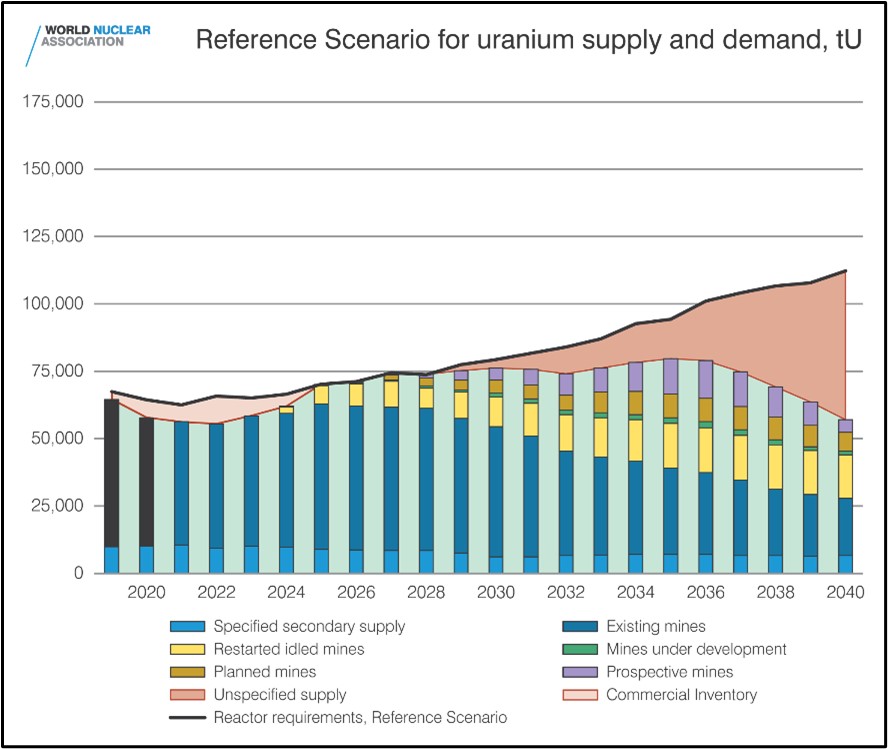
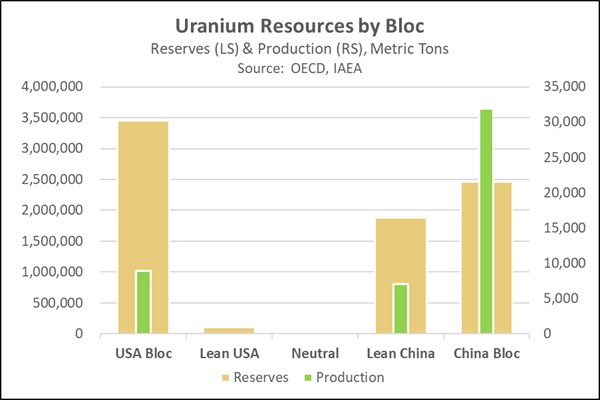
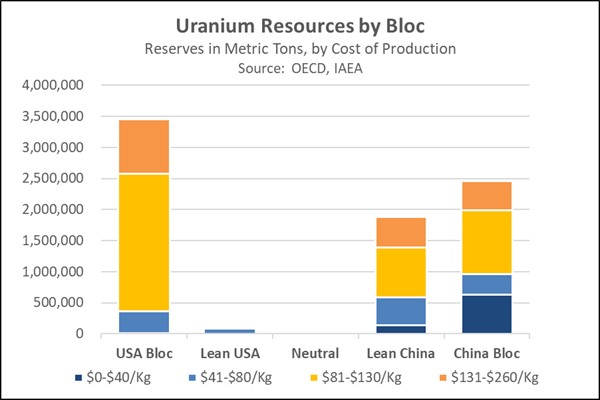
- Although nuclear energy remains controversial, it does not give off any greenhouse gases during the production of electricity. Therefore, Western governments are slowly considering the expansion of nuclear power. However, Russia and Kazakhstan are significant global suppliers of uranium, meaning that without new sources, the West is merely trading one vulnerability (oil and gas) for another. The U.S. is actively considering policies to develop domestic uranium sources to support the nuclear power industry.
- The EU is not pleased with the recently passed Inflation Reduction Act as the provision tailors subsidies for purchasing EVs to those made in the U.S. This rule either prevents the buyer of a European EV import to receive the subsidy, or it forces a European automaker to make the car in the U.S. Needless to say, the EU isn’t thrilled with this new law and wants carveouts or loopholes added or it will consider retaliation. However, if the goal of the administration was to boost jobs in the U.S., allowing carveouts defeats the purpose. USTR Tai is in Europe trying to make Washington’s case; so far, though, she isn’t budging on ending the preference of U.S. production.
- California is planning on ending the sale of natural gas-fired furnaces and water heaters by 2035. Natural gas utilities in the state are looking to repurpose their pipeline networks, perhaps for hydrogen.
- Copper is a critical metal in the energy transition, but current production is running below demand and there doesn’t appear to be enough investment to meet future demand. Prices have soared on the imbalances.
- Nickel is also important. Indonesia, the world’s largest producer, is floating the idea of a cartel body for the metal.
- California is trying to boost lithium production; however, its current tax policy is based on the amount extracted rather than the price, which may discourage investment.
- The government is supporting efforts to create electro-fuels, which are biofuels without the crops. By combining electricity, carbon dioxide, and algae, biofuels can be created. Although such fuels make environmental sense, they will face opposition from the farm lobby.
- Although Australia is a large producer of rare earths, the country’s resource minister indicated that his nation cannot, in the near term, replace China.
- The EU plans to end the sales of internal combustion engines by 2035.
- Renewable energy capacity is growing rapidly.
- In contrast, Germany is tearing down a wind farm to facilitate a lignite coal mine.
Asset Allocation Bi-Weekly – The Inflation Adjustment for Social Security Benefits in 2023 (October 31, 2022)
by the Asset Allocation Committee | PDF
Even for dedicated, successful investors who have built up a substantial nest egg, Social Security retirement and disability investments can be an important part of one’s financial security. For many Americans, Social Security benefits may be the only significant source of income in old age. On average, Social Security benefits account for approximately 30% of elderly people’s income and more than 5% of all personal income in the U.S. One aspect of Social Security is especially important in the current period of galloping price inflation: by law, Social Security benefits are adjusted annually to account for changes in the cost of living. In this report, we discuss the Social Security cost-of-living adjustment (COLA) for 2023 and what it implies for the economy.
In mid-October, the Social Security Administration announced that Social Security retirement and disability benefits will jump 8.7% in 2023, bringing the average retirement benefit to an estimated $1,827 per month (see chart below). The increase, which will be the biggest since 1982, will boost the average recipient’s monthly benefit by approximately $145. The benefit’s raise was right in line with expectations, given that it is computed from a special version of the Consumer Price Index (CPI) that is widely available. The COLA process also affected some other aspects of Social Security, although not necessarily by the same 8.7% rate. For example, the maximum amount of earnings subject to the Social Security tax was hiked to $160,200, up 9.0% from the maximum of $147,000 in 2022.

Media commentators often fret that the Social Security COLA could be “eaten up” by rising prices in the following year, or that the benefit boost could provide a windfall if price increases slow down. In truth, the COLA merely aims to compensate beneficiaries for price increases over the past year. It’s designed to maintain the purchasing power of a recipient’s benefits given past price changes. Price changes in the coming year will be reflected in next year’s COLA.
For the overall economy, the inflation-adjusted nature of Social Security benefits is particularly important. Since so many members of the huge baby boomer generation have now retired, and since more and more people are drawing disability benefits than in the past, Social Security income has become a bigger part of the economy (see chart below). In 2021, Social Security retirement and disability benefits accounted for 4.8% of the U.S. gross domestic product (GDP). Having such a large portion of the economy subject to automatic cost-of-living adjustments helps ensure that a sizeable part of demand is insulated from the ravages of inflation, albeit with some lag. In contrast, if Social Security income were fixed, a large part of the population would be seeing their purchasing power drop sharply, which could not only reduce demand but might also spark political instability. Of course, the additional benefits in 2023 will help buoy demand and keep inflation somewhat higher than it otherwise would be.

Finally, it’s important to remember that an individual’s own Social Security retirement benefit isn’t just determined by inflation. The formula for computing an individual’s starting benefit is driven, in part, by the person’s wage and salary history. Higher compensation will boost a retiree’s initial retirement benefit, which will then be adjusted via the COLA process over time. As average worker productivity increases, average wages and salaries have tended to grow faster than inflation, and as a result, the average Social Security benefit has grown much faster than the CPI. Over the last two decades, the average Social Security retirement benefit has grown at an average annual rate of 3.2%, while the CPI has risen at an average rate of just 2.3%. In summary, Social Security benefits provide an important source of growing purchasing power that helps buoy demand and corporate profits in the economy.
Asset Allocation Bi-Weekly – #87 “The Inflation Adjustment for Social Security Benefits in 2023” (Posted 10/31/22)
Business Cycle Report (October 27, 2022)
by Thomas Wash | PDF
The business cycle has a major impact on financial markets; recessions usually accompany bear markets in equities. The intention of this report is to keep our readers apprised of the potential for recession, updated on a monthly basis. Although it isn’t the final word on our views about recession, it is part of our process in signaling the potential for a downturn.
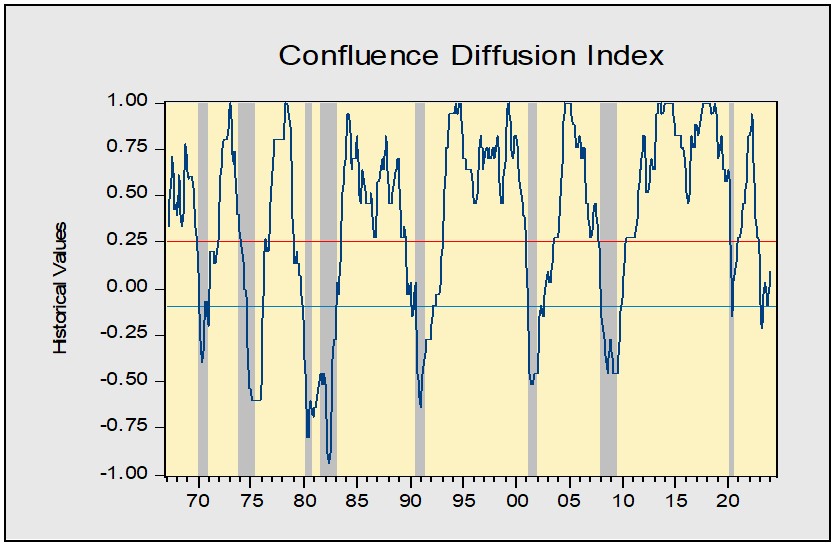
The Confluence Diffusion Index
fell further into contraction territory in September. The latest report showed that five out of 11 benchmarks are in contraction territory. The diffusion index declined from +0.2121 to +0.1515, below the recession signal of +0.2500.
- Financial conditions continue to hamper asset prices.
- The production of goods decelerated last month, but still show signs of life.
- The labor market remains tight but hiring is slowing.

The chart above shows the Confluence Diffusion Index. It uses a three-month moving average of 11 leading indicators to track the state of the business cycle. The red line signals when the business cycle is headed toward a contraction, while the blue line signals when the business cycle is in recovery. The diffusion index currently provides about six months of lead time for a contraction and five months of lead time for recovery. Continue reading for an in-depth understanding of how the indicators are performing. At the end of the report, the Glossary of Charts describes each chart and its measures. In addition, a chart title listed in red indicates that the index is signaling recession.
Weekly Energy Update (October 27, 2022)
by Bill O’Grady, Thomas Wash, and Patrick Fearon-Hernandez, CFA | PDF
Crude oil prices appear to be building in a base in the mid-$80s.

(Source: Barchart.com)
Crude oil inventories rose 2.6 mb compared to a 1.5 mb build forecast. The SPR declined 3.4 mb, meaning the net draw was 0.8 mb.

In the details, U.S. crude oil production was steady at 12.0 mbpd. Exports rose 1.0 mbpd, while imports rose 0.3 mbpd. Refining activity fell 1.8% to 88.9% of capacity. We are approaching the end of refinery maintenance season, which means oil demand should begin to rise soon.

(Sources: DOE, CIM)
The above chart shows the seasonal pattern for crude oil inventories. As the chart shows, we are past the seasonal trough in inventories. The build seen from October into November is usually strong due to the end of refinery maintenance. With the SPR withdrawals continuing, the seasonal build has been exaggerated this year.
Since the SPR is being used, to some extent, as a buffer stock, we have constructed oil inventory charts incorporating both the SPR and commercial inventories.

Total stockpiles peaked in 2017 and are now at levels last seen in 2003. Using total stocks since 2015, fair value is $106.28.
The Emergence of Zero: Since the onset of the war in Ukraine, Europe has been dealing with a natural gas crisis. Between sanctions and Russia’s actions to reduce exports to the EU, natural gas prices have been on a tear.[1]

(Source: Bloomberg)
As the previous chart shows, natural gas prices from prompt delivery reached €300 per megawatt hour.[2] However, a truism of markets is that prices engender a reaction. Consumption has fallen and high prices have attracted LNG flows, leading to nearly full inventory levels. With commodities, in general, but natural gas, in particular, once storage is maximized, there is really no place for the gas to go. With liquid fuels, there is often some storage at the tertiary level. With gasoline, for example, some can be stored in cars and at service stations, and this isn’t counted in national data. With a gas, however, the ability to store is limited and because temperatures have been unusually mild in northern Europe, consumption for home heating has declined. This week, prices actually went negative.

(Source: Bloomberg)
This situation is unlikely to last. The current problem is that there is nowhere for the current flows of gas to go, but once temperatures fall, prompt supply plus inventory will be necessary. What must be remembered about natural gas inventory is that most facilities cannot store gas indefinitely as gas goes into the facility and out of the facility at roughly a steady rate. In the U.S., storage injections usually end in November and then the gas must be moved into the market whether it is needed or not. This is why the lowest natural gas futures prices have occurred in January. If temperatures are warm, prompt supplies are combined with inventory disgorgement, leading to a collapse in prices.[3]
The Passive Investment Problem: Academic finance has floated a theory called “common ownership.” It goes like this: an active investor will select stocks within an industry, but a passive investor buys an index that represents the entire industry. The active investor, as an owner, has different goals than the passive investor. The active investor may support an individual company’s investment, or pricing policy, which would be designed to improve the profitability or the market power of that individual company. However, if all the companies in that industry engage in similar behavior, the collective outcome may not be positive for the investors in the individual companies. On the other hand, the passive investor, because they own the entire industry, would tend not to support actions by companies, for example, to lower prices to gain market share or expand investment to do the same. Instead, the passive investor should support industry concentration and market power that enhance returns to shareholders. Simply put, the passive investor has no interest in companies actually competing. As passive investment begins to dominate, the cost to society may be less production and higher prices, and some have even argued that passive investment is “worse than Marxism.”
Obviously, this theory is highly controversial. Anti-trust authorities are examining it, the passive industry suggests it doesn’t exist, and the pushback against ESG raises concerns about investment concentration. What caught our attention is the notion that the common ownership problem may be contributing to the disconnect between commodity prices, in this case oil and gas, and the lack of a supply response. In other words, we haven’t seen oil investment and production rise despite elevated oil and gas prices. Although ESG has been blamed for this disconnect, the Dallas FRB survey suggests investor pressure was more important.

Recent data shows that oil production growth is overwhelmingly coming from private companies, since publicly traded companies are refraining from boosting output.

Currently, it is estimated that passive funds hold about 30% of the publicly traded universe of stocks. That’s up from 10% in 2010. In a sense, passive investment becomes a form of tacit collusion. In a classic prisoner’s dilemma, both parties defect, leading them to longer prison sentences than if they both stayed quiet. This outcome assumes a lack of coordination. In economic terms, the decision matrix could be invest/don’t invest. If both parties don’t invest, they receive higher profits, but if one company invests and the other doesn’t, the investing company is better off. However, if both invest, production expands and prices fall, leading to a worse outcome for the businesses but a better outcome for society (greater supply, lower prices). Last week, we reported on Harold Hamm’s quest to take Continental Resources (CLR, $73.67) private in order to free his company to boost production and release the firm from the clutches of the indexers.
President Biden is pressing the industry to boost output. Maybe the solution is to address passive investing instead.
Policy: Last week, we discussed the situation with SPR policy and what appears to be the evolution toward using the reserve as a buffer stock. Although the White House continues to argue that the releases are not politically motivated, it is hard not to observe that the releases are occurring before the midterm elections.

This chart overlays how many gallons of gasoline can be purchased at the current average U.S. gasoline price and the hourly wage for non-supervisory workers. The higher the number, the better off the gasoline purchaser’s position. Since 1996, when the gallon per hour measure is less than eight, the presidential approval rating averages 42.8%, while measures higher than eight average a 54.7% approval rating. Lower gasoline prices don’t always help approval ratings (they didn’t do much for President Trump), but it is pretty obvious that they are having an impact now.
The SPR has seen the steepest decline in its history. We note media sources are suggesting that there is still plenty within the reserve for emergencies. That is only partially true as these comments ignore the fact that we have seen a larger decline in sour crude, which is preferred by U.S. refineries. Although sweet crude is usable, it is more likely to be exported. Thus, if the goal is the optimization of protecting Americans from a supply outage, it would make more sense to export sweet crude to lower global prices. The fact that sour crude was drawn suggests that the primary goal is to lower gasoline prices.
As we have noted, the White House is promising to keep draining the reserve, but it is also promising to start buying crude oil in the $72 to $67 range. We harbor serious doubts this buying will ever occur, as does the industry, but that promise is in the public record and could affect prices.
Finally, one of the overlooked elements of the SPR’s release was that cars don’t use crude oil; rather, they use gasoline (and a few use diesel). Refining capacity has been constrained for some time, and industry officials told the energy secretary that recently shuttered refineries are unlikely to reopen.
Market News:
- The IEA is warning that the current situation is the first actual global energy crisis.
- Germany is reluctant to support a price cap for natural gas, fearing that if the price is set too low, it could lead to shortages. EU industries are heavy users of natural gas, and if prices remain elevated, it is unclear if European industrial production can be maintained. For example, BASF (BASF, $11.38) announced it will “permanently downsize” its operations in Europe due to high energy prices. Petrochemicals are dependent on natural gas for feedstock, meaning that the loss of Russian gas makes operations in Europe tenuous.
- Although EU gas inventories are near capacity, the interconnectedness of the system has never been tested with this degree of stress before. If all works perfectly, flows must cross national borders. If nations decide to hoard gas to protect their own markets, shortages may emerge even with ample inventories.
- Germany and Spain are at odds with France over a pipeline proposal that would expand capacity from the Iberian Peninsula to Germany. France opposes the pipeline for economic and environmental reasons.
- France’s nuclear power industry has suffered a spate of maintenance issues. Currently, 26 of its 56 reactors are offline due to problems ranging from basic maintenance to corrosion issues. If these issues are not resolved soon, it could mean higher demand for natural gas, fuel oil, and coal.
- In eastern Europe, households are scrambling to heat their homes by using lignite, wood, or even trash.
- Although the U.S. is a net exporter of natural gas, the transportation system for gas (in the domestic U.S., most gas moves by pipeline) creates situations where some parts of the country require imports to meet demand. New England requires LNG imports to balance the market and is facing tight supplies as it competes with Europe for available supplies.
- Turkey has been straddling the conflict in Ukraine since it began. For example, it provided drones to Ukraine early in the conflict. It has also engaged in talks with Russia about becoming a natural gas hub. Turkey is already a transit state for oil from Iraq and Azerbaijan. Iran is planning on expanding natural gas exports to Turkey, and we would expect these flows to be eventually destined for Europe.
- A rise in COVID-19 cases in China’s coal-producing areas could lead to constrained supplies.
- Slow Chinese growth is freeing up product supplies for export. China’s September diesel exports rose to their highest level since July 2021.
- The U.S. will hold an auction for offshore oil development in March. This auction was part of the Inflation Reduction Act.
- China has made a large shale gas find in the Sichuan Basin.
- Shell (SHEL, $53.32) has announced its participation in a Qatar natural gas development.
Geopolitical News:
- The EU has announced sanctions on Iran due to Tehran’s decision to provide drones to Russia. Protests continue in Iran, and this article provides an anecdotal “feel” for how the protests appear on the ground. One of the more interesting quotes discusses the worries of the government: “They are really worried that Iran will become like Syria.” We suspect the market’s take on the protests is that if the government falls, it will be bullish for oil. However, if the end of the regime results in chaos, we could have a situation similar to Libya, where oil flows, even if permitted, become intermittent due to internal power struggles.
- Protest participants are moving beyond students and women to the labor movement. The security forces are cracking down with increasing ferocity, leveling charges against hundreds.
- Two Iranian Revolutionary Guard Corps members, including one colonel, were assassinated in the Baluchestan province. This area has always been difficult for Iran to control, but unrest has been rising along with tensions elsewhere.
- Tehran is moving more deeply into Russia’s camp.
- One of the reasons OPEC+ announced target cuts was to counteract the U.S.-sponsored price cap. The White House has countered that the cartel wasn’t the target of the measure; perhaps that is true, but the cap does create a mechanism that could be used against oil producers.
- Sources claim that Russia can probably evade the price cap and sanctions, although it would require ports and canals to accept Russian insurance. India and China continue to flout Western sanctions.
- According to reports, the Kingdom of Saudi Arabia (KSA) pressured other members of OPEC+ to publicly support the recent target cuts so that the U.S. couldn’t isolate the KSA for criticism.
- The Biden administration has not decided how to “recalibrate” its relations with the KSA. Clearly relations have deteriorated, but the White House seems to want to move slowly on a complete break. Conditions are so bad that the KSA had to issue a statement saying that the crown prince didn’t privately disparage President Biden. The NYT has reporting that suggests the administration thought it had a “secret deal” to raise production and thus was caught by surprise over the OPEC+ decision to reduce output. It appears to us that relations between the two countries have sunk to a new low, in part because Crown Prince Salman is charting a new foreign policy path that won’t be as dependent on the U.S. That decision will further disrupt trading patterns that have been in place for decades.
- We have observed that there is often a divergence between the business community and national security policy. For example, tech firms are often at odds with Washington over China policy. As the U.S. begins to distance itself from the KSA, we note that financial firms are apparently still on board with Riyadh.
- Although the U.S. has accused the KSA of siding with Russia, perhaps a more important trend is the Saudis’ engagement with China. The KSA has a long history of building relations with oil importers, so when the U.S. was a major oil importer, the KSA aggressively defended its market share to the U.S. Now that the U.S. is a less important importer, it would be consistent policy for Riyadh to improve relations with Beijing. However, this policy direction could put Saudi Arabia in direct conflict with the U.S. as relations with Washington and Beijing continue to sour.
- Norway is worried that Russia will sabotage its energy infrastructure. According to reports, unidentified drones, presumably Russian, have been buzzing Norwegian offshore oil and gas platforms. Norway has become a critical natural gas supply source for Europe, so any disruptions could be a major problem for natural gas supplies.
- Despite numerous investigations, there has been no official announcement on who sabotaged the Nord Stream pipelines.
- The Venezuelan opposition is contemplating ending its “interim government” claim, which would be a step toward allowing the U.S. to normalize relations with Caracas.
- The new left-wing government in Colombia is at odds with its energy industry. The Petro administration is raising taxes on the coal and oil sector and looking to curtail investment to back climate change reform.
Alternative Energy/Policy News:
- The SEC appears to be rethinking its proposal to make firms disclose carbon emissions. It is unclear what is causing this reversal, although we suspect some of it is due to the costs of compiling the data.
- Hyundai (HYMTF, $27.10) has started construction on an EV plant in Georgia.
- Climate issues continue to affect a wider circle of issues. The latest labor demand is for formalized time off to address local destruction caused by weather events.
- Although China continues to dominate battery production, the U.S. is seeing a surge in investment and a buildout of a “battery belt” across the lower 48. Meanwhile, U.S. battery infrastructure is at risk for siting constraints.
- Carbon capture is one way fossil fuel companies can address climate change issues. As CO2 is generated by burning fossil fuels, capturing that gas and storing it would allow for continued consumption. As investment grows, we should see in the next few years if such projects actually work.
- Climate change remains controversial, and last week we noted that the insurance industry is moving to factor this concern into policies. The survey from the insurer AXA (AXA_SA, $24.61) indicates that climate change is the primary concern of insurers.
[1] So much so that U.S. exports of fertilizer to the EU have soared, taking advantage of lower relative natural gas prices.
[2] That’s over $1,000 per MMBtu.
[3] There are some natural gas prices in the Permian that are approaching zero due to the lack of takeaway capacity.