

Weekly Energy Update (February 9, 2023)

by Bill O’Grady, Thomas Wash, and Patrick Fearon-Hernandez, CFA | PDF

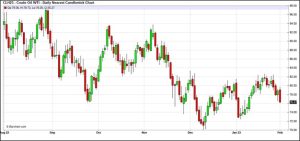
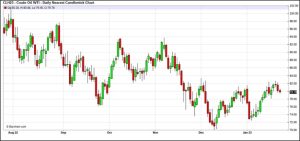
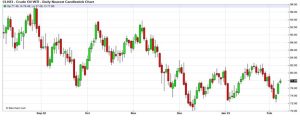
Crude oil prices appear to have based but so far have failed to break above resistance at around $80-$82 per barrel.
(Source: Barchart.com)

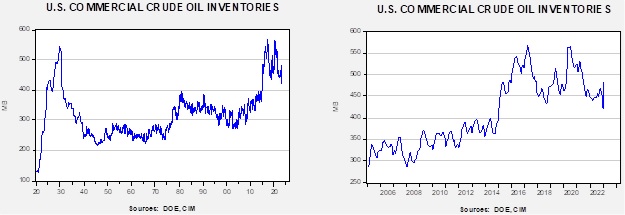
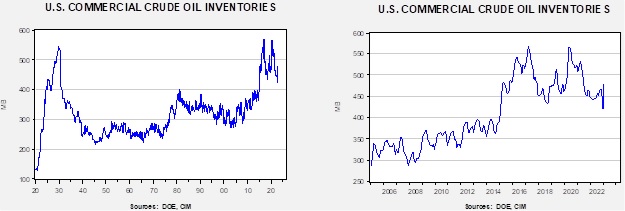
Crude oil inventories rose 2.4 mb compared to a 2.0 mb build forecast.  The SPR was unchanged.
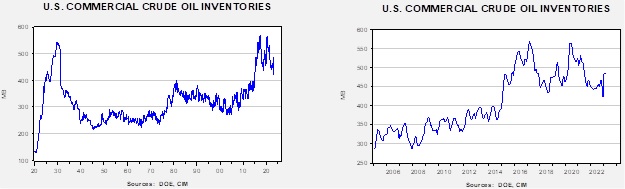
In the details, U.S. crude oil production rose 0.1 mbpd to 12.3 mbpd.  Exports fell 0.6 mbpd, while imports declined 0.2 mbpd.  Refining activity increased 2.2% to 87.9% of capacity.
(Sources: DOE, CIM)

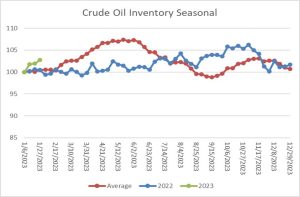
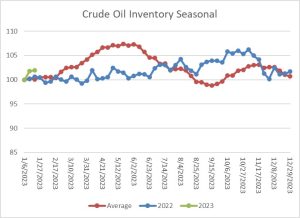
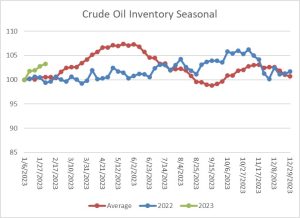
The above chart shows the seasonal pattern for crude oil inventories.  Last week’s increase was contra-seasonal.  So far, crude oil inventories have been rising this year, mostly because refinery operations have been weaker than normal.  As refining activity accelerates, we would look for commercial inventory accumulation to slow.
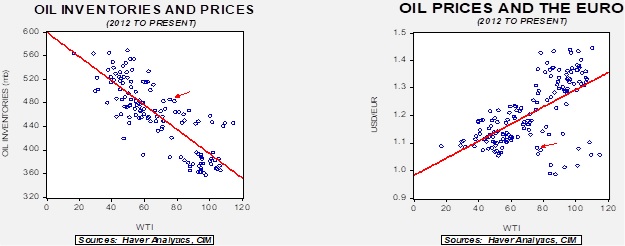
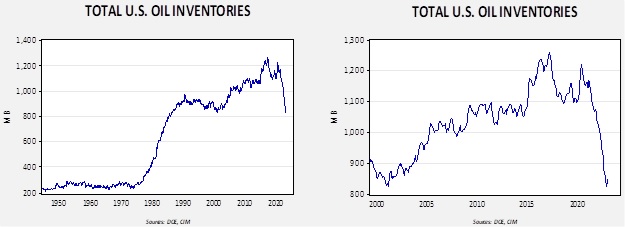
Since the SPR is being used, to some extent, as a buffer stock, we have constructed oil inventory charts incorporating both the SPR and commercial inventories.  For the next few months, we expect the SPR level to remain steady, so changes in total stockpiles will be driven solely by commercial adjustments.
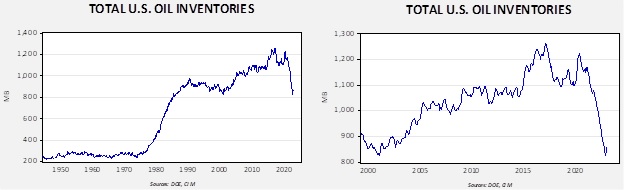
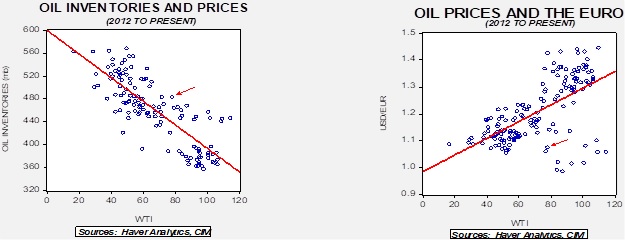
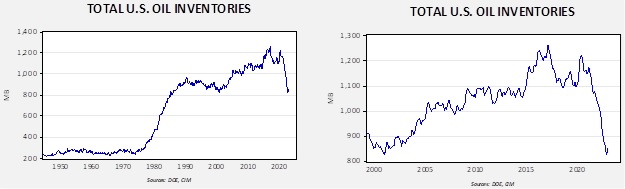
Total stockpiles peaked in 2017 and are now at levels last seen in 2001.  Using total stocks since 2015, fair value is $107.07.

Summer:

We don’t usually start thinking about summer until pitchers and catchers report to spring training.  By then, the Super Bowl has been played and we are only a couple of weeks away from the kick-off of the NCAA’s “March Madness” tournament.  However, we have been watching the gasoline markets and there are some concerns lurking around the bend.
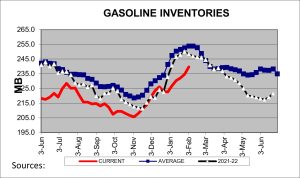
Gasoline inventories are running about 14 mb below their five-year average.  Scaled to consumption, inventories are in line with normal, but that’s only because consumption has been weak.  We are approaching the usual peak in gasoline stockpiles, since inventories usually decline as refiners clear their winter grade gasoline from surplus to prepare for summer.  If we experience the usual drop in the coming weeks, stockpiles could be lower than normal and may trigger higher prices.  High gasoline prices are politically sensitive and may trigger another round of SPR releases.

At the same time, we are in the midst of a secular drop in gasoline consumption.  The following chart shows annual miles driven by passenger cars and light trucks.  In general, the trend in miles driven rose steadily from the early 1970s until the Great Financial Crisis in 2007.  We use gray bars to highlight periods when we did not hit a new high in the number of miles driven and note the number of months until a new peak occurred.  There was a small dip from 1973 to 1975, which was a product of the Arab Oil Embargo (which pushed up gasoline prices), and a more notable dip in the uptrend from 1979 to 1982, triggered by two U.S. recessions and a spike in prices caused by the disruptions from the Iran/Iraq War.  From 1983 until 2007, the rise in driving was relentlessly higher, with only short interruptions typically due to recessions or periods of high prices.  After 2007, though, we had a long gap before a new high was reached and the underlying trend clearly declined.
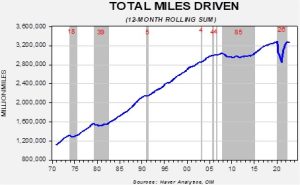
There are likely multiple reasons for the overall change in trend.  First, social media has led to friends being able to interact online, rather than needing to drive to meet in person.  Working from home and increased urbanization have also likely played a role.  Driving less, coupled with steady efficiency improvements, is leading to lower demand for gasoline.

The underlying factors reduce the chances of a gasoline crisis this summer, although the lack of inventory bears watching.  Probably the biggest factor that could push gasoline prices higher is crude oil pricing.

Market News:

  • The tragic earthquake in Turkey has closed the Ceyhan oil export terminal in southern Turkey. The terminal moves about 1.0 mbpd, with two-thirds coming from Azerbaijan and one-third from Iraqi Kurdistan.  Coupled with news that the KSA increased prices to Asia, oil markets were supported this week.  We do note that the port of Ceyhan has reopened, but it’s unclear just how long it will take for oil flows to resume.
  • The IEA has released its annual report on electricity. The report suggests that carbon emissions from electricity are trending lower as wind, solar, and nuclear power expand.
  • As we have noted in earlier reports, the Biden administration has approved a drilling project in Alaska over the objections of environmentalists. Although the president campaigned on restricting drilling activity on federal lands, he has found that the courts have not sided with this goal.  At the same time, high oil prices tend to soften opposition, so we do expect this project to go forward.
    • The administration has been struggling with dissonant objectives on crude oil production. On the one hand, the White House tends to criticize oil companies for not increasing output to quell oil prices, but then on the other it talks about a possible windfall profits tax, which would tend to reduce the incentive for investment.
    • This is not just a U.S. issue. EU climate goals, which hope to reduce natural gas imports, are stifling investment in U.S. production and LNG capacity.  It may be adversely affecting investment in the Middle East as well.  The Qatari energy minister mused recently that the EU will eventually return to buying Russian gas.  If that is the expectation, it is foolhardy to expand capacity.
  • The EIA is projecting record U.S. crude oil production (on an annual average basis) this year and next, although the growth rate is rather modest (0.1 mbpd this year and 0.4 mbpd in 2024). Much of that production is coming from the Permian Basin.
  • Japan is trying to cut coal import costs by burning lower grade coal (which is almost certainly dirtier).
  • Colombia’s President Petro made it clear during his campaign that he wanted to curtail the country’s oil and gas industry for climate change reasons. He has moved to ban oil exploration, a risky decision given that crude oil exports accounted for 34% of Colombia’s exports (excluding illegal substances).  Because oil is a depleting asset, cutting exploration will lead to falling output in the coming months.  Not only will this move hurt Colombia’s economy, it could also reduce global oil supplies.
  • Asian oil imports hit a new record in January, and that has occurred before the full effects of China’s reopening have been felt.
  • Oil and product prices have been stable recently, but much of that improvement is tied to a mild winter, which has reduced demand. Europe remains short of diesel, so prices could rise in the spring.
  • Despite the recent drop in natural gas prices, fertilizer supplies remain tight and could lead to widespread grain shortages.

 Geopolitical News:

 Alternative Energy/Policy News:

  View PDF

Bi-Weekly Geopolitical Report – Is Japan’s Sun Rising Again? (February 6, 2023)

Patrick Fearon-Hernandez, CFA | PDF

Ever since Japan’s “bubble economy” imploded at the end of the 1980s and its population began to fall in the 2000s, investors have tended to dismiss the country’s financial markets as well as its geopolitical and economic standing.  Japan’s pacifist constitution and its diplomatic deference to the United States constrained its international influence, while its slow economic growth, rising debt, and ultra-low inflation made its business environment seem sclerotic and stagnant.  Likewise, through much of the past few decades, Japanese stocks and bonds have not offered investors much to get excited about.  In U.S. dollar terms, the MSCI Japan stock index including gross dividends only returned 5.5% per year in the two decades prior to 2022, versus an average total return of 9.8% for U.S. stocks.

Japan had plenty of false dawns in recent decades, which raised hopes for a rejuvenated society and economy.  In this report, we explore whether the country could finally see reinvigorated economic growth and investment returns, not so much because of economic reforms like it has tried so often in recent years, but because of its unique role in the evolving geopolitical environment.  Diving deeply into Japan’s geopolitical position, economic situation, and financial market valuations, we will explore whether the country might find the catalyst needed to boost its power and growth again.  We also lay out the specific investment implications for a range of asset classes.

Read the full report

There will be no accompanying podcast with this report.

Weekly Energy Update (February 2, 2023)

by Bill O’Grady, Thomas Wash, and Patrick Fearon-Hernandez, CFA | PDF

Crude oil prices appear to have based but so far have failed to break above resistance at around $80-$82 per barrel.

(Source: Barchart.com)

Crude oil inventories rose 4.1 mb compared to a 1.0 mb draw forecast.  The SPR was unchanged.

In the details, U.S. crude oil production was unchanged at 12.2 mbpd.  Exports fell 1.2 mbpd, while imports rose 1.4 mbpd.  Refining activity declined 0.4% to 85.7% of capacity.

(Sources: DOE, CIM)

The above chart shows the seasonal pattern for crude oil inventories.  Last week’s increase was contra-seasonal.  Generally, we expect this year to follow last year, meaning that the usual rise in inventories isn’t likely.

Since the SPR is being used, to some extent, as a buffer stock, we have constructed oil inventory charts incorporating both the SPR and commercial inventories.  For the next few months, we expect the SPR level to remain steady, so changes in total stockpiles will be driven solely by commercial adjustments.

Total stockpiles peaked in 2017 and are now at levels last seen in 2001.  Using total stocks since 2015, fair value is $107.01.

Market News:

  • BP (BP, $36.31), has released its annual energy outlook. The research indicates that peak demand for fossil fuels will occur by 2035 at the latest but could occur by 2030 if policy leans against carbon emissions.  There are a number of factors behind the expected peak, but one of the most overlooked areas is improved consumption efficiency.  Research such as this makes it more difficult to argue for aggressive investment into future production.
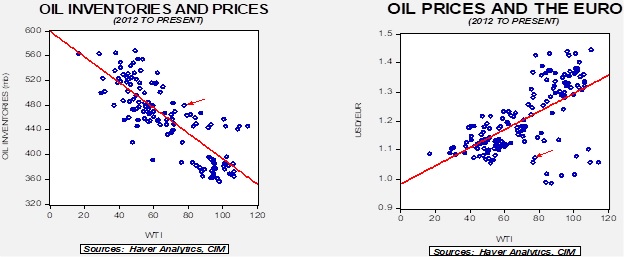
  • A normal response to supply shortages is hoarding since insecurity over supply leads consumers to build stockpiles to protect against future outages. Paradoxically, this activity can cause its own supply problems as this stockpiling becomes a source of additional demand.  We note that there are periods when U.S. commercial crude oil inventories are positively correlated to price.  If inventory is simply a residual of supply and demand, then a positive correlation would not be expected.  On this note, the German natural gas inventory manager says it intends to maintain a “buffer,” which we suspect means keeping a higher level of inventory than it would otherwise maintain.  Also, the German government is considering a “strategic” natural gas reserve, which would be another source of demand.  We have postulated, for some time, that as American hegemony wanes, one of the consequences would be insecurity of commodity supply, which would boost prices.  These reports from Germany provide evidence of such activity.
  • The White House criticized Chevron (CVX, $187.30) for its decision to repurchase shares. The administration would prefer the company expand production, but once an environment is created that calls for the replacement of fossil fuels, rewarding shareholders rather than boosting output is a rational outcome.
  • Whenever the price of an important commodity rises, politicians usually charge firms in those industries with “price gouging.” Although further investigation rarely confirms that suspicion, it persists.  Recently, Italian PM Meloni criticized gas station owners by accusing them of price gouging.  In response, they held a one-day strike.  Although closures of stations are rare, this event does highlight the potential for unrest due to high oil prices.
  • One of the consequences of the war in Ukraine has been a restructuring of global oil flows. We also note that the EU is placing a ban on Russian product imports on February 5.  It is not obvious if the markets are ready for this action.
  • Local governments in China have exhausted their funds in the battle against COVID and now find they lack the resources to buy natural gas.
  • One of the side effects of fracking is earthquakes. Although none of these earthquakes are of a high magnitude,[1] they are enough to be felt and raise fears among homeowners that the quakes will trigger structural damage.  Tremors have been reported in Oklahoma and also now in Texas.  It is thought that the primary culprit is fracking wastewater.  Sand, water, and other chemicals are injected into the ground when a well is fracked.  The water usually surfaces and needs to be disposed of, and a cheap solution is to reinject it into the depleted well.  The water is thought to act as a catalyst for these earthquakes.  The solution is to force energy companies to dispose of the wastewater in another fashion, and although possible, changing the regulations would lift costs and eventually raise energy prices.
    • It should be noted that oil activity is said to be in a “boom” in Texas and New Mexico. It is having ripple effects outside of the oil and gas industry by lifting salaries and employment in other sectors of the economy.
  • One of the bright spots for oil production is Guyana, which is expected to steadily boost production.
  • The Biden administration’s decision to aggressively sell oil out of the SPR has been controversial. Although it is arguable that there are still ample supplies, as the previous chart showed, combining both the SPR and commercial stockpiles indicates that inventory levels have notably declined.  The House of Representatives has passed a bill that would limit the Department of Energy’s ability to tap the SPR. While it has no chance of passage, it does reflect the current level of concern.
  • Warm weather has not just lowered natural gas prices in Europe, but it has also taken U.S. prices below $3.00 per MMBTU. Although inventory levels are rather close to their five-year average, we are in the period of the year with the strongest drawdowns, but because of mild temperatures, we actually saw a build in U.S. stocks.  Even if temperatures turn cold, it is likely we will begin the refill season in April with adequate stocks.  We do look for prices to recover in the spring and summer as LNG exports increase to ensure Europe has adequate supplies.

 Geopolitical News:

  • Over the weekend, Iran was hit with a series of aerial attacks. Oil refineries and defense infrastructure were reportedly hit by drones.  The U.S. is suggesting that Israel was behind the widespread attacks, and apparently the U.S. was apprised of the operation.  Iranian media reported that the damage was light, but the fact that the attacks occurred is notable for a few reasons.  First, Israel has been reluctant to support Ukraine due to relations with Moscow (Russia and Israel cooperate in Syria); however, Iran is supplying arms to Russia so by attacking its defense infrastructure Israel could both help Ukraine and attack an avowed enemy.  Second, Israel must believe that Iran has limited scope to retaliate, likely assuming that it probably can’t do much in response between the protests and a weak economy.  Third, although there isn’t evidence that the U.S. directly participated, Washington appears to have abandoned a return to the JCPOA and thus is working on other ways to contain Iran.  This cooperation may include the actions Israel took over the weekend.  Still, the attacks on Iran create conditions where the war in Ukraine could expand.
  • Even with the lack of progress in Iran and the U.S.’s return to the JCPOA, diplomats haven’t completely cut off contact, mostly because they don’t perceive any other available options to restrain Iran’s nuclear program.
  • The U.S. has accused Iran of a “murder for hire” plot to assassinate an Iranian-American writer living in New York.
  • Iraq is dealing with increased currency smuggling, which has led to the Iraqi dinar’s depreciation. It is suspected that Iran is using its allies in Iraq to acquire dollars and the drain is weakening the Iraqi currency.
  • Although Russia and China have publicly declared their strong alliance, in reality, the two nations don’t necessarily align in certain areas. One of the more contentious areas is in central Asia.  Since these regions were formerly part of the Soviet Union, Russia tends to think of the “stans” as part of its sphere of influence.  However, China’s goal of building a Eurasian bloc, expressed by its “belt and road” project, means that China would like these nations to align with Beijing.  China has been using its economic heft to build relations, and we note that Russia is also making overtures to the stans by offering to sell natural gas in return for influence.  So far, the stans have been reluctant to fully sign on.  The central Asian nations are open to joint ventures but are reluctant to give Russia control of infrastructure.
  • The EU has agreed on a price cap for natural gas, while the Intercontinental Exchange is creating a parallel contract in London to match the TTF price in Amsterdam ostensibly to skirt the cap.
  • As Venezuela begins to emerge from sanctions, it is attempting to normalize its trading relationships. While under sanctions, it had used middlemen trading firms, likely for selling oil and to evade U.S. sanctions.  As conditions normalize, it is now demanding cash up front for exports in a sign that it is moving on from sanctions trading.

 Alternative Energy/Policy News:

  • Polls show that the German public now supports nuclear power. Former Chancellor Merkel tried to phase out nuclear power after the Fukushima disaster, but high natural gas prices have changed public sentiment.
  • We are beginning to see price discounting of EVs. Tesla (TSLA, $169.34) started the process, and now Ford (F, $12.94) is following suit.  Some of this action is due to rising inventories, especially at Tesla, but another factor is that the cars may simply be too expensive to compete against gasoline-fired vehicles.
  • China is considering banning the exports of its solar technology. Since it dominates this industry, such an action would send up the cost of solar energy outside of China.
  • Researchers at the University of Illinois Urbana-Champaign have taken an abandoned oil well and turned it into a geothermal energy storage system. The researchers injected 120oF water into the well, and it maintained the temperature, suggesting that other abandoned wells could be repurposed for similar uses.
  • In response to U.S. subsidies in the Inflation Reduction Act, the EU is planning to use tax credits to offer European businesses support for green energy.

[1] Californians would not be impressed.

  View PDF

Asset Allocation Bi-Weekly – Secular Trends In Bond Yields (January 30, 2023)

by the Asset Allocation Committee | PDF

[Note: The podcast that accompanies this report will be posted later this week.]

Secular trends in markets are trends that have an extended life.  Their length can be different across various markets, but they are usually measured in years and sometimes decades.  It is not uncommon for shorter-term trends to occur within the secular trend.  But, in a secular bull market, the cyclical trends usually result in “higher highs and higher lows.”  From an investing perspective, knowing what kind of secular trend is in place in a market can be quite helpful.  The idea of “buying the dip” is rewarded in secular bull markets as downcycles offer buying opportunities.  The opposite notion, “selling the rallies,” makes sense in secular downtrends.

What causes secular trends?  Usually, it is a set of macroeconomic conditions that foster the trend.  These macroeconomic conditions can include growth and inflation trends and are often bolstered by policy.  Detecting reversals in secular trends is difficult[1] as history shows that often the underlying factors that supported a secular trend begin to deteriorate well before the market trend changes.  Some of this extension of the trend is simple inertia, while other times, even though the underlying factors are weakening, the factors that support a new and different trend are not yet in place.  Markets are often driven by narratives,[2] which can then become articles of faith to investors.  If these narratives become imbedded, they can make it hard to see when conditions change.  Complicating matters is that if a secular trend lasts long enough, a large number of investors may have no experience with any other type of trend.  If investors lack personal experience or a foundation in history, the change in trend can be difficult to manage.

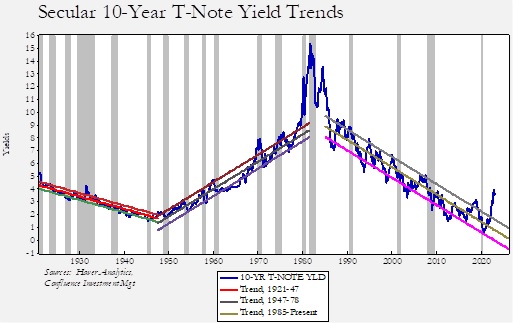
There is increasing evidence, in our opinion, that the secular downtrend in long-duration Treasury yields has ended.  The chart provided shows the 10-year T-note yield since 1921.  We have regressed time trends through periods when we estimate that a secular trend was in place.  The bands around the trend reflect a standard error above and below the estimated trend.  Over the past 102 years, we have identified three secular trends.  Clearly, these trends are persistent, and when changes do occur, they definitely matter.

Clearly, it is difficult to know in real time when a secular trend has changed.  Note that in 1931, there was a pop in yields that would have looked big enough to raise concerns that a secular reversal was underway.  However, yields subsequently declined and the downtrend remained in place.  Also, when the uptrend developed in the late 1940s, it probably wasn’t obvious that a trend change was in place for at least five years after the low in the former downtrend had occurred.  The difficulty that dealers had in selling those T-notes yielding more than 15% in 1981 is legendary.  Given the outsized move in yields from 1980-85, we didn’t attempt to calculate a trendline.  However, after a spectacular decline in yields from the peak in the autumn of 1981 to the bottom in July 2020, it appears to us that the secular downtrend is probably over.

What changed?  In our opinion, the U.S.-led hegemonic system, which began in the early 1980s but was bolstered by the end of the Cold War, has ended.  There are multiple causes for the end of this system.  Politically, the U.S. voting public has concluded that providing the reserve currency, which requires running persistent current account deficits, is too much of a burden.  When President Obama couldn’t pass the Trans-Pacific Partnership (TPP) and the Transatlantic Trade and Investment Partnership (TTIP), it was clear that free trade and open investment, which were critical to keeping inflation under control, were in trouble.  These two free trade agreements would have put the U.S. in a dominant position to control global trade.  Another factor was growing political instability in the U.S., and although there are multiple facets to that instability, much of it is driven by inequality.  Ending globalization and addressing inequality will almost certainly bring with it higher inflation, which will then likely lead to a rise in interest rates.

The great unknown is the pace of that expected rise.  Given the long-term nature of secular cycles, there isn’t a large number of “turns” to observe.  Even looking at U.K. Consol yields doesn’t offer much insight because interest rate changes were abrupt until 1825 but have tended to be much more gradual since then.  We have been expecting the secular downtrend in yields to gradually shift to a steady uptrend, similar to what we saw from the late 1940s into the early 1970s.  However, that assumption doesn’t have a strong theoretical underpinning.  The notion of gradual shifts in trend is mostly based on Milton Friedman’s theory that investor inflation expectations are built over a lifetime, and thus, when inflation changes accelerate, investor response tends to be slow.  In other words, it takes a rather long time for investors to adjust to the new inflation regime.

What worries us about the current environment for long-duration yields is that there is still a rather large cohort of baby boomers who have memories of the 1970s inflation crisis and the consequent bond bear market.  It is possible that instead of a slow, steady rise in long-duration interest rates over the next decade or two, we could see a sharp increase.  So far, market action seems to favor that outcome.  If that is the case, the FOMC and Treasury could come into conflict.  A rapid rise in long-duration yields may lead to excessive interest expenses.  Although the Treasury could offset that by shortening their borrowing profile, another response could be to force the Federal Reserve to fix interest rates along the Treasury yield curve.  This policy was executed during WWII and continued into the early 1950s before the Treasury/Federal Reserve Accord was established in 1951.  This accord gave the Fed its independence.  This process, called “yield curve control,” would prevent the secular rise in long-duration yields in Treasuries (but not necessarily in other investment-grade products) but could be catastrophic for the dollar.

Due to these risks, we have shortened duration in our fixed income allocations.  So far, the long end has behaved rather well, but we think there is an elevated risk of an unexpected outcome.  Usually, long-duration fixed income is a good place to be in a recession.  That may be the case this time as well, but if we are in the midst of a secular change in yields, the usual rally in long duration may not occur.


[1] For our reflections on inflection points, see Reflections on Inflections, part 1 and part 2.

[2] For a good discussion on narratives and economics, see: Shiller, Robert. (2019). Narrative Economics: How Stories go Viral and Drive Economic Events. Princeton, NJ: Princeton University Press.


View PDF

Business Cycle Report (January 26, 2023)

by Thomas Wash | PDF

The business cycle has a major impact on financial markets; recessions usually accompany bear markets in equities.  The intention of this report is to keep our readers apprised of the potential for recession, updated on a monthly basis.  Although it isn’t the final word on our views about recession, it is part of our process in signaling the potential for a downturn.

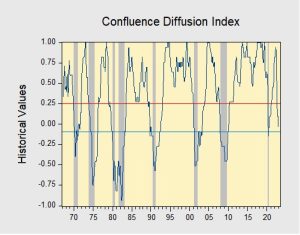
The Confluence Diffusion Index fell further into contraction territory in December. The latest report showed that seven out of 11 benchmarks are in contraction territory. The diffusion index declined from +0.091 to -0.03, below the recession signal of +0.2500.

  • Hawkish Fed policy weighed on financial indicators
  • Most of the manufacturing indicators have dipped into contraction territory
  • The labor market remains tight despite a slowdown in hiring


The chart above shows the Confluence Diffusion Index. It uses a three-month moving average of 11 leading indicators to track the state of the business cycle. The red line signals when the business cycle is headed toward a contraction, while the blue line signals when the business cycle is in recovery. The diffusion index currently provides about six months of lead time for a contraction and five months of lead time for recovery. Continue reading for an in-depth understanding of how the indicators are performing. At the end of the report, the Glossary of Charts describes each chart and its measures. In addition, a chart title listed in red indicates that the index is signaling recession.

Read the full report

Weekly Energy Update (January 26, 2023)

by Bill O’Grady, Thomas Wash, and Patrick Fearon-Hernandez, CFA | PDF

Crude oil prices appear to have based but so far have failed to break above resistance at around $80-$82 per barrel.

(Source: Barchart.com)

Crude oil inventories rose 0.5 mb compared to a 3.0 mb draw forecast.  The SPR was unchanged.

In the details, U.S. crude oil production was unchanged at 12.2 mbpd.  Exports rose 0.8 mbpd, while imports fell 1.0 mbpd.  Refining activity rose 0.8% to 86.1% of capacity.

(Sources: DOE, CIM)

The above chart shows the seasonal pattern for crude oil inventories.  Last week’s mostly steady injection is consistent with last year and seasonal patterns.  We expect this year to mostly follow last year, meaning that the usual rise in inventories isn’t likely.

Since the SPR is being used, to some extent, as a buffer stock, we have constructed oil inventory charts incorporating both the SPR and commercial inventories.  For the next few months, we expect the SPR level to remain steady, so changes in total stockpiles will be driven solely by commercial adjustments.

Total stockpiles peaked in 2017 and are now at levels last seen in 2001.  Using total stocks since 2015, fair value is $107.07.

Market News:

  • We are just over 11 months into Russia’s invasion of Ukraine. At this juncture, we don’t know what the outcome of the war will be.  Ukraine has proven itself to be a formidable opponent and is clearly leveraging its “home field advantage.”  At the same time, Russia is a larger nation and still has ample resources to throw at the conflict.  But even with this uncertainty, it looks like global energy markets are unlikely to return their pre-war state.
    • Europe now knows that Russia is an unreliable supplier of energy. Moscow would need to discount prices heavily to retake the European market share.  After all, Russia used to supply 40% of EU natural gas, but now that number is down to 14.4%.
    • Putin obviously wagered that the EU would not be willing to absorb the pain from the loss of Russian oil and natural gas. He might have been right, but in a fascinating twist of fate, a mild winter has allowed Europe to see a sharp drop in natural gas prices.  Russia, for centuries, has relied on winter as its ultimate defense against invaders.  Now, winter has, at best, postponed Russia’s leverage over Europe.  As supply chains adjust, Moscow’s leverage may be permanently reduced.
    • Russian oil has to go somewhere, and it has mostly flowed to India and China in a clear benefit to those nations. This has, however, reduced market share for Middle Eastern oil producers, and we wait to see their response.
    • Even with these expanded markets, it is highly likely that Russia will lose market share on global markets and eventually be forced to shut-in production. Complicating matters further is that that the price cap is beginning to reduce Russia’s revenues.  Washington’s goal with the price cap was this reduction in revenues, but it was also meant to keep oil supplies ample.  Thus, it set a price high enough to keep Russia producing, but low enough to “hurt.”  It’s quite possible that the price is set too low.
  • On February 5, the EU will begin a price capping system on Russian oil products, along with an outright ban on Russian diesel. However, the actual setting of the caps hasn’t been resolved.
  • Although the U.S. still imports crude oil and products, the net figure is increasingly positive, meaning that the U.S. is a net exporter of oil and products. As exports increase in importance, the goals of domestic energy security will clash with the oil industry’s revenue and profitability.
  • OPEC+ is expected to keep production targets unchanged when it meets next Tuesday. The cartel is taking a “wait and see” approach to the crosscurrents of China’s reopening and a looming global slowdown.
  • There are increasing reports that drilling activity is beginning to increase as high prices may finally be triggering a supply response. The DOE is forecasting that U.S. production will average 12.4 mbpd this year and 12.8 mbpd next year.
  • Freeport LNG has announced its plant repairs are complete and the company is preparing to restart operations. Last year, the plant suffered a major accident which reduced operations for several months.  The return of this liquification plant is a bullish factor for U.S. natural gas prices.
  • China’s electricity officials warn that economic recovery in the post-COVID era will boost electricity needs. This will lift demand for coal and LNG.
  • China oil trading firm Unipec, the trading arm of Sinopec (6000028, CNY, 4.54), is reported to be aggressively buying crude oil. It isn’t clear if it is buying the crude for China or merely reselling it.  In 2022, China’s oil imports declined from the previous year, but with COVID restrictions being lifted, we may be seeing Chinese firms prepare for higher consumption.  Imports from Malaysia have recently hit a new record.

 Geopolitical News:

 Alternative Energy/Policy News:

  • There are reports that wind turbines are falling over as structural problems are emerging.
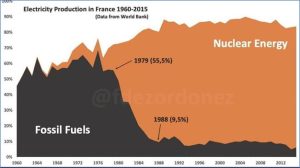
  • This chart shows the impact of France’s nuclear power on fossil fuel consumption. It shows that, at least for electricity, nuclear power can displace fossil fuels.

  View PDF

Bi-Weekly Geopolitical Report – The New German Problem (January 23, 2023)

Thomas Wash | PDF

When times are tough, you discover who your real friends are, just ask the European Union. From 1860 to 1945, Germany struggled to keep the peace with its neighbors. Commodity-deprived and lacking natural barriers, Germany has sought to impose its will throughout Europe to protect itself from being invaded or cut off from mineral resources. The European Union (EU) and the Northern Atlantic Treaty Organization (NATO) were eventually set up to mitigate this problem, but Germany’s unusual size and export needs created other issues.

Germany’s integration into the EU was designed to ensure that German interests were aligned with the West. However, things didn’t necessarily turn out that way. A decade ago, during the European debt crisis, the Germans lambasted southern European countries for being unable to repay the money they had loaned them. Germany built the Gazprom 2 pipeline with Russia against the wishes of the U.S., and its decision to sell a major port to China has drawn the ire of France. In short, Germany never truly committed itself to the European project.

The war in Ukraine has made Germany’s ambivalence unpalatable to its Western allies as the group gears up to take on a rising China and an aggressive Russia. Although it appears that Germany is attempting to maintain its neutrality, it isn’t clear whether this is possible, given the country’s size and influence. This report begins with a discussion on Germany’s conflicting loyalties, reviewing the country’s attempts to manage its relationships with its Western allies as well as China and Russia. Next, we consider how Germany has adapted to the changing geopolitical landscape, and we conclude with market ramifications.

Read the full report

The associated podcast episode for this report will be available later this week.