

Bi-Weekly Geopolitical Report – Implications of the Iran-Saudi Arabia Détente (May 1, 2023)

Bill O’Grady | PDF

In early March, China brokered a thaw between Iran and the Kingdom of Saudi Arabia (KSA).  The two countries have been at odds for decades, even before the Iranian Revolution in 1979.  Essentially, both nations believe themselves to be the rightful leader of the region.  The nations had been allied during the reign of the Iranian Shah under U.S. auspices, but after the revolution, the U.S. broke off ties with Iran and that break remains to this day.  The KSA has seen relations with Iran change over time, where sometimes they are improving and at other times they are at odds.  Before this most recent thaw, the KSA had broken off relations with Iran in 2016 in retaliation for violent protests directed toward Saudi embassies due to the execution of a Shiite activist by the KSA.

The decision to improve relations, especially under the guidance of Beijing, is noteworthy.  In this report, we will begin with why this attempt to improve relations has occurred now.  From there, we will examine the geopolitical implications that the improved relations could bring.  At the same time, as we noted above, Iran and the KSA have been in opposition for a long time, so an assessment of how far this thaw will go is also important.  We will conclude with market ramifications.

Read the full report

Don’t miss the accompanying Geopolitical Podcast, available on our website and most podcast platforms: Apple | Spotify | Google

Business Cycle Report (April 27, 2023)

by Thomas Wash | PDF

The business cycle has a major impact on financial markets; recessions usually accompany bear markets in equities.  The intention of this report is to keep our readers apprised of the potential for recession, updated on a monthly basis.  Although it isn’t the final word on our views about recession, it is part of our process in signaling the potential for a downturn.

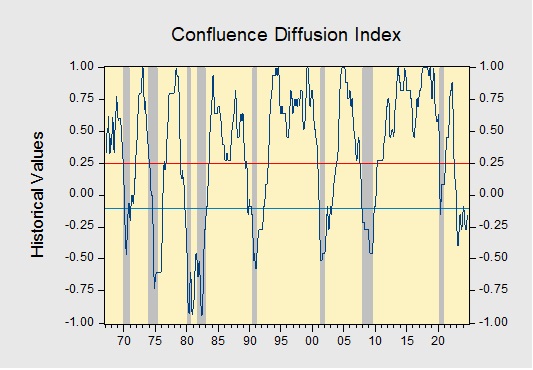
The Confluence Diffusion Index was unchanged but remained in contraction territory in March. The latest report showed that seven out of 11 benchmarks are in contraction territory. The diffusion index was unaffected at -0.3939 but remains well below the recession signal of +0.2500.

  • Financial stress worsened due to banking turmoil
  • Goods-Producing sector received an unexpected boost from housing
  • Employment indicators worsened but are not signaling contraction

The chart above shows the Confluence Diffusion Index. It uses a three-month moving average of 11 leading indicators to track the state of the business cycle. The red line signals when the business cycle is headed toward a contraction, while the blue line signals when the business cycle is in recovery. The diffusion index currently provides about six months of lead time for a contraction and five months of lead time for recovery. Continue reading for an in-depth understanding of how the indicators are performing. At the end of the report, the Glossary of Charts describes each chart and its measures. In addition, a chart title listed in red indicates that the index is signaling recession.

Read the full report

Weekly Energy Update (April 27, 2023)

by Bill O’Grady, Thomas Wash, and Patrick Fearon-Hernandez, CFA | PDF

After gapping two weeks ago, oil prices have filled the gap on worries about the global economy.

(Source: Barchart.com)

Commercial crude oil inventories fell 5.1 mb compared to the forecast draw of 1.5 mb.  The SPR fell 1.0 mb, putting the total draw at 6.1 mb.

In the details, U.S. crude oil production fell 0.1 mbpd to 12.2 mbpd.  Exports rose 0.2 mbpd, while imports rose 0.1 mbpd.  Refining activity rose 0.5% to 91.3% of capacity.

(Sources: DOE, CIM)

The above chart shows the seasonal pattern for crude oil inventories.  After accumulating oil inventory at a rapid pace into mid-February, injections first slowed and have since declined, putting storage levels below seasonal norms.

Fair value, using commercial inventories and the EUR for independent variables, yields a price of $58.47.  The recent actions of OPEC+ are clearly designed to prevent this sort of price from emerging.

Since the SPR is being used, to some extent, as a buffer stock, we have constructed oil inventory charts incorporating both the SPR and commercial inventories.  With another round of SPR sales set to happen, the combined storage data will again be important.

Total stockpiles peaked in 2017 and are now at levels last seen in 2002.  Using total stocks since 2015, fair value is $94.82.

Market News:

  • As U.S. oil production rises, associated natural gas production is also rising steadily, leading to a glut. This supply situation is keeping U.S. prices low and is encouraging the expansion of American LNG capacity.  However, higher interest rates and permitting issues are acting to constrain projects, thus leading to persistently low prices of natural gas.
  • China’s large SOE refiners are getting privileged access to cheap Russian crude oil.
  • Natural gas finds in the eastern Mediterranean raised hopes that nations in that region could profit from these discoveries. In addition, there was optimism that this gas could pave the way for improving previously fraught relations between states.  However, on the latter front, only modest changes have emerged.

 Geopolitical News:

 Alternative Energy/Policy News:

(Source: IEA)

  • As the chart shows, sales are lifting, with the bulk of those occurring in China. The IEA reports that 20% of car sales this year will be EVs.  Second, China is beginning to export EVs which could roil global car markets.

  • The expansion of EV sales will begin to destroy oil demand by the end of the decade.

(Source: IEA)

  • Even under existing policies, 5.3 mbpd of demand will be lost to electrics. This sort of information will tend to dampen oil investment, and, paradoxically, could be bullish for crude oil.
  • A battery is stored energy. We are used to thinking about batteries as a chemical process, but in reality any sort of energy storage that can be used later is technically a battery.  That energy can also be kinetic.  Renewable energy sources are notorious for creating excess electricity as particularly sunny or windy days can create more energy than is needed at any given time.  The startup Energy Vault is building facilities in Texas and Shanghai that will lift 24-ton blocks of dirt during periods of excess electricity, and then lower them to spin turbines to generate electricity when it is needed.
  • We continue to note news reports on geoengineering. Although controversial, as climate problems emerge, the use of this technology to address them will become attractive.
  • The EU is adjusting rules to encourage the use of sustainable fuels in aviation.

  View PDF

Asset Allocation Bi-Weekly – The Fed’s Employment Surprise (April 24, 2023)

by the Asset Allocation Committee | PDF

This is the tightest labor market for Black Americans in U.S. history. The Black unemployment rate fell to an all-time low in March unsurpassed since the Bureau of Labor Statistics began a separate calculation for Black workers in 1972. Meanwhile, the labor force participation rate for Black Americans hit a two-decade high, and the employment/population ratio for Black people exceeded the ratio for white people for the first time since the Labor Department started tracking the data. The improved employment conditions for Black Americans will be cheered by policymakers at the Federal Reserve, which has long pushed for an inclusive recovery. However, this doesn’t make the Fed’s future interest rate decisions any easier.

In March 2021, the Federal Reserve reframed its maximum employment goal mandate to include minority unemployment. At the time, the Black unemployment rate stood at 9.6% and the Hispanic unemployment rate was 7.7%, both well above the national rate of 6.1%. The disparity led to concerns that the Fed’s tightening would disproportionately impact minority groups. To help justify why he was not ready to lift rates, Fed Chair Jerome Powell argued that high unemployment in minority groups is a sign of slack within the labor market.

Powell’s reluctance to tighten policy made him a target of criticism. Annual inflation as measured by the consumer price index reached 7.5% before the Federal Reserve finally decided to raise rates in March 2022. Powell’s lack of response led to complaints that the central bank had allowed inflation to get out of control. During his renomination hearing, politicians accused Powell of allowing economic inequalities distract from the central bank’s mandate of maintaining price stability. As a result, Powell reassured lawmakers that the Fed was ready to increase borrowing costs as needed to address the rising price pressures.

In contrast to Fed expectations, labor market conditions improved for Black workers even as the central bank tightened policy. In just over a year, the Fed increased its policy rate by 475 bps, its fastest hiking cycle in history. During the period between February 2022 and March 2023, Black unemployment fell from 1.339 million to 1.114 million, for a decline of 16.8%, while total unemployment fell from 5.979 million to 5.839 million, for a decline of 2.3%. In other words, the number of Black unemployed workers fell more than seven times faster than the national rate. Tight policy with lower Black unemployment has added to speculation that the labor market is overly tight.

The improvement in employment conditions for Black workers reflects a secular demographic trend. The white civilian labor force participation rate has steadily declined since 1997, when it peaked at 67.6%. The pandemic accelerated this trend as older white males were reluctant to return to the workforce after being sidelined during lockdowns. Their exit reflects the age divide among racial groups. At 58 years old, the median age for white workers is more than twice that of minority workers, suggesting that many of the white workers likely left the market for good.

The participation gap shows that the Fed may need to rethink its view on minority employment. The lack of white workers means that minority groups will have more job opportunities than in previous generations. Additionally, the shortage of workers should lead to a lower overall unemployment rate and higher wage gains for minority workers. These labor market conditions suggest that the Fed could tighten policy without hurting marginalized groups. As a result, the Fed may now keep rates higher for longer.

However, the recent change in the labor market implies that the Fed’s full employment target may be too high. Its labor tightness gauge, known as the non-accelerating inflation rate of unemployment (NAIRU), currently sits at 4.42%, although this may not be accurate. NAIRU is calculated using the historical relationship between the unemployment rate and changes in the rate of inflation. This relationship likely does not account for the acceleration of white workers exiting the labor market due to the pandemic. The actual NAIRU may be lower, so it is possible that the Fed may need to lower rates sooner than the NAIRU would suggest.

The major dropout of white male workers from the job market has benefited minority workers but may complicate Fed policy. Because the drop in Black unemployment reflects a demographic shift, it may not be a valid tool for measuring employment slack in the labor market. That said, employment conditions for Black Americans suggest that the Fed will likely not return rates to zero any time soon. This market environment should be favorable to “value” assets as higher interest rates should dissuade investors from holding riskier, longer-duration securities.

View PDF

Weekly Energy Update (April 20, 2023)

by Bill O’Grady, Thomas Wash, and Patrick Fearon-Hernandez, CFA | PDF

After gapping last week, prices are consolidating.

(Source: Barchart.com)

Commercial crude oil inventories fell 4.6 mb compared to the forecast draw of 0.9 mb.  The SPR fell 1.6 mb, putting the total draw at 6.2 mb.

In the details, U.S. crude oil production was unchanged at 12.3 mbpd.  Exports rose 1.8 mbpd, while imports rose 0.1 mbpd.  Refining activity rose 1.7% to 91.0% of capacity.

(Sources: DOE, CIM)

The above chart shows the seasonal pattern for crude oil inventories.  After accumulating oil inventory at a rapid pace into mid-February, injections first slowed and have since declined, putting storage levels in line with seasonal norms.

Fair value, using commercial inventories and the EUR for independent variables, yields a price of $56.81.  The recent actions of OPEC+ are clearly designed to prevent this sort of price from emerging.

Since the SPR is being used, to some extent, as a buffer stock, we have constructed oil inventory charts incorporating both the SPR and commercial inventories.  With another round of SPR sales set to happen, the combined storage data will again be important.

Total stockpiles peaked in 2017 and are now at levels last seen in 2001.  Using total stocks since 2015, fair value is $94.11.

Market News:

 Geopolitical News:

  • Saudi Crown Prince Salman announced that 4% of Saudi Aramco (2222, SAR, 34.65), worth about $80 billion, will be moved to the nation’s sovereign wealth fund. The reason is to support the Kingdom of Saudi Arabia’s economic diversification.  Although the amount doesn’t necessarily suggest a rapid move away from fossil fuels, the “direction of travel” suggests less investment in oil and gas, and more in other parts of the economy.
  • The IEA admits that the price cap on Russian oil has been violated. Russian oil exports are now exceeding prewar levels with nearly all of the oil flows going to China and India.  Russia is also apparently selling oil in the Far East that is being exported by tanker, but this voyage is short enough to avoid insurance, which means that buyers can violate the price cap.  The U.S. is warning that it will begin cracking down on this practice.
  • Russia has surprisingly little domestic oil storage. Because of this lack of storage capacity, it must sell most of what it produces.  The country has announced that it will build new storage facilities which will give it more flexibility for timing sales.
  • China is proposing new natural gas pipelines from Kazakhstan to diversify its sources of the product.
  • Given China’s dominance in renewable energy and EV components, Chinese companies are often participants in foreign investment projects. However, due to deteriorating relations between China and the West, political resistance to these projects is growing.

 Alternative Energy/Policy News:

  View PDF

Bi-Weekly Geopolitical Report – U.S. Intelligence Sharing as a Tool of International Relations (April 17, 2023)

Patrick Fearon-Hernandez, CFA | PDF

Why should investors care about international relations?  Why should they pay attention as great powers jostle for influence and dominance across the globe?  One simple answer is that the global economy tends to grow better when there is one dominant country or “hegemon” that provides security, order, effective instruments for trade and investment, and perhaps even a common culture or set of values.  Since World War II, investors have benefited from relatively fast and stable economic growth as the United States provided those public goods in its role as the world’s “Benevolent Hegemon.”  Investors in the U.S. have enjoyed especially strong, risk-adjusted returns.

But as we’ve written before, the military, economic, and social costs of hegemony have now given the U.S. pause.  Whether the U.S. ultimately abandons its role as hegemon, and how fast it might do so, will have major implications for investors.  In this report, we look at one way U.S. officials today are trying to maintain their influence on other countries without the big economic costs they’ve accepted in the past.  As always, we will also examine the investment ramifications of that strategy.

Read the full report

Don’t miss the accompanying Geopolitical Podcast, available on our website and most podcast platforms: Apple | Spotify | Google

Weekly Energy Update (April 13, 2023)

by Bill O’Grady, Thomas Wash, and Patrick Fearon-Hernandez, CFA | PDF

Crude oil gapped higher in early April on reports that OPEC+ was cutting production targets.  It has held those gains and is now moving above chart resistance at $82 per barrel.

(Source: Barchart.com)

Commercial crude oil inventories rose 0.6 mb compared to the forecast draw of 1.7 mb.  The SPR fell 1.6 mb, putting the total draw at 1.0 mb

In the details, U.S. crude oil production rose 0.1 mbpd to 12.3 mbpd.  Exports plunged 2.5 mbpd, while imports dropped 0.9 mbpd.  Refining activity declined 0.3% to 89.3% of capacity.

(Sources: DOE, CIM)

The above chart shows the seasonal pattern for crude oil inventories.  After accumulating oil inventory at a rapid pace into mid-February, injections first slowed and then declined for two weeks.  The mostly steady report for last week puts stockpiles near seasonal norms.  Past history would suggest there will be mostly steady inventory levels into early June.

Fair value, using commercial inventories and the EUR for independent variables, yields a price of $55.36.  The actions of OPEC+ this week are clearly designed to prevent this sort of price from emerging.

Since the SPR is being used, to some extent, as a buffer stock, we have constructed oil inventory charts incorporating both the SPR and commercial inventories.  With another round of SPR sales set to happen, the combined storage data will again be important.

Total stockpiles peaked in 2017 and are now at levels last seen in 2001.  Using total stocks since 2015, fair value is $93.33.

Market News:

 Geopolitical News:

  • The U.S. has sent the USS Florida, a guided missile submarine, to the Persian Gulf region. The U.S. often has a naval presence in this region, but this sub could be viewed as a show of force against Iran.
  • The U.S has been restricting China’s ability to import semiconductor chips and the equipment for fabricating them. China is considering retaliation in the form of restricting rare earth exports.  Rare earths are critical in technology and alternative energy.
  • Last week, we noted that China hosted a meeting between diplomats from the Kingdom of Saudi Arabia (KSA) and Iran. Both sides agreed to resume flights between the two Middle Eastern nations.
  • Officials from the KSA are meeting in Yemen for talks with rebel groups. One potential outcome from the recent détente between Iran and the KSA could be a ceasefire in the long-running civil war in Yemen.
    • Graham (R-SC) had a “productive meeting” with Crown Prince Salman this week. Graham has been critical of the crown prince in the past, so the meeting might signal something of a thaw in U.S./KSA relations.
  • Although the U.S. political class is moving decidedly against China, the business class is clearly loath to break ties. We think that eventually businesses will be forced to choose.
  • Recently, we reported that schoolgirls in Iran were being poisoned in their schools. Apparently, the poisonings have continued.  It isn’t clear if Iran is facing a dissident movement within Shia Islam, or if the acts are being perpetrated by radical Sunni groups.  We note that the Islamic State and Taliban groups oppose education for women and so these acts may be being perpetrated by groups outside of Iran.
  • Iran is apparently in talks with China and Russia to provide components for missile fuel. Russia is attempting to acquire ammonium perchlorate which is used in solid fuel propellants in missiles.  If Iran supplies the component, it will surely face additional sanctions, but at the same time, Tehran may be reluctant to sell the fuel to Russia because it has its own needs for missile fuel.
  • Recent leaks of classified materials indicate that Russian hackers were targeting Canadian pipelines. Although the hackers claimed success in penetrating the networks, there were no reports of disruptions from cyberattacks.

 Alternative Energy/Policy News:

  View PDF

Asset Allocation Bi-Weekly – Increasing Concerns About Commercial Real Estate (April 10, 2023)

by the Asset Allocation Committee | PDF

Last month’s failure of Silicon Valley Bank (SIVB, $106.04) showed that the institution had vulnerabilities in both its assets and its liabilities.  On the asset side of its balance sheet, the bank had too much exposure to longer-maturity government bonds, which depreciated sharply as the Federal Reserve aggressively hiked interest rates over the last year.  On the liability side, the bank had many huge deposits from small, start-up technology firms that were burning through cash rapidly.  A number of those deposits far outstripped the FDIC insurance cap of $250,000.  As its deposits fell, Silicon Valley had to sell many of its bond holdings at a loss, undermining faith in the bank and spurring further withdrawals.  Investors worried that other small and mid-sized banks could have similar vulnerabilities, especially if they had excessive exposure to a particular industry or type of customer.

The moves by bank regulators to insure all of Silicon Valley’s deposits and set up a special lending facility for banks facing a potential run on deposits helped calm depositors and ease investor apprehensions about the banking system.  Still, the crisis has sparked concerns about what the next source of problems will be in the financial system.  The focus has fallen hard on the commercial real estate (CRE) industry.  A key concern is whether the crisis-driven flight of deposits from small and mid-sized banks to bigger banks and mutual funds will crimp CRE lending in the coming months.  Since small and mid-sized banks provide the majority of CRE loans in the U.S., such a drop in lending could make it harder for building owners to roll over their maturing loans, which could spark defaults, push down property prices, and slow new investment.

Our analysis indicates a drop in CRE lending is indeed likely.  For example, the chart below shows that the volume of bank CRE loans closely tracks the Fed’s Commercial Real Estate Price Index with a lag of about five quarters, or 14 months.  Since the price index hit a plateau at the end of 2021, the relationship suggests lending volumes should now be flattening out as well.

Similarly, the chart below shows that CRE lending is highly correlated with the price of real estate investment trusts (REITs), with a lag of about 20 months.  Since the Wilshire U.S. REIT Price Index peaked in December 2021 and then fell precipitously, this relationship suggests CRE lending should start to fall quickly by late summer 2023.

Finally, the following chart indicates that CRE lending is also highly correlated with the volume of bank deposits, with virtually no lag at all.  Even when deposit growth merely slows, as it did from 2009 to 2011, CRE loans have historically fallen.  The worrisome factor is that deposits have recently been in outright decline, even though many of the deposits pulled from small and mid-sized banks ended up in large banks.  Since bank deposits have already been falling for some time now, it would suggest a drop in CRE lending is now actually overdue.

In sum, these and other indicators point to an imminent fall in CRE lending.  Since banks have some flexibility in how they recognize their balance sheet position, the drop in lending will probably be drawn out rather than sudden.  The key question is how sharp the lending pullback will be, and an important consideration for that is what small and mid-sized bank depositors do with any funds they withdraw.  If those depositors believe that regulators’ actions have stabilized the banking system and they merely shift their funds to larger banks, then overall CRE lending may not fall too much.  However, if they think the banking system is still risky and therefore shift their funds into money market funds, short-term bonds, and the like, then the chance of a more painful CRE pullback would increase.  Any such drop in lending could make it harder for building owners to roll over their maturing loans and could spark widespread defaults, push down property prices, and deter new investment.  That would likely exacerbate any recession in the short term.  In any case, the implication for investors is that it is probably still too early to begin buying REITs again.

View PDF

Weekly Energy Update (April 6, 2023)

by Bill O’Grady, Thomas Wash, and Patrick Fearon-Hernandez, CFA | PDF

Crude oil jumped on the unexpected decision by OPEC+ to cut production targets.

(Source: Barchart.com)

Crude oil inventories fell 3.7 mb compared to the forecast of a 1.8 mb build.  The SPR fell 0.4 mb.

In the details, U.S. crude oil production was unchanged at 12.2 mbpd.  Exports rose 0.7 mbpd, while imports increased 1.8 mbpd.  Refining activity declined 0.7% to 89.6% of capacity.

(Sources: DOE, CIM)

The above chart shows the seasonal pattern for crude oil inventories.  After accumulating oil inventory at a rapid pace into mid-February, injections first slowed and then declined for the past two weeks, putting levels near seasonal norms.

Fair value, using commercial inventories and the EUR for independent variables, yields a price of $55.48.  The actions of OPEC+ this week are clearly designed to prevent this sort of price from emerging.

Since the SPR is being used, to some extent, as a buffer stock, we have constructed oil inventory charts incorporating both the SPR and commercial inventories.  With another round of SPR sales set to happen, the combined storage data will again be important.

Total stockpiles peaked in 2017 and are now at levels last seen in 2001.  Using total stocks since 2015, fair value is $94.11.

Market News:

 Geopolitical News:


Alternative Energy/Policy News:

  View PDF