


Tag: Powell
Asset Allocation Bi-Weekly – In Warsh, We Trust? (July 20, 2026)
by Thomas Wash | PDF
Newly appointed Federal Reserve Chair Kevin Warsh is pushing for a clear regime shift, starting with a complete overhaul of the central bank’s communications strategy. This month, he appointed a task force led by two former central bank heads — Mervyn King of the Bank of England and Arminio Fraga of the Central Bank of Brazil — alongside Peter Fisher, a former executive vice president of the New York Fed. Their mission is to address a core critique Warsh has held for years: Is the Fed offering markets too much forward guidance?
Central to the issue is Kevin Warsh’s longstanding contention that excessive reliance on forward guidance can erode the Fed’s credibility. He argues that giving markets highly detailed signals about the expected path of policy can constrain the Fed’s flexibility to respond abruptly when conditions change. In his critique, the Fed’s repeated characterization of inflation as “transitory” during the 2021-2022 surge illustrates this problem as it conditioned markets to expect rates to remain lower for longer even as price pressures intensified.
While it is easy to criticize, let’s not forget how we got here today. Forward guidance, as we understand it today, is a relatively recent innovation. Although the Fed has long sought to shape market expectations through its communications, a more explicit and transparent approach did not emerge until the aftermath of the Global Financial Crisis (GFC). Confronted with the most severe economic downturn since the Great Depression, the Fed recognized the urgent need to engage more directly with the public and financial markets.
Under Chair Ben Bernanke, the Fed introduced quarterly post-meeting press conferences — a decisive move toward greater transparency. This new communication channel was intended to help build trust and bolster its authority as the Fed undertook unprecedented changes in its operations, including the adoption of quantitative easing and a zero-interest-rate policy. The evolution continued under Chair Jerome Powell, who expanded press conferences to follow every FOMC meeting as he sought to help return monetary policy to its pre-GFC normal. In doing so, Powell further institutionalized forward guidance as a central policy tool.
The post-crisis monetary regime appeared to function reasonably well until the pandemic struck in 2020. In the years leading up to COVID-19, the Fed gradually lifted the federal funds rate off the zero lower bound toward a more neutral level, while simultaneously initiating a measured reduction of its balance sheet. This shift moved the system from a crisis-era framework of “abundant” reserves to one of merely “ample” reserves. Episodes of market turbulence (most notably the funding-market strains in 2019) were met with a so-called “mid-cycle” rate adjustment and renewed balance-sheet expansion, yet these responses remained firmly within the boundaries of the existing policy toolkit.
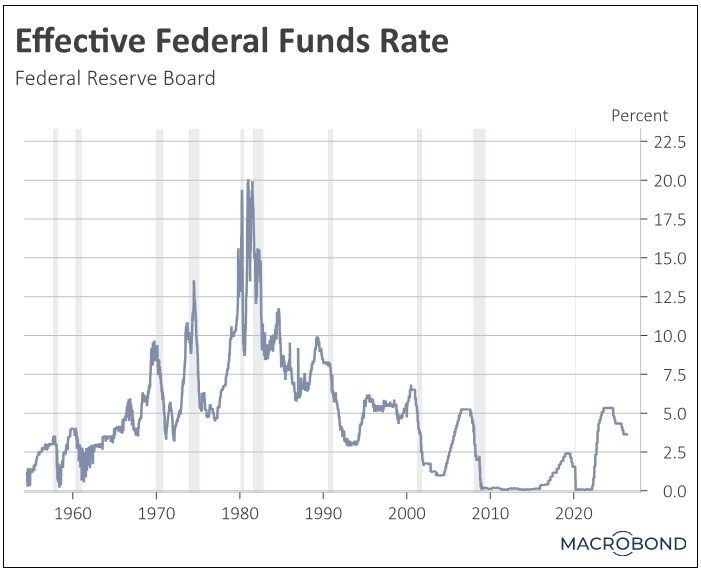
That trajectory was abruptly upended by the first global pandemic in over a century, prompting a nationwide lockdown and a coordinated push by the Fed and the federal government to inject liquidity and avert a prolonged downturn. The Fed rapidly scaled up its crisis‑era tools and leaned more heavily on forward guidance, while rolling out new facilities to stabilize markets and support credit to households and businesses. In doing so, it extended liquidity well beyond the banking system, marking a notable shift from its traditional focus on backstopping distressed banks.
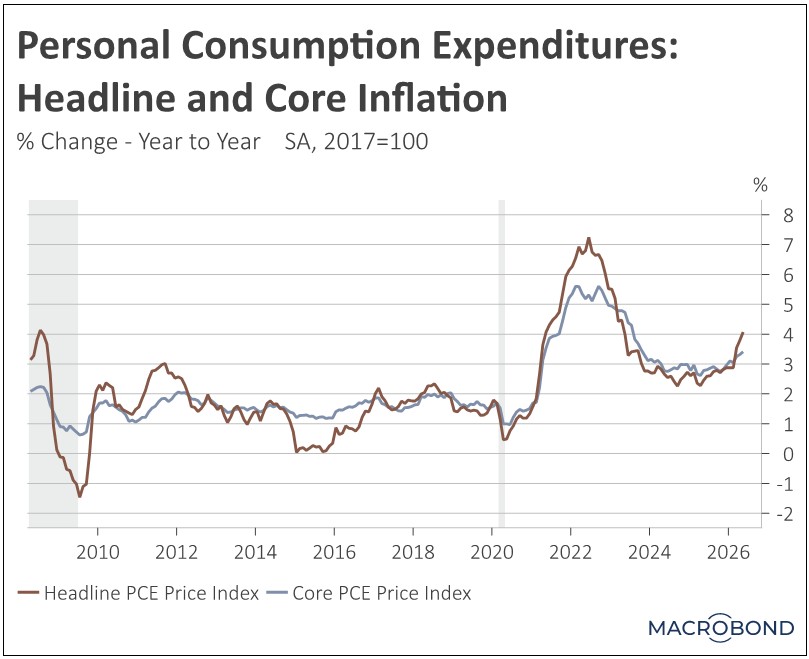
As COVID faded, the Fed confronted a new challenge of resetting policy for an economy emerging from the pandemic. During the early recovery, it effectively emphasized the maximum‑employment side of its mandate over the inflation objective, fearing that the end of lockdowns would still leave many workers struggling to reenter the labor force after prolonged layoffs and amid deep uncertainty about the durability of the rebound. As price pressures began to build, officials judged that much of the increase reflected uneven reopenings and temporary bottlenecks, which they expected to unwind over time, an assessment that led policymakers to famously label inflation as “transitory” and signal that rates would remain lower for longer.
However, as the recovery progressed and labor demand began to outstrip supply, a series of exogenous shocks — from the Suez Canal blockage to major ransomware attacks and, ultimately, Russia’s invasion of Ukraine — amplified the inflationary impulse already fueled by aggressive fiscal and monetary support. With inflation running well above its 2% target, the Fed was forced into an abrupt and politically costly U‑turn, abandoning its lower‑for‑longer stance and launching a rapid tightening cycle.
The decision to tighten created major complications as the Fed was widely perceived to be behind the curve on inflation. This perception contributed to an unprecedented spike in bond volatility. In an effort to regain its credibility, the Fed sought to hike rates more aggressively by moving from 25 basis points per meeting to 50, and then to 75. This rapid escalation only fueled further unease, offering no clear signal as to where the upper limit might be. Such uncertainty triggered a sudden run on regional banks like Silicon Valley Bank, which had mismanaged duration risk by relying too heavily on the Fed’s forward guidance.
As inflation showed signs of easing, the Fed restored some of the credibility that its earlier missteps had called into question, not only regarding its previous decisions but also its ability to provide reliable guidance on the future path of interest rates. However, its decision to lower rates in September was largely viewed as political, despite the Fed having provided hints in the previous meeting that the committee was leaning in that direction, largely because the move came so close to the election.
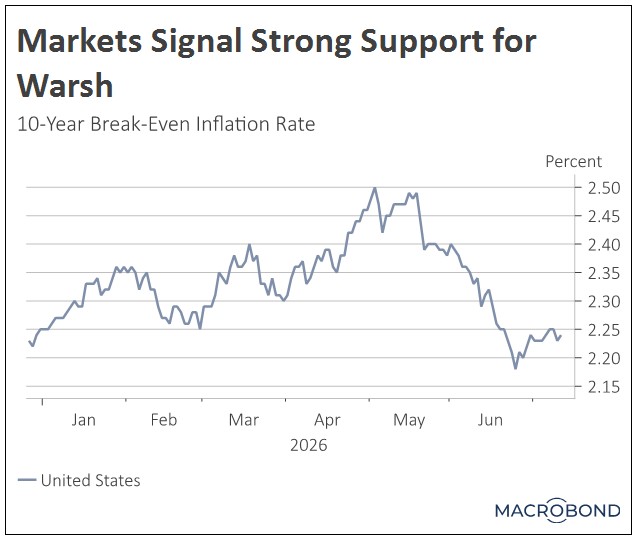
This perception of political bias became a major theme in the lead-up to Warsh taking over as Fed chair, as critics began to view monetary policy decisions as favoring a particular party. While that claim is debatable, it nonetheless became one of the key reasons why Warsh has decided to undertake a major revamp of Fed culture, beginning with its communications strategy. His hope is that reducing the Fed’s transparency, among other changes, could help restore its reputation and bring the Fed back to its pre-GFC stature. So far, markets appear to trust that he is the right person to do it.
In Conclusion
While it is impossible to know what conclusions the task force will ultimately draw regarding the Fed’s current communications strategy, recent experience suggests that a reassessment may be warranted. All things considered, reducing the use of forward guidance could enhance the Fed’s credibility as it works to achieve its dual mandate of price stability and maximum employment. However, the effectiveness of this shift will depend on the degree and the way guidance is scaled back. If the Fed becomes more selective, offering forward guidance only when it has a high degree of confidence in its policy path, it could strengthen its reliability, while still helping anchor expectations and contain bond yields. By contrast, a more aggressive withdrawal, either by eliminating forward guidance entirely or withholding it during periods of heightened uncertainty, could introduce greater volatility in fixed income markets and place upward pressure on yields.
Don’t miss our accompanying podcasts, available on our website and most podcast platforms: Apple | Spotify
Asset Allocation Bi-Weekly – #161 “The Consensus Builder” (Posted 4/27/26)
Asset Allocation Bi-Weekly – The Consensus Builder (April 27, 2026)
by Thomas Wash | PDF
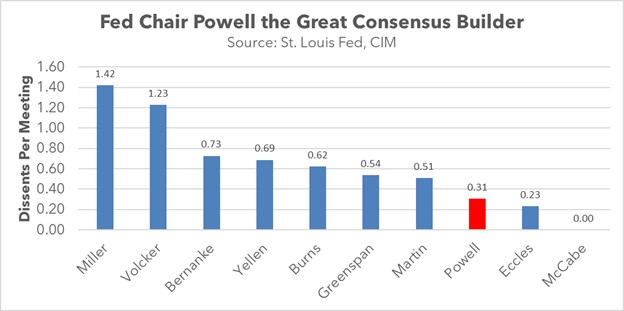
You never really appreciate a good thing until it’s gone. May 15 will be the final day in office for Federal Reserve Chair Jerome Powell, one of the most effective consensus builders in Fed history. Despite an extraordinary series of shocks during his tenure — from the 2019 repo market turmoil and the COVID‑19 pandemic to Russia’s invasion of Ukraine, the collapse of Silicon Valley Bank, new tariffs, and most recently the war in Iran — Powell’s ability to forge agreement on policy has stood out during the most aggressive hiking cycle since the Volcker era. It will likely be more difficult to sustain such unity when rates begin to ease.
Despite the controversy surrounding the Fed’s characterization of post‑pandemic inflation as “transitory,” Powell has still been able to set policy with near‑unanimous support on the FOMC. His ability to forge consensus is even more striking when set against that of his immediate predecessor. Based on available FOMC voting data, only two Fed chairs — Marriner Eccles and Thomas McCabe (who only served roughly three years as chair, 1948-1951) — have recorded fewer dissents per meeting.
While disagreements among policymakers were evident in speeches, projections, and occasional dissents, those differences were never significant enough to keep most members from ultimately backing major policy moves. That cohesion is all the more striking given the unusual amount of changes under Powell’s more than eight years as Fed chair, during which the Fed introduced a range of new liquidity facilities — both temporary and standing — to address and prevent bank runs, raised rates from the effective lower bound to their highest levels in over two decades, and oversaw a sharp expansion followed by a significant reduction of the Fed’s balance sheet.
The lack of dissent has likely helped provide markets with greater clarity on the overall direction of policy, even as investors have continually repriced the size and timing of moves in response to incoming data and Fed communications. While expectations for the magnitude of individual rate changes have fluctuated, the broad directional signal from the FOMC has generally remained aligned with subsequent policy decisions.
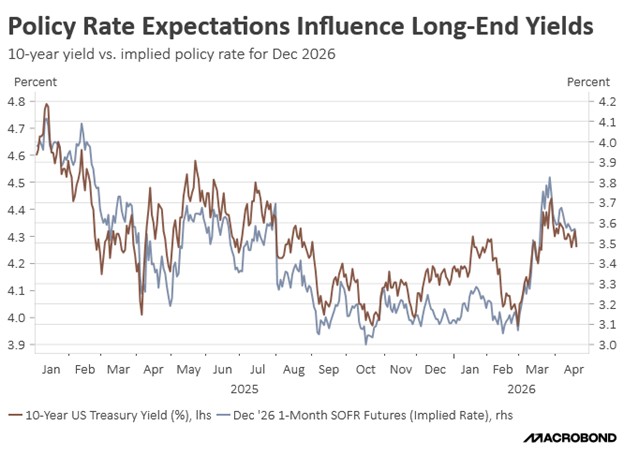
This relative certainty has made it easier for the Fed to influence long‑term interest rates by shaping expectations for the path of short‑term rates, particularly through its guidance and published projections. That influence is evident in the close co‑movement between pricing in overnight policy‑rate futures and the 10‑year Treasury yield over recent cycles, even though other factors such as term premia and global risk sentiment also play an important role.
Powell’s ability to build consensus is closely tied to the nature of the crises that defined his tenure and the clarity they gave to the Fed’s mandate. In the early phase of the pandemic, lockdowns and a sudden collapse in activity and employment made the case for cutting rates to near zero and deploying emergency tools to support a severely stressed labor market. Later, the need to raise rates was driven by an unprecedented surge in inflation that posed a direct threat to price stability, giving the FOMC a strong shared rationale for an aggressive tightening campaign.
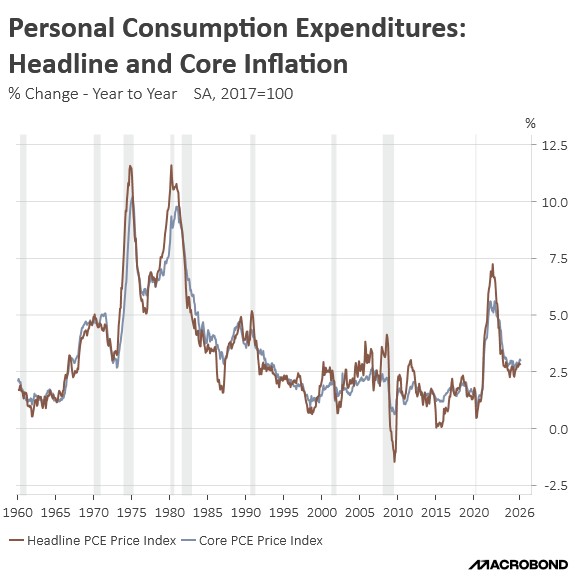
Powell’s named successor, nominee Kevin Warsh, is likely to find it much harder to limit dissents if he pushes for the deeper rate cuts that he has argued will support the AI buildout. Even though the Fed has already begun lowering rates, its inability to return inflation to its 2% target for more than five years has heightened concerns about moving too aggressively. The war in Iran further complicates the outlook, as renewed supply chain disruptions and higher energy prices are already showing signs of adding upward pressure to inflation.
As Powell departs the chair position and potentially the Board of Governors as well, bond markets are likely to face more volatility if Warsh were to press for rate cuts while inflation remains elevated. In our view, there is ample evidence that many FOMC members are prepared to resist cuts they see as unwarranted when inflation is drifting higher, a dynamic that could translate into greater instability in longer‑duration Treasurys as investors grapple with a less predictable policy path. By contrast, if inflation resumes a clear downward trend, Warsh’s job of building consensus could become much easier, allowing the Fed to retain meaningful influence over longer‑term yields.
Don’t miss our accompanying podcasts, available on our website and most podcast platforms: Apple | Spotify
Asset Allocation Bi-Weekly – #140 “White House vs. The Fed: The Looming Battle for US Monetary Policy ” (Posted 5/19/25)
Asset Allocation Bi-Weekly – White House vs. The Fed: The Looming Battle for US Monetary Policy (May 19, 2025)
by Thomas Wash | PDF
The Federal Reserve’s independence faces its most serious challenge in decades as the Trump White House escalates its criticism of central bank policy. This brewing confrontation echoes historic tensions — most notably the 1951 clash between President Truman and Fed policymakers over yield caps that ultimately led to the Treasury-Fed Accord. Today, the battle lines are being redrawn as the administration pushes for more accommodative monetary policy while it looks to shield the economy from its own trade war.
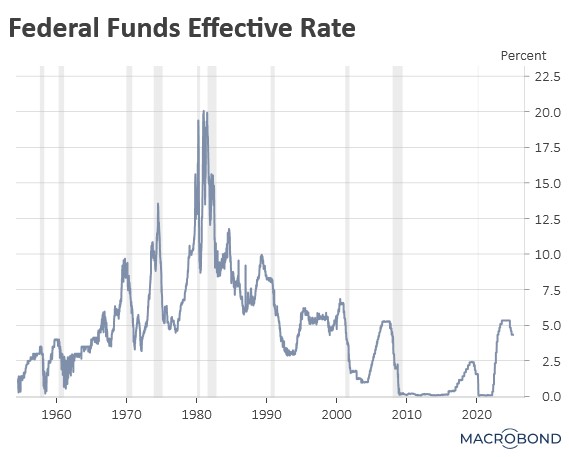
The widening policy gap between the Fed and its global peers has been highlighted in recent months. While the European Central Bank, Bank of England, and the People’s Bank of China have all lowered their benchmark short-term interest rates to combat slowing growth, the Fed has held its benchmark rate steady — a decision repeatedly criticized by the White House. This policy divergence is further strained by the Fed’s quantitative tightening program, which Treasury Secretary Bessent argues complicates the issuance of longer-term government securities.
The debate has now moved beyond short-term policy disagreements to fundamental questions about the Fed’s role and independence. Former Fed Governor Kevin Warsh, widely seen as the leading candidate to replace Chair Powell when his term ends in 2026, has emerged as a vocal critic of the central bank’s current direction. His critique focuses on two key concerns: first, that the Fed has strayed beyond its core mandate by engaging in issues like climate change policy and diversity, equity, and inclusion; and second, that its operational approach — particularly the frequency of public commentary by FOMC members — has created unnecessary market uncertainty.
Market participants are closely watching several potential flashpoints. The administration has reportedly considered accelerating the leadership transition by nominating Powell’s successor well before his term concludes, a move that could allow markets to price in policy changes gradually. Warsh’s combination of Republican credentials, Fed experience, and Treasury background makes him the probable choice, although some investors question how his well-documented hawkish views might align with the administration’s apparent preference for easier monetary policy.
The stakes for investors are significant. Any perception of compromised Fed independence could trigger a reassessment of risk premiums across asset classes. Treasury yields may face upward pressure, particularly at the long end of the curve, while the dollar could weaken if markets question the central bank’s commitment to price stability. In other words, concerns about reduced Fed independence could exacerbate the budding US capital flight that we discussed in our recent Asset Allocation Bi-Weekly from May 5, 2025. Perhaps most critically, the Fed’s ability to serve as a stabilizing force during future economic downturns could be diminished if political considerations are seen to influence its decision making.
As this drama unfolds, market participants would be wise to monitor three key developments: the timing and nature of any leadership transition, changes to the Fed’s communication strategy, and, most importantly, whether the central bank can maintain its operational independence while navigating increasingly choppy political waters. The outcome of this power struggle will shape monetary policy and market dynamics for years to come.