


Tag: divided government
Asset Allocation Bi-Weekly – The Third-Year Charm: Why Gridlock Sets the Stage for Market Growth (November 2, 2026)
by Thomas Wash | PDF
Every political cycle arrives wrapped in apocalyptic campaign ads branding the upcoming election as “the most consequential of our lifetime.” Yet while political strategists focus on polarization, we are watching a far more concrete signal: stock market performance over the four-year presidential cycle.
From 1930 to 2023, the third year of a president’s term generated the strongest equity returns of the four-year cycle, driven largely by especially outsized gains in the stretch immediately after the midterm elections. That pattern is especially pronounced under second-term Republican administrations, when post-midterm rallies gain significant momentum, which could point to a strong 2027.
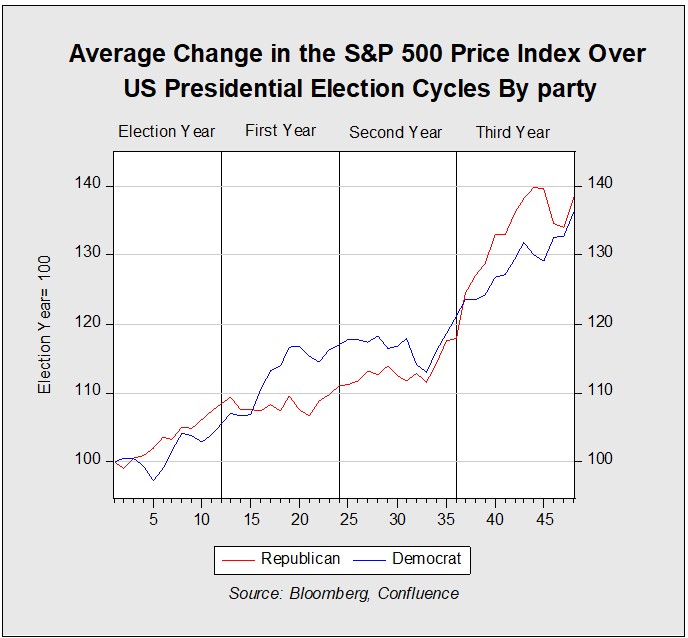
Measured from the start of the election year, when markets begin pricing in political shifts, through the third year of a term, stock returns under Republican presidents have slightly outpaced those under Democratic ones, with the S&P 500 rising 38.3% compared to 36.2%. What makes this outperformance particularly striking is that markets under Republican presidents typically underperform in their first two years, only to rally sharply in the third.
The market’s strong third-year performance is driven primarily by expectations of greater policy predictability. Historically, the party that lost the previous presidential race enjoys a midterm resurgence as rallying a frustrated base is far easier after a defeat. When this opposition party gains control of Congress, it creates legislative gridlock, tempering the administration’s most aggressive policies and forcing both parties toward consensus.
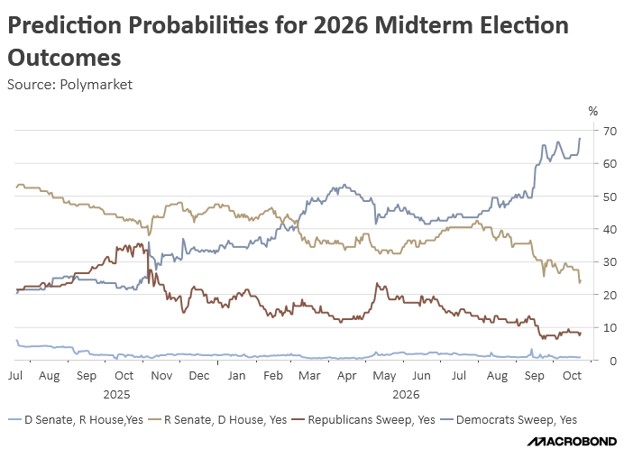
The latest Polymarket odds show more than an 80% probability that Democrats will take control of the House in the upcoming midterms. While prediction markets also favor a Democratic Senate takeover, polling data suggests those races may be much closer. Divided government — whether Democrats win one chamber or both — would likely bring gridlock after two years of unified Republican control of the White House and Congress.
Historically, shifts in congressional control have served as a vital check on executive and legislative overreach. For example, the 2022 midterm elections created a split Congress, reining in Democratic expansionary spending plans and easing investor worries over out-of-control federal deficits. Similarly, the 2018 midterms produced a divided government, forcing both parties to the negotiating table in 2020 and resulting in bipartisan economic relief packages for businesses and families during pandemic lockdowns.
Depending on whether Democrats take control of one or both houses of Congress, changes in fiscal and foreign policy could provide a welcome boost to markets. Democratic control of the House, in particular, would put the spotlight on the federal deficit. Because neither party would hold total control, both sides could be forced to compromise to pass a budget and avoid a government shutdown. While this budget fight may trigger political brinkmanship, it should ultimately yield a more concrete framework to curtail spending.
On the other hand, a Democratic sweep of Congress would pose a greater challenge to the executive branch, forcing the White House to coordinate more closely with lawmakers. While this legislative process is rarely pretty, both sides should ultimately be able to align on a clearer strategy on national security, trade, and AI governance. By balancing power between the executive and legislative branches, divided government tends to reduce market uncertainty by preventing sudden, unilateral policy shifts and fostering greater transparency.
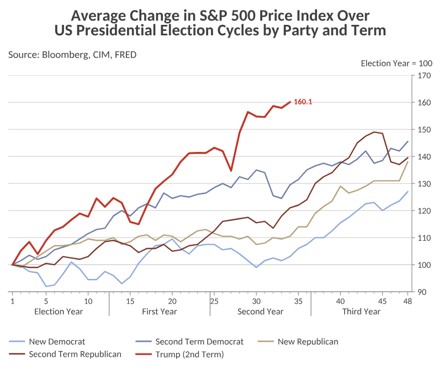
Markets typically perform better in a president’s third year because policy becomes far more predictable — a dynamic that could prove particularly beneficial heading into 2027. While data from George W. Bush’s presidency was distorted by the start of the subprime mortgage crisis in 2007, second-term Republican administrations have historically delivered the strongest third-year market gains. That same pattern could emerge this time around, particularly since fluctuating trade, fiscal, and foreign policies have created price volatility and complicated efforts to deploy capital beyond the AI sector — pressures that more gridlock could help ease.
Ultimately, the prospect of a more balanced Congress forcing bipartisan cooperation should serve as a key market catalyst. Fewer abrupt policy shifts would make it easier for companies to plan for the future. This newfound clarity — paired with lower interest rates driven by easing geopolitical tensions and better fiscal policy — should allow businesses to capitalize on the AI buildout and expand investment across the broader market.