

by Patrick Fearon-Hernandez, CFA | PDF
While investors in the United States have been understandably focused on the jump in US bond yields this autumn, it’s important to remember that yields have risen in most major foreign countries. Like other observers, we see many potential reasons for the run-up in rates, including concerns about higher consumer price inflation because of the US-Israeli war against Iran, unexpectedly strong economic growth in the US, and massive demand for capital by firms working on artificial intelligence. Other potential drivers include growing doubts about the credibility of key central banks and fears that rising government budget deficits and debt loads in the US and beyond could lead to sovereign defaults or financial repression (artificially holding down bond yields). Finally, some observers argue that the rise in yields is just a normalization process that will bring rates back up to their long-run norms after they were artificially suppressed during and following the Great Financial Crisis.
The rise in government bond yields has been especially sharp in France. Of all the problems that could be pushing up yields, rising deficits and debt loads are probably the most concerning in France, where the budget deficit has reached more than 5% of gross domestic product and the public debt burden is marching toward 100% of GDP. Those metrics would be much less alarming in a more dynamic, faster-growing economy such as that of the US. But for France, they are becoming much more worrisome for investors. Moreover, political gridlock in the French parliament suggests the government cannot soon implement the austerity program that would probably be needed to bring the debt under control and ensure its obligations are met. That problem is increasingly seen as a possible sign that France could pull out of the eurozone to gain the policy flexibility it needs to address its difficulties. And, of course, the issues in France could point to similar challenges elsewhere in the eurozone. Logically, these fears have started to weigh on the value of the euro.
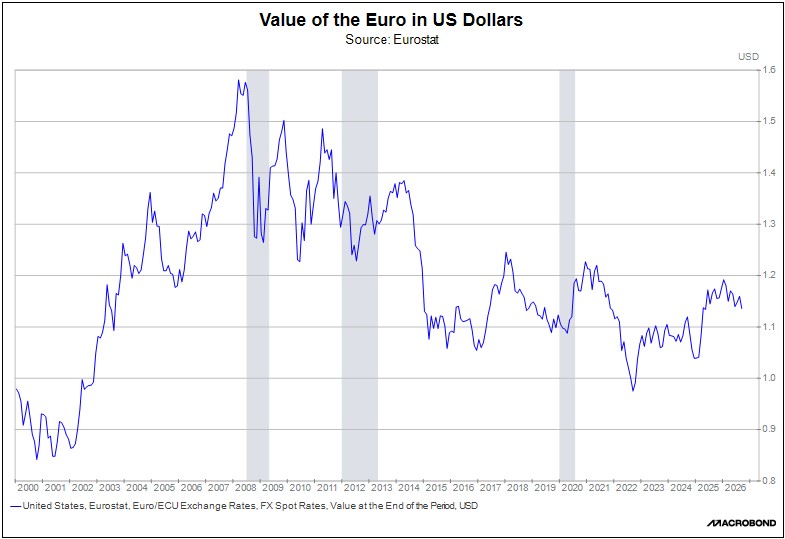
The chart below shows one way to gauge the softening of the euro this year. Over that period, the value of the euro in dollar terms fell from $1.1919 at the end of January to just $1.1355 at the end of September, for a decline of 4.7%. However, from a longer perspective, the euro-dollar exchange rate doesn’t look so out of line. The euro has actually been significantly weaker against the dollar for most of the last decade.
We think a more telling comparison is the value of the euro versus the value of the Swiss franc. After all, Switzerland sits at the very center of Europe, literally surrounded by the eurozone. Switzerland’s economy is much closer to that of the eurozone in structure, policy, and trading relationships than the US’s, but it is widely seen as a more dynamic, better run economy. As a result, the Swiss franc has long been viewed as a safe haven. So, how has the euro performed against this benchmark?
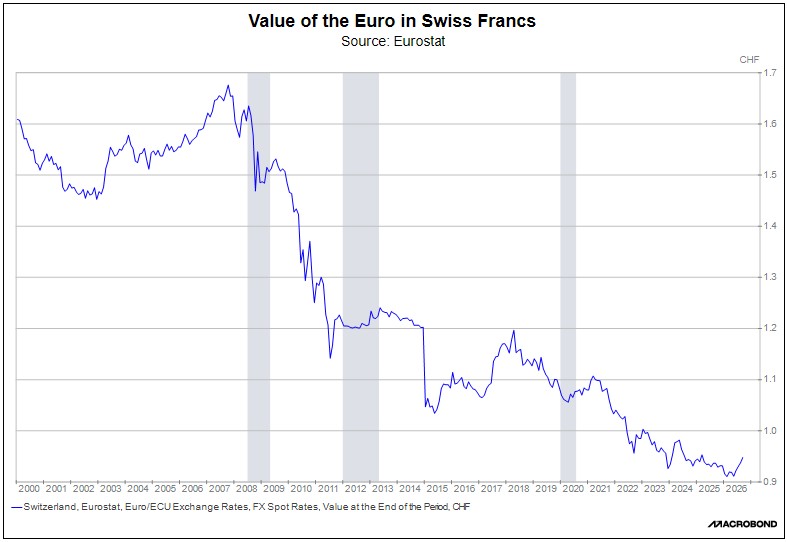
The chart on the next page shows the value of the euro in terms of Swiss francs. Comparing the euro to this key European peer currency, we see that it has actually been losing relative value for almost two decades. The long downtrend in the euro versus the franc is especially notable given that Switzerland’s benchmark short-term interest rate is essentially 0%, while its longer-term bond yields are significantly lower than those of not only France but even Germany. While Switzerland has occasionally adopted unorthodox economic policies, it still sports an unusually stable environment compared with the eurozone, including a strong fiscal position and low inflation.
In sum, the almost uninterrupted slide in the value of the euro versus its key European peer, the Swiss franc, points to longstanding investor concern about the viability of the eurozone. This doesn’t mean that a breakup of the eurozone is set in stone, and it doesn’t suggest a breakup is imminent. Indeed, as shown at the far right of the chart, the euro has actually appreciated versus the franc in recent months. All the same, we think the ongoing downtrend in the euro-franc exchange rate is a reminder to be cautious about the single currency and eurozone assets, including bonds and stocks.