

Daily Comment (March 6, 2026)

by Patrick Fearon-Hernandez, CFA, and Thomas Wash

[Posted: 9:30 AM ET] | PDF

Our Comment opens with our views on how the Middle East conflict is shaping the monetary policy outlook. We then provide a brief overview of other key market developments, including state lawsuits seeking to roll back the latest tariffs, new restrictions on chip exports, normalizing ties between the US and Venezuela, and the escalating dispute between the Pentagon and Anthropic. We also include a summary of recent US and international data releases.

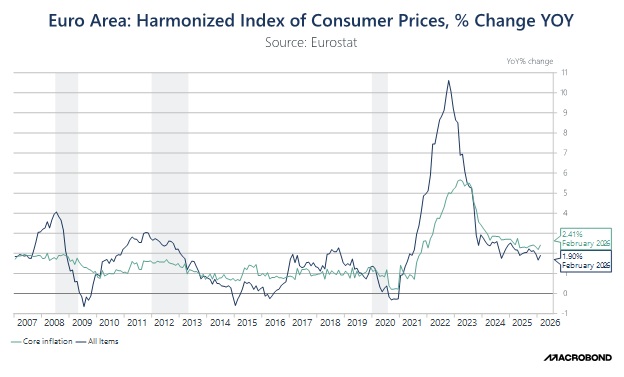
Iran and Monetary Policy: The escalating Middle East conflict is clouding the Federal Reserve’s policy path, introducing fresh uncertainty as it threatens to reignite inflation. Heightened tensions are raising alarms over potential global supply chain disruptions, with Brent crude nearing $90 a barrel and US gasoline prices climbing nearly 30 cents since hostilities began. This renewed price pressure has led to concerns that the Fed could pivot from debating when to cut rates to weighing whether hikes are needed to balance supply and demand.

  • Concerns over the potential inflationary impact of the war have already begun to weigh on both the fixed income and currency markets. The 10-year Treasury yield has surged, rising nearly 15 basis points over the last three days to hit a three-week high. Meanwhile, futures markets are rapidly pricing out expectations for rate cuts, with war-induced price pressures now seen as a key factor that could prevent the Federal Reserve from easing policy at all this year.
  • The recent market moves highlight concerns that the war could last longer than initially expected and potentially widen its geographic footprint. Azerbaijan has accused Iran of drone attacks on its territory and demanded explanations from Tehran, underscoring the risk of spillover along Iran’s northern border. At the same time, a US submarine strike that sank an Iranian warship off the coast of Sri Lanka has brought the conflict directly into the Indian Ocean, closer to key shipping routes serving India and Sri Lanka.
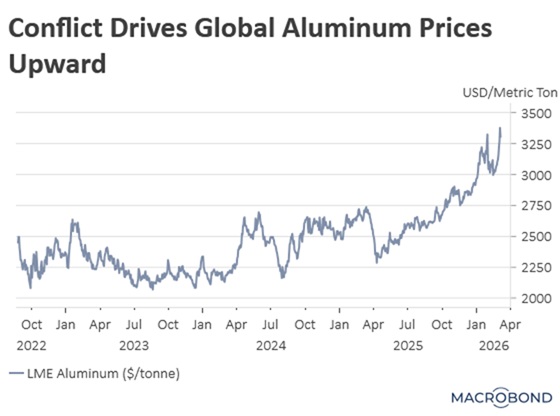
  • The conflict has already raised alarms about supply chain disruptions amid slowing trade flows. The Strait of Hormuz, a critical global shipping chokepoint, has already seen traffic sharply curtailed, raising the risk of broader trade bottlenecks. While energy markets have drawn the most attention, regional instability is also affecting other commodities, with industrial metals such as aluminum increasingly vulnerable to being caught in the crosshairs.
  • What the Fed does next will likely hinge on whether the conflict creates a meaningful supply/demand imbalance. If policymakers judge that supply disruptions could trigger a sustained price shock, they may feel compelled to pause rate cuts and even consider another hike. By contrast, if they expect the conflict to be short-lived, with supply normalizing quickly, or if they believe weaker demand will contain inflation without further action, then they may opt to keep policy unchanged.
  • The labor market is likely to be another key factor in whether the Federal Reserve shifts its policy stance. After a weak 2025, when employment recorded the slowest non‑recession job growth in more than two decades, hiring now appears to be stabilizing and gradually improving. If that nascent recovery were to fade, Fed officials could feel pressure to lower rates to support job creation.

  • In our view, the recent conflict and associated risk of a supply shock have likely reduced the scope for rate cuts this year, given the potential for higher input prices to feed into inflation. That said, we still see the possibility for some easing, assuming the conflict is resolved relatively quickly or the labor market slips back toward the pronounced slowdown seen in 2025.

Tariff Troubles: Several US states are pressing the Trump administration to halt the next round of tariffs following the Supreme Court’s decision to overturn the original measures. The pushback comes as the White House seeks alternative ways to ensure trading partners comply with the terms of its trade agreements. This added friction is likely to deepen uncertainty for businesses, which are struggling to assess whether current or proposed tariffs will ultimately remain in place, potentially leading to a period of strategic inertia.

Chip Restrictions: The US is weighing new rules that would further limit where chipmakers can do business. Under draft regulations from the Commerce Department, exports of certain chips would be restricted to destinations that have not received explicit approval from the White House. Although not yet final, the proposal could effectively curb the sale of most high‑end AI accelerators. The move underscores the government’s growing role in shaping the broader economy.

‘Don’roe Doctrine: The US and Venezuela have officially restored diplomatic ties, highlighting Washington’s renewed focus on Latin America. The move follows the US-backed transition that removed Nicolás Maduro from power earlier this year and signals a desire to draw South America more firmly back into its strategic and economic orbit. In our view, South American countries that deepen ties with the US could benefit from preferential trade access and increased investment flows, making them potentially attractive destinations for long‑term capital.

AI Showdwon: The dispute between Anthropic and the Pentagon has intensified after the US government formally categorized the AI firm’s technology as a supply-chain risk. The designation could restrict Anthropic from future defense collaborations and threatens its existing $200 million Pentagon contract. The conflict stems from disagreements over the company’s willingness to support certain government applications that it believes conflict with its internal ethical guidelines. This standoff could set a precedent for future public-private partnerships.
View PDF

Daily Comment (March 5, 2026)

by Patrick Fearon-Hernandez, CFA, and Thomas Wash

[Posted: 9:30 AM ET] | PDF

Our Comment opens with our take on China’s decision to revise its growth target. We then discuss the US economy in light of the latest ISM survey and ADP report. Next, we provide an update on Iran, examine another key breakthrough for crypto, and assess US shale’s ability to meet incremental demand following the Middle East conflict. We close with a summary of key US economic data and notable moves across global markets.

China Rethinks Target: The world’s second-largest economy has lowered its GDP target for the first time since 2023. On Wednesday, Beijing announced it would cut its growth target to a range of 4.5% to 5.0%, down from the previous target of 5.0%. The downgrade is being viewed as a signal that the government is willing to tolerate slower expansion as it pivots its growth model to address current challenges, including global pushback against its export-led strategy and a struggling real estate sector.

  • Beijing’s move to set a lower growth target range is widely seen as giving policymakers more room to tackle structural problems such as industrial overcapacity and weak domestic demand — issues that have also drawn criticism from key trading partners. At the same time, China’s state-led growth model has come under intensifying scrutiny, with the IMF recently urging Beijing to scale back sizable industrial subsidies and shift toward a more consumption-led model.
  • A transition in China’s growth model would be desirable, but it is unclear if the government is prepared to make the pivot. Consumers are seeing their net worth erode as the real estate sector continues to struggle, depleting household savings. Meanwhile, rather than stepping in with stimulus to restore confidence, Beijing has chosen to trim subsidies for consumer goods, raising questions about its commitment to supporting households through the transition.
  • That said, the shift represents an opportunity for China to negotiate a trade pact with the US as Presidents Xi Jinping and Donald Trump prepare to meet in a few weeks. The White House has signaled that any new agreement will require China to reform its export model and improve access for US business interests. Consequently, a lower growth target may signal China’s willingness to alter its economic model in exchange for reduced tariffs.
  • While the market ramifications of China reducing its growth target may not be immediate, we believe the move is a net positive if it paves the way for more productive trade talks. A potential agreement would benefit both equity markets but would be particularly impactful for US tech companies. In particular, a deal that loosens restrictions on Chinese rare earth minerals, critical components for emerging technologies, would provide a significant boost to the sector.

Economic Momentum: There are growing signs that the economy is gaining momentum as firms become more confident about future planning. The latest ISM Purchasing Managers’ Index showed business activity accelerating at its fastest pace since 2022, rising from 53.8 to 56.1 in February. Meanwhile, new data from ADP revealed that private employers added 63,000 jobs last month, well above the downwardly revised 11,000 in January, marking the strongest gain since July and suggesting companies are increasingly optimistic about future demand.

  • The latest ISM services report points to a clear pickup in demand. Key components such as inventories, backlogs, and new export orders are all in expansion territory, indicating a broad-based surge in activity. At the same time, the prices‑paid index has fallen below its 12‑month average, signaling that cost pressures, while still elevated, are starting to ease.
  • Meanwhile, private payroll data show that healthcare remains the primary driver of job growth, adding 58,000 positions in February. Construction also contributed significantly, with a gain of 19,000 jobs, while the information sector added another 11,000. In contrast, employment across most other sectors either declined slightly or remained largely unchanged from the previous month.
  • Despite ongoing economic improvement, business sentiment is being tempered by significant concerns over tariffs and the disruptive potential of AI. The latest ISM report underscores this shift, with anecdotal commentary revealing an intensified focus on cost pressures. On the labor front, the absence of robust job gains points to a prevailing “low hire, low fire” mentality. Crucially, this corporate caution regarding workforce expansion appears to be directly amplified by the rapid iteration and integration of AI technologies.
  • Overall, the economy continues to demonstrate resilience and is likely to remain on solid footing barring a major external shock. However, uncertainty surrounding tariffs and AI disruption warrants a cautious stance. We recommend managing risk by maintaining a balanced portfolio that includes diversifying beyond technology into other overlooked large cap sectors poised for growth, while also adding international exposure to hedge against domestic volatility.

Iran Update: The conflict has now entered its sixth day, and there are still no clear signs of an off-ramp. Iranian officials on Wednesday rejected reports of backchannel talks with the United States and warned that their war efforts will intensify. The White House, however, continues to express confidence that it has degraded Iran’s capacity to strike and is moving closer to bringing the conflict to an end. We continue to presume this turmoil will affect commodity markets, with higher oil prices and aluminum prices now also moving up. 

Crypto Access: In a landmark move for digital assets, the Federal Reserve has granted its first master account to a cryptocurrency firm. Kraken Financial secured a limited-purpose master account, providing direct access to the Fedwire Funds Service. This integration allows for significantly faster transfers and serves as a pivotal signal that cryptocurrency is maturing into a mainstream fixture of the global financial system.

US Shale Constraints: US shale drillers are signaling they may struggle to meet additional supply needs in the wake of the recent Middle East turmoil. Their main concern is that the high cost of new projects could undermine competitiveness at a time when the industry is focused on repaying shareholders. New developments are also expected to take time before coming online, limiting the near-term response. Taken together, constrained US supply suggests a prolonged conflict in the Middle East could keep oil prices elevated.

View PDF

Daily Comment (March 4, 2026)

by Patrick Fearon-Hernandez, CFA, and Thomas Wash

[Posted: 9:30 AM ET] | PDF

Our Comment opens with our assessment of the latest developments in Iran. We then examine how the conflict is reshaping the US relationship with its transatlantic allies. Next, we look at the Texas primary elections, review a new report on Germany’s infrastructure woes, and highlight emerging signs of renewed US engagement in South America. We also include a summary of key US economic data and notable moves in global markets.

Iran Conflict Broadens: Iran’s actions have disrupted trade throughout the Middle East and damaged several key oil storage facilities. Both Saudi Arabia and Iraq are reportedly running short on storage capacity in the aftermath of the attacks. Meanwhile, China has faced difficulties securing the energy supplies it depends on from the Strait of Hormuz. These developments drove a sharp spike in energy prices, which were later eased following the US announcement of plans to escort tankers through the region’s troubled waters.

  • There are growing signs that the US is making meaningful progress in its campaign against Iran, sparking debate over what comes next. US officials say ongoing strikes are steadily degrading Iran’s ability to threaten American interests and regional partners. At the same time, President Trump has cautioned against leaving Iran with a leader who is “no better” than the previous ruler. As a result, the administration has left open the option of deploying US ground forces, even as it insists such a move may not be necessary.
  • That said, the conflict has shown signs of intensifying. Iran appears to be broadening the conflict across the Middle East to provoke its neighbors into intervening. The campaign escalated sharply this week with major strikes on Monday against the US Embassy compound in Riyadh, Saudi Arabia, and on Tuesday near the US Consulate in Dubai. The UAE has been a primary target, facing nearly as many drone and missile attacks as Israel.
  • As of this morning, there are tentative signs that Iran may be seeking an off‑ramp from the conflict. Reporting indicates that Iranian intelligence officials have made indirect contact with US counterparts to probe possible terms for ending the war. This comes amid mounting signals that Mojtaba Khamenei, the son of the late Supreme Leader Ali Khamenei, has emerged as the regime’s favored choice to succeed his father, even if that succession has yet to be fully formalized in public.
  • While we are cautiously optimistic that the conflict could wind down in the coming days, there are still no definitive signs that an end is imminent. We continue to see maintaining commodity exposure as a prudent stance for now, with prices, especially in energy, likely to remain supported by ongoing disruption and uncertainty. That said, if tensions begin to ease in a more durable way, a rotation away from commodities could already be in its early stages.

Allies Disunited: The US-Israel joint operation has triggered notable pushback as several allied governments question the speed and scale of the escalation. On Thursday, Spain and the UK were sharply criticized by the White House after both initially refused to let the US use military bases on their territory to conduct strikes on Iran. In response, President Trump has threatened to cut off trade with Spain and publicly disparaged UK Prime Minister Keir Starmer’s leadership, saying he is “no Churchill.” The friction is another sign of the fraying transatlantic relationship.

  • Around the world, the response has been mixed, with many US allies stressing that Iran’s nuclear ambitions and regional aggression must be constrained even as they voice concern about the scale and legality of the US‑Israeli strikes. This tension was captured by Canadian Prime Minister Mark Carney, who backed efforts to prevent Iran from obtaining a nuclear weapon “with regret,” called the conflict “another example of the failure of the international order,” and urged rapid de‑escalation in the region.
  • Disagreements over the Iran strikes are emerging just as the US and its allies rework their broader security relationship. Washington is pressing partners to shoulder more of their own defense burdens, while the rest of the West steps up support for Ukraine and adjusts to a less predictable role from the US. This shift has pushed other Western countries to accelerate defense spending and raise their international profiles, from military outlays to crisis diplomacy in Ukraine and the Middle East.
  • While we do not think the US will completely abandon its Western allies, we do expect them to gradually diversify their exposure to the US. This is likely to involve strengthening their own defense capabilities, deepening trade ties with other partners, and reshaping their financial markets to better compete with the US for investment flows. Nevertheless, this would be a drawn‑out adjustment rather than a rapid, wholesale shift.
  • This gradual diversification is mirrored by a broad de‑risking across global markets, where the prolonged conflict appears to have shifted investor sentiment. Gold and silver have declined even as the dollar has strengthened, underscoring its continued status as the cornerstone of the financial system. While the dollar has since given back some of its gains as of this writing, we will be watching closely to see whether this marks the start of a more durable trend.

Texas Primary: The Texas primary saw James Talarico defeat his Democratic rival, Jasmine Crockett, in a closely watched US Senate contest. On the Republican side, Senator John Cornyn and Attorney General Ken Paxton both advanced to a runoff for their party’s nomination. The Senate race has drawn international attention because it offers Democrats a rare chance to flip a seat in a state that has been reliably Republican for decades, with potential implications for the chamber’s balance of power.

German Infrastructure: Germany has pledged to improve its military readiness, but recent reports suggest it still has a long way to go. While its armed forces now benefit from better equipment and facilities after Berlin moved to strengthen security in the wake of Russia’s invasion of Ukraine, chronic underinvestment means basic infrastructure remains a major constraint. We continue to view higher defense outlays as a positive catalyst for German equities, particularly within the country’s defense sector.

US Ecuador: The US is continuing to deepen its ties across Latin America, in what increasingly resembles a modern Monroe Doctrine-style approach to the region. On Tuesday, the US and Ecuador launched a joint military operation targeting drug trafficking, underscoring Washington’s growing security footprint. We see this kind of cooperation as a potential precursor to closer economic links as well, suggesting that South American countries with strong relationships with the White House could become attractive destinations for investment.

View PDF

Daily Comment (March 3, 2026)

by Patrick Fearon-Hernandez, CFA, and Thomas Wash

[Posted: 9:30 AM ET] | PDF

Our Comment today opens with an update on the war in the Middle East. We next review several other international and US developments with the potential to affect the financial markets today, including a move by France to extend its nuclear weapons umbrella across Europe and reports that Kevin Warsh, the nominee to be the next chair of the Federal Reserve, does not intend to cut the central bank’s balance sheet as sharply as some have feared.

United States-Israel-Iran: The war against Iran not only continues today but shows signs of widening into a broader regional conflict that could increasingly impair the production and shipment of energy supplies. Iran continues to lash out at countries all over the Middle East, including a drone attack on the US Embassy in Saudi Arabia and missile attacks on key airports. We have also seen reports of rioting in Bahrain, raising the specter that Iran has pre-positioned civil unrest squads across the region.

  • In support of Iran, Hezbollah militants in Lebanon launched attacks on Israel, prompting the Israeli military to stage attacks across that country and send troops over the border.
  • Meanwhile, the US and its allies are becoming increasingly concerned that Iran’s unexpectedly large inventory of available missiles and drones could lead them to deplete their inventories of air-defense missiles.
  • President Trump has tried to dismiss those concerns explicitly, saying the US has a “virtually unlimited supply” of most weapons, while acknowledging that the country is “not where we want to be” on the highest-end weapons. Nevertheless, the threat of a shortage illustrates how the US and its allies have failed to field Ukraine-style anti-drone units armed with less expensive but still relatively effective defenses against drones.
  • In any case, the rapid depletion of US and allied air-defense assets likely increases the risk that other adversaries will take advantage of the situation. For example, it could tempt China to make a grab for Taiwan, while Russia could conceivably be tempted to stage attacks in Eastern Europe.
  • As the conflict continues to expand, investors are becoming more concerned about the global economic impact. Energy prices continue to rise, with Brent crude oil today up another 7.5% to $83.53 per barrel. Natural gas prices are also surging. In contrast, gold and silver prices have pulled back a bit, perhaps reflecting both profit taking and concerns about an economic slowdown sparked by high energy prices. Indeed, stock index futures and copper prices are also down sharply so far this morning.

US Politics: President Trump has offered a range of justifications for launching the war against Iran now, angering the Republican Party’s influential “America First” wing, but the concerns were amplified yesterday by Secretary of State Rubio’s assertion that the US had to act because Israel was going to attack. The statement was interpreted by some as subordinating US interests to those of Israel. The growing controversy among Republicans could increase the odds of the Democrats taking control of the House in the November midterm elections.

Eurozone: In an initial estimate, the February consumer price index was up 1.9% from the same month one year earlier, above expectations and up from 1.7% in the year to January. Excluding the volatile food and energy components, February core CPI was up 2.4% on the year, up from 2.2% in the year to January. The accelerating price hikes were driven in part by an uptick in energy prices as investors looked to the possibility of war against Iran. Now that the war has begun, price inflation in Europe is expected to accelerate further.

France: President Macron yesterday said France is working on a plan under which it will boost its arsenal of nuclear weapons and forward-deploy them among eight other European nations including the UK, Belgium, the Netherlands, Sweden, Denmark, Germany, Poland, and Greece. The goal of the program would be to offer Europe a comprehensive nuclear deterrence with increased survivability in time of war. The announcement is consistent with our oft-stated belief that current geopolitical changes could well spark a new, global nuclear arms race.

  • Importantly, if France becomes the linchpin for Europe’s nuclear deterrence, it would greatly increase the country’s influence over the rest of the Continent. At some point, that would likely become intolerable to Germany, given its centuries-old rivalry with France. Germany and other European countries, such as Poland, might then seek to develop their own independent nuclear forces.
  • While the future prospects for uranium prices are rosy because of Chinese and Indian plans for more nuclear electricity in the coming years, we have long maintained that the added demand for nuclear weapons around the world will also tend to push up prices for the metal.

US Monetary Policy: According to the Financial Times, acquaintances of Kevin Warsh say the nominee to be the next Fed chair would reduce the central bank’s balance sheet over time, avoiding sudden moves that could destabilize the financial markets. The sources also said Warsh would only seek to shrink the balance sheet after extensive talks on its potential effects with banks and the broader public. If accurate, the report suggests that Warsh got the nomination by promising President Trump that he won’t tighten monetary policy too quickly.

US Private Credit Industry: The Financial Times reports that Blackstone’s $82 billion private credit fund, Bcred, suffered net outflows of $1.7 billion in the first quarter, equal to 7.9% of its assets. Coming shortly after Blue Owl halted redemptions from its private fund focused on the same asset class, the news illustrates how investors have become increasingly worried about “cockroaches” in exotic private debt and asset-backed lending markets. That will likely help tighten financial conditions, increasing the risk of an economic or financial market downturn.

View PDF

Daily Comment (March 2, 2026)

by Patrick Fearon-Hernandez, CFA, and Thomas Wash

[Posted: 9:30 AM ET] | PDF

Our Comment today opens with some thoughts on the new war against Iran that the US and Israel launched on Saturday. We next review several other international and US developments that could affect the financial markets today, including more signs of weak consumer demand in China and a continued effort by Canada and India to reduce their trade dependency on the US.

United States-Israel-Iran: Obviously, the weekend launch of a joint US-Israeli military attack on Iran is the key news that will drive the markets today. The news has been widely reported, so we’ll just focus on the key highlights for investors. Importantly, the attacks targeted both Iran’s political leadership and its military, resulting in the death of supreme leader Ayatollah Khamenei on Saturday as well as dozens of other high officials. Nevertheless, the Iranian military has launched retaliatory strikes across the region, and military operations continue.

  • Reports suggest that Khamenei dispersed political and military authority before the fighting started, ensuring in particular that the Iranian military had standing orders to keep fighting even if he were killed. Indeed, some reports suggest the Iranian Revolutionary Guards Corps is now fighting nearly independently. That could make it difficult to stop the fighting even if some political leaders or groups in Iran decide they want peace.
  • More broadly, the chaos has the potential to spark secession efforts by various groups within Iran, similar efforts by groups in other regional countries, and/or intervention by other regional powers. In other words, the situation continues to pose the risk of a wider regional war.
  • The main goals of the US appear to be further degrading Iran’s military capability (especially its nuclear and missile programs) and prompting a popular uprising that would lead to a new regime or at least a serious alteration of the current one. However, if that doesn’t occur within the next several weeks, we suspect President Trump would declare victory and stop the operation. We believe Trump is especially cognizant that US voters have little stomach for yet another long war aimed at regime change in the Middle East.
  • All the same, military operations are notoriously difficult to control. At the moment, much risk remains, and investors are rightly on edge about further conflict and risks related to the region’s energy supplies.
  • Reports this morning say Iran has now staged a drone attack on one of Saudi Arabia’s most important oil facilities at Ras Tanura and is expanding its attacks on shipping through the Strait of Hormuz. That will raise the risk of Saudi Arabia joining the attacks on Iran and potentially spur Iran to further escalate its attacks on Saudi Arabia.
  • Separately, other reports say Iranian attacks have forced Qatar to shut down its liquefied natural gas production, causing global prices to soar and risking bringing Qatar into the conflict.
  • As a result, global oil prices are surging this morning, with Brent up about 8.6% to $79.04 per barrel. Natural gas prices have also surged. Gold prices are up 3.1% to $5,409.40 per ounce, but Treasury obligations have weakened, probably on concerns about rising consumer price inflation. Benchmark 10-year Treasury yields as of this writing are up modestly to 4.006%. Finally, US and European defense stocks are getting a strong bid.

China: BYD, which is now the world’s largest electric vehicle maker, said its February sales were down a whopping 41% year-over-year as a 50% rise in export sales was more than offset by a 65% plunge in domestic sales. The figures show how Chinese firms’ efforts to make up for China’s weak domestic demand by going abroad won’t necessarily work. The figures therefore illustrate a key vulnerability for Chinese stocks that are heavily focused on sales to domestic consumers.

South Korea: According to new data from the Trade Ministry, exports in February were up a strong 29% year-over-year, beating expectations and almost matching the 34% rise in January. The data show that much of the strength came from semiconductors, reflecting South Korea’s strength in producing memory chips. This serves as a reminder that foreign economies and stocks are also benefiting from the surge in US data-center construction for artificial intelligence.

Canada-India: During Canadian Prime Minister Carney’s visit to New Delhi today, he and Indian Prime Minister Modi agreed to accelerate their talks on a free-trade deal, seeking to sign a pact by the end of the year. The agreement illustrates how both countries are trying to broaden their trade relationships to reduce their dependence on the US. Over time, the plethora of new non-US trade deals could potentially rejigger world trade flows and affect global stocks, although it’s probably too early to identify the winners and losers at this point.

Argentina: In President Milei’s biggest legislative victory so far, the Senate on Friday passed a major deregulation of the labor market that will make it easier for firms to lay off employees. The reform will also roll back rigid restraints on hiring and working hours. By giving companies greater flexibility, the reform could improve economic efficiency and ease business conditions. That could also help boost foreign investment in the country. Overall, the reform is likely to be positive for the Argentine economy and stock values.

US Artificial Intelligence (AI) Industry: As threatened, the White House late Friday ordered all federal agencies to halt use of Anthropic’s Claude AI model over the company’s insistence on specific prohibitions against the Pentagon using the model for mass surveillance of US citizens or the autonomous killing of foreign adversaries. The Pentagon also designated Anthropic a “Supply-Chain Risk to National Security,” preventing any company doing business with the US military from also having a commercial relationship with Anthropic.

  • The big winner from the confrontation is likely to be OpenAI, which closed on a new funding round worth $110 billion on Friday and then later announced that it had reached a deal in which the Pentagon would use its AI models subject to red lines similar to those that Anthropic had demanded.
  • Nevertheless, the incident is another example of how the US government has now become much more aggressive about intervening in the economy and pressuring private firms to adopt or abandon specific policies.

Global Asset-Backed Securities Market: Investors in the asset-backed securities market have become alarmed by the collapse of British mortgage lender Managed Financial Solutions last week after it was discovered that the firm double-pledged collateral on some of its bonds. The scandal echoed recent concerns about similar shenanigans in the US asset-backed markets. These incidents are likely to make asset-backed investors increasingly skittish, which would likely raise the risk of a credit crunch and financial disruptions.

View PDF

Asset Allocation Bi-Weekly – The Dip That Didn’t Bounce (March 2, 2026)

by Thomas Wash | PDF

Retail investors have emerged as a crucial stabilizing force behind the ascent of the “Magnificent 7” in recent years. Rather than displacing institutional or ETF demand, their participation has added a new, resilient layer of support. This cohort’s propensity to buy and hold mega-cap tech stocks, even through periods of market anxiety, has helped sustain momentum and enthusiasm for these names, insulating them to some degree from the sharper sentiment swings affecting the broader market.

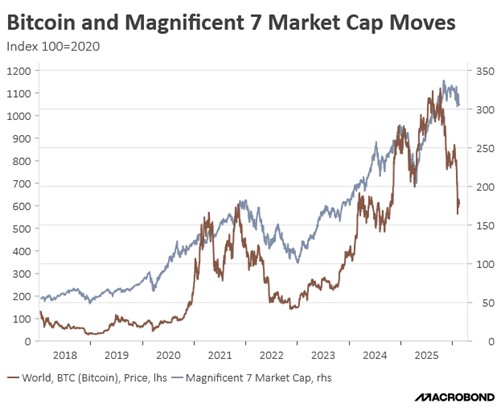
This distinct retail influence extends beyond equities, manifesting clearly in the behavior of Bitcoin. Estimates suggest that roughly two-thirds of Bitcoin’s supply remains in the hands of individual investors. Throughout 2024 and 2025, a notable correlation emerged, with Bitcoin and major tech and software names frequently moving in tandem. This parallel behavior reinforces the narrative that for many investors, particularly those with a higher risk appetite, mega-cap tech and crypto have effectively merged into a single, cohesive trade.

The sharp rise in Bitcoin and many tech-related stocks has coincided with a wave of new retail investors entering equity and crypto markets. This surge has been supported by pandemic-era stimulus payments, which boosted households’ risk-taking capacity, and by the rapid growth of easy-to-use, commission-free trading apps such as Robinhood, drawing many younger investors into markets for the first time. As a result of this new participation, the share of the daily trading volume of US equities attributable to individual investors went from the low single-digits pre-pandemic to nearly 20%.

This increased retail participation has pushed a larger share of market attention toward future growth potential and market themes, particularly in high‑growth technology and AI‑related names, rather than strictly traditional valuation metrics. Many retail investors have piled into rising tech stars, such as Nvidia, and into cryptocurrencies at the same time, often under the belief that prices would keep climbing, helping to cement a “buy‑the‑dip” mentality in which market pullbacks were frequently met with renewed retail buying.

This newer approach to investing has provided meaningful support to markets during periods of stress as it has been a source of incremental demand. Most notably, after President Trump’s “Liberation Day” tariff announcement sparked a sharp sell‑off, a strong wave of retail dip‑buying helped stabilize prices and fuel a powerful rebound. Also, brokerage and bank data indicate that retail investors’ returns around this episode and over 2025, as a whole, compared very favorably with many institutional strategies.

A major driver of this renewed wave of retail buying is the influx of younger investors into the market. Many of them have lived through a recession but have not experienced a deep, protracted equity downturn driven by widespread corporate failures. The only meaningful market pullback they recall is the 2022 episode, during which many of the hardest hit names later rebounded and went on to post extraordinary gains. As a result, many of these younger investors have held out hope that the equity market can help them accelerate their savings.

That said, retail investors — particularly younger cohorts — may prove to be a less reliable source of support for the market going forward. Using Bitcoin as a reference point, there are signs that individual traders have now become more risk‑averse, and this shift is starting to weigh on broader sentiment. This helps explain why the tech sector has seen limited upside so far this year, as investors continue to grapple with the true profitability of AI‑focused firms in light of their rising debt burdens and the threat they pose of triggering a broader “SaaS-pocalypse.”

While retail investors are likely to play a bigger role in markets over time, current uncertainty may prevent them from acting as buyers of last resort during future periods of stress. This growing risk aversion is especially likely to weigh on familiar large cap names in the technology sector. In our view, clients should pay closer attention to overlooked areas of the market as persistent pessimism toward mega‑cap tech could eventually drive a broader sector rotation as investors look to diversify into other industries.

View PDF

The accompanying podcast for this report will be available later this week.

Daily Comment (February 27, 2026)

by Patrick Fearon-Hernandez, CFA, and Thomas Wash

[Posted: 9:30 AM ET] | PDF

Our Comment opens with our thoughts on the recent disagreement between Anthropic and the Department of Defense. We then turn to the UK by-election, examining the broader populist wave sweeping across the West. Following that, we discuss the ongoing global chip shortage, provide an update on the Iran nuclear talks, and highlight recent solar funding advocacy within the White House. We also include a summary of key economic data from the United States and developments in global markets.

Pentagon Anthropic: Tensions between the US government and Anthropic escalated this week after the company said it cannot, in good conscience, agree to the Pentagon’s demand that its AI models be available for “all lawful purposes.” The stance puts Anthropic at risk of losing a Defense Department contract worth up to $200 million and of being labeled a “supply chain risk,” potentially barring its technology from Pentagon programs and key contractors. It also leaves the company vulnerable to the risk of being compelled to comply under the Defense Production Act.

  • The two sides have spent weeks negotiating over the Defense Department’s use of Anthropic’s systems for military and intelligence applications. Anthropic has insisted on explicit limits barring domestic mass surveillance and fully autonomous weapons that make targeting decisions without human oversight, while the Pentagon argues that existing law and internal policy already constrain such uses and that its contractors should not be able to veto lawful military operations.
  • AI is becoming increasingly integrated across the broader economy, and Anthropic has played a particularly prominent role. Its powerful AI tools have been a major catalyst for the so‑called “SaaS collapse,” reshaping how businesses use and value traditional software. As a result, the company is widely regarded as one of the leading players in the technology sector and is becoming strategically important to the country.
  • While there has been no official announcement on the government’s next steps, we see a meaningful risk that it could invoke its authority to assume control of Anthropic technology. If so, this would likely mark another step in a longer‑term shift toward a more activist state role in the economy and a further blurring of lines between the public and private sectors.
  • This shift in the global economy is unlikely to have a meaningful short‑term impact on markets as companies will, for now, continue to operate in a relatively market‑friendly environment. However, this could change over the longer term, perhaps over the next decade, with firms increasingly prioritizing government demands over shareholder interests. As a result, investors might consider greater international diversification to avoid excessive concentration in any single region.

Populist Wave: A strong performance by a left‑wing party in the UK highlights the growing appeal of populist movements across the West. On Friday, the Green Party won a key parliamentary by‑election in southeast Manchester, a seat long considered safe for the incumbent Labour Party. Labour not only lost to the Greens but also finished behind the right‑wing populist Reform UK party. The result is likely to fuel concerns that Labour is losing support just a year after taking power and may also signal the emergence of a new populist wave.

  • The Green Party’s election victory underscores the growing appeal of populist movements across the Western world. During its campaign, the party emphasized tackling the poverty crisis, arguing that poverty is a political choice that can be addressed through changes in tax policy. This approach mirrors that of the Reform UK Party, which similarly seeks to raise workers’ wages, though it frames the issue around curbing immigration rather than fiscal reform.
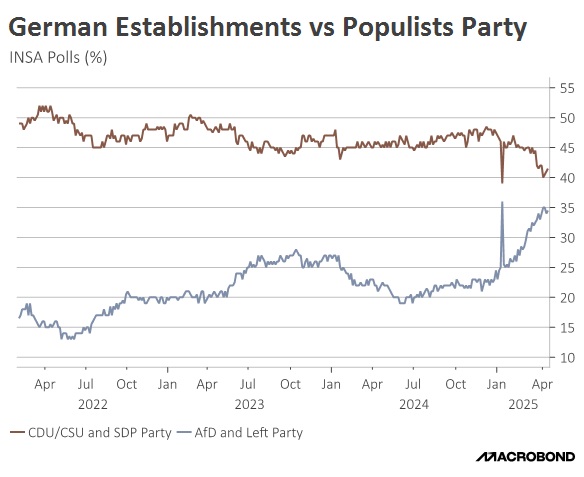
  • This growing populist trend is also evident in Europe and the United States. In Germany, the CDU/CSU has come under pressure as the far-right AfD has at times overtaken it in the polls, while some disaffected centrist voters have drifted toward parties on the left. Meanwhile, in the United States, populist figures have risen to prominence in major cities; local leaders such as New York Mayor Zohran Mamdani have cultivated high-profile relationships with populist President Donald Trump.

  • The ascendancy of populist movements appears to be a structural shift rather than a fleeting trend, driven by a public mandate for intervention in the face of rising cost of living. Should establishment parties continue to lose ground, we anticipate a tangible shift toward higher social spending and more accommodative monetary policies.
  • From a purely market perspective, right-wing populism is often regarded as the “lesser of two evils” compared to its left-wing counterpart. This preference stems from a right-wing lean toward deregulation and decentralization, which typically lowers the cost of doing business. However, investor sentiment is not strictly partisan; as demonstrated by Spain’s Socialist Party, markets are willing to tolerate left-wing administrations provided they maintain rigorous fiscal discipline.

Chip Shortage: According to IDC, the smartphone market is expected to shrink by 12.9% in 2026 due to a shortage of memory chips. This shortage is driven by a drop in the global supply of chips needed to power new technology. The report highlights how the rise of AI is starting to have a crowding-out effect, in which the sector’s enormous demand is beginning to price out other industries. As a result, we believe the surge in demand for chips could lead to either higher inflation or lower margins for certain goods.

Iran Progress: Momentum appears to be building toward a potential US-Iran deal. On Thursday, the two sides held intensive talks on Iran’s uranium enrichment program. Tehran rejected a US proposal to transfer its enriched uranium abroad but left the issue open for further negotiation. The White House continues to favor diplomacy. Vice President Vance stressed that the US has no intention of entering a prolonged war with Iran. The parties are expected to meet again next week in Vienna.

MAGA Goes Solar: The solar lobby has partnered with conservative influencer Katie Miller and former Trump adviser Kellyanne Conway to promote solar power among right‑leaning voters. The move comes as the White House has signaled skepticism toward renewable energy, reflecting concerns about its impact on traditional fuel industries. However, growing recognition of solar as a diversified source of power, with the potential to ease pressure on the electricity grid and improve energy security, appears to have softened that stance somewhat.

View PDF

Daily Comment (November 10, 2025)

by Patrick Fearon-Hernandez, CFA, and Thomas Wash

[Posted: 9:30 AM ET] | PDF

Our Comment today opens with news of a deal between Republicans and Democrats in the Senate that will likely end the federal government shutdown in the coming days. We next review several other international and US developments that could affect the financial markets today, including analysis showing artificial intelligence firms are increasingly using exotic debt instruments to fund their AI infrastructure investments and data showing China has at least temporarily moved out of its recent deflation.

US Fiscal Policy: Eight Democrats in the Senate yesterday struck a deal with Republican leaders and started pushing through a bill that would end the federal government shutdown. Under the deal, the eight Democrats would provide the votes needed for a temporary funding measure lasting until the end of January. In return, the deal would reverse all the layoffs initiated by the White House during the shutdown and guarantee furloughed workers back-pay. However, it only ensures a vote on the Affordable Care Act (ACA) health subsidies that Democrats were holding out for.

  • Democrats originally sought to guarantee an extension of the COVID-era ACA subsidies to prevent premiums from surging, but it now looks like they could only get a promise to hold a Senate vote on the matter.
  • If the compromise bill passes the Senate, it would go to the House for its approval, which seems likely. Of course, one key risk is that the funding measure only lasts until the end of January, so another shutdown could loom in just two months if legislators can’t come to a long-term agreement on funding the government.
  • In any case, the apparent progress toward ending the government shutdown and avoiding more economic damage is giving a boost to US risk assets so far this morning.

US Artificial Intelligence Industry: An important article in the New York Times over the weekend indicates that AI-related companies are increasingly turning to exotic debt instruments to pay for their massive investments in AI infrastructure. The article indicates that while many big, well-known hyperscalers and other firms initially relied largely on their own cash flow to build data centers, they are increasingly issuing asset-backed securities that can be relatively risky and harder for investors to track or analyze.

  • As the AI boom proceeds, driving up stock prices for AI-related companies and spurring massive investment in new data centers, models, and other assets, we’ve seen that investors are increasingly asking whether this is a bubble that’s ready to pop.
  • One likely indicator of heightened risk would be if today’s capital investment was creating excess capacity and was being financed largely by debt. At the moment, it still appears that the new data centers are being fully utilized, and the use of debt is still not especially high. Nevertheless, we think risks will increase more substantially when and if the boom starts to create unused capacity and starts to rely on large amounts of debt.

US Stock Market: New data from Charles Schwab’s STAX index of customer trading activity shows younger investors, such as those in Gen Z, have become less likely than those in older generations to “buy the dip” when stock prices pull back. The data suggests Gen Z investors have put more of their assets into bitcoin products that are now down for the year, possibly making them more skittish. Where Gen Z investors have been net buyers, they’ve focused on tech firms with solid balance sheets and positive current earnings.

  • On Friday, bitcoin prices fell below the psychologically important $100,000 level.
  • That means bitcoin has now given up virtually all its gains for the year-to-date.

US Defense Industry: On Friday, Defense Secretary Hegseth laid out several reforms to the Pentagon’s acquisition policies aimed at increasing competition, lowering costs, and speeding weapons development. Importantly, Hegseth said the five main defense contractors would be expected to invest more of their own capital into productive capacity and quicken the pace of innovation. The new policies, which we had been monitoring, help explain why we think foreign defense stocks are likely to outperform their US counterparts going forward.

US Meatpacking Industry: Following a social media post in which President Trump accused big meatpackers of artificially hiking prices, the Justice Department on Saturday said it has opened an investigation into collusion and price fixing among firms including JBS, Cargill, Tyson Foods, and National Beef. The “Big Four” meatpackers collectively slaughter 85% of the country’s cattle and most of its hogs, so the administration’s effort to break up their power and bring down prices could potentially lead to major changes in the industry.

United States-Hungary-Russia: After meeting with Hungarian Prime Minister Orbán at the White House on Friday, President Trump has granted Hungary a one-year extension on his sanctions targeting countries that buy Russian oil. Orbán also agreed to have Hungary buy about $600 million of liquified natural gas from the US. In any case, the sanctions exemption provides a bit of relief for Russia and somewhat reduces the impact of the new sanctions on the global oil market.

Chinese Economy: The October consumer price index (CPI) was unexpectedly up 0.2% from the same month one year earlier, just bringing the country out of deflation. Excluding the volatile food and energy components, the October core CPI was up 1.2%. The exit from deflation has given a boost to Chinese stocks today, although it’s still not clear if prices will continue to rise going forward.

  • Other data today showed Chinese producer prices are still under pressure from the country’s housing glut, weak consumer demand, and excess industrial capacity.
  • The October producer price index was down 2.1% year-over-year, for its 37th straight month of contraction.

Chinese Military: In a ceremony on Friday, the Chinese military commissioned the Fujian, the country’s third aircraft carrier overall and its second domestically produced carrier. The vessel incorporates several advanced technologies, such as electromagnetic catapults that allow it to launch a greater variety of aircraft at a quicker pace. That should boost China’s ability to keep the US Navy at bay in case of a conflict in the Western Pacific Ocean. However, the ship doesn’t have nuclear propulsion like US carriers do, so its ability to project power is somewhat limited.

Japan-Taiwan-China: In a parliamentary debate on how Japan should respond to a potential Chinese effort to seize control of Taiwan by force, Japanese Prime Minister Takaichi on Friday said, “If battleships are used and a naval blockade involves the use of force, I believe that would, by any measure, constitute a situation that could be deemed a threat to Japan’s survival,” implying she would order the Japanese military to get involved.

  • Takaichi today tried to soften the controversial statement, saying she hasn’t changed Japan’s defense policy.
  • Nevertheless, the statement has sparked controversy in Japan, underlining Takaichi’s reputation as an anti-China hawk.

View PDF

Keller Quarterly (October 2025)

Letter to Investors | PDF

“The more things change, the more they stay the same.” That old maxim is proving true again as the financial markets are experiencing the curious phenomenon of dual gold rushes. The first is a rush to own the yellow metal itself. The second is a race to make money in artificial intelligence (AI). These two movements dominating the news are not related, in my view, but each reflects important trends that investors need to be aware of.

As to the barbarous relic[1] (gold), deglobalization and US government policies emanating from both parties over the last 10 years are pressuring the dollar down relative to other currencies. In this regard, gold is a currency, one that cannot be manufactured at will by any central bank. And speaking of governments, foreign reserve managers worldwide are diversifying their foreign reserves by rebuilding their gold reserves after spending most of the last 55 years reducing their holdings. They’ve been busy buying gold for at least the last four years, and we expect this to continue. We’ve been arguing for over a decade that deglobalization is dollar-bearish and will worsen inflation. These realizations are finally coming to pass, influencing the gold market. For several years we have allocated to gold in Confluence strategies that involve commodity exposure (Asset Allocation and Global Hard Assets), and we expect to continue holding these positions.

The other gold rush is even more complicated. In modern parlance, the phrase gold rush denotes a race by investors to get rich by investing in new technologies that seem to have “can’t miss” potential. This, of course, is an analogy to the great gold rushes of the 19th century. The two most famous were the 1849 California gold rush and the 1896 Yukon gold rush, but there have been many others in US history, starting with the North Carolina gold rush of 1799. In fact, a new discovery somewhere precipitated another gold rush about every 20 to 30 years. It’s a historical oddity that stock market “gold rushes” occur at about the same frequency. Starting with the railroad boom of the post-Civil War era, we have had similar “gold rushes” for automobiles, radio, aeronautics, semiconductors, personal computers, the internet, and cell phones. Now, it’s AI.

Each one of these technological advancements has eventually proven to be every bit as economically and socially important as early investors thought they’d be. Unfortunately for those gold rush speculators, such booms (bubbles?) suffered from two common faults. First, in their haste to participate in the new technology, investors threw money at the stocks of many companies that eventually failed. It’s a fact that winners in new technological races are greatly outnumbered by the losers. Second, investors have tended to badly overvalue the future worth of these businesses. For example, we saw this on display in the internet bubble of 1999-2000. Not only did many of those dot-coms fail, but the stock prices of the surviving internet and telecom stocks set highs that were not equaled for many years. The NASDAQ Composite Index set a high in 2000 that was not equaled until 2015.

We’re seeing the same thing in the AI race today. Our own Thomas Wash reported in a recent Asset Allocation Bi-Weekly[2] that a study by MIT showed 95% of the companies investing in AI were earning a zero return. OpenAI, the private company that produces ChatGPT, was recently valued by investors at $500 billion, which is over 38 times the revenue they expect this year. Of course, the company is unprofitable in the extreme and does not even expect to be cash flow positive for another four years.

Is anyone making money on AI? Yes, the companies selling the products needed to build out the AI server farms: companies that make semiconductors, servers, cooling systems, data centers, electric generating equipment, etc. In our gold rush analogy, these are the makers of the picks and shovels needed to prospect for gold. Those businesses made a lot of money, at least until the rush ended, even though most of the miners didn’t. The same is true today, and the “picks and shovels” stock prices are also extremely high. Nvidia, the maker of the chips everyone wants for these servers, has a market value of $4.4 trillion (greater than that of the entire German stock market), which is merely 22 times its expected 2025 sales.

We expect that AI will prove to be every bit as economically important as its fans expect, but we caution investors not to over-invest in the sector. Such overly enthusiastic early excursions into economy-changing technologies of the past often ended badly. While we own a few AI-related stocks in our equity portfolios (and within the ETFs in our Asset Allocation portfolios), great businesses that we’ve owned for many years, we have stayed well diversified among many industries. We’re not speculators, but long-term investors. In a time of technological excitement, that’s a distinction that investors need to remember.

These Technology and Communications sectors are now worth 45% to 50% of the major US stock indexes, an amazing figure that, in my opinion, overvalues their economic value over the next years. This rapid run-up in prices has pressured downward the valuations of virtually every other sector of the stock market, leaving the stocks of many excellent businesses anywhere from reasonably valued to downright cheap. These include many outstanding dividend-payers. We cannot predict how long the current AI boom will last (nor how long the more modest valuations of other stocks will remain), but we encourage you to keep focused on your long-term objectives and concentrate, as we do, on quality businesses that will survive the boom-bust cycle.

We appreciate your confidence in us.

Gratefully,

Mark A. Keller, CFA
CEO and Chief Investment Officer


[1] A little over 100 years ago, John Maynard Keynes, the well-known British economist, famously dubbed gold “the barbarous relic.” The moniker stuck.

[2] “The AI Arms Race: Navigating the Divide Between Promise and Profit,” October 6, 2025.

View PDF