

Weekly Geopolitical Report – Intergenerational Forgetfulness (April 11, 2016)

by Bill O’Grady

As the political nominating season in the U.S. wears on, presidential candidates have been making statements about foreign policy that would signal a significant change in direction.  What has been striking about these comments is a seeming ignorance about why current policies are in place and what could occur if these policies are radically changed.

We believe these calls for change are the result of “intergenerational forgetfulness.”  When policymakers implement an initial policy regime, they tell their successors why such policies were deployed and guide their “children” to stay on course.  The next generation becomes less aware of the benefits of that policy but is acutely cognizant of the costs.  Eventually, younger policymakers reverse the policy, only to discover later why the original policy was made in the first place.

A complementary concept that goes along with intergenerational forgetfulness is policy dilemma.  Virtually all policies are dilemmas.  In logic, a dilemma contains two choices, neither of which is ideal.  In other words, both policy choices carry significant costs and whichever one is chosen will create costs for some part of the electorate.

Unfortunately, all policies are “sold” to the public on the positive merits alone.  As the costs of the policy become increasingly obvious, the political support for such policies erodes over time.  At some point, the costs of the current policy will lead to a new (and in many cases, opposite) policy direction and the cycle repeats itself.

In this report, we will examine the foreign policy predicament leaders faced at the end of WWII, their solution to these issues and the increasing disenchantment with current policy as an example of intergenerational forgetfulness.  As always, we will conclude with market ramifications.

View the full report

Asset Allocation Weekly (April 8, 2016)

by Asset Allocation Committee

One of our key investment decisions in terms of asset allocation has been to avoid emerging markets.   There are primarily two reasons for this call.

First, as the U.S. pulls back from its superpower position, the emerging world, which tends to be more dependent on exports for economic development, faces two significant risks.

  1. Their geopolitical position becomes more tenuous because the U.S. is less likely to “keep the peace” in the world.
  2. The American role of providing the reserve currency and acting as a consumer of last resort for emerging economy exports is at risk. Since the end of WWII, export promotion has been the most successful economic development model.  This model only works if there is an importer of last resort.  By providing the reserve currency, the U.S. has played that role.  If America stops acting as the primary purchaser of exports, the export promotion model collapses.

Second, a stronger dollar weighs on the relative performance of emerging markets to a dollar-based investor.  Again, there are two reasons for this outcome.

  1. Many emerging market economies are commodity producers and a strong dollar tends to dampen demand for commodities because they are priced in dollars. A stronger dollar raises the price of commodities for all non-dollar consumers, thus lowering total demand.
  2. Emerging economies often borrow in dollars because the interest rate is lower. As long as the dollar doesn’t appreciate, the debt service cost on these dollar loans is lower.  However, a stronger dollar will tend to lift debt service costs which hurt emerging economy growth and raise the risk of financial problems.

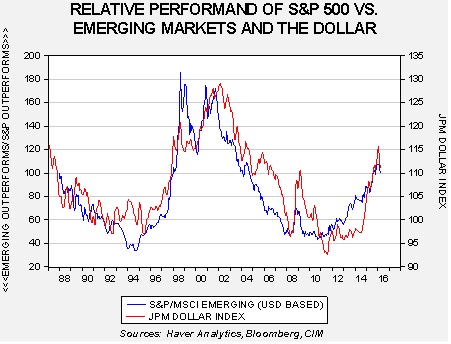
The dollar has been strengthening since 2014 due to the divergence of monetary policy between the Federal Reserve (Fed) and other central banks.  The Fed was very aggressive in easing after the 2008-09 recession, not only keeping rates at zero but implementing three rounds of quantitative easing.  The other major central banks tended to lag U.S. efforts.  However, in late 2013, the Fed began to taper its additions to the balance sheet and last December the FOMC raised rates for the first time since 2006.  This change in policy, coincident with other central banks becoming more aggressive in their policy accommodation, led to a stronger dollar.

This chart shows the relative index performance of the S&P and the MSCI Emerging Market Index.  When the blue line on the chart is rising, the S&P 500 is outperforming emerging markets and vice versa.  The JPM dollar index is directly correlated with the relative performance of these equity indices at the 86% level.  As we noted above, a stronger dollar tends to weigh on emerging market equity performance.

Interestingly, the dollar fell sharply last month.  There is growing evidence that Fed Chairwoman Yellen is keeping policy easier than the Phillips Curve would justify; one of the factors she seems to be targeting is the dollar.  It is clear that the strong dollar has weighed on net exports and the industrial sector, pressuring U.S. economic growth lower.  If the Fed decides to guide the dollar lower, emerging markets will look more attractive.

The key issue for our investment committee is whether these trends are durable enough for a cyclical allocation.  The longer term outlook for emerging markets is still problematic if America’s foreign policy trends remain in place.  That will be part of our decision process in upcoming allocation meetings.

View the PDF

Weekly Geopolitical Report – The Archetypes of American Foreign Policy: A Reprise (April 4, 2016)

by Bill O’Grady

We are currently experiencing one of the most contentious primary election seasons in at least 35 years.  Candidates have made numerous incendiary statements about foreign policy that offer insights into their thinking.  However, without a paradigm, it can be difficult for investors to determine what foreign policy decisions a candidate is likely to make.  By using these archetypes of American foreign policy, one can more easily anticipate how a candidate today might act if they were to occupy the Oval Office.  For this reason, I decided that our readers would benefit from a “refresh” of this study.

In 2012, we published a report titled “The Archetypes of American Foreign Policy.”  In that article, I borrowed heavily from Walter Russell Mead in his 2002 book, Special Providence.[1]  Mead took a unique approach in describing policy positions, using historical figures instead of abstract models.  Other policy analysts have used terms like “realists” or “idealists.”  Unfortunately, these broad generalizations fail to fully express the subtleties of American foreign policy.

Mead named four archetypes: Hamiltonian, Wilsonian, Jeffersonian and Jacksonian.  Each one of these archetypes has specific characteristics that describe the viewpoints and behavior of a policymaker of that certain type.  Mead does admit that other archetypes have existed throughout American history.  For example, the Davisonian was an archetype named after the President of the Confederate States of America.  Its goal was the preservation and expansion of slavery, and Davisonian foreign policy would be designed to support that institution.  Of course, this archetype ceased to exist after the South lost the Civil War.

By using a real historical figure as a representative of that archetype, it helps the reader to envision the position of that particular “school.”  As with all archetypes, these are considered model specimens for that particular type.  In real life, even these historical figures probably don’t fully capture the image that Mead projects for each type.  Actual policymakers tend to be a mix of these four types; rarely will a policymaker be of pure form.  However, the archetypes do offer a construct for an analyst to examine and predict the foreign policy behavior of elected officials.

In this report, we will briefly describe and discuss the four archetypes of American foreign policy.[2]  With presidential elections less than eight months away, I hope that this discussion will assist readers in examining the candidates and their potential foreign policy positions, using these archetypes as a guide.  This report will conclude with my characterization of the current leading candidates.

View the full report

____________________

[1] Mead, W. R. (2002). Special Providence: American Foreign Policy and How it Changed the World. New York, NY: Routledge.

[2] However, readers are urged to read Mead’s aforementioned book so as to better understand his position on the four major types of foreign policy.  My short report does not fully do justice to a 340-page book.

Asset Allocation Weekly (April 1, 2016)

by Asset Allocation Committee

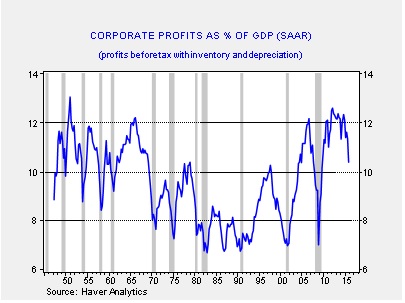
In the most recent GDP report, corporate profits plunged.

The overall decline in profits was $153 bn in Q4, although some of this drop was due to an $83 bn settlement that BP had with the government over the 2010 Gulf of Mexico oil spill.  We have been noting for some time that profit margins have been eroding.  This data tends to confirm that concern.

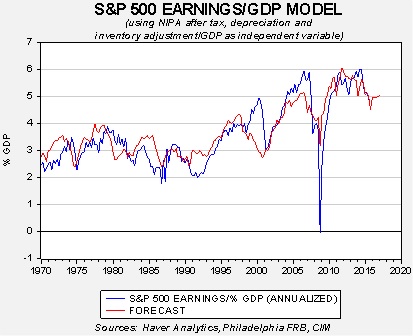
In our earnings forecast, we use a similar number from the National Income and Products Accounts (NIPA) that is similar to the above profits report except that it includes corporate taxes as well.

This chart shows the relationship between S&P 500 earnings as a percentage of GDP and the NIPA corporate profits after tax, depreciation and inventory adjustment.  We include this variable in a larger model that we use to project S&P earnings compared to GDP.  For the most part, the two series tend to track each other rather closely.  Periods when S&P earnings greatly exceed the NIPA numbers tend to signal that such divergences are not sustainable and they are resolved by a drop in S&P earnings.  Such divergences are evident in 1980, 2000 and 2007.  Fortunately, the two readings are not currently diverging.

Using the NIPA profits and GDP forecasts from the Philadelphia FRB, the relationship suggests that profits will recover in 2016.  In our latest update to our 2016 outlook, we reduced our earnings for the year mostly due to margin contraction.[1]  The most recent GDP data generally confirms this trend.  Overall, we are looking for a mostly flat year for the equity markets due to sluggish economic growth and mostly flat margins.  At the same time, we do not expect a recession this year, which should prevent a major pullback in equities.

View the PDF

_____________________

[1] See 2016: An Update.

Quarterly Energy Comment (March 24, 2016)

by Bill O’Grady

The Market

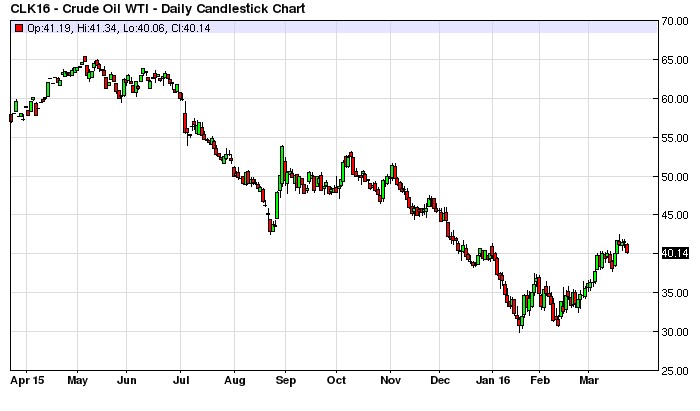
Oil prices have fallen steadily over the past year, reaching a new low early in the first quarter just below $30 per barrel.  Since mid-February, they have staged an impressive recovery.

(Source: Barchart.com)

Oil Prices and Inventories

This rally has occurred despite historic levels of U.S. commercial crude oil inventories.  The chart below shows the level of inventories dating back to 1920.  The current level of stockpiles is only about 12 mb below the all-time high set in October 1929.  The DOE estimates that U.S. working crude oil storage is 502 mb.  With current inventory levels at 533 mb, we are well above the working storage level.  Although there were some concerns over a price collapse if storage costs become excessive, thus far, the industry has been able to manage these high inventory levels without serious trouble.  Additionally, with the inventory build season nearing an end, the odds of breaking the recent lows are growing less likely.

View the complete PDF

Weekly Geopolitical Report – The Russian Withdrawal (March 21, 2016)

by Bill O’Grady

On March 14th, Russian President Vladimir Putin surprised the world with an announcement of the withdrawal of Russian troops from Syria. The move was unexpected and has raised questions as to whether Russia will really pull its forces out of Syria, and if so, why? In this report, we will examine Russia’s initial decision to place forces in Syria and discuss if Putin really means to remove his troops from the country. We will examine what might have prompted the decision to announce the withdrawal and, as always, discuss the market implications of the decision.

View the full report

Weekly Geopolitical Report – The Apple Problem (March 14, 2016)

by Bill O’Grady

On December 2, 2015, Syed Rizwan Farook and his wife, Tashfeen Malik, attacked a San Bernardino county facility, killing 14 people and seriously injuring 22 others.  The couple was subsequently killed by local law enforcement in a shootout several blocks from the facility.  The Federal Bureau of Investigation (FBI) opened an investigation into the attack.  As part of this work, an Apple (AAPL, 101.20, -0.67) iPhone was discovered that was used by Farook but owned by the county.  The FBI wanted to look at the information on his phone, but the encryption built into the device prevented authorities from accessing the data.  The government has sued Apple to force the company to circumvent its security; thus far, the company has refused.

In this report, we will discuss the attack and the perpetrators, including the gathering of evidence which included the phone in question.  We will explain in non-technical terms how Apple software protects the data on the iPhone.  We will compare and contrast the legal positions taken by the company and the government and frame the controversy using the U.S. Constitution, examining the tensions between the Bill of Rights and the problems presented by wartime.  As always, we will conclude with market ramifications.

View the full report

Weekly Geopolitical Report – The Iranian Elections (March 7, 2016)

by Bill O’Grady

On February 26, Iran held two elections, one for parliament and the other for the Council of Experts.  The former is Iran’s legislative body, and the latter is the part of government that monitors the Supreme Leader and selects his replacement if he dies, becomes incapacitated or is removed.  Since the 1979 revolution, Iran has not held these two elections simultaneously.  The results favored moderate candidates and rejected the most hardline factions.

In this report, we will discuss the structure of the Iranian government, examine the results of the elections and analyze their impact.  As always, we will conclude with market ramifications.

View the full report

Weekly Geopolitical Report – Brexit (February 29, 2016)

by Kaisa Stucke, CFA

The U.K. joined the European Common Market, what is now known as the EU, in 1973.  In 1992, the Maastricht Treaty formally created the EU.  However, as part of the treaty, the U.K. negotiated that it would be exempt from adopting the euro and joining the Eurozone.  Despite the EU’s founding premise that members should seek an ever closer union, both politically and monetarily, the U.K. is questioning the net benefits of its membership altogether.

The British public’s perception of the benefits of the U.K.’s EU membership has always been mixed.  Following a recent increase in public opinion asking to separate from the EU, U.K. Prime Minister David Cameron set a referendum on membership for June 23.  Cameron supports remaining in the EU, especially after he was able to negotiate a deal with the EU regarding some hotly contested issues for the country.  However, several other highly visible members of Cameron’s Conservative Party have stepped out in support of leaving the EU.  Political discussions have recently become quite heated and will likely remain so until the June referendum.  Additionally, political uncertainty will likely weigh on financial markets, increasing volatility as we move closer to the referendum date.

In this week’s report, we will take a look at the main factors leading to the call for Brexit and their impact on the economy and the markets.  As always, we will conclude with market ramifications.

View the full report