

Weekly Energy Update (July 1, 2021)

by Bill O’Grady, Thomas Wash, and Patrick Fearon-Hernandez, CFA | PDF

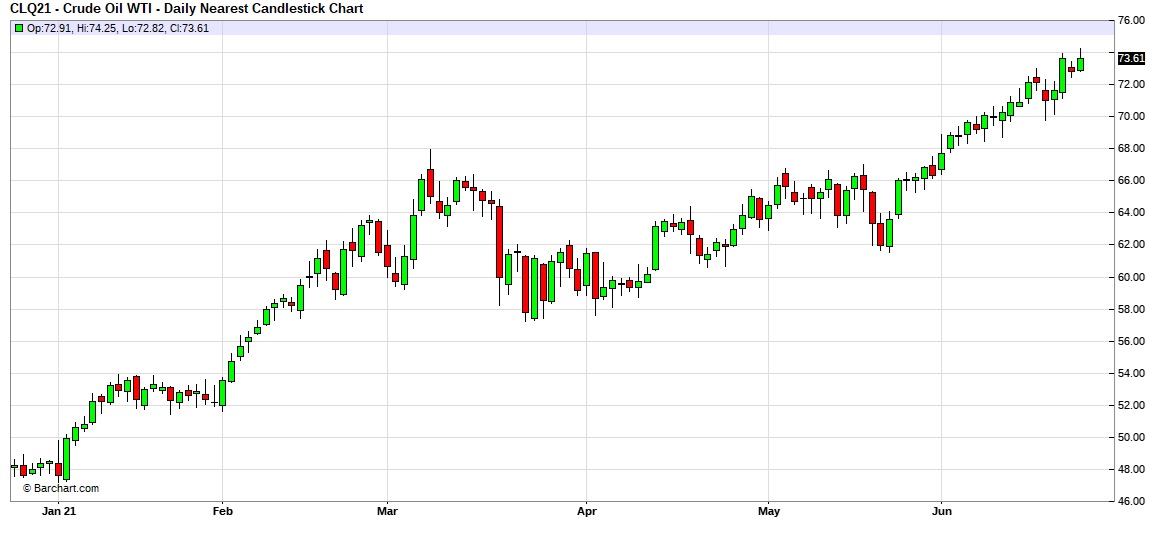
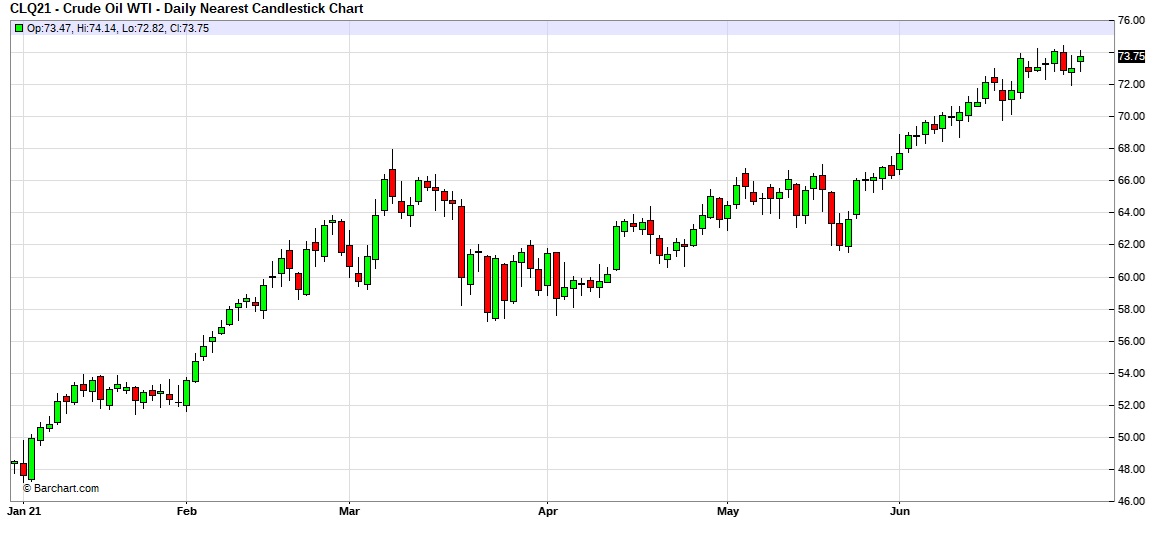
Oil prices are moving steadily higher although momentum is starting to slow.
(Source: Barchart.com)

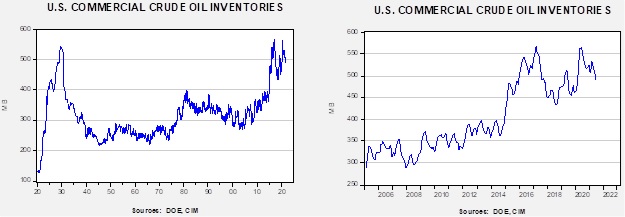
Crude oil inventories fell 6.7 mb compared to the 4.0 mb draw expected.  The SPR fell 1.4 mb, meaning without the addition from the reserve, commercial inventories would have declined 8.1 mb.  We note the SPR is at its lowest level since October 2003.
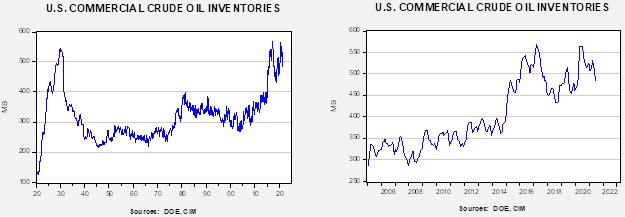
In the details, U.S. crude oil production was unchanged at 11.1 mbpd.  Exports rose 0.1 mbpd, while imports fell 0.5 mb.  Refining activity rose 0.4%.
(Sources: DOE, CIM)

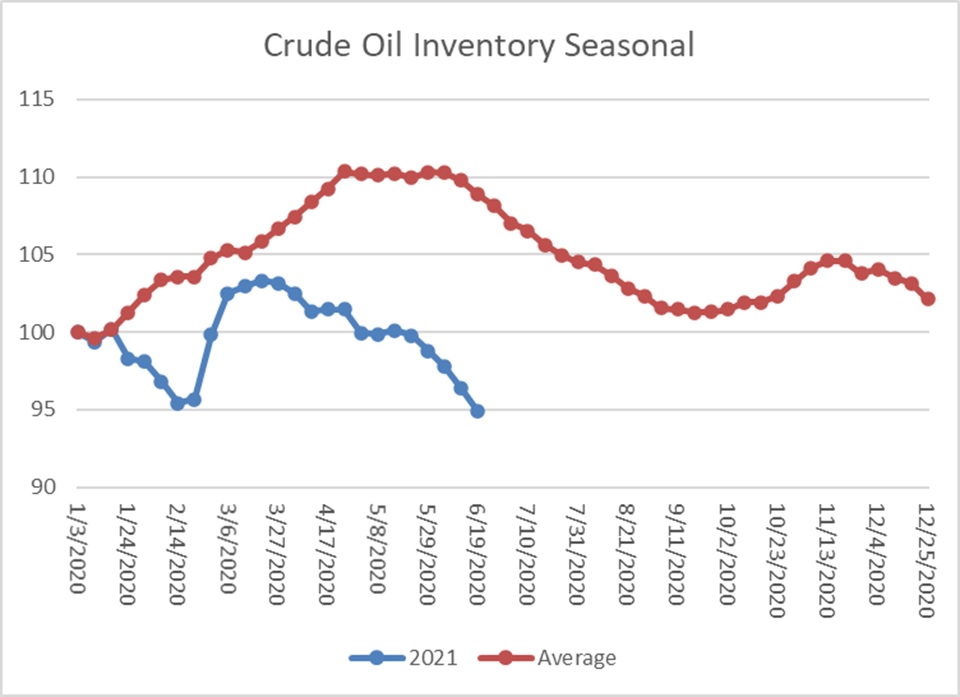
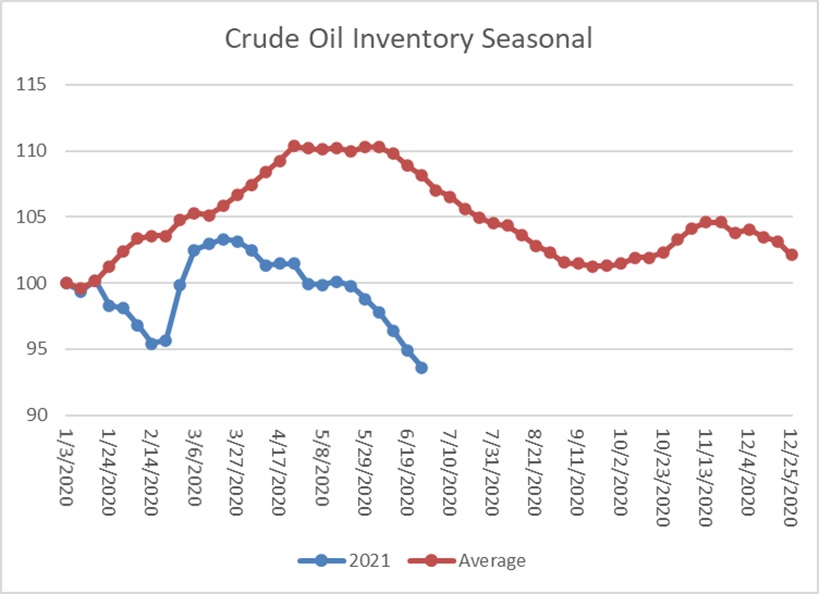
This chart shows the seasonal pattern for crude oil inventories.  We are well into the summer withdrawal season.  Note that stocks are already below the usual seasonal trough seen in early September.  A normal seasonal decline would result in inventories around 465 mb.  Our seasonal deficit is 75.1 mb.  At present, inventories are falling faster than normal.
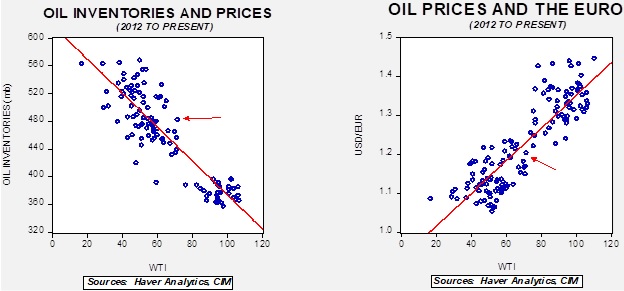
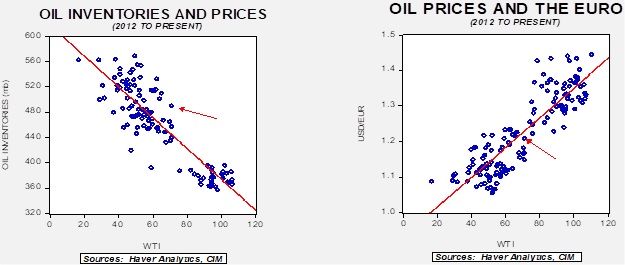
Based on our oil inventory/price model, fair value is $57.17; using the euro/price model, fair value is $67.63.  The combined model, a broader analysis of the oil price, generates a fair value of $62.15.  Oil prices are still “rich” relative to inventory levels.  Recent dollar strength caused by uncertainty surrounding Fed policy has also reduced the dollar model’s fair value.

Market news:

  • The Dallas FRB produces quarterly surveys of oil and gas activity in its district. The report suggests that production and investment are recovering.  At the same time, the survey indicates costs are rising as well.  So far, we have only seen a modest rise in production.  Some of this is due to concerns about future regulation.  The shale industry, in particular, is trying to shed its reputation as a capital consumer.  Thus, the previous pattern of rapid output increases does not appear to be occurring this time around…so far.
  • The Supreme Court has backed refiners in their disputes over biofuel waivers. The renewable fuel standards mandated the required amounts of biofuels to be used, assuming steady growth in demand.  However, after the Great Financial Crisis, demand growth fell, and the only way to meet the standard was to move beyond the 10% “blend wall.”  The courts have pushed back against the mandated level of usage.
  • This report examines the idea that we may be at peak oil consumption.

Geopolitical news:

Alternative energy/policy news:

  1. We have often discussed how climate activists have targeted pipelines ultimately to reduce the availability of fossil fuels.  Such actions are controversial; pipelines move oil and products with less environmental impact compared to trains and trucks.  The goal of activists is to reduce consumption, so if a pipeline disruption is resolved by trucks or trains, it makes conditions worse.  After the initial support from the Biden administration in halting the Keystone XL pipeline, the White House has become less active, disappointing environmentalists.  There is a political risk from rising gasoline prices, and we suspect the administration is trying to avoid voter dissatisfaction from higher energy prices while maintaining some level of creditability with environmentalists.
  • Last week, we discussed ideas about placing sails on ocean-going vessels to reduce carbon consumption.  This report expands on that notion.
  • A groundbreaking nuclear power plant, which uses molten salt instead of water, is being constructed in Wyoming.  It is replacing a coal plant.  Such plants have interesting features, including the ability to create intermittent power, unlike traditional nuclear reactors, which provide baseload power.  These reactors have the promise of being cheaper and safer and may provide a way to provide reliable carbon-free electricity.
  • Renewable diesel, a plant-based product, has the potential to be a better replacement than biodiesel, which has suffered from poor performance in cold weather.  This new product is refined from the same feedstocks as biodiesel, but since it is refined much like crude oil, it has properties similar to fossil diesel.
  • Direct carbon capture from the atmosphere remains the great hope of reducing CO2.  This report is an update on progress.
  • The Senate has passed a measure (S.1251) that would give farmers and foresters the ability to sell carbon credits for the CO2 their activities capture.  The fact the bill passed overwhelmingly (92-8) shows that it is still good politics to be seen as farm friendly.  However, the actual execution of such policies is complicated.

The U.S. has moved to ban some solar products produced in Xinjiang.
View PDF

Daily Comment (June 30, 2021)

by Bill O’Grady, Thomas Wash, and Patrick Fearon-Hernandez, CFA

[Posted: 9:30 AM EDT] | PDF

Today’s Comment opens with new developments related to U.S. monetary and regulatory policy.  We then turn to a review of some key economic data from China and various other international news.  We close with the latest developments related to the coronavirus pandemic.

U.S. Monetary Policy:  An inaugural survey of academic economists conducted by the Financial Times and the University of Chicago’s Initiative on Global Markets suggests that elevated inflation will compel the Federal Reserve to boost U.S. interest rates at least twice by the end of 2023.  That aligns closely with the “dot plot” of Fed officials’ own forecasts for when and how quickly rates will have to rise from their current level that is near zero.

  • The new FT-IGM U.S. Macroeconomists Survey polled 52 academic economists on the likelihood that the Fed’s main policy rate would indeed be higher by 0.5% by the end of 2023, as the dot plot indicated.  A majority of respondents said the likelihood of a move of that size or more was above 75%, and a large minority put it as high as 90%.
  • The findings underline our view that Fed Chair Powell has been unable to make a convincing case for his strategy of prioritizing labor market outcomes by keeping monetary policy loose.  Many establishment-leaning, capital-friendly policymakers on the FOMC are in open rebellion and are talking increasingly about the need to tighten policy, albeit gradually.  The financial markets seem to be coming to terms with that prospect over the last couple of weeks, but any sign of an even earlier policy tightening will have the potential to disrupt markets once again.

U.S. Competition Policy:  According to the Wall Street Journal, the Biden administration is developing an executive order directing federal agencies to strengthen their oversight of industries that they perceive to be dominated by a small number of large companies.  Although we’ve been highlighting how big businesses are facing increased regulatory risk in the area of antitrust, the goal of the new executive order would be to broaden the way regulators approach big business and business concentration beyond that area.  For industries dominated by a few big firms, for example, regulators might conduct heightened surveillance on fees charged to customers or on their relationships with suppliers.

European Union:  Justice Commissioner Didier Reynders has warned that the EU could eventually face a breakup due to a proliferation of legal challenges and rulings by EU member states against the principle that EU law supersedes national laws.  It doesn’t appear to be an imminent crisis for the EU, but the report shows that the issue has been building.  Brussels has been slow to respond.  This will probably have importance for the EU’s functioning and potential effectiveness over time, especially as it implements its new program of common, mutual EU debt issuance.

  • In a sign of the perceived threat, the European Commission this month launched legal proceedings against Germany.  It is in response to an explosive ruling by its constitutional court last year that the European Court of Justice had acted beyond its level of competence in a case related to the European Central Bank’s bond-buying.
  • The next big legal challenge Brussels is bracing for is a decision by the Polish constitutional tribunal, which could come on July 13, on whether certain elements of the EU’s treaties are compatible with the country’s constitution.

China:  The National Bureau of Statistics released its official purchasing managers indexes for the manufacturing and nonmanufacturing sectors, with the data hinting at a modest economic weakening as supply constraints weigh on production, export demand softens, and consumers remain cautious amid localized new pandemic lockdowns.  As with most such indexes, China’s PMIs are designed so that readings over 50 will point to expanding activity.  The details are below (and in the data tables of the .pdf version of this document).

  • The June PMI for manufacturing fell slightly to 50.9 in June from 51.0 in May.
    • Importantly, the subindex on production declined to 51.9 in June from 52.7 in the previous month, as recent shortages of semiconductors, coal, and power held back output at many factories.
    • Meanwhile, the subindex on new export orders fell from 48.3 in May to 48.1 in June, signaling weakening external demand for Chinese goods.
  • Separately, the June PMI for the nonmanufacturing sector declined to 53.5 from 55.2 in May.

Russia:  Today, President Putin is holding his annual call-in show, where citizens can call in questions to him directly.  The call is aimed at showcasing Putin’s willingness to respond to average Russian concerns.  The president has already made some news by insisting that last week’s incident off the coast of Crimea, where the British naval destroyer HMS Defender was confronted by Russian coast guard ships and fighter aircraft, was “a clear provocation.”  More news could arise as the call continues.

Brazil:  President Bolsonaro, who is gearing up for a re-election bid next year but trails former President Luiz Inácio Lula da Silva, is now facing a major scandal because of an apparent attempt to secure kickbacks on a major coronavirus vaccine contract.

COVID-19:  Official data show confirmed cases have risen to 181,908,304 worldwide, with 3,940,007 deaths.  In the United States, confirmed cases rose to 33,653,105 with 604,476 deaths.  Vaccine doses delivered in the U.S. now total 381,831,830, while the number of people who have received at least their first shot totals 179,940,202.  Finally, here is the interactive chart from the Financial Times that allows you to compare cases and deaths among countries, scaled by population.

Virology

  • According to the latest CDC data, 54.2% of the U.S. population has now received at least one dose of a vaccine, and 46.4% of the population is fully vaccinated.
  • In Europe, tourist-dependent countries like Spain and Greece are especially worried that the Delta variants of the virus could again force them to restrict international travelers.  Spain, Portugal, and Malta this week have already tightened restrictions on tourists from the U.K., where the Delta mutation is spreading.  Earlier this month, Italy required U.K. travelers to quarantine for five days.
  • Russian President Vladimir Putin, fielding questions from across the country on his annual call-in show, urged citizens to overcome their hesitancy and get vaccinated against COVID-19 as the country continues to rack up daily records for deaths from the coronavirus.  Putin also revealed for the first time that he got the locally developed Sputnik V vaccine, ending months of speculation over which shot he received behind closed doors late last year.
  • In Australia, resurgent infections have prompted authorities to lock down four major cities, representing more than half the country’s population.  The latest surge will put greater pressure on the government for its sluggish vaccination drive.
    • After winning international praise for its initial response to reining in the virus, the government was warned that a slow vaccine rollout would jeopardize those early gains.
    • While about 30% of the country’s 26 million people have received at least a first jab, only about 7% of Australians are fully vaccinated.
    • The infection resurgence in Australia comes despite the country’s strong efforts at contact tracing.
  • Without providing details, North Korean state media said paramount leader Kim Jong Un accused officials in his government of neglecting important party decisions related to the pandemic.  He said these officials “caused a grave incident that poses a huge crisis to the safety of the nation and its people.”  The statement is being taken as groundwork for the announcement of a pandemic crisis in the country or justification for allowing foreign experts to help vaccinate the country’s citizens.

 Economic and Financial Market Impacts

  • In an important sign of the post-pandemic recovery in the U.S. real estate finance market, the issuance of single-asset, single-borrower bonds is again surging after dropping by nearly half in 2020.
  • In the U.K., new data shows that as the latest lockdown curtailed spending in shops, bars, and restaurants early this year, the first-quarter household saving ratio — the average percentage of disposable income that is saved — rose to 19.9% from 16.1% in the final quarter of last year.  As in the U.S., this raises hope that the accumulated cash will boost the country’s economic recovery as businesses reopen.
  • Agustín Carstens, general manager of the Bank for International Settlements and the former chief of the Bank of Mexico, warned that developing countries have yet to feel the full economic impact of the pandemic, but they are already close to exhausting their capacity to borrow and to use fiscal and monetary policy to deal with it.
    • According to Carstens, the situation for developing countries is especially challenging given that so many developed countries are preparing to withdraw the fiscal and monetary policy support they had been providing to their economies.

Even though our expectations for a weaker dollar would suggest a positive outlook for the so-called emerging markets, Carstens makes a valid point that the shifting policy stances around the world could make this a trickier area to invest in than it otherwise would be.

 View PDF

Daily Comment (June 29, 2021)

by Bill O’Grady, Thomas Wash, and Patrick Fearon-Hernandez, CFA

[Posted: 9:30 AM EDT] | PDF

In today’s Comment, we open with a range of U.S. and global news regarding regulation and taxes, followed by various international political developments.  We conclude with our usual news update related to the coronavirus pandemic, including important new research indicating that it’s okay to mix different types of vaccines.

U.S. Technology Industry:  Although we’ve talked a lot about rising antitrust scrutiny and increased regulatory risks for big U.S. technology firms, it’s important to remember those firms will win some of their battles.  Yesterday, a U.S. district judge in Washington dismissed a series of federal and state antitrust suits against Facebook (FB, $355.64) on the grounds that they didn’t plead enough allegations to support monopolization claims, and the state attorneys general waited too long to bring their claims.

  • Despite the industry’s win in this battle, it will still have much work ahead to avoid losing the regulatory war it is facing.
  • Indeed, the federal suit dismissed yesterday can be amended and refiled within 30 days, and big tech firms still face a range of regulatory attacks all over the world.  For technology investors, that means regulatory risk will likely remain a risk for the time being.

U.S. Banking Industry:  Now that the Federal Reserve has loosened restrictions on payouts, several large U.S. banks yesterday announced they would hike their dividends.  The hikes announced yesterday should amount to approximately $2 billion in the coming quarter alone.

Global Minimum Corporate Tax:  The G7’s proposal for a global minimum tax of 15% on corporations is already hitting obstacles as negotiators try to get the entire G20 grouping to sign on to it.  Negotiators have become increasingly concerned that the compromises needed to get countries on board will water down the final agreement.

  • Major countries resisting the deal include China, India, many other developing countries in Eastern Europe and beyond, and tax havens such as Switzerland and Ireland.
  • The proposal is set to be discussed by finance ministers from the G20 group of countries at a summit in Venice next month.

Global Commodity Markets:  Prices for a wide range of commodities continue to correct after their big run-up during the spring, and not only because of the Federal Reserve’s recent hint that it might tighten monetary policy somewhat earlier than previously thought.  Now, U.S. hog prices are tumbling in response to the Chinese government’s declaration that it has rebuilt the hog herds devastated by an outbreak of African swine fever in 2018.  The most active hog futures contract on the CME recently fell below $1.00 per pound for the first time since March.

Germany:  In an interview with the Financial Times, Finance Minister Olaf Scholz tried to thread a very narrow needle by supporting continued high levels of fiscal stimulus next year.  But, he is also insisting that there is no need to loosen EU or German restrictions on spending and debt.  Scholz is the center-left Social Democrats’ candidate for chancellor in September’s federal election.

China-Russia:  Presidents Xi and Putin have agreed to extend the 20-year-old friendship treaty between their two countries, marking another step toward greater alignment between Beijing and Moscow and heightening their ability to compete against the U.S. and its liberal democratic allies.

Japan-China-Russia:  Japanese Deputy Defense Minister Yasuhide Nakayama has warned of the growing threat posed by Chinese and Russian collaboration.  He said it was necessary to “wake up” to Beijing’s pressure on Taiwan and protect the island “as a democratic country.”  Nakayama even questioned whether the U.S., Japan, and other countries should have ever recognized Beijing and its “One China” policy over Taipei.  The remarks are sure to generate condemnation by China and could lead to more significant disruptions in the Japan-China relationship.

Ethiopia/Tigray:  Rebels in the Tigray region have routed federal forces and taken control of the regional capital of Mekelle.  The interim regional administration installed by Addis Ababa has fled, and the federal government has called for a ceasefire.  However, now that the rebels appear to have momentum, they are unlikely to accept a truce and will probably keep pushing their advantage, which could lead to further instability in the horn of Africa.

COVID-19:  Official data show confirmed cases have risen to 181,497,289 worldwide, with 3,931,610 deaths.  In the United States, confirmed cases rose to 33,641,386 with 604,152 deaths.  Vaccine doses delivered in the U.S. now total 381,282,720, while the number of people who have received at least their first shot totals 179,615,165.  Finally, here is the interactive chart from the Financial Times that allows you to compare cases and deaths among countries, scaled by population.

Virology

  • The latest CDC data shows, 54.1% of the U.S. population has now received at least one dose of a vaccine, and 46.3% of the population is fully vaccinated.
  • As the European Union’s mass vaccination programs finally hit their stride and the U.S. program continues to slow, many EU countries are on the verge of surpassing the U.S. in terms of the share of their population having received at least one shot.  A faster increase in vaccination rates is seen as essential in containing the more deadly, highly transmissible Delta variants of the virus.
  • According to a new study, alternating a dose of the vaccine from Pfizer (PFE, $39.12) with a dose of the vaccine from AstraZeneca (AZN, $60.07) is safe and provides a strong immune response against COVID-19.  The research supports the idea of mixing different vaccine types, which is already being done in some countries.  In turn, that could help ease the logistical challenges in vaccinating people.

 View PDF

Daily Comment (June 28, 2021)

by Bill O’Grady, Thomas Wash, and Patrick Fearon-Hernandez, CFA

[Posted: 9:30 AM EDT] | PDF

Good morning and happy Monday.  U.S. equity futures are mixed and trading quietly as we close out the second quarter this week.  We lead off today with the Western heat wave.  Up next, we discuss U.S. airstrikes in the Syrian/Iranian region.  Economics and policy news begin our regular coverage, followed by China news.  The international news roundup is next, and we close with the pandemic update.

Western heat wave:  The Western U.S. is suffering through a drought and heat wave.  Droughts for the Southwest are clearly nothing new, but triple-digit temperatures in the usually temperate Northwest are something differentPortland hit 112o and Seattle 104o.  The Canadian city of Lytton hit 116o, a new record for the country.  Areas that frequently get hot have adapted.  Air conditioning is common, and officials have experience in opening cooling centers.  However, the Northwest does not have the same level of experience with intense heat, and thus, will struggle to cope with the temps.  What is occurring is a classic heat dome; these are often seen in the Midwest.  The jet stream cuts off weather systems that could bring rain and cooler temperatures.  Such events in the nation’s midsection usually touch off grain rallies as drought fears trigger worries about corn and soybean crops being adversely affected.  These domes are hard to shift.  It often takes a major cold front to break them up (in the Midwest, a dissipating tropical storm can do the trick).  Not only do the temperatures stress people, but they can put pressure on electrical grids that lead to brownouts and outages.   High temperatures can also boost natural gas demand to meet the rise in electricity production.

Airstrikes:  The U.S. conducted airstrikes against Iranian-backed militia groups in the border region of Syria and Iraq.  The U.S. is accusing these groups of launching drone strikes against U.S. troops in the region.  The targets were weapons storage and operational facilities.  Although negotiations to return to the 2015 nuclear deal continue, the war conducted by Iranian proxies will make the talks difficult.  We expect a return to the deal, but there won’t be much progress beyond these talks.

Economics and policy:  The White House continues to balance its interests for infrastructure spending, the labor market remains unsettled, and Fed officials continue to make hawkish statements.

  • After a dustup last week, when President Biden linked passing the bipartisan infrastructure package with the broader budget bill, the White House appears to have smoothed over the dispute. The president actively worked to overcome the apparent mistake of linking the two measures.  Although the pundits slammed the “own goal” of linking the budget bill and the infrastructure package, the reality is that the White House is trying to keep a shaky coalition together.  If it leans toward the bipartisan measure, the LWP might withdraw support.  We note that Manchin (D-WV) has essentially scotched Sen. Sanders’s (I-VT) $6.0 trillion budget plan.
  • The turmoil in the labor markets continues. The latest is the issue regarding unemployment insurance.  The concern is that generous benefits may be keeping workers away from jobs.  Although we don’t doubt there is some effect, our suspicion is that the issue is more complicated than just income support.  The history of pandemics suggests that in their wake, labor power increases; there was a notable increase in real wages after the Black Death to the point where the English Crown tried to force workers to accept jobs (it didn’t work).  We are watching the media framing of the issue.  The WSJ is touting that initial claims are falling faster in states where benefits have been cut.  At the same time, the NYT reports that even in states where benefits have been reduced, recruiters are still struggling to fill jobs.  We suspect that underlying these reports is that the pandemic has encouraged workers to rethink their career choices.  The surge in new business formation may be a clue.  If this is the case, jobs in leisure and hospitality may only be filled at higher wages.
    • A side note to this issue is immigration. We note a story from Oregon about an asparagus farm being unable to source foreign workers and opening up the farm to locals to pick for free.  It details the impact of immigration policy.
  • We continue to monitor comments from Fed officials about policy. Although the leadership remains strongly committed to continued stimulus, there is clear dissension in the ranks, especially among the regional bank presidents.  The most recent to chime in has been Boston FRB President Rosengren, who commented that policymakers need to avoid a “boom/bust” cycle in residential real estate.  We characterize Rosengren as a “financial sensitive,” meaning that he thinks monetary policy should also, in part, be conducted to prevent asset bubbles.  This position, in our opinion, is theoretically justifiable but politically impossible.  Imagine a Fed Chair trying to explain to Congress that the Fed raised rates to bring down market P/E’s.  Greenspan took heat for his “irrational exuberance” comments in 1996.  Still, this means Rosengren is probably supporting some level of stimulus withdrawal.  We note he votes in 2022.

China:  There are renewed tensions on the India/China border, and internationalizing the CNY will require difficult choices.

International roundup:   Sweden may be facing elections, and Minsk blinks.

COVID-19:  The number of reported cases is 181,167,056, with 3,924,865 fatalities.  In the U.S., there are 33,625,392 confirmed cases with 603,967 deaths.  For illustration purposes, the FT has created an interactive chart that allows one to compare cases across nations using similar scaling metrics.  The FT has also issued an economic tracker that looks across countries with high-frequency data on various factors.  The CDC reports that 381,282,720 doses of the vaccine have been distributed with 323,327,328 doses injected.  The number receiving at least one dose is 179,261,269, while the number of second doses, which would grant the highest level of immunity, is 153,028,665.  The FT has a page on global vaccine distribution.

 View PDF

Daily Comment (June 25, 2021)

by Bill O’Grady, Thomas Wash, and Patrick Fearon-Hernandez, CFA

[Posted: 9:30 AM EDT] | PDF

Good morning, all! U.S. equities appear to be headed for a higher open this morning. We begin with a discussion about the impact that transitory effects may have on the global economy.  International news follows, with reports on India restoring autonomy to Kashmir and Russia threatening to bomb ships entering its waters.  U.S. Economics and policy news are next, including the bipartisan infrastructure package and large banks passing the Fed’s stress tests.  China news follows, and we end with our pandemic coverage.

As inflation begins to rise across the world, central banks are now mulling when to begin raising interest rates.  Central banks in emerging markets have already started. Brazil, the first of the major economies to raise rates, has increased its policy rate three times this year.  Although developing countries are still wary of raising rates prematurely, it does seem that the spend-and-see approach may no longer be in vogue.  Given the extreme measures governments have taken to shield their economies from the pandemic, we are not surprised by the change of heart.  That said, we do have some concerns that inflation may not be the only statistic impacted by transitory effects. One statistic that we are closely monitoring is the unemployment rate of each country. The pandemic has caused significant disruption of the labor markets.  Workers have received unusually large unemployment benefits, and clearly, some of them are considering new career options.  Yesterday, we noted the surge in new business startups.  Capturing these new businesses in the employment statistics could be difficult.  In addition, a large number of older workers in the developed world appear to have concluded that retirement is a better option…for now.  Investors should be prepared for noisy employment data, which may include unexpected increases in the unemployment rate both here and abroad.  The increases probably don’t mean a slowdown but a churn.

International news:  Russia warns of targeting foreign warships, Modi reaches out to Kashmir, and EU members rebuff Putin’s invite.

  • A day after Russia allegedly fired shots and dropped bombs in the path of the British destroyer, HMS Defender, a Russian diplomat warned that next time Russia might attempt to hit the target. The attack represents an escalation in tensions between Russia and the West.
  • India’s Prime Minister Narendra Modi has held talks with Kashmiri politicians about restoring the region’s democracy. In 2019, the Indian government removed a constitutional provision that granted political autonomy to Kashmir.  The move to reconcile with Kashmir appears to be in response to concerns about the U.S. withdrawal from Afghanistan and its growing feud with China.  The decision is intended to reduce tensions with Pakistan as the two sides attempt to normalize ties.
  • A request by Germany and France to consider inviting Russian Vladimir Putin to the EU summit was rebuffed by other EU members. Those in opposition stated that inviting Putin would send the wrong message to the Kremlin regarding the EU’s stance about its previous abuses.

Economics and policy: A bipartisan infrastructure plan, the extension of the eviction moratorium, and banks can return to buying back shares.

  • President Biden has backed a bipartisan infrastructure package. The bill would include $1.2 trillion in infrastructure spending, which includes more than $550 billion of new spending on roads, bridges, and other projects. There appear to be some obstacles that could prevent the bill from becoming law.  On Thursday, House Speaker Nancy Pelosi (D- CA) said that the House would not support a bipartisan infrastructure bill until the Senate passes a bill that includes pieces of the $4 trillion proposal.  Additionally, President Biden has stated that he does not plan to sign the bipartisan bill into law without a reconciliation bill.  This likely means that the Democrats will try to push a second infrastructure package through Congress.  However, it isn’t clear whether it will have the necessary votes to make it law.  Noticeable holdouts Joe Manchin (D-WV) and Krysten Sinema (D-AZ) have yet to comment regarding whether they would support a reconciliation bill.  There is still a chance that the administration overreaches, and nothing gets done.
  • The Center for Disease Control and Prevention announced the extension of the eviction moratorium to July 31. The moratorium allows individuals who have lost income during the pandemic to protect themselves from eviction by declaring under penalty of perjury that they have made their best effort to pay rent and could face homelessness if evicted. In the meantime, the Biden administration is working with state and local governments to distribute $46 billion in rental assistance and other programs to prevent a wave of evictions when the moratorium ends.
  • The Senate approved a bill that would allow landowners—particularly farmers, ranchers, and foresters—to sell carbon credits. The bill will encourage them to change their operations to cut emissions so they can sell these carbon credits to companies.
  • The Federal Reserve has lifted pandemic-related restrictions on large banks following the latest stress test results. The test revealed that in a hypothetical downturn, 23 of the largest banks would lose a combined $474 billion, which still leaves banks twice the amount of capital required under Fed rules. As a result of the test, large banks will now be able to buy back shares and issue dividends.
  • On Thursday, a residential building in Surfside, Florida partially collapsed. It is unclear what caused the building to collapse, although the building did show signs of sinking in the 1990s, which may have been a contributing factor.

China: The U.S. bans Hoshine’s products and a NATO official’s warning.

  • The U.S. announced a ban on silica-based products made by Hoshine Silicon Industry Company ( 603260.SS, CNY, 60.21) as well as goods made using those products. The ban comes as part of the Biden administration’s goal of cracking down on forced labor used in supply chains.
  • A NATO senior official warned that China’s military has modernized at an unprecedented rate. Additionally, he claimed that China’s expansive military and diplomatic presence poses a risk to the international rules-based order. The concern highlights the alliance’s growing focus shift away from Russia and toward China. So far, NATO has struggled to counter a strengthening China, as the group has been unable to get all its members to agree on a plan of action.

COVID-19:  The number of reported cases is 180,036,101 with 3,901,300 fatalities.  In the U.S., there are 33,590,550 confirmed cases with 603,178 deaths.  For illustration purposes, the FT has created an interactive chart that allows one to compare cases across nations using similar scaling metrics.  The FT has also issued an economic tracker that looks across countries with high-frequency data on various factors.  The CDC reports that 379,248,700 doses of the vaccine have been distributed, with 320,687,205 doses injected.  The number receiving at least one dose is 178,331,677, while the number of second doses, which would grant the highest level of immunity, is 151,252,034.  The FT has a page on global vaccine distribution.

 View PDF

Daily Comment (June 24, 2021)

by Bill O’Grady, Thomas Wash, and Patrick Fearon-Hernandez, CFA

[Posted: 9:30 AM EDT] | PDF

Good morning!  Risk assets are trending higher this morning.  Although the Fed scare remains in the background, as the markets become accustomed to the change in tone, we are seeing a resumption in earlier trends.  China news leads our coverage today, as Apple Daily ceases operation.  Market and economics coverage are next.  The international roundup follows, and we close with the pandemic update.

China:  Apple Daily closes, and the U.S. blocks China’s purchase of a South Korean chipmaker.

Economics and policy:  The debt ceiling looms, infrastructure makes progress, and the Supreme Court decides the fate of the government mortgage guarantors.

  • The debt limit is creeping closer. By August, Treasury says it may not be able to meet all of its obligations.  In 2019, Congress suspended the borrowing limit until July 31, 2021.  Obviously, that deadline is approaching, although Treasury can deflect some payments to continue to operate beyond the deadline.  Treasury Secretary Yellen has warned that financial markets could be adversely affected if the limit isn’t raised.  So far, the Congressional leadership doesn’t seem to have a plan.  The normal order would be to convince 10 GOP senators to agree to either a rise or suspension of the ceiling.  Or, the measure could be placed in a budget bill that only requires a majority.  Either way, some senators will need to be swayed, either to accept a measure that they may not agree with or a method of passage they oppose.  This situation bears watching as the end of July approaches.
  • It looks like a bipartisan $1.0 trillion infrastructure bill framework is in place. This development increases the odds of passage.  Whether another bill passes in reconciliation remains to be seen.
  • The Supreme Court ruled yesterday that the Federal Housing Finance Agency was unconstitutionally structured in that it didn’t give the executive branch control of the agency’s leader. After the decision, the Biden administration signaled the removal of Mark Calabria, the current head of the agency.  It will soon appoint a replacement.  The administration has also signaled that it is in no hurry to return the mortgage guarantors, Fannie Mae (FNMA, USD, 1.52) and Freddie Mac (FMCC, USD, 1.41), to the private sector.  In a related decision, the court rejected claims from investors who wanted to end the practice of the firms turning profits over to the Treasury, something that was established after the housing crisis when the two firms failed.  The stocks plunged on the news.
  • Bank stress test results should start arriving soon. The banks that pass are expected to boost dividends and buybacks.
  • Thirty-nine million households will begin receiving childcare credit checks soon. The new program gives funds monthly instead of at tax time.
  • One surprising development in the aftermath of the pandemic is that new business formation has been soaring. An NBER study suggests that some of the growth reflects post-pandemic restructuring; there has been a surge in non-store retailing, for example.  Logistic snags have led to a jump in truck firms, often small owner-operators.  A rise in professional and personal services may reflect how workers in other areas used the disruption caused by the pandemic to start different careers.  The lift in entrepreneurial activity is a good sign for the economy, one that might be difficult to capture in the economic data.
  • In another surprising development, Congress is taking a second look at the successor of the Trans-Pacific Partnership. Although we doubt the U.S. would be interested in the original treaty, a narrow trade arrangement might find some interest in Congress.
  • The rent moratorium is scheduled to end on June 30. We expect the administration to extend it by at least a month, but eventually, it will need to end.  Although various programs designed to support renters and landlords have been put in place, the government is struggling to distribute the funds.  The administration would like to avoid mass evictions, but that might be difficult without better fund distribution.
  • The shipping industry continues to be plagued by bottlenecks. Nearly all elements of transport—trucks, ships, and airplanes—have faced some degree of disruption.  The last three business cycles have seen sluggish recoveries, and thus, firms in the industry have been reluctant to build capacity.  Complicating the issue has been the slowing of globalization that emerged after the Great Financial Crisis.  Malinvestment played a role as well.  Shippers chartered container vessels that became so large that ports struggled to handle them.  In addition, the large ships travel slower than the smaller ones, and in a world that is behind in shipments, slower isn’t better.  Although the situation will improve over time, it may still take years before conditions normalize.
  • Easy credit conditions have kept firms afloat during the pandemic. We are now starting to see “going concern” notices from auditors.
  • Meatpacking has become increasingly concentrated and vertically integrated over the past three decades. This development has given the firms market power over ranchers and farmers.  Regulators and Congress are beginning to look at measures to weaken the power of these firms.
  • Tech firms, facing increasing scrutiny, are boosting their lobbying efforts. Their efforts, thus far, have failed to prevent new regulations and Congressional oversight.
  • Russia is curtailing natural gas supplies to Europe, lifting prices there.
  • Home builders are apparently worsening the housing shortage by slowing production due to the uncertainty surrounding building supplies and costs.
  • Human resource job openings are rising rapidly as firms navigate the transition to hybrid workforces and excessive churn in the labor markets.

International roundup:   Germany and France go it alone with Russia, and conditions deteriorate in Myanmar.

COVID-19:  The number of reported cases is 179,657,832 with 3,893,114 fatalities.  In the U.S., there are 33,578,819 confirmed cases with 602,838 deaths For illustration purposes, the FT has created an interactive chart that allows one to compare cases across nations using similar scaling metrics.  The FT has also issued an economic tracker that looks across countries with high-frequency data on various factors.  The CDC reports that 378,882,200 doses of the vaccine have been distributed, with 319,872,053 doses injected.  The number receiving at least one dose is 177,948,892, while the number of second doses, which would grant the highest level of immunity, is 150,787,303.  The FT has a page on global vaccine distribution.

We have seen governments use all sorts of incentives to encourage vaccination, including lotteries, beer, etc.  Philippines President Duterte is threatening to jail citizens who refused to be vaccinated.

 View PDF

Weekly Energy Update (June 24, 2021)

by Bill O’Grady, Thomas Wash, and Patrick Fearon-Hernandez, CFA | PDF

Oil prices are moving steadily higher in an orderly fashion.

(Source: Barchart.com)

Crude oil inventories fell 7.6 mb compared to the 3.5 mb draw expected.  The SPR fell 1.7 mb, meaning without the addition from the reserve, commercial inventories would have declined 9.3 mb.  We note the SPR is at its lowest level since October 2003.

In the details, U.S. crude oil production fell 0.2 mbpd to 11.0 mbpd.  Exports fell 0.2 mbpd, while imports rose 0.2 mb.  Refining activity fell 0.4%.

(Sources: DOE, CIM)

This chart shows the seasonal pattern for crude oil inventories.  We are beginning the summer withdrawal season.  Note that stocks are already below the usual seasonal trough seen in early September.  A normal seasonal decline would result in inventories around 465 mb.  Our seasonal deficit is 72.2 mb.  At present, inventories are falling faster than normal.

Based on our oil inventory/price model, fair value is $55.05; using the euro/price model, fair value is $68.47.  The combined model, a broader analysis of the oil price, generates a fair value of $61.47.  Oil prices are still “rich” relative to inventory levels; recent dollar strength caused by uncertainty surrounding Fed policy has also reduced the dollar model’s fair value.

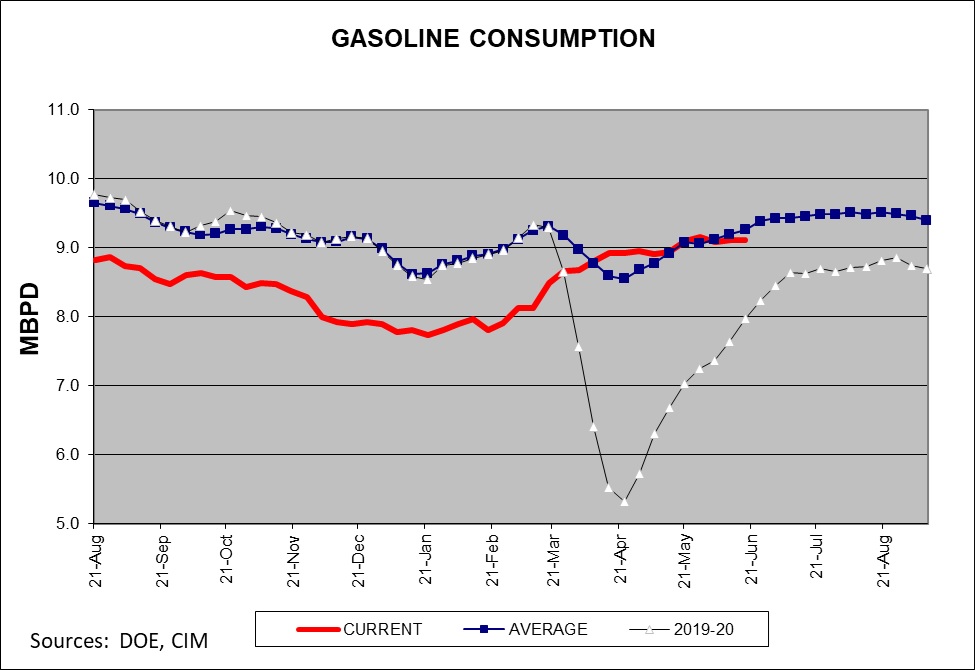
Although the economy is reopening, gasoline demand does not reflect any sort of “pent-up” demand.  Consumption is running in line with the five-year average.

Market news:

Geopolitical news:

Alternative energy/policy news:

View PDF

Daily Comment (June 23, 2021)

by Bill O’Grady, Thomas Wash, and Patrick Fearon-Hernandez, CFA

[Posted: 9:30 AM EDT] | PDF

We open today’s Comment with the latest developments regarding U.S. monetary and fiscal policy, followed by news that a socialist may be poised to become the mayor of a major U.S. city for the first time in decades.  Next, we cover international items ranging from U.S.-China tensions to more evidence of a global regulatory push against private cryptocurrencies.  We close with the latest news on the coronavirus pandemic.

U.S. Monetary Policy:  In testimony before Congress again yesterday, Federal Reserve Chair Powell admitted that price increases in the wake of the coronavirus pandemic have been larger than policymakers had expected and may prove more persistent.  He underscored his view that shortages—including used cars, computer chips, and workers—will fade over time, bringing inflation closer to the Fed’s 2% long-run target.  The comments show Powell continues to fight the good fight regarding his view that monetary policy should remain loose, even as it has become clear that multiple members of the policymaking committee are more concerned about inflation and would prefer to tighten policy earlier rather than later.  The more those inflation hawks make their views known, the more likely it is that the financial markets will price in at least some tightening, which will, in turn, keep real financial conditions tighter than they would be otherwise.

U.S. Fiscal Policy:  As White House officials and a bipartisan group of senators negotiated over their $1.2 trillion infrastructure proposal yesterday, it appears that the main sticking point was over ways to cover at least some of the cost.  Republicans continue to balk at the idea of raising income taxes, and Democrats reject increasing the gasoline tax or imposing a tax on electric vehicles.  It looks increasingly like the only significant revenue raiser that might come with the deal will be to boost funding for IRS enforcement programs.  In other words, most if not all of any spending that passes will likely be unfunded.  That may give a significant boost to the economy, although it’s probably also already priced into the markets.

U.S. Politics:  In New York’s primary elections yesterday, a former nurse and community activist running under the banner of the Democratic Socialists of America and the Working Families Party has unseated Buffalo’s four-term Democratic mayor.  If she wins the general election in November, she would be the first socialist mayor of a major U.S. city since 1960.

United States-China:  A long article in the Wall Street Journal yesterday highlighted China’s extensive use of a form of home imprisonment called “residential surveillance at a designated location.”  Authorities will hold a suspect for interrogation in a secret location for months at a time before any arrest or charge.  We suspect the program, which has even ensnared U.S. citizens, will become a new source of tension between the U.S. and China in the coming months.

  • In another development that will worsen U.S.-China relations, Hong Kong’s Apple Daily pro-democracy tabloid said it will be forced to close down after its assets were frozen and its journalists were arrested last week under the draconian new security law that Beijing imposed on the city.  The newspaper said its final edition would be printed on Thursday, and its website would stop being updated at midnight the same day.
  • Despite the accumulating concern about Chinese human rights abuses, reports overnight indicated the Biden administration is pushing to ramp up high-level engagement with the Chinese government.  The two sides are reportedly discussing a possible meeting between U.S. Secretary of State Blinken and Chinese Foreign Minister Wang at next week’s G20 meeting in Italy.  The Biden administration has also told Beijing it would like to send Deputy Secretary of State Sherman to China over the summer.
    • After months of pursuing an unexpectedly hardline approach to China, the administration’s apparent pivot toward talks may reflect its growing confidence after getting the coronavirus pandemic under control at home and making good gains on rebuilding U.S. alliances abroad.
    • All the same, it feels like any pivot to talks at this point may be premature.  Such a shift would also subject President Biden to criticism for being “soft on China.”  If the talks do happen, much will depend on how firmly the administration pushes and how much success it might have in curbing China’s geopolitical, economic, and technological aggressions.
    • As if to inoculate the administration from charges of being soft on China, the U.S. Navy conducted the sixth “freedom of navigation operation” of Biden’s presidency today, sending the guided-missile destroyer USS Curtis Wilbur on a pass through the Taiwan Strait.

United States-Iran:  The Department of Justice said it has seized dozens of U.S. websites linked to Iranian groups, including the Revolutionary Guard’s, because they were spreading misinformation and operating in the country without licenses.

United Kingdom-Russia:  The Russian military said one of its warships fired warning shots and a warplane dropped bombs to force the British destroyer HMS Defender from Russia’s waters near Crimea in the Black Sea.

Global Oil Market:  Global oil prices are now at their highest level in roughly two and a half years.  OPEC and its Russia-led allies are reportedly considering boosting their collective oil output by 500,000 barrels per day when they meet next week.  If the production hike is implemented, it would mean that almost half of the group’s massive, pandemic-inspired output cut last year was reversed.

Global Cryptocurrencies:  The Bank for International Settlements, often referred to as the central bank for central banks, today issued a report that essentially trashes private cryptocurrencies for overstated benefits and having the potential to undermine the public good provided by the current global payments system and central banks.  The report marks a continued push by central banks and financial regulators against private cryptocurrencies, even as many central banks work to develop their own digital currencies.

COVID-19:  Official data show confirmed cases have risen to 179,232,891 worldwide, with 3,884,162 deaths.  In the United States, confirmed cases rose to 33,566,075 with 602,465 deaths.  Vaccine doses delivered in the U.S. now total 379,446,660, while the number of people who have received at least their first shot totals 177,635,067.  Finally, here is the interactive chart from the Financial Times that allows you to compare cases and deaths among countries, scaled by population.

Virology

 Economic and Financial Market Impacts

  • As the pandemic-induced online retailing surge continues apace and firms search for new distribution centers close to ports and population centers, rents are surging for industrial and warehouse space.
    • Demand for industrial real estate is so strong that taking rents—the initial base rent agreed on by a landlord and tenant—are rising faster than asking rents.
    • Industrial taking rents were up 9.7% in the first five months of 2021 compared with the same period last year, while industrial asking rents rose 7.1%.
  • Evidence continues to accumulate, showing that the economic reopening in Europe is likely to produce extraordinarily rapid economic growth and at least temporary inflation pressures.  The IHS Markit “flash” Purchasing Managers’ Index for June jumped to 59.2, beating expectations and marking its highest level in 15 years.  Like all major PMIs, the Market PMI is designed such that readings over 50 will point to expanding activity.

 View PDF

Daily Comment (June 22, 2021)

by Bill O’Grady, Thomas Wash, and Patrick Fearon-Hernandez, CFA

[Posted: 9:30 AM EDT] | PDF

In today’s Comment, we open with the latest developments regarding U.S. monetary and fiscal policy.  We follow that with news on the growing push for tighter antitrust regulation–including in college sports!  We then cover various international developments before wrapping up with the latest on the coronavirus pandemic.

U.S. Monetary Policy:  In testimony before Congress yesterday, Federal Reserve Chair Powell said job creation should improve, and inflation should moderate in the coming months, vehemently reiterating his message after the Fed’s policy meeting last week.  Separately, New York FRB Chief Williams agreed conditions were improving but backed Powell in asserting that they still are not at the point where policy should be tightened.  In contrast, Dallas FRB Chief Kaplan and St. Louis FRB Chief Bullard emphasized that the time is drawing nigh when the policymakers must consider tightening policy.

  • Overall, the flurry of statements reflects our view that Powell has lost full control of the Fed’s policymaking committee.  Pro-capital, establishment-oriented hawks like Bullard and Kaplan are striking out on their own to argue for a quicker response to inflation pressures.
  • This has already prompted the financial markets to react, as shown by the tightening yield curve and the accompanying tightening of market monetary conditions.
  • We expect it will be some time before the Fed ratchets back its asset purchases or formally hikes interest rates.  Indeed, there is even some political pressure building to support that idea.  Ahead of Powell’s testimony yesterday, Carolyn Maloney (D-NY), a senior member of the House Financial Services Committee, warned the Fed not to put the brakes on the economy too soon.  Nevertheless, the continued debate will probably serve to keep financial conditions somewhat tighter than they would be otherwise.

U.S. Fiscal Policy:  White House officials will head to Capitol Hill today for a briefing on the status and details of the $1.2 trillion bipartisan infrastructure proposal being developed by the “Group of 20” senators.  The briefing marks a fresh push by President Biden to find a compromise with Republican lawmakers.

  • Sen. Rob Portman (R-OH) indicated last evening that he and the “Group of 20” would try to advance the talks before the Senate leaves at the end of the week for July 4 recess.
  • If today’s meeting goes well, Biden is reportedly inclined to meet with the senators to try to advance the talks. Yesterday, he separately hosted Sens. Joe Manchin (D-W.Va.) and Kyrsten Sinema (D-Ariz.) to discuss the matter.

U.S. College Sports:  The Supreme Court yesterday unanimously invalidated the NCAA’s restrictions on granting college athletes education-related compensation.  The ruling essentially said that the restrictions amount to price-setting for student-athletes and violates federal antitrust laws.  Under the ruling, universities and colleges can now compete for student-athletes by offering education-related inducements such as scholarships for graduate or vocational school, payments for academic tutoring, or paid post-eligibility internships.  Although the ruling actually only dealt with a narrow slice of the NCAA’s restrictions, we believe it reflects the growing shift toward tighter antitrust regulation around the world.

EU Antitrust Regulation:  The EU today said it is launching a formal antitrust probe against Google (GOOG, $2,529.10).  The investigation is to determine whether Google has broken EU rules by giving an advantage to its own online display ad technology services to the detriment of rivals.  The probe, which has been going on informally since at least 2019, will examine whether Google is “distorting competition by restricting access by third parties to user data for advertising purposes on websites and apps, while reserving such data for its own use.”  This probe further highlights the growing regulatory risk facing large, dominant technology firms.

Germany:  Chancellor Angela Merkel’s ruling center-right CDU/CSU party grouping, which currently has a commanding lead in the opinion polls ahead of the September federal elections, released a platform pledging tax relief and a quick return to balanced budgets after the massive spending splurge during the COVID-19 crisis.

  • Armin Laschet, the group’s candidate for chancellor, has vowed to continue Merkel’s conservative policies if he is elected.
  • The platform foresees a 25% cap on corporate taxes, down from around 30% now, and it pledges to abolish the “solidarity surcharge” introduced in 1991 to help pay for German reunification.  The platform also promises income tax relief for people on low and middle incomes while saying the group wants a return to balanced budgets “as soon as possible” and to bring Germany into compliance with the Maastricht treaty by bringing its debt-to-gross domestic product ratio below 60%.

Germany-Russia:  German authorities said they arrested a Russian citizen accused of passing sensitive information from a German university to Moscow in return for cash.  The suspect worked as a research assistant for a scientific and technical professorship at an unidentified German university and was arrested on June 18.  The report illustrates how Russian intelligence agencies continue to pursue their traditional craft in areas such as human intelligence and industrial espionage, even as they have become more noted for their cyberwarfare.

Japan-South Korea:  The two governments are in talks for South Korean President Moon Jae-in to attend the opening ceremony of the Tokyo Summer Olympics next month.  Moon reportedly wants to make the trip to reciprocate for former Japanese Prime Minister Shinzo Abe’s trip to South Korea in 2018 for the PyeongChang Winter Olympics.  Such a visit would also hold out hope for some further easing of tensions between the two countries over World War II issues, and it would potentially allow the leaders to coordinate their response to China’s geopolitical and economic aggressiveness in the region.  All the same, Tokyo is reluctant to hold a formal summit between Prime Minister Yoshihide Suga and Moon if the president makes a visit.

COVID-19:  Official data show confirmed cases have risen to 178,840,744 worldwide, with 3,874,630 deaths.  In the United States, confirmed cases rose to 33,555,046 with 602,107 deaths.  Vaccine doses delivered in the U.S. now total 379,003,410, while the number of people who have received at least their first shot totals 177,342,954.  Finally, here is the interactive chart from the Financial Times that allows you to compare cases and deaths among countries, scaled by population.

Virology

  • According to the latest CDC data, 53.4% of the U.S. population has now received at least one dose of a vaccine, and 45.2% of the population is fully vaccinated.
  • The latest data show that South America has now become the region worst hit by the pandemic.
    • With just 5% of the world’s population, the region now accounts for a fourth of the global death toll.
    • Last weekend, Brazil’s death toll surpassed 500,000, with the virus killing seven times as many people per capita each day than in hard-hit India.
  • The highly contagious, deadlier Delta variant, which delayed the U.K.’s economic reopening, has become dominant in Portugal and appeared in clusters across Germany, France, and Spain.  The spread of Delta has raised concerns that it could halt the progress the EU has made over the past two months in bringing new infections and deaths down to their lowest level since at least the autumn.
  • In China, the government is reportedly planning to keep its pandemic border restrictions in place for at least another year as officials fret over the emergence of new variants and a calendar of sensitive events, including the Winter Olympics in February.  In addition, the Communist Party Congress will take place toward the end of 2022, where President Xi is widely expected to seek an additional term beyond the customary two-term limit.

 Economic and Financial Market Impacts

  • Rebounding service businesses in the U.S. boosted wage rates and benefits in order to attract workers, but many manufacturers are now finding that their pay rates aren’t as competitive as they used to be.  That’s likely to put upward pressure on factory wages, on top of the significant cost increases for materials and transportation that manufacturers are already facing. Not only will that keep inflation fears live, but it has the potential to be a hit to corporate earnings if and when firms find they can no longer pass the cost hikes on to their customers.
  • Despite the spread of the Delta variant in Europe, a range of unofficial, high-frequency data suggests consumers on the continent are flocking back to bars and restaurants, booking holidays, and traveling to work again.  The data suggest pre-pandemic patterns of economic activity are re-emerging, which should boost economic activity and European risk assets going forward.
    • Nevertheless, labor and material shortages similar to those in the U.S. are already keeping the European recovery from strengthening as much as it could.
    • Some workers are reluctant to sign up for jobs in Greece, for example, for fear of being stuck there in the event of a new pandemic lockdown.
  • In China, the Yantian terminal in Shenzhen that closed for almost a week in late May after port workers tested positive for COVID-19 is still struggling to get back to normal.  Productivity at the port has reportedly recovered to only about 70% of normal levels, putting further strain on the global supply chain and snarling Chinese trade with the rest of the world.

 View PDF