Bi-Weekly Geopolitical Report – Reflections on the 20th Party Congress (November 7, 2022)

by Bill O’Grady | PDF

(The Bi-Weekly Geopolitical Report will not be published in two weeks due to Thanksgiving.  The report will return on December 12.)

The Communist Party of China’s (CPC) 20th Party Congress has come to a close.  By all accounts, General Secretary Xi has tightened his grip on power.  Not only has he secured a third term, breaking the pattern of a two-term limit informally implanted by Deng Xiaoping, but he has also filled his inner circle, the Standing Committee of the Politburo, and the Politburo itself, with loyalists.

In this report, we will offer our take on the meetings, including an examination of key speeches and a rundown of the new Standing Committee of the Politburo along with important figures within the Politburo.  From there, we will examine our view of the possible direction of Chinese policy in General Secretary Xi’s third term.  As always, we will conclude with market ramifications.

View the full report

Don’t miss the accompanying Geopolitical Podcast, available on our website and most podcast platforms: Apple | Spotify | Google

Daily Comment (November 7, 2022)

by Patrick Fearon-Hernandez, CFA, and Thomas Wash

[Posted: 9:30 AM EDT] | PDF

Our Comment today opens with an update on the Russia-Ukraine war.  We next review a wide range of other international and U.S. developments with the potential to affect the financial markets today, including multiple reports related to China.  Importantly, there are conflicting reports about China’s readiness to ease its Zero-COVID policies, which have done so much to impede Chinese and global economic activity.

Russia-Ukraine:  As Ukrainian forces continue to press their counteroffensives in the northeastern Donbas region and in the southern region around Kherson, Russian forces continue to strike back with air, missile, and kamikaze drone attacks against civilian infrastructure across Ukraine.  The Russians are also attempting to counterattack with ground forces, but reports indicate a contingent of their Pacific Fleet Marines took heavy casualties in the Donbas recently.  At the same time, Russian financier Yevgeny Prigozhin continues to throw his Wagner Group mercenaries against the Ukrainian city of Bakhmut in the Donbas region and is reportedly close to taking the city, albeit with significant casualties.  However, most Western observers that we follow believe that the capture of Bakhmut would give Russia little strategic advantage; rather, the Wagner Group attacks there appear to be designed to bolster Prigozhin’s leadership credentials, perhaps for his take over as Russian defense minister or for him to eventually seize power from President Putin.

  • A report in the Wall Street Journal stated that U.S. National Security Advisor Sullivan, in recent months, has engaged in confidential discussions with high-level Russian officials to reduce the risk of a broader conflict over Ukraine and to warn Moscow against using nuclear or other weapons of mass destruction.
  • Some Western analysts dismiss the possibility out-of-hand that Russia might take steps toward using a tactical nuclear weapon in its war with Ukraine, but as President Putin becomes increasingly backed into a corner, we would place the probability of such a move at around 25% or so.
    • Sullivan’s discussions with the Russian leadership confirm that the risk of such an event is not negligible.
    • In any case, Sullivan’s instinct to keep the lines of communication open reflects how many national security personnel in the U.S. administration are traditionalists and well-schooled in the imperatives of U.S.-Russian diplomacy and great-power rivalry.

United States-China:  Just one month after the U.S. imposed a series of tough, new restrictions on sending advanced semiconductor technology, goods, or services to China, reports show Chinese tech firms such as Alibaba (BABA, $69.81) have found at least one workaround as the firms are tweaking their most advanced chip designs to reduce processing speeds, allowing them to avoid U.S. sanctions when the chips are shipped back to China after being made in Taiwan.

  • With the U.S.-China geopolitical rivalry intensifying, the U.S. restrictions aim to suppress China’s computing power and make it more difficult for the country to compete economically and militarily.
  • China’s indigenous semiconductor plants are most likely decades away from producing cutting-edge chips such as those designed by Alibaba, so the move to deliberately cut their processing speeds is likely to have a noticeable impact on Chinese firms.

China-Solomon Islands-Australia:  Illustrating how some countries will likely try to play the evolving China-led geopolitical bloc against the U.S.-led bloc for their own advantage, last week the Solomon Islands took delivery of a Chinese domestic security aid package consisting of two water cannon trucks, 30 motorcycles, and 20 SUVs for its police force, just days after it took delivery from Australia of 60 short-barreled police rifles and 13 vehicles.

  • In our recent study projecting which countries will end up in each of the evolving geopolitical blocs, we assigned the Solomon Islands to the “Neutral” camp. Our study projects that Australia will be a key member of the U.S.-led bloc.
  • The competing Chinese and Australian donations come one year after the Solomons’ Prime Minister Sogavare put down a violent uprising stemming from his efforts to switch the country’s allegiance to China as he attempts to retain power.
  • In the coming years, as the U.S. and Chinese blocs attempt to curry favor with other ostensibly neutral countries, such as Indonesia and Vietnam, we suspect many of the neutrals will try to play the two blocs off each other in order to take advantage of the situation and retain their room to maneuver.

Chinese COVID Policy:  In a Saturday press conference, government health officials said they will continue to enforce President Xi’s “dynamic Zero-COVID” policy, calling it “completely correct, most economical, and effective.”  Although the officials promised to continually refine the policy to minimize economic and social disruptions, the statement suggested that the Chinese economy and financial markets will continue to struggle with the economically painful policy.  However, reports based on insider accounts this morning indicate high-level officials are actually reconsidering the Zero-COVID policy but want to move slowly before abandoning it to limit any downside for public health and/or for the political position of the Communist Party.  The conflicting reports have whipsawed stock equity futures over the last day.

Chinese Finance Sector:  The Communist Party announced that Fan Yifei, one of the six deputy governors of the People’s Bank of China, has been detained as part of an investigation into “suspected serious violations of discipline and law.”  Fan, a former high-level officer at China Construction Bank (CICHY, $10.98), is the latest in a series of financial officials who have been arrested on corruption charges over the past two years.

  • Foreign investors are now quite attuned to President Xi’s value-destroying crackdowns on sectors such as technology and real estate development.
  • Fan’s arrest is a reminder that China’s broader financial sector is also at risk of a regulatory crackdown. At the PBOC, Fan’s responsibilities included overseeing the country’s payment system and shepherding the central bank’s effort to create a digital currency.  His arrest signals that those two areas may now be a focus of the party’s corruption police.

United Kingdom:  When he releases his Autumn Statement at mid-month, Chancellor Hunt reportedly will call for tax increases and public spending cuts worth up to £54 billion per year to close the government’s yawning fiscal deficit.  Not only would the fiscal tightening reverse Former Prime Minister Truss’s plans, which sparked a massive selloff in U.K. government bonds, but it would also mark a return to growth-inhibiting austerity like that of the early 2010s.

U.S. Economy:  New polling suggests that almost three-quarters of U.S. consumers plan to seek less-expensive alternatives in this year’s holiday shopping season, driven largely by high inflation and concerns about an economic downturn.  The report is a reminder that the resilient labor market and continued high employment will not necessarily preclude a drop in consumer spending or a broader economic recession.  We continue to believe a recession is likely to begin in the next few quarters.

U.S. Elections:  Voters across the country will go to the polls tomorrow for mid-term elections in which all seats in the House of Representatives and one-third of the seats in the Senate will be contested.  The latest polling suggests that the summer swing of voting intentions toward the Democrats has now largely dissipated, raising the chance that the Republicans could take control of both chambers.

  • For investors, perhaps the key thing to remember is that U.S. stock prices typically rebound once the mid-term elections are finished, perhaps reflecting greater clarity on which party will control policy.
  • If that happens again this year, it would suggest stocks could rebound in the coming months and beyond. The chart below shows stock performance this cycle versus the average when a new party takes over the presidency (as happened in 2020).

View PDF

Daily Comment (November 4, 2022)

by Patrick Fearon-Hernandez, CFA, and Thomas Wash

[Posted: 9:30 AM EDT] | PDF

Good morning! Today’s Comment begins with our thoughts on the impact higher interest rates will have on investor sentiment. Next, we discuss how the changing geopolitical landscape is forcing leaders to rethink their alliances. Lastly, we talk about both the positive and the negative developments internationally.

 Pay Now, Not Later: Expectations of higher interest rates are adding to investor woes about duration risk.

  • Investors have reevaluated their estimates of rate hikes for 2023 in response to comments made by Fed Chair Jerome Powell. In a press conference, Powell stated that the central bank’s peak interest rates were likely higher than markets have currently priced in. As a result of this comment, investors have updated their peak interest rates to slightly above 5% by March 2023.
    • The chart below shows the market-implied Fed funds rate through 2023. Post-meeting data shows that investors have priced in a higher peak and have extended expectations of a Fed reversal.

  • Investors have begun offloading some of their duration sensitive assets thanks to new interest rate expectations. The nominal total return for the 30-year Treasury is down more than 30% year-to-date. Meanwhile, the NASDAQ composite index is down nearly 26% for 2022. The sell-off in duration sensitive assets is related to investors demanding higher premiums for investments that cannot provide short-term returns. Hence, investors are now prioritizing stocks that can give them a return now rather than later.
  • The combination of higher interest rates and inflation will encourage investors to demand higher premiums to hold on to riskier assets. As a result, investors are starting to prefer stocks with low multiples and high-dividend-paying potential. This dynamic partially explains why iShares ETF for value (IVE, $140.42) has outperformed its growth (IVW, $56.23) counterpart this year (-8.62% vs. -30.53%). It appears that investors are becoming increasingly uncomfortable with holding onto securities for long periods when there is uncertainty concerning inflation and borrowing costs. This trend will likely continue as long as the Fed continues to tighten the screws on its monetary policy.

A New Identity: As Europe adjusts to the new world order, leaders begin to show their true colors.

  • The once Eurosceptic Giorgia Meloni has changed her tune since taking over as Prime Minister of Italy. On Thursday, Meloni met with Brussels to dispel notions that she was unwilling to work with officials to manage the country’s heavy debt burden. When Meloni was initially elected, there much skepticism about her readiness to make the reforms required for Italy to receive its total allocation of EU funds. So far, those concerns have been muted as Meloni has expressed an openness to working with Brussels.
    • The improved outlook on Italy explains why Italian bond yields have declined in the weeks following Meloni’s election victory. The interest rate on bonds has fallen nearly 30 bps since the Italian elections. Although rates still remain elevated, the decline shows that investors are willing to give Meloni a chance.

  • Meanwhile, German Chancellor Olaf Scholz reminded the world that Berlin will always prioritize its own self-interest. Scholz is set to meet with Chinese officials on Friday to ensure that the ties between Beijing and Berlin remain tight. China is Germany’s third biggest trading partner behind the European Union and the U.S. The decision by Scholz angered some of his Western allies who then accused Germany of making the same mistake it did when it built close ties with Russia. Scholz’s gesture toward Beijing suggests that the world may not be split into two blocs but possibly three, with the U.S., EU, and China each leading their own blocs.
  • It is not clear how an independent Europe could coexist with the U.S. However, if we are correct, companies could be caught in the crosshairs as governments may pressure firms to choose sides. We are already seeing the S pressure firms such as Intel (INTC, $27.39) to stop selling semiconductors to China. Additionally, the situation will likely play out slowly over the next ten years as governments adapt to this new normal. In the meantime, companies with domestic supply chains may be relatively more attractive because they are less susceptible to policy-related disruptions.


Brighter Outlook: There is finally some good news coming out of China; however, rising uncertainty persists in other parts of the world.

  • The investing environment in China is showing signs of improvement. For example, on Thursday, Bloomberg News reported that Chinese authorities were looking for ways to ease the impact of their Zero-COVID policy. Officials plan to lift restrictions on flight suspensions to make it easier for the country to receive more travelers. Additionally, U.S. regulators are ahead of schedule on their audit of Chinese companies. So far, the developments have provided a reprieve for Chinese stocks the day after Beijing stamped out speculation that it was preparing to end its COVID restrictions.
  • Despite the positive news out of Asia, Europe and the Middle East still look like a mess. The EU is considering using the assets it seized from the Russian Central Bank to help Ukraine rebuild. Tensions between the West and Russia will surely escalate if Moscow is forced to bankroll the development of Ukraine. Thus, there is an increased likelihood that the two sides will completely sever ties. In the Middle East, former Pakistani Prime Minister Imran Khan was nearly assassinated on Thursday during a protest. The shooting of Khan reflects the rising tensions within Pakistan as the country deals with a heavy debt burden, slow economic growth, and high inflation. A political crisis in Pakistan could spill over to China and India.
  • There is much uncertainty around the world which could weigh on investor sentiment. However, that doesn’t mean that there are not opportunities internationally. The development in China suggests that Beijing is somewhat sensitive to the market’s perception of its policies. Meanwhile, the stories from Europe and the Middle East will not have an immediate market impact. Nevertheless, it is essential to remember that a broad understanding of what is happening worldwide will help investors improve their valuation process, which is why we make certain to provide the good, the bad and the ugly in all of our reports.

View PDF

Daily Comment (November 3, 2022)

by Patrick Fearon-Hernandez, CFA, and Thomas Wash

[Posted: 9:30 AM EDT] | PDF

Good morning. Today’s Comment begins with our thoughts on the Federal Reserve’s rate decision. Next, we discuss how the Fed indirectly pressures other central banks to tighten their own policy. Finally, we explain how an international push away from globalization will likely impact U.S. firms.

 The Fed Is Not Done: Bullish investors got whacked on Wednesday after Federal Reserve Chair Jerome Powell squashed pivot expectations.

  • The Federal Reserve raised rates by 75 bps and signaled the possibility of a more moderate rate hike in its next meeting. Although the hike was widely expected, the Fed gave somewhat conflicting remarks about future increases. In the Fed statement, officials mentioned increasing interest rates until inflation returns to its 2% target while acknowledging that it will be monitoring the policy’s impact on the economy. The two statements led to confusion within markets as investors interpreted it as a signal that the Fed was nearing the end of its tightening cycle. However, Powell later clarified that the central bank is not ready to pause or pivot and has instead increased the ceiling of its interest rate target.
  • Although the market initially responded favorably to the possibility of policy moderation, the mood changed after Powell spoke. The S&P 500 tanked 2.5% following the news as Powell’s comment dashed hopes of an imminent Fed reversal. Meanwhile, the dollar rose, and bond prices dropped as tighter financial conditions made cash more attractive. The market’s reaction suggests that many investors still hold risky assets in their portfolios, with hope that the Fed will change course. Hence, the market has not likely hit bottom yet.
  • Clearly, the Fed would like investors to believe it is prepared to combat inflation at all costs; however, we have our doubts. The Federal Open Market Committee is unlikely to have unanimous support in favor of raising rates into a recession. In fact, the committee’s reference to a decrease in the size of the rate hikes and an increase in the peak of interest rates suggests that it will try to push up rates as high as it can while the economy remains relatively strong. Hence, the Fed may raise rates by 50 bps until either inflation falls or the economy contracts.
    • The increase in borrowing costs has pushed auto and mortgage rates to their highest levels in more than a decade. Thus, the rise in interest rates is already hurting growth as it suppresses durable goods consumption and investment spending.

 The More, The Scarier: Monetary policymakers in other countries feel compelled to follow the Fed’s lead, whether they like it or not.

  • The Bank of England hiked its benchmark interest rates by 75 bps on Thursday, marking its biggest hike in 33 years.  The central bank was forced to raise rates aggressively after unfunded tax cuts from the Truss administration called into question the country’s ability to contain inflation. In its statement, the BOE specified that its interest rate peak would be lower than the market expects. The comment indicates that the bank is reluctant to continue to hike rates as the economy starts to slow. The two dissenters who voted for smaller hikes reflected this cautiousness. The lack of action suggests inflation in the U.K. could be higher for longer, and the pound may begin to weaken again.
  • European Central Bank officials have also signaled that they are now more hawkish. ECB president Christine Lagarde stated that a recession would not be enough to bring down inflation. Meanwhile, Governing Council member Martins Kazaks went further and noted that the banks should raise rates “significantly” even with a recession on the horizon. The signaling from ECB officials indicates that the bank will raise rates by 75 bps in its next meeting and could continue to tighten for the foreseeable future.
    • The spread between the 10-year bonds for Italy and Germany, a gauge for financial distress in Europe, is well below its 2022 high. So far, European fragmentation is less of an issue than earlier in the year; however, this could change if the Eurozone falls into recession.

  • It is unlikely that either the BOE or ECB feels comfortable becoming more hawkish. This fact explains why these banks have yet to close the door on their respective bond-purchasing programs completely. Their decision to follow the Fed’s lead reflects their need to save face in order to persuade investors not to sell off their respective currencies. Thus, it is unlikely that either central bank will continue with jumbo hikes when the Fed eventually decides to halt its tightening cycle. In the meantime, ubiquitous monetary tightening of financial conditions raises the likelihood of a severe global downturn.

A Darker World:  Globalization may run out of steam as the governments become more hostile and demagogues gain influence.

  • Benjamin Netanyahu’s right-wing coalition will face resistance from other countries. The Biden administration has hinted that it is reluctant to work with Jewish supremacist politician Itamar Ben-Gvir. His history of making threats toward the Palestinians makes a relationship untenable. The controversial figure has risen in prominence due to the rise in popularity of ultra-right-wing candidates. His party, Religious Zionism, will be essential for Netanyahu to be able to form a government. The election in Israel reflects how nationalistic countries are becoming and provides further evidence that the world is moving away from multilateralism.
  • U.S. rivals North Korea and Russia are becoming increasingly belligerent. Pyongyang tested its most powerful intercontinental ballistic missile (ICBM) on Thursday. Although the launch failed, it is clear that North Korea’s weapon capabilities are still improving. Meanwhile, Russian officials discussed when or how to use nuclear weapons in Ukraine. Although the U.S. will be unlikely to seek violent means to contain these threats, military action is not completely out of the question. That said, the risk of a continental war in Asia and Europe is elevated.
  • Globalization cannot survive in a hostile world. Companies’ reliance on supply chains depends solely on the belief that countries will remain stable. Thus, as governments become more nationalistic and assertive, firms will be forced to move their manufacturing production to safer countries or bring them back home. This outcome will lead firms to increase their capital expenditures and potentially increase prices as they adjust to a costlier world.
    • In addition to rising conflict, the lack of cooperation is also a headwind to the global economy. Today’s sell-off in China is a good example. Beijing’s unwillingness to seek help from the West has prolonged its COVID recovery. On Wednesday, Beijing reiterated its plans to adhere to Zero-Covid policy. The outcome could make a global recession more likely and weigh on commodity prices.

View PDF

Weekly Energy Update (November 3, 2022)

by Bill O’Grady, Thomas Wash, and Patrick Fearon-Hernandez, CFA | PDF

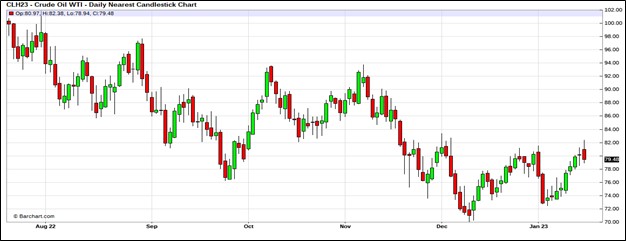
Crude oil prices appear to be building in a base in the mid-$80s.

(Source: Barchart.com)

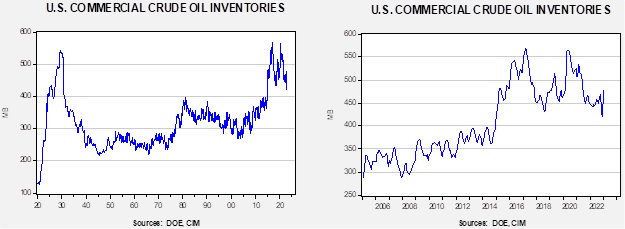
Crude oil inventories fell 3.1 mb compared to a 1.5 mb build forecast.  The SPR declined 1.9 mb, meaning the net draw was 5.0 mb.

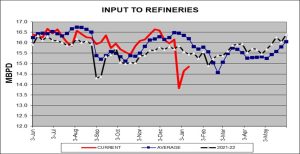
In the details, U.S. crude oil production fell 0.1 mbpd to 11.9 mbpd.  Exports declined 1.2 mbpd, while imports were steady.  Refining activity rose 1.7% to 90.6% of capacity.

(Sources: DOE, CIM)

The above chart shows the seasonal pattern for crude oil inventories.  As the chart shows, we are past the seasonal trough in inventories and heading toward the secondary peak which occurs later this month.  SPR sales have distorted the usual seasonal pattern in this data.

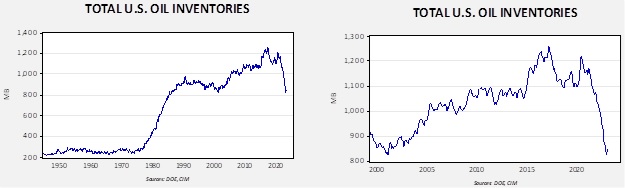
Since the SPR is being used, to some extent, as a buffer stock, we have constructed oil inventory charts incorporating both the SPR and commercial inventories.

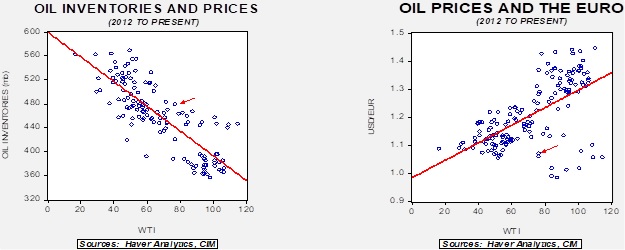
Total stockpiles peaked in 2017 and are now at levels last seen in 2002.  Using total stocks since 2015, fair value is $107.47.

The Diesel Scare:

A prominent news personality recently suggested that “the country will run out of diesel fuel by Thanksgiving,” leading to a steady stream of questions to our inbox.  So, here is our take…

Diesel is part of a family of fuels called “distillates.”  Other members of this family include heating oil (diesel with a higher sulfur content) and sometimes jet fuel.  In general, diesel for road use has a lower sulfur content (it’s cleaner, in other words) so other distillates can’t easily be substituted for the diesel.  In the weekly data, diesel demand isn’t broken out from overall distillate demand.  To create a standardized measure of inventory (a mere level won’t tell you how much you have relative to demand), we divide stockpiles into daily demand.  By dividing inventory into consumption, we determine how many days of supply are available given current demand.  We are hearing that there are 21 days of inventory available, but since we can’t confirm diesel demand separate from distillate demand, we can’t confirm that number, although we can say that distillate stocks are tight, around 27 days.

The above chart, which is weekly data going back to 1987, measures current distillate inventories compared to consumption.  As the chart shows, levels are around 25 days, which is “tight.”  On average, the “days to cover” is 35 days with a standard deviation of six days.  So, the current level of 27 days is in the “bucket” of two standard deviations below average.  At the same time, it is important to remember that this number tells us how many days we can go if our only source of distillate is inventory.  That would assume the U.S. refining industry would close, and we couldn’t import any fuel.  That isn’t the case.  It is strictly true that we could run out of distillate by Thanksgiving, but only if we closed the ports and stopped refining completely, which isn’t likely.  Simply put, conditions are tight but not dire.

Complicating matters is that Europeans are importing diesel as a backup fuel for electricity generation and heating, both at the utility level as well as the firm and household level.

This is why the administration has floated export controls to ensure domestic supplies.  The problem is that it will be hard to keep the EU supporting the war in Ukraine if Europeans are freezing because the U.S. won’t send diesel.  At the same time, it will be hard to maintain support for the war in the U.S. if tight diesel supplies lift overall inflation.  In the past, when diesel fuel stocks tightened, our exports were much smaller.  So, the export situation has complicated matters.

We do have some refining capacity to tap.  Currently, refinery capacity is running around 89%, so we could see increased production.  Unfortunately, U.S. refinery capacity has been declining for some time as about 3.0 mbpd of refining capacity has closed since 1993.

There is yet another complication.  The Northeast (PADD1) is facing a severe shortage of diesel.  This region uses both natural gas and heating oil for home heating (the rest of the country mostly uses natural gas or propane) and so tight supplies can be a real problem.  Due to the Jones Act, this region usually imports distillate from abroad because it is cheaper to use foreign shipping than higher cost U.S. shippers, who are protected by the act.  But currently, Europe is absorbing the global supplies that would normally end up on the Eastern Seaboard.  It is unclear how this situation will be resolved, but the overall tight distillate market is being exacerbated by the shipping situation to the Northeast.

We don’t expect that the trucking industry will “shut down” due to the lack of diesel; instead, diesel prices will likely rise, which will cause adjustments (more rail traffic, for example, as trains are much more efficient) and delays in shipping.  However, the situation isn’t good.  About the only silver lining is that for every barrel of crude oil refined, roughly a third is distillates and 55% to 60% is gasoline.  As refiners lift production to meet diesel demand, we will get more gasoline in the market.

We also note that a weaker economy will reduce energy demand.  Already, U.S. trucking firms are reporting that shipments are down and we note that European economies are slumping as well.

 Natural Gas Update:

Natural gas prices have been weak lately as the storage injection season is near its end, the tropical storm season spared the oil sensitive regions of the Gulf of Mexico, and so far, temperatures have been mild.  For the most part, the trends in supply and demand are balanced.

On a rolling 12-month basis, there is a modest level of excess demand.  Meanwhile, inventories appear to be in balance.

With supply and demand nearly in balance and inventories in line with seasonal norms, the direction of prices going forward will mostly be a function of temperature.  The official NOAA forecast suggests that most of the nation’s major population centers will be normal to warmer-than-normal this winter.

Of course, even in an otherwise mild winter, a cold snap can have important effects on demand and natural gas prices.  Overall, though, the forecast does offer hope that home heating costs will be manageable.

Market News:

  • In the latest IEA annual report, one of the more important assertions is that fossil fuels are approaching peak demand, in part driven by the war in Ukraine. We have doubts that this forecast is correct, but the fact that it exists will tend to affect investment decisions.  In other words, if investors believe peak demand is on the horizon, there will be less incentive for investment, which will tend to crimp supply and lift prices.
  • Major oil companies are reporting record-breaking profits. President Biden is floating a windfall profits tax, accusing the oil industry of war profiteering.  In general, such taxes are counterproductive.  If the goal is to increase supply, taxing it works against that outcomeIf production remains low, the case for higher taxes on energy companies will become more compelling.  However, unless the tax is crafted to offer exemptions for increased production, this tax won’t increase production.  And, given the near certainty that the government will be divided after next week’s elections, the White House would have to put the tax through in the “lame duck” session.
  • It looks like the price cap idea on Russian crude oil is slowly unraveling. It has been arduous to get enough nations on board with the plan, leading the U.S. to lift the proposed price cap.  At the same time, it may be difficult for Russia to overcome the looming insurance ban, since the country may not have enough ships to avoid reducing exports.
  • Although the U.S. is the world’s largest oil producer, it is also a major consumer as well. Complicating matters is the mismatch between what U.S. drillers produce and what refiners use.  The U.S. tends to produce more sweet/light oil, whereas U.S. refiners prefer sour/heavy crudes.  Thus, the U.S. tends to export the former and import the latter to make the adjustment.  There are two nearby producers that generate sour/heavy oils: Canada and Venezuela.  The former is a major exporter to the U.S.  However, recent prices suggest that Canada could export even more to the U.S. if pipeline constraints were relieved.
  • In recent reports, we have discussed how the SPR is evolving from a strategic reserve to a buffer stock. It seems that others are also thinking in a similar fashion.  Buffer stocks in commodities have operated to the benefit of both consumers and producers, but they have a long history of failure.  Scenes of blocks of processed cheese being tossed to the crowds from the back of trucks in the 1980s were the result of a buffer stock of dairy products that were used to keep milk prices above their market-clearing level.  In our current situation, the failure point for the SPR is that there will never be a price low enough to trigger buying for the reserve.  That’s because consumers really like free goods, and once you start buying for the SPR, you are setting a floor price.

(Source: Bloomberg)

  • The current spread of Western Canadian Select and WTI is nearly $30 per barrel, nearly double the average of $16.  Unfortunately, expanding pipelines is difficult, since local opposition tends to be high, and environmentalists have targeted pipeline construction as a way to reduce oil and gas production.  So, instead, the administration is considering easing sanctions on Venezuela.  Caracas has been under sanctions for its repressive tactics and support of drug trafficking.
  • After prompting OPEC+ to cut production targets recently, the Saudi oil minister suggested that the Kingdom of Saudi Arabia (KSA) might be willing to lift output if the energy crisis worsens. He also suggested that the recent cuts had more to do with maintaining a supply buffer than lifting prices.
  • Recently we have reported that LNG tankers are sitting off the Iberian Peninsula waiting to disgorge their cargos. Initially, it seemed they lacked a space to dock and regassify.  However, recent indications suggest it may be more about waiting for higher prices.  After all, as we noted last week, prices for prompt natural gas briefly turned negative due to weak prompt demandWeaker EU demand relative to supply is creating a game of “chicken” for buyers and sellers.  Current sellers who are hedged have to deliver the gas, and if they can’t, they must either take a lower price or offset the position but pay to store the gas on a tanker, which isn’t cheap.
  • COVID infections are disrupting China’s coal industry.

 Geopolitical News:

 Alternative Energy/Policy News:

  View PDF

Daily Comment (November 2, 2022)

by Patrick Fearon-Hernandez, CFA, and Thomas Wash

[Posted: 9:30 AM EDT] | PDF

Our Comment today opens with an update on the Russia-Ukraine war, including news that Russia has reversed its decision to stop participating in the UN-brokered deal which allows Ukraine to keep exporting grain out of its southern ports.  We next review a wide range of other international and U.S. developments with the potential to affect the financial markets today, including a call by U.S. Trade Representative Tai for an allied industrial policy against China and a preview of the Federal Reserve’s latest policy decision, due out this afternoon.

Russia-Ukraine:  As Ukrainian forces continue to press their counteroffensives in the northeastern Donbas region and in the southern region around Kherson, and as the Russians counterattack with air, missile, and kamikaze drone attacks on Ukraine’s civilian infrastructure, new reports suggest Russia is buying more drones and ballistic missiles from Iran to shore up its depleted inventory of such weapons.  The new purchases from Iran suggest Russia will continue its attacks on Ukraine’s civilian infrastructure in an effort to break the Ukrainians’ will to fight.

  • In an important reversal for global food supplies, the Russian government today said it would resume participating in the UN-brokered deal allowing Ukraine to ship grain out of its southern ports. Even though many ships had continued to sail into and out of Ukrainian ports since Russia announced a suspension of its participation last weekend, the news was welcomed by world grain traders.
  • So far this morning, wheat prices are down some 5.7% and are almost back down to the levels seen before Russia’s weekend suspension.

Global Economy:  Søren Skou, the chief executive of Danish shipping giant AP Møller-Maersk (AMKBY, $10.63), warned that “every” indicator his company uses to gauge future demand is flashing “dark red.”  According to Skou, the global economy is certainly sliding into recession, which is consistent with our view that the U.S. economy will likely begin contracting in the next few quarters.

Denmark:  In yesterday’s elections, center-left Prime Minister Frederiksen secured the bare minimum of 90 seats in parliament that is necessary for a majority.  However, such a slim majority may not be viable, so she also announced that her current government would resign, and she would focus on building a broad coalition including parties from both the left and the right.

Israel:  With about 84% of the vote counted following yesterday’s parliamentary elections, right-wing Former Prime Minister Netanyahu’s coalition is projected to get between 62 and 65 seats in the 120-seat Knesset.  The expected government would be one of the country’s most conservative and religious-oriented in history.  Meanwhile, center-left incumbent Prime Minister Lapid’s bloc is expected to come in second with about 54 seats.  However, the results could end up being different when the official count is finalized.

Brazil:  Incumbent right-wing President Bolsonaro vowed publicly yesterday to respect the constitution and recognize that he lost the weekend presidential election to leftist Former President Luiz Inácio Lula da Silva.

  • Bolsonaro’s statement removes the risk of a constitutional crisis that could have been very negative for Brazilian assets.
  • Of course, the re-election of Lula will also weigh on Brazilian stocks, at least in the near term, given his vague plans to boost spending on social programs and infrastructure and to impose stricter environmental regulations in Brazil.

Colombia-Venezuela:  Yesterday, leftist Presidents Gustavo Petro and Nicolás Maduro held the first Colombia-Venezuela summit in six years, illustrating how new, leftist leaders in the region are willing to re-engage with Venezuela in defiance of the U.S.  The focus of the meeting reportedly was on bilateral trade and regional environmental protection policies.

North Korea-South Korea:  To protest U.S.-South Korean military exercises, North Korea today launched its biggest barrage of missiles in years.  The missiles were launched from at least eight locations on both the east and west coasts of North Korea, with at least one falling so close to a South Korean island that it triggered an air-raid siren.  In response, South Korea fired three air-to-ground missiles from warplanes into the sea north of the countries’ disputed border.

China:  Chinese stocks posted strong gains yesterday on rumors that the government has established a committee to look at loosening its disruptive, unpredictable Zero-COVID policies.  As we have argued previously, those policies have created a significant headwind for the Chinese economy and, by implication, the global economy.  However, it’s important to remember that even if the government loosened its Zero-COVID policies, the economy would still face a number of other challenges, from the government’s crackdown on various types of private enterprise to the U.S.’s imposition of trade and capital flows.

United States-China:  FCC Chairman Carr, in his strongest statement on the issue so far, has called for the Committee on Foreign Investment in the U.S. (CFIUS) to ban social media app TikTok from the U.S. market because of the way the Chinese-owned company collects information on its users.

  • Although the FCC has no authority to ban TikTok itself, the CFIUS and Congress could take tough action in that direction.
  • In any case, the call by Carr is a reminder of the strong anti-China political winds in the U.S., which are likely to undermine the value of Chinese stocks going forward.

United States-European Union:  In an interview with the Financial Times, U.S. Trade Representative Tai has offered an impassioned defense against EU complaints regarding the subsidies recently passed for U.S. technology and green-energy firms.  To defend the new U.S. subsidies, Tai argued that the U.S. and the EU should develop a coordinated industrial policy in which the EU also provides such support to its industries and reduces China’s role in them.

  • According to Tai, “Our vision is for an industrial policy that isn’t just about us, but is about complementing the work with our friends and allies to allow us to together build a resiliency and to wean us off some dependencies and concentrations that have proven to be so economically harmful over the last couple of years.”
  • Tai also stressed that such a coordinated, anti-China industrial policy should include the U.S.’s key allies in Asia, including Japan and South Korea.
  • EU officials will likely keep pushing back against the U.S. subsidies and “buy-American” policies despite Tai’s proposal, but Tai also insisted that the administration is intent on a deal that will bring all sides on board. That’s important because it reflects an understanding that maintaining and strengthening alliances always take work, compromise, and time.  The new U.S. subsidies and other policies, like the administration’s consideration of fuel export controls while the EU is suffering energy shortages, all produce strains in the relationship, but Tai’s statement suggests that the administration could be taking a broader view of U.S.-EU relations that will keep the alliance together.

U.S. Monetary Policy:  Officials at the Federal Reserve wrap up their latest policymaking meeting today, with their decision due out at 2:00 pm ET.  The officials are widely expected to hike their benchmark fed funds interest rate by another 75 basis points, but investors are also hoping that they will signal more moderate rate hikes going forward out of fear that tighter monetary policy could send the U.S. economy into a sharp downturn.  Meanwhile, derivative markets suggest investors are now betting that the Fed policymakers will have to keep interest rates higher for longer before they finally bring inflation pressures down to acceptable levels.

U.S. Diesel Fuel Market:  Recent media reports have highlighted that U.S. diesel inventories are at a very low 21 days of consumption.  That’s consistent with a broader data set showing that overall inventories of “distillates” (diesel, jet fuel, heating oil, etc.) are unusually low, as shown in the chart below.  In addition, European energy shortages from the war in Ukraine have boosted U.S. distillate exports.

  • But the figure of 21 days of consumption means the U.S. would run out of diesel fuel in 21 days if there were no additional refinery output or imports. As long as U.S. refineries keep producing new diesel and gasoline, and as long as the U.S. can import such fuels, there is little reason to think the country would literally run out of diesel.
  • More likely, the historically low inventory/consumption ratio suggests diesel prices will move higher in the near term. That will probably produce some “demand destruction” as diesel users look for ways to economize.

View PDF

Daily Comment (November 1, 2022)

by Patrick Fearon-Hernandez, CFA, and Thomas Wash

[Posted: 9:30 AM EDT] | PDF

Our Comment today opens with an update on the Russia-Ukraine war, including the latest on Russia’s destruction of Ukrainian civilian infrastructure and Yevgeny Prigozhin’s continued effort to position himself for a potential takeover of power.  We next review a wide range of other international and U.S. developments with the potential to affect the financial markets today, including foreign electoral news and a preview of the Federal Reserve’s latest policymaking meeting.

Russia-Ukraine:  Russian forces continue to launch massive air, missile, and kamikaze drone attacks across Ukraine, targeting mostly civilian energy infrastructure in an effort to break the Ukrainians’ will to fight.  Ukrainian utility crews are racing to repair the damage before that happens.  Meanwhile, Ukrainian forces continue their counteroffensives in the country’s eastern Donbas region and in the south around Kherson.  It remains unclear just how strenuously the Russians will defend Kherson as various reports indicate they are already pulling back some units to the east of the Dnipro River.

  • Following up on Russia’s declaration on Saturday that it would no longer participate in the UN-brokered deal allowing Ukraine to export grain from its southern ports, the Russian government warned yesterday that it may interdict the ships that continue to arrive at and depart from those ports. Global grain prices have surged since yesterday on fear that Ukrainian grain stocks would no longer be available on the market.
  • On a more positive note, however, European fertilizer producers are ramping up output again as natural gas prices continue to fall due to warm weather and Europe’s gas storage facilities being full. Renewed production could help bring down the cost of fertilizers and encourage farmers to use more of the product, potentially boosting yields globally and helping bring down global food costs.
  • Meanwhile, Yevgeny Prigozhin, financier and mercenary leader of the Wagner Group, continues working to build his popularity for an apparent effort to grab power if President Putin becomes sufficiently weakened. In his latest gambit, Prigozhin has lambasted the leaders of the provincial government of St. Petersburg and associated oligarchs for allegedly setting up a criminal organization to plunder the state budget.  Local media reports that Prigozhin’s popularity is “skyrocketing.”

China:  Today, reports indicate that the Chinese economy will continue to face headwinds from President Xi’s crackdown on private enterprise and his strict Zero-COVID policies.  In one such report, the government banned entertainers and social-media influencers from endorsing private tutoring, health foods, tobacco, and other goods and services that don’t conform to “socialist core values . . . and traditional virtues.”  In another report, authorities have once again shut down Shanghai Disneyland after a single guest tested positive for COVID-19.

  • Separately, a mass pandemic shutdown of the city of Zhengzhou continues to disrupt the main iPhone factory there, raising costs for Apple (AAPL, $153.34) and top assembler Hon Hai Precision Industry (HNHPF, $6.23).
  • The Communist clampdown on private enterprise and disruptive, unpredictable pandemic lockdowns continue to slow the Chinese economy, taking further wind out of Chinese stock values.

United Kingdom:  Illustrating the economic pullback taking hold in the U.K. because of soaring energy prices and skyrocketing interest rates, the Nationwide housing company said home prices fell 0.9% in October, for their first drop since July 2021 and their biggest monthly decline since June 2020.  Home prices in October were still up 7.2% year-over-year, but that was significantly cooler than the 9.5% rise in the year to September.

Denmark:  In parliamentary elections today, Prime Minister Mette Frederiksen is in danger of being ousted, in large part because of her hasty decision during the pandemic to require the slaughtering of some 17 million mink over infection concerns.  The decision has devastated the country’s once-thriving fur business.

Brazil:  More than a day after leftist firebrand Luiz Inácio Lula da Silva was declared the winner of Sunday’s presidential election, incumbent President Jair Bolsonaro still has not conceded the contest.  Truckers, who have made up a large share of Bolsonaro’s constituency, are disrupting traffic at hundreds of locations around the country to show their support for the president.  Other major supporters of Bolsonaro have recognized Lula’s win, but the incumbent’s failure to concede so far raises the risk that he will officially contest and spark a constitutional crisis.

Israel:  Today, the country is holding its fifth parliamentary election since 2019, with polls predicting a tight vote that will give neither center-left Prime Minister Lapid nor right-wing opposition leader Netanyahu a clear path to power.

Iran:  The anti-government protests sparked by the death of a woman in the custody of Iran’s morality police on September 16 have continued in recent days despite a warning to stop by Major Gen. Hossein Salami, the commander of Iran’s Islamic Revolutionary Guard Corps.  The direct warnings from Gen. Salami appeared to be part of a new strategy to target students more directly.

U.S. Monetary Policy:  Officials at the Federal Reserve begin their latest policymaking meeting today, with their decision due on Wednesday afternoon.  The officials are widely expected to hike their benchmark fed funds interest rate by another 75 basis points, but investors are also hoping that they will signal more moderate rate hikes going forward out of fear that tighter monetary policy could send the U.S. economy into a sharp downturn.  Meanwhile, derivative markets suggest that investors are now betting that the Fed policymakers will have to keep interest rates higher for longer before they finally bring inflation pressures down to acceptable levels.

U.S. Tax Policy:  President Biden yesterday called for a windfall profits tax on energy producers that benefit from today’s high energy prices but don’t reinvest their profits in order to help bring down prices.  Of course, the proposal would face major hurdles in Congress, especially if the Republicans win the House and/or Senate in next week’s midterm election.  All the same, the proposal highlights the tax and regulatory risk that energy companies face as they rake in profits because of high prices.

U.S. Antitrust Policy:  Yesterday, a federal judge ruled in favor of a Justice Department move to block the planned merger of book publishers Penguin Random House and Simon & Schuster, on grounds that the combination would lessen competition in the market for publishing rights.  The decision highlights the more aggressive antitrust stance taken by the Biden administration.

View PDF

Daily Comment (October 31, 2022)

by Patrick Fearon-Hernandez, CFA, and Thomas Wash

[Posted: 9:30 AM EDT] | PDF

Our Comment today opens with an update on the Russia-Ukraine war, including the latest on Russia’s apparent withdrawal from the UN-brokered deal which allowed Ukraine to export grain from its southern ports.  We next review a wide range of other international and U.S. developments with the potential to affect the financial markets today, including news of an unexpectedly high rate of inflation in the Eurozone and a leftist win in Brazil’s presidential election.

Russia-Ukraine:  Ukrainian forces continue to recapture modest amounts of territory in the northeastern Donbas region, but Russian forces have apparently pushed them back in some areas as both sides jockey for position ahead of winter.  The Ukrainians also continue pressing their counteroffensive in the southern region around Kherson, although it appears that their gains there may have stalled.  In any case, the Russian military continues to strike back at Ukraine with air, missile, and kamikaze drone attacks on the country’s civilian energy infrastructure in an effort to break the Ukrainians’ will to fight.  Reports on whether Russia will try to defend Kherson rather than abandoning it have become contradictory.

Eurozone:  As shown in the data tables below, the Eurozone’s October consumer price index was up 10.7% from the same month one year earlier, far worse than expected and much higher than the 10.0% increase in the year to September.  The inflation rate in October was a record for the Eurozone, but its data only goes back to the late 1990s.  Germany’s rate in October, at 11.6%, was its highest since 1951.

  • The October inflation figures largely reflect the spike in energy prices touched off by the war in Ukraine.
  • The sky-high inflation rate has the potential to spark further social unrest in Europe. Indeed, thousands of German industrial workers walked out for several hours over the weekend in an escalating pay dispute sparked by high inflation, and leaders of Germany’s powerful IG Metall union warned of more strikes to come if employers failed to improve their offer.  High inflation also ensures that the European Central Bank will continue to hike interest rates aggressively.

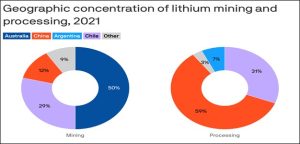
Indonesia:  Investment Minister Bahlil Lahadalia said Indonesia, the world’s largest nickel producer, is exploring the possibility of establishing a cartel for nickel and other key battery metals in order to control supply and boost prices, much like the Organization of the Petroleum Exporting Countries (OPEC).

  • Forming such a cartel would likely discourage new foreign investment in Indonesia’s metals sector, and it isn’t clear whether Indonesia could get the cooperation of other major producers, such as Russia, Canada, and Australia.
  • In our recent study of how the world is breaking up into relatively separate geopolitical and economic blocs, we projected that Indonesia would attempt to remain in the “Neutral” bloc. That helps explain its consideration of a cartel, as such a grouping would help it leverage its mineral resources in a fractured world.  However, since big producers like Canada, Australia, and the Philippines are likely to be in the U.S. bloc and may not participate in such a cartel, Indonesia’s move may not be successful.

Brazil:  In a run-off election yesterday, leftist Former President Luiz Inácio Lula da Silva appeared to beat incumbent right-wing President Jair Bolsonaro by 50.9% to 49.1%.  In the runup to the election, Bolsonaro had pushed the argument that the country’s voting machines are subject to fraud, so there is probably still some chance that he will challenge the vote.

  • If Lula prevails, however, he is likely to push for looser fiscal policy to support greater spending on social programs and infrastructure, and he is likely to impose tougher environmental regulations and other rules.
  • Lula’s expected economic policies are likely to scare investors, so the election outcome could result in lower values for Brazilian stocks and bonds in the near term.

China:  The main iPhone assembler for Apple (AAPL, $155.74) said that it is shifting production away from its main Chinese plant in Zhengzhou after a botched COVID-19 lockdown in that city prompted masses of workers to flee.  The shutdown of the Zhengzhou plant will reportedly affect about 10% of the company’s iPhone output.  Both Apple and the assembler, Hon Hai Precision Industry (HNHPF, $6.40), are facing downward pressure on their stock prices thus far this morning.

United States-China:  Under Secretary of Commerce for Industry and Security Alan Alvarez stated in a speech last week that the administration’s broad new ban on selling U.S. computer chips, chipmaking technology, and related services to China will likely be followed by similar curbs on quantum computing, high-end biotechnology, and artificial intelligence software.  According to Alvarez, who transferred to the Commerce Department after a long career at the Defense Department, the U.S. restrictions are aimed solely at protecting U.S. national security.

  • Alvarez insisted that the U.S. technology bans are not aimed at stifling Chinese economic development. Based on the imperative of national security, he also warned that the additional technology restrictions could be implemented even if they hurt business for U.S. companies.
  • Overall, the statements by Alvarez confirm that the U.S. government will probably keep squeezing technology flows between the U.S. geopolitical bloc and the Chinese bloc out into the future. That will likely hurt even more Chinese stocks in technology and other sectors, even beyond those that have already been impacted.

U.S. Defense Strategy:  As required by law, last week the Biden administration released the unclassified version of its National Defense Strategy.  The document identifies China as the U.S.’s key “strategic competitor” and the military’s “pacing challenge,” while it recognizes Russia as merely an “acute threat.”  The overall strategy is based on “integrated deterrence,” or coordinating military, diplomatic, and economic levers from across the U.S. government to deter an adversary from taking an aggressive action. It also stresses “campaigning” to build up the capability of international coalitions and complicate adversaries’ actions.

  • The strategy also emphasizes making new investments in advanced, cutting-edge technologies such as hypersonic missiles and artificial intelligence. The strategy’s integrated Nuclear Posture Review emphasizes the need to modernize U.S. nuclear forces and highlights the dilemma of simultaneously deterring two nuclear-armed competitors: Russia and China.
    • It also includes a nod to President Biden’s hope to reduce the nation’s nuclear weapons effort by retiring the B83-1 nuclear gravity bomb and ceasing development of the nuclear sea-launched cruise missile (SLCM).
    • However, a bipartisan group of Congressmen has already taken steps to keep the SLCM program alive.
  • The document’s approach to the posture of force focuses on the geographical access and warfighting capabilities needed to deter potential Chinese and Russian aggression against vital U.S. national interests, and to prevail in conflicts if deterrence fails. The strategy suggests that the U.S. will continue to replace large, expensive, politically unpopular foreign bases with “heel to toe” rotational deployments.

U.S. Monetary Policy:  Officials at the Federal Reserve begin their latest policymaking meeting tomorrow, with their decision due out on Wednesday afternoon.  The officials are widely expected to hike their benchmark fed funds interest rate by another 75 basis points, but investors are also hoping that they will signal more moderate rate hikes going forward.

U.S. Bond Market:  When the Treasury Department issues its fourth-quarter funding plan in the coming days, investors will be looking for signs that it will start repurchasing older Treasury bonds in an effort to improve market liquidity.  Limited liquidity this year has produced volatile swings in Treasury prices and has made it much harder for investors to buy and sell government obligations.

U.S. Real Estate Investment Trusts:  Publicly-traded real estate investment trusts (REITs) have registered negative total returns of more than 25% so far this year, but non-traded REITs have produced positive total returns of as much as 10%.  The disparity is raising concerns that the non-traded funds are not properly marking down the value of their properties and are therefore over-valued.  If so, the non-traded REITs could be at risk of a sudden drop in value.

View PDF

Asset Allocation Bi-Weekly – The Inflation Adjustment for Social Security Benefits in 2023 (October 31, 2022)

by the Asset Allocation Committee | PDF

Even for dedicated, successful investors who have built up a substantial nest egg, Social Security retirement and disability investments can be an important part of one’s financial security.  For many Americans, Social Security benefits may be the only significant source of income in old age.  On average, Social Security benefits account for approximately 30% of elderly people’s income and more than 5% of all personal income in the U.S.  One aspect of Social Security is especially important in the current period of galloping price inflation: by law, Social Security benefits are adjusted annually to account for changes in the cost of living.  In this report, we discuss the Social Security cost-of-living adjustment (COLA) for 2023 and what it implies for the economy.

In mid-October, the Social Security Administration announced that Social Security retirement and disability benefits will jump 8.7% in 2023, bringing the average retirement benefit to an estimated $1,827 per month (see chart below).  The increase, which will be the biggest since 1982, will boost the average recipient’s monthly benefit by approximately $145.  The benefit’s raise was right in line with expectations, given that it is computed from a special version of the Consumer Price Index (CPI) that is widely available.  The COLA process also affected some other aspects of Social Security, although not necessarily by the same 8.7% rate.  For example, the maximum amount of earnings subject to the Social Security tax was hiked to $160,200, up 9.0% from the maximum of $147,000 in 2022.

Media commentators often fret that the Social Security COLA could be “eaten up” by rising prices in the following year, or that the benefit boost could provide a windfall if price increases slow down.  In truth, the COLA merely aims to compensate beneficiaries for price increases over the past year.  It’s designed to maintain the purchasing power of a recipient’s benefits given past price changes.  Price changes in the coming year will be reflected in next year’s COLA.

For the overall economy, the inflation-adjusted nature of Social Security benefits is particularly important.  Since so many members of the huge baby boomer generation have now retired, and since more and more people are drawing disability benefits than in the past, Social Security income has become a bigger part of the economy (see chart below).  In 2021, Social Security retirement and disability benefits accounted for 4.8% of the U.S. gross domestic product (GDP).  Having such a large portion of the economy subject to automatic cost-of-living adjustments helps ensure that a sizeable part of demand is insulated from the ravages of inflation, albeit with some lag.  In contrast, if Social Security income were fixed, a large part of the population would be seeing their purchasing power drop sharply, which could not only reduce demand but might also spark political instability.  Of course, the additional benefits in 2023 will help buoy demand and keep inflation somewhat higher than it otherwise would be.

Finally, it’s important to remember that an individual’s own Social Security retirement benefit isn’t just determined by inflation.  The formula for computing an individual’s starting benefit is driven, in part, by the person’s wage and salary history.  Higher compensation will boost a retiree’s initial retirement benefit, which will then be adjusted via the COLA process over time.  As average worker productivity increases, average wages and salaries have tended to grow faster than inflation, and as a result, the average Social Security benefit has grown much faster than the CPI.  Over the last two decades, the average Social Security retirement benefit has grown at an average annual rate of 3.2%, while the CPI has risen at an average rate of just 2.3%.  In summary, Social Security benefits provide an important source of growing purchasing power that helps buoy demand and corporate profits in the economy.

View PDF