

The Case for Hard Assets: An Update (First Quarter 2026)

by Patrick Fearon-Hernandez, Joe Hanzlik, Bill O’Grady, and Mark Keller  | PDF

Background and Summary

One of the key trends we perceived in 2008 (when we started our firm) was that the US domestic political consensus to maintain American hegemony was fraying. Prior to that point, fears of global communism had fostered a political consensus that encouraged Americans to bear the costs of hegemony. Those costs were tied to the two primary global public goods that the hegemon provides. These goods are:

  1. Global security — the hegemon develops a military of global reach and often projects power into conflicts unrelated to its own security. As part of this role, the hegemon also protects global sea lanes, supporting international trade.
  2. Global financial security — the hegemon provides the financial architecture of the global financial system. This includes providing the reserve currency and reserve asset and intervening in financial crises in other nations.

American hegemony was exercised differently than its predecessors. European hegemons used colonies to project power, in part because they were engaged in a “great game” against other competing European powers. In contrast, the US was engaged in an ideological contest, to not only prove to be a stronger power than the Soviet Union, but to be a better power. George Kennan’s famous “long telegram” became the blueprint of American policy against communism. Essentially, US policy was designed to outlast the Soviet Union by containing it and demonstrating that democratic capitalism offered better results than communism. And so, US foreign policy had a strong element of soft power,[1] where the US opened its economy to imports, which allowed allied nations to prosper in the post-WWII environment.

The US created a set of international organizations that built an order based on rules.[2] It also contained longstanding conflicts in Asia (China versus Japan) and Europe (Germany[3]) by providing security to both regions. Thus, Asian nations no longer had to fear Japan’s militaristic attempts to secure resources as the US Navy protected sea lanes and allowed commodities to flow freely. In Europe, nations no longer had to fear German insecurity because the US demilitarized the country. This policy was costly, but it was designed not just to secure American hegemony, but to defeat communism.


[1] For a recap of the American way of hegemony, see our three-part Weekly Geopolitical Report series from 2018, “The Malevolent Hegemon,” Part I, Part II, and Part III.

[2] This didn’t mean the US always abided by the rules, but US administrations did generally try to operate within them. For example, when the Bush administration was planning to invade Iraq, it did attempt to get UN approval.

[3] See our Weekly Geopolitical Report from July 27, 2009, “The German Problem.”
Read the full report

The Case for Hard Assets: An Update (First Quarter 2025)

by Patrick Fearon-Hernandez, Bill O’Grady, Mark Keller, and Joe Hanzlik | PDF

Background and Summary

Secular markets are defined as long-term trends in an asset. There are both secular bear and bull markets. In most markets, there are also cyclical bull and bear markets, often tied to the business cycle, and in some markets, there are seasonal bull and bear markets that are usually tied to annual production or consumption cycles. For example, a secular bull market in bonds is characterized by falling inflation expectations that trigger steady declines in interest rates. A secular bear market in bonds is caused by the opposite condition ― rising inflation expectations that drive interest rates consistently higher. In comparison, a cyclical bull market in bonds is often related to the business cycle and monetary policy.

In general, secular cycles tend to last a long time. Using bonds as an example, we are likely concluding a four-decade secular bull market, which encompassed several cyclical markets as well. The length tends to be tied to specific characteristics of each market.

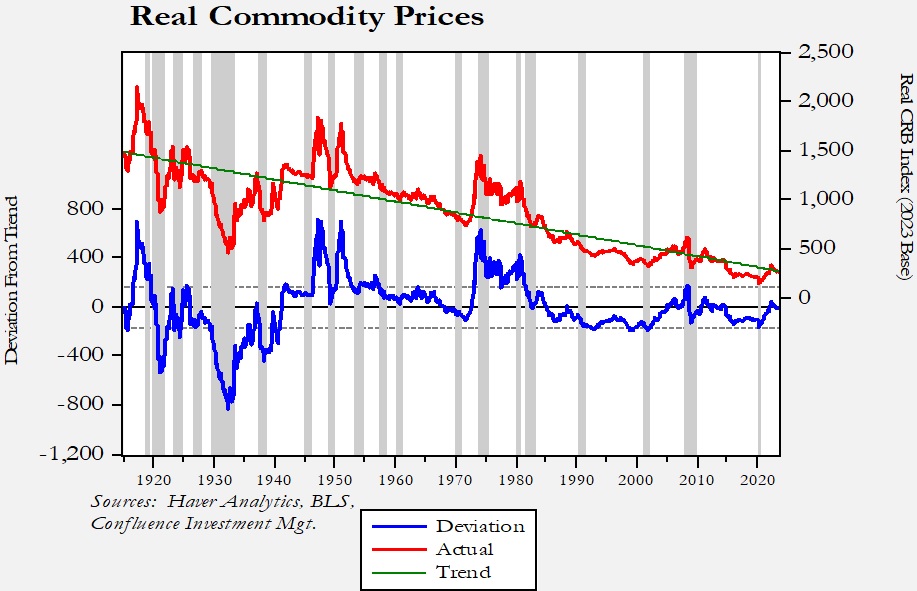
Commodity markets have secular cycles as well. Commodity demand is mostly a function of economic and population growth, whereas commodity supply comes from agriculture, ranching, mining, and drilling. As the chart on the next page shows, commodity producers are likely to face a serious secular headwind as capitalist economies tend to persistently improve their efficiency in producing finished goods from raw commodities. Commodity production is also subject to steady improvement in productivity.

Read the full report

The Case for Hard Assets: An Update (June 2023)

by Bill O’Grady & Mark Keller | PDF

Background and Summary

Secular markets are defined as long-term trends in an asset. There are both secular bear and bull markets. In most markets, there are also cyclical bull and bear markets, often tied to the business cycle, and in some markets, there are seasonal bull and bear markets that are usually tied to annual production or consumption cycles. For example, a secular bull market in bonds is characterized by falling inflation expectations that trigger steady declines in interest rates. A secular bear market in bonds is caused by the opposite condition―rising inflation expectations which lead to consistently rising interest rates. In comparison, a cyclical bull market in bonds is often related to the business cycle and monetary policy.

In general, secular cycles tend to last a long time. Using bonds as an example, we are likely concluding a four-decade secular bull market which encompassed several cyclical cycles. The length tends to be tied to specific characteristics of each market.

Commodity markets have secular cycles as well. Commodity demand is mostly a function of economic and population growth, whereas commodity supply comes from agriculture, ranching, mining, and drilling. As this chart shows, commodity producers face a serious secular headwind—capitalist economies tend to persistently improve their efficiency in producing finished goods from raw commodities. Commodity production is also subject to steady improvement in productivity.

Read the full report