


Weekly Geopolitical Report – Greece: An Update (June 1, 2015)

by Bill O’Grady

In February, we reported on the situation in Greece.  Over the past few months, there has been no resolution to Greece’s debt problem, despite numerous deadlines and meetings.  In our earlier report, we framed the conflict between Greece and the EU in terms of game theory.

In this report, we will begin by recapping our earlier analysis.  Using this framework, we will discuss how a third option has evolved which will likely force PM Tsipras to acquiesce to the EU.  As always, we will conclude with potential market ramifications.
View the full report

Weekly Geopolitical Report – The U.K. Elections (May 18, 2015)

by Bill O’Grady

The May 7th elections in the U.K. shocked pollsters, who had predicted a hung parliament.  Instead, the Conservatives (Tories) won an outright majority of seats in the legislature, allowing the party, led by David Cameron, to form a government without a coalition.

In this report, we will begin by recapping the election results and discuss the campaigns and what they may indicate for future U.K. policy.  An examination of the impact of the election will follow, beginning with an analysis of the geopolitics of Britain and ending with how the election affects the country’s geopolitical situation.  As always, we will conclude with potential market ramifications.

View the full report

Weekly Geopolitical Report – The Next Generation (May 11, 2015)

by Bill O’Grady

On April 29th, Saudi King Salman announced a set of changes to his cabinet and to the order of royal succession.  We believe these changes are very significant, perhaps the most critical since the first royal succession in 1953.

In this report, we will detail the changes announced by King Salman.  To put these changes in context, we will provide a short history of the important succession plan that was established in 1964.  With this background, we will show how the king’s announcement represents the first change in the program and discuss how these changes could affect the future stability of the kingdom.  As always, we will conclude with potential market ramifications.

View the full report

Quarterly Energy Comment (May 6, 2015)

by Bill O’Grady

The Market

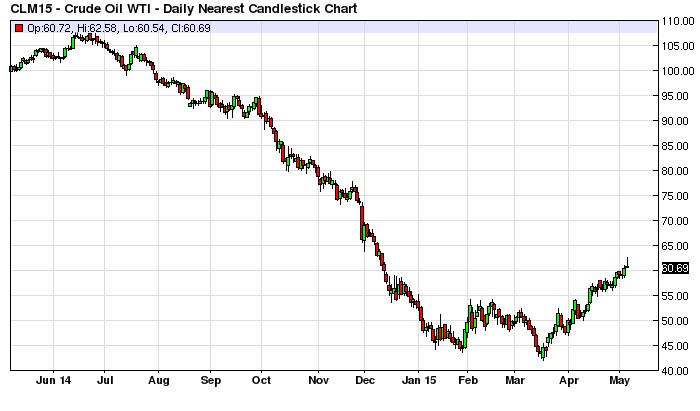
After a precipitous decline from June 2014 to late January, oil prices have been forming a base over the past few months. As the chart below indicates, oil prices have mostly been trading between $45 and $55 per barrel this year. The recent rise above $60 per barrel is raising hopes that the bottom could be in for crude oil.

(Source: Barchart.com)

Are we there yet?  In this report, we will discuss some arguments for whether or not the lows are in place for crude oil.

View the complete PDF

Weekly Geopolitical Report – Can Assad Survive? (May 4, 2015)

by Bill O’Grady

Since the beginning of the year, rebels in Syria have been making steady gains against forces loyal to the Assad regime.  Over the past six weeks, these gains have accelerated.  The recent rebel victories are raising questions about the Assad regime’s ability to survive.

In this report, we will recap the problems the Syrian government faces, including internal dissention and military losses.  We will discuss the growing evidence of a Turkey-Saudi axis that may be aiding the rebels to weaken or eliminate Assad and pressure Iran.  From there, we will examine the potential Iranian and American responses to the rebel gains and support from Riyadh and Ankara.  As always, we will conclude with potential market ramifications.

View the full report

Weekly Geopolitical Report – The Ideology of IS (April 27, 2015)

by Bill O’Grady

The March edition of Atlantic Magazine published an article about Islamic State (IS) that examined its theology and ideology.  This article along with a paper from the Brookings Institute on the ideology of IS form the basis of our report this week.

In this report, we will examine the intellectual foundations of IS, showing how it evolved from two different sources of thought.  We will follow this with an analysis of the concept of the Caliphate and the critical importance it has in Islamic theology.  A Caliphate is a form of Islamic government which, in some Islamic conceptions, is a universal government for all people.  An examination of the eschatology of IS will also be included.  The consequences of IS’s ideology will be discussed.  As always, we will conclude with potential market ramifications.

View the full report

Weekly Geopolitical Report – The AIIB (April 20, 2015)

by Bill O’Grady

China has founded an infrastructure bank, the Asian Infrastructure Investment Bank (AIIB), to compete with the World Bank (WB) and the Asian Development Bank (ADB).  The U.S. has opposed the creation of this bank but, despite administration opposition, 57 nations have joined it, including 14 members of the G-20.  A chorus of commentators has suggested that the founding of this bank may mark the end of U.S. hegemony.

In this report, we will describe the AIIB, including its members and capitalization.  Next, we will cover the conventional wisdom surrounding the bank, and follow up with our analysis of the real impact of the bank.  We will conclude with potential market ramifications of this framework.

View the full report

Weekly Geopolitical Report – The Ideology of IS (April 13, 2015)

by Bill O’Grady

On April 2, the P5+1[1] negotiating team and Iran announced a framework to deal with Iran’s nuclear program.  The framework is a “roadmap” to establishing a final agreement in June.  Negotiations on this issue have been underway for years; this framework could be a major step toward delaying Iran’s entry into the “nuclear club,” the group of nations that have nuclear weapons.

In this report, we will begin with a short history of Iran’s nuclear program.  Next, we will review the details of the framework.  The third part will address the broader policy issues surrounding Iran’s nuclear program.  An analysis of the real issue, regional hegemony, will follow along with a review of the political factors of the deal.  We will conclude with the potential market effects from this framework.

View the full report

__________________

[1] P5+1 includes the U.S., U.K., France, Russia and China (the five permanent members of the U.N. Security Council), plus Germany.

Keller Quarterly (April 2015)

Letter to Investors

We lead off this quarterly letter where we ended our previous one, with the same quotation by Ben Graham, the father of securities analysis.  He wrote in his wonderful book, The Intelligent Investor, “Indeed, the investor’s chief problem – and even his worst enemy – is likely to be himself.”  What a humiliation to discover that the main problem you’ll have as an investor is dealing with yourself!  Mr. Graham knew whereof he spoke, because experience had taught him that his emotional temperament was, if unchecked, likely to be the chief impediment to successful investing.

It’s easy to become emotional about investing; those old demons, fear and greed, will raise themselves within each of us and turn our good ideas into dust.  Emotions can play an injurious role even when we think we’re doing careful analysis.  For example, an emotional bias toward or against a certain type of investment or a company may look like reasoned judgment, but it’s not the same.  Reasoned judgment can be wrong, of course, just like emotional attachment can result in success.  But when looking to improve my odds of success, give me thinking over feeling every time.

But what about professional investors?  Do investment managers ever get frustrated?  I can’t speak for the entire industry, but from my desk the answer is an emphatic “Yes!”  While we rely extensively on quantitative methods to do our jobs correctly, at the end of the day we are human beings attempting to make sound judgments.  How do we keep emotions out of the loop?  While one can never completely eliminate emotional responses, we have found that our collaborative investment process is the best way to keep decision-making as rational as possible.

A collaborative process means that each of our investment teams works as a unit, the polar opposite of the so-called “star system,” where a single manager makes all decisions.  When one must test his or her ideas before colleagues and submit to their criticism, we believe better (and less emotional) decisions are produced.  In particular, while one person may get emotionally positive or negative on an investment, it’s unusual that an entire team can get so emotionally involved.  While we individually work hard to keep emotions out and bring rationality in, it simply works better when a competent team works together to stay focused on good decision-making.  It’s not a guarantee of success, but we think it improves the odds.

We thank you for your confidence in us.


Gratefully,

Mark A. Keller, CFA
CEO and Chief Investment Officer

View the PDF